The year that broke Billy Sunday: 1907

A brother’s funeral he could not attend. A newborn son. A lawsuit. A carriage wreck. A converted entire police force. And the summer he finally said enough.

On a day in early July of 1907, somewhere in the Gibson City, Illinois tabernacle, Billy Sunday was handed a telegram. His brother had died. The funeral was being arranged in Iowa. The Gibson City revival was three weeks deep and at the height of its drawing power. The local committee had paid for the tabernacle, organized the choir, raised the expenses, and was counting on him to finish.

Sunday did not go to the funeral. He stayed and preached.

Within a few weeks of that decision, his wife Helen would give birth to their son Paul. The baby was born on the opening day of the Gibson City campaign. Sunday had been there for neither the birth of his son nor the death of his brother. He had been on a platform.
By the end of August he would, for the first time in his career, announce that he intended to cut back on the work that had taken him from those two events. He would announce it from a 4,000-seat steel auditorium in Joliet, Illinois at the close of a Chautauqua season that had seen him deliver eighty-six lectures in roughly thirty different towns and earn the equivalent, in 2026 dollars, of about a million and a half dollars. He was forty-four years old. He had been running this schedule for eleven years. He was, by the contemporary newspaper record, the highest-paid evangelist in America. And he was exhausted.

Kankakee in winter

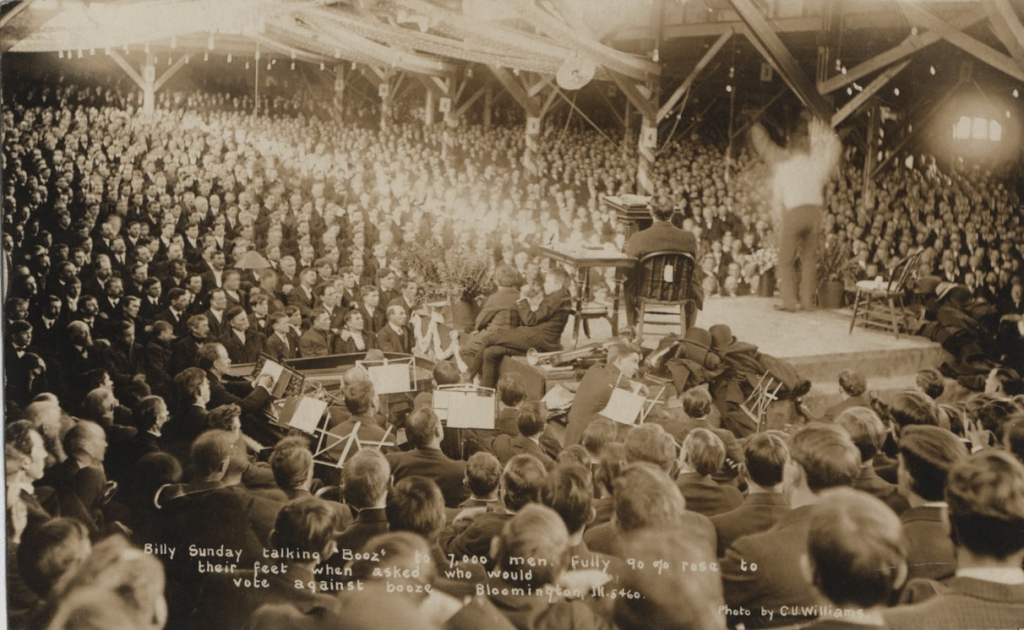
The year began at Kankakee, Illinois — a town of about fifteen thousand people in the Illinois prairie, an hour south of Chicago. The campaign ran from mid-January through the middle of February in a four-thousand-seat tabernacle with a three-hundred-and-fifty-voice choir.

The Streator Times of January 26 published an extended excerpt from one of his sermons under the heading “Rev. Billy Sunday Defines What He Terms Society of the Present Day.” It was an extraordinary piece of Sunday writing, full of the period’s sense that something was slipping in American life. He drew a contrast between the brilliant drawing rooms of society women playing progressive euchre and the back rooms of “stale beer joints” where four “blear-eyed, vermin-covered old soaks” played penny ante. Then he delivered the line that the Times made sure to print:

I fear that cursed gang of society more than I do all the town loafers in that beer joint.

It was a long way from the cheerful baseball-evangelist anecdotes that had filled the Chautauqua dates the summer before. Sunday at Kankakee was in his serious mode — a working revivalist preaching for six weeks straight to crowds of three and four thousand in subzero Illinois cold, naming evils he could see in the towns he was visiting.

Spring in southern Illinois and Iowa

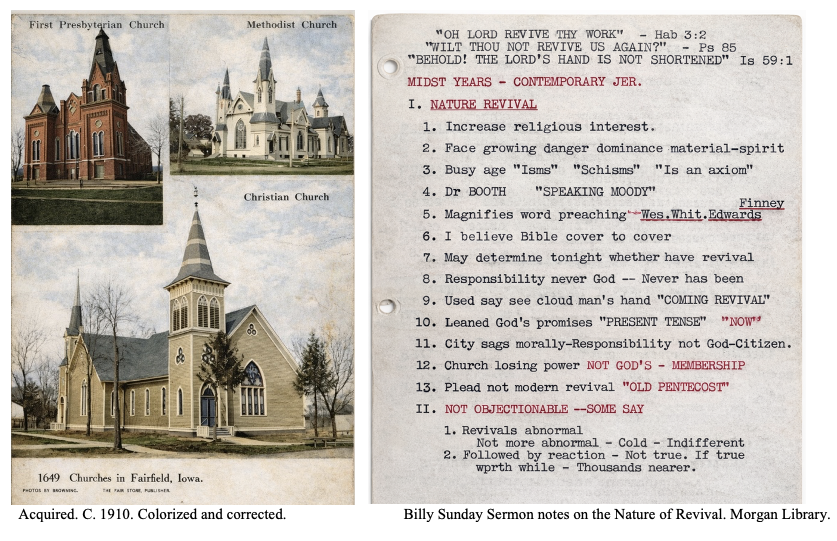
From late February through May, Sunday worked his way through southern Illinois and Iowa. Murphysboro for six weeks. Fairfield, Iowa for five. Knoxville, Iowa for five. Each campaign followed the same pattern: a temporary tabernacle, a choir of two or three hundred voices, a six-week timetable, and a thousand or more conversions by the closing service.

Fairfield produced what may be the most detailed single-day sermon record in Sunday’s pre-1910 career. On Sunday, April 28, he preached three separate sermons in a single day — morning, afternoon, and evening — each anchored on a different text. Earlier that month he had opened the Fairfield campaign with a sermon called “Revive Us Again.” It was the kind of Sunday-disciplined preaching that the Chautauqua circuit never quite asked of him. Four sermons in a row from four different texts. He could still do it.

The Knoxville campaign produced sixty sermons in five weeks and a thousand cards signed. It also produced a small but telling detail in the local paper: someone who had been converted during the campaign was sent to an asylum shortly after. The Sunday revival method, for all its successes, had limits that the campaign committees did not always discuss publicly. The Iowa newspaper noted the case and moved on.

Gibson City

From mid-June through mid-July, Sunday preached at Gibson City, Illinois — a small Ford County town of about twenty-five hundred people. The revival drew over a thousand conversions. Sunday’s purse came in at thirty-six hundred dollars. The economic terms by 1907 were no longer remarkable for him; they were standard.

What made Gibson City unforgettable in the Sunday family record was that it bracketed both ends of life. Paul Sunday was born on the first day of the campaign. Sunday’s brother died near its midpoint. Sunday declined several Chautauqua offers in order to finish the campaign — a sign that the revivals still had first claim on his schedule even as the Chautauqua money grew larger. But his brother’s funeral was the cost of finishing.

There is no surviving record of what Sunday said about it publicly. Two sermons from the Gibson City campaign — one on John 7:17 and one titled simply “Hell” — were transcribed in the regional press over the next month. The papers ran them as significant sermons, the kind worth preserving. Neither sermon mentioned the brother, the baby, or the funeral Sunday had missed. Whatever he was carrying that summer, he was carrying it on the platform.

The lawsuit

On June 28, Sunday was supposed to be in Des Moines, Iowa, opening a slot at the Midland Chautauqua. He did not show. The Iowa Lyceum Bureau, which had booked him, sued him for five thousand dollars for breach of contract. Newspapers picked the story up immediately. Quad-City Times, Des Moines Register, Richmond Item.

Sunday’s defense, when he gave it, was straightforward. His evangelistic work, he said, ought to have preference over Chautauqua dates. If a revival ran long, or a town needed him for an extra week, he was going to honor that. The Chautauqua bureau could sue him if it wanted to.

The case never went anywhere notable in the public record. But the spectacle of it was something new. Sunday was no longer just an itinerant preacher who could be expected to keep his commitments because his name and reputation depended on it. He was now a commercially booked entertainer with contracts that could be litigated. The Iowa Lyceum Bureau had not bought a sermon. It had bought a calendar slot. And when Sunday treated the slot as flexible, the Bureau treated the contract as enforceable.

The lawsuit told you something else about where Sunday’s life had gone. He had become the kind of person who could be sued.

The 86-lecture summer

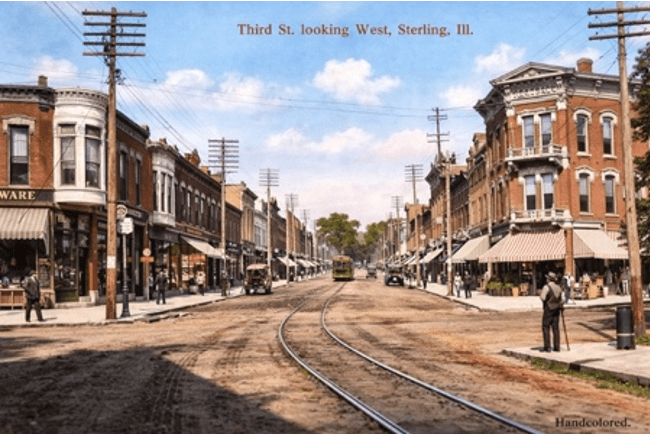
Once the Gibson City revival ended in mid-July, Sunday’s Chautauqua summer began. By the time it ended at Joliet at the end of August, he had spoken at roughly thirty different towns across Illinois, Iowa, Indiana, Wisconsin, Ohio, and Missouri. The eighty-six lectures total was reported later, in a July 1910 retrospective, and the figure is so large that it strains belief — until you do the arithmetic. About six weeks of summer Chautauqua. Two or three talks at most stops. A few sites where Sunday spoke five or six times across a week. The number works out.

The bookings paid roughly forty-three thousand dollars in 1907 dollars. In current dollars, perhaps a million and a half. After bureau commissions and travel expenses, perhaps a million two. Most of this came in checks of two hundred to three hundred dollars per lecture, occasionally rising to five hundred or six hundred when the local committee had organized a special gate. By Bryan’s standards as a Chautauqua speaker, the rate was modestly higher. By any other measure, the figure was staggering.

Two of the eighty-six lectures took place on August 14 in Oskaloosa, Iowa. On the way back to his hotel that evening, the carriage Sunday was riding in was in a bad wreck. Sunday was bruised but unhurt. The story went out over the wires anyway, and by the next morning newspapers in five states were running headlines about how Billy Sunday had been “badly injured” in an “overturned carriage.” Sunday kept his schedule. The next morning he was at Aurora, Illinois — where a different paper had announced he had canceled because of hay fever. The two stories crossed in the wires. Either Sunday had been hurt or he had hay fever or both or neither. He was, by his own account, just tired.

A steel auditorium and an announcement

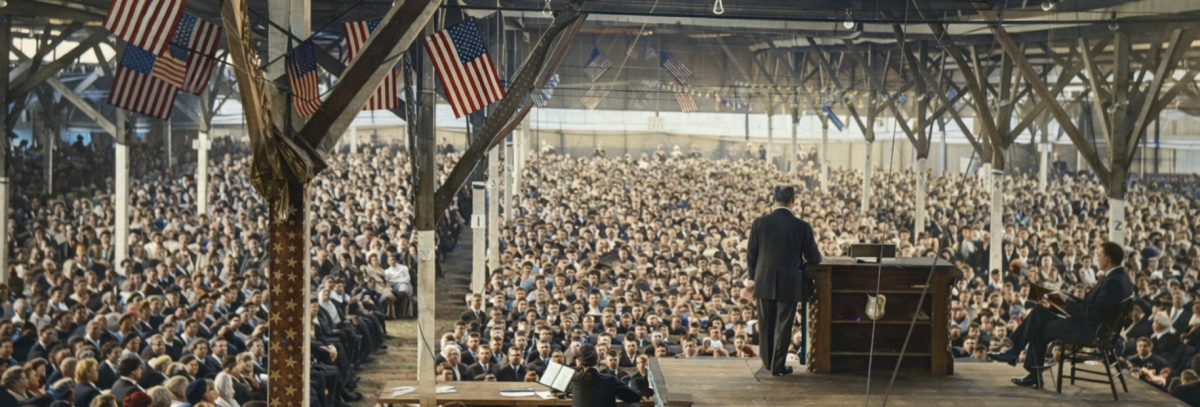
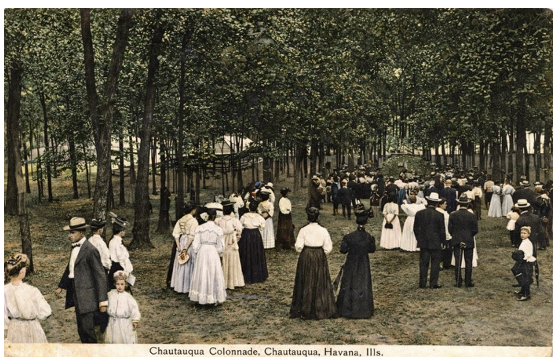
The summer ended at Dellwood Park, just outside Joliet, Illinois, where a brand-new Chautauqua assembly opened on August 30. The venue was something the Chautauqua circuit had never seen: a steel auditorium with four thousand seats and what the builders called “perfect acoustic properties.” Sunday spoke at the opening at 8:15 in the evening. The opening sermon was called “Grounders Hot Off the Bat” — a baseball talk, with a baseball title for the first and only time in the curated record.

The next day the Joliet Daily News published a piece called “Billy Sunday as He Is, Spoke.” The headline was a deliberate pun. The reporter had watched Sunday at close range and was unsparing:

Billy Sunday is like his discourse: unpolished in appearance. He still looks more like a baseball player than a preacher, talks more in the manner of a heavy hitter than a gentleman of the cloth, and, judging from his frenzied utterances, thinks more like one as well. He works as hard on the stage as he ever did on the diamond, and his voice is worn nearly to shreds by long-continued gospel shouting.

The auditorium, the reporter noted, was not packed. Joliet seemed to have been “frightened off by Sunday’s reputation for vigorous execution.” Sunday had hay fever. When a sympathetic listener tossed him a handkerchief during his sermon, he muffed the catch. The retired ballplayer dropped a fly ball in front of four thousand people.

It was during this Joliet engagement that Sunday made his announcement. He was going to cut back on Chautauqua speaking after this season. The constant travel was depriving him of the rest he needed for his evangelistic work. The newspaper of August 30 carried the news as a routine item. Whether Sunday himself believed it at the time is harder to know. The next summer, in 1908, he would deliver Chautauqua lectures again. By 1909 he would be back at full schedule. He would not actually retreat from the platform. But he had said the words. He had reached his limit.
Galesburg and Muscatine

Sunday took a few weeks off after the summer ended. Then in late September he opened a five-week revival at Galesburg, Illinois — eighteen thousand people, a five-thousand-seat tabernacle, two thousand five hundred and eighty conversions, a closing-night crowd of eight thousand plus standing room outside. His purse came in at six thousand three hundred and forty dollars, sixteen hundred of which he turned around and gave back to the local YMCA.

The Galesburg campaign drew attendees from seventy different towns. After it ended, the local newspapers wrote about the “Bible famine” that followed — the Presbyterian church alone took in sixty new members, and the Baptists and Methodists between them took in another two hundred. A Gibson City paper, looking back at the campaign a week after it closed, said one-tenth of Galesburg had professed conversion during Sunday’s stay.

November and the first half of December went to Muscatine, Iowa — five weeks in a purpose-built tabernacle, thirty-six hundred conversions, six thousand seven hundred and eighty-five dollars in Sunday’s pocket, seventy-four sermons preached. The campaign averaged out to a remarkable two dollars and sixty-three cents per soul converted, a number the local paper printed with what seems to be genuine satisfaction. The Muscatine News-Tribune of December 15 used the phrase “the largest revival in our history.” The Muscatine Journal the next day went further — it called it “the greatest revival in the nation’s history.” Both papers were, almost certainly, wrong about the second claim. But they meant what they said, and the readers seemed to agree.

Carrying it al

The 1907 year is the one in which the cumulative weight of Sunday’s choices becomes hard to look away from. The brother’s funeral he could not attend. The newborn son. The lawsuit. The carriage wreck and the false injury rumors. The eighty-six Chautauqua lectures. The five revival campaigns. The pulled voice and the hay fever and the dropped handkerchief in front of four thousand people. The announcement at Joliet that he would cut back, and the everyone-knew-it-wouldn’t-take quality of the announcement when he made it.

He was making more money than any evangelist in American history had ever made. He was preaching to more people in a single summer than most pastors preached to in a lifetime. He was the subject of newspaper feature stories from Idaho to Indiana. The same newspaper that ran his Joliet headline ran his Galesburg revival report a few weeks later. The same press that ran the lawsuit story ran the Muscatine “greatest revival” story. He was everywhere.

And he was, somewhere underneath all of it, a forty-four-year-old man who had not been in Iowa to bury his brother and had not been in Chicago to see his son born. The next two years would bring some of the biggest revivals of his career — Spokane, Springfield, Cedar Rapids, the early relationship with Homer Rodeheaver. They would also bring more of the same exhaustion that the Joliet announcement had named out loud. Whatever broke in Billy Sunday in 1907 did not get put back together. It got worked around.

The Muscatine paper called it the greatest revival in the nation’s history. It was the greatest revival of Sunday’s hardest year.

How to cite this post

Chicago: McNutt, Kraig. “The Year That Broke Billy Sunday: 1907.” Evangelist Billy Sunday (1862–1935), June 15, 2026. https://evangelistbillysunday.com/2026/06/15/the-year-that-broke-billy-sunday-1907/.
MLA: McNutt, Kraig. “The Year That Broke Billy Sunday: 1907.” Evangelist Billy Sunday (1862–1935), 15 June 2026, evangelistbillysunday.com/2026/06/15/the-year-that-broke-billy-sunday-1907/.

APA: McNutt, K. (2026, June 15). The year that broke Billy Sunday: 1907. Evangelist Billy Sunday (1862–1935). https://evangelistbillysunday.com/2026/06/15/the-year-that-broke-billy-sunday-1907/

Turabian: McNutt, Kraig. “The Year That Broke Billy Sunday: 1907.” Evangelist Billy Sunday (1862–1935). June 15, 2026. https://evangelistbillysunday.com/2026/06/15/the-year-that-broke-billy-sunday-1907/.

“To-morrow”: Inside Billy Sunday’s Last Day in Fairfield

Seventh in a series drawn from Lindsay Denison’s profile of Billy Sunday in The American Magazine, September 1907.


By the final Sunday of the Fairfield revival, Billy Sunday had already brought nearly nine hundred people to a public profession of faith — more than any of the town’s ministers had believed possible. It would have been a triumph to stop there. Sunday had no intention of stopping. Lindsay Denison describes him on that last day as gripped by a fierce, almost savage zeal to gather in everyone still outside the fold.

What followed was, in Denison’s words, an unforgettable experience — and it makes the emotional climax of this whole series.

Three services in one day

Sunday’s custom was to preach three times on his final Sunday. The first, at half past ten in the morning, was open to all. The third, at night, was for everybody. In between came an afternoon service for men only — while Mrs. Sunday or one of the other helpers held a parallel meeting for women in one of the churches.

The men’s meeting, Denison thought, was in one sense the most impressive of the three. Much of the Fairfield company of the state militia sat on the platform in full uniform, many of them already Sunday converts. A great block of seats held the workmen of the Iowa Malleable Iron Works. The Odd Fellows, the Red Men, and the Woodmen filled reserved sections. The big barn-like room was packed wall to wall, with hundreds of men standing in the aisles.

The subject was “Booze.”

The banker who went first

When Sunday finished — whispering directions all the while to Honeywell about clearing the front benches to receive converts — he threw out the challenge: who would be the first to stand up for God and lead the way?

The answer came in a figure no one could miss. One of the town’s leading bankers rose and strode down the aisle, head erect and eyes shining, and behind him came farmers, storekeepers, lawyers, physicians, farm boys, and laborers. Sunday leaned far out over the edge of the platform, swaying his arms rhythmically as if to sweep the entire congregation forward with him, while the ministers and personal workers moved through the rows laboring with those still in doubt. Eighty men were converted in that single afternoon meeting.

The effect reached past the tabernacle walls. The next day, the agents of the two express companies had to report that three barrels of beer consigned to Fairfield citizens were refused on delivery — and in the “remarks” column of their paperwork, they noted the cause plainly: the influence of Sunday’s sermons.

A town that couldn’t get in

The crowds began gathering for the night meeting almost as soon as the men’s meeting let out, a little after four o’clock — though the evening service would not begin until half past six. By six, long streams of disappointed people were already tramping back downtown through the rain, having failed to get close enough even to hear Sunday’s voice.

Inside, the air itself seemed to tingle. Sunday, hoarse from a week of open-air preaching in the surrounding towns, could at times barely raise more than a husky whisper — yet every syllable carried. He spoke of how doubting parents and hesitating children might save one another, of the double blessing that came to anyone who brought a loved one out of the darkness, and, above all, of the nearness of death.

His text was a single word: To-morrow.

The veil and the coffin

The closing was vintage Sunday — fear wielded with terrible precision. To-night, he told them, when the last song was sung and the lights switched off and the tabernacle stood dark, the sinner’s chance would be gone. To-morrow, he warned, the doctor’s buggy might be standing at your gate, the family gathered with handkerchiefs to their eyes, the doctor turning to say, “He is gone.” Borrowing a line from the evangelist Moody, he pictured the unrepentant carried off as a corpse without Christ, in a coffin without Christ, to a grave without Christ. If only God would draw back the veil between a man and his own coffin, Sunday cried, he would leap back in horror to find it within arm’s reach. But you say “To-morrow.”

Then came the appeal, and the slow hypnotic sweep of his arms out over the benches. They came from every direction — girls and old women, gray-bearded veterans and schoolboys in their first long trousers, rich men and poor. Honeywell and the Rev. Mr. Cole ran up the aisles with arms outstretched to welcome them, while Sunday reached down to take each hand and give his blessing and the choir glided from hymn to hymn, sometimes humming, sometimes shouting in triumph.

The picture that stayed

Denison confesses that the reporters stopped taking notes. Everyone in the room was on his feet; some were standing on the tables. And out of the whole turmoil, he says, one small picture stood clear.

Fred Seibert had broken through the crowd at the back, dragging by the collar a weak-faced, loose-lipped boy — shambling along shamefaced but not unwilling. Sunday clapped him on the back; Honeywell settled him three rows from the front. Then, from a far corner on the left, came a muffled scream. A shabbily dressed girl came crowding out into the aisle and ran forward, tears streaming down her face, her hat knocked askew and her red hair hanging loose over her shoulder. She barely touched Sunday’s hand. She ran to the third bench, threw herself on the boy’s shoulder, wrapped her arms around his neck, and hid her face against his. She was still there, motionless, when a shout from another corner announced one more soul won.

Denison had seen college football celebrations, the riots of joy after a Yale–Harvard boat race, a famous New York district attorney’s election-night headquarters. He had never, he wrote, seen a crowd more beside itself than the Fairfield tabernacle that night.

The noise was formless until Fischer took hold of it and shaped it. There were a hundred surges toward the platform and Billy Sunday; people kept calling for three cheers for him. And when the final tally was announced — 1,118 Fairfield souls won from the Devil for Christ — it seemed, Denison wrote, as though the very roof were tugging at its rafters.


Next in the series: What 1907 Tells Us About the Rise of Billy Sunday — a closing reflection.

The year Helen Sunday packed her bags: 1906

A first professional photograph, a tent under snow, and the wife of a baseball evangelist boarding the train for good.

In late March of 1906, a brief notice appeared in the Bureau County Tribune. Mrs. William A. Sunday, the wife of the well-known evangelist, had announced she would henceforth be joining her husband on the campaign trail. The notice carried her own words:

Hereafter I shall accompany my husband. I can be a great help to him, taking charge of women Bible classes, organizing girl Bible classes and giving personal care to converted persons.

It is one of the most consequential single sentences in the entire Billy Sunday archive. Helen Sunday — known to friends as “Ma” Sunday in the years to come — was, until that announcement, a Chicago-area pastor’s wife who had spent most of her married life keeping her household running while Billy traveled. From that moment on, she would be on the road with him. She would be his organizational lieutenant, his front office, his backstage manager, and ultimately the steadiest center of his entire ministry.

Without Helen, there is no Billy Sunday of American memory. The campaigns get smaller. The big-city tabernacles never happen. The Rodeheaver era never quite assembles. The household engine that powered the next thirty years of Sunday’s career was not in place yet on the morning of March 28, 1906. It was in place on the morning of March 30. The change in his career happened in the space of those two days.

A photograph in Freeport

A few weeks earlier, on February 13, 1906, the Freeport Journal-Standard had published a photograph. It showed a clean-shaven man in his early forties wearing a dark suit, looking just past the camera with the slightly unfocused expression that early-twentieth-century professional portraits always required. It was the first professional photograph of Billy Sunday to appear in a newspaper.

A photograph in print, in 1906, meant something different than it does now. Printing technology was just becoming able to reproduce photographs in regional newspapers at workable cost. To have your photograph carried — not a sketch, not an engraving, but an actual halftone reproduction — meant your name had reached a tier where readers would recognize the face and where the paper thought running the picture would help sell copies. Sunday had reached that tier.

The photograph appeared while he was in the middle of a four-week revival at Princeton, Illinois — a small town in Bureau County where he was preaching in a temporary tabernacle that held thirty-six hundred. By the time the Princeton campaign closed in mid-March, over two thousand people had come forward as converts. The local U.B. pastor, a visiting minister from Freeport, told the papers the town was “aflame with the revival spirit.” Another eyewitness called Sunday “a storm, a whirlwind, a cyclone, hurricane, a tornado, a — well, everything indicative of power.”

The highest paid evangelist in America

By the end of March, the Princeton campaign had produced something else: a headline. On March 30, 1906, the Bureau County Tribune ran a piece under the title “Billy Sunday the Highest Paid Evangelist in America.” It was the first time that phrase had appeared in print about Sunday. It would not be the last.

The article tried to make the math human. Since October of 1905, the paper said, Sunday had earned an average of two dollars and sixteen cents per convert. The number sounded almost comical when laid out that way — pennies and dimes per soul saved — but the implication was clear. Sunday was running an evangelistic ministry that produced consistent measurable output for predictable cost. The towns where he held his campaigns understood it. The papers understood it. And, increasingly, the bookings reflected it.

Sometime in the early months of 1906, a Chicago-area booking manager named H.M. Holbrook formalized what had been an informal summer schedule the year before. Holbrook announced he had “exclusive rights to Billy Sunday” and would place him as the headline attraction at seven Chautauquas that summer: Belvidere, Sterling, Freeport, Sycamore, Janesville, Sandwich, and Valparaiso, Indiana. The Chautauqua decade was officially organized.

Prophetstown

In June Sunday took his summer revival to Prophetstown, Illinois — a small town of about twelve hundred people served by exactly three churches. The campaign ran four weeks and produced over seven hundred conversions. By any honest accounting, more than half the town walked down an aisle.

The numbers are the kind that defy plausibility until you remember what a small-town revival in 1906 actually looked like. Sunday preached against evolution under the title “Evolution a Sham” — the formal naming of a sermon he had been delivering in less polished form since at least Rockford in 1904. He preached against dance, against card playing, against the local saloons. People came in from twenty miles in every direction. The Sterling Standard carried sermon-by-sermon coverage. The numbers grew from a few hundred conversions in the first week to over seven hundred by the end of June.

Sunday’s purse at Prophetstown was about twenty-three hundred dollars. The town’s three churches reorganized to absorb the new members. The local saloons reported almost no business during the revival weeks. The pattern was now mature, repeating, and exportable.

The Chautauqua summer

The 1906 summer Chautauqua run took Sunday across the upper Midwest at a pace that would have broken most preachers. Belvidere on June 22 to a crowd of eight thousand. Globe Park in Freeport on July 8, where Sunday spoke twice in a single day and the local paper said his afternoon sermon was the best he had ever preached there. Jacksonville on July 15, where his single talk raised five thousand dollars for the local YMCA that had recently closed its doors. Janesville on July 29 to four thousand listeners. A handful of other Iowa and Illinois Chautauquas in early August. Sycamore on August 26, where he spoke twice and the local paper made sure to note that Sunday had posed for an imprinted postcard now in circulation as a souvenir.

The pattern that had only been a hypothesis a year earlier — that Sunday could sustain crowds across a multi-week Chautauqua circuit using a small rotation of well-tested sermons — was now an established fact. The Baseball sermon anchored most of the dates. “Nuts for Skeptics” made its first documented appearance at Muscatine in early August. The two-sermon Chautauqua rotation that would carry Sunday through 1907 was beginning to take shape.

Salida in the snow

In September Sunday went west again. The Salida, Colorado revival ran through October — five weeks in a mountain town at altitude. The campaign drew six hundred converts. It also drew weather. The tabernacle tent collapsed under early snow. The October 3 and 4 services moved indoors to a local church. The closing night service had to be moved a second time, to a four-hundred-seat opera house far too small for the crowd that wanted to attend.

Sunday’s closing services at Salida included an unusual range of subjects. He preached a eulogy of Abraham Lincoln. He delivered a tribute to President Theodore Roosevelt. And he closed with one of the moral admonitions he liked best: “Read good books and keep good company. Every gambler and drunkard became so by imitating the gang he went with.”

Kewanee, twice

The fall return brought Sunday to Kewanee, Illinois for a six-week revival in a new local armory — a venue large enough to handle the crowds that an earlier tent could not. Twenty-seven hundred and sixty-eight converts. Four hundred and five of those came forward on the closing night. Sunday’s purse came in at five thousand dollars — by far his largest revival purse to date.

Four days after the revival ended, Sunday returned to Kewanee for a single Chautauqua talk. The offering for that single talk was five thousand, three hundred dollars — more than he had been paid for the entire six-week revival. The Richmond-Item carried the figure on December 6. It was the kind of number that did not exist in the Sunday archive a year earlier and that would, from this point on, become routine.

The story of the two Kewanee engagements told you everything you needed to know about where Sunday’s career was going. The revival was the old model — multi-week, slow-building, institution-deepening, expensive in time and emotional capital. The Chautauqua was the new model — one talk, one offering, the same money or better. Sunday could no longer pretend he was not paying attention to the difference.

Worthington in the cold

December brought Sunday to Worthington, Minnesota for what would be his last revival of 1906 and his first of 1907. The Advance-Herald summed up the man and his methods with a single arresting metaphor: “His sermons are a bombardment having the rapidity of the gatling gun and the force of the big 12-inch rifle.”

More than a thousand converts came forward across the five weeks. The temporary tabernacle, ninety feet by a hundred and fifty, accommodated thousands. Sunday’s musical director Fred Fischer ran the music. A tabernacle caretaker named Siebert kept the building in shape. The Sunday operation was small — still just a handful of people moving from town to town — but it was now durable enough that the team had names that appeared in newspaper accounts of the campaign.

What changed

Most years in Billy Sunday’s pre-1910 career can be understood as gradual shifts. 1906 is the exception. By the time the year was over, four things had changed permanently.

Helen Sunday was on the road. The single most consequential change of the year, and arguably of his entire career. The ministry was no longer just Billy.

The first professional photograph existed. Sunday now had a public face. Postcards bearing his image were beginning to circulate as souvenirs. He was no longer a name in a newspaper. He was a recognizable person.

The Chautauqua circuit was formally organized. Holbrook’s seven-site bookings turned what had been a flexible summer experiment into a contracted commercial operation. The booking bureau model would shape the next four years of Sunday’s life.

The Chautauqua money had become a serious rival to the revival money. The Kewanee comparison — one Chautauqua talk that paid more than a six-week revival — was the moment Sunday could no longer ignore. The economics were starting to point at a different shape of ministry. By the summer of 1907, he would deliver more than eighty Chautauqua lectures in a single season, and the gravitational center of his career would shift away from the tabernacle and toward the platform.

In some ways 1906 was Sunday’s last year of the old life. The revivals were still the dominant form. The campaigns still ran four to six weeks. The team was still small enough to fit in a single railway car. By the summer of 1907 the picture would already be different. By 1909 the picture would be barely recognizable from this one.

But in 1906 Helen got on the train. And once she was on the train, everything else was a matter of time.

How to cite this post

Chicago: McNutt, Kraig. “The Year Helen Sunday Packed Her Bags: 1906.” Evangelist Billy Sunday (1862–1935), June 13, 2026. https://evangelistbillysunday.com/2026/06/13/the-year-helen-sunday-packed-her-bags-1906/.

MLA: McNutt, Kraig. “The Year Helen Sunday Packed Her Bags: 1906.” Evangelist Billy Sunday (1862–1935), 13 June 2026, evangelistbillysunday.com/2026/06/13/the-year-helen-sunday-packed-her-bags-1906/.

APA: McNutt, K. (2026, June 13). The year Helen Sunday packed her bags: 1906. Evangelist Billy Sunday (1862–1935). https://evangelistbillysunday.com/2026/06/13/the-year-helen-sunday-packed-her-bags-1906/

Turabian: McNutt, Kraig. “The Year Helen Sunday Packed Her Bags: 1906.” Evangelist Billy Sunday (1862–1935). June 13, 2026. https://evangelistbillysunday.com/2026/06/13/the-year-helen-sunday-packed-her-bags-1906/.

The Business of Revival: Tabernacles, Guarantees, and the “Grafter” Question

Sixth in a series drawn from Lindsay Denison’s profile of Billy Sunday in The American Magazine, September 1907.


Sooner or later, every discussion of a famous revivalist arrives at the same question: what about the money? Lindsay Denison’s 1907 profile does not dodge it. In fact, it lays out the financial machinery of a Billy Sunday revival in unusual detail — and then takes the “grafter” charge head-on.

Chicago 1918 campaign

God helps those who help themselves

Sunday’s whole operation rested on a piece of practical theology: God helps those who help themselves. He had no intention of letting his revivals be dragged down by the constant whine of money-begging, so he built the funding in advance.

The process began only after the ministers of all a town’s evangelical churches signed a joint invitation and agreed to close their own churches and throw their full energy behind the revival. Once that was secured, the town had to put up real money. Typically a stock company was formed — an incorporated “Evangelical Association” — that issued shares to raise the necessary funds.

The list of what Sunday required was specific, and he printed it in a little pamphlet covering every detail. The town had to erect a wooden tabernacle with fixed seats. It had to guarantee board and lodging for Sunday and his entire company, cover their travel expenses, pay half of Fred Fischer’s salary, and handle the printing and advertising. On top of that, committees of church members had to be organized to serve as ushers, as personal workers pursuing converts, and as the choir.

A company to support

That company was not small. Beyond Mr. and Mrs. Sunday, it included Mr. and Mrs. Fischer; the Rev. T. E. Honeywell, secretary and associate evangelist; Miss Miller, a Bible-class teacher; and Fred Seibert — a former cow-puncher turned evangelist who handled most of the sexton’s duties between meetings and also sold the hymn books. Supporting that traveling staff, plus building a tabernacle from scratch, was a serious undertaking for a town of a few thousand.

The part the critics missed

Here is the distinction Denison is careful to draw, and it is the heart of the matter.

All of that up-front money — the shares, the tabernacle, the guarantees — went to expenses, not to Sunday’s pocket. He took none of it for himself. He even refused to guarantee that the collections taken at the services would be enough to repay the subscribers who had advanced the money. And yet, Denison reports, he had never once failed to raise enough within ten days or two weeks to square those accounts.

From the moment the guarantors were reimbursed until the final day of the revival, money was simply not mentioned — not by Sunday, not by anyone, with no collections taken at all. He deliberately minimized the money-raising in both time and eloquence.

“Give what you want to”

Sunday’s own income came from a single appeal on the very last day, made on the plain principle that the laborer is worthy of his hire. He explained that this closing collection was for himself, his family, and his helpers, standing in for the ordinary salaries and wages they might have earned in secular work. And he set no figure on it.

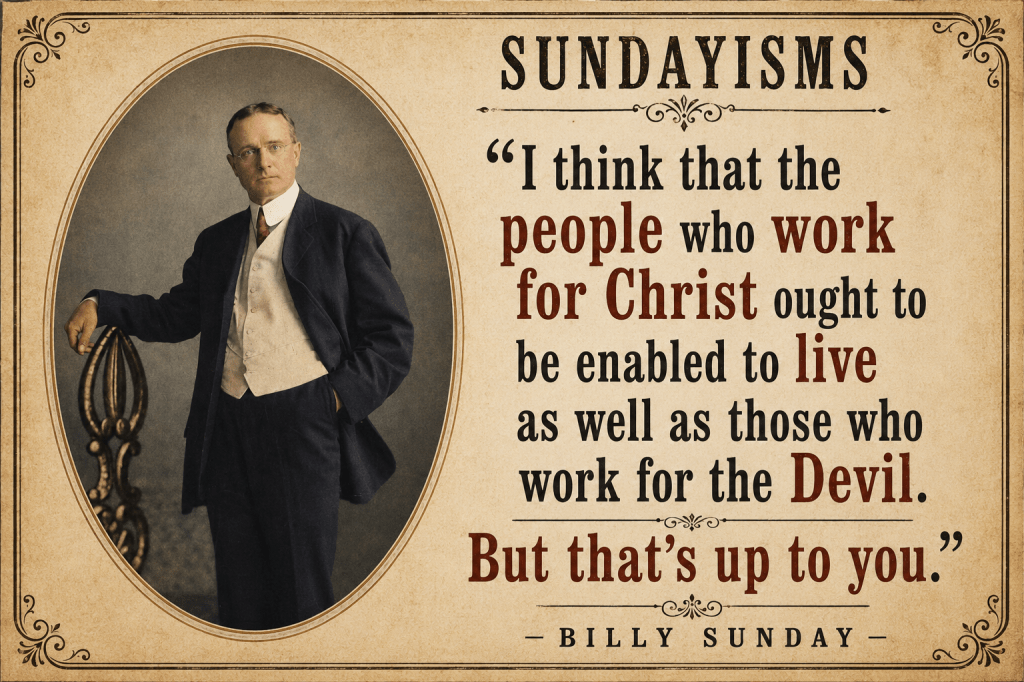
His pitch was disarmingly open-handed: people should give what they wanted to, in proportion to how much good they felt he had done the town. He could get along, he said, even if they gave nothing, because plenty of people had already been more generous than he deserved — though he added, pointedly, that those who labor for Christ ought to be able to live as well as those who labor for the Devil. Beyond that, it was up to them.

In Fairfield, the result was striking. After paying $3,200 to cover the revival’s expenses, the town gave Sunday a farewell thank-offering of $3,660. Even after the share he distributed among his helpers, Denison concluded, his own reward compared well with the salaries some big-city churches paid their pastors.

The grafter charge — and the rubber gloves

This was exactly the figure that drew sneers. Critics pointed to Sunday’s comfortable income, questioned his sincerity, and lumped him in with preachers better known for their finances than their good works.

Denison’s rebuttal is pointed: Sunday never raised money “for the Lord” and then quietly banked it to his own credit. The expense money was genuinely spent on the revival; his own pay came openly, once, at the end, with no pretense about what it was for. (As we saw earlier in this series, Sunday also had a long memory for the lean years — he liked to note that nobody called him a grafter back when the 1893 hard times left him too poor to afford trolley fare.)

He was, Denison admits, slow to discuss these criticisms, because he was apt to lose his temper over them — and sometimes did. When the editors of a small newspaper in nearby Brighton took it upon themselves to call him a grafter, Sunday held his wrath for three days. Then he aired it the only way the pulpit allowed: in a prayer.

Working down a list of surrounding towns he asked God to bless, he arrived at the Brighton editors and suggested the Almighty might tackle them too — but cautioned the Lord to be careful and take along a bottle of disinfectant, since he wasn’t sure much could be done with them. And if God did decide it was worth a try, Sunday added, here was a pointer: wear rubber gloves.

The congregation dissolved into smothered laughter and a roar of approving amens. It was not, perhaps, the most charitable prayer ever offered — but it tells you exactly how a proud man, stung by an accusation he believed unjust, defended his good name when he couldn’t quite manage to turn the other cheek.


Next in the series: “To-morrow” — inside Billy Sunday’s last day in Fairfield.

The summer Billy Sunday filled the platform: 1905

Twenty-below-zero weather, a half-hour roast of a New York editor, a tent collapse in Colorado, and the summer Sunday decided he was a Chautauqua man.

In late January of 1905, somewhere inside a tabernacle built of rough boards and tar paper at Mason City, Iowa, six furnaces were going full blast. The temperature outside had dropped to twenty below zero. Inside, a women-only Saturday afternoon meeting drew a thousand women, while Billy Sunday — across town in the larger tabernacle — was preaching to two thousand men on a sermon he called “Chickens Come Home to Roost.”

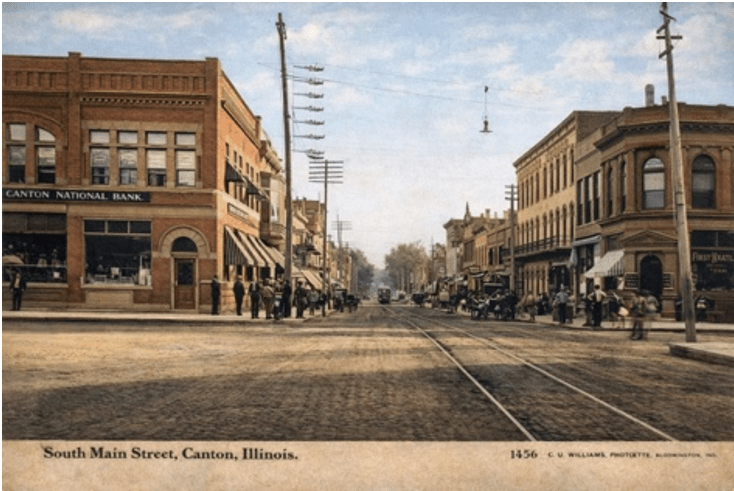
Canton, Illinois. c. 1910.

Fifty of those men were converted that single afternoon. Eight hundred dollars was raised before the campaign ended for the poor of the city, a line item Sunday quietly added to his revival economics that year and never abandoned. By the time he left Mason City in February, he had spent five weeks doing the kind of work that newspapers in 1905 still didn’t quite have a name for. He was a revivalist. He was a temperance crusader. He was, increasingly, a regional celebrity. And he was about to become, in a way he had not been before, a national platform attraction.

A different kind of revival economy

The first thing to notice about 1905 is that Sunday was now thinking about his revivals as more than just spiritual events. They were starting to behave like community investments.

The Mason City campaign collected money for the poor. The Aledo, Illinois campaign in October produced a careful public breakdown of where every dollar went — expenses paid first, then Sunday’s compensation. The line he liked to use, and that local papers loved to print, was that he “takes nothing until all expenses are paid.” His associate evangelist Ira E. Honeywell — a man who would serve quietly on Sunday’s team for the next twelve years — was running the women’s parallel meetings.

A theme was emerging. Sunday’s revivals had stopped being a one-man traveling show and started being a small organization arriving in town with a sustainable economic model behind it. The towns paid for their own tabernacles. They underwrote their own expenses. They saw the books. And by the end of a campaign, they had not just new church members but a small but real institutional legacy — money raised for the poor, donations to local YMCAs, building plans being discussed.

Canon City and the State Penitentiary

In late March Sunday left the Midwestern winter behind and went to Colorado. The Canon City campaign ran from late March through late April under canvas — a hundred feet by a hundred fifty, with three thousand seats. He preached to coal miners and ranch hands and the families of penitentiary employees.

On a Sunday in mid-April, Sunday entered the Colorado State Penitentiary and preached four times in a single day to the inmates. Nearly 250 of them came forward as converts. The afternoon Sunday service in the tabernacle that same day drew nine thousand people. Even allowing for the inevitable exaggeration in revival-attendance figures of the era, that kind of crowd was extraordinary for a town the size of Canon City.

Around this same period, a small Iowa town called Fort Dodge took an entirely different posture toward Sunday. The local committee voted down an invitation for him to hold meetings, saying he was “not the type to appeal to the average person.” The vote made the papers across several states. Sunday, characteristically, made no public response. He had work in Colorado.

Macomb and the system

Sunday’s late-spring campaign at Macomb, Illinois drew the closest contemporary description we have of how his revival method worked, end to end. The Muscatine Journal of May 20, 1905 laid the whole thing out.

A united local ministry would invite Sunday, and the various churches would form a stock company to raise money for a temporary tabernacle. The structure would be sized to the town — anywhere from twenty-five hundred to four thousand seats. Before Sunday’s arrival there would be cottage prayer meetings, extra prayer meetings, and union services. A chorus choir would be organized. Sunday’s musical director would arrive with his preferred hymn book, the one he used exclusively.

Then Sunday would begin. He worked the church members first. He raised the money for expenses. He went after the sinners. And, in the Journal’s deadpan phrasing, “he handles sin and all its connection without gloves.” For his compensation, he asked for the last Sunday’s collection — which, after a month of meetings, generally came to twenty-five hundred or three thousand dollars.

The article also offered a real criticism, the kind that Sunday’s supporters tended to dismiss but that the longer record bears out at least partially: “after he is gone comes the reaction and the pendulum swings back even to conditions worse than they were before he visits the town.” Whether that was generally true is a question that would take a few more years to answer. But by 1906, when newspapers started doing convert-stickiness analyses on Sunday’s earlier campaigns, the answer would turn out to be: usually not.

The Macomb campaign itself was Sunday’s largest revival to that point. Sixty-two sermons in thirty days. A final day of three hundred and four conversions. The previous campaign-best had been a hundred and seventy-seven.

The Hubbard roast at Sterling

On July 16, 1905, at the Sterling Chautauqua, Billy Sunday stood on a wooden platform in front of fifteen thousand people. It was the largest audience of his platform career to that point — larger than any tabernacle he had yet preached in, larger than any revival service he had yet conducted, larger by some margin than anything that had come before.

He talked for two hours. About half of that time he spent on a sermon. The other half he spent on Elbert Hubbard.

Hubbard was the editor of an East Coast literary magazine called The Philistine. He was a celebrity of a particular Edwardian kind — an aesthete, an essayist, a self-appointed sophisticate who liked to take public swipes at preachers and politicians. He had recently called Sunday a “grafter.” Sunday had read it. And now he was on the largest platform of his life with a coat off, a vest off, and his sleeves rolled up.

He called Hubbard good for nothing. He called him indecent and pusillanimous. He called him a blot on humanity. He called The Philistine the work of the devil and a carbuncle on the neck of humanity. The crowd cheered nearly every sentence. The Quad-City Times of July 17 carried the whole thing.

The Hubbard roast was not really a sermon. It was theater. It was Sunday discovering — in front of fifteen thousand people — that his own personality, his combative instincts, his unfiltered Midwestern bluntness, could carry an outdoor platform as effectively as any sermon he had ever written. He had been preaching for nearly a decade. This was the day he became a public performer.

The summer decision

By late August Sunday had made up his mind. The Rockford Register Star of August 29 carried the announcement: Sunday was “so pleased with the results of his work among the Chautauquas during the summer that he has decided to devote a portion of all summers in the future to Chautauqua work.”

It was, in retrospect, the most consequential career decision he ever made before the great urban campaigns of the next decade. He had run the experiment. Sterling had given him his answer. Joliet, Cedar Lake, Pontiac, Springfield, Racine — every Chautauqua he had touched that summer had confirmed it. He could fill the platform.

A booking bureau started organizing his dates. The summer schedule for 1906 was already being negotiated. The next four years of Sunday’s life were beginning to take shape on a stationery letterhead somewhere in Chicago.

Salida and the snow

In the fall Sunday traveled back to Colorado for a five-week revival at Salida. It was a small mountain town. The campaign drew six hundred converts across its run. But the weather had its own ideas. The tent collapsed under early snow. The October 3 and 4 services had to be moved into a local church. The closing night on October 21 had to be relocated again — this time to a four-hundred-seat opera house. Sunday preached his closing service to a fraction of the people who wanted to hear him.

It was the kind of unglamorous logistical disaster that revival memoirs usually omit and contemporary newspapers usually emphasize. The Daily Sentinel out of Grand Junction covered every weather setback. Salida 1905 stayed in the regional memory as the campaign where the tent fell down and Sunday kept preaching anyway.

Burlington and the closing prayer

The Burlington, Iowa campaign closed out 1905 from early November through mid-December. The tabernacle held four thousand. Average daily attendance came to about six thousand. On the closing night, seven thousand people were inside and five thousand more stood outside.

Dr. G. Walter Barr — a Keokuk physician and journalist who had heard Sunday preach more than a hundred and seventy-five times and who would go on to publish a long, sympathetic study of Sunday’s methods in 1906 — wrote that the Burlington revival “exceeded anything in the history of revivalism in America and equaled the top of the wave in Wales, England and Australia.” Whether or not he was right about the comparison, the claim made the papers across the country.

On the closing night Sunday prayed a prayer that the Cedar Rapids Gazette printed in full the next morning. It is, for a man not generally remembered for the literary quality of his prayers, a striking piece of public speech:

O, Lord, save old Burlington; save old Burlington; save her Lord; let salvation sweep over her like a tidal wave. Let Thy love and mercy roll down through her streets like great rivers; let hundreds come to see their duty, and to take the right stand.

What 1905 was

The 1902 essay framed that year as the moment Sunday’s style locked in. The 1903 essay framed that year as the quiet pivot. The 1904 essay framed that year as the year he started taking positions on the modern world.

1905 was the year Sunday filled the platform. Fifteen thousand at Sterling. The largest audience of his life so far, and not a tabernacle audience that had taken weeks of cottage prayer meetings and ministerial visits to build, but an outdoor Chautauqua audience that just came. Came because they had read about him. Came because the bureau had advertised. Came because, by the summer of 1905, Billy Sunday was the kind of person a Midwestern audience now drove fifty miles to hear.

It was also the year he found out that he did not need a sermon to hold a crowd. The Hubbard roast had been pure personality — Sunday’s combative instincts loose on an outdoor platform with fifteen thousand people cheering. The implication was enormous. It meant that the constraints of the revival-tent format — the careful build-up, the cottage prayer meetings, the four-week emotional arc — were not the only way for Sunday to do what he did. There was another mode available: the platform mode, the personality mode, the single-afternoon mode. And the bureau organizing his 1906 schedule already knew it.

Sunday closed out the year preaching to twelve thousand people in a Burlington tabernacle. He opened 1906 in Rochester, Minnesota. The Chautauqua circuit was beginning to organize itself around him. The first professional photograph of him would appear in a Freeport newspaper in February. His wife Helen would announce at the end of March that she was joining him on the road full-time. The career-defining decade was opening.

1905 was the year that made all of it possible.

How to cite this post

Chicago: McNutt, Kraig. “The Summer Billy Sunday Filled the Platform: 1905.” Evangelist Billy Sunday (1862–1935), June 11, 2026. https://evangelistbillysunday.com/2026/06/11/the-summer-billy-sunday-filled-the-platform-1905/.

MLA: McNutt, Kraig. “The Summer Billy Sunday Filled the Platform: 1905.” Evangelist Billy Sunday (1862–1935), 11 June 2026, evangelistbillysunday.com/2026/06/11/the-summer-billy-sunday-filled-the-platform-1905/.

APA: McNutt, K. (2026, June 11). The summer Billy Sunday filled the platform: 1905. Evangelist Billy Sunday (1862–1935). https://evangelistbillysunday.com/2026/06/11/the-summer-billy-sunday-filled-the-platform-1905/

Turabian: McNutt, Kraig. “The Summer Billy Sunday Filled the Platform: 1905.” Evangelist Billy Sunday (1862–1935). June 11, 2026. https://evangelistbillysunday.com/2026/06/11/the-summer-billy-sunday-filled-the-platform-1905/.

Combs, Megaphones, and “Old Kentucky Home”: The Music of a Billy Sunday Revival

Fifth in a series drawn from Lindsay Denison’s profile of Billy Sunday in The American Magazine, September 1907.


If Billy Sunday provided the thunder of a revival, the man beside him provided the music — and it was every bit as unconventional as the preaching. His name was Frederic G. Fischer, and Lindsay Denison’s 1907 profile makes clear that the singing in a Sunday meeting was no solemn warm-up. It was a show in its own right.

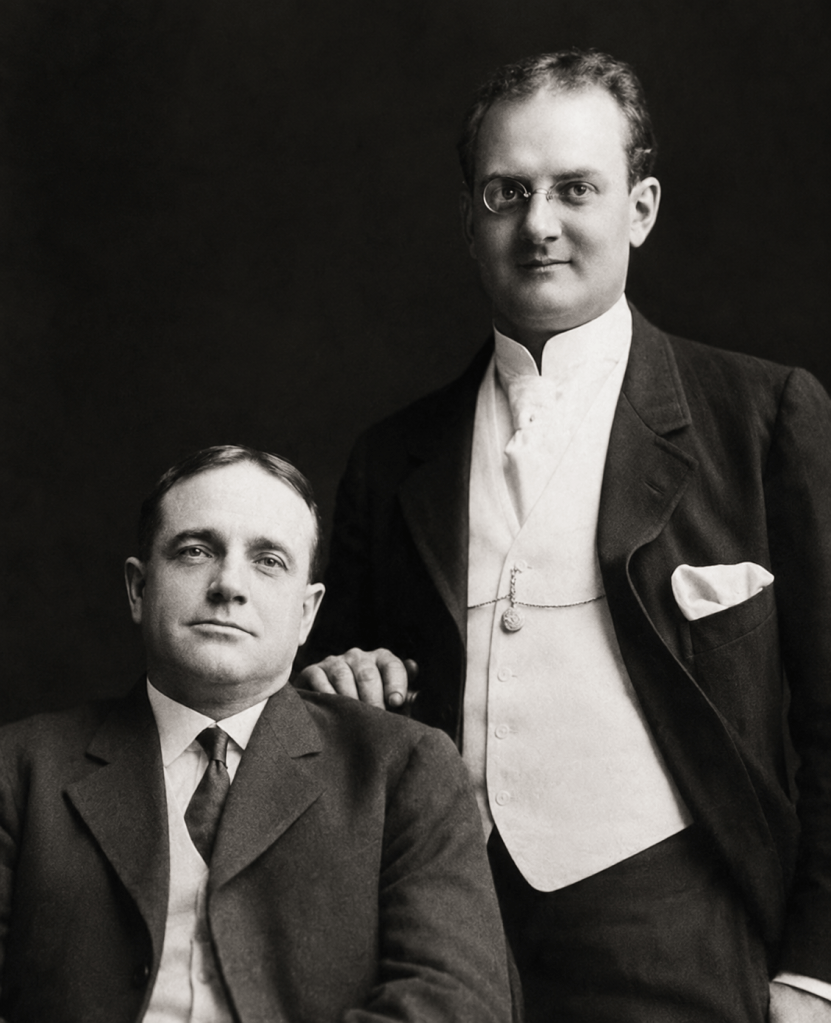
Billy Sunday (left) and Fred Fischer (right).

Sacred words, familiar tunes

Fischer’s guiding idea was simple and, to many traditionalists, slightly shocking: meet ordinary people where their ears already were. Rather than impose formally religious music on a crowd, he set sacred words to tunes the audience already knew and loved — the same instinct, Denison noted, that drove the Salvation Army to go to the people for their music instead of forcing church music upon them.

The song book was full of these thinly disguised melodies. One hymn ran close enough to a popular music-hall number of the day — Vesta Victoria’s “Waiting at the Church” — that a sophisticated city visitor might startle to hear it drifting out of the tabernacle at night. Stephen Foster’s “Suwannee River” carried new words of praise. So did “Old Kentucky Home,” reworked into a hymn pointing toward the New Jerusalem.

To purists, dressing parlor and minstrel tunes in religious clothing bordered on sacrilege. To Fischer, it was evangelism: a melody a farmer already hummed was a melody that would carry the message home with him.

Anything that makes a joyful noise

Fischer barred no instrument capable of joyful sound. At some services the Fairfield Brass Band sat right in with the choir. Cornet solos were dropped into the proceedings again and again.

And then there were the props. The choir was issued tin megaphones, snatched up on Fischer’s signal to multiply the volume of praise. Toward the end of the meetings, singers were asked to bring combs from home; supplied with tissue paper, they produced a novel buzzing music that delighted the crowd. Fischer thought nothing of announcing that the congregation might like to whistle a chorus — and choir and crowd alike would oblige with complete enthusiasm.

This was not church music as anyone in genteel New England would have recognized it. It was closer to a band concert, a sing-along, and a tent show rolled together — exactly the point.

The day the ministers had to sing

The single best Fischer scene in the article is a small comic masterpiece, and it shows the man’s playful streak.

The Fairfield high-school students were seated in a body to one side, the grammar-school children in the rows up front. Fischer drilled the various sections of the room through the verses of a hymn one at a time — the whole audience on one stanza, the high-schoolers on another, the little ones piping the next in their trebles — until each group moved with real thrill and vim.

Then he sprang his trap. He turned to the students and asked how they’d like to hear the ministers sing the last verse. The front benches howled their joyful approval. And so the seven clergymen on the platform — shaking their heads at Fischer, frowning at one another, hanging back — were forced to line up and sheepishly quaver out the final stanza. The roar of delighted applause that sent them blushing back to their seats must, Denison guessed, have reassured them. It is a glimpse of a revival that knew how to laugh at itself, and of a music director happy to engineer the joke.

Master of the room

For all the fun, Fischer was no mere entertainer. His real gift surfaced at the emotional climax of the revival’s final night, when the great altar-call surge sent converts streaming down every aisle and the room dissolved into a roar of singing, weeping, and shouting.

In that chaos, it was Fischer who took charge and organized the noise into something. He stood just behind Sunday, directing the choir and the two pianists stationed at each end of the platform, catching each of the preacher’s whispered suggestions and gliding one hymn into the next — humming here, swelling into triumph there — so that the emotional current never broke. When the energy threatened to spill over into a hundred dangerous rushes toward the platform, Fischer channeled it: have them sing the tune, then whistle it, then hum it.

It was, in its way, as skilled a performance as Sunday’s own. The preacher worked the souls; Fischer worked the room that held them. Together they built an experience that small-town audiences had simply never had before — and would not soon forget.


Next in the series: The Business of Revival — tabernacles, guarantees, and the “grafter” question.

The year Billy Sunday started talking back to the modern world: 1904

Telephone wires, evolution, an English partnership, and a Pontiac woman’s $20,000 check. Twelve months that showed where the rest of the Sunday story was headed.

On a Sunday afternoon in mid-March 1904, somewhere in the wooden tabernacle at Sterling, Illinois, three telephone receivers sat on a wooden table in front of Billy Sunday’s pulpit. They were wired out to a regional operator. The operator in turn was wired out to telephones in 188 cities and towns across the upper Midwest. While Sunday preached one of his sermons that day — pacing, shouting, leaping — people in 188 places who had never seen him, and probably never would, listened to him preach in something like real time.

Sterling, Illinois. c. 1907.

It is, as far as the record knows, the earliest broadcast preaching event in American religious history. Two decades before radio. Six decades before televised crusades. The St. Louis Post-Dispatch made it the lead detail of a March 20 feature. The Oquawka Spectator followed up three days later. The 41-year-old former baseball player, working a small Illinois town under canvas, had just done something no preacher in the country had ever done.

That was 1904 for Billy Sunday. Not a year of single milestones but a year of firsts — small ones, large ones, technical ones, theological ones, financial ones. By December he had preached his first public anti-evolution sermon, taken his first English-and-Australia booking inquiry, organized his first city-wide ministerial coalition that ended with the entire police force converted, and accepted a single $20,000 donation toward a new YMCA building — the equivalent of roughly $700,000 today. He was just six years out from his last baseball contract. He was about to enter the most consequential decade of his life.

Jefferson and Marshall: the year opens cold

The year began the way most of Sunday’s years began in this decade — in a cold-weather Iowa town, in a temporary tabernacle, on a four-week timetable. Jefferson, Iowa ran from mid-December 1903 through mid-January 1904. The 1,500-seat tabernacle hit standing-room-only capacity on the final night, when 2,600 people came. 107 conversions that single night alone. The published Sioux Falls and Sioux City papers noted Sunday’s $1,400 purse — defending it pointedly: “he gets well paid; it is only right and just.” A 100-voice choir under Fred G. Fischer carried the music.

The Marshall, Minnesota campaign that followed in late January and February drew over 600 converts in a town of just 2,088 people. Some papers claimed Sunday remained in Marshall until early March — but the records show he had to be in Sterling by February 11. The local editor’s dry note that “this doesn’t seem possible” gives us a small glimpse of how the Sunday road schedule looked to people watching it from the outside: punishing, implausible, relentless.

Sterling and the telephone

From February 11 to March 10, Sunday held his Sterling, Illinois campaign in a temporary tabernacle with a 200-voice choir. Over 35 days he preached 73 sermons. Total cumulative attendance came in around 160,000. Final conversion count: 1,678. Sunday’s purse: $3,275 — by far his largest to that point, three-quarters again the size of his previous Carthage record. The previous year’s $2,100 Carthage purse had been flagged as historic. The Sterling number meant the trajectory was real.

It was at Sterling that the telephone broadcast happened. The technology was straightforward in retrospect — long-distance telephone trunk lines were spreading across the upper Midwest in those years, and amplified speaker setups were beginning to appear in public meeting halls. What was unusual was the idea of using them to extend a single revival service across 188 separate towns simultaneously. No one had done it before. Sunday, never one to refuse a press opportunity, agreed to preach to whoever happened to be on the other end of the wires.

The campaign also drew its share of opposition. Flyers circulated in Sterling associating Sunday’s revival with the “wiles of the Devil.” The Rock Island Argus covered the controversy on March 4. Sunday seemed unbothered. The final-day conversion count, $3,275 purse, and 160,000 attendance figure suggested the flyers had not worked.

Galva and the YMCA tithe

Late March through early April Sunday spent at Galva, Illinois, in another tent tabernacle. The Galva numbers were smaller — $1,325 purse, 600 conversions — but the campaign produced a quietly important first. Sunday returned $900 of his $1,325 purse to the local YMCA. He paid Fred Fischer’s salary of $40 out of the same purse. Then he and Fischer left for Rockford with what remained.

This is the earliest documented case of Sunday voluntarily redirecting a substantial portion of his personal purse back into a community institution. Two-thirds of a Galva-size purse, given back. Not as expense-recovery, not as facility-construction, but as a direct gift to a local Christian organization Sunday wanted to support. The pattern would recur. At Galesburg in 1907 he would return $1,600 of his $6,340 purse to the local YMCA. At Winona Lake in 1909 he would donate $500 personally plus all his lecture fees. The Galva 1904 gift was the prototype.

Rockford and the first evolution sermon

From April 14 to May 17, Sunday preached at Rockford, Illinois in a tabernacle that measured 129 by 140 feet, with 5,000 seats. The campaign drew hundreds of people daily who could not get inside. The Sterling YMCA, seventy miles away, sent organized delegations of attendees. A Chautauqua auditorium had been proposed for the meetings; Sunday vetoed it and insisted on his own preferred tabernacle setup. The first documented case in the curated record of Sunday asserting venue control over a local committee. It would not be the last.

Across 50 services, 925 conversions came forward. But the historic note in the Rockford campaign was theological, not numerical. In a sermon during the campaign, Sunday went after the theory of evolution directly. The Quad-City Times of April 21 quoted him calling it “all rot” and a “damnable theory.” The Perry Chief of May 6 reported the same line.

This is, as far as the curated record shows, the earliest public anti-evolution sermon Sunday preached. It predates the major Modernist-Fundamentalist controversy by half a decade, and it predates the Scopes Trial — the moment that fixed anti-evolution preaching as a defining mark of conservative American Protestantism — by twenty-one years. By 1906 he would have a titled sermon for it: “Evolution a Sham.” But in April 1904, somewhere in a Rockford tabernacle, in the middle of a four-week revival campaign, he was already saying it out loud and the papers were already writing it down.

The Rockford campaign also drew opposition from a different direction. The Reverend J.F. Seedoff, a Lutheran pastor in town, preached against Sunday’s coming and gave the Muscatine News-Tribune a long quote: “How can Billy Sunday in a few weeks do what forty ministers are trying to do all the year around? It requires sensationalism… Stay away from Billy Sunday’s tent.” Sunday took no public notice. The 5,000-seat tabernacle filled anyway.

During Rockford, Sunday also played in a demonstration baseball game — possibly the first documented case of him using baseball as a public-relations vehicle for a revival campaign. Coverage spread to multiple regional papers. The ex-major-leaguer leveraged his old identity for the sake of his new one, and the press loved it.

Harvey and the converted police force

Late May through late June Sunday spent at Harvey, Illinois. The campaign produced 427 conversions. But the line that the Louisville Courier-Journal carried on June 20 was the line that traveled: Sunday had “converted the entire police force.”

The claim was probably exaggerated in detail and probably accurate in essence. Harvey was a small town of a few thousand people with a correspondingly small police department. A revival campaign that produced 427 conversions across six weeks would have plausibly captured most or all of the men carrying badges. But what the Courier-Journal headline did was give Sunday a story that could be reduced to a single sentence — and it traveled. By 1909, Spokane newspapers were reporting on Sunday’s revivals with similar headlines about converted firemen and converted police officers. Harvey 1904 invented the form.

Keokuk, an English overture, and the second call

The Keokuk, Iowa campaign ran from September 30 to October 31 in a tent tabernacle seating 2,500 to 3,000, on the corner of Main and Twelfth Streets. The conversion total was around 1,000. Sunday’s purse came in at $2,100. The Sunday October 23 service drew 13,000 attendees.

Two moments stand out. First, the Waterloo Courier of October 5 reported that Sunday’s schedule was now booked through January 1906, “when he may join an English evangelist for work in Great Britain and Australia.” This is the earliest documented suggestion that Sunday was considering an overseas ministry. He would never make that trip — but the fact that it was a serious public conversation in 1904 means his American profile had reached a tier where international tours were plausible options. Most American evangelists, then as now, never approached that tier.

The second moment came on the closing night, October 31. Sunday formally dismissed the meeting at the end of his service — and converts kept coming forward anyway. He extended the call. More came. Eventually he closed for the night. The detail is striking enough that it appeared in multiple papers. Anyone who has watched a Promise Keepers stadium event or a Franklin Graham crusade with a “second call” segment knows the moment intuitively. Keokuk 1904 is one of the earliest documented instances in Sunday’s career.

Two years later, in March 1906, the Mattoon Journal Gazette and Times-Courier published its multi-campaign stickiness analysis. Keokuk came in at 75 percent of its converts still “living the new life” — one of the strongest results in the entire study.

Pontiac and a $20,000 check

From November 5 to December 5, Sunday held a revival at Pontiac, Illinois, in a large temporary tabernacle seating 2,500. The campaign produced over 1,000 conversions. The Herald and Review of December 6 noted that “1,000 souls” had been saved.

But the financial story of the Pontiac campaign was extraordinary. A wealthy woman of Pontiac, attending the services, donated $20,000 toward a new YMCA building. In 1904 dollars. The equivalent of roughly $700,000 today. It is the single largest charitable gift documented in any Sunday revival in the curated record up to that point.

This is a different kind of revival economics than the Galva $900 YMCA gift from Sunday’s own purse seven months earlier. Galva had been about Sunday redirecting his compensation. Pontiac was about Sunday’s preaching catalyzing a major capital gift from an attendee. Both pointed at the same outcome — durable institutional change in the towns Sunday visited — but they reflected very different economic mechanisms. Both would shape Sunday’s revival approach for the next decade.

What 1904 was about

The 1902 essay framed that year as the moment Sunday’s preaching style locked into its mature form. The 1903 essay framed that year as quiet pivot — three foundations being laid for what was to come. The 1904 record reads differently from either. It is the year Sunday started taking positions on big subjects, in public, that he would carry for the rest of his career.

A position on technology. The Sterling telephone broadcast was not just a press stunt. It was a working model of using new technology to extend a single preaching event beyond its physical room. Sunday would never become a radio preacher in the systematic sense Charles Fuller or Aimee Semple McPherson did. But the 1904 Sterling moment showed he was completely comfortable being the test subject for whatever broadcast technology the period happened to offer.

A position on evolution. The Rockford anti-evolution preaching predates the Scopes Trial by two decades and the Modernist controversy by half a decade. By the time the rest of conservative Protestantism caught up to the evolution question, Sunday had been preaching against it for years. His Rockford lines — “all rot,” “damnable theory” — would, with relatively little modification, still be his lines in the 1920s.

A position on temperance and civic engagement. Harvey’s converted police force, Pontiac’s wealthy YMCA donor, Keokuk’s “second call” pattern: Sunday’s revivals in 1904 were starting to look less like devotional events and more like coordinated civic interventions. The institutional results — new YMCAs, new church buildings, transformed police departments — were the same kind of outcomes Centerville had produced in 1903, but on a larger scale and across more towns. He had found the formula. He was now applying it.

A position on his own scale. The casual reference to a possible English-and-Australia tour in October told you everything about where 1904 had put Sunday in the public mind. He was still preaching to towns of 2,000 to 5,000 people in southern Iowa and central Illinois. But he was also being talked about in terms of international evangelism. Both things were true at once, and 1904 was the year both became possible to say in print without anyone laughing.

By the time Sunday opened his Redwood Falls, Minnesota campaign in mid-December 1904, the trajectory he had been on since the Wheaton leap of 1902 was no longer ambiguous. The Chautauqua bookings would explode in 1905. The bigger purses were already coming. The audiences were already growing. And the positions he had taken in 1904 — on evolution, on civic engagement, on broadcast technology, on the size of his own ministry — were the positions he would still hold thirty years later.

1904 was the year Billy Sunday’s preaching grew up.

How to cite this post

Chicago: McNutt, Kraig. “The Year Billy Sunday Started Talking Back to the Modern World: 1904.” Evangelist Billy Sunday (1862–1935), June 9, 2026. https://evangelistbillysunday.com/2026/06/09/the-year-billy-sunday-started-talking-back-to-the-modern-world-1904/.

MLA: McNutt, Kraig. “The Year Billy Sunday Started Talking Back to the Modern World: 1904.” Evangelist Billy Sunday (1862–1935), 9 June 2026, evangelistbillysunday.com/2026/06/09/the-year-billy-sunday-started-talking-back-to-the-modern-world-1904/.

APA: McNutt, K. (2026, June 9). The year Billy Sunday started talking back to the modern world: 1904. Evangelist Billy Sunday (1862–1935). https://evangelistbillysunday.com/2026/06/09/the-year-billy-sunday-started-talking-back-to-the-modern-world-1904/

Turabian: McNutt, Kraig. “The Year Billy Sunday Started Talking Back to the Modern World: 1904.” Evangelist Billy Sunday (1862–1935). June 9, 2026. https://evangelistbillysunday.com/2026/06/09/the-year-billy-sunday-started-talking-back-to-the-modern-world-1904/.

Preaching the Devil in Plain English: Billy Sunday’s Pulpit Style

Fourth in a series drawn from Lindsay Denison’s profile of Billy Sunday in The American Magazine, September 1907.


For three hundred years, Lindsay Denison observed, Americans had been accustomed to discussing God and the soul in the stately cadences of the King James Bible. To depart from that vocabulary had come to feel almost like sacrilege. Billy Sunday departed from it completely.

He talked about God and salvation, Denison wrote, exactly the way people talked to one another six days a week — across a shop counter, over the dinner table, out on the street. That was the scandal of his preaching, and it was also the secret of it.

1908 period postcard of Billy Sunday preaching at Bloomington, Illinois.

The Devil who came from Missouri

The clearest example in the article is a stretch of Sunday’s sermon on “Temptation,” built on Satan’s effort to corrupt Christ in the wilderness.

Sunday had no patience for the modern, comfortable idea that the Devil was merely a figure of speech — a poetic personification of human sin. People who said so, and especially the ministers who said so, he flatly called liars, because to him they were calling the Bible itself a lie. There was a Devil, he insisted, and he was no fool: a smooth operator who was, at that very moment, running up and down the aisles of the tabernacle trying to keep sinners indifferent to their own salvation.

Then came the part that made audiences gasp and laugh at once. Sunday staged the wilderness temptation as a piece of street theater. The Devil swaggers up to a weary, hungry, lonely Christ, looks him over from sweat-stained brow to dusty hem, and sneers. And when Christ admits who he is, the Devil laughs and throws down a challenge in the slang of a Missouri skeptic: he’s not so easily fooled, Christ will have to show him — turn these stones into bread and produce the goods.

To stage Satan as a wisecracking “show-me” doubter was, by every standard of nineteenth-century pulpit decorum, outrageous. Denison watched the ministers seated behind Sunday wince. But he also watched the crowd, and he came to understand that their laughter and applause were not the jeering of sinners at sacred things. It was the delight of plain people hearing the old Bible stories made suddenly new, real, and as immediate as the incidents of their own daily lives.

The pointing finger

If the Missouri Devil was Sunday at his most entertaining, another passage shows him at his most uncomfortable — and most effective.

Mid-sermon, he would single out individuals in the crowd. Without naming names, he turned an accusing finger on a man who had spent sixty dollars on tobacco in two years while his wife went without a new dress; on a woman pouring time and money into fancy hats and card parties while her husband fled badly cooked meals and her children ran wild in the streets; on a respectable citizen and what he really bought behind the druggist’s counter; on a group of boys at the back who slid down in their seats as he spoke. Each thrust landed on someone, and the whole congregation felt the danger that the next one might land on them.

It was a remarkable bit of crowd control — intimate, theatrical, and faintly terrifying. Denison noted heads quailing and boys shrinking down their benches. Sunday had turned the anonymous safety of a large audience into the exposed feeling of being known.

A whole body in the pulpit

Sunday did not preach with his voice alone. Denison describes a man with the lope of a professional athlete and the tense springiness of a cat, a penetrating voice pitched just short of harshness.

In his very first Fairfield sermon, growing overheated, he peeled off his coat, then his waistcoat, then his tie and collar — and even then his gestures grew so violent that sweat flew from his brow and ears as he beat the pulpit and tossed his head until he was hoarse. He acted out the gait and gestures of every character in his stories. When he preached on the wages of drink, he seized a chair and swung it over his head to dramatize a drunkard’s violence, then dashed it to the platform so hard the legs splintered. The performance was physical, even alarming, and it riveted the room.

Fear as the engine

For all the humor and showmanship, Denison was clear-eyed about the machinery underneath. Sunday preached the old, old doctrine of damnation, and he got his results by inspiring fear and gloom in the hearts of sinners — the fear of sudden death with torment waiting beyond it.

He spoke of the love of Christ, too, and with real tenderness. But even that he turned into a weapon: a tender reproach aimed at the hard-hearted, a way of making the unrepentant feel the full weight of what they were refusing. The joy came later, as a revival neared its close; the early going was meant to frighten.

Why the commonness worked

It would be easy to read all this — the slang, the theatrics, the chair-smashing — as mere sensationalism. Denison resists that reading, and his reason is worth holding onto.

No man, he wrote, could talk to three thousand sensible people night after night for a month in such language and hold them, unless they believed he was honest. The vehemence and the commonplace vocabulary would have defeated themselves if Sunday’s sincerity had not shone unmistakably from his face. The plainness was not a trick laid over the message. It was the message — proof, to the people in those benches, that salvation was meant for ordinary folks like them and not only for the genteel and the instinctively religious.

That conviction is the thread connecting Sunday’s pulpit to everything else about his revivals — including, as we’ll see next, the music.


Next in the series: Combs, Megaphones, and “Old Kentucky Home” — the music of a Billy Sunday revival.