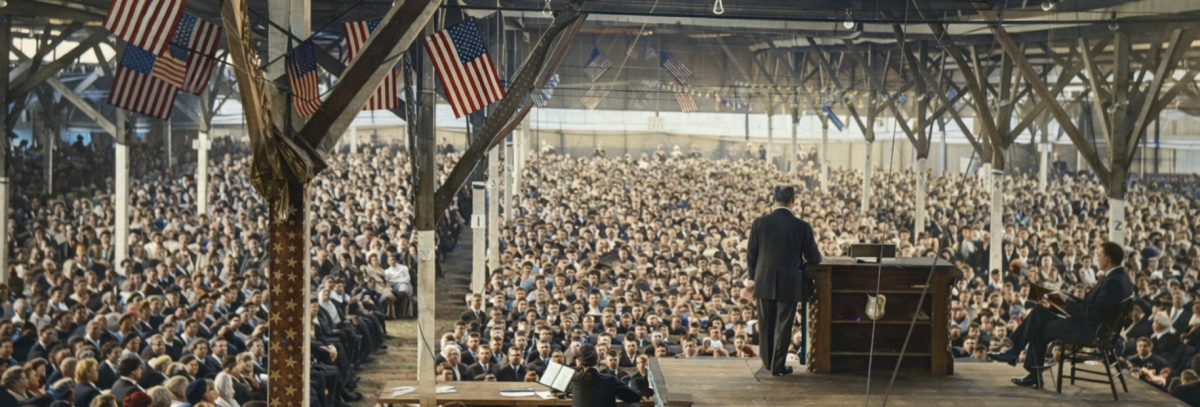
His power: what is it?

Cited in: The Philadelphia Evening Ledger. January 5, 1915:5. – William Rader

Billy Sunday is not easily defined. Power conceals its secret. Psychologists would call it hypnotism; theologians, the power of the spirit; the ethical teacher, the gift of truth; the dramatist, the art of the player; while others declare:

His strength is as the strength of ten,
Because his heart is pure.

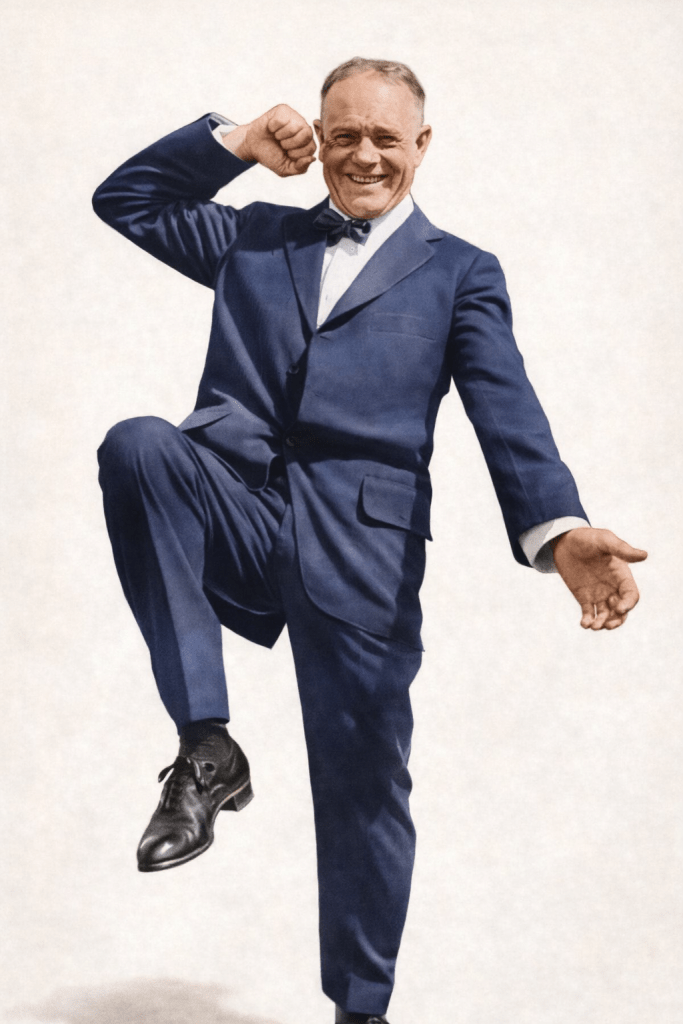
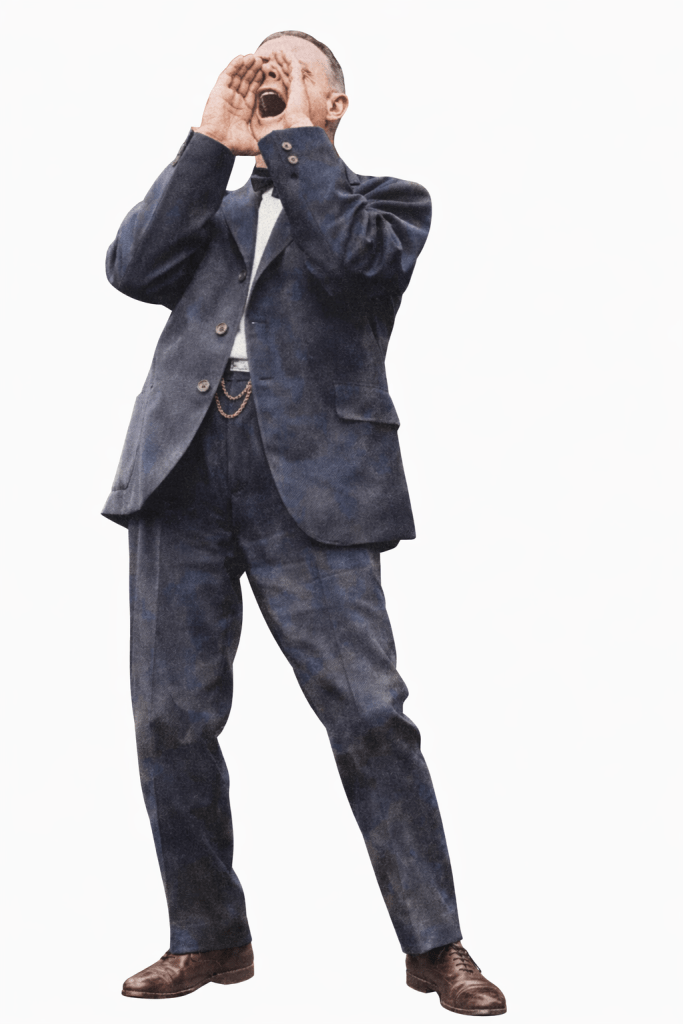
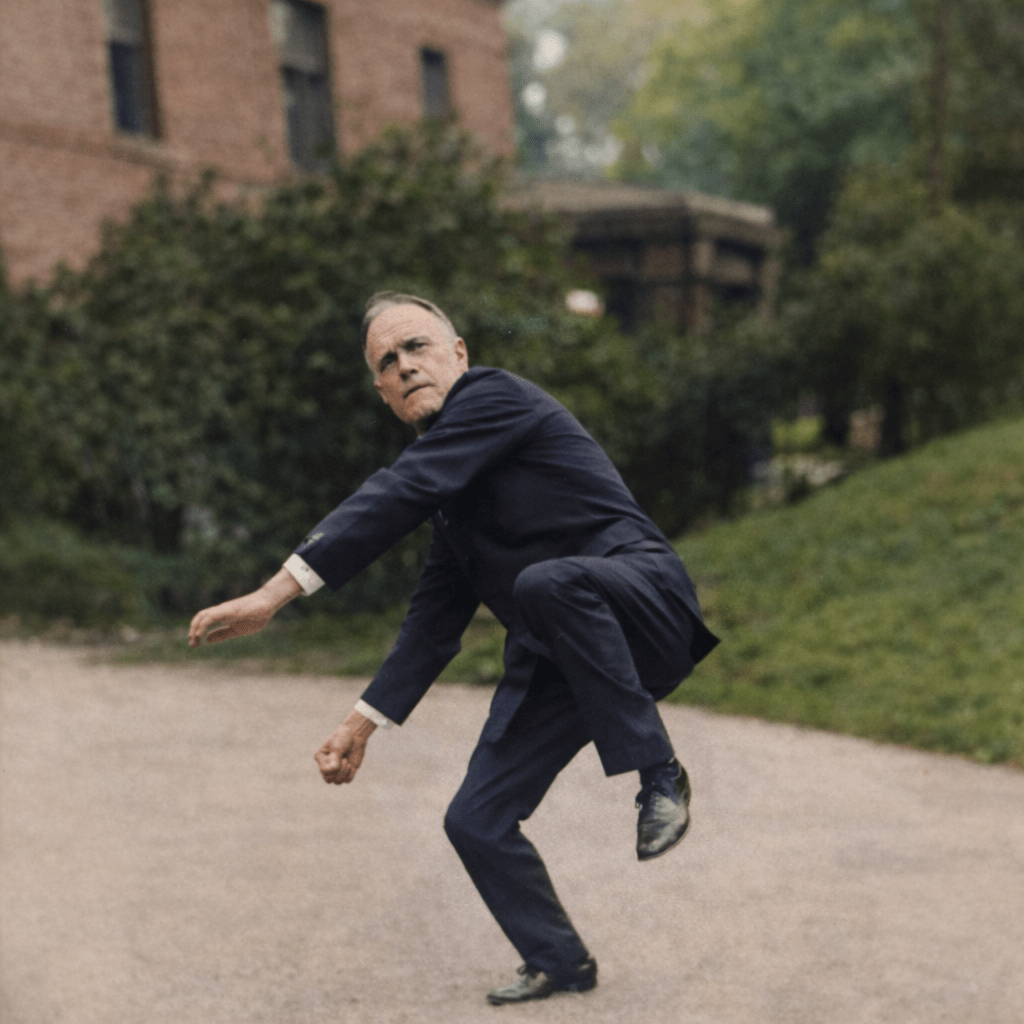
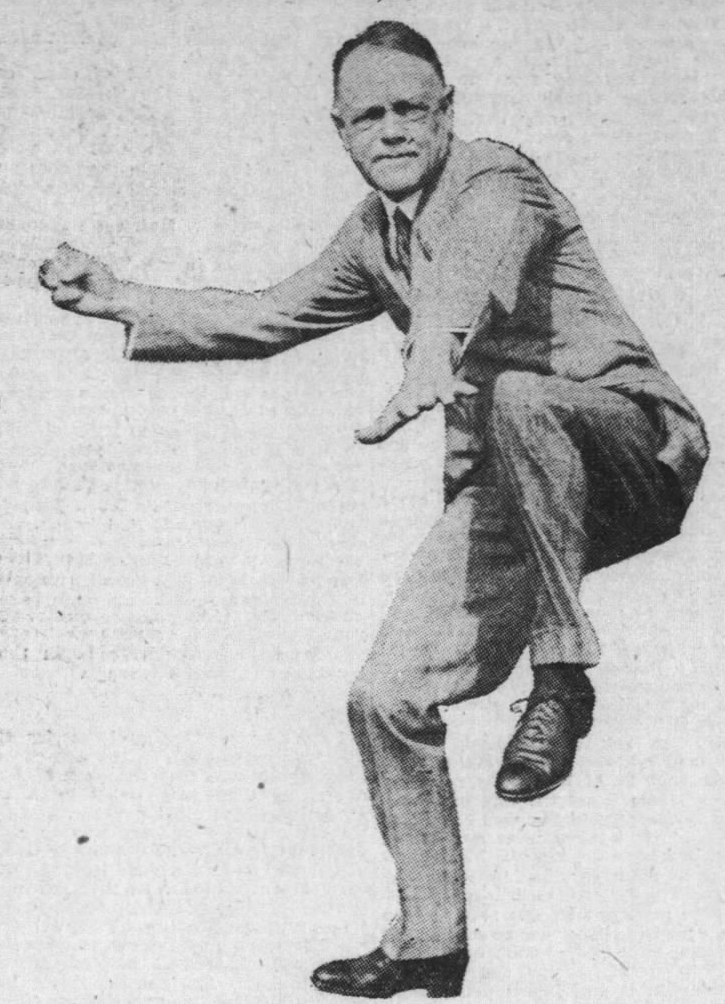
Billy Sunday is a good actor. Each sermon is carefully prepared, and some of it read from manuscript. Certain climaxes are illustrated. At one point he slides to a base; at another, kneels, or leaps upon the pulpit desk, or smashes a chair to pieces. Edward Everett did not more carefully prepare a speech with its proper gestures than does this evangelist build his sermons. The local color with which he decorates his main thought is taken from the city in which he speaks.

His imagination interested me. Speaking on “The Grenadier,” the consideration of his theme invited the use of the imagination, and he gave it full play. The sermon was an application of military attributes to practical life, a rebuke to the “wind-jammer” of the prayer meeting, and an appeal to the man who has taken an oath to be good to go out and honor it. He assailed the “saphead” who criticises the Church, and the description he gave of Daniel in the lion’s den and of the head of John the Baptist on a charger will not be forgotten.

I confess to a liking for his so-called slang. Most of it is plain English with a punch in it. It is the punch which preachers and editors and people who use words generally lack. Words are like shot, made to strike, and especially when used to influence great bodies of people. It is refreshing to hear a man say what he thinks and say it as he pleases—a thing most public men signally fail to do.

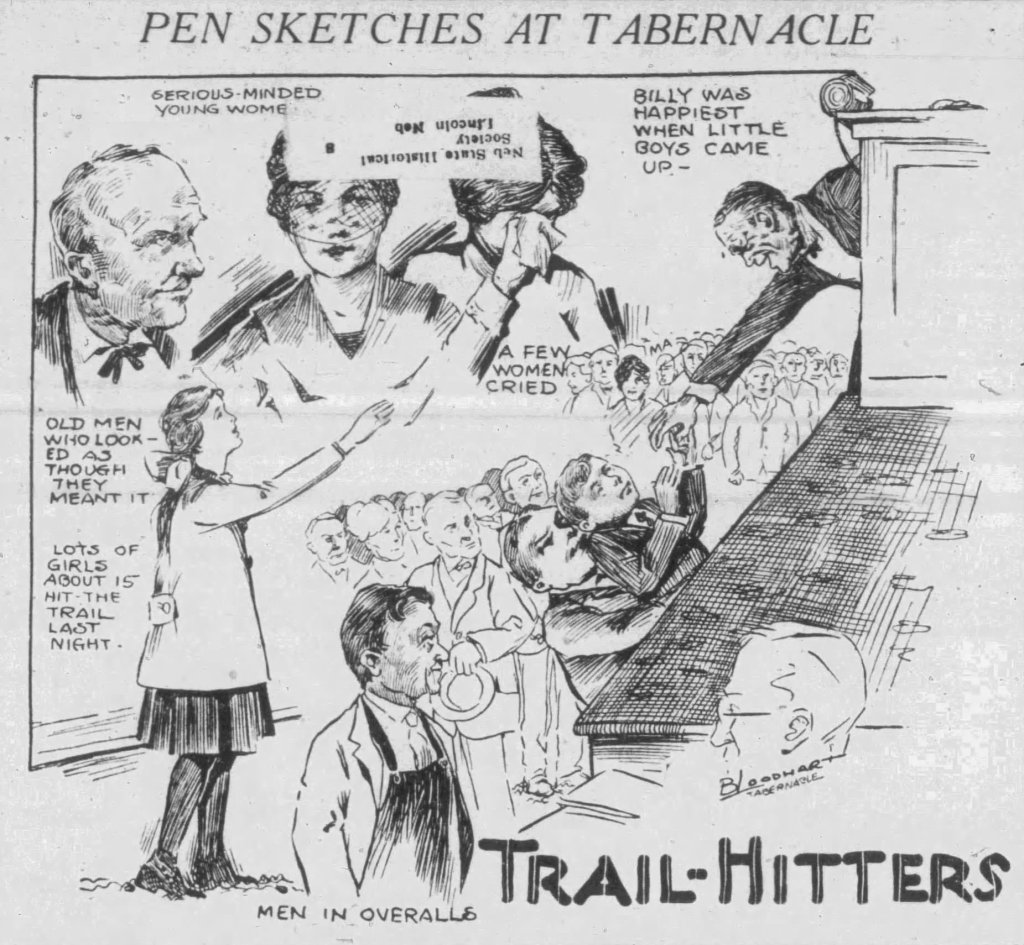
HIT TYPEWRITER KEYS FOR PASTOR; THEN “HIT TRAIL”

Cited from: The Philadelphia Evening Public Ledger. January 2, 1915:3.

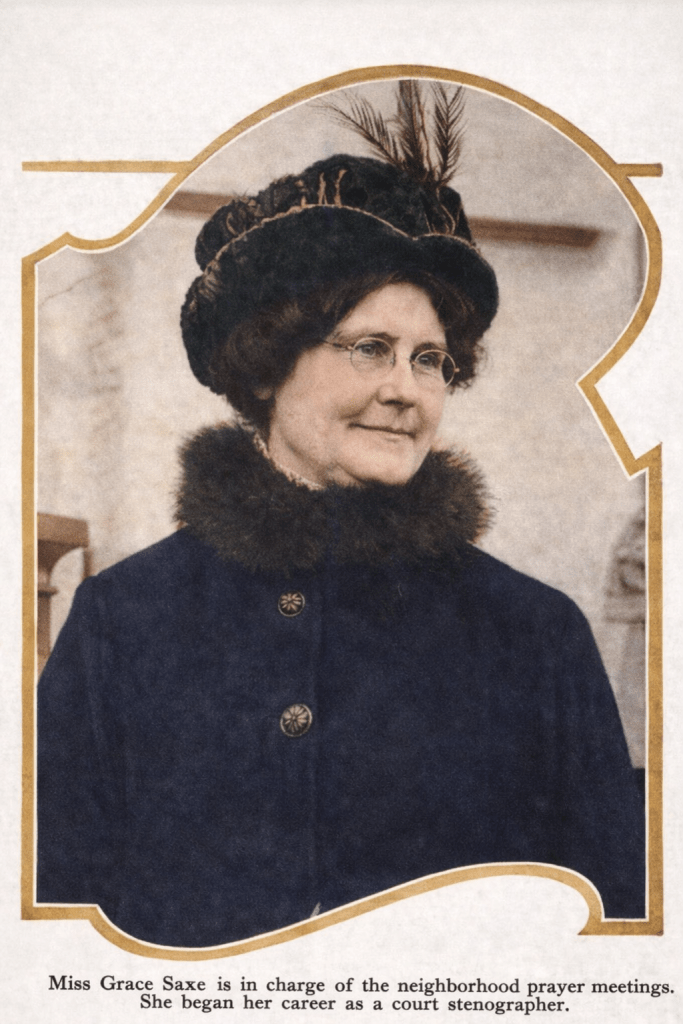
Miss Grace Saxe, “Billy” Sunday’s Prayer Meeting Organizer, Tells of Her Conversion.

“Billy” Sunday’s right-hand woman, whose other name is Miss Grace Saxe, is just as much a woman as though she didn’t hold one of the most important positions in the whole Sunday organization, a position which might make even a man forget all else but the responsibilities of his work.

For one of the very first things she did on arriving in Philadelphia several days in advance of the opening of the campaign was to launch forth on an energetic shopping tour.

“I simply had to have some pretty clothes to wear, to conduct my meetings,” she said, smiling nervously, at “Billy” Sunday’s home, 1914 Spring Garden street, happy, but exhausted, at the termination of her first work in Philadelphia.

Miss Saxe is the person whom Mr. Sunday has selected for the very vital work of organizing the neighborhood prayer meetings in the various cities where the revivals are conducted, and it is her particular duty to bring religion into as many of the private homes as she can possibly get into touch with and to make it a permanent factor of those homes.

“Our work would be a very poor thing indeed,” she said earnestly, “if we worked at these people up to a state of high religious fervor only to let them drop back again and cool off soon after the campaign was over.”


TELLS OF HER CONVERSION

“Although the revivals have not yet started, I cannot help feeling that the way Philadelphia has received us has been nothing short of magnificent. Already 5000 homes have been thrown open to these prayer meetings and more than 15,000 volunteers have come forward and signified their intention of fostering these meetings permanently and keeping the spirit of Christ in the home indefinitely.

“One phase of the work that I am particularly interested in is teaching people how to read the Bible. There are many who have a great desire to study the Book of God, but who do not know how to go about it, and organizing teaching, high school girls and women in city houses, into Bible classes is my chief duty.

Miss Saxe’s career has been an interesting one. Born in Iowa, she “entered” St. Louis to accept a position as court stenographer, and it was while she was energetically hitting the keys in the city that something occurred which, to use her own expression, “made her see the light.”

“Up until that time,” she said, a little shamefacedly, “I was rather an unregenerate creature. I used to come to town in Lyons, Dr. A. B. Simpson came to town and I was engaged to go and take down in shorthand a series of his lectures. There were about ten of them, and in addition to having to hear them I also had to go all over them again, transcribing them on the typewriter.


“TURNS DOWN” ROOSEVELT

“They made me think, and soon after I began a very careful study of the Bible. Later on I was engaged to work with the Rev. Dwight L. Moody, of Chicago, and after that I traveled abroad with Torrey and Alexander. By that time the work of making a Christian out of me was completed.

“Later on I happened to be in Egypt taking a little vacation when I received a request to go up the Nile and meet Mr. Roosevelt at Luxor, there to take down some of his lectures, but I found I was spoiled for that sort of thing. I had become so interested in religious work that nothing else seemed to satisfy, and it was soon after this that I accepted Mr. Sunday’s offer to become a member of his organization, and have worked with him ever since.”

Miss Saxe has the calm, placid Madonna-like face of one who is at peace with the world and herself.

“The test of his wonderful work is in the results that he gets. Day after day hundreds of testimonials come in which show the lasting conversions that he is responsible for.

“Only the other day a man sent a letter from Waterloo, Iowa, where a revival was conducted some three years ago, saying that he was thankful for the change that had been brought about in him, that he was willing even to have his name used if other conversions might be effected thereby.

“For 30 years this Johnny Bates had been a confirmed drunkard. His wife got disgusted and divorced him, his children grew away from him and he went down into the very depths. Three years ago he hit the sawdust trail and since then has never touched a drop. He now holds a splendid lucrative position and his wife has remarried him. That is but one of the many cases which testify to the indisputably good work that Mr. Sunday is doing.”

Cited from: The Philadelphia Evening Public Ledger. January 2, 1915:3.

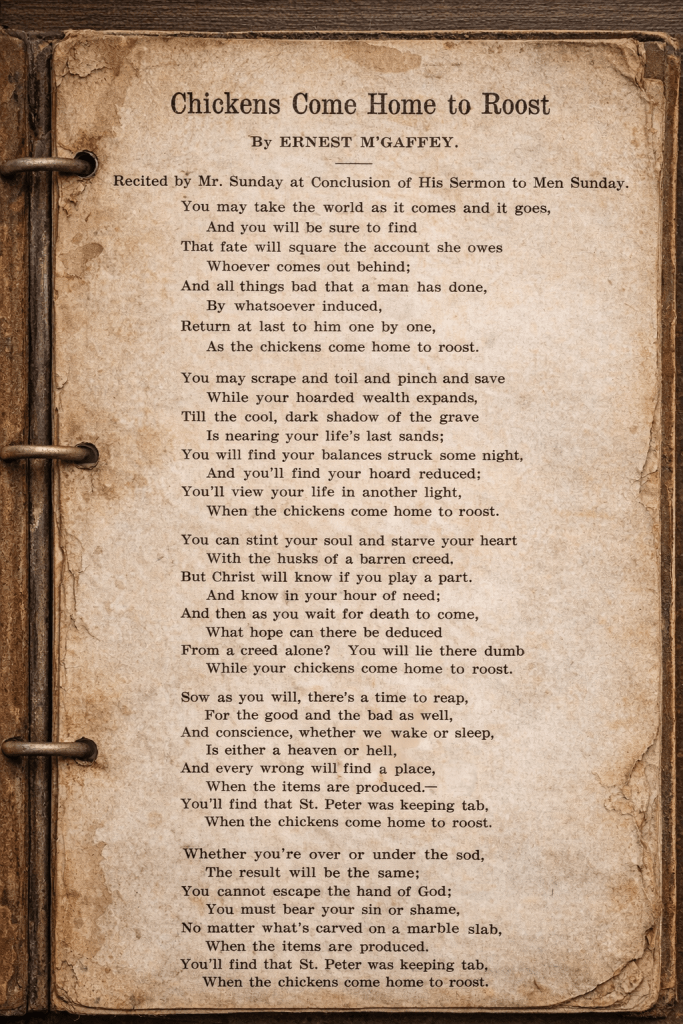
Sermon: When chickens come home to roost

One of Billy’s favorite sermons was When chickens come home to Roost. He would preach it often and usually in the first 1-2 weeks of a revival.

What was the sermon about?

In “Chickens Come Home to Roost,” Billy Sunday argues that sin is never isolated or harmless—it inevitably returns with consequences that grow over time. What begins as a small compromise develops into habit, then character, and ultimately destruction. He emphasizes that sin corrupts the individual internally before it manifests outwardly, dulling the conscience and weakening the will. Sunday also stresses that sin is not merely personal; it affects families, communities, and even nations. He dismantles common excuses—denial, delay, and comparison—and insists that no one escapes moral accountability. The sermon builds toward an urgent appeal: repentance must happen now, before sin’s consequences fully mature and bring irreversible damage.

Representative Quote:
“Your sin may seem quiet tonight, but it will rise up tomorrow and demand its wages.”

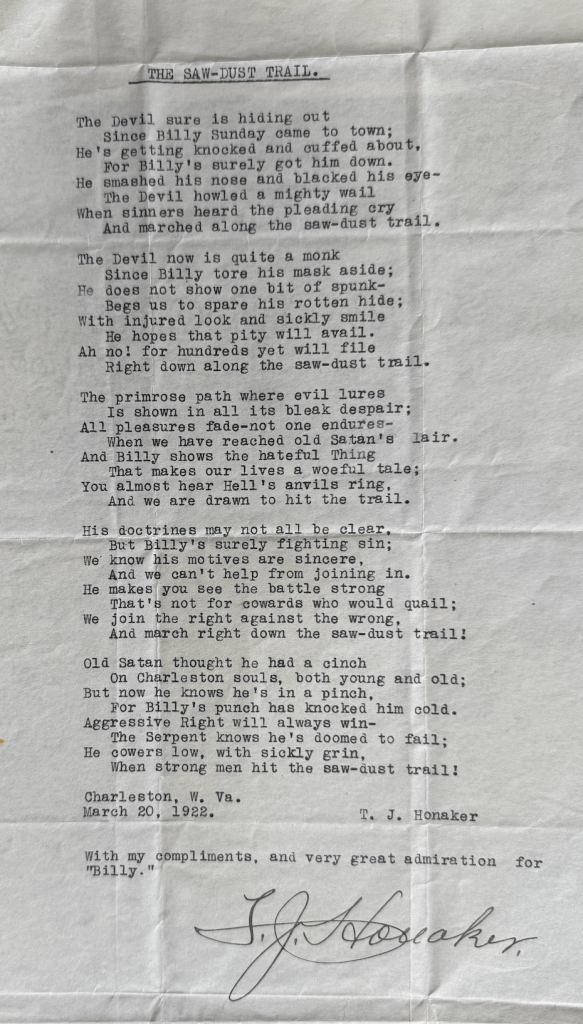
The sawdust Trail poem

This poem was sent to Billy and Ma c.1922. It is housed in Morgan Library at Grace College.

Transcription

THE SAW-DUST TRAIL

The Devil sure is hiding out
Since Billy Sunday came to town;
He’s getting knocked and cuffed about,
For Billy’s surely got him down.
He smashed his nose and blacked his eye—
The Devil howled a mighty wail
When sinners heard the pleading cry
And marched along the saw-dust trail.

The Devil now is quite a monk
Since Billy tore his mask aside;
He does not show one bit of spunk—
Begs us to spare his rotten hide;
With injured look and sickly smile
He hopes that pity will avail.
Ah no! for hundreds yet will file
Right down along the saw-dust trail.

The primrose path where evil lures
Is shown in all its bleak despair;
All pleasures fade—not one endures—
When we have reached old Satan’s lair.
And Billy shows the hateful Thing
That makes our lives a woeful tale;
You almost hear Hell’s anvils ring,
And we are drawn to hit the trail.

His doctrines may not all be clear,
But Billy’s surely fighting sin;
We know his motives are sincere,
And we can’t help from joining in.
He makes you see the battle strong
That’s not for cowards who would quail;
We join the right against the wrong,
And march right down the saw-dust trail!

Old Satan thought he had a cinch
On Charleston souls, both young and old;
But now he knows he’s in a pinch,
For Billy’s punch has knocked him cold.
Aggressive Right will always win—
The Serpent knows he’s doomed to fail;
He cowers low, with sickly grin,
When strong men hit the saw-dust trail!

Charleston, W. Va.
March 20, 1922.

T. J. Honaker

“With my compliments, and very great admiration for ‘Billy.’”

The Circus That Tried to Hire Billy Sunday, c. 1917


And Why the Offer Destroys the Claim That He Preached for Money

One of the most common criticisms leveled against evangelist Billy Sunday is that he preached for money.

Critics point to the generous love offerings that were sometimes taken at the close of his revival campaigns and conclude that Sunday must have been motivated by financial gain. It is an easy accusation to make. But historical evidence tells a very different story.

One remarkable document from 1917 puts the matter in perspective.

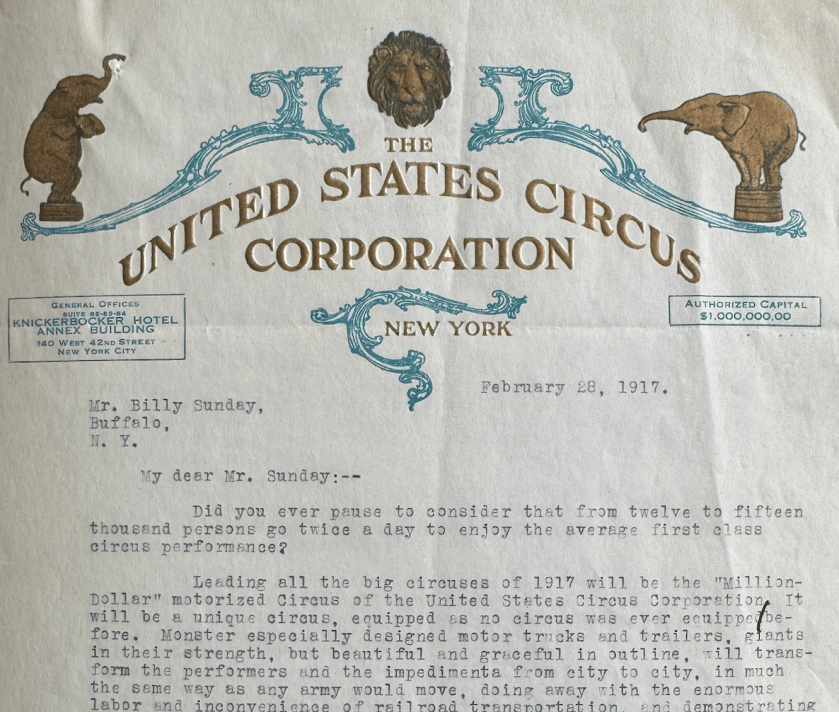
On February 28, 1917, Billy Sunday received an extraordinary letter from the president of the United States Circus Corporation. The proposal was simple, bold, and almost unbelievable.

The circus wanted Billy Sunday to join the show.

Original 1917 contract. Grace College. Morgan Library.

The letter opened by reminding Sunday of the enormous audiences that circuses attracted:

“Did you ever pause to consider that from twelve to fifteen thousand persons go twice a day to enjoy the average first class circus performance?”

The promoter explained that the company was launching what he called a “Million-Dollar” motorized circus, equipped with fleets of specially designed trucks and trailers that would carry the show from city to city.

The scale was enormous. Tens of thousands of people attended circus performances daily.

And the circus president believed Billy Sunday could preach to them.

Then came the offer.

“I… offer you a weekly salary of $14,000, or $2,000 a day, for as many weeks of the coming summer season as you can give.”

To grasp how staggering this proposal was, consider the numbers.

If Sunday had accepted the offer and worked for roughly ninety to one hundred days during the summer season, he would have earned between $180,000 and $200,000 in 1917.

Adjusted for inflation, that is roughly $4 million today.

In return, the circus would provide transportation, luxury touring cars for Sunday and his staff, and access to massive crowds across the country.

The promoter even suggested that Sunday hold revival meetings on Sundays as part of the circus program.

But here is the crucial point.

The proposal made no provision for Sunday to keep offerings from those meetings. In fact, the letter suggested that the proceeds from Sunday services could go largely or entirely to charity.

The circus wanted Billy Sunday not as a fundraiser—but as an attraction.

A headline act.

A revivalist who could preach to the largest audiences in America.

And yet Billy Sunday refused.


The Economics of Sunday’s Real Ministry

Now compare this circus offer to the income Sunday actually received during the same years.

During the summer Chautauqua season, Sunday could deliver 50 to 70 speaking engagements.

Typical speaking fees ranged from $250 to $500 per engagement.

That means a strong Chautauqua season might produce:

  • $12,500 on the low end
  • $35,000 on the high end

Even at the very top of that range, the circus contract would have paid five to six times more.

In other words, if Billy Sunday had been motivated primarily by money, the decision would have been obvious.

He could have become the highest-paid religious speaker in America simply by joining a circus.

Instead, he chose the sawdust trail.

He chose the revival tabernacle.

He chose the ministry that demanded months of exhausting preaching, travel, prayer meetings, counseling, and organization.

And he did it for far less money than the circus was willing to pay.

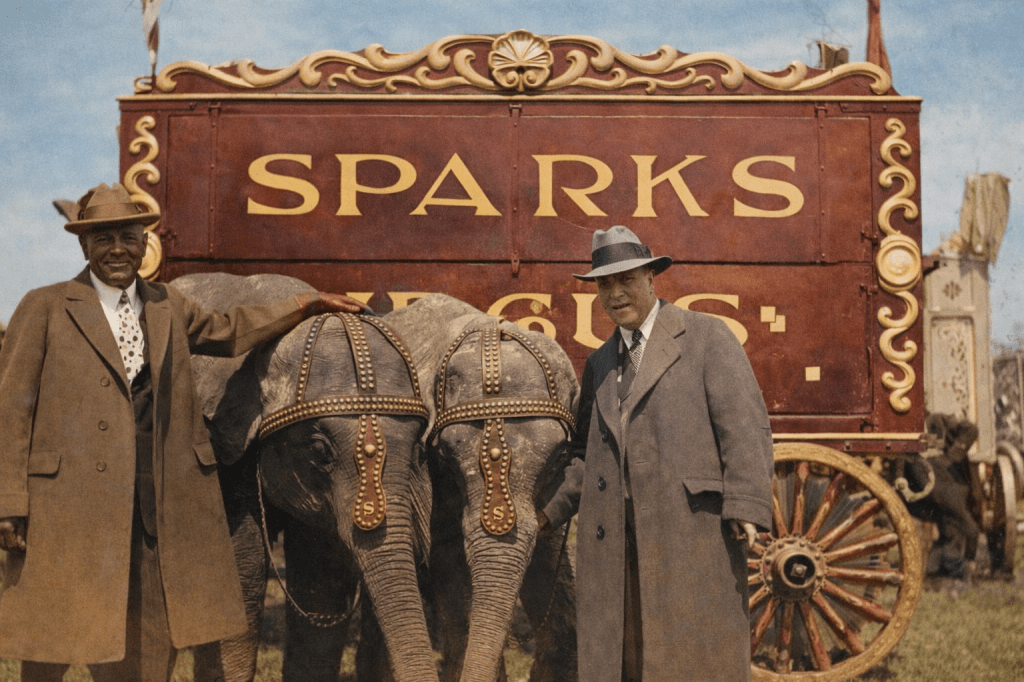
Rare original Sparks Bros Circus photograph showing evangelist Billy Sunday and Charles Sparks.

Why the Critics Miss the Point

Billy Sunday never pretended that money did not matter. Revival campaigns required large temporary tabernacles, choirs, staff members, and enormous logistical efforts.

But Sunday consistently refused opportunities that would have turned his preaching into entertainment.

The 1917 circus contract proves it.

The entertainment industry was willing to pay him millions in today’s dollars to headline the largest traveling show in America.

He said no.

The same evangelist who was accused of preaching for money walked away from a fortune.

And that fact should cause us to reconsider the narrative that Sunday’s critics often repeat.

Billy Sunday may have been many things—a fiery preacher, a former baseball player, a relentless evangelist—but the historical record shows that he was not in the ministry merely for the money.

If he had been, the circus would have had its star.

Instead, the revival fires continued to burn.


Did you know?

“It may not be generally known, but ‘Billy’ Sunday supports a mission on Van Buren street, Chicago, paying all the expenses of maintaining it out of his own pocket. He is also educating twenty boys and paying for it with his own money. These boys are waifs he has picked up out of the street. In this he is following the plan of the late Sam Jones, who in his lifetime educated hundreds of poor boys and made useful citizens out of them.”

The Kalamazoo Gazette. Fri, Jul 23, 1909 ·Page 4

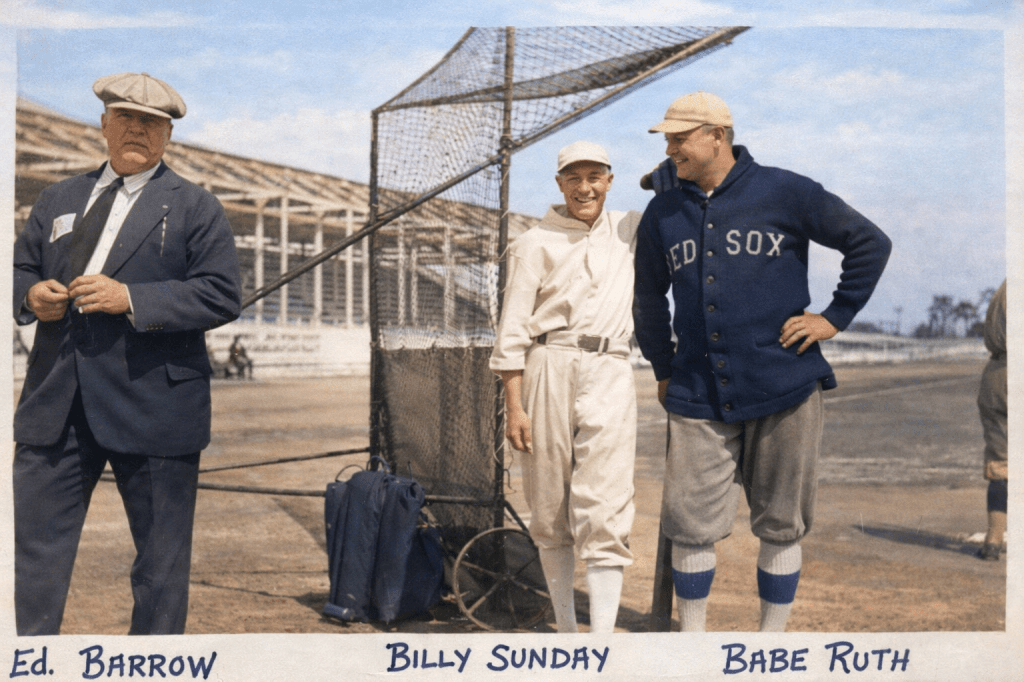
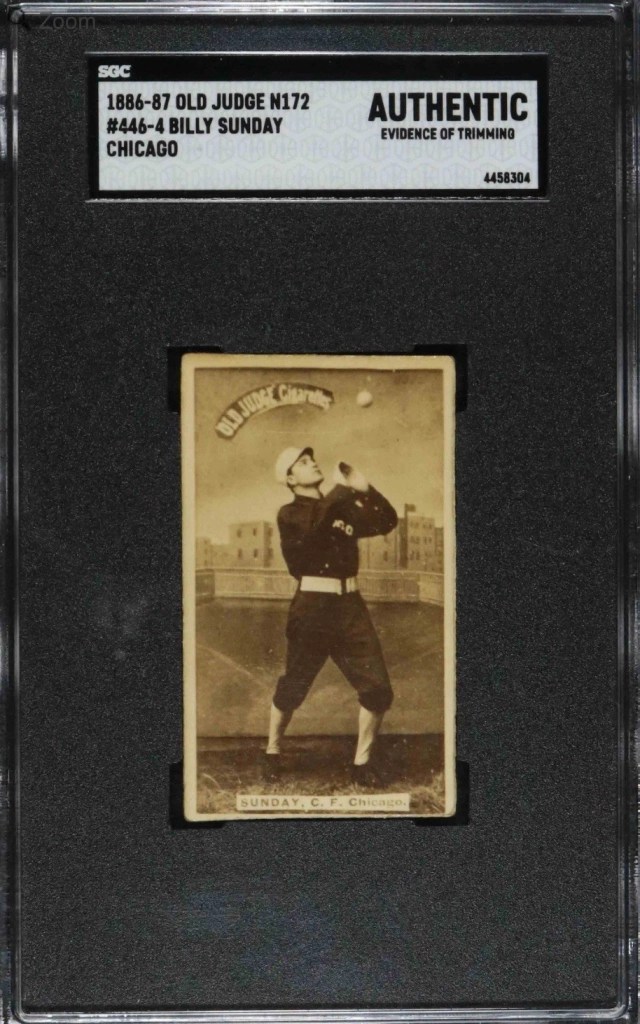
When did Billy Sunday play professional baseball?

Billy Sunday played professional baseball from 1883 to 1890.

Here is the basic timeline of his baseball career:

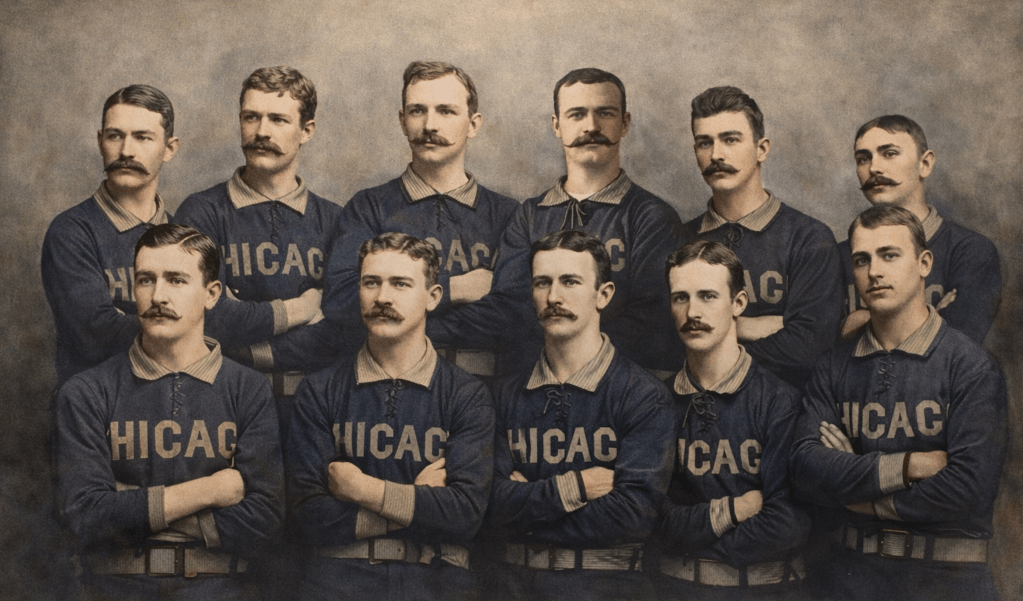
1883–1887 — Chicago White Stockings (National League)

  • Discovered by manager Cap Anson while playing for a local amateur team in Marshalltown, Iowa.
  • Joined the Chicago White Stockings (now the Chicago Cubs) in 1883.
  • Known more for speed and defense in the outfield than for hitting.
  • Played on the 1885 and 1886 National League championship teams.

1888–1890 — Pittsburgh Alleghenys (National League)

  • Traded to Pittsburgh in 1888.
  • Continued as an outfielder and base runner.

1890 — Philadelphia Phillies (Players’ League)

  • Jumped to the short-lived Players’ League in 1890 with the Philadelphia Phillies.
  • This was his final season in professional baseball.

Career Snapshot

  • Years: 1883–1890
  • Teams:
    • Chicago White Stockings (1883–1887)
    • Pittsburgh Alleghenys (1888–1890)
    • Philadelphia Phillies – Players’ League (1890)
  • Position: Outfielder
  • Batting Average: .248
  • Games Played: 499
  • Stolen Bases: 95

After Baseball

After leaving baseball in 1890, Sunday worked briefly with the Chicago YMCA, where his speaking ability began to emerge. Within a few years he joined the evangelistic team of J. Wilbur Chapman, launching the ministry that eventually made him the most famous evangelist in America before Billy Graham.

After Baseball

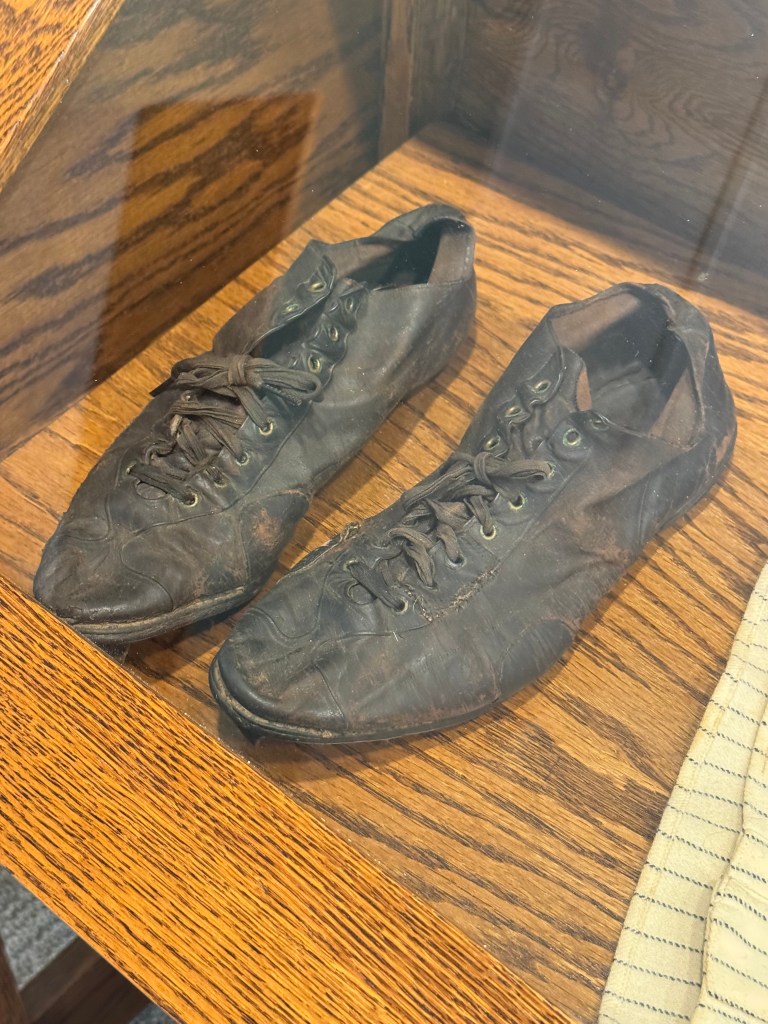
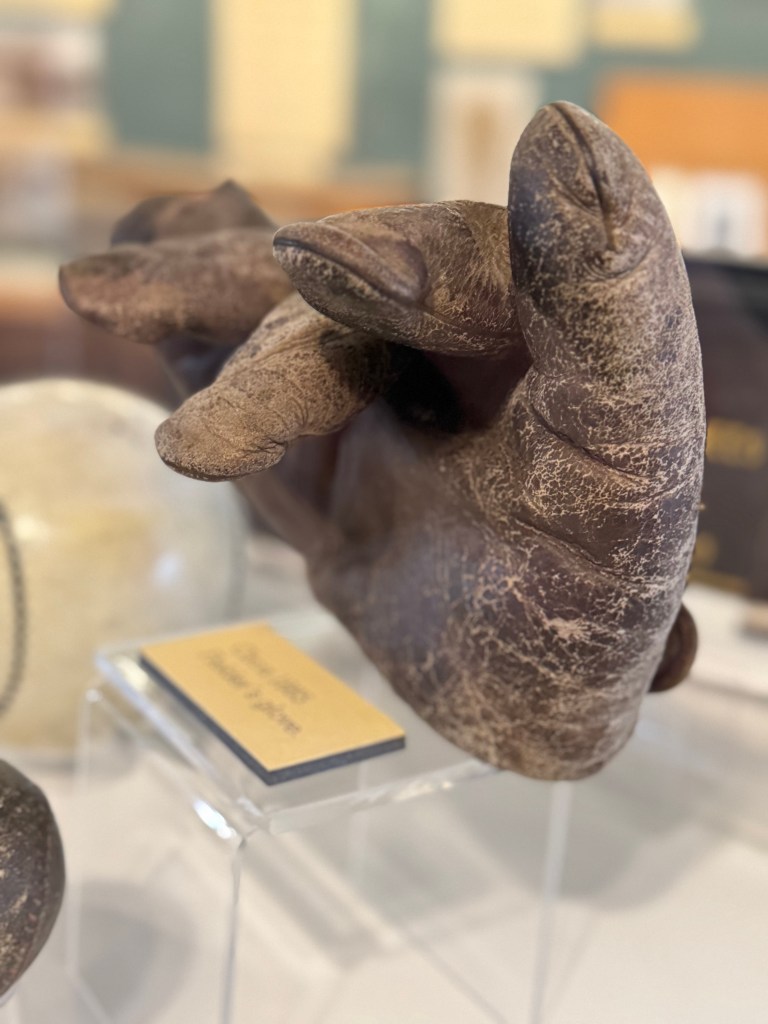
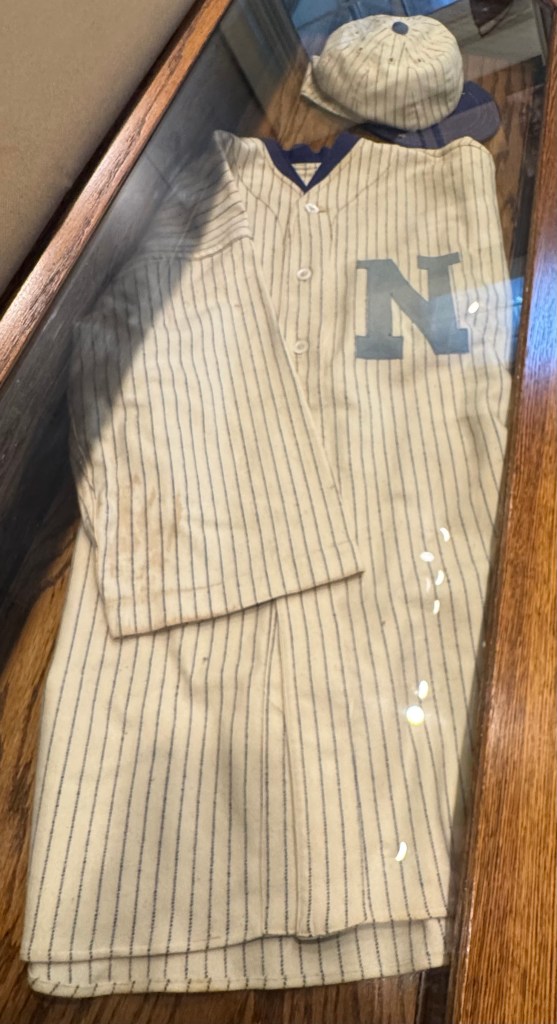
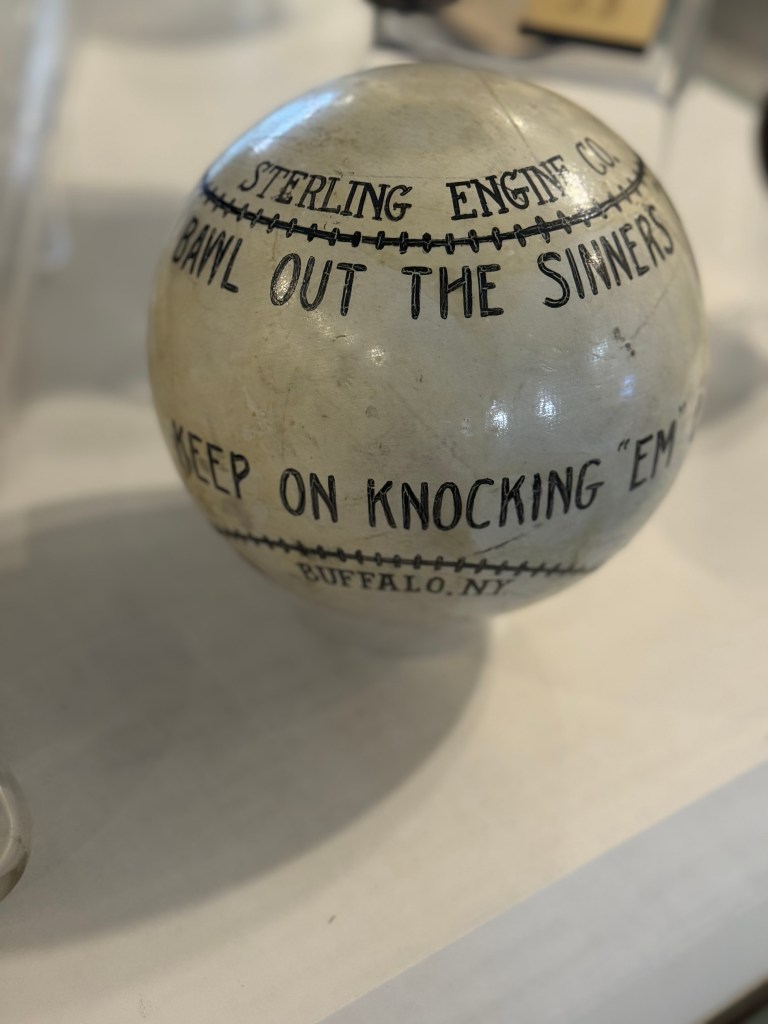
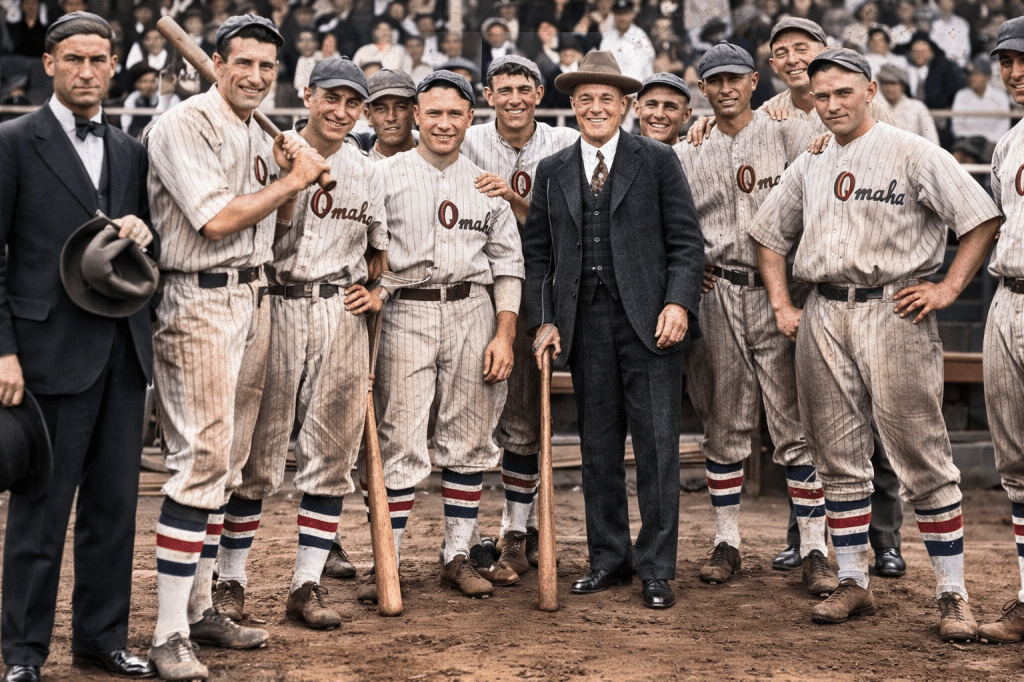
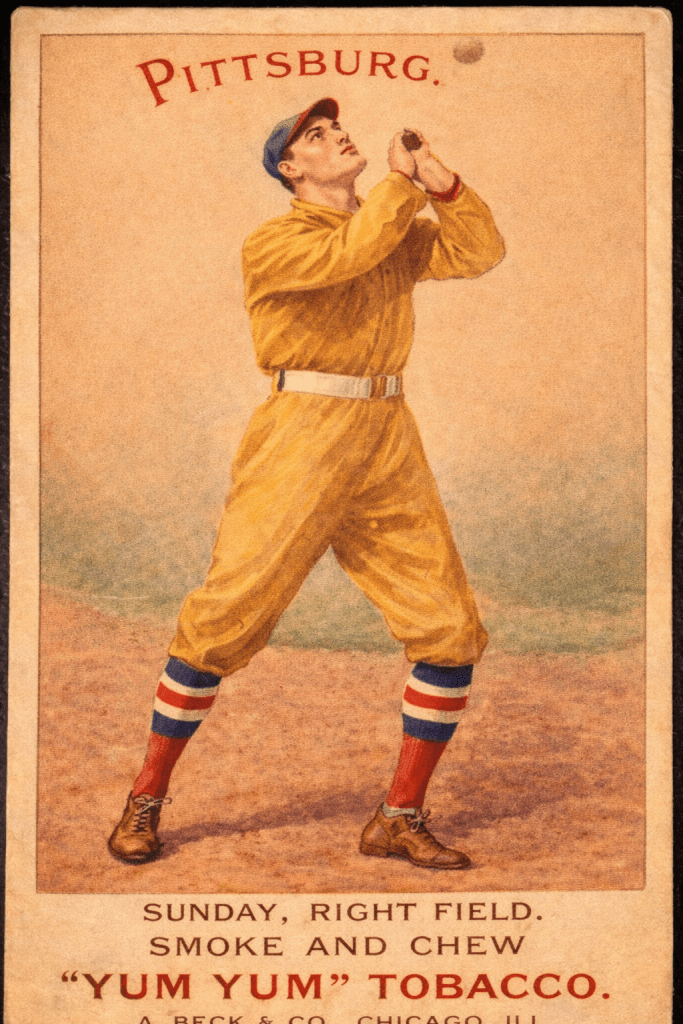
Here is a photo gallery of baseball related images associated with Billy Sunday.

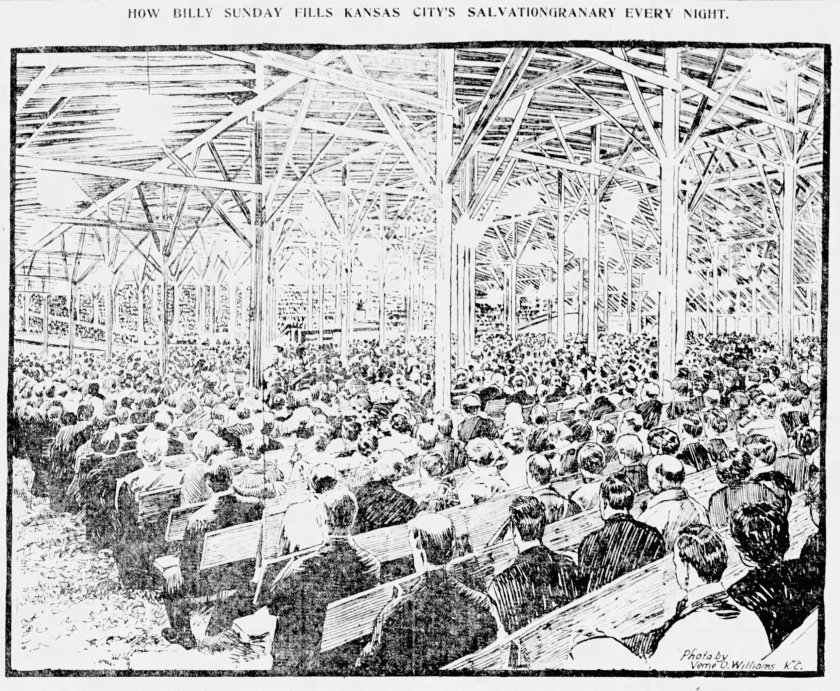
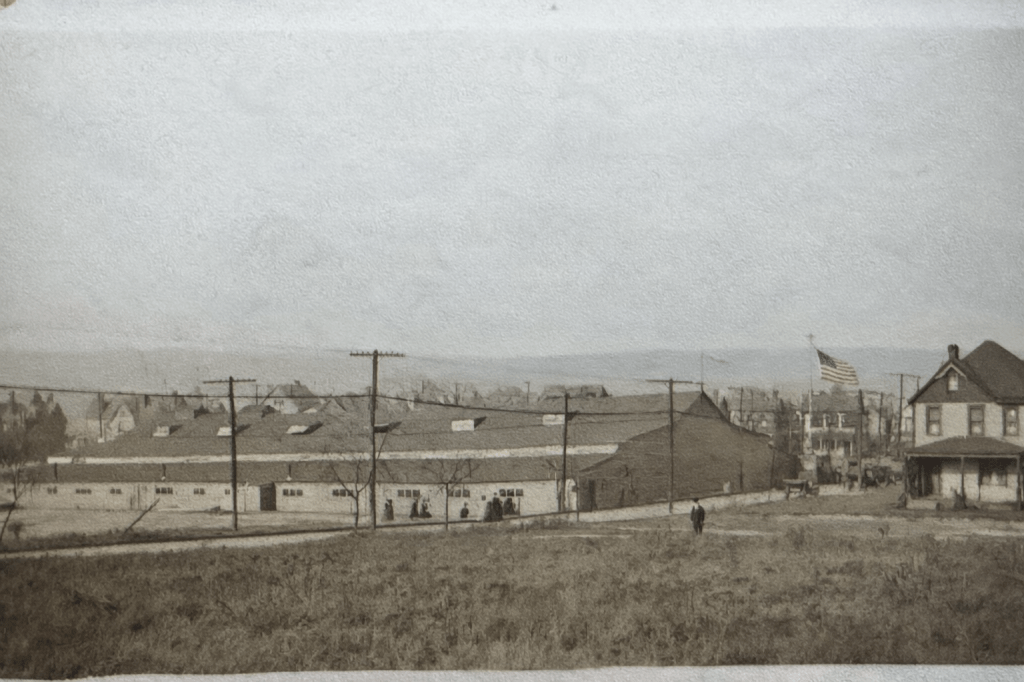
Need help identifying this Billy Sunday Tabernacle

I recently acquired this image. It is obviously a Billy Sunday Tabernacle but I can’t 100% confirm its location.

It is close to his Lima and Toledo tabernacles, but its not one of those.

I am hoping the town in the background and the house on the right helps it being properly identified.

It feels like the 19-teens.

It almost feels like its Pennsylvania. I know he did a revival in Sharon, PA (May 1st – June 22, 1908. Sharon, PA (Shenango Valley).

Please put your thoughts in the Comments field.

Mother’s Day, 1909

ONE of the most impressive and successful days in the great campaign was Mother’s Day, as suggested by Rev. Mr. Sunday. The following request was published:

Every person is requested to wear a white flower or ribbon to-day in honor of mother. If your mother is alive do her an act of kindness. Telegraph or write to her, or give her a gift to express your love. If mother is not alive, perform an act of kindness to somebody else’s mother. The services at the tabernacle will be for mothers, although everybody is invited. Businessmen are invited to close their places of business from two to four o’clock, or at least to let as many employees off as possible. An offering will be taken at the tabernacle to be given to the Woman’s Club to be distributed to the charities of the city as the club deems best.

 W. A. Sunday

Source (text above): 1909 Springfield, Illinois souvenir booklet

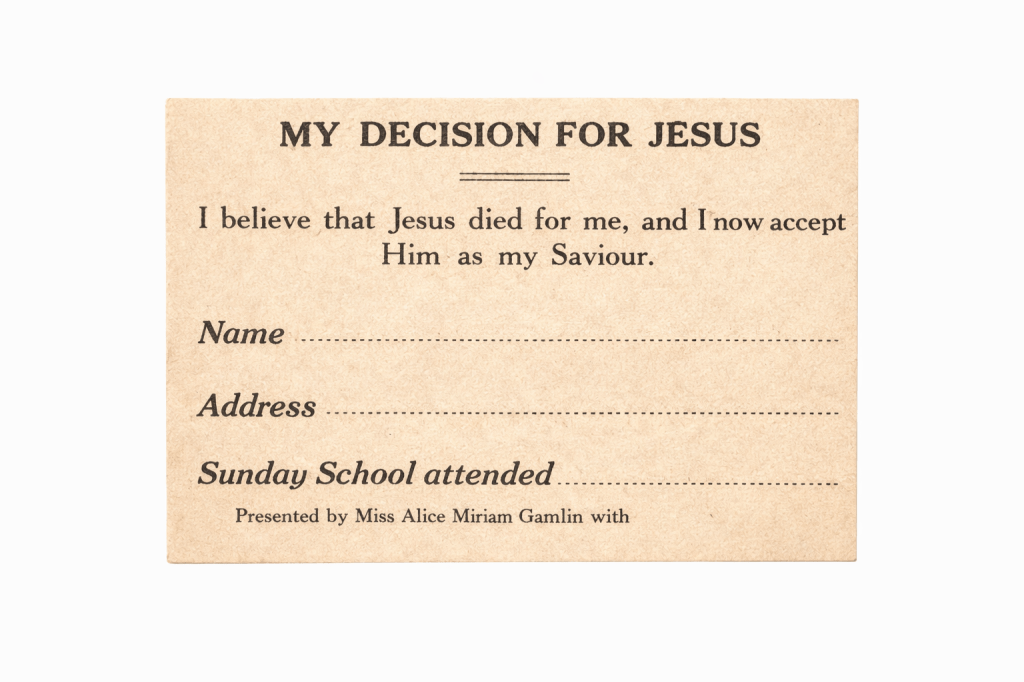
A ‘salvation’ decision card for a Billy Sunday revival

Here is what a ‘trail hitter’ filled out who walked the sawdust trail during a Billy Sunday revival. Omaha saw 13,000+ conversions, closing on October 24, 1915 (opening Sept 5). Billy preached at least 96 times just in the tabernacle during this revival, and scores more outside of the tabernacle venue.

Who is Billy Sunday c. 1909

The Billy Sunday campaign published a souvenir booklet in 1910 that summarized the Springfield, Illinois campaign (Feb 26 – Apr 12, 1909). The following narrative shared much about the Rev. William A. ‘Billy’ Sunday

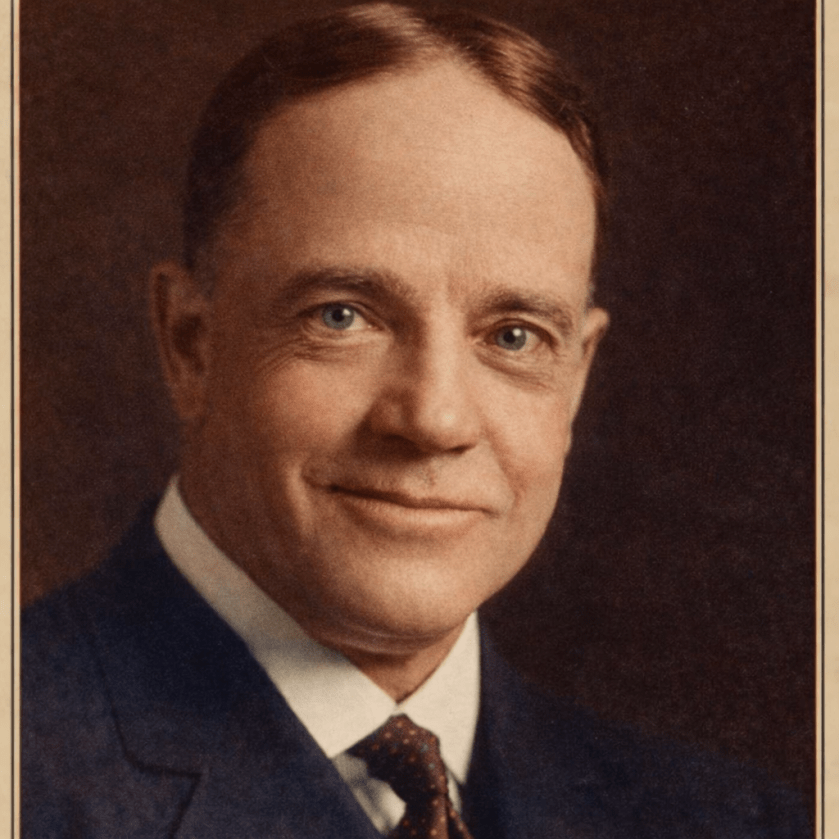
Rev. W. A. Sunday

WILLIAM ASHLEY SUNDAY is the best beloved and the most abused, the simplest and the most misunderstood, the most soulful and the most like a vaudeville performer, the most powerful in oratory and the least appealing to the emotions, the most persuasive and the most controversial, the most scholarly and the plainest, not to say coarsest, the greatest poet in essence and the greatest scrapper, of any man on the forum, the platform, or the stage of the world today.

He has been styled, the polygonal preacher, because he has so many sides, each a complete, finished, forceful fact. A character picture of the man, to be complete, must be a description of each of these baker’s dozen sides of his personality, none of which is much more important than any other one. The most that can be done within a small space—or indeed within any limitation of space—is to sketch in broad lines the mere outlines of this evangelist who is preaching the gospel of peace on earth and fighting the devil with the hottest of fire at the same time.

His father was killed in the civil war. The little boy was sent to the Iowa home for soldiers’ orphans. Later he made his own living at a youthful age, and his school teacher of that time says she would often watch him on the playground and wonder whether he would be the greatest crook or the greatest power for good in America—she was even then sure he would be one of the two. The boy took the right hand road.

When a young man he was a locomotive fireman on the Chicago and Northwestern Railroad and lived at Marshalltown. This was also the home of the famous A. C. Anson, captain of the old Chicagos, who watched Billy Sunday play baseball on corner lots while at home in Marshalltown. Anson took him to Chicago, discovered in him a great baseball player, and Sunday held the record for base running for years, a record which he still holds; was the second man chosen on the All-American team to tour the world—an accident to his knee kept him from making the tour—and was a popular idol of the fans.

An old time catcher for the Louisville team says that in those days when en route the rest of the men would play poker in the Pullman, but Billy Sunday was always back on the cushions with a book. He has kept close to books ever since. He has a remarkable faculty of choosing the very best and most authoritative writing on any particular subject and reading that only—and hence the range of subjects upon which he is thoroughly and accurately informed, includes almost everything from histology to astronomy and from bacteriology to history—it is a little interesting to notice that chemistry is the one topic unmentioned in his sermons. Three medical college professors who met at the end of his sermon which includes a half hour of the deepest microscopical pathology, agreed that William A. Sunday is the only layman they ever heard or read who was accurate in all he said about medical science.

One night a bunch of baseball players strolling along a Chicago street ran into a curbstone evangelist and stopped to be amused. Sunday stayed after the others went on. He went from there to the Pacific Garden mission, where he was converted. He kept on playing baseball, and nobody who ever heard it will ever forget his own description of how the others of that famous Chicago team approved his home run into Christianity.

A little later he was employed by the Chicago Young Men’s Christian Association at a small salary, only part of it paid during the panic of 1893, and refusing offers of $500 a month to return to the diamond. As a part of his work, he addressed groups of men—he always did know men, because of his early life and hard struggles. The addresses became longer and stronger with the growth of the work and experience in it. That great evangelist, Wilbur F. Chapman, took Sunday away from the Chicago Y.M.C.A. to be his assistant. Sunday learned the art of evangelizing and after learning it thoroughly treated it as Napoleon treated the art of war—he re-made it for himself, so that its old practitioners hardly recognize it, and at the same time made it produce victories hitherto undreamed of. The William A. Sunday methods of campaigning for Christ are unlike any others; they include the best of those of the past and many things unique; probably only Sunday could use them successfully in all their details; but it seems certain that they have factors not found in most others which really are the corner stones of successful work in evangelism. Some of the chief parts of the art of evangelism, as practiced by William A. Sunday, are these: Absolute accuracy in every statement made, whether one of the essential parts of the argument, or merely an illustration; hew close to the line that Jesus Christ laid down, regardless of the falling chips, and wherever that line leads; use language that everybody can understand, never talk down to an audience, but be lucid to the most ignorant while you are talking up to the most scholarly persons before you; avoid sectarianism; demand united work from all the evangelical churches in the city, and push united work by all the members of those churches; roast the skin of vice and sin in all its forms, from backsliding and carelessness to murder and adultery, rub salt into the burnt flesh, and then apply a healing balm that causes the object of the criticism to leave the tabernacle chastened in spirit, but loving the rod that smote him; avoid all fads and fancies, all tangential movements of society, but do a common thing in a most unusual way; and—many others. Starting with small towns and a few hundred converts at each series of meetings, the same plan of campaign has been used for all the years involving campaigns in cities of all sizes, and the first meetings years ago were, so far as Mr. Sunday is concerned, almost exactly like the meetings in Springfield. Of course, some minor modifications have been made, but these are few. Always there are the first sermons to get the church members back out of the world into the influence of Christ and to get the public to come to the tabernacle—the public seems to find its greatest attraction in hearing church-member hypocrites and Pharisees skinned like eels. Always the strenuosity of the sermons almost imperceptibly lessens gradually until the preacher who preaches as man never preached before is less athletic and more rhetorical about the middle of the series. Then, to the amazement of people who judged the man from his first pulpit stunts, the Reverend William Ashley Sunday preaches like the great orator that he is, the scholar that he is, the poet-philosopher that he is. This many sided man cannot be even sketched within a hundred pages. There is competent authority for saying of him these superlatives as being strictly true: He understands the minds and feelings of men as few men ever have done. He is one of the greatest orators the world has ever seen—and this is proved by the results of his work.

He is one of the most remarkable stylists in literature, his perfect imitation in one hour of the styles of Carlyle, Gibbon, Ingersoll, and several other writers of individual styles being an unprecedented feat.

He is said by scientists to be the most—and indeed the only—perfectly accurate preacher in matters of science. And a large part of his sermons deal with science.

He appeals entirely to the reason of the people, and rarely or never to their emotions, and in this he is the greatest of evangelists in the opinion of many people.

In numbers of converts, dramatic height of scenes, and wonderful stirring of the audience, several of his meetings have eclipsed anything in the history of evangelism since pentecost—and the most of these have been meetings for men.