Former professional baseball player-turned urban evangelist. Follow this daily blog that chronicles the life and ministry of revivalist preacher William Ashley "Billy" Sunday (1862-1935)
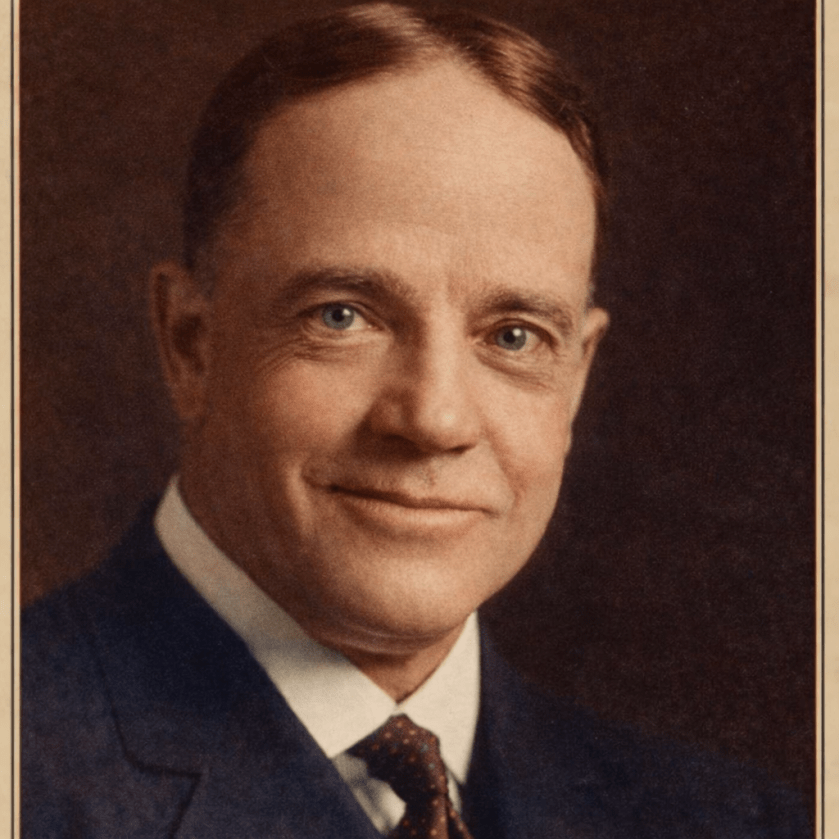
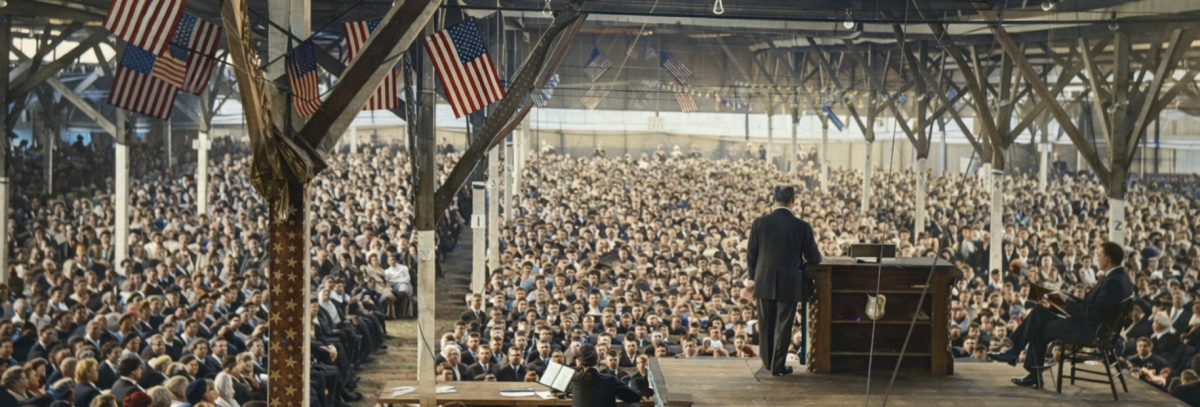
Colorized picture from 1915. This was Billy’s favorite picture at the time.
“A revival is needed when the worldly spirit is in the church of God. It isn’t necessary to do something grossly inconsistent. A ship is all right in the sea, but all wrong when the sea is in her. The church of God is all right in the world, but all wrong when the world is in the church. Some people come to church on Sunday morning and on Monday morning they take a header into the world and the church never sees them again until Sunday morning. They squat and take up a little space in the pew and stay there and put a little money on the plate, but you never see them again until Sunday morning. I tell you, I believe half of the church members could die and the church wouldn’t lose anything of its spiritual force; it would lose them in numbers, but it wouldn’t lose anything in spiritual power.
I tell you, my friends, we need a panic in religion; the world don’t need informing; it needs reforming. We are going to the devil over culture clubs, as if the world needed informing; it don’t need anything of the kind. There are people who go to church and go to a certain denomination because their wife goes there. They got their religion and their property in their name. They go to that church.”
Cited in: Philadelphia Evening Public Ledger. January 6, 1915:6.
From a sermon on A Defense of Revivals, from Habakkuk 3:2. January 5, 1915. Philadelphia.
Cited in: The Evening Public Ledger. January 5, 1915: 5.
“What is a revival? Now listen to me. A revival does two things. First, it returns the church from her backsliding; and, second, it causes the conversion of men and women; and it always includes the conviction of sin on the part of the church. What a spell the devil seems to cast over the church today!
“I suppose the people here are pretty fair representatives of the church of God, and if everybody did what you do there would never be a revival. Suppose I did no more than you do, then no people would ever be converted through my efforts; I would fold my arms and rust out. A revival helps to bring the unsaved to Jesus Christ.
“God Almighty never intended that the devil should triumph over the church. He never intended that the saloons should walk roughshod over Christianity. And if you think that anybody is going to frighten me, you don’t know me yet.
“I will cram it down their throats in this town for the miserable lies they hurl against me up and down the streets of this city. Don’t you forget it. You bet your life. You bet, and they will get it.
“When is a revival needed? When the individuals are careless and unconcerned. If the church was down on her face in prayer they would be more concerned with the fellow outside. The church has degenerated into a third-rate amusement joint with religion left out.
“When is a revival needed? When carelessness and unconcern keep the people asleep. It is must the duty of the church to awaken and work and labor for the men and women of this city as it is the duty of the fire department to arouse when the call sounds. What would you think of the fire department of Philadelphia if it slept while the town burned? You would condemn it and I will condemn you if you sleep and let men and women go to hell. It is just as much your business to be awake. The church of God is asleep today; it is turned into a dormitory, and has taken the devil’s opiates.”
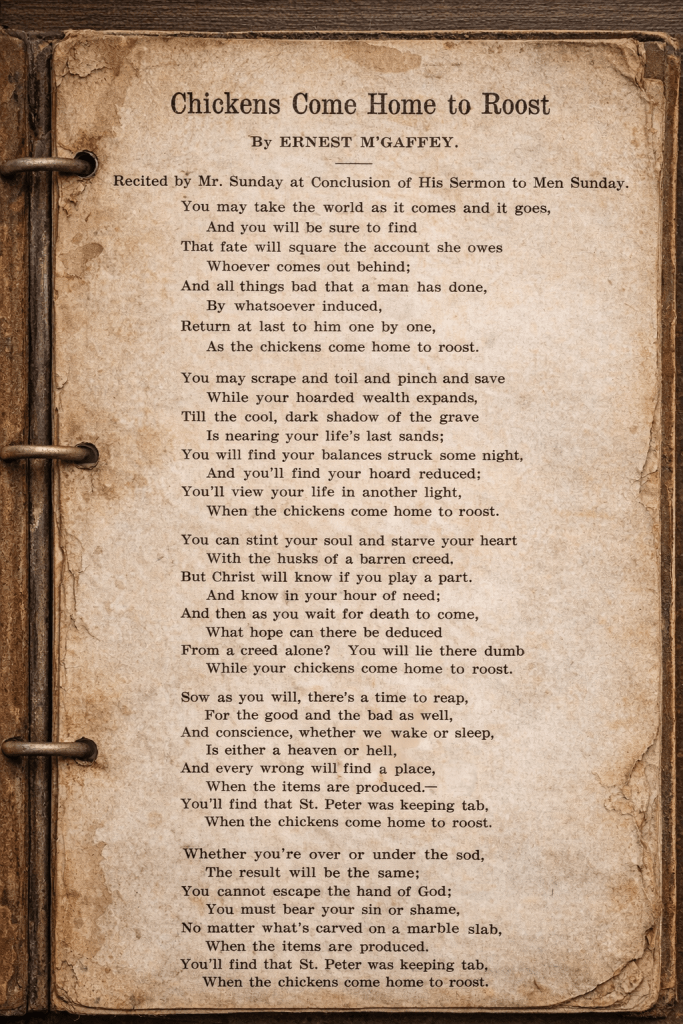
One of Billy’s favorite sermons was When chickens come home to Roost. He would preach it often and usually in the first 1-2 weeks of a revival.
What was the sermon about?
In “Chickens Come Home to Roost,” Billy Sunday argues that sin is never isolated or harmless—it inevitably returns with consequences that grow over time. What begins as a small compromise develops into habit, then character, and ultimately destruction. He emphasizes that sin corrupts the individual internally before it manifests outwardly, dulling the conscience and weakening the will. Sunday also stresses that sin is not merely personal; it affects families, communities, and even nations. He dismantles common excuses—denial, delay, and comparison—and insists that no one escapes moral accountability. The sermon builds toward an urgent appeal: repentance must happen now, before sin’s consequences fully mature and bring irreversible damage.
Representative Quote: “Your sin may seem quiet tonight, but it will rise up tomorrow and demand its wages.”
From Trenton to Baltimore: How Billy Sunday’s Preaching Evolved in 1916
When Billy Sunday concluded his revival campaign in Trenton, New Jersey, in February 1916, he had already delivered an extraordinary number of sermons in just a few winter weeks. Soon afterward he moved south to begin what would become an even larger campaign in Baltimore, Maryland.
A comparison of the sermon lists from the two cities reveals something fascinating about Sunday’s preaching strategy. While the evangelist was famous for repeating certain signature sermons from city to city, the Baltimore campaign shows a noticeable shift in emphasis and structure compared with Trenton.
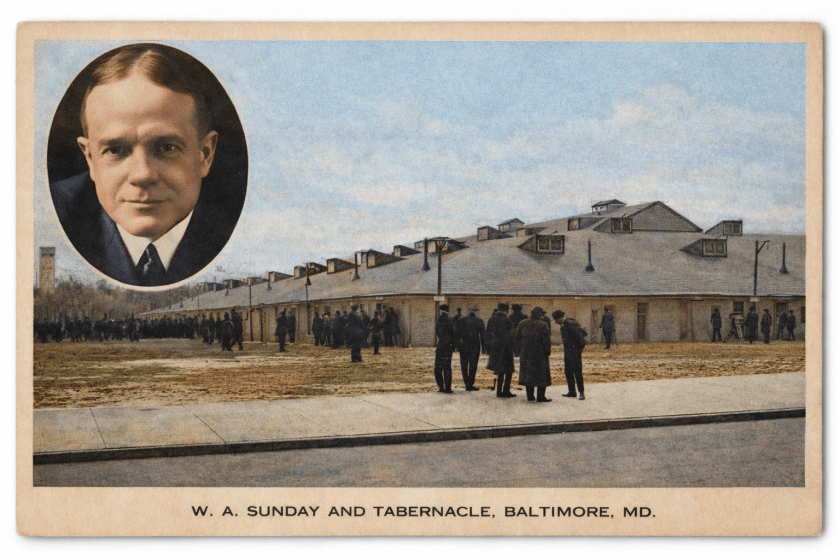
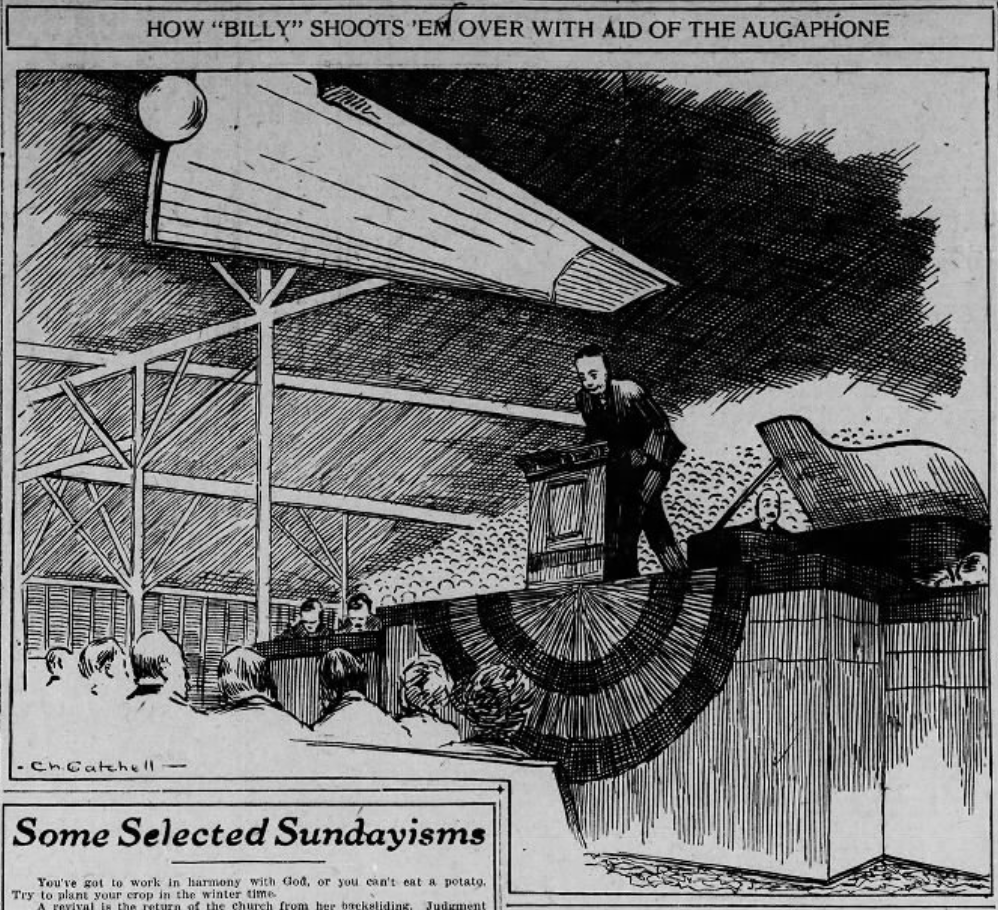
The Baltimore Tabernacle
The Trenton Campaign: Classic Revival Preaching
The Trenton sermons follow the pattern of a traditional evangelistic revival. Many of the titles focus directly on conversion, repentance, and the urgency of salvation. Messages such as What Must I Do to Be Saved?, After Death, Judgment, Rich Young Ruler, and What Shall the End Be? formed the backbone of Sunday’s preaching.
These sermons were part of Sunday’s well-known revival repertoire. In Trenton he rotated them rapidly, returning to the themes of judgment, repentance, and personal decision again and again. Titles like Backsliding, Get Right, Choose Ye This Day, and Be Sure Your Sins Will Find You Out show how directly he pressed the audience toward a response.
This approach reflected the classic revival method: present the danger of sin, call for repentance, and invite listeners to make a public decision.
Baltimore: A Broader and More Structured Campaign
When Sunday arrived in Baltimore later in February, the preaching program became noticeably broader. While the evangelistic messages remained, the sermon list shows a wider range of topics and a more deliberate sequence of themes.
Several sermons addressed revival within the church itself, including The Need of Revivals, Revive Thy Work, and The Restoration of the Church. Others focused on Christian living, such as Following Christ, Positive and Negative Religion, and Show Thyself a Man.
New Sermons Appear
The Baltimore list also introduces several sermons that do not appear in the Trenton campaign. Messages such as The Authenticity of the Bible, God’s Battle Line, The Temptation of Christ, Love Your Enemies, and The Incarnation of Christ reveal a more doctrinal dimension to the preaching.
In other words, Baltimore was not only about winning converts. It also included teaching aimed at strengthening believers and encouraging churches.
The Core Sermons Remained
Despite these differences, Sunday’s core sermons appear in both campaigns. Titles such as Dr. Jekyll and Mr. Hyde, The Fig Tree, Samson, The Atonement, Choose Ye This Day, and What Must I Do to Be Saved? were staples of his preaching for years.
These messages formed the foundation of Sunday’s evangelistic ministry, and he carried them from city to city with remarkable consistency.
A Larger Revival
The Baltimore campaign also dwarfed Trenton in size. By the time the meetings ended in April, reported attendance had reached 1,376,000 people across the entire series of services.
Such a large audience may explain the broader range of sermons. A major metropolitan revival like Baltimore required not only evangelistic appeals but also teaching, church renewal, and special meetings addressing different audiences.
Two Cities, One Evangelist
Taken together, the Trenton and Baltimore sermon lists provide a revealing glimpse into Billy Sunday’s methods. Trenton shows the evangelist operating in his classic revival mode—pressing the claims of the gospel with urgency and repetition. Baltimore shows him expanding that message into a wider program of preaching that addressed both unbelievers and the church itself.
In both cities, however, the heart of the message remained the same. Whether speaking in a smaller industrial city like Trenton or in a large urban center like Baltimore, Billy Sunday continued to deliver the message that had defined his ministry from the beginning: a call to repentance, faith, and a transformed life.
Another popular sermon for Billy Sunday during the 1915-1916 campaigns was the Secret of Failure.
In “Secret of Failure,” Billy Sunday argues that failure in life is not accidental but rooted in disobedience to known truth. Using Jeremiah 5:5, he contends that God’s blessings are available, but people forfeit them by breaking His laws. The central issue is not ignorance but willful rebellion—people know what is right yet refuse to do it. Sunday emphasizes that sin is often subtle and socially acceptable, not just gross immorality, and that even church members can live in quiet compromise. He warns that partial obedience, moral neglect, and conformity to the world lead to spiritual defeat. External religion—church attendance, respectability, or profession of faith—cannot substitute for genuine obedience and transformation. True success, he insists, comes from aligning one’s life with God’s revealed will. The sermon builds toward a direct appeal: stop excusing sin, confess it honestly, and live out what you already know to be true, or failure—spiritual and moral—is inevitable.
Quotes from the sermon
“Your failure isn’t because you don’t know better—it’s because you won’t do better.”
“God tells you what to do, and you nod your head—but you never move your feet.”
“Some men are too good to be counted among the wicked—and too bad to be counted among the saved.”
“A half-obedient man is a whole failure.”
“You can sit in church and hear the truth every week—and still go to hell with a Bible in your lap.”
Billy Sunday preached the sermon of David and Nathan often during 1915-1916, using it in Kansas City, Baltimore, Philly, and Omaha.
Billy was fond of using narrative passages of Scripture to apply to a gospel sitting.
In this sermon, Billy Sunday argues that the Bible’s credibility is demonstrated by its honesty in revealing both the virtues and sins of its central figures. This transparency proves Scripture is not fabricated but divinely truthful. From this foundation, he emphasizes the universality and progressive nature of sin, showing how it enslaves individuals and shapes character over time. Sunday rejects the idea that morality, religious rituals, or personal effort can remove sin, insisting that only Christ provides true forgiveness and transformation. Genuine salvation, he argues, results in a changed life, not mere outward reform. The sermon builds toward an urgent appeal for repentance and new birth, calling listeners to abandon self-deception and receive the cleansing and renewal that only God can provide.
June 4, 1916. The Kansas City Star.
Here are some noteworthy quotes from the sermon
“God tells both sides of the story. He doesn’t whitewash His saints—He shows you the black spots as well as the bright.”
“A man doesn’t become a criminal in a day; he practices himself into it. Sin is a habit before it is a headline.”
“You can’t whitewash your heart with good works—sin soaks through. It takes the blood of Christ to make it clean.”
“If a man is born again and lives like the devil, then either he isn’t born again—or the Bible isn’t true.”
When Billy Sunday preached in Kansas City during his 1916 revival campaign, his sermons often struck directly at the spiritual condition of the church itself. One message, reported by the The Kansas City Star, carried a sharp and revealing title: “Why the Church Is Weak.”
Sunday did not begin by blaming society, politics, or culture. Instead, he argued that the church’s weakness came from within.
“The sermon by Billy Sunday this afternoon had for its subject this verse from Judges xvi, 20: ‘He wist not that the spirit of the Lord had departed from him.’”
Drawing from the story of Samson, Sunday warned that the modern church could lose its spiritual power without even realizing it. In his view, the problem was not a lack of organization, buildings, or membership.
“Nothing in the world can substitute for the spirit of God.”
For Sunday, the church had become timid. Instead of confronting sin, it had grown cautious and respectable. He charged that many congregations had traded spiritual authority for social approval.
“The church is afraid of men and women; we are to be in the world, but not of the world.”
The evangelist insisted that the church had gradually surrendered its moral courage. Leaders often hesitated to rebuke wrongdoing among their members, even when it was obvious.
“Leading church members lead in nothing but card parties and society functions.”
To Sunday, such compromises drained the church of its influence. A church that tolerated worldliness could no longer confront it.
He argued that the true strength of Christianity had never been found in numbers or wealth. The early church, he reminded his audience, possessed little of either.
“God’s church has not increased correspondingly in power as it has in numbers… it has decreased in spiritual power.”
Sunday contrasted the modern church with the first believers described in the book of Acts. They had no impressive buildings, no social prestige, and little money. Yet they possessed something far greater—spiritual conviction.
“There was a time when the church had more members than she has today; there never was a time when she had more money than she has today… but there was a time when she had more spiritual power than she has today.”
Another cause of weakness, Sunday argued, was the church’s tendency to accommodate fashionable society. Rather than confronting sin, some congregations had become comfortable with it.
“That is why many a preacher is a failure today; he is a compromiser.”
Sunday spoke especially bluntly about moral compromise among church members. When churches tolerated behavior they should have challenged, they undermined their own witness.
“We have lost our power because we have compromised.”
But the evangelist did not end his message with criticism. He pointed his listeners toward the remedy: a return to genuine spiritual life. The church needed renewed faith, repentance, and courage.
He concluded with a simple but urgent appeal. If the church wanted to regain its strength, it needed to return to prayer and dependence upon God.
“If there’s anything the church of God needs it is to climb the stairs and get in an upper room.”
In the packed tabernacle that afternoon, Sunday’s message was unmistakable. The problem facing the church was not outside pressure or hostile culture. It was the quiet erosion of conviction within.
And until the church rediscovered the spiritual power that marked its earliest days, Sunday warned, its influence would continue to fade.
It is a campaign in the name of God against the world, the flesh and the devil, and against a revival you will find every brewer …. every whiskey seller in this valley; every blackleg gambler in this valley; every sham madame of the red-light district; every man and woman that feeds and fattens and gormandizes upon the virtue of men and women, so if you want to line up with a bunch like that, God pity you; that is the best compliment on God’s earth.
Men say the day of the revival is over. Fellows harp on that in the Methodist conference, in the Presbyterian meetings, in the Baptist associations, in the Congregational associations—the day of the revival is over. No, it is not. No, only with the fellow who vomits out the sentiment; but it is not over with God. The day of the revival is over. God Almighty leaned over the battlements of heaven and looked down into the coal mines of Wales and said, “Oh. Roberts!” and out of the depths of the coal mine came that grimy, soiled man, with dirty face, with a little lamp in his cap, and he said, “What is it, God?” And God said, “I want you to go and shake up Wales,” and he gave Wales the greatest revival that ever swept over that land since the days of Pentecost. There was not a college professor or preacher in Wales that God would trust with the job.
The Tribune-Republican. Wed, Mar 04, 1914 ·Page 10
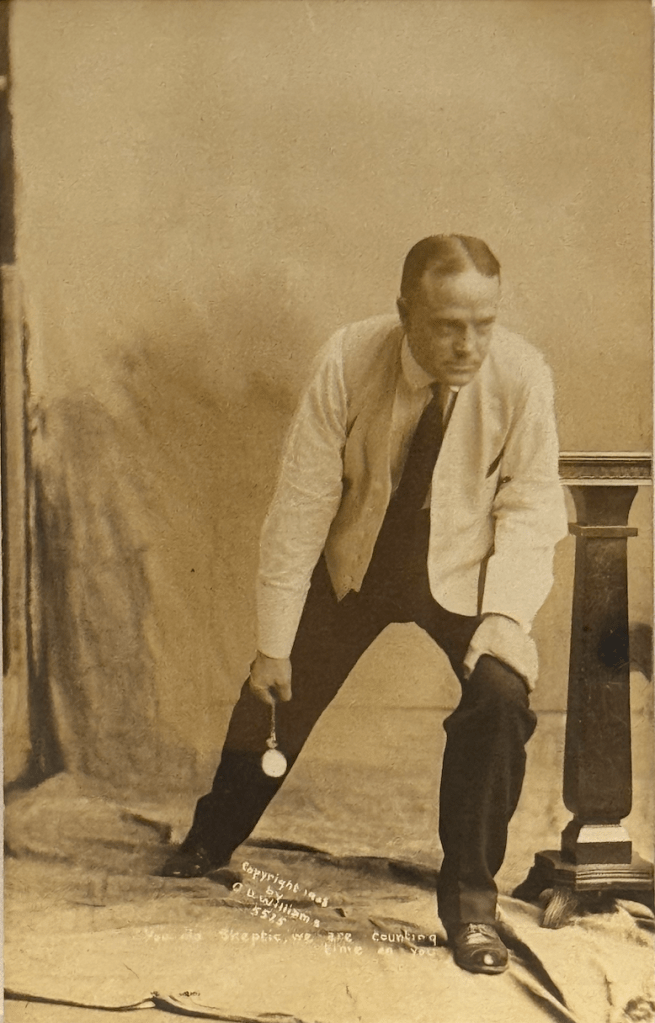
THIS IS HOW BILLY FINDS OUT IF YOU ARE GOING TO “TAKE THE COUNT”
BILLY SUNDAY IN UNUSUAL POSE.
Billy Sunday in a famous pose. C. 1908. Author’s Collection.
The above is a characteristic position for Billy Sunday to assume during one of his meetings for men only.
He bends over until his right knee nearly touches the floor of his platform; then he pulls out his watch and inquires if you are going to “take the count” for the devil.
Sunday’s sermons are filled with such unusual features as this, but they are never so plentiful as in the men’s sermons. There is no doubt about it the evangelist is at his best in these talks. He always bends every energy to the end of impressing his male audience with the truth of what he is saying, and in this he never fails.
The South Bend Tribune. Thu, Jun 05, 1913 ·Page 10
BILLY SUNDAY GOING TO TAKE PRECAUTION AGAINST FIRE.
Citation: The South Bend Tribune. Tue, May 13, 1913 ·Page 7
Just Now, Evangelist Has No Duplicate Copies of His Famous Addresses—Ackley Does Work.
“No, I have only the one copy of each of my sermons,” replied Billy Sunday to a question as to whether he had duplicates of his sermons.
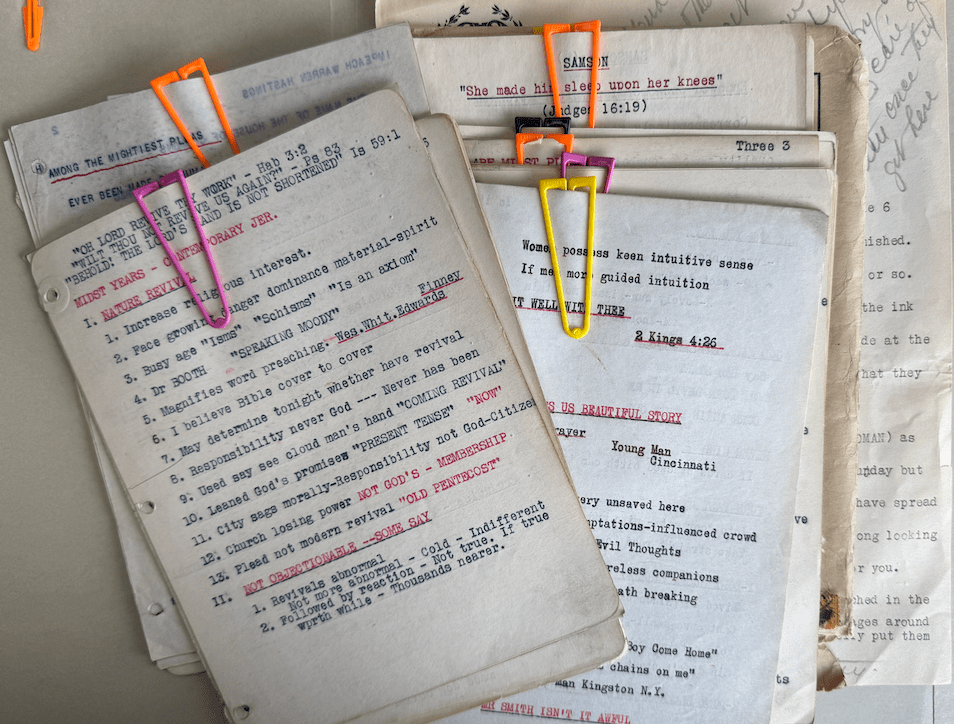
“These sermons are not in full,” continued the evangelist, as he showed the books in which he keeps the addresses that sway so many thousands; “they are just mere skeletons of the sermon and no one else but myself can read them, or at least I don’t think that anyone else can.”
Mr. Sunday was asked if he could remember the sermons if they were stolen and he replied that he recalled the majority of the material that composed them. He says that he intends to have duplicates made of the sermons and have them put into a safety deposit vault so that if one is stolen or should be destroyed by fire or in some other manner, he will have a copy.
“I thought at first that I would be able to get them copied this summer,” he said, “but it don’t look like the work will be accomplished, as I have so much to do this year.”
B. D. Ackley, pianist of the Sunday party, and secretary to the evangelist, copies the sermons of Mr. Sunday. This work takes up quite a bit of the pianist’s time, as Mr. Sunday is continually adding and detracting from his sermons as he acquires new material from many different sources.
“I always let Ackley fix up the sermons. He has a knack for doing things up pretty and nice,” said Sunday, while talking of his work.
“Now, boss, just because we have company you don’t need to make fun of me to my very face. He knows that I can’t fix them right,” said Ackley, as he turned to the visitor.
“That is all right; you do it just to suit me,” replied Sunday.
It is probable that sometime within the next year or so the evangelist will have all his sermons duplicated and deposited in a safety deposit vault.