The year Helen Sunday packed her bags: 1906

A first professional photograph, a tent under snow, and the wife of a baseball evangelist boarding the train for good.

In late March of 1906, a brief notice appeared in the Bureau County Tribune. Mrs. William A. Sunday, the wife of the well-known evangelist, had announced she would henceforth be joining her husband on the campaign trail. The notice carried her own words:

Hereafter I shall accompany my husband. I can be a great help to him, taking charge of women Bible classes, organizing girl Bible classes and giving personal care to converted persons.

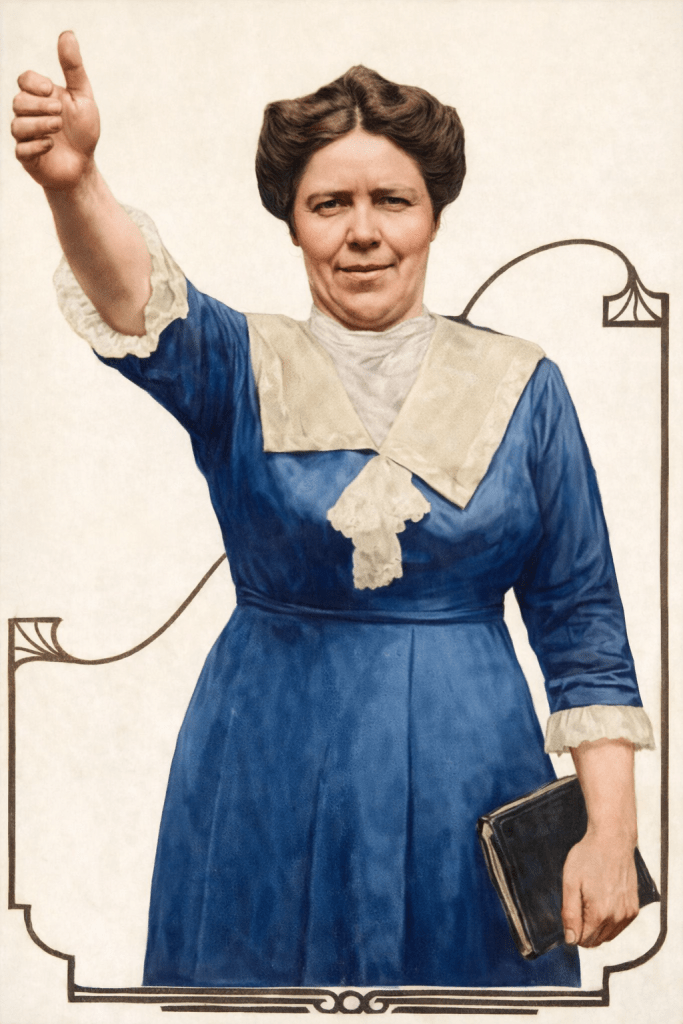
It is one of the most consequential single sentences in the entire Billy Sunday archive. Helen Sunday — known to friends as “Ma” Sunday in the years to come — was, until that announcement, a Chicago-area pastor’s wife who had spent most of her married life keeping her household running while Billy traveled. From that moment on, she would be on the road with him. She would be his organizational lieutenant, his front office, his backstage manager, and ultimately the steadiest center of his entire ministry.

Without Helen, there is no Billy Sunday of American memory. The campaigns get smaller. The big-city tabernacles never happen. The Rodeheaver era never quite assembles. The household engine that powered the next thirty years of Sunday’s career was not in place yet on the morning of March 28, 1906. It was in place on the morning of March 30. The change in his career happened in the space of those two days.

A photograph in Freeport
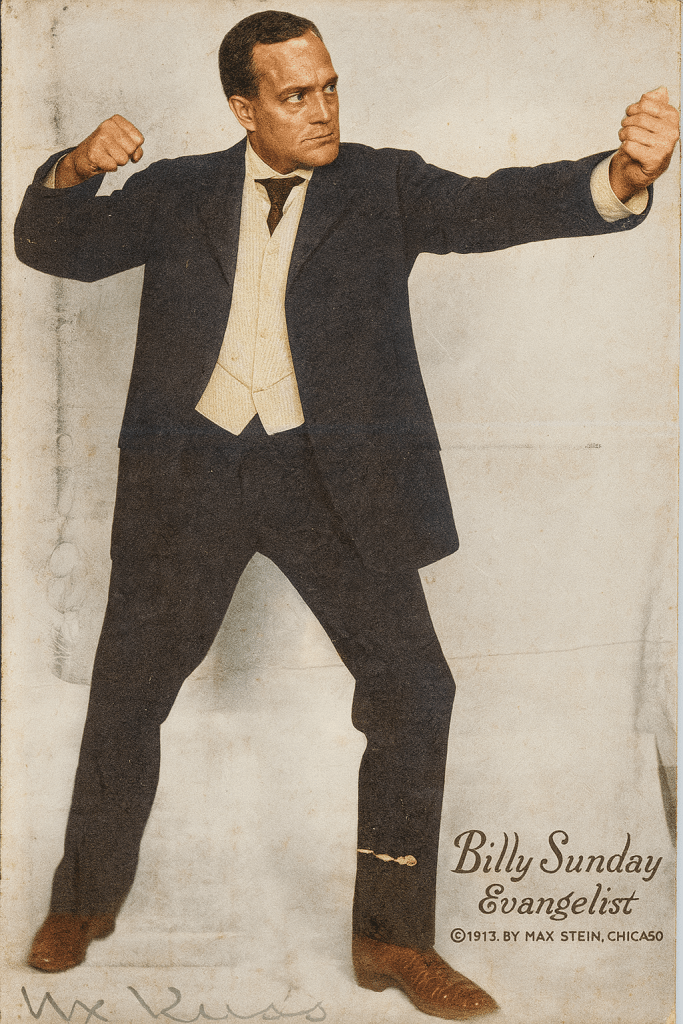
A few weeks earlier, on February 13, 1906, the Freeport Journal-Standard had published a photograph. It showed a clean-shaven man in his early forties wearing a dark suit, looking just past the camera with the slightly unfocused expression that early-twentieth-century professional portraits always required. It was the first professional photograph of Billy Sunday to appear in a newspaper.

A photograph in print, in 1906, meant something different than it does now. Printing technology was just becoming able to reproduce photographs in regional newspapers at workable cost. To have your photograph carried — not a sketch, not an engraving, but an actual halftone reproduction — meant your name had reached a tier where readers would recognize the face and where the paper thought running the picture would help sell copies. Sunday had reached that tier.

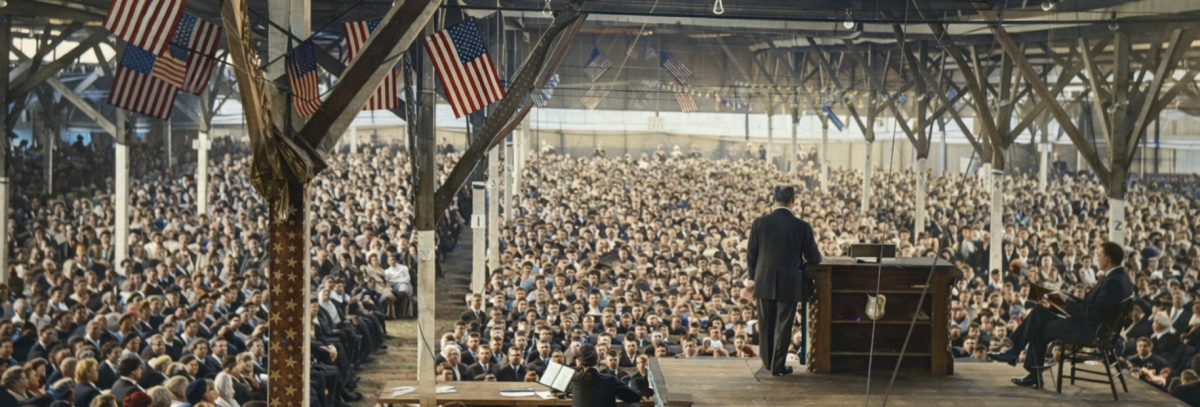
The photograph appeared while he was in the middle of a four-week revival at Princeton, Illinois — a small town in Bureau County where he was preaching in a temporary tabernacle that held thirty-six hundred. By the time the Princeton campaign closed in mid-March, over two thousand people had come forward as converts. The local U.B. pastor, a visiting minister from Freeport, told the papers the town was “aflame with the revival spirit.” Another eyewitness called Sunday “a storm, a whirlwind, a cyclone, hurricane, a tornado, a — well, everything indicative of power.”

The highest paid evangelist in America

By the end of March, the Princeton campaign had produced something else: a headline. On March 30, 1906, the Bureau County Tribune ran a piece under the title “Billy Sunday the Highest Paid Evangelist in America.” It was the first time that phrase had appeared in print about Sunday. It would not be the last.

The article tried to make the math human. Since October of 1905, the paper said, Sunday had earned an average of two dollars and sixteen cents per convert. The number sounded almost comical when laid out that way — pennies and dimes per soul saved — but the implication was clear. Sunday was running an evangelistic ministry that produced consistent measurable output for predictable cost. The towns where he held his campaigns understood it. The papers understood it. And, increasingly, the bookings reflected it.

Sometime in the early months of 1906, a Chicago-area booking manager named H.M. Holbrook formalized what had been an informal summer schedule the year before. Holbrook announced he had “exclusive rights to Billy Sunday” and would place him as the headline attraction at seven Chautauquas that summer: Belvidere, Sterling, Freeport, Sycamore, Janesville, Sandwich, and Valparaiso, Indiana. The Chautauqua decade was officially organized.

Prophetstown

In June Sunday took his summer revival to Prophetstown, Illinois — a small town of about twelve hundred people served by exactly three churches. The campaign ran four weeks and produced over seven hundred conversions. By any honest accounting, more than half the town walked down an aisle.

The numbers are the kind that defy plausibility until you remember what a small-town revival in 1906 actually looked like. Sunday preached against evolution under the title “Evolution a Sham” — the formal naming of a sermon he had been delivering in less polished form since at least Rockford in 1904. He preached against dance, against card playing, against the local saloons. People came in from twenty miles in every direction. The Sterling Standard carried sermon-by-sermon coverage. The numbers grew from a few hundred conversions in the first week to over seven hundred by the end of June.

Sunday’s purse at Prophetstown was about twenty-three hundred dollars. The town’s three churches reorganized to absorb the new members. The local saloons reported almost no business during the revival weeks. The pattern was now mature, repeating, and exportable.

The Chautauqua summer

The 1906 summer Chautauqua run took Sunday across the upper Midwest at a pace that would have broken most preachers. Belvidere on June 22 to a crowd of eight thousand. Globe Park in Freeport on July 8, where Sunday spoke twice in a single day and the local paper said his afternoon sermon was the best he had ever preached there. Jacksonville on July 15, where his single talk raised five thousand dollars for the local YMCA that had recently closed its doors. Janesville on July 29 to four thousand listeners. A handful of other Iowa and Illinois Chautauquas in early August. Sycamore on August 26, where he spoke twice and the local paper made sure to note that Sunday had posed for an imprinted postcard now in circulation as a souvenir.

The pattern that had only been a hypothesis a year earlier — that Sunday could sustain crowds across a multi-week Chautauqua circuit using a small rotation of well-tested sermons — was now an established fact. The Baseball sermon anchored most of the dates. “Nuts for Skeptics” made its first documented appearance at Muscatine in early August. The two-sermon Chautauqua rotation that would carry Sunday through 1907 was beginning to take shape.

Salida in the snow

In September Sunday went west again. The Salida, Colorado revival ran through October — five weeks in a mountain town at altitude. The campaign drew six hundred converts. It also drew weather. The tabernacle tent collapsed under early snow. The October 3 and 4 services moved indoors to a local church. The closing night service had to be moved a second time, to a four-hundred-seat opera house far too small for the crowd that wanted to attend.

Sunday’s closing services at Salida included an unusual range of subjects. He preached a eulogy of Abraham Lincoln. He delivered a tribute to President Theodore Roosevelt. And he closed with one of the moral admonitions he liked best: “Read good books and keep good company. Every gambler and drunkard became so by imitating the gang he went with.”

Kewanee, twice

The fall return brought Sunday to Kewanee, Illinois for a six-week revival in a new local armory — a venue large enough to handle the crowds that an earlier tent could not. Twenty-seven hundred and sixty-eight converts. Four hundred and five of those came forward on the closing night. Sunday’s purse came in at five thousand dollars — by far his largest revival purse to date.

Four days after the revival ended, Sunday returned to Kewanee for a single Chautauqua talk. The offering for that single talk was five thousand, three hundred dollars — more than he had been paid for the entire six-week revival. The Richmond-Item carried the figure on December 6. It was the kind of number that did not exist in the Sunday archive a year earlier and that would, from this point on, become routine.

The story of the two Kewanee engagements told you everything you needed to know about where Sunday’s career was going. The revival was the old model — multi-week, slow-building, institution-deepening, expensive in time and emotional capital. The Chautauqua was the new model — one talk, one offering, the same money or better. Sunday could no longer pretend he was not paying attention to the difference.

Worthington in the cold

December brought Sunday to Worthington, Minnesota for what would be his last revival of 1906 and his first of 1907. The Advance-Herald summed up the man and his methods with a single arresting metaphor: “His sermons are a bombardment having the rapidity of the gatling gun and the force of the big 12-inch rifle.”

More than a thousand converts came forward across the five weeks. The temporary tabernacle, ninety feet by a hundred and fifty, accommodated thousands. Sunday’s musical director Fred Fischer ran the music. A tabernacle caretaker named Siebert kept the building in shape. The Sunday operation was small — still just a handful of people moving from town to town — but it was now durable enough that the team had names that appeared in newspaper accounts of the campaign.

What changed

Most years in Billy Sunday’s pre-1910 career can be understood as gradual shifts. 1906 is the exception. By the time the year was over, four things had changed permanently.

Helen Sunday was on the road. The single most consequential change of the year, and arguably of his entire career. The ministry was no longer just Billy.

The first professional photograph existed. Sunday now had a public face. Postcards bearing his image were beginning to circulate as souvenirs. He was no longer a name in a newspaper. He was a recognizable person.

The Chautauqua circuit was formally organized. Holbrook’s seven-site bookings turned what had been a flexible summer experiment into a contracted commercial operation. The booking bureau model would shape the next four years of Sunday’s life.

The Chautauqua money had become a serious rival to the revival money. The Kewanee comparison — one Chautauqua talk that paid more than a six-week revival — was the moment Sunday could no longer ignore. The economics were starting to point at a different shape of ministry. By the summer of 1907, he would deliver more than eighty Chautauqua lectures in a single season, and the gravitational center of his career would shift away from the tabernacle and toward the platform.

In some ways 1906 was Sunday’s last year of the old life. The revivals were still the dominant form. The campaigns still ran four to six weeks. The team was still small enough to fit in a single railway car. By the summer of 1907 the picture would already be different. By 1909 the picture would be barely recognizable from this one.

But in 1906 Helen got on the train. And once she was on the train, everything else was a matter of time.

How to cite this post

Chicago: McNutt, Kraig. “The Year Helen Sunday Packed Her Bags: 1906.” Evangelist Billy Sunday (1862–1935), June 13, 2026. https://evangelistbillysunday.com/2026/06/13/the-year-helen-sunday-packed-her-bags-1906/.
MLA: McNutt, Kraig. “The Year Helen Sunday Packed Her Bags: 1906.” Evangelist Billy Sunday (1862–1935), 13 June 2026, evangelistbillysunday.com/2026/06/13/the-year-helen-sunday-packed-her-bags-1906/.

APA: McNutt, K. (2026, June 13). The year Helen Sunday packed her bags: 1906. Evangelist Billy Sunday (1862–1935). https://evangelistbillysunday.com/2026/06/13/the-year-helen-sunday-packed-her-bags-1906/

Turabian: McNutt, Kraig. “The Year Helen Sunday Packed Her Bags: 1906.” Evangelist Billy Sunday (1862–1935). June 13, 2026. https://evangelistbillysunday.com/2026/06/13/the-year-helen-sunday-packed-her-bags-1906/.

When “Ma” Sunday Called Them Forward, c.1915

Ma Sunday in Omaha, c. 1915

There are moments in the Sunday campaigns that feel almost hidden in the shadow of Billy’s larger-than-life presence—but when you find them, they reveal something just as powerful.

One such moment came during a women-only meeting led by “Ma” Sunday.

The tabernacle was full—some 6,000 to 7,000 gathered—but this was a different kind of service. No booming theatrics. No sawdust-charged bravado. Instead, there was a quieter, deeply personal appeal.

And when she called them forward, 115 women and girls rose and walked the aisle.

A Different Kind of “Trail-Hitting”

The newspapers called it a “replica” of Billy’s famous trail-hitting—but it wasn’t quite the same.

There was a tenderness to it. And, at first, a bit of confusion.

Many of the women thought they were simply going forward to greet Mrs. Sunday—to shake her hand, to thank her, to meet her. They came quickly, almost instinctively, forming what one observer described as a “bee-line” down the aisle.

It took a firm voice from Mrs. Asher, one of the Sunday team, to steady the moment:

This is not a reception line. This is for those who want to be saved.

And just like that, the tone shifted.


Faces in the Crowd

The reports linger on the people—and that’s where the story lives.

A housemaid, still in her work attire, came forward and clasped Mrs. Sunday’s hand, covering it with kisses.

A weeping mother walked the aisle with her small son, alongside her grown daughter.

Two young girls, barely ten years old, came arm in arm.

High school girls stepped forward carrying their school pennants.

Even the choir—singing hymn after hymn—was visibly moved, some of them weeping as they sang.

This wasn’t spectacle. It was personal, family-bound, deeply human.


Her Message: Personal Service

If Billy Sunday’s sermons often thundered, Ma Sunday’s message pressed inward.

She didn’t just call women to come forward—she called them to act.

  • Make a prayer list.
  • Win at least one person to Christ.
  • Take responsibility for the spiritual lives around you.

Her appeal was practical, almost methodical—but never cold. It was rooted in experience, shaped by her own life, and delivered with a kind of plainspoken honesty.

At one point, she reflected on her upbringing—rigid, formal, spiritually lifeless—and contrasted it with her determination to move forward anyway:

I was going to bust.

It’s the kind of line that doesn’t sound polished—but it lands.


Tears—and Resolve

Perhaps the most telling moment came when she addressed women with unsaved husbands and children.

Many of them broke down.

The article notes they wept bitterly.

This wasn’t abstract theology. This was eternity pressing into the home.

And Ma Sunday didn’t leave it there. She pointed them toward action, toward prayer, toward persistence.

She even set her sights on the next gathering—calling for a packed house of mothers and grandmothers, marked by a simple white flower.


The Broader Picture

What we see here is something easy to miss if we focus only on Billy:

The Sunday campaigns were not a one-man operation.

They were a network of voices, and Ma Sunday’s was essential—especially among women. Her meetings didn’t mirror Billy’s so much as complement them.

Where he confronted, she invited.
Where he thundered, she persuaded.
Where he called for decision, she called for ongoing service.

And in doing so, she mobilized an entire segment of the revival that might otherwise have remained on the margins.


Final Reflection

In the end, the numbers—115 responding—tell only part of the story.

What matters more is what those women carried home with them:

  • A renewed sense of responsibility
  • A burden for their families
  • A call to personal witness

Ma Sunday didn’t just ask them to walk an aisle.

She asked them to live differently when they walked back out.

And for many of them, that’s where the real revival began.

Source: The Omaha Daily Bee, Sept 20, 1915:1

‘MA’ DOES MUCH TO HELP ‘PA’ IN HIS LABOR

Mrs. William A. Sunday always denies the statement so often and so lovingly made by her son, George, also of the party, that she is the ‘boss’ of the Sunday campaign, but that doesn’t do away with the fact that it was largely through her efforts that the wonderful system of the Sunday’s has been developed.

Along with her many charming feminine qualities Mrs. Sunday is a woman of unusual executive ability, and her keen ability to see the needs and apply the remedies required in work of this kind has made possible the plans whereby the campaigns are made so effective.

‘Do you not relieve Mr. Sunday many tasks, of seeing people, of making plans and of deciding questions concerning the work,’ Mrs. Sunday was asked.

‘Oh, Yes, we all give him as much help as we can, but in the last analysis it is ‘papa’ who decides, and we, of course, do all that I can in this line.’

It has even been said by people who ought to know that Mrs. Sunday frequently suggests phrases for some of his sermons, and also the subjects. This is what she says about that:

‘When I go around with ‘papa’ I don’t just sit and look about, but I think and plan. I frequently see things which might be of use to ‘papa’ and I tell him about them. He is always welcome to all that I have to give him, to every suggestion I can make.’

Besides the work which Mr. and Mrs. Sunday are doing and which they both consider ‘God’s work,’ the nearest thing to Mrs. Sunday’s heart is her home. Her children are very dear to her. By reason of campaigns held in cities far from their home in Winona Lake, Mr. and Mrs. Sunday see little of their children during the nine months when they are doing evangelistic work.

‘I make it a point to go back home two or three days at a time, just to be where we are at home,’ Mrs. Sunday declares. ‘One of my greatest sorrows is the fact that my boys must grow up without the direct influence of Mr. Sunday and myself.’

‘Do you ever feel unhappy about leaving home to begin a new campaign,’ Mrs. Sunday was asked.

‘Yes, we both feel that way sometimes, but the thought that this is the greatest work which we could be given to do, helps us. For several days before we leave home, however, Mr. Sunday is completely broken up, and frequently is unable to eat.’

The Sundays do not grudge the sacrifice that they give, but instead they enter into the work with vim and with an intense desire to ‘live up to what God expects them to do,’ as they express it.

Paul, the eight year old son of the Sundays, who broke an ankle while playing football in the autumn, has recovered and is back at school and back too at his favorite sports.

In a very different way, Mrs. Sunday has just as great getting powers as her husband and when she addresses a group of women her sincere manner, her definite message and her wide-awake methods win the immediate attention of her audience.

‘Ma’ has her trail hitters too, and when she extends the invitation to the women to accept Christ and to lead Christian lives many are eager to shake her hand and to promise better living in the future.

It is an interesting life that Mr. and Mrs. Sunday have led ever since they were married out in Chicago years ago. For two years after their marriage ‘Billy’ played ball but he finally gave that up to do permanent work in the Y. M. C. A., in which he had been working in the winter months. Soon after that he became assistant for Dr. Wilbur Chapman and upon the retirement of that evangelist from active revival work Mr. Sunday conducted revival services in towns outside of Chicago.

Since then he has been in revival work.

Mrs. Sunday was formerly Miss Helen Thompson, one of four daughters of pioneer Chicago business men. Before her marriage she was interested in the church and was an active worker and since that time she has always assisted Mr. Sunday in God’s work.

Cited from a period 1915 newspaper

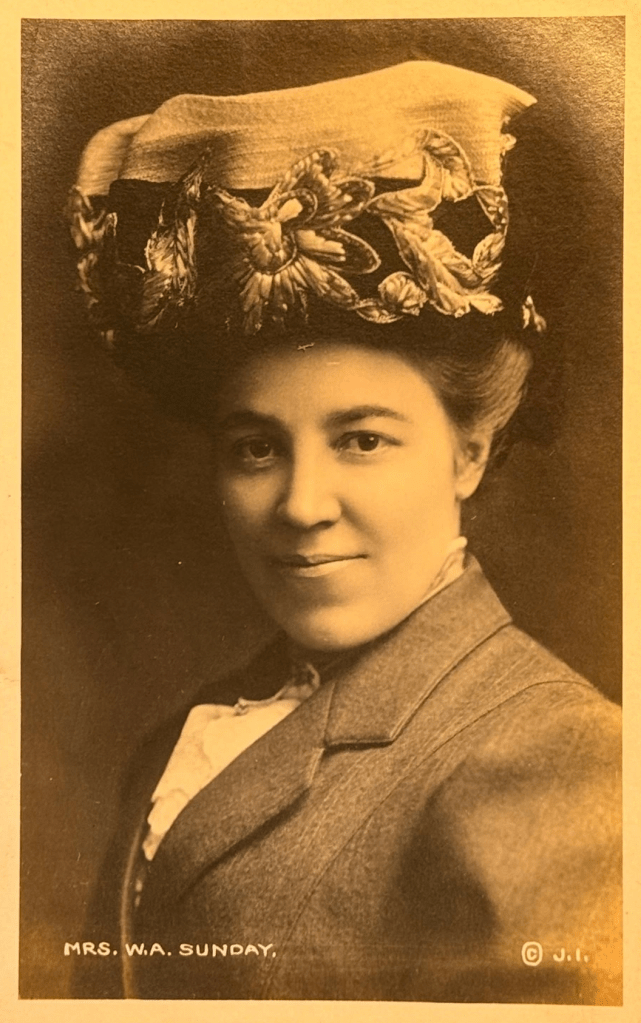
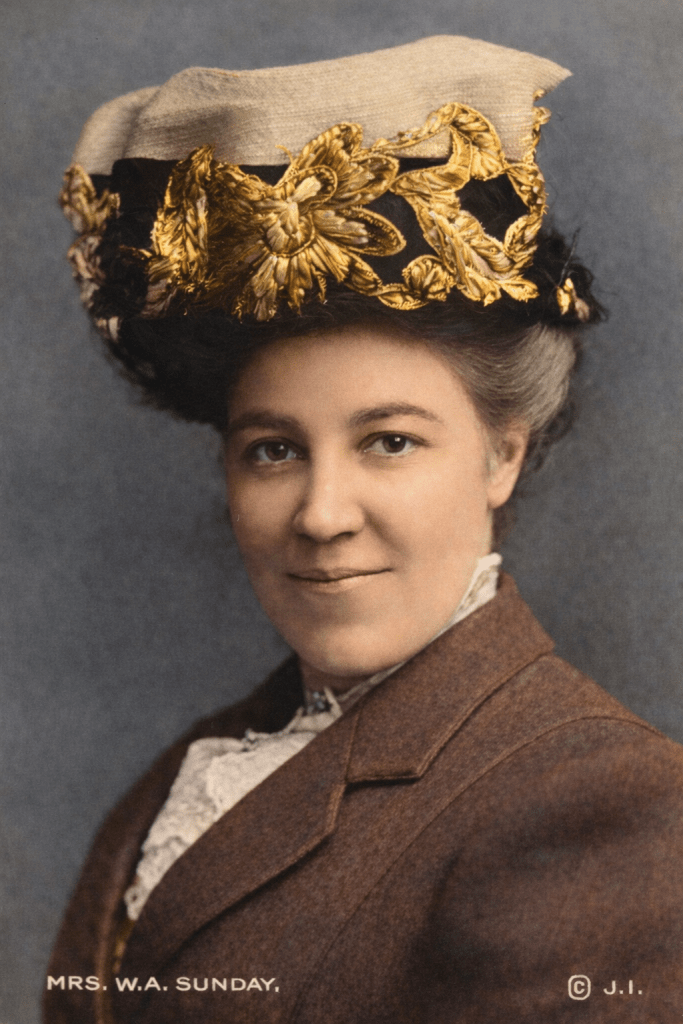
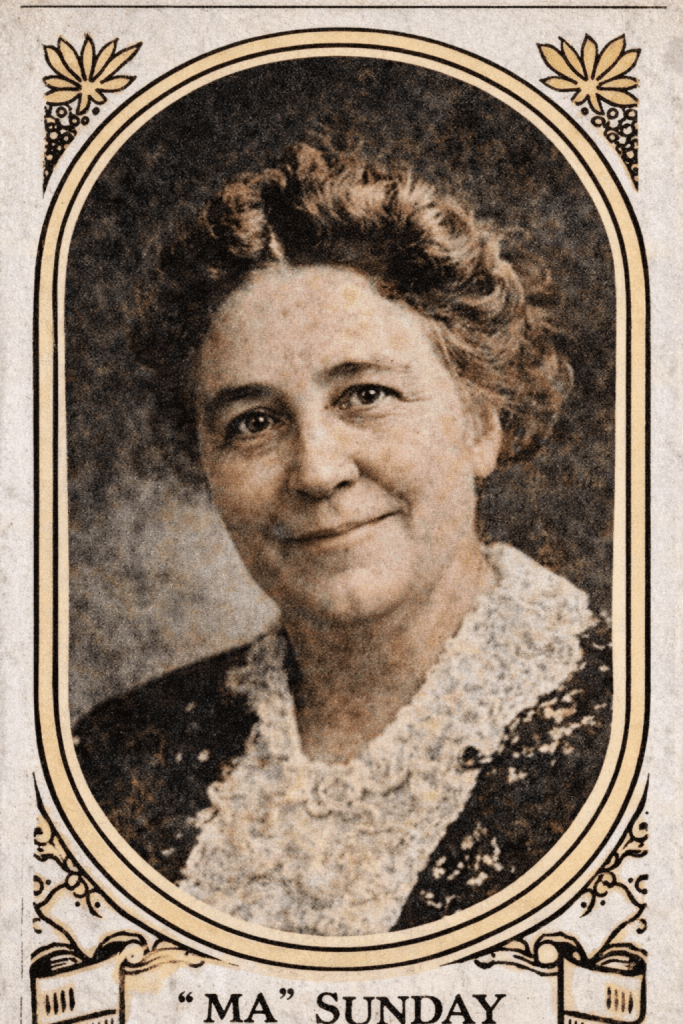
Who is Hellen ‘Ma’ Sunday? c. 1909

The following is a biographical sketch of Helen Sunday, wife of Billy Sunday. Part of the 1909 Springfield campaign souvenir.

Mrs. W. A. Sunday

THE biographer who omits to study the wife of his subject certainly will miss the key to his problem of investigation. The world talks of the influence of the mothers upon its men; but it, curiously enough, generally omits appreciation of the strong influence of the wife upon any man; and perhaps more men have been made and unmade by their wives than by their mothers, when heredity is omitted from the matter.

Mrs. William A. Sunday was a girl of great strength of character when she was Miss Helen A. Thompson, the daughter of a Chicago business man. She married a famous baseball player and found herself the wife of one of the greatest of evangelists—and she not only made the revolutionary change with him but is one of the chief causes of William A. Sunday being what he is in the eyes of the world. She was a church worker, a shining exception to the rule of the results of marrying a man to make him better. She upheld the hands of her husband when he was in poverty and the poorly paid worker of the Chicago Y.M.C.A., writing letters declining, for seven times his salary, to return to the baseball field. When William A. Sunday was starting out as an evangelist along entirely new lines of endeavor which merged into In his entirely unprecedented lines of achievement, his wife helped greatly to keep up his courage, keep him along the line he had chosen, and keep him as much as possible free from worries. Mrs. Sunday complements her husband perfectly—they are not at all similar, and she is strongest where he is weakest and weakest where he is strongest. If he had a helpmeet like himself, Mr. Sunday might be plunging into hot water every month and every year. Luckily for him, his wife guides him around and over most obstacles, keeps his fingers out of the fire, and does what Mr. Sunday never thinks of doing—looks after his own interests.

The wedding of Mr. and Mrs. William A. Sunday was not the kind one finds pictured in Paul and Virginia by any manner of means; it was a twentieth-century marriage of two distinct individuals joining as helpmeets, without either submerging a personality in the other—certainly not the old kind of entire submergence of the wife in the husband. They disagree about as many things as other people do, but each knows in what things the other is best informed or strongest, and the one best qualified always decides the question. The result is that they are more free from actual, important disagreements—the kind called love spats or marital troubles—than most people. This is a match of brains as well as of hearts, of sense as well as of souls, and of respect as well as of love.

Mrs. Sunday does what she can in public during a series of meetings conducted by her husband, but the most important thing she does is to keep her husband able to do the great things he accomplishes in every city in which he works. She is a perfect wife for a very remarkable man.

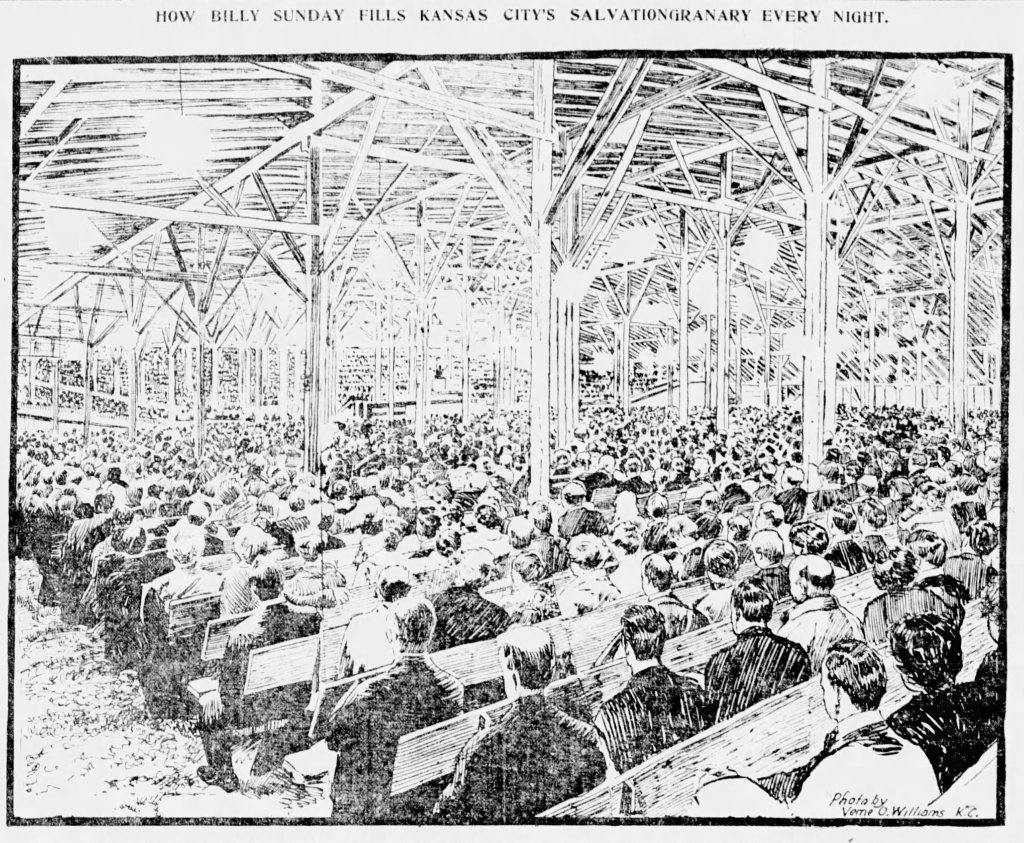
“Ma Sunday” Takes the Pulpit in Kansas City (1916)

During the 1916 revival campaign of Billy Sunday in Kansas City, one of the most striking moments came when the evangelist’s wife, Helen Amelia Thompson Sunday—known widely as “Ma Sunday”—took the pulpit herself.

A report in the The Kansas City Star described her address as unmistakably in the style of her famous husband: energetic, blunt, and deeply challenging to church members.

The newspaper noted that Kansas City audiences had not heard her preach before, but the reaction was immediate. Speaking rapidly and with confidence, she quoted Scripture freely, used expressive gestures, and even thumped the pulpit for emphasis.

By the end of her half-hour address, the reporter observed, “she was perspiring freely,” a familiar description for anyone who had watched Billy Sunday preach.

Her message was aimed squarely at professing Christians, not skeptics or outsiders. She criticized believers whose lives contradicted their testimony.

“The professed Christian who forgets his vows every time a joy ride is offered… is a liar—she said liar—every time testimonials are called for.”

Like her husband, Ma Sunday believed revival depended not only on converting sinners but also on awakening the church. In her view, too many Christians expected evangelists to do the spiritual work while they remained passive.

“Don’t you think that we are going to carry the load and let you sit back and say, ‘I hope you have a good meeting.’”

Instead, she challenged church members to take personal responsibility for the spread of the gospel. Her message emphasized the role of ordinary believers as witnesses for Christ.

She even offered a striking calculation:

“If every church member would win one person to God a year in twenty-five years the world would be saved.”

But she also warned that careless Christian living could damage the church’s influence.

“The church member who proves himself a liar every time he testifies is more harm than good to the church.”

At one point she posed a simple question to the audience: how many people were praying for others? Only a few hands rose. Yet when she asked how many were professed Christians, nearly every hand went up. The contrast, she implied, revealed the problem.

Another theme in her address was the temptation of worldly distractions. She criticized believers who treated recreation as more important than spiritual discipline.

“Lots of Christians forget every time they have a chance to go joy riding.”

Her solution was straightforward: prayer and active participation in the revival effort.

“Get a prayer list… I don’t mean to show around and talk about, but to pray for.”

She also defended the unusual style of her husband’s ministry. Critics often accused Billy Sunday of being theatrical or unconventional. Ma Sunday reminded her listeners that religious leaders throughout the Bible had often acted outside ordinary expectations.

“The Pharisees tried to trip up Jesus for doing things out of the ordinary… Mr. Sunday has lots of authority for doing things out of the ordinary.”

Her address illustrated an important aspect of the Sunday revival campaigns: they were family efforts. While Billy Sunday delivered the dramatic evening sermons, Ma Sunday frequently reinforced the message by speaking directly to believers about prayer, personal responsibility, and spiritual integrity.

In Kansas City that spring of 1916, the newspaper report made one thing clear. The revival was not powered by one voice alone.

Ma Sunday had her own message—and she delivered it with the same urgency and conviction that had made the Sunday campaigns famous across America.

The Kansas City Star. May 9, 1916:4.

Billy Sunday family c. 1902

This image was likely take around 1902 because the oldest boy, George was born in 1892. He looks around 8-9 years old here. The other child must be Billy, Jr., born in 1901. The older woman is Helen’s mother. I colorized the image.

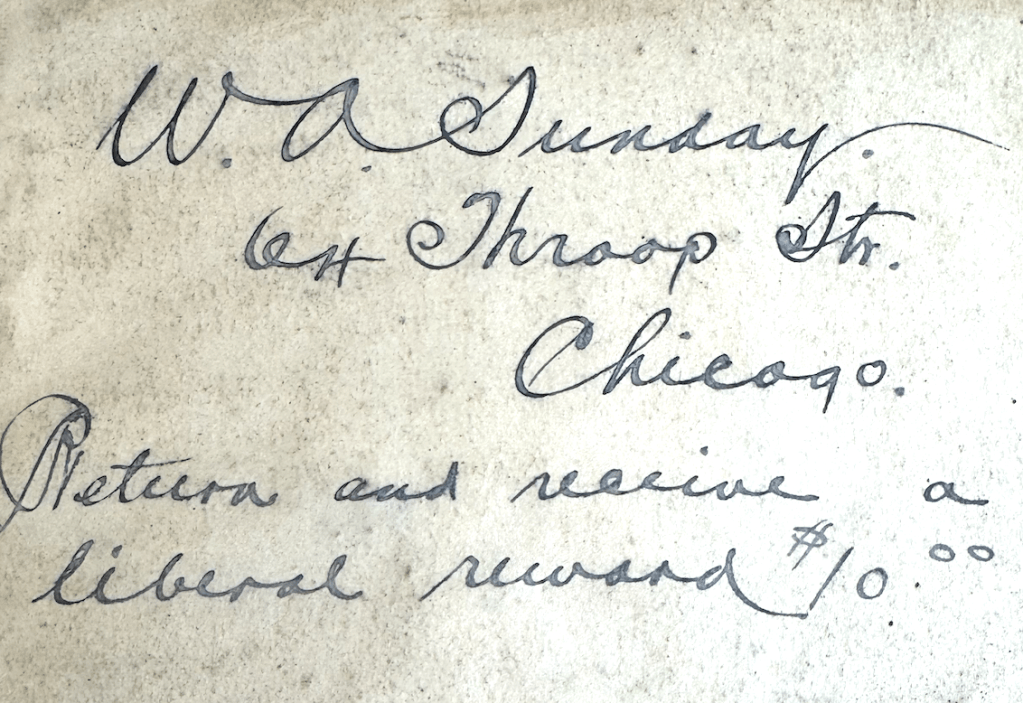
Circa 1890s notebook belonging to Billy

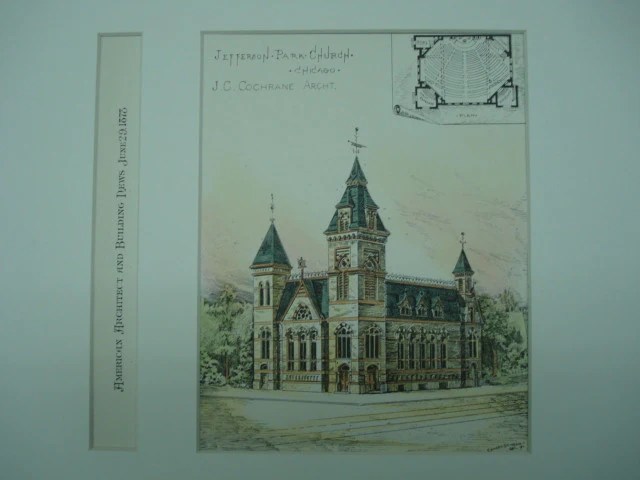
Morgan Library at Grace College has a wonderful artifact that appears to be a notebook with various (mostly) handwritten notes, undoubetdly by Billy himself, that resemble the raw materials and resources Billy used in his earliest ministry days, perhaps as early as the 1890s. It is chalked full with handwritten notes, stats, illustrations, and what appears to be outlines for messages. It is personally inscribed by W.A. Sunday with an address of 64 Throop St. Chicago. The address is interesting because across the street from the home (now gone) is Jefferson Park Church (see Bruns:47).

This Google Earth views shows the site of the previous Park Jefferson Church (8-story red building today). 64 Throop would have been right across today, where a long distribution or warehouse sits today.

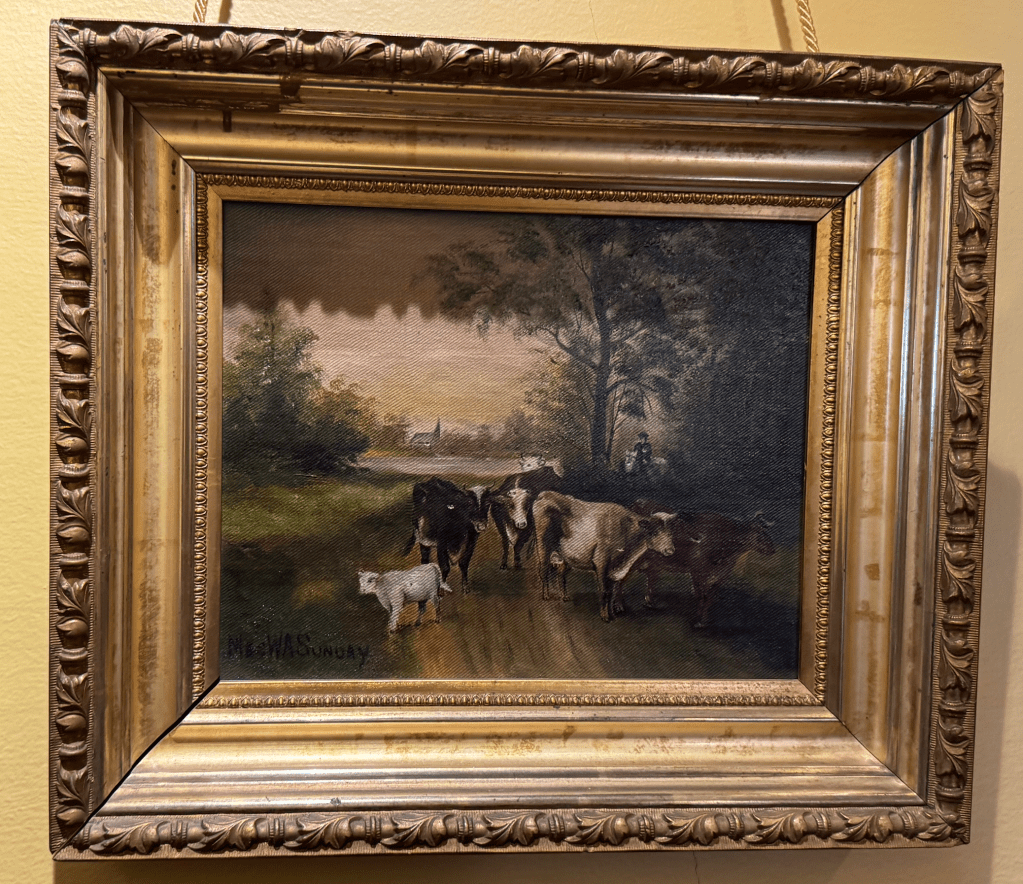
Helen ‘Ma’ Sunday liked to paint

Several paintings by Ma Sunday (Billy’s wife) hang in their former home in Winona Lake. Many of her subjects were landscapes and animals.

Permission granted by the Winona Lake History Center.