Former professional baseball player-turned urban evangelist. Follow this daily blog that chronicles the life and ministry of revivalist preacher William Ashley "Billy" Sunday (1862-1935)
Seventh in a series drawn from Lindsay Denison’s profile of Billy Sunday in The American Magazine, September 1907.
By the final Sunday of the Fairfield revival, Billy Sunday had already brought nearly nine hundred people to a public profession of faith — more than any of the town’s ministers had believed possible. It would have been a triumph to stop there. Sunday had no intention of stopping. Lindsay Denison describes him on that last day as gripped by a fierce, almost savage zeal to gather in everyone still outside the fold.
What followed was, in Denison’s words, an unforgettable experience — and it makes the emotional climax of this whole series.
Three services in one day
Sunday’s custom was to preach three times on his final Sunday. The first, at half past ten in the morning, was open to all. The third, at night, was for everybody. In between came an afternoon service for men only — while Mrs. Sunday or one of the other helpers held a parallel meeting for women in one of the churches.
The men’s meeting, Denison thought, was in one sense the most impressive of the three. Much of the Fairfield company of the state militia sat on the platform in full uniform, many of them already Sunday converts. A great block of seats held the workmen of the Iowa Malleable Iron Works. The Odd Fellows, the Red Men, and the Woodmen filled reserved sections. The big barn-like room was packed wall to wall, with hundreds of men standing in the aisles.
The subject was “Booze.”
The banker who went first
When Sunday finished — whispering directions all the while to Honeywell about clearing the front benches to receive converts — he threw out the challenge: who would be the first to stand up for God and lead the way?
The answer came in a figure no one could miss. One of the town’s leading bankers rose and strode down the aisle, head erect and eyes shining, and behind him came farmers, storekeepers, lawyers, physicians, farm boys, and laborers. Sunday leaned far out over the edge of the platform, swaying his arms rhythmically as if to sweep the entire congregation forward with him, while the ministers and personal workers moved through the rows laboring with those still in doubt. Eighty men were converted in that single afternoon meeting.
The effect reached past the tabernacle walls. The next day, the agents of the two express companies had to report that three barrels of beer consigned to Fairfield citizens were refused on delivery — and in the “remarks” column of their paperwork, they noted the cause plainly: the influence of Sunday’s sermons.
A town that couldn’t get in
The crowds began gathering for the night meeting almost as soon as the men’s meeting let out, a little after four o’clock — though the evening service would not begin until half past six. By six, long streams of disappointed people were already tramping back downtown through the rain, having failed to get close enough even to hear Sunday’s voice.
Inside, the air itself seemed to tingle. Sunday, hoarse from a week of open-air preaching in the surrounding towns, could at times barely raise more than a husky whisper — yet every syllable carried. He spoke of how doubting parents and hesitating children might save one another, of the double blessing that came to anyone who brought a loved one out of the darkness, and, above all, of the nearness of death.
His text was a single word: To-morrow.
The veil and the coffin
The closing was vintage Sunday — fear wielded with terrible precision. To-night, he told them, when the last song was sung and the lights switched off and the tabernacle stood dark, the sinner’s chance would be gone. To-morrow, he warned, the doctor’s buggy might be standing at your gate, the family gathered with handkerchiefs to their eyes, the doctor turning to say, “He is gone.” Borrowing a line from the evangelist Moody, he pictured the unrepentant carried off as a corpse without Christ, in a coffin without Christ, to a grave without Christ. If only God would draw back the veil between a man and his own coffin, Sunday cried, he would leap back in horror to find it within arm’s reach. But you say “To-morrow.”
Then came the appeal, and the slow hypnotic sweep of his arms out over the benches. They came from every direction — girls and old women, gray-bearded veterans and schoolboys in their first long trousers, rich men and poor. Honeywell and the Rev. Mr. Cole ran up the aisles with arms outstretched to welcome them, while Sunday reached down to take each hand and give his blessing and the choir glided from hymn to hymn, sometimes humming, sometimes shouting in triumph.
The picture that stayed
Denison confesses that the reporters stopped taking notes. Everyone in the room was on his feet; some were standing on the tables. And out of the whole turmoil, he says, one small picture stood clear.
Fred Seibert had broken through the crowd at the back, dragging by the collar a weak-faced, loose-lipped boy — shambling along shamefaced but not unwilling. Sunday clapped him on the back; Honeywell settled him three rows from the front. Then, from a far corner on the left, came a muffled scream. A shabbily dressed girl came crowding out into the aisle and ran forward, tears streaming down her face, her hat knocked askew and her red hair hanging loose over her shoulder. She barely touched Sunday’s hand. She ran to the third bench, threw herself on the boy’s shoulder, wrapped her arms around his neck, and hid her face against his. She was still there, motionless, when a shout from another corner announced one more soul won.
Denison had seen college football celebrations, the riots of joy after a Yale–Harvard boat race, a famous New York district attorney’s election-night headquarters. He had never, he wrote, seen a crowd more beside itself than the Fairfield tabernacle that night.
The noise was formless until Fischer took hold of it and shaped it. There were a hundred surges toward the platform and Billy Sunday; people kept calling for three cheers for him. And when the final tally was announced — 1,118 Fairfield souls won from the Devil for Christ — it seemed, Denison wrote, as though the very roof were tugging at its rafters.
Next in the series: What 1907 Tells Us About the Rise of Billy Sunday — a closing reflection.
A Pennsylvania steel-valley revival, a lawsuit over his own sermons, a deaf interpreter, and the summer Billy stopped being just a Midwesterner.
A Pennsylvania steel-valley revival, a lawsuit over his own sermons, a deaf interpreter, and the summer Billy stopped being just a Midwesterner.
On a Friday in May of 1908, Billy Sunday stepped off a train in Sharon, Pennsylvania — a steel-mill town in the Shenango Valley along the Ohio border, eighty miles north of Pittsburgh. He had never preached this far east before. Every revival of his career up to that point had been in Iowa, Illinois, Indiana, Minnesota, Missouri, or one of the closer western states. The Sharon campaign was something new: a seven-week revival in a Pennsylvania industrial valley, and the first real test of whether the Sunday revival method would translate beyond the small Midwestern county-seat towns where he had built it.
By the time he left Sharon in late June, nearly five thousand people had come forward as converts. The campaign had drawn more than fourteen thousand dollars in offerings. A new mission was pledged for the city. And Sunday had given up the Chautauqua circuit for half the summer to make it work. The New Castle Herald, on the second day of the campaign, had already named the thing that mattered:
He has stirred up enthusiasm that has never before been evidenced in this town.
It was a quiet observation, written by a small-paper reporter who had no way of knowing that Sharon was the first piece of a much larger pivot. But the eastern industrial cities were where Sunday’s mature career would unfold. Sharon was the rehearsal.
Bloomington opens the year
The year began at Bloomington, Illinois — a town of about twenty thousand people in central Illinois. The campaign had been organized so thoroughly that the local committee opened the tabernacle on December 26, 1907, three days before Sunday himself arrived. When he stepped onto the platform on Sunday morning the twenty-ninth, three thousand people were already waiting, and they greeted him with what the Muscatine Journal called “the Chautauqua salute” — a waving of white handkerchiefs across the auditorium. It was the first time the gesture had been used to welcome him at a revival, but it would not be the last.
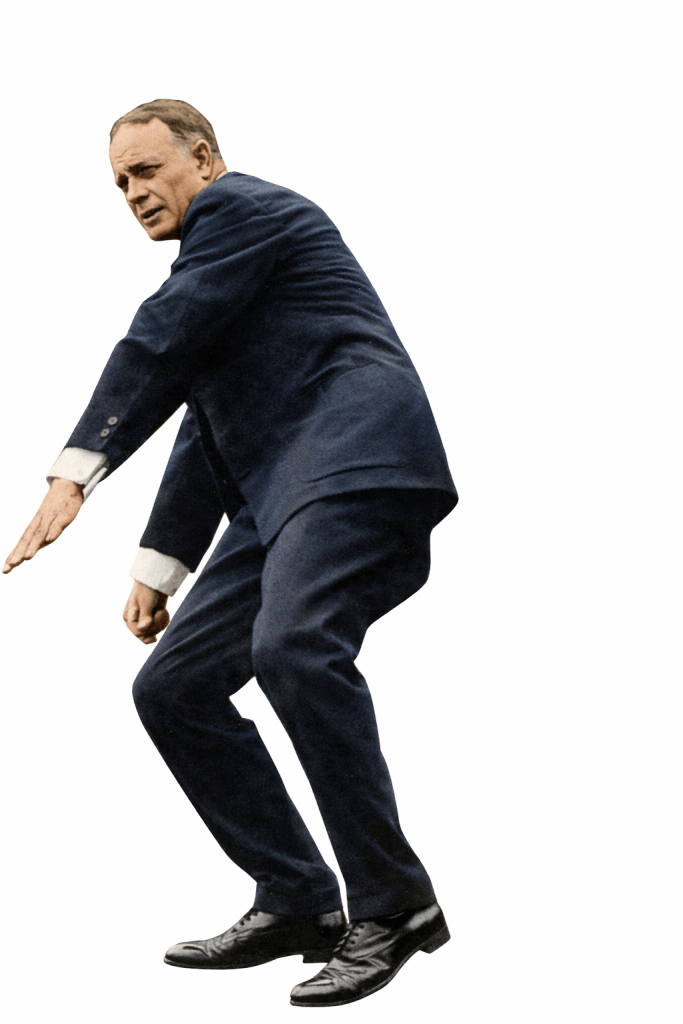
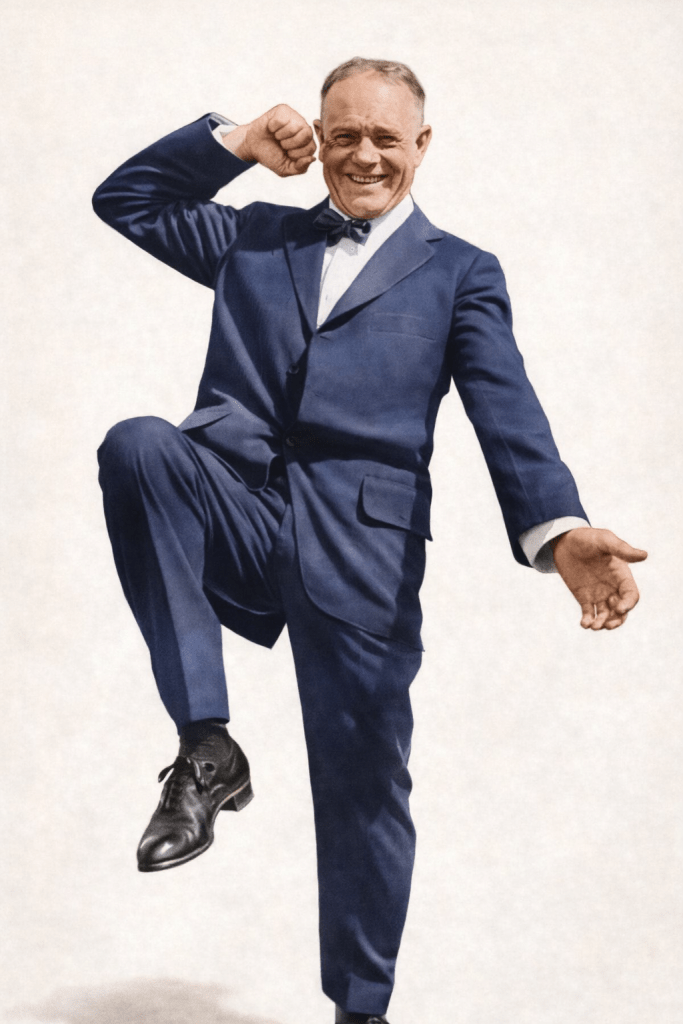
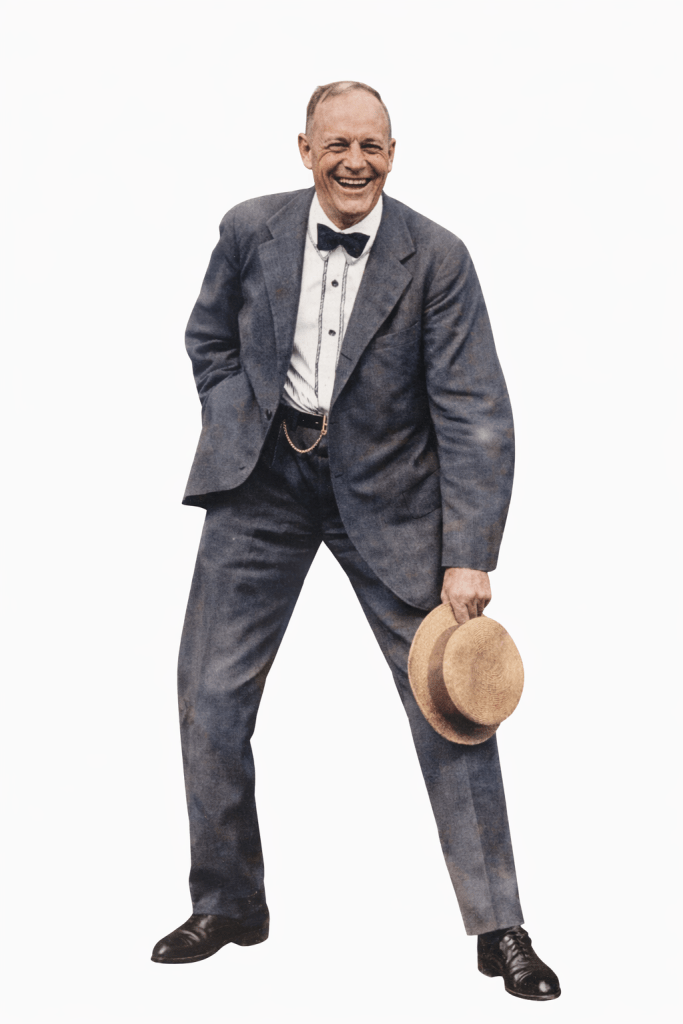
Colorized version of a 1908 Bloomington image. Billy Sunday in action.
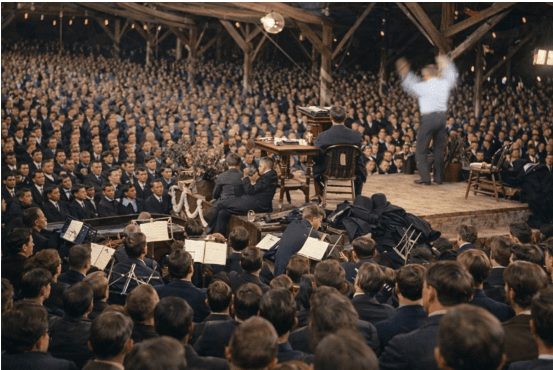
Eleven thousand people attended his three services that opening Sunday. Forty-five hundred came to the morning meeting alone. A five-hundred-voice choir carried the music. By the time the campaign closed five and a half weeks later, more than four thousand of those who had come had walked down the aisle as converts. Sunday’s purse came in at $7,773.19 — by some margin the largest revival purse of his career to date. And Helen, by now a fixture on the road with him, was preaching her own Sunday afternoon meetings to fourteen hundred women at the Second Presbyterian Church.
The closing sermon was titled “Always Be Ready to Give an Answer,” taken from First Peter chapter three. It would, in the months to come, become one of the most-printed sermons of Sunday’s career.
Decatur and the printed sermons
Sunday moved directly from Bloomington to Decatur, Illinois — another central Illinois town, this one with a population of about thirty-one thousand. The campaign ran for five and a half weeks, from early February into mid-March, probably in a temporary tabernacle erected inside Decatur’s Fairview Park. By the end of it, more than six thousand people had come forward as converts. Sunday’s purse came in at over eleven thousand dollars — surpassing the Bloomington record set just weeks earlier.
But the Decatur revival had a wrinkle that the contemporary papers found themselves writing about for months afterward. The Decatur Herald — a local newspaper — had been running Sunday’s sermons in print throughout the campaign. After Sunday left town, a Decatur printing concern collected those newspaper transcriptions and published them as a book. The book sold. Sunday had not authorized it.
He spent the next several months trying to stop the publication and, when he could not, decided to buy the copyright outright. The story finally surfaced publicly in September. According to the Freeport Daily Bulletin of September 5, Sunday paid the Decatur printing concern thirty-five hundred dollars for full possession of the copyright to his own sermons.
It was the kind of transaction that did not exist in the world of itinerant revivalism before 1908. Most evangelists were happy to have their sermons reprinted anywhere they could be reprinted. Sunday had decided, by the middle of his Pennsylvania campaign, that his sermons were worth more controlled than free. By later that year his own publishing operation was issuing sermon manuscripts under titles like “What Shall the End Be,” “The Three Groups,” and “The Moral Leper” — small printed pamphlets carrying the formal byline “William Ashley Sunday.” Sunday had become, alongside everything else, a publishing concern.
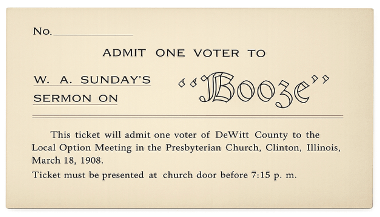
A March ticket for the Booze sermon
On Wednesday, March 18, 1908, Sunday made the short trip from Decatur to Clinton, Iowa for a single evening engagement at the local Presbyterian Church. The occasion was a local-option meeting — a temperance vote that DeWitt County voters would soon be asked to weigh in on. Sunday’s contribution was a single sermon, his now-famous “Booze.” The local committee printed numbered tickets in cream paper.
The phrasing made the political stakes plain. The sermon was a campaign event. The audience was specifically registered DeWitt County voters. The doors closed at 7:15 sharp. Sunday’s “Booze” sermon — already by 1908 a fixture of his Chautauqua repertoire — was being deployed as direct political advocacy on the eve of a temperance referendum. The line between revival preacher and political organizer, never very thick in Sunday’s career, had just become almost invisible.
Charleston and the deaf interpreter
After Clinton, Sunday spent the rest of March and most of April at Charleston, Illinois — another central Illinois revival, five weeks in a four-thousand-seat tabernacle that drew twenty-five hundred conversions and around two hundred and twenty thousand cumulative attendees. His purse came in at fifty-five hundred dollars. The Decatur Herald and Review called it “the greatest religious awakening that Charleston has ever known and one of the greatest revivals that has ever taken place in Illinois.” On the final night, the crowd refused to leave the tabernacle even after Sunday had gone home — the Herald reporter watched them stand around the platform “trying to shake the great minister’s hand for the last time.”
The Charleston campaign also produced one of the most quietly moving details in the entire 1908 record, though it would not make it into print until the next year’s Springfield souvenir booklet. A Charleston-based teacher at the State School for the Deaf, Professor Frank Reed Jr., had begun attending Sunday’s services with a delegation of deaf students. Reed stood up in the audience and signed Sunday’s sermons to the deaf attendees in real time. The visual rhythms of Reed’s interpretation became, for the hearing audience around him, almost a parallel performance.
Prof. Reed stood up and repeated to the mutes just what Mr. Sunday said, and it was a very unique and interesting sight to watch the movements and gestures of the interpreter. He would enter into the spirit of Mr. Sunday’s discourse… The expression on the faces of the mutes would brighten up as he said something amusing.
Between thirty and forty deaf attendees converted across that campaign and the Springfield campaign that followed in 1909. At the offering, when the deaf delegation contributed ten dollars, Sunday paused his sermon to address it from the platform: “If men who could not hear a word of what I say were contributing to this extent, what ought some of you fellows down there do who hear it all?”
Sharon, Pennsylvania
The eastward turn began on May 1, 1908. Sunday opened a seven-week revival in Sharon, Pennsylvania — a steel-mill town in the Shenango Valley along the Ohio border. The decision to take the Sharon engagement cost him most of his usual Chautauqua summer income, and the Sunday camp itself flagged this in a margin note: “this revival eliminated Billy’s opportunity to supplement his income from chautauquas; a significant diversion for several years.”
Sunday was forty-five years old. The Chautauqua circuit had been paying him more than forty thousand dollars in summers by now. He had announced the previous August that he was going to cut back on the platform work. And now he was choosing, for the first time, to forgo a major piece of the summer revenue in order to preach a long campaign in a place he had never been. The Sharon decision was the first time Sunday’s revival ambitions clearly outweighed his Chautauqua income. It would not be the last.
The Sharon campaign drew nearly five thousand converts. The freewill offering for Sunday came in at $6,448.45, with total collected offerings reaching over fourteen thousand dollars. A new local mission was pledged. The local New Castle Herald, in its earliest coverage, captured what Sharon was seeing for the first time:
His eccentric methods of delivering the gospel and his homely statements have hit their mark and today everybody in Sharon is talking of Billy Sunday, the old-time baseball player.
Sunday had stepped outside his Midwestern comfort zone and found a Pennsylvania industrial city that responded to him the same way Iowa farm towns did. The early evidence said the Sunday method traveled. The full proof would come in the urban tabernacle campaigns of the 1910s. But the test case was Sharon.
A compressed Chautauqua summer
Sunday returned to the platform circuit at the end of June for a sharply truncated summer. He had less than two months. He still managed to deliver Chautauqua talks at more than twenty different sites across Illinois, Iowa, Indiana, Ohio, Michigan, Missouri, and Pennsylvania. The four-sermon rotation that had crystallized the previous year carried him: “Get on the Water Wagon,” “Forces That Win,” “The Devil’s Boomerang,” and “Nuts for Skeptics to Crack.”
A few stops stood out. On August 9 at Patterson Springs, Illinois — declared “Billy Sunday Day” by the local committee — ten thousand people came to hear his “Booze” sermon. Helen was with him. Sunday was in real physical pain from what he described to reporters as a “carbuncle,” and he and Helen left town on the 7:30 a.m. train the next morning, exhausted. At Coshocton, Ohio on July 31, he was paid two hundred and fifty dollars for a two-hour talk and fifteen hundred people came to hear it. At Clarinda, Iowa on August 6, he spoke at a brand-new ten-thousand-dollar steel auditorium that held over four thousand. He stayed long enough afterward to umpire a baseball game.
Lincoln Chautauqua in Macon County, Illinois on August 15 produced one of the strangest preserved artifacts of Sunday’s middle period: a newspaper advertisement showing him in a head-and-shoulders portrait with his arms crossed, captioned “Meet Me At Lincoln Chautauqua: Saturday Afternoon, Billy Sunday.” It is, as much as anything in the 1908 archive, the moment when the Sunday brand became a commercial graphic asset that booking committees were placing in regional papers to sell admission.
Jacksonville and the G.A.R. veterans
Sunday’s fall return brought him to Jacksonville, Illinois for a six-week revival running from late September through early November. The campaign drew over twenty-five hundred converts and a freewill offering for Sunday of $7,279. By mid-October, more than 131,000 people had already attended services. The campaign was strong enough that multiple regional papers covered the closing service, repeating the same figures back and forth across the state.
From the Jacksonville pulpit Sunday delivered one of the tribute lines that the Freeport Daily Journal would reprint in November and that would become characteristic of his entire later career — a deliberate appeal to Civil War veterans of the Grand Army of the Republic:
If there are any public favors to be shown, are any offices to be filled, I want you young fellows to stand back and make room for the gray-haired veterans of the sixties. I want you to understand that there is but one piece of jewelry to which Billy Sunday takes off his hat, and that is the bronze button worn by the Grand Army of the Republic.
In 1908 the Civil War was still living memory for half the people in Sunday’s audiences. The Civil War veterans were now in their late sixties and early seventies — Sunday himself was forty-five — and were still organized in active local G.A.R. chapters in nearly every Northern town. Sunday’s tribute to them was both deeply felt and shrewdly calculated. The line traveled. The Freeport paper printed it. Other papers picked it up. And it remained one of the signature Sunday quotes for the rest of his life.
Ottumwa and the skin-flint complaint
The year ended at Ottumwa, Iowa. Six weeks in the local opera house, from early November through mid-December. Thirty-five hundred conversions. Sunday’s purse came in at seven thousand dollars.
The Ottumwa campaign also produced a moment of public criticism that the Minnesota New Ulm Review later reprinted, and that captures the kind of opposition Sunday now drew everywhere he went. The complaint, attributed to an unnamed correspondent in Ottumwa before Sunday’s arrival, ran like this:
Sunday’s skin-flint brand of religion is a money-getter to the sorrow of many a town. Let’s make Ottumwa the exception. Sunday uses his religion as his method of hypnotizing people, for he knows that in the heat of religious fervor people will give up money when you can’t get it from them in any other way. So, he uses religion.
It was the kind of complaint that had been following Sunday since the Charles City Herald editorial of 1907 had called him “a sideshow to the Chautauqua.” By 1908 it was a familiar pattern: regional papers running detailed positive coverage of his revivals; other regional papers running pointed editorial criticism that questioned his methods, his motives, and especially his money. Sunday rarely responded publicly to either. He just kept moving.
What 1908 changed
If the easy story of Billy Sunday’s career runs “small-town revivalist becomes big-city evangelist in the 1910s,” 1908 is the year where the move starts. Four things changed.
The eastern pivot. Sharon was the first sustained revival east of Ohio. He gave up half a summer of Chautauqua money to make it work. The Sunday method, transplanted to a Pennsylvania steel valley, performed exactly the way it had performed in the Iowa river towns. The proof of concept was now in hand.
The published sermon library. By the end of 1908, Sunday was operating a small publishing concern that issued sermon manuscripts under his own byline. The Decatur lawsuit had been the catalyst. The lesson was that his sermons had become an intellectual-property asset worth defending, and one that could carry his voice into towns where he himself would never preach.
The Helen Sunday women’s ministry. Helen’s Bloomington women’s meetings — fourteen hundred women, gathered at Second Presbyterian, on Sunday afternoons during the main revival — were now a documented and reportable part of the Sunday operation. She was no longer just on the road with Billy. She had her own platform alongside his.
The political-religious fusion. The Clinton temperance ticket, the G.A.R. veterans tribute, the local-option organizing folded into revival sermons, the integrated approach of revival-as-civic-mobilization — these were all visible in earlier years, but in 1908 they consolidated. Sunday was now a political force in every town he visited, in addition to being a religious one. His sermons sold pamphlets, mobilized voters, and built G.A.R. constituencies all at once.
By the time Sunday left Ottumwa just before Christmas to prepare for the Spokane, Washington campaign opening on December 25 — his first revival in a city of more than a hundred thousand people — the architecture of his mature ministry was effectively in place. Eastern cities. Published sermons. Helen running her own meetings. The platform-and-pulpit double income engine. The four-sermon Chautauqua rotation. The deaf interpreter. The G.A.R. tribute. The political mobilization. The carbuncle.
Spokane was the test of whether the whole thing would scale to a real American city. The answer would arrive within six weeks. But the architecture that would carry that test had been built in 1908.
MLA: McNutt, Kraig. “The Year Billy Sunday Went East: 1908.” Evangelist Billy Sunday (1862–1935), 17 June 2026, evangelistbillysunday.com/2026/06/17/the-year-billy-sunday-went-east-1908/.
A first professional photograph, a tent under snow, and the wife of a baseball evangelist boarding the train for good.
In late March of 1906, a brief notice appeared in the Bureau County Tribune. Mrs. William A. Sunday, the wife of the well-known evangelist, had announced she would henceforth be joining her husband on the campaign trail. The notice carried her own words:
Hereafter I shall accompany my husband. I can be a great help to him, taking charge of women Bible classes, organizing girl Bible classes and giving personal care to converted persons.
It is one of the most consequential single sentences in the entire Billy Sunday archive. Helen Sunday — known to friends as “Ma” Sunday in the years to come — was, until that announcement, a Chicago-area pastor’s wife who had spent most of her married life keeping her household running while Billy traveled. From that moment on, she would be on the road with him. She would be his organizational lieutenant, his front office, his backstage manager, and ultimately the steadiest center of his entire ministry.
Without Helen, there is no Billy Sunday of American memory. The campaigns get smaller. The big-city tabernacles never happen. The Rodeheaver era never quite assembles. The household engine that powered the next thirty years of Sunday’s career was not in place yet on the morning of March 28, 1906. It was in place on the morning of March 30. The change in his career happened in the space of those two days.
A photograph in Freeport
A few weeks earlier, on February 13, 1906, the Freeport Journal-Standard had published a photograph. It showed a clean-shaven man in his early forties wearing a dark suit, looking just past the camera with the slightly unfocused expression that early-twentieth-century professional portraits always required. It was the first professional photograph of Billy Sunday to appear in a newspaper.
A photograph in print, in 1906, meant something different than it does now. Printing technology was just becoming able to reproduce photographs in regional newspapers at workable cost. To have your photograph carried — not a sketch, not an engraving, but an actual halftone reproduction — meant your name had reached a tier where readers would recognize the face and where the paper thought running the picture would help sell copies. Sunday had reached that tier.
The photograph appeared while he was in the middle of a four-week revival at Princeton, Illinois — a small town in Bureau County where he was preaching in a temporary tabernacle that held thirty-six hundred. By the time the Princeton campaign closed in mid-March, over two thousand people had come forward as converts. The local U.B. pastor, a visiting minister from Freeport, told the papers the town was “aflame with the revival spirit.” Another eyewitness called Sunday “a storm, a whirlwind, a cyclone, hurricane, a tornado, a — well, everything indicative of power.”
The highest paid evangelist in America
By the end of March, the Princeton campaign had produced something else: a headline. On March 30, 1906, the Bureau County Tribune ran a piece under the title “Billy Sunday the Highest Paid Evangelist in America.” It was the first time that phrase had appeared in print about Sunday. It would not be the last.
The article tried to make the math human. Since October of 1905, the paper said, Sunday had earned an average of two dollars and sixteen cents per convert. The number sounded almost comical when laid out that way — pennies and dimes per soul saved — but the implication was clear. Sunday was running an evangelistic ministry that produced consistent measurable output for predictable cost. The towns where he held his campaigns understood it. The papers understood it. And, increasingly, the bookings reflected it.
Sometime in the early months of 1906, a Chicago-area booking manager named H.M. Holbrook formalized what had been an informal summer schedule the year before. Holbrook announced he had “exclusive rights to Billy Sunday” and would place him as the headline attraction at seven Chautauquas that summer: Belvidere, Sterling, Freeport, Sycamore, Janesville, Sandwich, and Valparaiso, Indiana. The Chautauqua decade was officially organized.
Prophetstown
In June Sunday took his summer revival to Prophetstown, Illinois — a small town of about twelve hundred people served by exactly three churches. The campaign ran four weeks and produced over seven hundred conversions. By any honest accounting, more than half the town walked down an aisle.
The numbers are the kind that defy plausibility until you remember what a small-town revival in 1906 actually looked like. Sunday preached against evolution under the title “Evolution a Sham” — the formal naming of a sermon he had been delivering in less polished form since at least Rockford in 1904. He preached against dance, against card playing, against the local saloons. People came in from twenty miles in every direction. The Sterling Standard carried sermon-by-sermon coverage. The numbers grew from a few hundred conversions in the first week to over seven hundred by the end of June.
Sunday’s purse at Prophetstown was about twenty-three hundred dollars. The town’s three churches reorganized to absorb the new members. The local saloons reported almost no business during the revival weeks. The pattern was now mature, repeating, and exportable.
The Chautauqua summer
The 1906 summer Chautauqua run took Sunday across the upper Midwest at a pace that would have broken most preachers. Belvidere on June 22 to a crowd of eight thousand. Globe Park in Freeport on July 8, where Sunday spoke twice in a single day and the local paper said his afternoon sermon was the best he had ever preached there. Jacksonville on July 15, where his single talk raised five thousand dollars for the local YMCA that had recently closed its doors. Janesville on July 29 to four thousand listeners. A handful of other Iowa and Illinois Chautauquas in early August. Sycamore on August 26, where he spoke twice and the local paper made sure to note that Sunday had posed for an imprinted postcard now in circulation as a souvenir.
The pattern that had only been a hypothesis a year earlier — that Sunday could sustain crowds across a multi-week Chautauqua circuit using a small rotation of well-tested sermons — was now an established fact. The Baseball sermon anchored most of the dates. “Nuts for Skeptics” made its first documented appearance at Muscatine in early August. The two-sermon Chautauqua rotation that would carry Sunday through 1907 was beginning to take shape.
Salida in the snow
In September Sunday went west again. The Salida, Colorado revival ran through October — five weeks in a mountain town at altitude. The campaign drew six hundred converts. It also drew weather. The tabernacle tent collapsed under early snow. The October 3 and 4 services moved indoors to a local church. The closing night service had to be moved a second time, to a four-hundred-seat opera house far too small for the crowd that wanted to attend.
Sunday’s closing services at Salida included an unusual range of subjects. He preached a eulogy of Abraham Lincoln. He delivered a tribute to President Theodore Roosevelt. And he closed with one of the moral admonitions he liked best: “Read good books and keep good company. Every gambler and drunkard became so by imitating the gang he went with.”
Kewanee, twice
The fall return brought Sunday to Kewanee, Illinois for a six-week revival in a new local armory — a venue large enough to handle the crowds that an earlier tent could not. Twenty-seven hundred and sixty-eight converts. Four hundred and five of those came forward on the closing night. Sunday’s purse came in at five thousand dollars — by far his largest revival purse to date.
Four days after the revival ended, Sunday returned to Kewanee for a single Chautauqua talk. The offering for that single talk was five thousand, three hundred dollars — more than he had been paid for the entire six-week revival. The Richmond-Item carried the figure on December 6. It was the kind of number that did not exist in the Sunday archive a year earlier and that would, from this point on, become routine.
The story of the two Kewanee engagements told you everything you needed to know about where Sunday’s career was going. The revival was the old model — multi-week, slow-building, institution-deepening, expensive in time and emotional capital. The Chautauqua was the new model — one talk, one offering, the same money or better. Sunday could no longer pretend he was not paying attention to the difference.
Worthington in the cold
December brought Sunday to Worthington, Minnesota for what would be his last revival of 1906 and his first of 1907. The Advance-Herald summed up the man and his methods with a single arresting metaphor: “His sermons are a bombardment having the rapidity of the gatling gun and the force of the big 12-inch rifle.”
More than a thousand converts came forward across the five weeks. The temporary tabernacle, ninety feet by a hundred and fifty, accommodated thousands. Sunday’s musical director Fred Fischer ran the music. A tabernacle caretaker named Siebert kept the building in shape. The Sunday operation was small — still just a handful of people moving from town to town — but it was now durable enough that the team had names that appeared in newspaper accounts of the campaign.
What changed
Most years in Billy Sunday’s pre-1910 career can be understood as gradual shifts. 1906 is the exception. By the time the year was over, four things had changed permanently.
Helen Sunday was on the road. The single most consequential change of the year, and arguably of his entire career. The ministry was no longer just Billy.
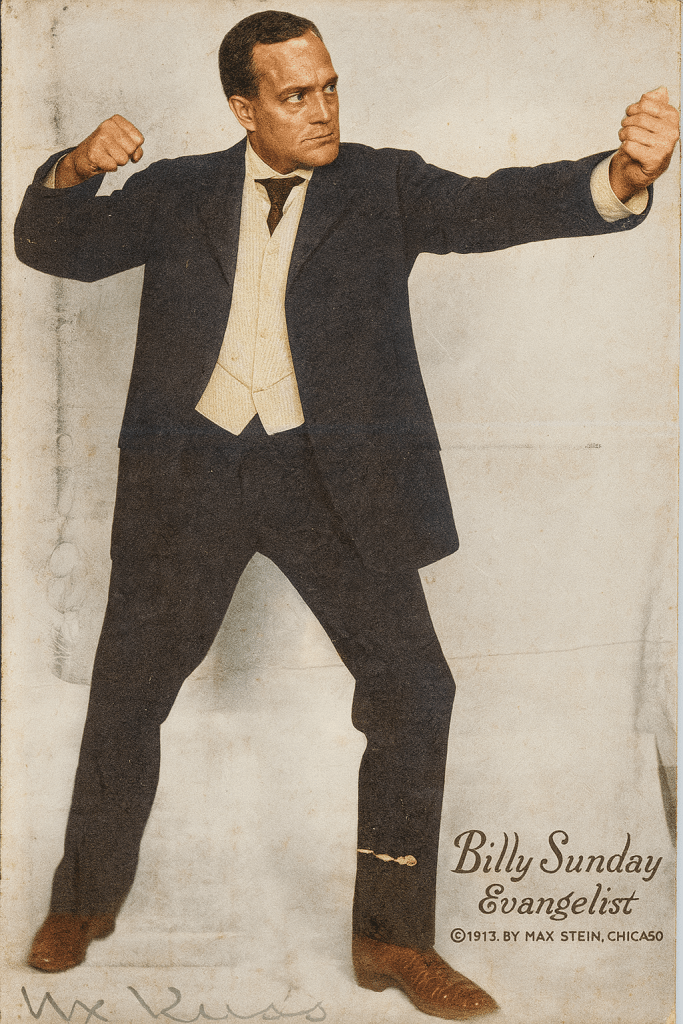
The first professional photograph existed. Sunday now had a public face. Postcards bearing his image were beginning to circulate as souvenirs. He was no longer a name in a newspaper. He was a recognizable person.
The Chautauqua circuit was formally organized. Holbrook’s seven-site bookings turned what had been a flexible summer experiment into a contracted commercial operation. The booking bureau model would shape the next four years of Sunday’s life.
The Chautauqua money had become a serious rival to the revival money. The Kewanee comparison — one Chautauqua talk that paid more than a six-week revival — was the moment Sunday could no longer ignore. The economics were starting to point at a different shape of ministry. By the summer of 1907, he would deliver more than eighty Chautauqua lectures in a single season, and the gravitational center of his career would shift away from the tabernacle and toward the platform.
In some ways 1906 was Sunday’s last year of the old life. The revivals were still the dominant form. The campaigns still ran four to six weeks. The team was still small enough to fit in a single railway car. By the summer of 1907 the picture would already be different. By 1909 the picture would be barely recognizable from this one.
But in 1906 Helen got on the train. And once she was on the train, everything else was a matter of time.
MLA: McNutt, Kraig. “The Year Helen Sunday Packed Her Bags: 1906.” Evangelist Billy Sunday (1862–1935), 13 June 2026, evangelistbillysunday.com/2026/06/13/the-year-helen-sunday-packed-her-bags-1906/.
I had been reading Billy Sunday’s sermons for months — the atonement, the heaven imagery, the careful anti-moralism arguments — and I thought I had a reasonable handle on the man. Earnest. Urgent. Theologically sharper than his reputation. Then I hit a passage where he turned on his critics, and I actually laughed out loud in my study.
“You little two-by-four whisky-soaked fellows who can’t earn $10 a week and turn up your nose at religion. It is beneath you to be a Christian. It would lower your manhood. You are a fool.”
That’s not pastoral. That’s not even particularly civil. That is a man who has been called a vulgarian so many times that he has decided to demonstrate exactly what vulgarity looks like when it is aimed at the right target. And his critics — the educated, the respectable, the comfortably pewed — were exactly the right target.
The criticism of Sunday’s language is old and persistent. He talked like a street fighter. He invented words (“foolosopher” remains my personal favorite — philosophy plus fool, a portmanteau that dismisses two thousand years of Western skepticism in four syllables). He called Napoleon, Caesar, and Hannibal “old ginks who used to juggle power and men’s lives.” He described a wife-beater as “whisky-soaked, hog-jowled, weasel-eyed, pug-gut.” He told an old infidel that his ideas could go “to perdition.” He rendered the newsboy’s voice in four consecutive street slang terms without pausing for a breath.
The critics heard all of this and said: undignified. Unbecoming. Unworthy of a pulpit.
They were not entirely wrong. I’ll get to that.
But they were mostly wrong. And the way they were mostly wrong is the more interesting story.
What the Criticism Gets Right
There are moments — I counted them carefully across forty-five sermons — where Sunday reaches for a contempt word in a place where an argument should have gone. When he calls the participants of the 1893 Parliament of Religions “mutts like Hindus, followers of Zoroaster,” he is not engaging with religious pluralism. He is dismissing it. The slang is doing the work the reasoning should do, and the reasoning is absent.
That is a real weakness. The book I’m writing will name it without flinching.
There is also a genuine risk when the compound insult strings get long enough to become funny. “Whisky-soaked, hog-jowled, weasel-eyed, pug-gut” is objectively hilarious. And a sentence that makes the congregation laugh at the image may not be making them feel the gravity behind it. When the rhetoric is entertaining enough to applaud, it is sometimes too entertaining to convict.
Fair point. Conceded. Moving on.
What the Criticism Gets Wrong — Which Is Most of It
Here is what I kept noticing as I worked through the transcripts: Sunday’s slang has a targeting system. The compound insult strings are almost never aimed at the repentant, the struggling, or the socially marginal. They are aimed at the powerful who abuse the vulnerable, at false systems dressed in religious clothing, and at the self-righteous who use respectability as a hedge against grace.
The “whisky-soaked, hog-jowled, weasel-eyed, pug-gut” compound? Applied to a man beating his wife and children while invoking his personal liberty. The contempt tracks the abuse. Sunday’s critics — themselves largely comfortable professionals — heard the language as a class issue. The primary sources suggest it was a moral issue.
Then there is the street dialogue, which his critics consistently conflated with Sunday’s own voice. When the Chicago newsboy delivers four authentic period slang terms in four lines — “Aw, gwan with you, you big mutt” / “not on your tintype” / “Boss, I’m from Missouri, come across with the dough” — Sunday is not preaching in slang. He is reproducing a voice. Any novelist would claim the same distinction. Sunday had been a YMCA street worker in Chicago. He knew what newsboys sounded like. That precision is not vulgarity. It is observation disciplined into art.
And here is the thing about “foolosopher” that I want the critics to reckon with: it is not Sunday’s substitute for an argument against philosophical skepticism. It is the verdict at the end of an argument he has already made — a careful working-through of the internal contradictions of Enlightenment rationalism. The slang is the conclusion. Critics who read it without the preceding argument are reading a partial text and declaring a whole verdict. That is not criticism. That is a setup.
The Critics Themselves
This is where it gets interesting to me personally.
The people who criticized Sunday’s language most loudly were almost entirely drawn from the educated professional class and liberal Protestant clergy — the same people Sunday called out for preaching “deodorized, disinfected sermons” that had removed everything offensive from the gospel, including the offence of the gospel itself.
They heard “foolosopher” and “hog-jowled” from a pulpit and called it vulgarity. Of course they did. Their entire formation had taught them that elevated subjects require elevated language.
Sunday’s actual audiences — factory workers, railroad employees, domestic servants, immigrants still learning English — heard something entirely different. They heard recognition. The street slang was not a barrier between them and the theological content. It was the door through which the content entered.
Sunday was not preaching to the educated class and failing. He was preaching to everyone else and succeeding. That distinction matters enormously when you are evaluating whether a rhetorical choice was a failure of decorum or a brilliant act of pastoral intelligence.
The Passage I Can’t Shake
In “I Find No Fault in Him,” Sunday paraphrases Matthew 23 — Jesus’ scorched-earth denunciation of the Pharisees — in period vernacular:
“You miserable old lobster. You’re a fine bunch of guys, the way you skin widows. You sanctimonious rascals, you’re like a sepulchre — nice outside, but inside rotten. The whole bunch of you ought to be in jail.”
Every time I read that I think two things simultaneously. First: that is reckless. Second: that is exactly right.
Matthew 23 is not a pastoral nuance passage. It is white-hot prophetic fury directed at religious respectability weaponized against vulnerable people. Most formal translations preserve the dignity of the target along with the words of the rebuke. Sunday’s vernacular strips the dignity away — which is, arguably, precisely what Jesus was doing.
Is that good homiletics? I’m genuinely not settled on it. What I’m settled on is this: it is not a failure of register. It is a translation decision. And the question worth arguing about is not whether Billy Sunday talked like that — he clearly did — but whether talking like that was, for his specific audience in his specific moment, an act of faithful proclamation.
The trail responses documented across his campaigns suggest it was.
Billy Sunday talked like that. And the people he was talking to — not the critics in the press gallery, but the people in the seats — heard him.
Cited in: The Philadelphia Evening Ledger. January 5, 1915:5. – William Rader
Billy Sunday is not easily defined. Power conceals its secret. Psychologists would call it hypnotism; theologians, the power of the spirit; the ethical teacher, the gift of truth; the dramatist, the art of the player; while others declare:
His strength is as the strength of ten, Because his heart is pure.
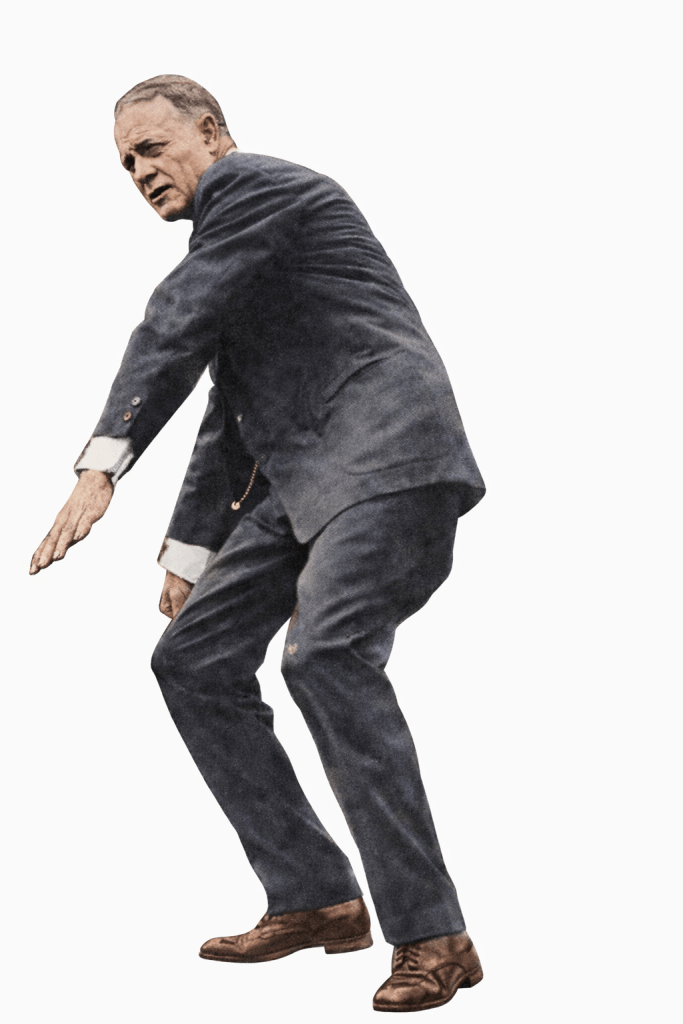
Billy Sunday is a good actor. Each sermon is carefully prepared, and some of it read from manuscript. Certain climaxes are illustrated. At one point he slides to a base; at another, kneels, or leaps upon the pulpit desk, or smashes a chair to pieces. Edward Everett did not more carefully prepare a speech with its proper gestures than does this evangelist build his sermons. The local color with which he decorates his main thought is taken from the city in which he speaks.
His imagination interested me. Speaking on “The Grenadier,” the consideration of his theme invited the use of the imagination, and he gave it full play. The sermon was an application of military attributes to practical life, a rebuke to the “wind-jammer” of the prayer meeting, and an appeal to the man who has taken an oath to be good to go out and honor it. He assailed the “saphead” who criticises the Church, and the description he gave of Daniel in the lion’s den and of the head of John the Baptist on a charger will not be forgotten.
I confess to a liking for his so-called slang. Most of it is plain English with a punch in it. It is the punch which preachers and editors and people who use words generally lack. Words are like shot, made to strike, and especially when used to influence great bodies of people. It is refreshing to hear a man say what he thinks and say it as he pleases—a thing most public men signally fail to do.
Cited in: The Evening Public Ledger. January 5, 1915: 5.
“What is a revival? Now listen to me. A revival does two things. First, it returns the church from her backsliding; and, second, it causes the conversion of men and women; and it always includes the conviction of sin on the part of the church. What a spell the devil seems to cast over the church today!
“I suppose the people here are pretty fair representatives of the church of God, and if everybody did what you do there would never be a revival. Suppose I did no more than you do, then no people would ever be converted through my efforts; I would fold my arms and rust out. A revival helps to bring the unsaved to Jesus Christ.
“God Almighty never intended that the devil should triumph over the church. He never intended that the saloons should walk roughshod over Christianity. And if you think that anybody is going to frighten me, you don’t know me yet.
“I will cram it down their throats in this town for the miserable lies they hurl against me up and down the streets of this city. Don’t you forget it. You bet your life. You bet, and they will get it.
“When is a revival needed? When the individuals are careless and unconcerned. If the church was down on her face in prayer they would be more concerned with the fellow outside. The church has degenerated into a third-rate amusement joint with religion left out.
“When is a revival needed? When carelessness and unconcern keep the people asleep. It is must the duty of the church to awaken and work and labor for the men and women of this city as it is the duty of the fire department to arouse when the call sounds. What would you think of the fire department of Philadelphia if it slept while the town burned? You would condemn it and I will condemn you if you sleep and let men and women go to hell. It is just as much your business to be awake. The church of God is asleep today; it is turned into a dormitory, and has taken the devil’s opiates.”
In the fall of 1915, Nebraska found itself hosting two of the largest public gatherings in its history.
One was expected. The other was not.
In Lincoln, the Nebraska State Fair was in full swing. Newspaper headlines called it “the greatest ever held.” Despite rain and poor weather early in the week, crowds poured through the gates. By the time it ended, total attendance reached 180,767—a record-setting year. The fairgrounds were packed with machinery exhibits, livestock judging, aerial shows, wrestling matches, and the familiar buzz of a state coming together for its biggest annual spectacle.
It was, by every measure, a success.
But sixty miles away, something far more remarkable was unfolding.
In Omaha, a temporary wooden tabernacle had been erected for evangelist Billy Sunday. There were no rides. No prize livestock. No grandstand attractions. Just sawdust, benches, a pulpit—and a preacher.
Yet by the time Sunday’s campaign ended, the numbers told a different story.
The revival recorded approximately 930,000 total attendees across its six weeks of meetings. Of those, nearly 795,000 passed through the tabernacle itself. More than 13,000 people walked the “sawdust trail,” publicly declaring their decision for Christ.
Let that sink in.
The largest civic event in the state drew just over 180,000 people in a week. Billy Sunday’s revival drew over five times that number (in six weeks total).
The 1915 Omaha Billy Sunday revival, bookstore.
And it wasn’t confined to a single venue or moment. The revival spread throughout the city:
Over 2,100 cottage prayer meetings during the campaign
Tens of thousands attending women’s meetings, Bible classes, and noon gatherings
Business leaders, factory workers, students, and families all pulled into its orbit
This was not simply a series of sermons. It was a citywide movement.
The contrast is striking. The State Fair represented the best of Nebraska’s agriculture, industry, and entertainment. It was planned, promoted, and expected to succeed.
Sunday’s revival, on the other hand, was built on something less tangible but far more powerful—a shared spiritual hunger that transcended social boundaries.
For a brief moment in 1915, Omaha became the epicenter of something larger than spectacle. Larger than tradition. Larger even than the state’s greatest annual event.
The fairgrounds would empty. The tabernacle would be torn down.
But for those who were there, the memory remained:
A season when the crowds came—not for entertainment—but for transformation.
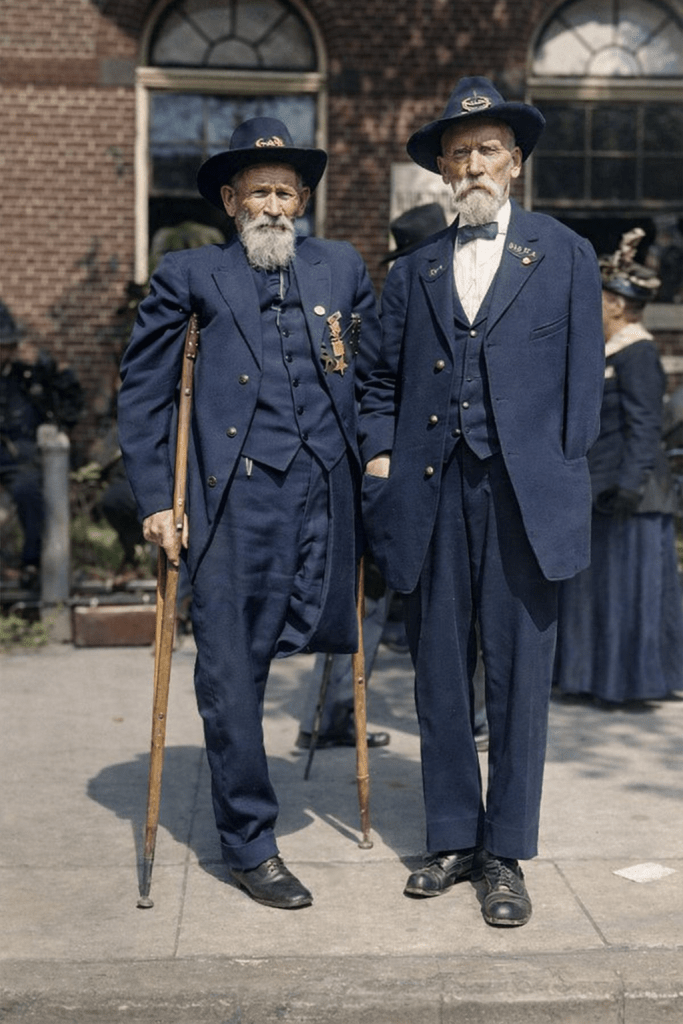
During Billy Sunday’s great revival in Baltimore in the spring of 1916, one evening at the tabernacle took on a distinctly historic tone. The sawdust aisles—normally filled with businessmen, laborers, and curious citizens—were suddenly occupied by a different kind of procession. A body of Union veterans of the Civil War, many gray with age but still proud of their service, marched forward together into the meeting.
1915 Civil War veterans, source unknown
According to the Baltimore Sun, nearly 500 veterans of the Grand Army of the Republic (GAR) attended the revival that night. The GAR, the powerful national organization of Union veterans, was still an important presence in American civic life in the early twentieth century. Though the war had ended more than fifty years earlier, the men who had fought to preserve the Union remained symbols of sacrifice and national memory.
The veterans were led by James E. Van Sant, commander of the Maryland Department of the GAR, along with E. R. Monfort of Iowa, who at the time served as Commander-in-Chief of the national organization. When they entered the tabernacle they were warmly received, and the crowd greeted them with enthusiastic applause.
The occasion had the character of both a patriotic ceremony and a revival meeting. The veterans arrived with a brass band, and when the musicians began to play familiar airs the audience responded with equal fervor. The strains of “Maryland, My Maryland” and “The Star-Spangled Banner” rang through the building, followed by old martial tunes such as “Yankee Doodle” and “Dixie.” The building reportedly shook with applause as the music echoed beneath the great wooden roof of the tabernacle.
The veterans also presented Billy Sunday with a gift—a ceremonial Old Glory mounted on an elaborately wrought brass standard. It was a gesture that connected the evangelist’s message with the patriotic ideals the veterans had fought to defend half a century earlier.
The evening was opened with prayer by Rev. B. F. Clarkson, chaplain of the Maryland GAR. Both Billy Sunday and his music director Homer Rodeheaver spoke warmly of the veterans and the sacrifices they had made for the nation. Rodeheaver added to the patriotic atmosphere by playing martial music and bugle calls on his trombone.
For the aging soldiers, the gathering was more than a nostalgic reunion. Many of them walked the same sawdust aisles as the younger men and women attending the revival. Their presence reminded the audience that the Civil War generation was rapidly passing from the scene. These men had once marched into battle for the Union; now they marched into a revival meeting in search of spiritual renewal.
By 1916, the Civil War was already receding into history, but its memory still held powerful emotional force. That night in Baltimore, the veterans’ appearance created a striking moment where patriotism, memory, and revival religion met under one roof.
The sight of those aged soldiers marching forward—flags waving, band playing, and the crowd cheering—must have been unforgettable. For one evening at least, the old warriors of the Union once again marched together, not onto a battlefield, but down the sawdust trail of Billy Sunday’s revival.
Curated from: The Philadelphia Evening Ledger. January 6, 1915:3.
You don’t just attend a Billy Sunday meeting—you step into it.
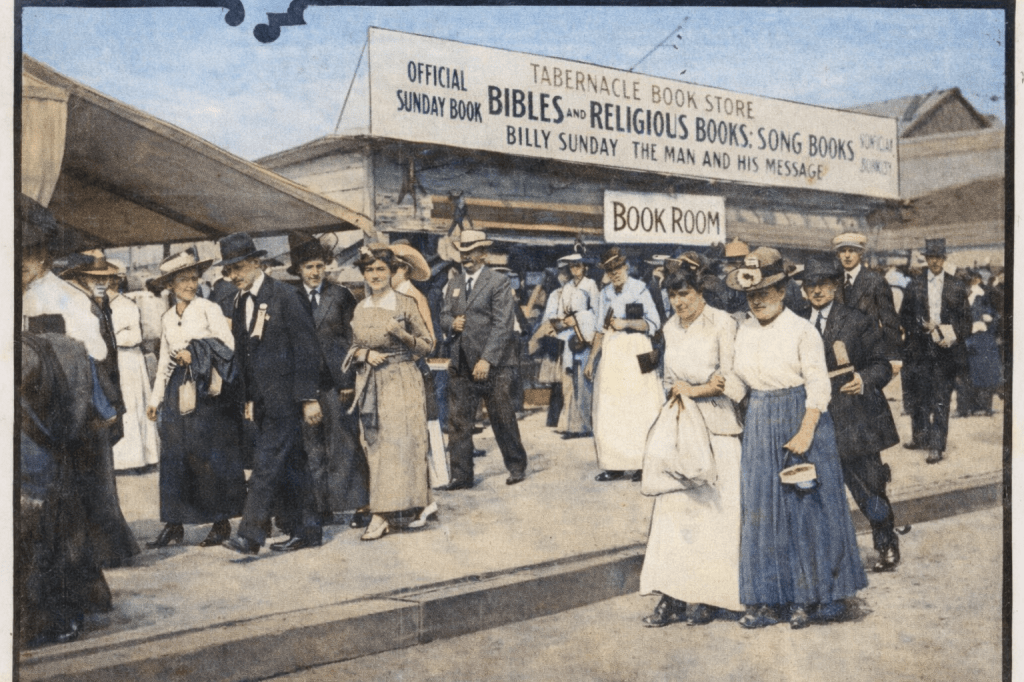
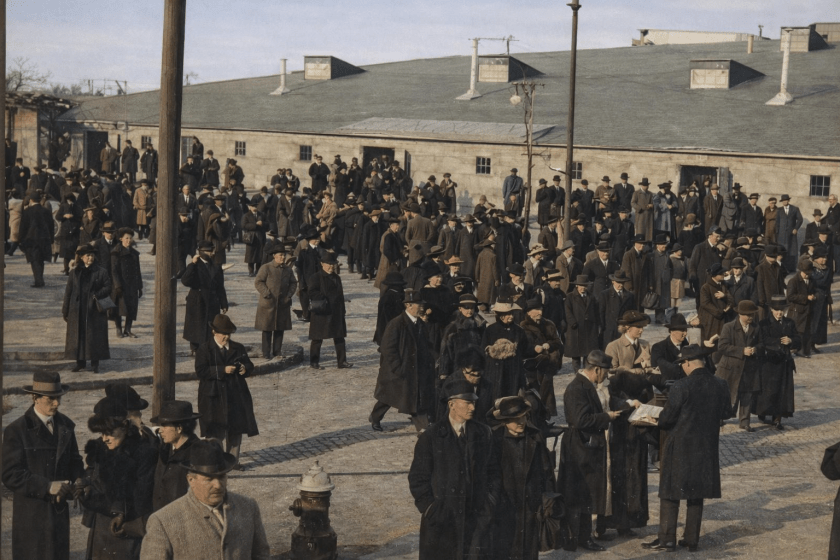
By the time I reached the tabernacle, the place was already alive. Not just crowded—alive. Policemen lined the edges, firemen stood ready, and yet there wasn’t even “the merest hint of disorder.” Whatever this thing was, it had structure. It had gravity. And it was pulling people in.
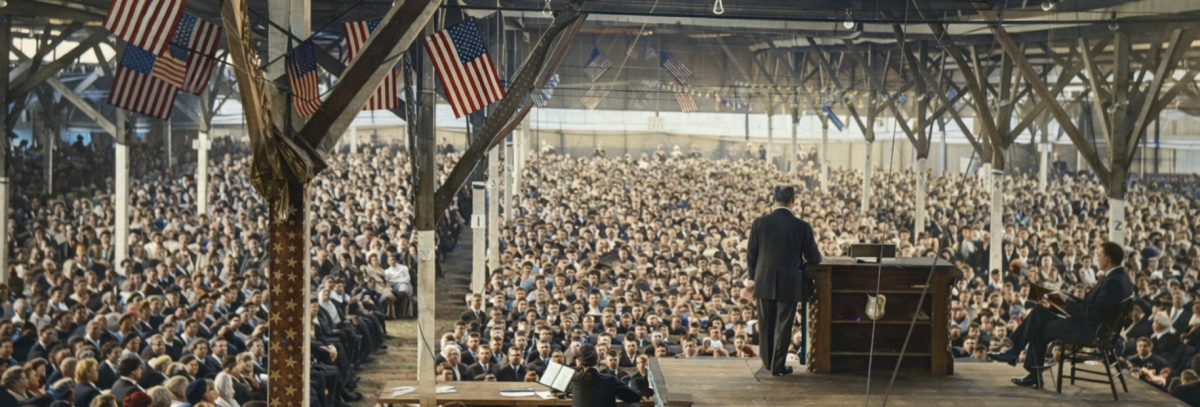
Colorized image of the Billy Sunday tabernacle in Philadelphia, c.1915.
Inside, the air carried that peculiar mixture of sawdust, sweat, and anticipation. Outside, though—that’s where you heard the real story.
A man near me, confident as a prophet, said to no one in particular:
“Billy Sunday has only started… it’s going to get worse and worse. He arouses more enthusiasm each day. If you don’t believe me, ask Scranton.”
That was the mood—this wasn’t the event. This was the beginning of the event.
The Crowd Watching the Crowd
It struck me quickly: people weren’t just watching Billy Sunday.
They were watching each other.
One visitor said it plainly:
“I was naturally interested in ‘Billy’ Sunday, and perhaps even more so in the crowd.”
And what a crowd it was.
A boy—no more than ten—hobbled in on crutches just to hear him. A sailor from the battleship Kansas had been waiting “for months” to catch a meeting. A woman stood nearby, nervous, almost whispering:
“Oh! no. I cannot give my name… my husband would throw a fit if he knew I had been in here.”
And yet—there she was.
That’s how you knew something was happening. Not just attendance—but risked attendance.
What People Were Saying
If you wanted to understand Billy Sunday, you didn’t start with the sermon.
You started with the talk afterward.
“What do you think of ‘Billy’?” someone asked.
The answers came quick, overlapping:
“Great.” “Some man.” “An ace.” “I like him because he goes after the hypocrites.”
Others reached for bigger words:
“Wonderful… splendid… marvelous.”
But not everyone could quite put their finger on it.
One woman, looking slightly dazed, said:
“I have had so many things fired at me in the last hour that I can’t quite set my bearings.”
That may have been the most honest response of all.
More Than a Sermon
There was something else in the air—something heavier than excitement.
A man, speaking to a small group of women, said what many were thinking:
“I would like to see ‘Billy’ Sunday wake this city up and get the rum out of it… Look how many homes he would make happy.”
And then, almost quietly, another moment:
In the northeast corner of the tabernacle, someone reported hearing a man say:
“This is my last drink.”
No sermon transcript can capture that.
That’s the sawdust trail doing its work.
The Unexpected Details
Not everything was solemn.
Someone joked about the sawdust itself:
“They say Mr. Sunday hates noise, and I know I am going to sneeze. I always do when around sawdust.”
Even the ministers weren’t immune to the moment. One well-known clergyman was said to amuse himself before preaching by reading The Fun of Getting Thin—and now, thanks to the crowds, “occupies two seats.”
And everywhere—evidence of men lingering longer than usual:
“There were enough cigar butts left in the gutters… to start a true second-hand cigar store.”
It wasn’t tidy.
It wasn’t polished.
But it was real.
Order in the Midst of It All
For all its energy, the thing held together.
The crowds were vast, but they moved. The police managed them. The firemen stood watch. The machinery of the city seemed, for a moment, to cooperate with something larger than itself.
One observer summed it up best:
“To get and hold a vast throng like this on a weekday for the purpose of hearing the gospel certainly is a tribute to the man himself.”
And It’s Only the Beginning
If you stood there long enough, listening—not to the sermon, but to the people—you began to realize something:
The revival hadn’t peaked.
It hadn’t even arrived yet.
It was building.
You could hear it in the confidence of the man who said, “ask Scranton.” You could see it in the boy on crutches. You could feel it in the nervous woman who came anyway. You could sense it in the man who muttered, “my last drink.”
Billy Sunday may have been the preacher.
But the city— the crowd— the conversations spilling out onto the streets—
They were becoming the message.
And Philadelphia, whether it knew it yet or not, was just getting started.
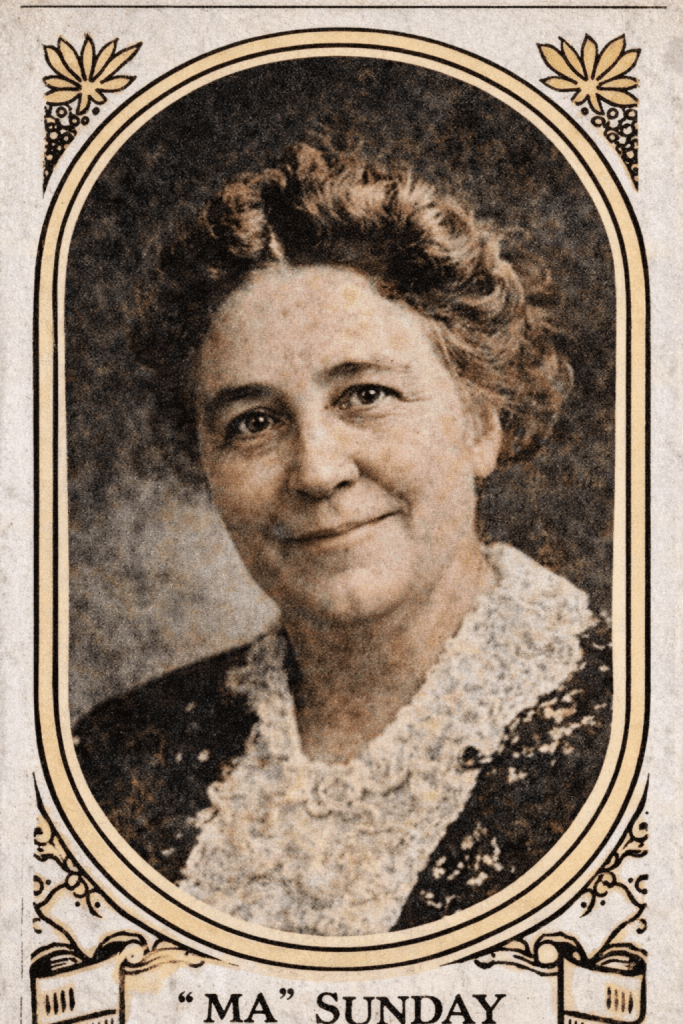
Mrs. William A. Sunday always denies the statement so often and so lovingly made by her son, George, also of the party, that she is the ‘boss’ of the Sunday campaign, but that doesn’t do away with the fact that it was largely through her efforts that the wonderful system of the Sunday’s has been developed.
Along with her many charming feminine qualities Mrs. Sunday is a woman of unusual executive ability, and her keen ability to see the needs and apply the remedies required in work of this kind has made possible the plans whereby the campaigns are made so effective.
‘Do you not relieve Mr. Sunday many tasks, of seeing people, of making plans and of deciding questions concerning the work,’ Mrs. Sunday was asked.
‘Oh, Yes, we all give him as much help as we can, but in the last analysis it is ‘papa’ who decides, and we, of course, do all that I can in this line.’
It has even been said by people who ought to know that Mrs. Sunday frequently suggests phrases for some of his sermons, and also the subjects. This is what she says about that:
‘When I go around with ‘papa’ I don’t just sit and look about, but I think and plan. I frequently see things which might be of use to ‘papa’ and I tell him about them. He is always welcome to all that I have to give him, to every suggestion I can make.’
Besides the work which Mr. and Mrs. Sunday are doing and which they both consider ‘God’s work,’ the nearest thing to Mrs. Sunday’s heart is her home. Her children are very dear to her. By reason of campaigns held in cities far from their home in Winona Lake, Mr. and Mrs. Sunday see little of their children during the nine months when they are doing evangelistic work.
‘I make it a point to go back home two or three days at a time, just to be where we are at home,’ Mrs. Sunday declares. ‘One of my greatest sorrows is the fact that my boys must grow up without the direct influence of Mr. Sunday and myself.’
‘Do you ever feel unhappy about leaving home to begin a new campaign,’ Mrs. Sunday was asked.
‘Yes, we both feel that way sometimes, but the thought that this is the greatest work which we could be given to do, helps us. For several days before we leave home, however, Mr. Sunday is completely broken up, and frequently is unable to eat.’
The Sundays do not grudge the sacrifice that they give, but instead they enter into the work with vim and with an intense desire to ‘live up to what God expects them to do,’ as they express it.
Paul, the eight year old son of the Sundays, who broke an ankle while playing football in the autumn, has recovered and is back at school and back too at his favorite sports.
In a very different way, Mrs. Sunday has just as great getting powers as her husband and when she addresses a group of women her sincere manner, her definite message and her wide-awake methods win the immediate attention of her audience.
‘Ma’ has her trail hitters too, and when she extends the invitation to the women to accept Christ and to lead Christian lives many are eager to shake her hand and to promise better living in the future.
It is an interesting life that Mr. and Mrs. Sunday have led ever since they were married out in Chicago years ago. For two years after their marriage ‘Billy’ played ball but he finally gave that up to do permanent work in the Y. M. C. A., in which he had been working in the winter months. Soon after that he became assistant for Dr. Wilbur Chapman and upon the retirement of that evangelist from active revival work Mr. Sunday conducted revival services in towns outside of Chicago.
Since then he has been in revival work.
Mrs. Sunday was formerly Miss Helen Thompson, one of four daughters of pioneer Chicago business men. Before her marriage she was interested in the church and was an active worker and since that time she has always assisted Mr. Sunday in God’s work.

 Evangelist Billy Sunday (1862-1935)