A brother’s funeral he could not attend. A newborn son. A lawsuit. A carriage wreck. A converted entire police force. And the summer he finally said enough.
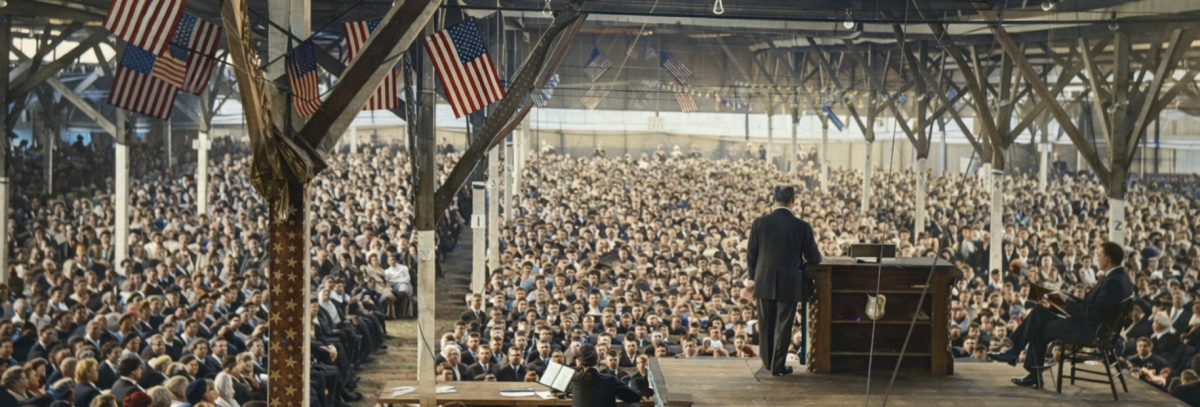
On a day in early July of 1907, somewhere in the Gibson City, Illinois tabernacle, Billy Sunday was handed a telegram. His brother had died. The funeral was being arranged in Iowa. The Gibson City revival was three weeks deep and at the height of its drawing power. The local committee had paid for the tabernacle, organized the choir, raised the expenses, and was counting on him to finish.
Sunday did not go to the funeral. He stayed and preached.
Within a few weeks of that decision, his wife Helen would give birth to their son Paul. The baby was born on the opening day of the Gibson City campaign. Sunday had been there for neither the birth of his son nor the death of his brother. He had been on a platform.
By the end of August he would, for the first time in his career, announce that he intended to cut back on the work that had taken him from those two events. He would announce it from a 4,000-seat steel auditorium in Joliet, Illinois at the close of a Chautauqua season that had seen him deliver eighty-six lectures in roughly thirty different towns and earn the equivalent, in 2026 dollars, of about a million and a half dollars. He was forty-four years old. He had been running this schedule for eleven years. He was, by the contemporary newspaper record, the highest-paid evangelist in America. And he was exhausted.
Kankakee in winter
The year began at Kankakee, Illinois — a town of about fifteen thousand people in the Illinois prairie, an hour south of Chicago. The campaign ran from mid-January through the middle of February in a four-thousand-seat tabernacle with a three-hundred-and-fifty-voice choir.
The Streator Times of January 26 published an extended excerpt from one of his sermons under the heading “Rev. Billy Sunday Defines What He Terms Society of the Present Day.” It was an extraordinary piece of Sunday writing, full of the period’s sense that something was slipping in American life. He drew a contrast between the brilliant drawing rooms of society women playing progressive euchre and the back rooms of “stale beer joints” where four “blear-eyed, vermin-covered old soaks” played penny ante. Then he delivered the line that the Times made sure to print:
I fear that cursed gang of society more than I do all the town loafers in that beer joint.
It was a long way from the cheerful baseball-evangelist anecdotes that had filled the Chautauqua dates the summer before. Sunday at Kankakee was in his serious mode — a working revivalist preaching for six weeks straight to crowds of three and four thousand in subzero Illinois cold, naming evils he could see in the towns he was visiting.
Spring in southern Illinois and Iowa
From late February through May, Sunday worked his way through southern Illinois and Iowa. Murphysboro for six weeks. Fairfield, Iowa for five. Knoxville, Iowa for five. Each campaign followed the same pattern: a temporary tabernacle, a choir of two or three hundred voices, a six-week timetable, and a thousand or more conversions by the closing service.
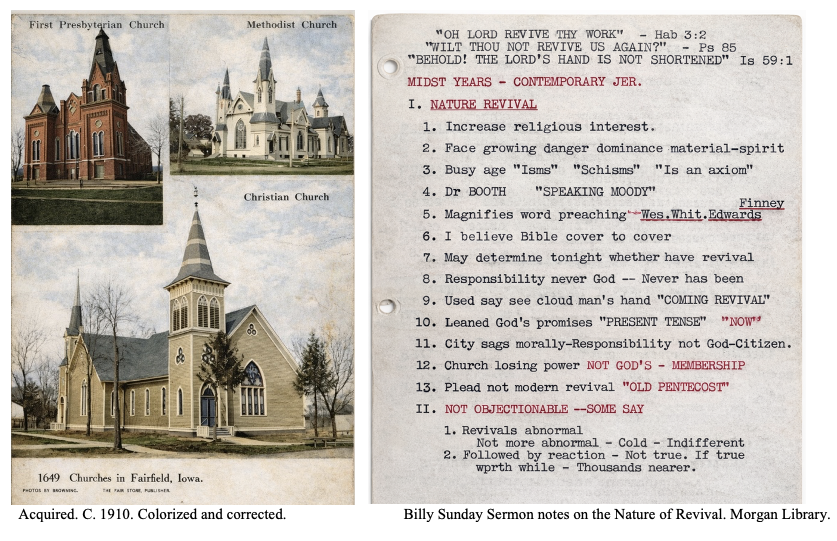
Fairfield produced what may be the most detailed single-day sermon record in Sunday’s pre-1910 career. On Sunday, April 28, he preached three separate sermons in a single day — morning, afternoon, and evening — each anchored on a different text. Earlier that month he had opened the Fairfield campaign with a sermon called “Revive Us Again.” It was the kind of Sunday-disciplined preaching that the Chautauqua circuit never quite asked of him. Four sermons in a row from four different texts. He could still do it.
The Knoxville campaign produced sixty sermons in five weeks and a thousand cards signed. It also produced a small but telling detail in the local paper: someone who had been converted during the campaign was sent to an asylum shortly after. The Sunday revival method, for all its successes, had limits that the campaign committees did not always discuss publicly. The Iowa newspaper noted the case and moved on.
Gibson City
From mid-June through mid-July, Sunday preached at Gibson City, Illinois — a small Ford County town of about twenty-five hundred people. The revival drew over a thousand conversions. Sunday’s purse came in at thirty-six hundred dollars. The economic terms by 1907 were no longer remarkable for him; they were standard.
What made Gibson City unforgettable in the Sunday family record was that it bracketed both ends of life. Paul Sunday was born on the first day of the campaign. Sunday’s brother died near its midpoint. Sunday declined several Chautauqua offers in order to finish the campaign — a sign that the revivals still had first claim on his schedule even as the Chautauqua money grew larger. But his brother’s funeral was the cost of finishing.
There is no surviving record of what Sunday said about it publicly. Two sermons from the Gibson City campaign — one on John 7:17 and one titled simply “Hell” — were transcribed in the regional press over the next month. The papers ran them as significant sermons, the kind worth preserving. Neither sermon mentioned the brother, the baby, or the funeral Sunday had missed. Whatever he was carrying that summer, he was carrying it on the platform.
The lawsuit
On June 28, Sunday was supposed to be in Des Moines, Iowa, opening a slot at the Midland Chautauqua. He did not show. The Iowa Lyceum Bureau, which had booked him, sued him for five thousand dollars for breach of contract. Newspapers picked the story up immediately. Quad-City Times, Des Moines Register, Richmond Item.
Sunday’s defense, when he gave it, was straightforward. His evangelistic work, he said, ought to have preference over Chautauqua dates. If a revival ran long, or a town needed him for an extra week, he was going to honor that. The Chautauqua bureau could sue him if it wanted to.
The case never went anywhere notable in the public record. But the spectacle of it was something new. Sunday was no longer just an itinerant preacher who could be expected to keep his commitments because his name and reputation depended on it. He was now a commercially booked entertainer with contracts that could be litigated. The Iowa Lyceum Bureau had not bought a sermon. It had bought a calendar slot. And when Sunday treated the slot as flexible, the Bureau treated the contract as enforceable.
The lawsuit told you something else about where Sunday’s life had gone. He had become the kind of person who could be sued.
The 86-lecture summer
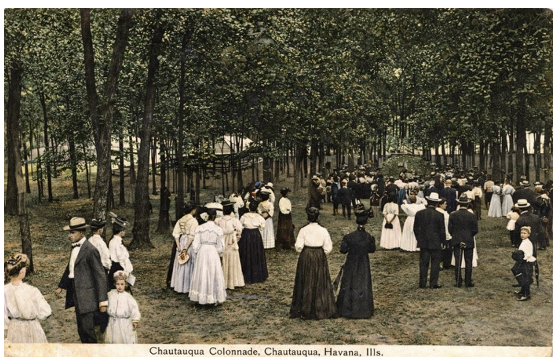
Once the Gibson City revival ended in mid-July, Sunday’s Chautauqua summer began. By the time it ended at Joliet at the end of August, he had spoken at roughly thirty different towns across Illinois, Iowa, Indiana, Wisconsin, Ohio, and Missouri. The eighty-six lectures total was reported later, in a July 1910 retrospective, and the figure is so large that it strains belief — until you do the arithmetic. About six weeks of summer Chautauqua. Two or three talks at most stops. A few sites where Sunday spoke five or six times across a week. The number works out.
The bookings paid roughly forty-three thousand dollars in 1907 dollars. In current dollars, perhaps a million and a half. After bureau commissions and travel expenses, perhaps a million two. Most of this came in checks of two hundred to three hundred dollars per lecture, occasionally rising to five hundred or six hundred when the local committee had organized a special gate. By Bryan’s standards as a Chautauqua speaker, the rate was modestly higher. By any other measure, the figure was staggering.
Two of the eighty-six lectures took place on August 14 in Oskaloosa, Iowa. On the way back to his hotel that evening, the carriage Sunday was riding in was in a bad wreck. Sunday was bruised but unhurt. The story went out over the wires anyway, and by the next morning newspapers in five states were running headlines about how Billy Sunday had been “badly injured” in an “overturned carriage.” Sunday kept his schedule. The next morning he was at Aurora, Illinois — where a different paper had announced he had canceled because of hay fever. The two stories crossed in the wires. Either Sunday had been hurt or he had hay fever or both or neither. He was, by his own account, just tired.
A steel auditorium and an announcement
The summer ended at Dellwood Park, just outside Joliet, Illinois, where a brand-new Chautauqua assembly opened on August 30. The venue was something the Chautauqua circuit had never seen: a steel auditorium with four thousand seats and what the builders called “perfect acoustic properties.” Sunday spoke at the opening at 8:15 in the evening. The opening sermon was called “Grounders Hot Off the Bat” — a baseball talk, with a baseball title for the first and only time in the curated record.
The next day the Joliet Daily News published a piece called “Billy Sunday as He Is, Spoke.” The headline was a deliberate pun. The reporter had watched Sunday at close range and was unsparing:
Billy Sunday is like his discourse: unpolished in appearance. He still looks more like a baseball player than a preacher, talks more in the manner of a heavy hitter than a gentleman of the cloth, and, judging from his frenzied utterances, thinks more like one as well. He works as hard on the stage as he ever did on the diamond, and his voice is worn nearly to shreds by long-continued gospel shouting.
The auditorium, the reporter noted, was not packed. Joliet seemed to have been “frightened off by Sunday’s reputation for vigorous execution.” Sunday had hay fever. When a sympathetic listener tossed him a handkerchief during his sermon, he muffed the catch. The retired ballplayer dropped a fly ball in front of four thousand people.
It was during this Joliet engagement that Sunday made his announcement. He was going to cut back on Chautauqua speaking after this season. The constant travel was depriving him of the rest he needed for his evangelistic work. The newspaper of August 30 carried the news as a routine item. Whether Sunday himself believed it at the time is harder to know. The next summer, in 1908, he would deliver Chautauqua lectures again. By 1909 he would be back at full schedule. He would not actually retreat from the platform. But he had said the words. He had reached his limit.
Galesburg and Muscatine
Sunday took a few weeks off after the summer ended. Then in late September he opened a five-week revival at Galesburg, Illinois — eighteen thousand people, a five-thousand-seat tabernacle, two thousand five hundred and eighty conversions, a closing-night crowd of eight thousand plus standing room outside. His purse came in at six thousand three hundred and forty dollars, sixteen hundred of which he turned around and gave back to the local YMCA.
The Galesburg campaign drew attendees from seventy different towns. After it ended, the local newspapers wrote about the “Bible famine” that followed — the Presbyterian church alone took in sixty new members, and the Baptists and Methodists between them took in another two hundred. A Gibson City paper, looking back at the campaign a week after it closed, said one-tenth of Galesburg had professed conversion during Sunday’s stay.
November and the first half of December went to Muscatine, Iowa — five weeks in a purpose-built tabernacle, thirty-six hundred conversions, six thousand seven hundred and eighty-five dollars in Sunday’s pocket, seventy-four sermons preached. The campaign averaged out to a remarkable two dollars and sixty-three cents per soul converted, a number the local paper printed with what seems to be genuine satisfaction. The Muscatine News-Tribune of December 15 used the phrase “the largest revival in our history.” The Muscatine Journal the next day went further — it called it “the greatest revival in the nation’s history.” Both papers were, almost certainly, wrong about the second claim. But they meant what they said, and the readers seemed to agree.
Carrying it al
The 1907 year is the one in which the cumulative weight of Sunday’s choices becomes hard to look away from. The brother’s funeral he could not attend. The newborn son. The lawsuit. The carriage wreck and the false injury rumors. The eighty-six Chautauqua lectures. The five revival campaigns. The pulled voice and the hay fever and the dropped handkerchief in front of four thousand people. The announcement at Joliet that he would cut back, and the everyone-knew-it-wouldn’t-take quality of the announcement when he made it.
He was making more money than any evangelist in American history had ever made. He was preaching to more people in a single summer than most pastors preached to in a lifetime. He was the subject of newspaper feature stories from Idaho to Indiana. The same newspaper that ran his Joliet headline ran his Galesburg revival report a few weeks later. The same press that ran the lawsuit story ran the Muscatine “greatest revival” story. He was everywhere.
And he was, somewhere underneath all of it, a forty-four-year-old man who had not been in Iowa to bury his brother and had not been in Chicago to see his son born. The next two years would bring some of the biggest revivals of his career — Spokane, Springfield, Cedar Rapids, the early relationship with Homer Rodeheaver. They would also bring more of the same exhaustion that the Joliet announcement had named out loud. Whatever broke in Billy Sunday in 1907 did not get put back together. It got worked around.
The Muscatine paper called it the greatest revival in the nation’s history. It was the greatest revival of Sunday’s hardest year.
How to cite this post
Chicago: McNutt, Kraig. “The Year That Broke Billy Sunday: 1907.” Evangelist Billy Sunday (1862–1935), June 15, 2026. https://evangelistbillysunday.com/2026/06/15/the-year-that-broke-billy-sunday-1907/.
MLA: McNutt, Kraig. “The Year That Broke Billy Sunday: 1907.” Evangelist Billy Sunday (1862–1935), 15 June 2026, evangelistbillysunday.com/2026/06/15/the-year-that-broke-billy-sunday-1907/.
APA: McNutt, K. (2026, June 15). The year that broke Billy Sunday: 1907. Evangelist Billy Sunday (1862–1935). https://evangelistbillysunday.com/2026/06/15/the-year-that-broke-billy-sunday-1907/
Turabian: McNutt, Kraig. “The Year That Broke Billy Sunday: 1907.” Evangelist Billy Sunday (1862–1935). June 15, 2026. https://evangelistbillysunday.com/2026/06/15/the-year-that-broke-billy-sunday-1907/.

