Competing for the Crowd: What Else Philadelphia Could Do in 1915

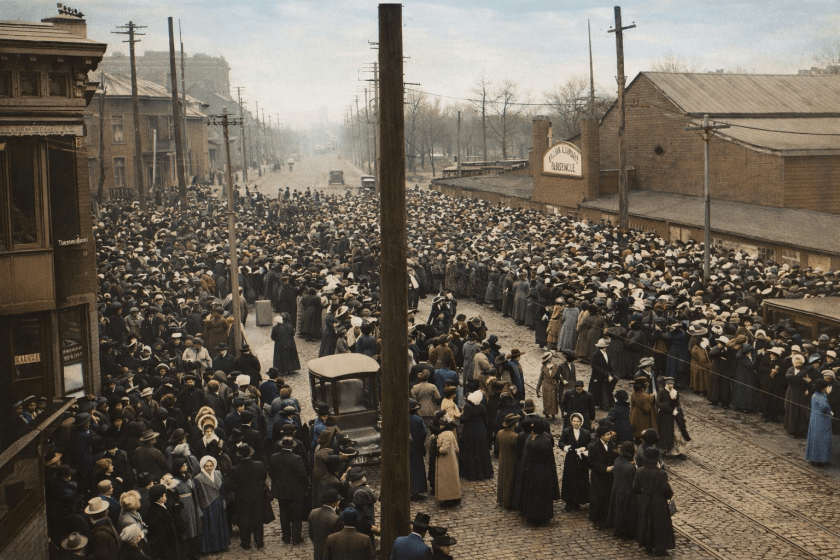
When Billy Sunday arrived in Philadelphia in early 1915, he stepped into a city alive with options.

This wasn’t a spiritually quiet moment in American life—it was a crowded marketplace of attention. Every night, Philadelphians could choose where to go, what to watch, and how to spend their time. Entertainment was not scarce; it was everywhere. And much of it was designed to delight, distract, and hold an audience far more comfortably than a hard-hitting revival sermon.

That’s what makes Sunday’s campaign so compelling.

He didn’t draw crowds because there was nothing else to do.
He drew crowds in spite of everything else there was to do.

Let’s step into that world.


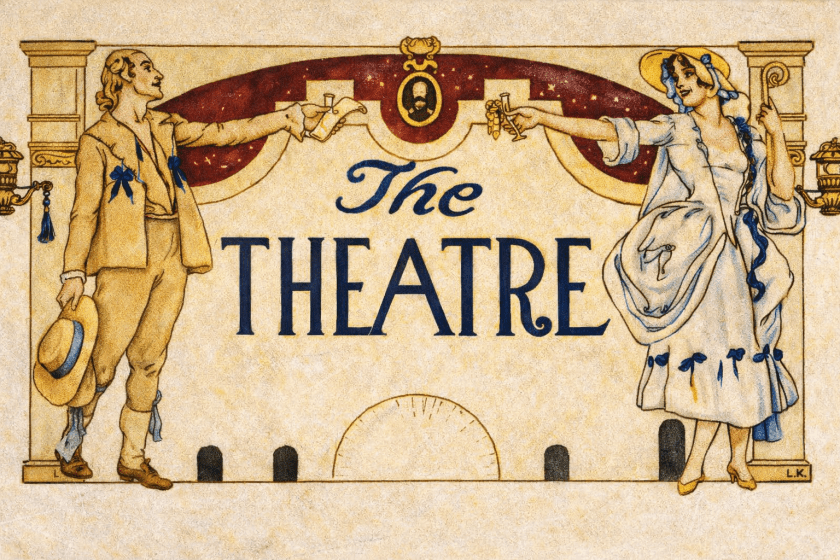
The Bright Lights of the Theatre

Philadelphia had a thriving theatre scene—serious plays, comedies, and traveling productions that brought a touch of Broadway to the city. These venues were polished and respectable, often appealing to middle- and upper-class audiences.

An evening at the theatre meant dressing well, sitting in a structured setting, and watching trained actors perform carefully scripted stories. It was entertainment with dignity—refined, cultural, and often expensive.

The theatre still carried prestige in 1915, but it was no longer the only game in town.


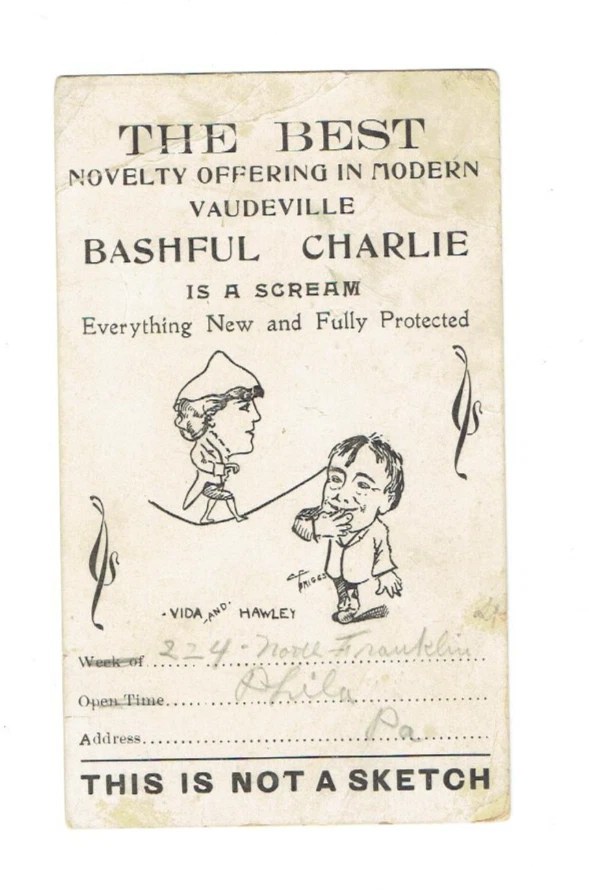
Vaudeville: Fast, Funny, and Everywhere

If theatre was refined, vaudeville was electric.

Vaudeville shows were built on variety—comedians, singers, dancers, acrobats, magicians—all packed into a single program. The pace was quick, the tone was lively, and the appeal was broad.

For many working-class and middle-class Philadelphians, vaudeville was the go-to night out. It was affordable, constantly changing, and full of energy. No two shows were exactly alike, and that unpredictability kept audiences coming back.

In 1915, vaudeville was at or near its peak. It wasn’t just popular—it was a cultural force.


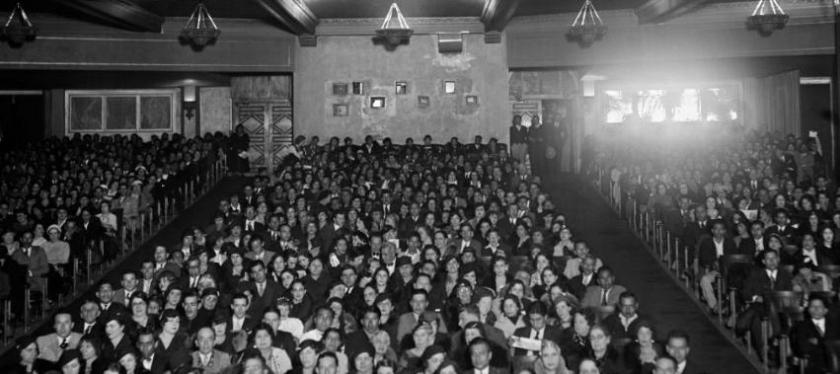
The Rise of the Photoplay

And then there were the movies—still new, still evolving, but already reshaping the landscape.

They were called photoplays, and by 1915 they were drawing massive crowds. For just a few cents, people could step into a darkened theater and be transported into another world through silent film.

That same year saw the release of The Birth of a Nation, a film that demonstrated just how powerful and immersive cinema could be.

Movies had three advantages that made them unstoppable:

  • They were cheap
  • They were accessible
  • They were constantly changing

In many ways, they represented the future of entertainment—and people knew it.


Music, Dance, and the Pull of the Nightlife

For younger audiences especially, entertainment wasn’t just about watching—it was about participating.

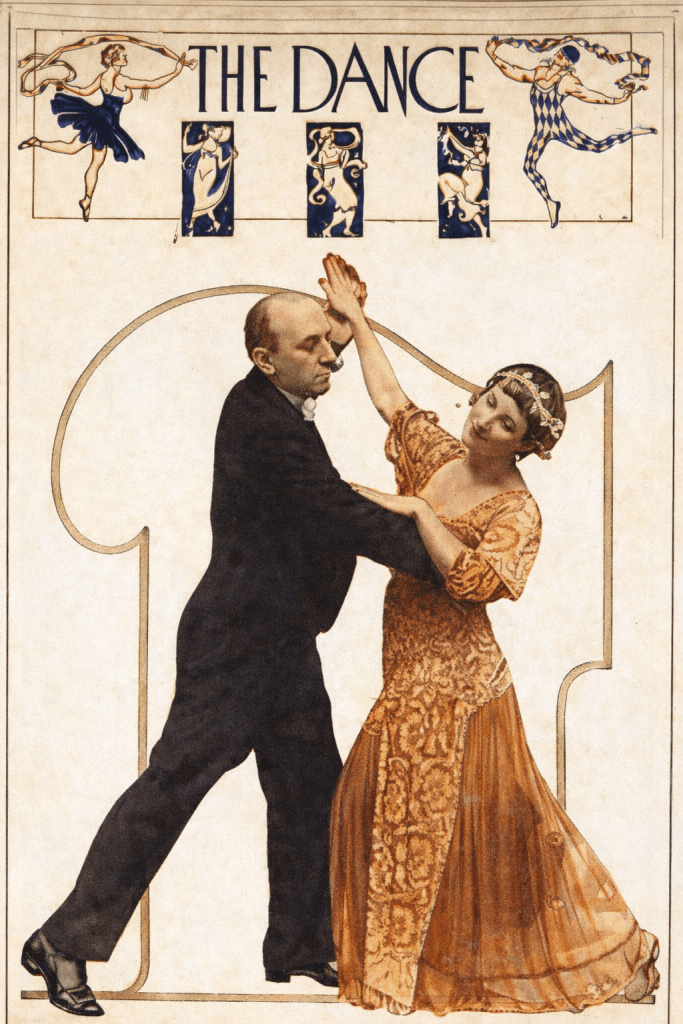
Dance halls and social clubs offered ragtime music, lively crowds, and a chance to be part of the action. These venues were social, energetic, and often stretched late into the night.

They were also controversial.

Revivalists like Billy Sunday frequently warned against the moral dangers of dance halls, seeing them as places where discipline gave way to impulse. But for many in the city, they were simply where life felt most alive.


Traveling Shows and Big-Tent Spectacle

Even in a major city, the draw of spectacle remained strong.

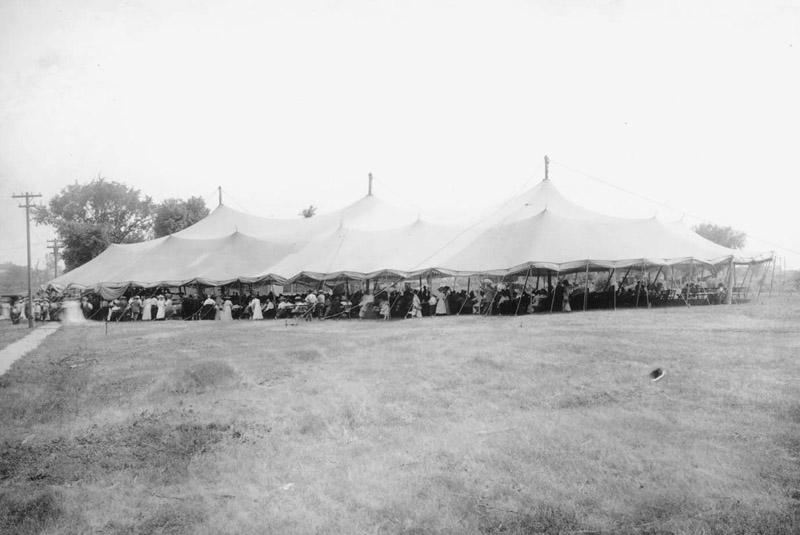
Circuses, traveling shows, and Chautauqua events brought something different—large-scale experiences that combined entertainment, education, and wonder. Whether it was a circus parade or a lecture under a tent, these events added to the sense that something exciting was always happening just around the corner.

They were part of the cultural fabric, especially for families and those looking for something beyond the everyday.


And Then… There Was the Tabernacle

Into that world stepped Billy Sunday.

No velvet curtains.
No orchestra.
No stagecraft.

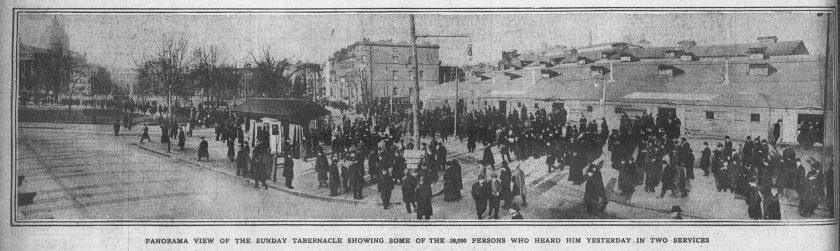
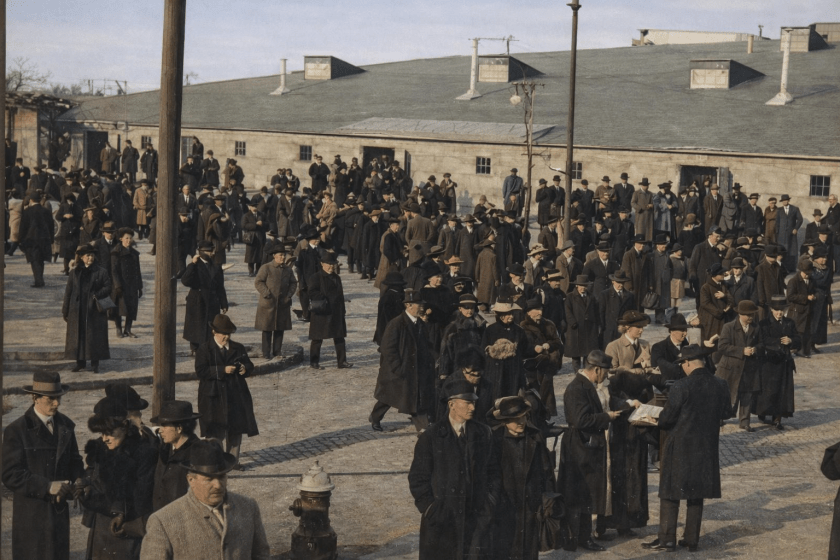
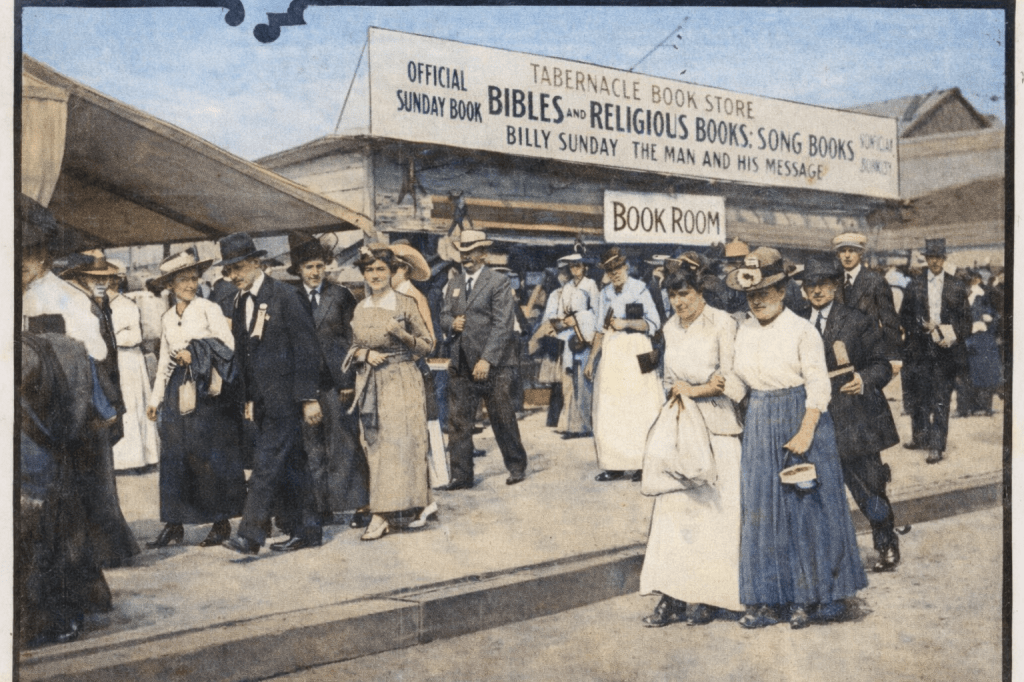
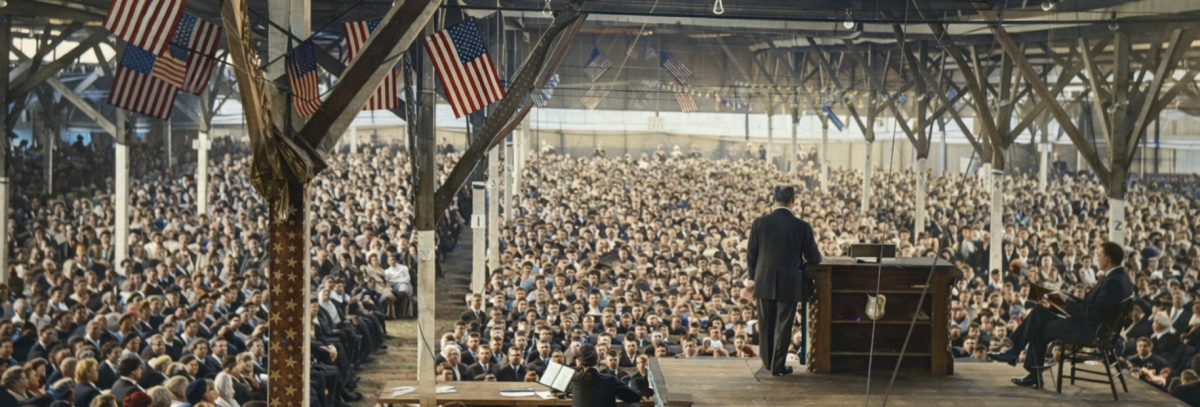
Just a rough wooden tabernacle, a sawdust-covered floor, and a preacher who spoke with urgency and conviction.

And yet—night after night—people came.

Why?

Because Sunday offered something none of the others could.

  • The theatre entertained.
  • Vaudeville amused.
  • Movies captivated.
  • Dance halls energized.

But Sunday confronted.

He spoke about sin, purpose, eternity, and the need for decision. His meetings were not passive experiences. They demanded a response.


The Real Story

The real story of Philadelphia in 1915 is not just that Billy Sunday drew crowds.

It’s that he drew them in the middle of one of the most competitive entertainment environments America had ever seen.

Every night, people made a choice.

They could laugh, watch, dance, or be distracted.
Or they could walk into a wooden tabernacle and be challenged.

And tens of thousands chose the latter.

That’s not just revival.

That’s a man—and a message—breaking through the noise of an entire culture.

Major national and world events going on during the Jan-March 1915 Philadelphia campaign?

Article curated by AI, examining period newspapers, with human oversight.

A City on the Edge: The World Behind Billy Sunday’s Philadelphia Campaign (Jan–Mar 1915)

When Billy Sunday stepped into Philadelphia on January 3, 1915, he didn’t enter a quiet city.

He stepped into a world already under strain.

To understand the power of that campaign—why thousands poured into the tabernacle, why his words landed with such force—you have to look beyond the sawdust trail and into the broader setting. Because what was happening outside the tabernacle made what happened inside feel urgent, even necessary.


A World at War—But Not Yet America’s

By early 1915, Europe was already bleeding.

What had begun in the summer of 1914 as a war of movement had hardened into something far more brutal. The Western Front was frozen in place. Soldiers lived in trenches carved into mud and misery. Artillery thundered day and night. Machine guns cut down advances before they began. The casualty lists grew longer by the week.

And in February 1915, something changed that Americans could not ignore: Germany declared the waters around Great Britain a war zone. Submarines—U-boats—would strike without warning.

For the first time, the war felt like it might reach across the Atlantic.

America was still neutral. But no one felt untouched.


A Nation Holding Its Breath

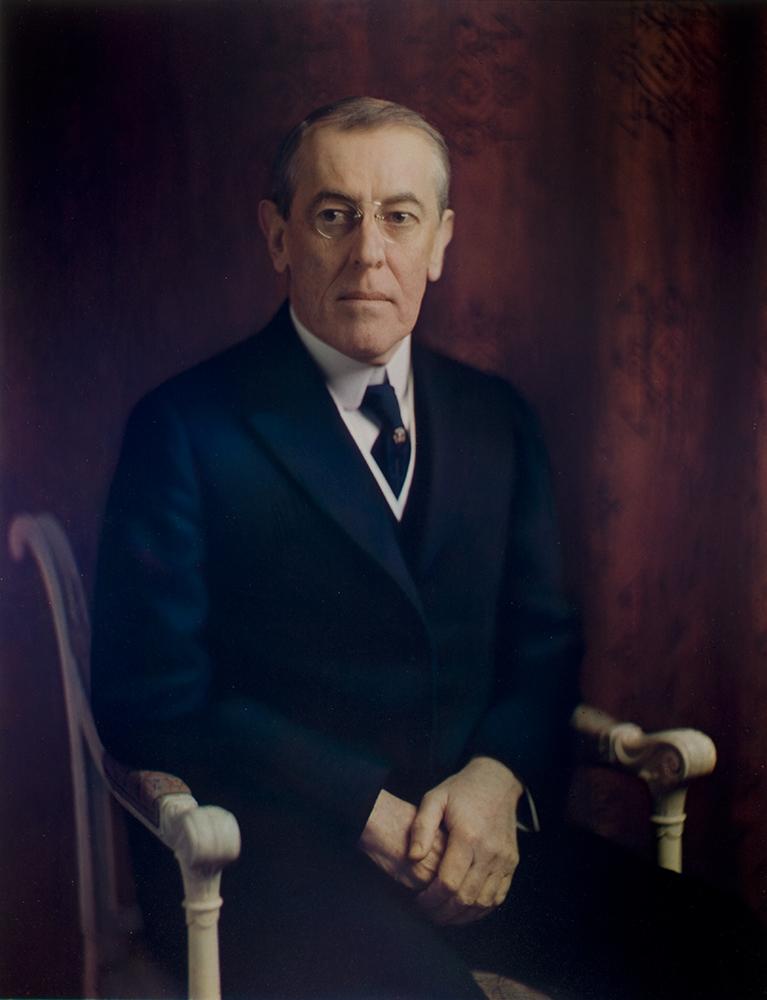
Under President Woodrow Wilson, the United States tried to maintain distance. Officially, this was not our war.

But neutrality is easier to declare than to feel.

Every day, newspapers carried headlines from Europe. Americans followed the movements of armies, the sinking of ships, the warnings issued to neutral nations. Trade tied the U.S. to the Allies. American goods crossed the ocean. American lives traveled those same routes.

The question lingered, unspoken but persistent:

How long can we stay out of this?

There was no clear answer—only a growing sense that the ground was shifting.


Prosperity with a Shadow

At the same time, the American economy was waking up.

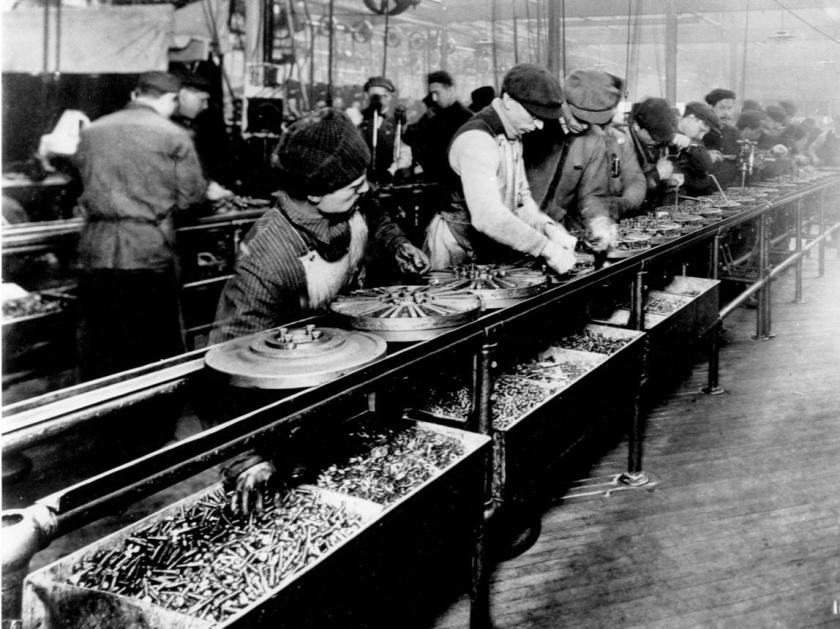
Factories were busy. Orders increased. Production surged. War in Europe meant demand for American goods—steel, machinery, supplies.

Philadelphia, an industrial powerhouse, felt it.

But prosperity came with questions.

Was America simply helping… or quietly profiting from the suffering overseas? Could a nation grow rich while the world burned?

These weren’t always spoken out loud. But they were felt.

And men like Billy Sunday had a way of bringing those quiet tensions into the open.


A Moral Movement Finding Its Voice

This was also a moment when moral reform was cresting.

The temperance movement was no longer a fringe cause. The Anti-Saloon League had become a powerful national force. States were beginning to go dry. The conversation about alcohol, vice, and public morality was moving from pulpits into politics.

Sunday did not arrive in Philadelphia as a lone voice crying in the wilderness.

He arrived as a leading voice in a growing chorus.

His attacks on the saloon, his calls for personal repentance, his insistence on moral clarity—they resonated because the ground had already been prepared.


The Pressure of the Modern City

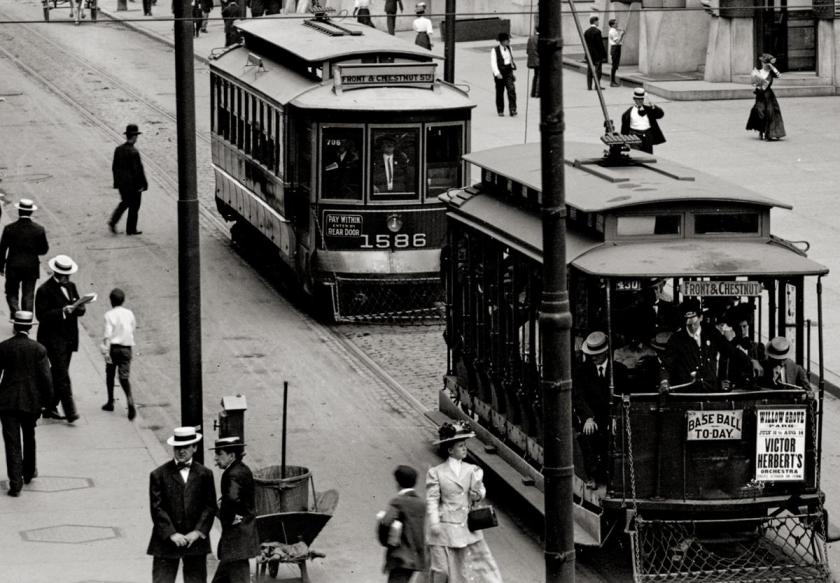
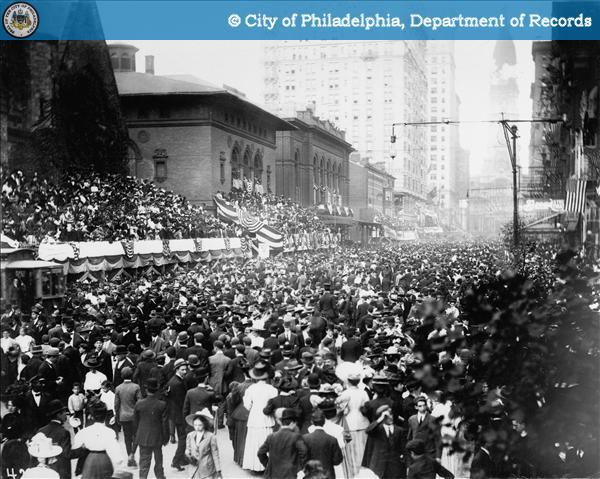
Philadelphia in 1915 was a city alive with motion—and tension.

Immigrants poured into neighborhoods already crowded. Industry demanded long hours and offered uncertain stability. Streets were full. Lives were busy. The pace was relentless.

And beneath it all was something harder to measure:

A kind of spiritual restlessness.

People were working, striving, building—but many sensed something was missing. The old certainties felt less certain. The future felt unclear.

It is no accident that revival fires so often burn brightest in moments like these.


Why It All Matters

Billy Sunday’s Philadelphia campaign did not happen in isolation.

It unfolded in a world:

  • unsettled by war
  • uncertain about the future
  • prospering, but uneasy
  • crowded, busy, and spiritually searching

When Sunday preached about sin, judgment, repentance, and decision, he was not introducing new concerns.

He was naming what people were already feeling.

And that is why they came.


A Final Word

If you want to understand the Philadelphia campaign, don’t start with the tabernacle.

Start with the world outside it.

Because Billy Sunday did not create the urgency of that moment—he stepped into it, gave it language, and called a city to respond.

Billy Sunday’s Mouth: In Defense of a Preacher Who Talked Like That

I was not prepared for the switchblade.

I had been reading Billy Sunday’s sermons for months — the atonement, the heaven imagery, the careful anti-moralism arguments — and I thought I had a reasonable handle on the man. Earnest. Urgent. Theologically sharper than his reputation. Then I hit a passage where he turned on his critics, and I actually laughed out loud in my study.

“You little two-by-four whisky-soaked fellows who can’t earn $10 a week and turn up your nose at religion. It is beneath you to be a Christian. It would lower your manhood. You are a fool.”

That’s not pastoral. That’s not even particularly civil. That is a man who has been called a vulgarian so many times that he has decided to demonstrate exactly what vulgarity looks like when it is aimed at the right target. And his critics — the educated, the respectable, the comfortably pewed — were exactly the right target.

The criticism of Sunday’s language is old and persistent. He talked like a street fighter. He invented words (“foolosopher” remains my personal favorite — philosophy plus fool, a portmanteau that dismisses two thousand years of Western skepticism in four syllables). He called Napoleon, Caesar, and Hannibal “old ginks who used to juggle power and men’s lives.” He described a wife-beater as “whisky-soaked, hog-jowled, weasel-eyed, pug-gut.” He told an old infidel that his ideas could go “to perdition.” He rendered the newsboy’s voice in four consecutive street slang terms without pausing for a breath.

The critics heard all of this and said: undignified. Unbecoming. Unworthy of a pulpit.

They were not entirely wrong. I’ll get to that.

But they were mostly wrong. And the way they were mostly wrong is the more interesting story.

What the Criticism Gets Right

There are moments — I counted them carefully across forty-five sermons — where Sunday reaches for a contempt word in a place where an argument should have gone. When he calls the participants of the 1893 Parliament of Religions “mutts like Hindus, followers of Zoroaster,” he is not engaging with religious pluralism. He is dismissing it. The slang is doing the work the reasoning should do, and the reasoning is absent.

That is a real weakness. The book I’m writing will name it without flinching.

There is also a genuine risk when the compound insult strings get long enough to become funny. “Whisky-soaked, hog-jowled, weasel-eyed, pug-gut” is objectively hilarious. And a sentence that makes the congregation laugh at the image may not be making them feel the gravity behind it. When the rhetoric is entertaining enough to applaud, it is sometimes too entertaining to convict.

Fair point. Conceded. Moving on.

What the Criticism Gets Wrong — Which Is Most of It

Here is what I kept noticing as I worked through the transcripts: Sunday’s slang has a targeting system. The compound insult strings are almost never aimed at the repentant, the struggling, or the socially marginal. They are aimed at the powerful who abuse the vulnerable, at false systems dressed in religious clothing, and at the self-righteous who use respectability as a hedge against grace.

The “whisky-soaked, hog-jowled, weasel-eyed, pug-gut” compound? Applied to a man beating his wife and children while invoking his personal liberty. The contempt tracks the abuse. Sunday’s critics — themselves largely comfortable professionals — heard the language as a class issue. The primary sources suggest it was a moral issue.

Then there is the street dialogue, which his critics consistently conflated with Sunday’s own voice. When the Chicago newsboy delivers four authentic period slang terms in four lines — “Aw, gwan with you, you big mutt” / “not on your tintype” / “Boss, I’m from Missouri, come across with the dough” — Sunday is not preaching in slang. He is reproducing a voice. Any novelist would claim the same distinction. Sunday had been a YMCA street worker in Chicago. He knew what newsboys sounded like. That precision is not vulgarity. It is observation disciplined into art.

And here is the thing about “foolosopher” that I want the critics to reckon with: it is not Sunday’s substitute for an argument against philosophical skepticism. It is the verdict at the end of an argument he has already made — a careful working-through of the internal contradictions of Enlightenment rationalism. The slang is the conclusion. Critics who read it without the preceding argument are reading a partial text and declaring a whole verdict. That is not criticism. That is a setup.

The Critics Themselves

This is where it gets interesting to me personally.

The people who criticized Sunday’s language most loudly were almost entirely drawn from the educated professional class and liberal Protestant clergy — the same people Sunday called out for preaching “deodorized, disinfected sermons” that had removed everything offensive from the gospel, including the offence of the gospel itself.

They heard “foolosopher” and “hog-jowled” from a pulpit and called it vulgarity. Of course they did. Their entire formation had taught them that elevated subjects require elevated language.

Sunday’s actual audiences — factory workers, railroad employees, domestic servants, immigrants still learning English — heard something entirely different. They heard recognition. The street slang was not a barrier between them and the theological content. It was the door through which the content entered.

Sunday was not preaching to the educated class and failing. He was preaching to everyone else and succeeding. That distinction matters enormously when you are evaluating whether a rhetorical choice was a failure of decorum or a brilliant act of pastoral intelligence.

The Passage I Can’t Shake

In “I Find No Fault in Him,” Sunday paraphrases Matthew 23 — Jesus’ scorched-earth denunciation of the Pharisees — in period vernacular:

“You miserable old lobster. You’re a fine bunch of guys, the way you skin widows. You sanctimonious rascals, you’re like a sepulchre — nice outside, but inside rotten. The whole bunch of you ought to be in jail.”

Every time I read that I think two things simultaneously. First: that is reckless. Second: that is exactly right.

Matthew 23 is not a pastoral nuance passage. It is white-hot prophetic fury directed at religious respectability weaponized against vulnerable people. Most formal translations preserve the dignity of the target along with the words of the rebuke. Sunday’s vernacular strips the dignity away — which is, arguably, precisely what Jesus was doing.

Is that good homiletics? I’m genuinely not settled on it. What I’m settled on is this: it is not a failure of register. It is a translation decision. And the question worth arguing about is not whether Billy Sunday talked like that — he clearly did — but whether talking like that was, for his specific audience in his specific moment, an act of faithful proclamation.

The trail responses documented across his campaigns suggest it was.

Billy Sunday talked like that. And the people he was talking to — not the critics in the press gallery, but the people in the seats — heard him.

When a Revival Outdrew the State Fair: Omaha, 1915

In the fall of 1915, Nebraska found itself hosting two of the largest public gatherings in its history.

One was expected.
The other was not.

In Lincoln, the Nebraska State Fair was in full swing. Newspaper headlines called it “the greatest ever held.” Despite rain and poor weather early in the week, crowds poured through the gates. By the time it ended, total attendance reached 180,767—a record-setting year. The fairgrounds were packed with machinery exhibits, livestock judging, aerial shows, wrestling matches, and the familiar buzz of a state coming together for its biggest annual spectacle.

It was, by every measure, a success.

But sixty miles away, something far more remarkable was unfolding.

In Omaha, a temporary wooden tabernacle had been erected for evangelist Billy Sunday. There were no rides. No prize livestock. No grandstand attractions. Just sawdust, benches, a pulpit—and a preacher.

Yet by the time Sunday’s campaign ended, the numbers told a different story.

The revival recorded approximately 930,000 total attendees across its six weeks of meetings. Of those, nearly 795,000 passed through the tabernacle itself. More than 13,000 people walked the “sawdust trail,” publicly declaring their decision for Christ.

Let that sink in.

The largest civic event in the state drew just over 180,000 people in a week.
Billy Sunday’s revival drew over five times that number (in six weeks total).

The 1915 Omaha Billy Sunday revival, bookstore.

And it wasn’t confined to a single venue or moment. The revival spread throughout the city:

  • Over 2,100 cottage prayer meetings during the campaign
  • Tens of thousands attending women’s meetings, Bible classes, and noon gatherings
  • Business leaders, factory workers, students, and families all pulled into its orbit

This was not simply a series of sermons. It was a citywide movement.

The contrast is striking. The State Fair represented the best of Nebraska’s agriculture, industry, and entertainment. It was planned, promoted, and expected to succeed.

Sunday’s revival, on the other hand, was built on something less tangible but far more powerful—a shared spiritual hunger that transcended social boundaries.

For a brief moment in 1915, Omaha became the epicenter of something larger than spectacle. Larger than tradition. Larger even than the state’s greatest annual event.

The fairgrounds would empty. The tabernacle would be torn down.

But for those who were there, the memory remained:

A season when the crowds came—not for entertainment—but for transformation.

Sources: curated from Omaha newspapers from 1915.

How did Billy’s Baltimore revival sermons compare to his Trenton campaign (both in 1916)?

From Trenton to Baltimore: How Billy Sunday’s Preaching Evolved in 1916

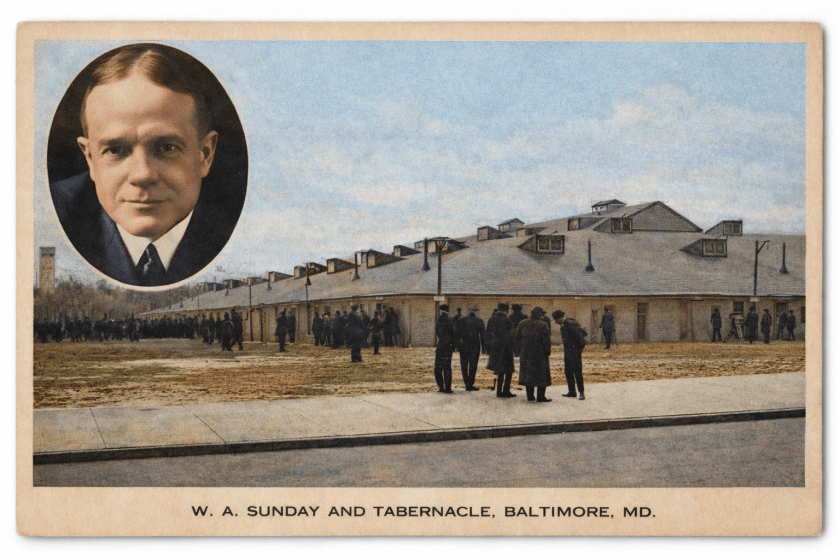
When Billy Sunday concluded his revival campaign in Trenton, New Jersey, in February 1916, he had already delivered an extraordinary number of sermons in just a few winter weeks. Soon afterward he moved south to begin what would become an even larger campaign in Baltimore, Maryland.

A comparison of the sermon lists from the two cities reveals something fascinating about Sunday’s preaching strategy. While the evangelist was famous for repeating certain signature sermons from city to city, the Baltimore campaign shows a noticeable shift in emphasis and structure compared with Trenton.

The Baltimore Tabernacle

The Trenton Campaign: Classic Revival Preaching

The Trenton sermons follow the pattern of a traditional evangelistic revival. Many of the titles focus directly on conversion, repentance, and the urgency of salvation. Messages such as What Must I Do to Be Saved?, After Death, Judgment, Rich Young Ruler, and What Shall the End Be? formed the backbone of Sunday’s preaching.

These sermons were part of Sunday’s well-known revival repertoire. In Trenton he rotated them rapidly, returning to the themes of judgment, repentance, and personal decision again and again. Titles like Backsliding, Get Right, Choose Ye This Day, and Be Sure Your Sins Will Find You Out show how directly he pressed the audience toward a response.

This approach reflected the classic revival method: present the danger of sin, call for repentance, and invite listeners to make a public decision.

Baltimore: A Broader and More Structured Campaign

When Sunday arrived in Baltimore later in February, the preaching program became noticeably broader. While the evangelistic messages remained, the sermon list shows a wider range of topics and a more deliberate sequence of themes.

Several sermons addressed revival within the church itself, including The Need of Revivals, Revive Thy Work, and The Restoration of the Church. Others focused on Christian living, such as Following Christ, Positive and Negative Religion, and Show Thyself a Man.

New Sermons Appear

The Baltimore list also introduces several sermons that do not appear in the Trenton campaign. Messages such as The Authenticity of the Bible, God’s Battle Line, The Temptation of Christ, Love Your Enemies, and The Incarnation of Christ reveal a more doctrinal dimension to the preaching.

In other words, Baltimore was not only about winning converts. It also included teaching aimed at strengthening believers and encouraging churches.

The Core Sermons Remained

Despite these differences, Sunday’s core sermons appear in both campaigns. Titles such as Dr. Jekyll and Mr. Hyde, The Fig Tree, Samson, The Atonement, Choose Ye This Day, and What Must I Do to Be Saved? were staples of his preaching for years.

These messages formed the foundation of Sunday’s evangelistic ministry, and he carried them from city to city with remarkable consistency.

A Larger Revival

The Baltimore campaign also dwarfed Trenton in size. By the time the meetings ended in April, reported attendance had reached 1,376,000 people across the entire series of services.

Such a large audience may explain the broader range of sermons. A major metropolitan revival like Baltimore required not only evangelistic appeals but also teaching, church renewal, and special meetings addressing different audiences.

Two Cities, One Evangelist

Taken together, the Trenton and Baltimore sermon lists provide a revealing glimpse into Billy Sunday’s methods. Trenton shows the evangelist operating in his classic revival mode—pressing the claims of the gospel with urgency and repetition. Baltimore shows him expanding that message into a wider program of preaching that addressed both unbelievers and the church itself.

In both cities, however, the heart of the message remained the same. Whether speaking in a smaller industrial city like Trenton or in a large urban center like Baltimore, Billy Sunday continued to deliver the message that had defined his ministry from the beginning: a call to repentance, faith, and a transformed life.

Did converts of Billy Sunday campaigns ‘stick”?

Three years after the Carthage meetings, a Mattoon, Illinois newspaper said that 80% of Carthage converts were still “living the new life. While two years after Keokuk, 75% of the converts “are still leading the new life.”
– JG-TC: Journal Gazette and Times-Courier (Mattoon, Illinois) · Mon, Mar 19, 1906 · Page 1.

Five years after the Belvidere revival of September 1901, a Belvidere newspaper reported that membership of Belvidere Methodist church in 1901 was 500 persons, and five years later it was 850, showing the ‘stickiness’ of Sunday converts over a long period of time.
– Belvidere Daily Republican (Belvidere, Illinois) · Mon, Mar 26, 1906 · Page 2.

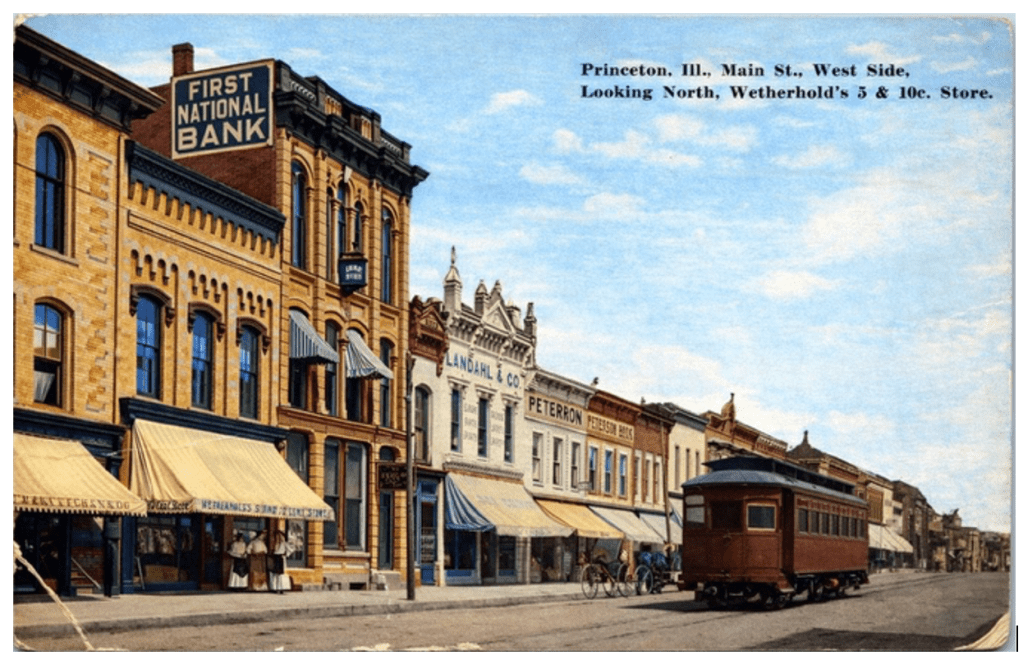
February 11 – March 11, 1906. Princeton, Illinois – Billy Sunday

From February 11 to March 11, 1906, evangelist Billy Sunday conducted a major revival campaign in Princeton, drawing sustained crowds and producing significant conversion totals that reinforced his growing reputation as one of the most effective evangelists in the Midwest. A temporary tabernacle seating approximately 3,600 people was filled nightly, indicating the strong regional interest in Sunday’s preaching and the extensive cooperation of local churches.

The meetings quickly produced measurable results. One report noted 919 conversions in a single day on February 24, illustrating the intense response often seen at the height of Sunday’s campaigns. Despite severe winter weather—including one of the worst storms of the season on March 3—attendance and participation remained strong. By March 8, newspapers reported 1,298 converts, and by the close of the revival on March 11, the total number of recorded conversions had reached 2,325.

Contemporary observers described the atmosphere in Princeton as spiritually charged. A visiting pastor reported that the “city was aflame with the revival spirit,” while others praised Sunday’s dynamic preaching style, likening his delivery to a “storm” or “cyclone” in its intensity. His methods, though sometimes criticized as sensational, were widely regarded by supporters as effective in reaching large audiences—especially men—who might otherwise avoid church.

The Princeton campaign also contributed to Sunday’s rapidly expanding influence across the region. Shortly afterward, newspapers noted that since October 1905 he had reportedly received about $12,000 in offerings and recorded 9,000 conversions, with 20,000 conversions attributed to his work across the Rock River Valley of Illinois. The Princeton meetings thus formed a significant chapter in the early expansion of Sunday’s evangelistic career.

Sources:
The Dixon Evening Telegraph, March 2, 1906, p. 5.
Bureau County Tribune (Princeton, IL), March 9, 1906, p. 3.
Freeport Journal-Standard (Freeport, IL), February 26, 1906, pp. 1, 5; March 8, 1906, p. 4.
Journal Gazette and Times-Courier (Mattoon, IL), March 19, 1906, p. 1.

Billy Sunday on the Chautauqua Circuit: The Brief but Notable Season of 1910

In the summer of 1910, Billy Sunday stood at an interesting crossroads in his rapidly expanding ministry. By this point he was already nationally known as one of America’s most electrifying evangelists. Cities across the country were beginning to build large tabernacles to accommodate the crowds that flocked to hear him preach. Yet during the summer months—when revival campaigns often paused—Sunday occasionally appeared on the Chautauqua circuit, the great American network of traveling lecture assemblies that combined education, entertainment, reform movements, and religion.

Unlike many lecturers who spent the entire season touring the circuit, Sunday’s 1910 Chautauqua schedule was surprisingly limited. He appeared only at a handful of assemblies, and his comments to the press make clear that this was intentional. Sunday had been offered lucrative opportunities to spend the entire summer lecturing. One newspaper reported that he declined an offer of $20,000 to devote the season to Chautauqua work, explaining that the exhausting schedule would leave him unable to conduct revival campaigns in the fall.

“The report that I am to retire is all pure nonsense… I refused $20,000 to give my time to Chautauqua work this summer, as I would be worn out and could not preach before January.”

Sunday’s priority remained evangelistic preaching. Nevertheless, the few Chautauqua appearances he did make during the summer of 1910 provide a fascinating glimpse into his growing national popularity and the remarkable drawing power he already possessed.


Whidbey Island: The Northwestern Chautauqua Assembly

Sunday’s Chautauqua engagements began on July 24, 1910, at the Northwestern Chautauqua Assembly on Whidbey Island, Washington.

At this gathering Sunday delivered a message titled “Forces that Win.” Like many of his sermons, it blended moral exhortation with vivid biblical storytelling. Reports indicate he illustrated his message with the story of David and Goliath, a favorite example of spiritual courage overcoming overwhelming odds.

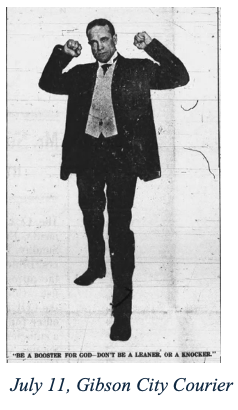
Even among the prominent lecturers and performers typical of a Chautauqua program, Sunday stood out. His dynamic speaking style—rapid delivery, colorful language, and dramatic physical movement—contrasted sharply with the more measured lecture format audiences often expected.


Hillsboro–Litchfield: A Midwestern Assembly

In early August Sunday appeared at the Hillsboro–Litchfield Chautauqua, running from August 4 through August 11. These regional Chautauqua assemblies usually featured a mixture of lectures, concerts, political discussions, and religious addresses.

Sunday’s presence on such programs reflected the growing recognition that he was not merely a revivalist but also one of the most compelling public speakers in the country.


Maxwelton, Washington: Crowds Even in Small Communities

On August 6, Sunday spoke at the Maxwelton Chautauqua in Washington, addressing a crowd estimated at 4,500 people.

The size of the audience is striking. Maxwelton itself was a small community, yet thousands gathered to hear Sunday speak. Even outside the large urban revival campaigns for which he would soon become famous, his reputation alone was enough to draw impressive crowds.


Patterson Springs: Record-Breaking Interest

Another Chautauqua stop came on August 10 at Patterson Springs. Newspapers noted that Sunday had previously delivered a lecture there that produced $3,600 in ticket receipts, reportedly a record for a single Chautauqua lecture.

This financial success reveals something important about Sunday’s role in the Chautauqua movement. He was not just a preacher filling a religious slot in the program. He was one of the circuit’s major attractions, capable of drawing large audiences and generating significant revenue.

Even so, Sunday resisted becoming primarily a Chautauqua lecturer. His heart remained in revival work.


Lake Whatcom: The “Human Interest” Lecturer

On August 24, Sunday appeared at the Washington Assembly Chautauqua near Lake Whatcom. Promotional material advertised him as delivering the program’s “human interest” lecture, a category that perfectly suited his style.

Sunday’s talks often mixed humor, storytelling, social criticism, and passionate moral appeal. He could move easily from a humorous anecdote to a blistering denunciation of vice, particularly the liquor trade. This blend of entertainment and moral seriousness made him an ideal Chautauqua speaker.


Richmond, Indiana: A Crowd of Eight Thousand

Sunday’s most dramatic Chautauqua appearance of 1910 came on August 28 at the Richmond, Indiana Chautauqua.

The crowd numbered roughly 8,000 people, and Sunday delivered one of his most famous temperance sermons, “Booze.”

Contemporary accounts describe a performance that was nothing short of theatrical. Once fully warmed up, Sunday removed his coat and launched into an explosive denunciation of the saloon. At one point he grabbed a red flag representing the liquor trade, hurled it to the ground, and stamped on it before triumphantly seizing the American flag to symbolize moral victory.

Such dramatic gestures were typical of Sunday’s style. Critics sometimes mocked them as stage tricks, but audiences loved them. They reinforced his reputation as the relentless enemy of alcohol and social vice.


Why the 1910 Season Was Short

One of the most interesting aspects of Sunday’s Chautauqua activity in 1910 is how limited it was.

Rumors circulated in the press that he might be retiring from public speaking altogether. In reality, the opposite was true. Sunday simply refused to devote the entire summer to the lecture circuit.

He explained that constant Chautauqua travel would leave him exhausted and unable to conduct the revival campaigns that he believed were his true calling. Instead, he used the summer months partly for rest and partly for select speaking engagements before returning to the intense schedule of fall revivals.

This decision proved wise. Later in 1910 Sunday conducted major campaigns in New Castle, Pennsylvania, and Waterloo, Iowa, drawing enormous crowds and recording thousands of conversions.


A Glimpse of Sunday’s Expanding Influence

Though brief, Billy Sunday’s 1910 Chautauqua season reveals several important aspects of his rising influence.

First, it demonstrates the extraordinary demand for him as a public speaker. Even isolated appearances drew crowds in the thousands.

Second, it shows that he was already a major figure in the reform movements of the era—especially the temperance crusade.

Finally, it highlights Sunday’s own priorities. While many speakers made their careers on the Chautauqua circuit, Sunday viewed it as secondary. His passion remained revival preaching and evangelism.

In hindsight, the summer of 1910 marks a moment when Billy Sunday could have easily become one of the most lucrative lecturers in America. Instead, he chose the harder path—returning to the sawdust floors of revival tabernacles and the exhausting pace of evangelistic campaigns.

And in doing so, he continued building the ministry that would soon make him the most famous evangelist in America.

The Circus That Tried to Hire Billy Sunday, c. 1917


And Why the Offer Destroys the Claim That He Preached for Money

One of the most common criticisms leveled against evangelist Billy Sunday is that he preached for money.

Critics point to the generous love offerings that were sometimes taken at the close of his revival campaigns and conclude that Sunday must have been motivated by financial gain. It is an easy accusation to make. But historical evidence tells a very different story.

One remarkable document from 1917 puts the matter in perspective.

On February 28, 1917, Billy Sunday received an extraordinary letter from the president of the United States Circus Corporation. The proposal was simple, bold, and almost unbelievable.

The circus wanted Billy Sunday to join the show.

Original 1917 contract. Grace College. Morgan Library.

The letter opened by reminding Sunday of the enormous audiences that circuses attracted:

“Did you ever pause to consider that from twelve to fifteen thousand persons go twice a day to enjoy the average first class circus performance?”

The promoter explained that the company was launching what he called a “Million-Dollar” motorized circus, equipped with fleets of specially designed trucks and trailers that would carry the show from city to city.

The scale was enormous. Tens of thousands of people attended circus performances daily.

And the circus president believed Billy Sunday could preach to them.

Then came the offer.

“I… offer you a weekly salary of $14,000, or $2,000 a day, for as many weeks of the coming summer season as you can give.”

To grasp how staggering this proposal was, consider the numbers.

If Sunday had accepted the offer and worked for roughly ninety to one hundred days during the summer season, he would have earned between $180,000 and $200,000 in 1917.

Adjusted for inflation, that is roughly $4 million today.

In return, the circus would provide transportation, luxury touring cars for Sunday and his staff, and access to massive crowds across the country.

The promoter even suggested that Sunday hold revival meetings on Sundays as part of the circus program.

But here is the crucial point.

The proposal made no provision for Sunday to keep offerings from those meetings. In fact, the letter suggested that the proceeds from Sunday services could go largely or entirely to charity.

The circus wanted Billy Sunday not as a fundraiser—but as an attraction.

A headline act.

A revivalist who could preach to the largest audiences in America.

And yet Billy Sunday refused.


The Economics of Sunday’s Real Ministry

Now compare this circus offer to the income Sunday actually received during the same years.

During the summer Chautauqua season, Sunday could deliver 50 to 70 speaking engagements.

Typical speaking fees ranged from $250 to $500 per engagement.

That means a strong Chautauqua season might produce:

  • $12,500 on the low end
  • $35,000 on the high end

Even at the very top of that range, the circus contract would have paid five to six times more.

In other words, if Billy Sunday had been motivated primarily by money, the decision would have been obvious.

He could have become the highest-paid religious speaker in America simply by joining a circus.

Instead, he chose the sawdust trail.

He chose the revival tabernacle.

He chose the ministry that demanded months of exhausting preaching, travel, prayer meetings, counseling, and organization.

And he did it for far less money than the circus was willing to pay.

Rare original Sparks Bros Circus photograph showing evangelist Billy Sunday and Charles Sparks.

Why the Critics Miss the Point

Billy Sunday never pretended that money did not matter. Revival campaigns required large temporary tabernacles, choirs, staff members, and enormous logistical efforts.

But Sunday consistently refused opportunities that would have turned his preaching into entertainment.

The 1917 circus contract proves it.

The entertainment industry was willing to pay him millions in today’s dollars to headline the largest traveling show in America.

He said no.

The same evangelist who was accused of preaching for money walked away from a fortune.

And that fact should cause us to reconsider the narrative that Sunday’s critics often repeat.

Billy Sunday may have been many things—a fiery preacher, a former baseball player, a relentless evangelist—but the historical record shows that he was not in the ministry merely for the money.

If he had been, the circus would have had its star.

Instead, the revival fires continued to burn.


Did you know?

“It may not be generally known, but ‘Billy’ Sunday supports a mission on Van Buren street, Chicago, paying all the expenses of maintaining it out of his own pocket. He is also educating twenty boys and paying for it with his own money. These boys are waifs he has picked up out of the street. In this he is following the plan of the late Sam Jones, who in his lifetime educated hundreds of poor boys and made useful citizens out of them.”

The Kalamazoo Gazette. Fri, Jul 23, 1909 ·Page 4

Billy Sunday receives bomb death threat while in Omaha in 1915

Curated from original Omaha Daily Bee newspaper

A sensational threat upon the life of Evangelist Billy Sunday, conveyed through a crudely written “black-hand” letter, stirred the city yesterday but failed to interrupt the progress of the revival meetings at the great tabernacle.

The warning, received through the mails on Wednesday, declared that a bomb would be hurled into the tabernacle at 2 o’clock Thursday afternoon, September 23, and that Sunday would be killed unless he departed the city within ten days. The missive, scrawled in poor handwriting across ordinary note paper, bore at its lower corner the drawing of a black hand and a crude sketch of a bomb connected to a clock marking the fatal hour.

The Billy Sunday Tabernacle. Omaha, Nebraska.

Authorities were immediately notified. Chief of Police Dunn detailed detectives to trace the author of the threat, and a vigilant watch was ordered about the tabernacle grounds. Secretary Mathews, who first examined the letter, refrained from alarming the evangelist and quietly placed the matter in the hands of the police.

Despite the ominous warning, the Thursday afternoon meeting proceeded without incident. A squad of detectives, led by Sergeants Patsk Havey and Tom Donahue, mingled with the crowd, keeping careful surveillance in anticipation of any attempt upon Sunday’s life.

If the threat was intended to deter attendance, it met with mixed success. Many curious men flocked to the tabernacle, drawn by the sensational report, while the number of women present was noticeably reduced. Total attendance fell below the usual mark. Yet inside, the service moved forward undisturbed—save for the innocent crying of a baby, whose presence, smuggled past ushers, proved the only interruption to the evangelist’s address.

Thus, what promised to be a day of danger passed into one of quiet defiance. The bomb did not appear. The preacher remained. And the revival, under the watchful eye of the law, pressed on.

Adapted from: The Omaha Daily Bee, September 23 and 24, 1915