Telephone wires, evolution, an English partnership, and a Pontiac woman’s $20,000 check. Twelve months that showed where the rest of the Sunday story was headed.
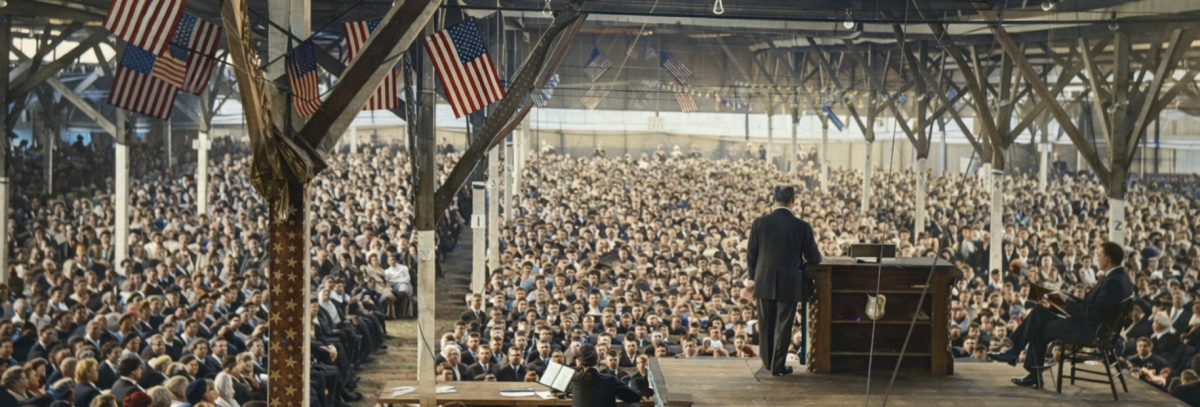
On a Sunday afternoon in mid-March 1904, somewhere in the wooden tabernacle at Sterling, Illinois, three telephone receivers sat on a wooden table in front of Billy Sunday’s pulpit. They were wired out to a regional operator. The operator in turn was wired out to telephones in 188 cities and towns across the upper Midwest. While Sunday preached one of his sermons that day — pacing, shouting, leaping — people in 188 places who had never seen him, and probably never would, listened to him preach in something like real time.
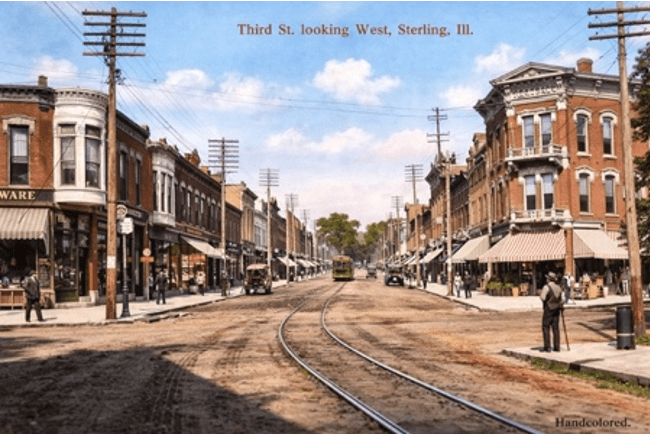
It is, as far as the record knows, the earliest broadcast preaching event in American religious history. Two decades before radio. Six decades before televised crusades. The St. Louis Post-Dispatch made it the lead detail of a March 20 feature. The Oquawka Spectator followed up three days later. The 41-year-old former baseball player, working a small Illinois town under canvas, had just done something no preacher in the country had ever done.
That was 1904 for Billy Sunday. Not a year of single milestones but a year of firsts — small ones, large ones, technical ones, theological ones, financial ones. By December he had preached his first public anti-evolution sermon, taken his first English-and-Australia booking inquiry, organized his first city-wide ministerial coalition that ended with the entire police force converted, and accepted a single $20,000 donation toward a new YMCA building — the equivalent of roughly $700,000 today. He was just six years out from his last baseball contract. He was about to enter the most consequential decade of his life.
Jefferson and Marshall: the year opens cold
The year began the way most of Sunday’s years began in this decade — in a cold-weather Iowa town, in a temporary tabernacle, on a four-week timetable. Jefferson, Iowa ran from mid-December 1903 through mid-January 1904. The 1,500-seat tabernacle hit standing-room-only capacity on the final night, when 2,600 people came. 107 conversions that single night alone. The published Sioux Falls and Sioux City papers noted Sunday’s $1,400 purse — defending it pointedly: “he gets well paid; it is only right and just.” A 100-voice choir under Fred G. Fischer carried the music.
The Marshall, Minnesota campaign that followed in late January and February drew over 600 converts in a town of just 2,088 people. Some papers claimed Sunday remained in Marshall until early March — but the records show he had to be in Sterling by February 11. The local editor’s dry note that “this doesn’t seem possible” gives us a small glimpse of how the Sunday road schedule looked to people watching it from the outside: punishing, implausible, relentless.
Sterling and the telephone
From February 11 to March 10, Sunday held his Sterling, Illinois campaign in a temporary tabernacle with a 200-voice choir. Over 35 days he preached 73 sermons. Total cumulative attendance came in around 160,000. Final conversion count: 1,678. Sunday’s purse: $3,275 — by far his largest to that point, three-quarters again the size of his previous Carthage record. The previous year’s $2,100 Carthage purse had been flagged as historic. The Sterling number meant the trajectory was real.
It was at Sterling that the telephone broadcast happened. The technology was straightforward in retrospect — long-distance telephone trunk lines were spreading across the upper Midwest in those years, and amplified speaker setups were beginning to appear in public meeting halls. What was unusual was the idea of using them to extend a single revival service across 188 separate towns simultaneously. No one had done it before. Sunday, never one to refuse a press opportunity, agreed to preach to whoever happened to be on the other end of the wires.
The campaign also drew its share of opposition. Flyers circulated in Sterling associating Sunday’s revival with the “wiles of the Devil.” The Rock Island Argus covered the controversy on March 4. Sunday seemed unbothered. The final-day conversion count, $3,275 purse, and 160,000 attendance figure suggested the flyers had not worked.
Galva and the YMCA tithe
Late March through early April Sunday spent at Galva, Illinois, in another tent tabernacle. The Galva numbers were smaller — $1,325 purse, 600 conversions — but the campaign produced a quietly important first. Sunday returned $900 of his $1,325 purse to the local YMCA. He paid Fred Fischer’s salary of $40 out of the same purse. Then he and Fischer left for Rockford with what remained.
This is the earliest documented case of Sunday voluntarily redirecting a substantial portion of his personal purse back into a community institution. Two-thirds of a Galva-size purse, given back. Not as expense-recovery, not as facility-construction, but as a direct gift to a local Christian organization Sunday wanted to support. The pattern would recur. At Galesburg in 1907 he would return $1,600 of his $6,340 purse to the local YMCA. At Winona Lake in 1909 he would donate $500 personally plus all his lecture fees. The Galva 1904 gift was the prototype.
Rockford and the first evolution sermon
From April 14 to May 17, Sunday preached at Rockford, Illinois in a tabernacle that measured 129 by 140 feet, with 5,000 seats. The campaign drew hundreds of people daily who could not get inside. The Sterling YMCA, seventy miles away, sent organized delegations of attendees. A Chautauqua auditorium had been proposed for the meetings; Sunday vetoed it and insisted on his own preferred tabernacle setup. The first documented case in the curated record of Sunday asserting venue control over a local committee. It would not be the last.
Across 50 services, 925 conversions came forward. But the historic note in the Rockford campaign was theological, not numerical. In a sermon during the campaign, Sunday went after the theory of evolution directly. The Quad-City Times of April 21 quoted him calling it “all rot” and a “damnable theory.” The Perry Chief of May 6 reported the same line.
This is, as far as the curated record shows, the earliest public anti-evolution sermon Sunday preached. It predates the major Modernist-Fundamentalist controversy by half a decade, and it predates the Scopes Trial — the moment that fixed anti-evolution preaching as a defining mark of conservative American Protestantism — by twenty-one years. By 1906 he would have a titled sermon for it: “Evolution a Sham.” But in April 1904, somewhere in a Rockford tabernacle, in the middle of a four-week revival campaign, he was already saying it out loud and the papers were already writing it down.
The Rockford campaign also drew opposition from a different direction. The Reverend J.F. Seedoff, a Lutheran pastor in town, preached against Sunday’s coming and gave the Muscatine News-Tribune a long quote: “How can Billy Sunday in a few weeks do what forty ministers are trying to do all the year around? It requires sensationalism… Stay away from Billy Sunday’s tent.” Sunday took no public notice. The 5,000-seat tabernacle filled anyway.
During Rockford, Sunday also played in a demonstration baseball game — possibly the first documented case of him using baseball as a public-relations vehicle for a revival campaign. Coverage spread to multiple regional papers. The ex-major-leaguer leveraged his old identity for the sake of his new one, and the press loved it.
Harvey and the converted police force
Late May through late June Sunday spent at Harvey, Illinois. The campaign produced 427 conversions. But the line that the Louisville Courier-Journal carried on June 20 was the line that traveled: Sunday had “converted the entire police force.”
The claim was probably exaggerated in detail and probably accurate in essence. Harvey was a small town of a few thousand people with a correspondingly small police department. A revival campaign that produced 427 conversions across six weeks would have plausibly captured most or all of the men carrying badges. But what the Courier-Journal headline did was give Sunday a story that could be reduced to a single sentence — and it traveled. By 1909, Spokane newspapers were reporting on Sunday’s revivals with similar headlines about converted firemen and converted police officers. Harvey 1904 invented the form.
Keokuk, an English overture, and the second call
The Keokuk, Iowa campaign ran from September 30 to October 31 in a tent tabernacle seating 2,500 to 3,000, on the corner of Main and Twelfth Streets. The conversion total was around 1,000. Sunday’s purse came in at $2,100. The Sunday October 23 service drew 13,000 attendees.
Two moments stand out. First, the Waterloo Courier of October 5 reported that Sunday’s schedule was now booked through January 1906, “when he may join an English evangelist for work in Great Britain and Australia.” This is the earliest documented suggestion that Sunday was considering an overseas ministry. He would never make that trip — but the fact that it was a serious public conversation in 1904 means his American profile had reached a tier where international tours were plausible options. Most American evangelists, then as now, never approached that tier.
The second moment came on the closing night, October 31. Sunday formally dismissed the meeting at the end of his service — and converts kept coming forward anyway. He extended the call. More came. Eventually he closed for the night. The detail is striking enough that it appeared in multiple papers. Anyone who has watched a Promise Keepers stadium event or a Franklin Graham crusade with a “second call” segment knows the moment intuitively. Keokuk 1904 is one of the earliest documented instances in Sunday’s career.
Two years later, in March 1906, the Mattoon Journal Gazette and Times-Courier published its multi-campaign stickiness analysis. Keokuk came in at 75 percent of its converts still “living the new life” — one of the strongest results in the entire study.
Pontiac and a $20,000 check
From November 5 to December 5, Sunday held a revival at Pontiac, Illinois, in a large temporary tabernacle seating 2,500. The campaign produced over 1,000 conversions. The Herald and Review of December 6 noted that “1,000 souls” had been saved.
But the financial story of the Pontiac campaign was extraordinary. A wealthy woman of Pontiac, attending the services, donated $20,000 toward a new YMCA building. In 1904 dollars. The equivalent of roughly $700,000 today. It is the single largest charitable gift documented in any Sunday revival in the curated record up to that point.
This is a different kind of revival economics than the Galva $900 YMCA gift from Sunday’s own purse seven months earlier. Galva had been about Sunday redirecting his compensation. Pontiac was about Sunday’s preaching catalyzing a major capital gift from an attendee. Both pointed at the same outcome — durable institutional change in the towns Sunday visited — but they reflected very different economic mechanisms. Both would shape Sunday’s revival approach for the next decade.
What 1904 was about
The 1902 essay framed that year as the moment Sunday’s preaching style locked into its mature form. The 1903 essay framed that year as quiet pivot — three foundations being laid for what was to come. The 1904 record reads differently from either. It is the year Sunday started taking positions on big subjects, in public, that he would carry for the rest of his career.
A position on technology. The Sterling telephone broadcast was not just a press stunt. It was a working model of using new technology to extend a single preaching event beyond its physical room. Sunday would never become a radio preacher in the systematic sense Charles Fuller or Aimee Semple McPherson did. But the 1904 Sterling moment showed he was completely comfortable being the test subject for whatever broadcast technology the period happened to offer.
A position on evolution. The Rockford anti-evolution preaching predates the Scopes Trial by two decades and the Modernist controversy by half a decade. By the time the rest of conservative Protestantism caught up to the evolution question, Sunday had been preaching against it for years. His Rockford lines — “all rot,” “damnable theory” — would, with relatively little modification, still be his lines in the 1920s.
A position on temperance and civic engagement. Harvey’s converted police force, Pontiac’s wealthy YMCA donor, Keokuk’s “second call” pattern: Sunday’s revivals in 1904 were starting to look less like devotional events and more like coordinated civic interventions. The institutional results — new YMCAs, new church buildings, transformed police departments — were the same kind of outcomes Centerville had produced in 1903, but on a larger scale and across more towns. He had found the formula. He was now applying it.
A position on his own scale. The casual reference to a possible English-and-Australia tour in October told you everything about where 1904 had put Sunday in the public mind. He was still preaching to towns of 2,000 to 5,000 people in southern Iowa and central Illinois. But he was also being talked about in terms of international evangelism. Both things were true at once, and 1904 was the year both became possible to say in print without anyone laughing.
By the time Sunday opened his Redwood Falls, Minnesota campaign in mid-December 1904, the trajectory he had been on since the Wheaton leap of 1902 was no longer ambiguous. The Chautauqua bookings would explode in 1905. The bigger purses were already coming. The audiences were already growing. And the positions he had taken in 1904 — on evolution, on civic engagement, on broadcast technology, on the size of his own ministry — were the positions he would still hold thirty years later.
1904 was the year Billy Sunday’s preaching grew up.
How to cite this post
Chicago: McNutt, Kraig. “The Year Billy Sunday Started Talking Back to the Modern World: 1904.” Evangelist Billy Sunday (1862–1935), June 9, 2026. https://evangelistbillysunday.com/2026/06/09/the-year-billy-sunday-started-talking-back-to-the-modern-world-1904/.
MLA: McNutt, Kraig. “The Year Billy Sunday Started Talking Back to the Modern World: 1904.” Evangelist Billy Sunday (1862–1935), 9 June 2026, evangelistbillysunday.com/2026/06/09/the-year-billy-sunday-started-talking-back-to-the-modern-world-1904/.
APA: McNutt, K. (2026, June 9). The year Billy Sunday started talking back to the modern world: 1904. Evangelist Billy Sunday (1862–1935). https://evangelistbillysunday.com/2026/06/09/the-year-billy-sunday-started-talking-back-to-the-modern-world-1904/
Turabian: McNutt, Kraig. “The Year Billy Sunday Started Talking Back to the Modern World: 1904.” Evangelist Billy Sunday (1862–1935). June 9, 2026. https://evangelistbillysunday.com/2026/06/09/the-year-billy-sunday-started-talking-back-to-the-modern-world-1904/.

 Evangelist Billy Sunday (1862-1935)