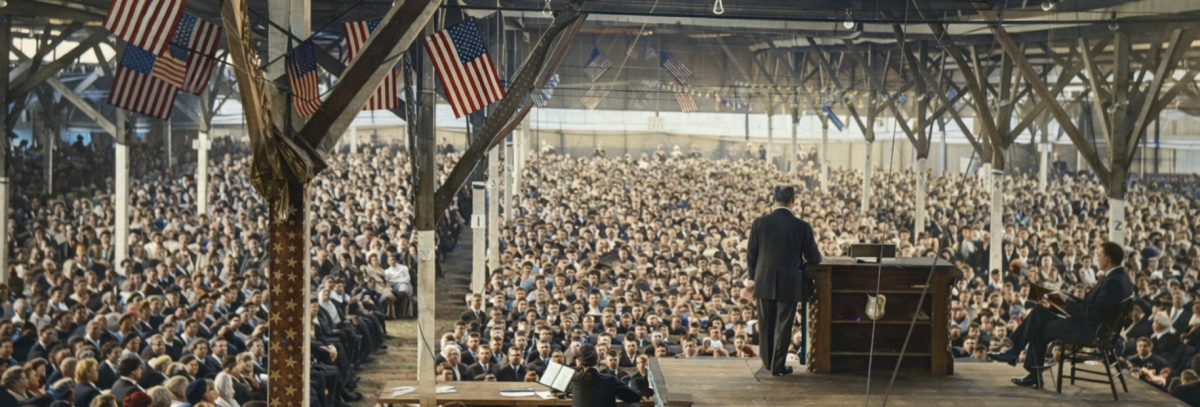
Three different ways Billy Sunday handled the journalists who came after him — and the prayer that became the most quotable single passage in the entire archive.
There was a small patent-inside newspaper in Brighton, Iowa — a town about fifteen miles southeast of Fairfield. Sometime in late April or early May of 1907, while Billy Sunday was preaching his Fairfield revival, the Brighton editors took it on themselves to publish a piece calling him a “grafter.”
“Grafter” in 1907 was a heavy word. It meant a fraud, a fake, a man who lined his pockets in religion’s name. The American press had spent the previous decade leveling the charge against figures like John Alexander Dowie, the Zion City prophet whose Illinois utopia had collapsed in 1906 under accusations of financial impropriety. To call a working evangelist a grafter in 1907 was to put him in Dowie’s category. It was a serious attack.
Lindsay Denison, the New York reporter writing his American Magazine piece from the Fairfield press table, watched Sunday hold the attack inside himself for three days. Denison noted that Sunday is “slow to discuss these criticisms of his comfortable income; he knows that he is likely to lose his temper.” For three days, Sunday said nothing publicly about the Brighton editors.
On the fourth day, he prayed about them. The prayer is worth reading in full:
Oh, dear Lord Jesus, save Fairfield! Bless Mount Pleasant, Stockport and Birmingham and Batavia and—er—bless— [the evangelist opened his eyes, turned around and in an ordinary conversational tone questioned his secretary]: What was that town we went to the other day, over there on the railroad, Honeywell? Oh, yes, Eldon. [Again closing his eyes and presuming the higher pitched tone of addressing the Almighty]—Bless Eldon, dear Lord, and Packwood and Richland and Pleasant Plain. And O dear Lord, if you think its any use, you might tackle those Brighton editors. But, dear Lord, be careful—take along a bottle of disinfectant. I don’t know as you can do much with them, Jesus, but if you think its worth while, try it, Lord, try it! And if you try it, here’s a pointer, Lord, wear rubber gloves.
Denison watched the Fairfield congregation react. “From the bowed heads,” he wrote, “there rolled up a queer smothered clucking sound, followed by a cheerful roar of amens mingled with fervent assurances: ‘Yes, Lord, that’s right.'” After the benediction, Denison mingled with the audience. Not one person complained about the wording of the prayer. Several came up to him to congratulate one another that “those ‘limbs of Satan had been set out like they deserved.'”
It was, in three sentences of public prayer, a complete demolition of the Brighton editors as community figures. Sunday had not named them. He had not described what they had written. He had not defended himself against the accusation. He had simply asked the Lord to consider taking them on, while warning Him to bring disinfectant and wear gloves.
Three ways to handle a press attack
The Brighton prayer is the middle entry in what was, by 1907, a small but distinguishable catalog of Sunday techniques for dealing with newspaper editors who came after him. Three different attacks, three different responses, all preserved in the contemporary record between July 1905 and August 1907.
Sterling, 1905: counterattack from the platform
In July of 1905, Sunday spoke at the Sterling, Illinois Chautauqua to fifteen thousand people — the largest audience of his platform career to that point. The previous year, an East Coast literary celebrity named Elbert Hubbard, editor of a magazine called The Philistine, had taken a public swipe at Sunday. The Hubbard piece had called him, among other things, a grafter.
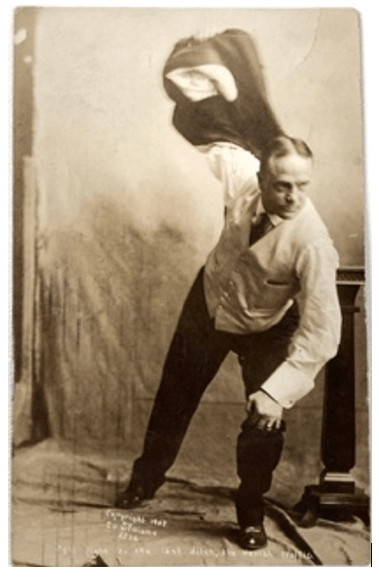
Sunday spent half of his two-hour Sterling talk on Hubbard. The Quad-City Times of July 17 carried the demolition in detail. Sunday, “coatless, vestless and with his sleeves rolled up to his elbows,” called Hubbard “good for nothing, indecent, pusillanimous, and a blot on humanity.” He called The Philistine “the result of the workers of the devil and a carbuncle on the neck of humanity.” Almost every sentence was applauded.
The Sterling response was Sunday’s first option. Direct counterattack. Loud, sustained, in front of the largest audience he could find, with the magazine and its editor named explicitly. The technique works when the attacker is famous enough that the audience knows who he is. Hubbard, at the height of his celebrity in 1905, qualified. The Sterling Chautauqua audience knew exactly what Sunday was demolishing, and they cheered it.
Brighton, 1907: weaponize the prayer
The Brighton editors were not Elbert Hubbard. They were small-town Iowa newspapermen running a patent-inside paper — the kind of publication that bought its inside pages pre-printed from a central syndicator and filled the front and back with local news. Their reach was a few hundred subscribers. The audience at the Fairfield tabernacle had probably mostly never heard of them.
A Sterling-style counterattack would have been wasted on opponents that obscure. Sunday’s second option was different: bring the attackers into the room without describing them, and let the audience’s communal sense of grievance do the work. The rubber-gloves prayer named no names and described no charges. It simply asked God to consider tackling “those Brighton editors” with appropriate sanitary precautions. The Fairfield audience knew, by the time Sunday said the word “Brighton,” exactly who he was praying about and why. They roared their assent.
The technique works when the attacker is too obscure to be worth a direct response but too local to be ignored. The prayer turns a personal grievance into a communal score-settling, with God as the agent. Sunday’s grievance becomes the audience’s grievance. The Brighton editors become a town joke. And the joke travels — first by word of mouth around southeast Iowa, and then, two months later, by national magazine. The American Magazine reached several hundred thousand readers in September 1907. Most of them had never heard of Brighton, Iowa. After September 1907, all of them had.
Charles City, 1907: ignore entirely
In mid-August of 1907, while Sunday was working the heaviest stretch of his Chautauqua summer schedule, the Charles City Herald published a long editorial attack on him. The Herald called his sermons “vile and sloppy” and his platform antics “what might be expected from a Comanche Indian.” It called him “a sideshow to the chautauqua.”
Sunday said nothing. The Charles City piece survives in the regional newspaper archive because other papers printed excerpts and the curated Sunday Master Speaking List preserves the citation. But Sunday himself, as far as the record shows, never publicly responded. No Sterling-style counterattack. No Brighton-style weaponized prayer. Just silence.
The third option works when the attacker is hostile enough that direct engagement would only amplify the attack. The Charles City editor wanted a fight. Sunday declined to give him one. The piece traveled only as far as a few regional papers and a few archived editorial columns. It was, in practical terms, a forgotten attack within months. By choosing not to respond, Sunday denied the editor the oxygen the editor was clearly looking for.
The pattern
By the summer of 1907 Sunday had worked out a usable approach to press attacks. Famous attackers got the Sterling treatment — counterattack from the largest platform available. Obscure local attackers got the Brighton treatment — communal score-settling through public prayer. Hostile but minor attackers got the Charles City treatment — silence and indifference. Each technique fit the situation, and Sunday applied them with a judgment that suggests he had thought about it more than he ever publicly admitted.
The Brighton prayer is the most readable of the three. It is also, in some ways, the most ruthless. The Sterling roast at least gave Elbert Hubbard the dignity of being named — and named at length, in front of a vast audience, with his magazine and his work specifically denounced. The Charles City silence at least gave the Herald editor the absence of a fight he was looking for. The Brighton editors got something different. They got Sunday’s wry humor turned on them in a community ceremony, with the entire Fairfield audience laughing along, with their professional integrity reduced to a recommended bottle of disinfectant and a pair of rubber gloves. They had wanted to call Billy Sunday a grafter. He had let them sit with the consequence of having said so.
The prayer also illustrates the side of Billy Sunday that biographers have always found hardest to capture. Sunday was a man who could be wounded by a small-town newspaper attack and who would hold the wound for three days before speaking. He was also a man who could turn that wound into a public prayer that the entire town would still be quoting weeks later. The Brighton editors had no idea, when they sat down to write their piece, that they were about to become a national-magazine joke in The American Magazine of September 1907. Sunday probably did not know either when he composed the prayer. But the prayer worked. It traveled. And the rubber gloves, more than a century later, are still doing their work.
Sources: Lindsay Denison, “The Rev. Billy Sunday and His War on the Devil,” The American Magazine, Vol. LXIV, No. 5, September 1907; Quad-City Times (Davenport, IA), July 17, 1905, p. 2; Charles City (IA) Herald, August 1907.
How to cite this post
Chicago: McNutt, Kraig. “The Brighton Editors and the Rubber Gloves, c. 1907.” Evangelist Billy Sunday (1862–1935), June 25, 2026. https://evangelistbillysunday.com/2026/06/25/the-brighton-editors-and-the-rubber-gloves-c-1907/.
MLA: McNutt, Kraig. “The Brighton Editors and the Rubber Gloves, c. 1907.” Evangelist Billy Sunday (1862–1935), 25 June 2026, evangelistbillysunday.com/2026/06/25/the-brighton-editors-and-the-rubber-gloves-c-1907/.
APA: McNutt, K. (2026, June 25). The Brighton editors and the rubber gloves, c. 1907. Evangelist Billy Sunday (1862–1935). https://evangelistbillysunday.com/2026/06/25/the-brighton-editors-and-the-rubber-gloves-c-1907/
Turabian: McNutt, Kraig. “The Brighton Editors and the Rubber Gloves, c. 1907.” Evangelist Billy Sunday (1862–1935). June 25, 2026. https://evangelistbillysunday.com/2026/06/25/the-brighton-editors-and-the-rubber-gloves-c-1907/.


