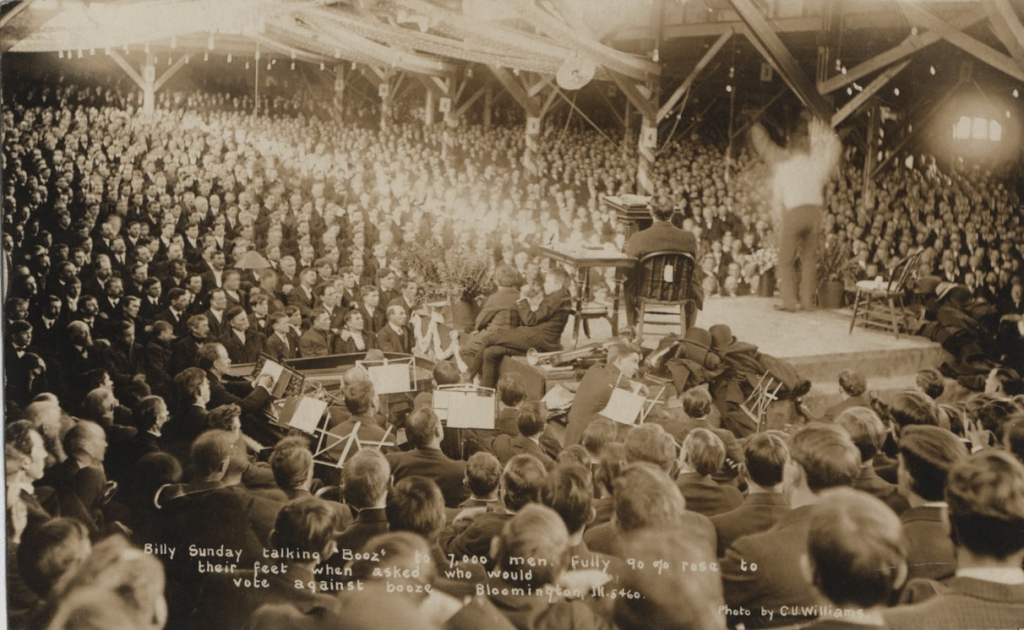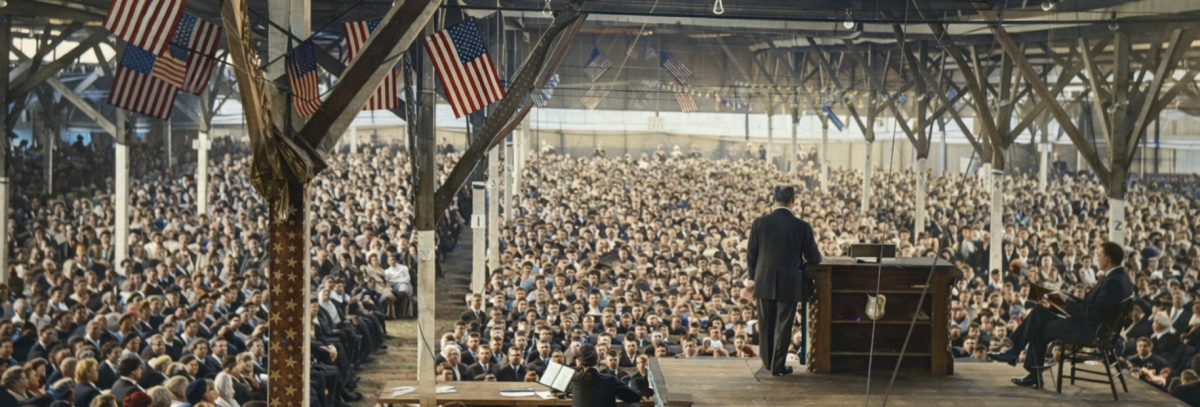
The Brighton editors and the rubber gloves, c. 1907

Three different ways Billy Sunday handled the journalists who came after him — and the prayer that became the most quotable single passage in the entire archive.

There was a small patent-inside newspaper in Brighton, Iowa — a town about fifteen miles southeast of Fairfield. Sometime in late April or early May of 1907, while Billy Sunday was preaching his Fairfield revival, the Brighton editors took it on themselves to publish a piece calling him a “grafter.”
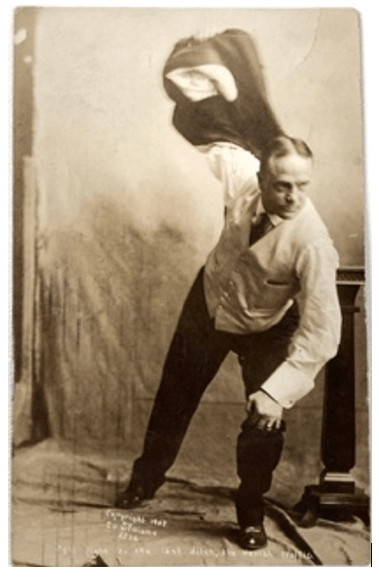
“Grafter” in 1907 was a heavy word. It meant a fraud, a fake, a man who lined his pockets in religion’s name. The American press had spent the previous decade leveling the charge against figures like John Alexander Dowie, the Zion City prophet whose Illinois utopia had collapsed in 1906 under accusations of financial impropriety. To call a working evangelist a grafter in 1907 was to put him in Dowie’s category. It was a serious attack.

Lindsay Denison, the New York reporter writing his American Magazine piece from the Fairfield press table, watched Sunday hold the attack inside himself for three days. Denison noted that Sunday is “slow to discuss these criticisms of his comfortable income; he knows that he is likely to lose his temper.” For three days, Sunday said nothing publicly about the Brighton editors.

On the fourth day, he prayed about them. The prayer is worth reading in full:

Oh, dear Lord Jesus, save Fairfield! Bless Mount Pleasant, Stockport and Birmingham and Batavia and—er—bless— [the evangelist opened his eyes, turned around and in an ordinary conversational tone questioned his secretary]: What was that town we went to the other day, over there on the railroad, Honeywell? Oh, yes, Eldon. [Again closing his eyes and presuming the higher pitched tone of addressing the Almighty]—Bless Eldon, dear Lord, and Packwood and Richland and Pleasant Plain. And O dear Lord, if you think its any use, you might tackle those Brighton editors. But, dear Lord, be careful—take along a bottle of disinfectant. I don’t know as you can do much with them, Jesus, but if you think its worth while, try it, Lord, try it! And if you try it, here’s a pointer, Lord, wear rubber gloves.

Denison watched the Fairfield congregation react. “From the bowed heads,” he wrote, “there rolled up a queer smothered clucking sound, followed by a cheerful roar of amens mingled with fervent assurances: ‘Yes, Lord, that’s right.'” After the benediction, Denison mingled with the audience. Not one person complained about the wording of the prayer. Several came up to him to congratulate one another that “those ‘limbs of Satan had been set out like they deserved.'”

It was, in three sentences of public prayer, a complete demolition of the Brighton editors as community figures. Sunday had not named them. He had not described what they had written. He had not defended himself against the accusation. He had simply asked the Lord to consider taking them on, while warning Him to bring disinfectant and wear gloves.

Three ways to handle a press attack

The Brighton prayer is the middle entry in what was, by 1907, a small but distinguishable catalog of Sunday techniques for dealing with newspaper editors who came after him. Three different attacks, three different responses, all preserved in the contemporary record between July 1905 and August 1907.

Sterling, 1905: counterattack from the platform

In July of 1905, Sunday spoke at the Sterling, Illinois Chautauqua to fifteen thousand people — the largest audience of his platform career to that point. The previous year, an East Coast literary celebrity named Elbert Hubbard, editor of a magazine called The Philistine, had taken a public swipe at Sunday. The Hubbard piece had called him, among other things, a grafter.

Sunday spent half of his two-hour Sterling talk on Hubbard. The Quad-City Times of July 17 carried the demolition in detail. Sunday, “coatless, vestless and with his sleeves rolled up to his elbows,” called Hubbard “good for nothing, indecent, pusillanimous, and a blot on humanity.” He called The Philistine “the result of the workers of the devil and a carbuncle on the neck of humanity.” Almost every sentence was applauded.

The Sterling response was Sunday’s first option. Direct counterattack. Loud, sustained, in front of the largest audience he could find, with the magazine and its editor named explicitly. The technique works when the attacker is famous enough that the audience knows who he is. Hubbard, at the height of his celebrity in 1905, qualified. The Sterling Chautauqua audience knew exactly what Sunday was demolishing, and they cheered it.

Brighton, 1907: weaponize the prayer

The Brighton editors were not Elbert Hubbard. They were small-town Iowa newspapermen running a patent-inside paper — the kind of publication that bought its inside pages pre-printed from a central syndicator and filled the front and back with local news. Their reach was a few hundred subscribers. The audience at the Fairfield tabernacle had probably mostly never heard of them.

A Sterling-style counterattack would have been wasted on opponents that obscure. Sunday’s second option was different: bring the attackers into the room without describing them, and let the audience’s communal sense of grievance do the work. The rubber-gloves prayer named no names and described no charges. It simply asked God to consider tackling “those Brighton editors” with appropriate sanitary precautions. The Fairfield audience knew, by the time Sunday said the word “Brighton,” exactly who he was praying about and why. They roared their assent.

The technique works when the attacker is too obscure to be worth a direct response but too local to be ignored. The prayer turns a personal grievance into a communal score-settling, with God as the agent. Sunday’s grievance becomes the audience’s grievance. The Brighton editors become a town joke. And the joke travels — first by word of mouth around southeast Iowa, and then, two months later, by national magazine. The American Magazine reached several hundred thousand readers in September 1907. Most of them had never heard of Brighton, Iowa. After September 1907, all of them had.

Charles City, 1907: ignore entirely

In mid-August of 1907, while Sunday was working the heaviest stretch of his Chautauqua summer schedule, the Charles City Herald published a long editorial attack on him. The Herald called his sermons “vile and sloppy” and his platform antics “what might be expected from a Comanche Indian.” It called him “a sideshow to the chautauqua.”

Sunday said nothing. The Charles City piece survives in the regional newspaper archive because other papers printed excerpts and the curated Sunday Master Speaking List preserves the citation. But Sunday himself, as far as the record shows, never publicly responded. No Sterling-style counterattack. No Brighton-style weaponized prayer. Just silence.

The third option works when the attacker is hostile enough that direct engagement would only amplify the attack. The Charles City editor wanted a fight. Sunday declined to give him one. The piece traveled only as far as a few regional papers and a few archived editorial columns. It was, in practical terms, a forgotten attack within months. By choosing not to respond, Sunday denied the editor the oxygen the editor was clearly looking for.

The pattern

By the summer of 1907 Sunday had worked out a usable approach to press attacks. Famous attackers got the Sterling treatment — counterattack from the largest platform available. Obscure local attackers got the Brighton treatment — communal score-settling through public prayer. Hostile but minor attackers got the Charles City treatment — silence and indifference. Each technique fit the situation, and Sunday applied them with a judgment that suggests he had thought about it more than he ever publicly admitted.

The Brighton prayer is the most readable of the three. It is also, in some ways, the most ruthless. The Sterling roast at least gave Elbert Hubbard the dignity of being named — and named at length, in front of a vast audience, with his magazine and his work specifically denounced. The Charles City silence at least gave the Herald editor the absence of a fight he was looking for. The Brighton editors got something different. They got Sunday’s wry humor turned on them in a community ceremony, with the entire Fairfield audience laughing along, with their professional integrity reduced to a recommended bottle of disinfectant and a pair of rubber gloves. They had wanted to call Billy Sunday a grafter. He had let them sit with the consequence of having said so.

The prayer also illustrates the side of Billy Sunday that biographers have always found hardest to capture. Sunday was a man who could be wounded by a small-town newspaper attack and who would hold the wound for three days before speaking. He was also a man who could turn that wound into a public prayer that the entire town would still be quoting weeks later. The Brighton editors had no idea, when they sat down to write their piece, that they were about to become a national-magazine joke in The American Magazine of September 1907. Sunday probably did not know either when he composed the prayer. But the prayer worked. It traveled. And the rubber gloves, more than a century later, are still doing their work.

Sources: Lindsay Denison, “The Rev. Billy Sunday and His War on the Devil,” The American Magazine, Vol. LXIV, No. 5, September 1907; Quad-City Times (Davenport, IA), July 17, 1905, p. 2; Charles City (IA) Herald, August 1907.

How to cite this post

Chicago: McNutt, Kraig. “The Brighton Editors and the Rubber Gloves, c. 1907.” Evangelist Billy Sunday (1862–1935), June 25, 2026. https://evangelistbillysunday.com/2026/06/25/the-brighton-editors-and-the-rubber-gloves-c-1907/.
MLA: McNutt, Kraig. “The Brighton Editors and the Rubber Gloves, c. 1907.” Evangelist Billy Sunday (1862–1935), 25 June 2026, evangelistbillysunday.com/2026/06/25/the-brighton-editors-and-the-rubber-gloves-c-1907/.

APA: McNutt, K. (2026, June 25). The Brighton editors and the rubber gloves, c. 1907. Evangelist Billy Sunday (1862–1935). https://evangelistbillysunday.com/2026/06/25/the-brighton-editors-and-the-rubber-gloves-c-1907/

Turabian: McNutt, Kraig. “The Brighton Editors and the Rubber Gloves, c. 1907.” Evangelist Billy Sunday (1862–1935). June 25, 2026. https://evangelistbillysunday.com/2026/06/25/the-brighton-editors-and-the-rubber-gloves-c-1907/.
The Gibson City decision, c. 1907

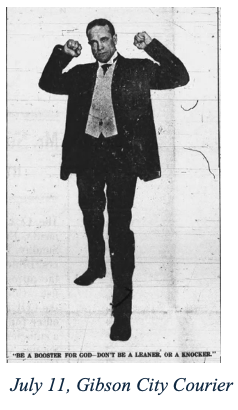
In the summer of 1907, Billy Sunday’s son was born on the opening day of a revival. A few weeks later, in the middle of the same revival, his brother died. Sunday did not go to the funeral.

Gibson City, Illinois was a small Ford County town of about twenty-five hundred people. In the summer of 1907 the local committee invited Billy Sunday to hold a revival, and the campaign opened on Thursday, June 13. The town had built a temporary tabernacle. The choir had been organized. The cottage prayer meetings had been running for weeks. By the time Sunday left Gibson City a month later in mid-July, more than eleven hundred people would have come forward as converts and Sunday’s purse would come in at thirty-six hundred dollars — entirely standard numbers for a Sunday revival by 1907.

What was not standard was what happened to the Sunday family during those four weeks.

A son and a brother

On the opening day of the Gibson City campaign — June 13, 1907 — Helen Sunday gave birth to a son. They named him Paul. Helen and the baby were in Chicago. Billy was in central Illinois, standing on the platform of a tabernacle a hundred and fifty miles south of his wife and his newborn, preaching his opening sermon to a Gibson City audience that had been waiting for him for weeks.

A few weeks later, sometime in early July, a telegram reached him in Gibson City. His brother had died in Iowa. The funeral was being arranged.

There is no surviving record of which brother it was, or what he died of, or how old he was. The Sunday family records of this period are not detailed enough to recover those facts. What the contemporary newspaper record does confirm is that Sunday received the news in the middle of the Gibson City campaign, and that he made the decision not to leave for the funeral.

He stayed. He preached.

What he gave up

The Gibson City campaign also cost Sunday something else that summer. He had declined several Chautauqua bookings to do the revival. In 1907 the Chautauqua circuit was where Sunday was earning the bulk of his summer income — he would deliver eighty-six lectures that season for about forty-three thousand dollars in total, the equivalent of more than a million and a half dollars today. By choosing a four-week revival in a town of twenty-five hundred people in the middle of his peak earning season, he was knowingly giving up a substantial piece of his year.

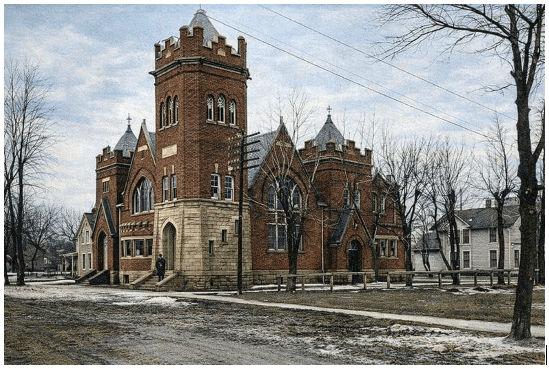
Gibson City, ILL. Presbyterian Church. C. 1910

The Gibson City committee had asked for him. He had said yes. By the time the campaign opened on June 13 he had committed to staying. His son’s birth on that opening day did not change the commitment. His brother’s death a few weeks later did not change it either. The Iowa Lyceum Bureau had sued him for breach of contract back in late June for missing a single Chautauqua date he had walked away from in order to extend a different revival. Sunday’s defense in that lawsuit had been straightforward: his evangelistic work, he said, ought to have preference over Chautauqua dates.

Gibson City was the same principle applied. Sunday had given a town his word. He kept it. The town got him for four weeks. His family did not.

What he preached

Two sermons from the Gibson City campaign were transcribed in regional newspapers in August and so survive into the record. One was based on a verse from the Gospel of John, chapter seven, verse seventeen — “If any man will do his will, he shall know of the doctrine, whether it be of God, or whether I speak of myself.” It was a sermon about willingness, about the believer’s choice to step forward. The other, transcribed a week later, was a sermon titled simply “Hell.”

Neither sermon mentioned the brother. Neither sermon mentioned the baby. Neither sermon mentioned the funeral Sunday had not attended. Whatever the inner cost of those four weeks was, Sunday did not preach it from the Gibson City platform. He preached, as he always did, on the standard themes — the willingness of the human heart, the reality of God’s judgment, the inescapability of the choice he was demanding his audience to make.

The Gibson City crowd would not have known. The newspaper editors who later transcribed and reprinted his sermons would not have known. The Champion Daily News of July 15, when it reported the close of the campaign with its eleven hundred converts and Sunday’s purse and the standard summary statistics, did not mention the brother or the baby. The only people who knew, that summer, were Sunday and Helen and a few members of the team.

The cost of saying yes

A few weeks after Gibson City closed, Sunday traveled to Joliet, Illinois to open the brand-new Chautauqua assembly at Dellwood Park. The auditorium was a new four-thousand-seat steel structure — the most expensive Chautauqua building in the country. Sunday spoke on the opening night, August 30, on a sermon titled “Grounders Hot Off the Bat.” A reporter for the Joliet Daily News watched him closely and wrote a piece the next day called “Billy Sunday As He Is, Spoke.” The piece is preserved in full and is hard to read in light of what had just happened to him a few weeks earlier:

He still looks more like a baseball player than a preacher, talks more in the manner of a heavy hitter than a gentleman of the cloth, and, judging from his frenzied utterances, thinks more like one as well. He works as hard on the stage as he ever did on the diamond, and his voice is worn nearly to shreds by long-continued gospel shouting.

The voice worn nearly to shreds. The hay fever that had been getting worse all summer. The dropped handkerchief in front of four thousand people. And then, at the end of his Joliet appearance, the announcement that Sunday made to the press: he was going to cut back on Chautauqua speaking after the season. The constant travel was eating into the rest he needed for his evangelistic work.

It is, in retrospect, the closest thing in the record to Billy Sunday saying out loud what Gibson City had cost him. The constant travel. The schedule. The yes-after-yes-after-yes to revival committees and Chautauqua bureaus and ministerial associations. The decision, made each time, to honor the commitment over the family. He did not, in fact, cut back in 1908. The summer Chautauqua schedule for the next year was already being booked. The big-city revivals were already being negotiated. The arc of his life had committed itself.

What we do not know

The historical record does not tell us what Helen said to Billy when she got to him after the Gibson City campaign closed. It does not tell us whether Billy made it to Iowa to see his brother’s grave that fall, or whether he ever did. It does not tell us how Paul’s first weeks of life unfolded in Chicago while his father was preaching a hundred and fifty miles away. It does not tell us what Sunday thought about, alone in his hotel rooms during the campaign, after the choir went home and Fred Fischer locked up the tabernacle and the Gibson City town fell quiet for the night.

What the record does tell us is that Sunday’s three other children — George, William Jr., and Helen, all of whom had been born in earlier years — would later grow up with a father who was almost never home. Paul, born on the opening day of the Gibson City revival, would grow up the same way. He would die young, in his twenties, in 1930 — twenty-three years after the campaign that opened on the day he was born.

All four Sunday children would, in different ways, struggle with the absence of their father during their childhoods. Three would predecease their parents. Helen and Billy outlived almost everyone they raised.

The Gibson City decision is in the record as just one moment among hundreds. The brother’s name does not survive. The funeral details are gone. The eleven hundred and fifty conversions and the thirty-six hundred dollar purse and the cottage prayer meetings are all preserved in the local Champion Daily News and the regional papers. The four weeks of Sunday preaching to the Gibson City audience while his newborn was in Chicago and his brother was being buried in Iowa are not preserved anywhere except in the gap between the dates.

He had said yes to the Gibson City committee. He kept his word. The committee got what they had been promised. He preached the campaign. He filled the tabernacle. He saw the conversions to the end. He drew his purse. He moved on to the next town.

It was a cost he chose to pay. It is also one of the quietest pieces of the Billy Sunday story, and one of the hardest to look at squarely. He paid it more than once.

Sources: Bloomington Weekly Pantagraph, June 14, 1907; The Davenport Daily Times, July 4 and July 17, 1907; The Joliet Herald News, July 9, 1907; Gibson City Courier, July 12, 1907; The Champion Daily News, July 15, 1907; The Joliet Daily News, August 31, 1907.

How to cite this post

Chicago: McNutt, Kraig. “The Gibson City Decision, c. 1907.” Evangelist Billy Sunday (1862–1935), June 23, 2026. https://evangelistbillysunday.com/2026/06/23/the-gibson-city-decision-c-1907/.

MLA: McNutt, Kraig. “The Gibson City Decision, c. 1907.” Evangelist Billy Sunday (1862–1935), 23 June 2026, evangelistbillysunday.com/2026/06/23/the-gibson-city-decision-c-1907/.

APA: McNutt, K. (2026, June 23). The Gibson City decision, c. 1907. Evangelist Billy Sunday (1862–1935). https://evangelistbillysunday.com/2026/06/23/the-gibson-city-decision-c-1907/

Turabian: McNutt, Kraig. “The Gibson City Decision, c. 1907.” Evangelist Billy Sunday (1862–1935). June 23, 2026. https://evangelistbillysunday.com/2026/06/23/the-gibson-city-decision-c-1907/.

Lindsay Denison goes to Fairfield. c. 1907

The summer a New York reporter boarded a train for southeast Iowa to find out what Billy Sunday actually did — and came back having seen something he had never seen at a Yale-Harvard boat race.

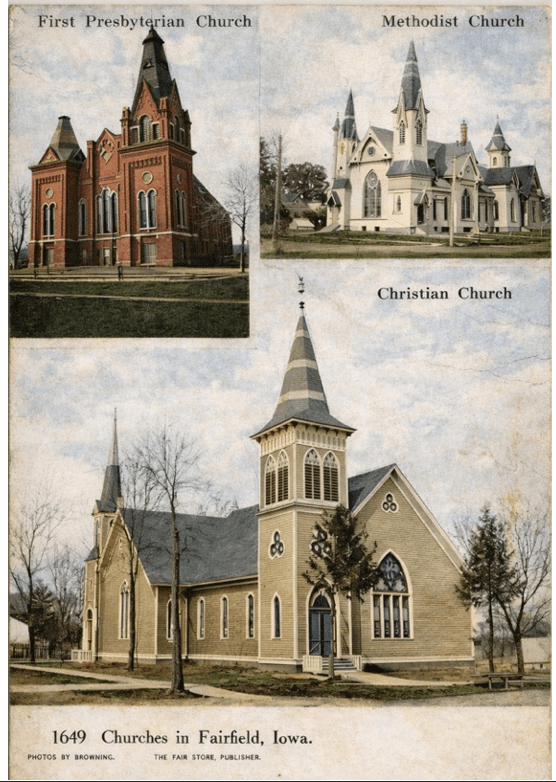
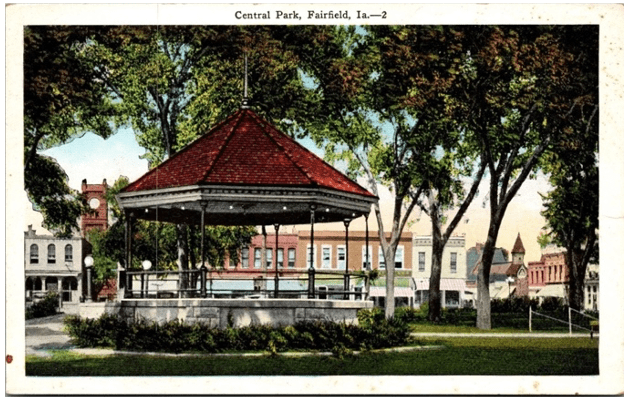
Sometime in April of 1907, a man named Lindsay Denison stepped off a train at the depot in Fairfield, Iowa. He had come from New York. He was a writer for The American Magazine, a glossy monthly with several hundred thousand readers — one of the major national magazines of the period. He had been sent to a southeast Iowa town of about five thousand people to write about a former major-league baseball player turned evangelist named William A. Sunday. The piece he eventually filed, titled “The Rev. Billy Sunday and His War on the Devil,” ran in the September 1907 issue as the magazine’s lead article. It is the longest and most carefully observed contemporary account of Billy Sunday’s revival method that survives from his pre-1910 ministry.

It is also one of the strangest things to read in 2026. Denison had walked into Fairfield as a sophisticated New York journalist expecting to write a polite ethnographic piece about Midwestern revivalism. He walked out having seen Sunday smash a chair on a platform to demonstrate a drunkard murdering his child, watched 1,118 people in a town of five thousand walk down an aisle to confess Christ, heard Sunday pray for newspaper editors who had called him a grafter — asking the Lord to “take along a bottle of disinfectant” and “wear rubber gloves” — and seen a closing-night service that he could only compare to the celebration after a Yale-Harvard boat race.

I have seen many a university foot-ball victory celebration; I have seen several riots of joy after a Yale-Harvard boat race; I was in the headquarters of District Attorney Jerome of New York when the word came, on election night, that he had beaten independently the candidates of all the regular parties. But I have never seen any crowd more beside itself than was the congregation of the tabernacle when that meeting was over.

It is one of the most extraordinary single sentences ever written about an American religious event. A national-magazine reporter putting a small-town Iowa revival closing service alongside the most famous celebrations of the early twentieth century — Yale-Harvard, an election-night district-attorney upset, the rolling crowds of Ivy League football season — and ranking it first.

A town and a reporter

Fairfield was not an obvious revival town. Denison described it carefully — and with the slight condescension that New York writers in 1907 reserved for Midwestern county seats — as “a little more conventional and a little less given to emotion in its enthusiasms than most towns of the great middle west.” It was prosperous, well-painted, and full of New England transplants who said “shawn’t” and “cawn’t” to one another at the curb. It was a prohibition town. It had Judson College. It had what Denison called “a sense of righteousness rather exceeding that of most New England villages.” Sunday himself had approached it with misgivings. He told the local committee that Fairfield was “likely to be a tough proposition” because it was already a town of church members.

Denison was no friend of revivalism going in. The Brooklyn-born reporter had been writing for The American Magazine since its 1906 founding and was part of the broader muckraker movement that included Ida Tarbell, Lincoln Steffens, and Ray Stannard Baker. The magazine was edited by men with very little patience for old-time religion. Denison arrived expecting to write a piece that would tell his New York readers what was actually happening in the small towns of the Mississippi Valley. He had no particular reason, before he arrived, to be impressed.

What he found in the tabernacle

The first sermon Denison heard, Sunday ripped off his coat, his waistcoat, his tie, and his collar. By the time it was over, the drops of sweat were flying from his brow and ears. The pulpit was being beaten on. The Devil was being execrated. Six weeks later, when the campaign closed, Denison had filled a notebook with what may be the most carefully transcribed Sunday sermon excerpts that survive from this period.

He watched Sunday do the long sermon on temptation, with Sunday playing the role of the Devil himself in the wilderness — “Are you the man that’s been going up and down the country passing as the Son of God?” — while pointing across the audience at a man who had spent sixty dollars on tobacco in two years while telling his wife he could not afford a new dress for her. He watched Sunday point at a different man and accuse him of buying alcohol “back of the drug store prescription counter” under the pretext of “buying medicine for the baby.” He watched a row of teenage boys slide down on their benches in modest panic when Sunday turned and called them out about “that girl over at Ottumwa.” He watched the seven Fairfield ministers — Methodists and Baptists and Presbyterians and the rest — first wince at the methods, then huddle to discuss whether to allow the revival to continue, and then, by the end, leap to their feet at Sunday’s call for the audience to “give Christ the Chautauqua salute.”

Most strikingly, Denison watched Sunday physically act out a Pentecost-era sermon about a Chicago workingman named George who came home drunk on a Saturday night, beat his wife unconscious on the bedroom floor while the little curly-haired baby cried “Papa, don’t hurt Mamma!” — and then, in Denison’s transcription, Sunday seized a chair from the platform, swung it over his head, smashed it down onto the floor to demonstrate the killing blow, and let the legs splinter as he gasped through the rest of the story. The same Sunday who would, on the closing day, be cheered for half an hour by three thousand people standing on their tables.

Rev. Pearse Pinch breaks first

The first Fairfield minister to fully convert to Sunday’s methods, as Denison documented him, was the Rev. Pearse Pinch of the local Congregationalist Church. At the close of one of the meetings he gave Denison a quote that is perhaps the cleanest single articulation in the entire archive of how a traditional Midwestern Protestant minister came to terms with Billy Sunday:

Why, my dear sir, the man has trampled all over me and my theology. He has kicked my teachings up and down that platform like a football. He has outraged every ideal I have had regarding my sacred profession. But what does that count, as against the results he has accomplished? My congregation will be increased by hundreds. I didn’t do it. Sunday did it. It is for me to humble myself and thank God for his help. He is doing God’s work. That I do know!

Pinch’s words capture the central tension of Sunday’s career better than perhaps any other contemporary statement. The man’s methods were impossible. His theology was, by most professional standards, embarrassing. He talked to people about God the way other people talked across a counter or a dinner table. And yet the results talked. The congregations grew. The deathbed conversions held. The drunkards stopped drinking. The new church members joined and stayed. By 1906 the published stickiness studies were showing 75 to 80 percent of converts still in the faith years later. Pearse Pinch could either keep his theology and watch his church empty, or trample on his theology and watch his church fill. He chose the second.

The Brighton editors prayer

The most quotable single passage Denison preserved from the Fairfield campaign was Sunday’s prayer about the editors of a small patent-inside newspaper in nearby Brighton, who had called him a “grafter” in print. The prayer is worth reading in full:

Oh, dear Lord Jesus, save Fairfield! Bless Mount Pleasant, Stockport and Birmingham and Batavia and—er—bless— [the evangelist opened his eyes, turned around and in an ordinary conversational tone questioned his secretary]: What was that town we went to the other day, over there on the railroad, Honeywell? Oh, yes, Eldon. [Again closing his eyes and presuming the higher pitched tone of addressing the Almighty]—Bless Eldon, dear Lord, and Packwood and Richland and Pleasant Plain. And O dear Lord, if you think its any use, you might tackle those Brighton editors. But, dear Lord, be careful—take along a bottle of disinfectant. I don’t know as you can do much with them, Jesus, but if you think its worth while, try it, Lord, try it! And if you try it, here’s a pointer, Lord, wear rubber gloves.

Denison watched the audience react to the prayer. “From the bowed heads there rolled up a queer smothered clucking sound, followed by a cheerful roar of amens mingled with fervent assurances: ‘Yes, Lord, that’s right.'” Mingling with the crowd after the benediction, he heard not one congregant complain about the wording. Several came up to him and congratulated each other “that those ‘limbs of Satan had been set out like they deserved.'”

It is the kind of prayer that should not work and yet, when you read it carefully in Denison’s transcription, exposes exactly how Sunday actually worked. The pause to consult his secretary on the name of a small town. The shift from conversational tone back into formal prayer cadence. The wry humor in the middle. The genuine pastoral concern for actual towns Sunday had visited and would visit again. And the closing flourish — the rubber gloves — that turned the whole prayer from polite Christian charity into the kind of communal score-settling that the Fairfield audience went home talking about. Sunday’s prayers, like his sermons, were never quite what the traditional pastors expected them to be. They worked anyway. They worked because they worked.

The closing service

The Fairfield campaign closed on a Sunday in May with three services: a morning meeting open to all, an afternoon meeting for men only (Sunday’s “Booze” sermon, drawing the entire local company of state militia in full uniform along with the workmen of the Iowa Malleable Iron Works), and a final night meeting. Denison sat through all three. The afternoon meeting produced eighty conversions, and Sunday’s preaching had been so effective that the next morning the two express companies in Fairfield had to report that three barrels of beer consigned to local citizens had been repudiated on delivery. The agents had written in the official remarks column of the delivery records: “Cause.—Influence of sermons of Rev. W. Sunday.”

The night meeting was something different. By six o’clock — a half hour before the doors opened — long streams of disappointed people were already trudging back to town in the rain because they could not get inside. The tabernacle was packed by people who had skipped supper. By the time Sunday closed the night with his sermon on “To-morrow” — the same sermon that, two years later, he would use to invent his signature closing call at Spokane — the audience was in a state that Denison described as “tense fervor” that made “the very air tingle.”

The conversions came from every direction. “Girls and old women; gray-bearded veterans and school boys in their first trousers; rich men and poor.” Denison watched Fred Seibert, the former cowpuncher who handled the Sunday operation’s logistics, drag a shy weak-faced boy down the aisle by his collar. He watched a shabbily dressed red-haired girl with her hat knocked askew run to the third bench and throw her arms around the boy’s neck, weeping. He watched Frederic Fischer, Sunday’s music director, organize the postservice singing into a kind of structured euphoria — first hymns, then whistled choruses, then the same melodies hummed.

When the final count came in — 1,118 souls won for Christ in the Fairfield campaign — Denison wrote down the comparison that has made his article unforgettable: he had never seen any American crowd more beside itself, not at Yale-Harvard, not at an election-night party headquarters, not at a college football victory.

“Bless our friend Denison”

The last public mention Sunday made of Lindsay Denison from the Fairfield pulpit came in the closing prayer at the final night meeting. Sunday had a habit of working through the towns and people he wanted to bless by name. The closing Fairfield prayer ran past the city marshals, the county officers, the doctors and lawyers, the grocers and dry goods merchants, the bankers, the livery men, the barbers, the blacksmiths, the newspaper men, the hotels, the schoolteachers, the restaurant keepers — and then:

Bless our friend Denison, who has come all the way from New York for THE AMERICAN MAGAZINE.

It is one of the more touching small moments in the entire Sunday archive. The evangelist taking a moment in the closing prayer of a six-week revival to ask God’s blessing on the New York reporter who had just spent a month sitting at the press table, watching Sunday do everything Sunday did, and writing it down for several hundred thousand American Magazine readers. Denison had come prepared to be a skeptic. Sunday treated him as a brother. And Denison, when he sat down to write his eight-thousand-word piece six weeks later, gave Sunday what may still be the fairest, most observant, and most affectionate full-length portrait of his preaching method that exists from his entire career.

What it meant

The Denison piece changed what Billy Sunday was. Until September of 1907, Sunday was a regional phenomenon — known across the upper Midwest, written up in the small county-seat papers and the regional dailies, occasionally noted in Chicago or St. Louis. After the American Magazine piece, he was a national figure. The magazine’s circulation reached hundreds of thousands of subscribers in every part of the country. Sunday’s name, his methods, his theology, his sermon excerpts, his prayer about the Brighton editors, his physical chair-smashing, his closing-night Yale-Harvard-grade audience euphoria — all of it now circulated in places that Sunday himself had never visited and would not visit for years.

The piece did not invent Billy Sunday. It documented him at exactly the moment when his career was about to scale beyond the small-town circuit and into the cities. The 1908 Sharon revival in Pennsylvania, the 1909 Spokane breakthrough, the great urban tabernacle campaigns of the 1910s — all of them were already coming, with or without the American Magazine. But the Denison piece is the closest thing we have to a definitive contemporary portrait of Sunday at the exact moment when his small-town method had been fully refined and was about to be deployed against the major American cities.

Lindsay Denison watched the whole thing for six weeks and went back to New York to write it up. He saw what he saw and he reported what he reported. The piece he filed is, more than a century later, one of the half-dozen most useful primary sources we have for understanding what Billy Sunday actually did in front of an audience. The chair-smashing. The rubber gloves prayer. The three barrels of beer returned to sender. The Yale-Harvard comparison. The Rev. Pearse Pinch acknowledging that his theology had been kicked around like a football and that he was going to thank God for it anyway.

Bless our friend Denison.

Source: Lindsay Denison, “The Rev. Billy Sunday and His War on the Devil,” The American Magazine, Vol. LXIV, No. 5, September 1907, illustrated with photographs by Masters of Princeton, Ill. and others. All direct quotations are from Denison’s article.

How to cite this post

Chicago: McNutt, Kraig. “Lindsay Denison Goes to Fairfield, c. 1907.” Evangelist Billy Sunday (1862–1935), June 21, 2026. https://evangelistbillysunday.com/2026/06/21/lindsay-denison-goes-to-fairfield-c-1907/.

MLA: McNutt, Kraig. “Lindsay Denison Goes to Fairfield, c. 1907.” Evangelist Billy Sunday (1862–1935), 21 June 2026, evangelistbillysunday.com/2026/06/21/lindsay-denison-goes-to-fairfield-c-1907/.

APA: McNutt, K. (2026, June 21). Lindsay Denison goes to Fairfield, c. 1907. Evangelist Billy Sunday (1862–1935). https://evangelistbillysunday.com/2026/06/21/lindsay-denison-goes-to-fairfield-c-1907/

Turabian: McNutt, Kraig. “Lindsay Denison Goes to Fairfield, c. 1907.” Evangelist Billy Sunday (1862–1935). June 21, 2026. https://evangelistbillysunday.com/2026/06/21/lindsay-denison-goes-to-fairfield-c-1907/.

“To-morrow”: Inside Billy Sunday’s Last Day in Fairfield

Seventh in a series drawn from Lindsay Denison’s profile of Billy Sunday in The American Magazine, September 1907.


By the final Sunday of the Fairfield revival, Billy Sunday had already brought nearly nine hundred people to a public profession of faith — more than any of the town’s ministers had believed possible. It would have been a triumph to stop there. Sunday had no intention of stopping. Lindsay Denison describes him on that last day as gripped by a fierce, almost savage zeal to gather in everyone still outside the fold.

What followed was, in Denison’s words, an unforgettable experience — and it makes the emotional climax of this whole series.

Three services in one day

Sunday’s custom was to preach three times on his final Sunday. The first, at half past ten in the morning, was open to all. The third, at night, was for everybody. In between came an afternoon service for men only — while Mrs. Sunday or one of the other helpers held a parallel meeting for women in one of the churches.

The men’s meeting, Denison thought, was in one sense the most impressive of the three. Much of the Fairfield company of the state militia sat on the platform in full uniform, many of them already Sunday converts. A great block of seats held the workmen of the Iowa Malleable Iron Works. The Odd Fellows, the Red Men, and the Woodmen filled reserved sections. The big barn-like room was packed wall to wall, with hundreds of men standing in the aisles.

The subject was “Booze.”

The banker who went first

When Sunday finished — whispering directions all the while to Honeywell about clearing the front benches to receive converts — he threw out the challenge: who would be the first to stand up for God and lead the way?

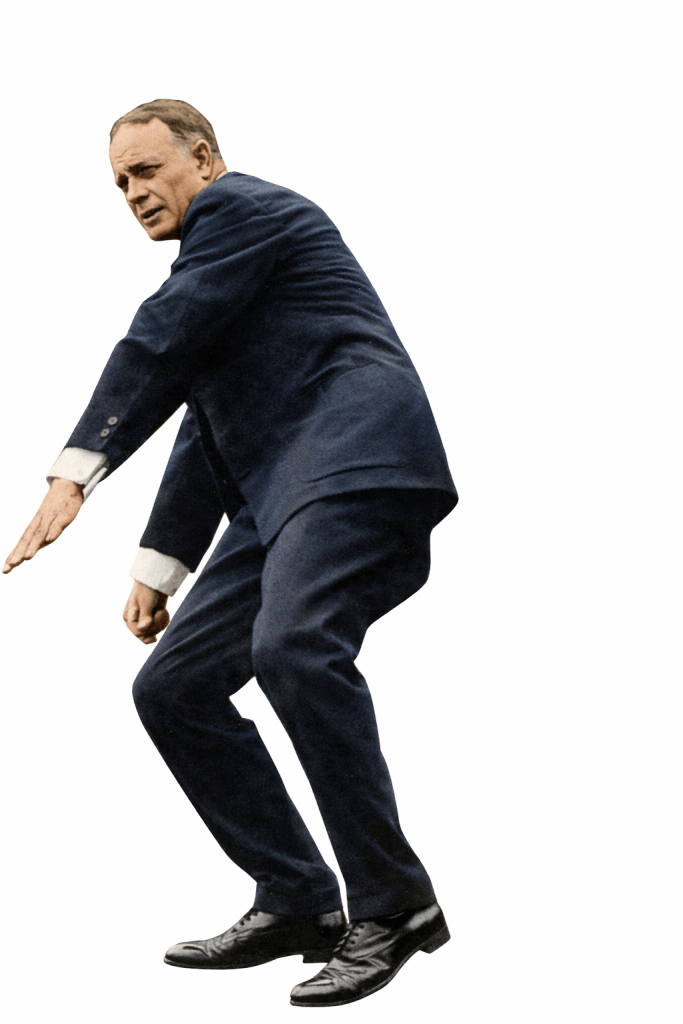
The answer came in a figure no one could miss. One of the town’s leading bankers rose and strode down the aisle, head erect and eyes shining, and behind him came farmers, storekeepers, lawyers, physicians, farm boys, and laborers. Sunday leaned far out over the edge of the platform, swaying his arms rhythmically as if to sweep the entire congregation forward with him, while the ministers and personal workers moved through the rows laboring with those still in doubt. Eighty men were converted in that single afternoon meeting.

The effect reached past the tabernacle walls. The next day, the agents of the two express companies had to report that three barrels of beer consigned to Fairfield citizens were refused on delivery — and in the “remarks” column of their paperwork, they noted the cause plainly: the influence of Sunday’s sermons.

A town that couldn’t get in

The crowds began gathering for the night meeting almost as soon as the men’s meeting let out, a little after four o’clock — though the evening service would not begin until half past six. By six, long streams of disappointed people were already tramping back downtown through the rain, having failed to get close enough even to hear Sunday’s voice.

Inside, the air itself seemed to tingle. Sunday, hoarse from a week of open-air preaching in the surrounding towns, could at times barely raise more than a husky whisper — yet every syllable carried. He spoke of how doubting parents and hesitating children might save one another, of the double blessing that came to anyone who brought a loved one out of the darkness, and, above all, of the nearness of death.

His text was a single word: To-morrow.

The veil and the coffin

The closing was vintage Sunday — fear wielded with terrible precision. To-night, he told them, when the last song was sung and the lights switched off and the tabernacle stood dark, the sinner’s chance would be gone. To-morrow, he warned, the doctor’s buggy might be standing at your gate, the family gathered with handkerchiefs to their eyes, the doctor turning to say, “He is gone.” Borrowing a line from the evangelist Moody, he pictured the unrepentant carried off as a corpse without Christ, in a coffin without Christ, to a grave without Christ. If only God would draw back the veil between a man and his own coffin, Sunday cried, he would leap back in horror to find it within arm’s reach. But you say “To-morrow.”

Then came the appeal, and the slow hypnotic sweep of his arms out over the benches. They came from every direction — girls and old women, gray-bearded veterans and schoolboys in their first long trousers, rich men and poor. Honeywell and the Rev. Mr. Cole ran up the aisles with arms outstretched to welcome them, while Sunday reached down to take each hand and give his blessing and the choir glided from hymn to hymn, sometimes humming, sometimes shouting in triumph.

The picture that stayed

Denison confesses that the reporters stopped taking notes. Everyone in the room was on his feet; some were standing on the tables. And out of the whole turmoil, he says, one small picture stood clear.

Fred Seibert had broken through the crowd at the back, dragging by the collar a weak-faced, loose-lipped boy — shambling along shamefaced but not unwilling. Sunday clapped him on the back; Honeywell settled him three rows from the front. Then, from a far corner on the left, came a muffled scream. A shabbily dressed girl came crowding out into the aisle and ran forward, tears streaming down her face, her hat knocked askew and her red hair hanging loose over her shoulder. She barely touched Sunday’s hand. She ran to the third bench, threw herself on the boy’s shoulder, wrapped her arms around his neck, and hid her face against his. She was still there, motionless, when a shout from another corner announced one more soul won.

Denison had seen college football celebrations, the riots of joy after a Yale–Harvard boat race, a famous New York district attorney’s election-night headquarters. He had never, he wrote, seen a crowd more beside itself than the Fairfield tabernacle that night.

The noise was formless until Fischer took hold of it and shaped it. There were a hundred surges toward the platform and Billy Sunday; people kept calling for three cheers for him. And when the final tally was announced — 1,118 Fairfield souls won from the Devil for Christ — it seemed, Denison wrote, as though the very roof were tugging at its rafters.


Next in the series: What 1907 Tells Us About the Rise of Billy Sunday — a closing reflection.

What 1907 Tells Us About the Rise of Billy Sunday

Last in a series drawn from Lindsay Denison’s profile of Billy Sunday in The American Magazine, September 1907.


Over the past seven posts, we’ve followed Lindsay Denison’s 1907 profile through a single revival in a single Iowa town — the conversion on a Chicago curb, the footrace that tested it, the plain-English preaching, the carnival-bright music, the money and the “grafter” charge, and the overwhelming final day in Fairfield. It remains to ask what the whole thing meant, and where it sat in the larger story of the man.

Denison asked the same question, and his answer is the most quietly important passage in the article.

“Merely a repetition”

The Fairfield revival, for all its drama, was not unique. It was, Denison wrote, merely a repetition of scenes that had already played out in a score of towns across Iowa, Illinois, Wisconsin, Minnesota, and Colorado — and that scores more towns in those states would yet know. Sunday’s calendar was booked solid three years ahead, and organizations both religious and secular kept coming to beg a place on his “future list.”

In other words, what a New York reporter had traveled west to witness as a marvel was, by 1907, already Billy Sunday’s settled routine. He had a circuit, a method, a company, a system — and a waiting list.

A small part of something larger

Then Denison widened the lens in a way that reframes everything. Sunday, he insisted, was really only a small part of a much broader spiritual ferment moving through the middle of the country. From Pittsburgh to Denver, from Duluth to New Orleans, the impulse to read the Bible, to pray, and to enlist one’s neighbors in the Christian army was spreading and growing more intense.

Sunday was not the whole movement. He was its most spectacular general. And what the movement would ultimately come to, Denison declined to predict — it was, he said, no part of his business to guess.

But, he added, it was worth watching.

Caught at the threshold

That line is the reason this 1907 article rewards a closer look. Read it carefully and you realize Denison was describing a man on the cusp.

Consider the geography of the situation. Sunday’s actual labors were confined to small towns in the rural Midwest — Fairfield had about five thousand people; he moved on from it to Knoxville, another small Iowa town, after only four days’ rest. Yet here was a national magazine, based a thousand miles east, sending a reporter “all the way from New York,” as Sunday noted in his own closing prayer, to explain this Midwestern phenomenon to readers who had likely never heard of him.

That gap — between where Sunday worked and who had now come to write about him — is the signature of a regional figure crossing into national awareness. The article is not documentation of a man already at the summit. It is an early national notice of a man about to climb one, arriving just before the ascent steepened. The largest and most famous campaigns of his career, the ones in major cities that would make him a household name, still lay ahead. In 1907 he was an extraordinarily successful small-town evangelist whom the wider country was just beginning to discover.

In that sense, Denison’s “worth watching” was better advice than perhaps even he knew.

The defense of plain language

Denison closed his profile not with a prediction but with a defense — and it is a fitting note to end this series on, too.

To most readers, he acknowledged, the methods seemed impossible to take seriously as religion: the circus-freak ushers and concert-hall tunes, the shirt-sleeve oratory and melodramatic impersonation, the Scripture rendered into a traveling salesman’s slang. These were not the means by which most people imagined the souls of the world would be won.

And yet, Denison reminded his readers, there had once been those who looked down on the plain speech of the Apostle Paul. The Saviour himself had rebuked the people who clung to their own traditions while rejecting the commandment of God. Denison let the apostle have nearly the last word, citing Paul’s declaration that God had chosen the foolish and the weak and the despised things of the world to confound the wise and the mighty.

It is the deepest defense of Billy Sunday in the whole article, and it goes well beyond results. The argument is not merely that the crude methods worked. It is that crudeness, plainness, even foolishness in the eyes of the refined had always been one of the ways the gospel reached people — and that the genteel critics wincing in the front rows of the tabernacle were standing, whether they knew it or not, in a very old tradition of standing in the way.

A snapshot worth keeping

That is what makes this 1907 article such a valuable document. It catches Billy Sunday whole, at a hinge moment — the ballplayer fully transformed into the preacher, the method fully formed, the national spotlight just beginning to swing his way.

A century and more later, we know what Denison could only sense: that the man on that platform in Fairfield was at the beginning of one of the most remarkable rises in American religious history. He told us it was worth watching.

He was right.


This concludes the series on Lindsay Denison’s 1907 American Magazine profile of Billy Sunday. Thank you for following along.

The year that broke Billy Sunday: 1907

A brother’s funeral he could not attend. A newborn son. A lawsuit. A carriage wreck. A converted entire police force. And the summer he finally said enough.

On a day in early July of 1907, somewhere in the Gibson City, Illinois tabernacle, Billy Sunday was handed a telegram. His brother had died. The funeral was being arranged in Iowa. The Gibson City revival was three weeks deep and at the height of its drawing power. The local committee had paid for the tabernacle, organized the choir, raised the expenses, and was counting on him to finish.

Sunday did not go to the funeral. He stayed and preached.

Within a few weeks of that decision, his wife Helen would give birth to their son Paul. The baby was born on the opening day of the Gibson City campaign. Sunday had been there for neither the birth of his son nor the death of his brother. He had been on a platform.

By the end of August he would, for the first time in his career, announce that he intended to cut back on the work that had taken him from those two events. He would announce it from a 4,000-seat steel auditorium in Joliet, Illinois at the close of a Chautauqua season that had seen him deliver eighty-six lectures in roughly thirty different towns and earn the equivalent, in 2026 dollars, of about a million and a half dollars. He was forty-four years old. He had been running this schedule for eleven years. He was, by the contemporary newspaper record, the highest-paid evangelist in America. And he was exhausted.

Kankakee in winter

The year began at Kankakee, Illinois — a town of about fifteen thousand people in the Illinois prairie, an hour south of Chicago. The campaign ran from mid-January through the middle of February in a four-thousand-seat tabernacle with a three-hundred-and-fifty-voice choir.

The Streator Times of January 26 published an extended excerpt from one of his sermons under the heading “Rev. Billy Sunday Defines What He Terms Society of the Present Day.” It was an extraordinary piece of Sunday writing, full of the period’s sense that something was slipping in American life. He drew a contrast between the brilliant drawing rooms of society women playing progressive euchre and the back rooms of “stale beer joints” where four “blear-eyed, vermin-covered old soaks” played penny ante. Then he delivered the line that the Times made sure to print:

I fear that cursed gang of society more than I do all the town loafers in that beer joint.

It was a long way from the cheerful baseball-evangelist anecdotes that had filled the Chautauqua dates the summer before. Sunday at Kankakee was in his serious mode — a working revivalist preaching for six weeks straight to crowds of three and four thousand in subzero Illinois cold, naming evils he could see in the towns he was visiting.

Spring in southern Illinois and Iowa

From late February through May, Sunday worked his way through southern Illinois and Iowa. Murphysboro for six weeks. Fairfield, Iowa for five. Knoxville, Iowa for five. Each campaign followed the same pattern: a temporary tabernacle, a choir of two or three hundred voices, a six-week timetable, and a thousand or more conversions by the closing service.

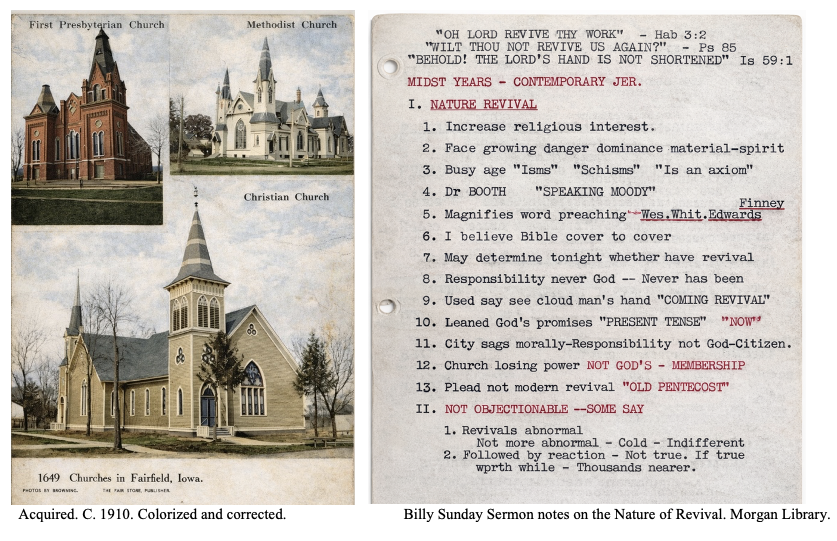
Fairfield produced what may be the most detailed single-day sermon record in Sunday’s pre-1910 career. On Sunday, April 28, he preached three separate sermons in a single day — morning, afternoon, and evening — each anchored on a different text. Earlier that month he had opened the Fairfield campaign with a sermon called “Revive Us Again.” It was the kind of Sunday-disciplined preaching that the Chautauqua circuit never quite asked of him. Four sermons in a row from four different texts. He could still do it.

The Knoxville campaign produced sixty sermons in five weeks and a thousand cards signed. It also produced a small but telling detail in the local paper: someone who had been converted during the campaign was sent to an asylum shortly after. The Sunday revival method, for all its successes, had limits that the campaign committees did not always discuss publicly. The Iowa newspaper noted the case and moved on.

Gibson City

From mid-June through mid-July, Sunday preached at Gibson City, Illinois — a small Ford County town of about twenty-five hundred people. The revival drew over a thousand conversions. Sunday’s purse came in at thirty-six hundred dollars. The economic terms by 1907 were no longer remarkable for him; they were standard.

What made Gibson City unforgettable in the Sunday family record was that it bracketed both ends of life. Paul Sunday was born on the first day of the campaign. Sunday’s brother died near its midpoint. Sunday declined several Chautauqua offers in order to finish the campaign — a sign that the revivals still had first claim on his schedule even as the Chautauqua money grew larger. But his brother’s funeral was the cost of finishing.

There is no surviving record of what Sunday said about it publicly. Two sermons from the Gibson City campaign — one on John 7:17 and one titled simply “Hell” — were transcribed in the regional press over the next month. The papers ran them as significant sermons, the kind worth preserving. Neither sermon mentioned the brother, the baby, or the funeral Sunday had missed. Whatever he was carrying that summer, he was carrying it on the platform.

The lawsuit

On June 28, Sunday was supposed to be in Des Moines, Iowa, opening a slot at the Midland Chautauqua. He did not show. The Iowa Lyceum Bureau, which had booked him, sued him for five thousand dollars for breach of contract. Newspapers picked the story up immediately. Quad-City Times, Des Moines Register, Richmond Item.

Sunday’s defense, when he gave it, was straightforward. His evangelistic work, he said, ought to have preference over Chautauqua dates. If a revival ran long, or a town needed him for an extra week, he was going to honor that. The Chautauqua bureau could sue him if it wanted to.

The case never went anywhere notable in the public record. But the spectacle of it was something new. Sunday was no longer just an itinerant preacher who could be expected to keep his commitments because his name and reputation depended on it. He was now a commercially booked entertainer with contracts that could be litigated. The Iowa Lyceum Bureau had not bought a sermon. It had bought a calendar slot. And when Sunday treated the slot as flexible, the Bureau treated the contract as enforceable.

The lawsuit told you something else about where Sunday’s life had gone. He had become the kind of person who could be sued.

The 86-lecture summer

Once the Gibson City revival ended in mid-July, Sunday’s Chautauqua summer began. By the time it ended at Joliet at the end of August, he had spoken at roughly thirty different towns across Illinois, Iowa, Indiana, Wisconsin, Ohio, and Missouri. The eighty-six lectures total was reported later, in a July 1910 retrospective, and the figure is so large that it strains belief — until you do the arithmetic. About six weeks of summer Chautauqua. Two or three talks at most stops. A few sites where Sunday spoke five or six times across a week. The number works out.

The bookings paid roughly forty-three thousand dollars in 1907 dollars. In current dollars, perhaps a million and a half. After bureau commissions and travel expenses, perhaps a million two. Most of this came in checks of two hundred to three hundred dollars per lecture, occasionally rising to five hundred or six hundred when the local committee had organized a special gate. By Bryan’s standards as a Chautauqua speaker, the rate was modestly higher. By any other measure, the figure was staggering.

Two of the eighty-six lectures took place on August 14 in Oskaloosa, Iowa. On the way back to his hotel that evening, the carriage Sunday was riding in was in a bad wreck. Sunday was bruised but unhurt. The story went out over the wires anyway, and by the next morning newspapers in five states were running headlines about how Billy Sunday had been “badly injured” in an “overturned carriage.” Sunday kept his schedule. The next morning he was at Aurora, Illinois — where a different paper had announced he had canceled because of hay fever. The two stories crossed in the wires. Either Sunday had been hurt or he had hay fever or both or neither. He was, by his own account, just tired.

A steel auditorium and an announcement

The summer ended at Dellwood Park, just outside Joliet, Illinois, where a brand-new Chautauqua assembly opened on August 30. The venue was something the Chautauqua circuit had never seen: a steel auditorium with four thousand seats and what the builders called “perfect acoustic properties.” Sunday spoke at the opening at 8:15 in the evening. The opening sermon was called “Grounders Hot Off the Bat” — a baseball talk, with a baseball title for the first and only time in the curated record.

The next day the Joliet Daily News published a piece called “Billy Sunday as He Is, Spoke.” The headline was a deliberate pun. The reporter had watched Sunday at close range and was unsparing:

Billy Sunday is like his discourse: unpolished in appearance. He still looks more like a baseball player than a preacher, talks more in the manner of a heavy hitter than a gentleman of the cloth, and, judging from his frenzied utterances, thinks more like one as well. He works as hard on the stage as he ever did on the diamond, and his voice is worn nearly to shreds by long-continued gospel shouting.

The auditorium, the reporter noted, was not packed. Joliet seemed to have been “frightened off by Sunday’s reputation for vigorous execution.” Sunday had hay fever. When a sympathetic listener tossed him a handkerchief during his sermon, he muffed the catch. The retired ballplayer dropped a fly ball in front of four thousand people.

It was during this Joliet engagement that Sunday made his announcement. He was going to cut back on Chautauqua speaking after this season. The constant travel was depriving him of the rest he needed for his evangelistic work. The newspaper of August 30 carried the news as a routine item. Whether Sunday himself believed it at the time is harder to know. The next summer, in 1908, he would deliver Chautauqua lectures again. By 1909 he would be back at full schedule. He would not actually retreat from the platform. But he had said the words. He had reached his limit.

Galesburg and Muscatine

Sunday took a few weeks off after the summer ended. Then in late September he opened a five-week revival at Galesburg, Illinois — eighteen thousand people, a five-thousand-seat tabernacle, two thousand five hundred and eighty conversions, a closing-night crowd of eight thousand plus standing room outside. His purse came in at six thousand three hundred and forty dollars, sixteen hundred of which he turned around and gave back to the local YMCA.

The Galesburg campaign drew attendees from seventy different towns. After it ended, the local newspapers wrote about the “Bible famine” that followed — the Presbyterian church alone took in sixty new members, and the Baptists and Methodists between them took in another two hundred. A Gibson City paper, looking back at the campaign a week after it closed, said one-tenth of Galesburg had professed conversion during Sunday’s stay.

November and the first half of December went to Muscatine, Iowa — five weeks in a purpose-built tabernacle, thirty-six hundred conversions, six thousand seven hundred and eighty-five dollars in Sunday’s pocket, seventy-four sermons preached. The campaign averaged out to a remarkable two dollars and sixty-three cents per soul converted, a number the local paper printed with what seems to be genuine satisfaction. The Muscatine News-Tribune of December 15 used the phrase “the largest revival in our history.” The Muscatine Journal the next day went further — it called it “the greatest revival in the nation’s history.” Both papers were, almost certainly, wrong about the second claim. But they meant what they said, and the readers seemed to agree.

Carrying it al

The 1907 year is the one in which the cumulative weight of Sunday’s choices becomes hard to look away from. The brother’s funeral he could not attend. The newborn son. The lawsuit. The carriage wreck and the false injury rumors. The eighty-six Chautauqua lectures. The five revival campaigns. The pulled voice and the hay fever and the dropped handkerchief in front of four thousand people. The announcement at Joliet that he would cut back, and the everyone-knew-it-wouldn’t-take quality of the announcement when he made it.

He was making more money than any evangelist in American history had ever made. He was preaching to more people in a single summer than most pastors preached to in a lifetime. He was the subject of newspaper feature stories from Idaho to Indiana. The same newspaper that ran his Joliet headline ran his Galesburg revival report a few weeks later. The same press that ran the lawsuit story ran the Muscatine “greatest revival” story. He was everywhere.

And he was, somewhere underneath all of it, a forty-four-year-old man who had not been in Iowa to bury his brother and had not been in Chicago to see his son born. The next two years would bring some of the biggest revivals of his career — Spokane, Springfield, Cedar Rapids, the early relationship with Homer Rodeheaver. They would also bring more of the same exhaustion that the Joliet announcement had named out loud. Whatever broke in Billy Sunday in 1907 did not get put back together. It got worked around.

The Muscatine paper called it the greatest revival in the nation’s history. It was the greatest revival of Sunday’s hardest year.

How to cite this post

Chicago: McNutt, Kraig. “The Year That Broke Billy Sunday: 1907.” Evangelist Billy Sunday (1862–1935), June 15, 2026. https://evangelistbillysunday.com/2026/06/15/the-year-that-broke-billy-sunday-1907/.

MLA: McNutt, Kraig. “The Year That Broke Billy Sunday: 1907.” Evangelist Billy Sunday (1862–1935), 15 June 2026, evangelistbillysunday.com/2026/06/15/the-year-that-broke-billy-sunday-1907/.

APA: McNutt, K. (2026, June 15). The year that broke Billy Sunday: 1907. Evangelist Billy Sunday (1862–1935). https://evangelistbillysunday.com/2026/06/15/the-year-that-broke-billy-sunday-1907/

Turabian: McNutt, Kraig. “The Year That Broke Billy Sunday: 1907.” Evangelist Billy Sunday (1862–1935). June 15, 2026. https://evangelistbillysunday.com/2026/06/15/the-year-that-broke-billy-sunday-1907/.

“To-morrow”: Inside Billy Sunday’s Last Day in Fairfield

Seventh in a series drawn from Lindsay Denison’s profile of Billy Sunday in The American Magazine, September 1907.


By the final Sunday of the Fairfield revival, Billy Sunday had already brought nearly nine hundred people to a public profession of faith — more than any of the town’s ministers had believed possible. It would have been a triumph to stop there. Sunday had no intention of stopping. Lindsay Denison describes him on that last day as gripped by a fierce, almost savage zeal to gather in everyone still outside the fold.

What followed was, in Denison’s words, an unforgettable experience — and it makes the emotional climax of this whole series.

Three services in one day

Sunday’s custom was to preach three times on his final Sunday. The first, at half past ten in the morning, was open to all. The third, at night, was for everybody. In between came an afternoon service for men only — while Mrs. Sunday or one of the other helpers held a parallel meeting for women in one of the churches.

The men’s meeting, Denison thought, was in one sense the most impressive of the three. Much of the Fairfield company of the state militia sat on the platform in full uniform, many of them already Sunday converts. A great block of seats held the workmen of the Iowa Malleable Iron Works. The Odd Fellows, the Red Men, and the Woodmen filled reserved sections. The big barn-like room was packed wall to wall, with hundreds of men standing in the aisles.

The subject was “Booze.”

The banker who went first

When Sunday finished — whispering directions all the while to Honeywell about clearing the front benches to receive converts — he threw out the challenge: who would be the first to stand up for God and lead the way?

The answer came in a figure no one could miss. One of the town’s leading bankers rose and strode down the aisle, head erect and eyes shining, and behind him came farmers, storekeepers, lawyers, physicians, farm boys, and laborers. Sunday leaned far out over the edge of the platform, swaying his arms rhythmically as if to sweep the entire congregation forward with him, while the ministers and personal workers moved through the rows laboring with those still in doubt. Eighty men were converted in that single afternoon meeting.

The effect reached past the tabernacle walls. The next day, the agents of the two express companies had to report that three barrels of beer consigned to Fairfield citizens were refused on delivery — and in the “remarks” column of their paperwork, they noted the cause plainly: the influence of Sunday’s sermons.

A town that couldn’t get in

The crowds began gathering for the night meeting almost as soon as the men’s meeting let out, a little after four o’clock — though the evening service would not begin until half past six. By six, long streams of disappointed people were already tramping back downtown through the rain, having failed to get close enough even to hear Sunday’s voice.

Inside, the air itself seemed to tingle. Sunday, hoarse from a week of open-air preaching in the surrounding towns, could at times barely raise more than a husky whisper — yet every syllable carried. He spoke of how doubting parents and hesitating children might save one another, of the double blessing that came to anyone who brought a loved one out of the darkness, and, above all, of the nearness of death.

His text was a single word: To-morrow.

The veil and the coffin

The closing was vintage Sunday — fear wielded with terrible precision. To-night, he told them, when the last song was sung and the lights switched off and the tabernacle stood dark, the sinner’s chance would be gone. To-morrow, he warned, the doctor’s buggy might be standing at your gate, the family gathered with handkerchiefs to their eyes, the doctor turning to say, “He is gone.” Borrowing a line from the evangelist Moody, he pictured the unrepentant carried off as a corpse without Christ, in a coffin without Christ, to a grave without Christ. If only God would draw back the veil between a man and his own coffin, Sunday cried, he would leap back in horror to find it within arm’s reach. But you say “To-morrow.”

Then came the appeal, and the slow hypnotic sweep of his arms out over the benches. They came from every direction — girls and old women, gray-bearded veterans and schoolboys in their first long trousers, rich men and poor. Honeywell and the Rev. Mr. Cole ran up the aisles with arms outstretched to welcome them, while Sunday reached down to take each hand and give his blessing and the choir glided from hymn to hymn, sometimes humming, sometimes shouting in triumph.

The picture that stayed

Denison confesses that the reporters stopped taking notes. Everyone in the room was on his feet; some were standing on the tables. And out of the whole turmoil, he says, one small picture stood clear.

Fred Seibert had broken through the crowd at the back, dragging by the collar a weak-faced, loose-lipped boy — shambling along shamefaced but not unwilling. Sunday clapped him on the back; Honeywell settled him three rows from the front. Then, from a far corner on the left, came a muffled scream. A shabbily dressed girl came crowding out into the aisle and ran forward, tears streaming down her face, her hat knocked askew and her red hair hanging loose over her shoulder. She barely touched Sunday’s hand. She ran to the third bench, threw herself on the boy’s shoulder, wrapped her arms around his neck, and hid her face against his. She was still there, motionless, when a shout from another corner announced one more soul won.

Denison had seen college football celebrations, the riots of joy after a Yale–Harvard boat race, a famous New York district attorney’s election-night headquarters. He had never, he wrote, seen a crowd more beside itself than the Fairfield tabernacle that night.

The noise was formless until Fischer took hold of it and shaped it. There were a hundred surges toward the platform and Billy Sunday; people kept calling for three cheers for him. And when the final tally was announced — 1,118 Fairfield souls won from the Devil for Christ — it seemed, Denison wrote, as though the very roof were tugging at its rafters.


Next in the series: What 1907 Tells Us About the Rise of Billy Sunday — a closing reflection.

The Business of Revival: Tabernacles, Guarantees, and the “Grafter” Question

Sixth in a series drawn from Lindsay Denison’s profile of Billy Sunday in The American Magazine, September 1907.


Sooner or later, every discussion of a famous revivalist arrives at the same question: what about the money? Lindsay Denison’s 1907 profile does not dodge it. In fact, it lays out the financial machinery of a Billy Sunday revival in unusual detail — and then takes the “grafter” charge head-on.

Chicago 1918 campaign

God helps those who help themselves

Sunday’s whole operation rested on a piece of practical theology: God helps those who help themselves. He had no intention of letting his revivals be dragged down by the constant whine of money-begging, so he built the funding in advance.

The process began only after the ministers of all a town’s evangelical churches signed a joint invitation and agreed to close their own churches and throw their full energy behind the revival. Once that was secured, the town had to put up real money. Typically a stock company was formed — an incorporated “Evangelical Association” — that issued shares to raise the necessary funds.

The list of what Sunday required was specific, and he printed it in a little pamphlet covering every detail. The town had to erect a wooden tabernacle with fixed seats. It had to guarantee board and lodging for Sunday and his entire company, cover their travel expenses, pay half of Fred Fischer’s salary, and handle the printing and advertising. On top of that, committees of church members had to be organized to serve as ushers, as personal workers pursuing converts, and as the choir.

A company to support

That company was not small. Beyond Mr. and Mrs. Sunday, it included Mr. and Mrs. Fischer; the Rev. T. E. Honeywell, secretary and associate evangelist; Miss Miller, a Bible-class teacher; and Fred Seibert — a former cow-puncher turned evangelist who handled most of the sexton’s duties between meetings and also sold the hymn books. Supporting that traveling staff, plus building a tabernacle from scratch, was a serious undertaking for a town of a few thousand.

The part the critics missed

Here is the distinction Denison is careful to draw, and it is the heart of the matter.

All of that up-front money — the shares, the tabernacle, the guarantees — went to expenses, not to Sunday’s pocket. He took none of it for himself. He even refused to guarantee that the collections taken at the services would be enough to repay the subscribers who had advanced the money. And yet, Denison reports, he had never once failed to raise enough within ten days or two weeks to square those accounts.

From the moment the guarantors were reimbursed until the final day of the revival, money was simply not mentioned — not by Sunday, not by anyone, with no collections taken at all. He deliberately minimized the money-raising in both time and eloquence.

“Give what you want to”

Sunday’s own income came from a single appeal on the very last day, made on the plain principle that the laborer is worthy of his hire. He explained that this closing collection was for himself, his family, and his helpers, standing in for the ordinary salaries and wages they might have earned in secular work. And he set no figure on it.

His pitch was disarmingly open-handed: people should give what they wanted to, in proportion to how much good they felt he had done the town. He could get along, he said, even if they gave nothing, because plenty of people had already been more generous than he deserved — though he added, pointedly, that those who labor for Christ ought to be able to live as well as those who labor for the Devil. Beyond that, it was up to them.

In Fairfield, the result was striking. After paying $3,200 to cover the revival’s expenses, the town gave Sunday a farewell thank-offering of $3,660. Even after the share he distributed among his helpers, Denison concluded, his own reward compared well with the salaries some big-city churches paid their pastors.

The grafter charge — and the rubber gloves

This was exactly the figure that drew sneers. Critics pointed to Sunday’s comfortable income, questioned his sincerity, and lumped him in with preachers better known for their finances than their good works.

Denison’s rebuttal is pointed: Sunday never raised money “for the Lord” and then quietly banked it to his own credit. The expense money was genuinely spent on the revival; his own pay came openly, once, at the end, with no pretense about what it was for. (As we saw earlier in this series, Sunday also had a long memory for the lean years — he liked to note that nobody called him a grafter back when the 1893 hard times left him too poor to afford trolley fare.)

He was, Denison admits, slow to discuss these criticisms, because he was apt to lose his temper over them — and sometimes did. When the editors of a small newspaper in nearby Brighton took it upon themselves to call him a grafter, Sunday held his wrath for three days. Then he aired it the only way the pulpit allowed: in a prayer.

Working down a list of surrounding towns he asked God to bless, he arrived at the Brighton editors and suggested the Almighty might tackle them too — but cautioned the Lord to be careful and take along a bottle of disinfectant, since he wasn’t sure much could be done with them. And if God did decide it was worth a try, Sunday added, here was a pointer: wear rubber gloves.

The congregation dissolved into smothered laughter and a roar of approving amens. It was not, perhaps, the most charitable prayer ever offered — but it tells you exactly how a proud man, stung by an accusation he believed unjust, defended his good name when he couldn’t quite manage to turn the other cheek.


Next in the series: “To-morrow” — inside Billy Sunday’s last day in Fairfield.

Combs, Megaphones, and “Old Kentucky Home”: The Music of a Billy Sunday Revival

Fifth in a series drawn from Lindsay Denison’s profile of Billy Sunday in The American Magazine, September 1907.


If Billy Sunday provided the thunder of a revival, the man beside him provided the music — and it was every bit as unconventional as the preaching. His name was Frederic G. Fischer, and Lindsay Denison’s 1907 profile makes clear that the singing in a Sunday meeting was no solemn warm-up. It was a show in its own right.

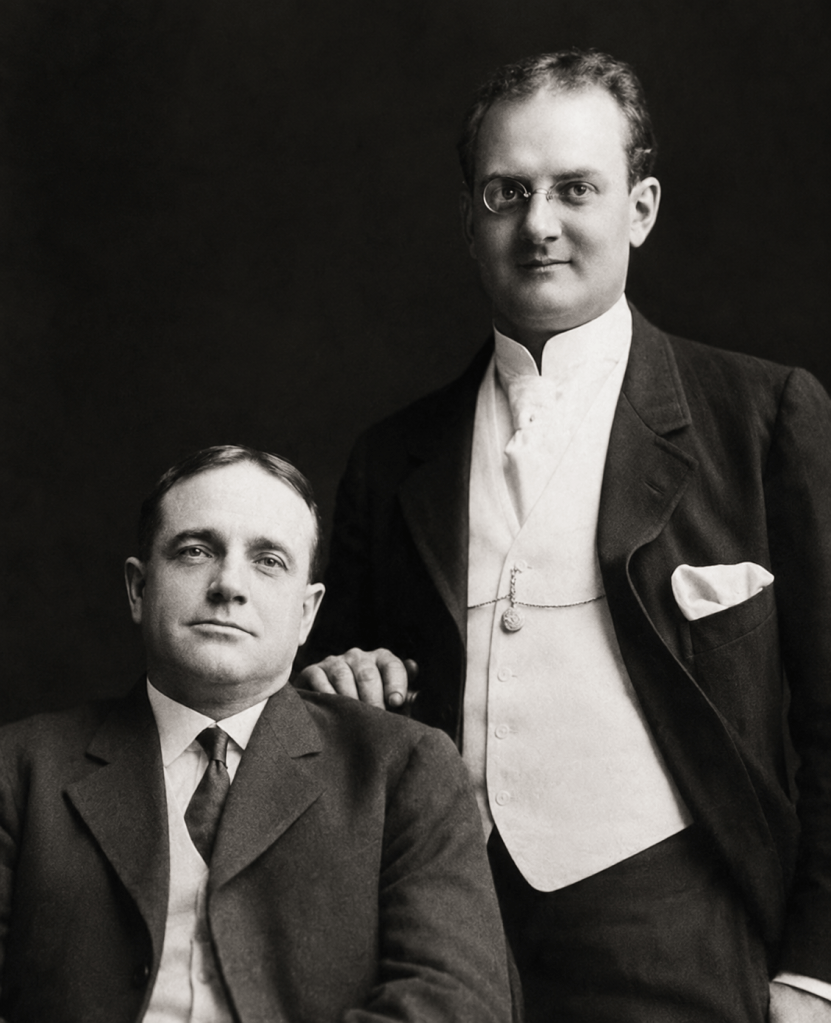
Billy Sunday (left) and Fred Fischer (right).

Sacred words, familiar tunes

Fischer’s guiding idea was simple and, to many traditionalists, slightly shocking: meet ordinary people where their ears already were. Rather than impose formally religious music on a crowd, he set sacred words to tunes the audience already knew and loved — the same instinct, Denison noted, that drove the Salvation Army to go to the people for their music instead of forcing church music upon them.

The song book was full of these thinly disguised melodies. One hymn ran close enough to a popular music-hall number of the day — Vesta Victoria’s “Waiting at the Church” — that a sophisticated city visitor might startle to hear it drifting out of the tabernacle at night. Stephen Foster’s “Suwannee River” carried new words of praise. So did “Old Kentucky Home,” reworked into a hymn pointing toward the New Jerusalem.

To purists, dressing parlor and minstrel tunes in religious clothing bordered on sacrilege. To Fischer, it was evangelism: a melody a farmer already hummed was a melody that would carry the message home with him.

Anything that makes a joyful noise

Fischer barred no instrument capable of joyful sound. At some services the Fairfield Brass Band sat right in with the choir. Cornet solos were dropped into the proceedings again and again.

And then there were the props. The choir was issued tin megaphones, snatched up on Fischer’s signal to multiply the volume of praise. Toward the end of the meetings, singers were asked to bring combs from home; supplied with tissue paper, they produced a novel buzzing music that delighted the crowd. Fischer thought nothing of announcing that the congregation might like to whistle a chorus — and choir and crowd alike would oblige with complete enthusiasm.

This was not church music as anyone in genteel New England would have recognized it. It was closer to a band concert, a sing-along, and a tent show rolled together — exactly the point.

The day the ministers had to sing

The single best Fischer scene in the article is a small comic masterpiece, and it shows the man’s playful streak.

The Fairfield high-school students were seated in a body to one side, the grammar-school children in the rows up front. Fischer drilled the various sections of the room through the verses of a hymn one at a time — the whole audience on one stanza, the high-schoolers on another, the little ones piping the next in their trebles — until each group moved with real thrill and vim.

Then he sprang his trap. He turned to the students and asked how they’d like to hear the ministers sing the last verse. The front benches howled their joyful approval. And so the seven clergymen on the platform — shaking their heads at Fischer, frowning at one another, hanging back — were forced to line up and sheepishly quaver out the final stanza. The roar of delighted applause that sent them blushing back to their seats must, Denison guessed, have reassured them. It is a glimpse of a revival that knew how to laugh at itself, and of a music director happy to engineer the joke.

Master of the room

For all the fun, Fischer was no mere entertainer. His real gift surfaced at the emotional climax of the revival’s final night, when the great altar-call surge sent converts streaming down every aisle and the room dissolved into a roar of singing, weeping, and shouting.

In that chaos, it was Fischer who took charge and organized the noise into something. He stood just behind Sunday, directing the choir and the two pianists stationed at each end of the platform, catching each of the preacher’s whispered suggestions and gliding one hymn into the next — humming here, swelling into triumph there — so that the emotional current never broke. When the energy threatened to spill over into a hundred dangerous rushes toward the platform, Fischer channeled it: have them sing the tune, then whistle it, then hum it.

It was, in its way, as skilled a performance as Sunday’s own. The preacher worked the souls; Fischer worked the room that held them. Together they built an experience that small-town audiences had simply never had before — and would not soon forget.


Next in the series: The Business of Revival — tabernacles, guarantees, and the “grafter” question.

Preaching the Devil in Plain English: Billy Sunday’s Pulpit Style

Fourth in a series drawn from Lindsay Denison’s profile of Billy Sunday in The American Magazine, September 1907.


For three hundred years, Lindsay Denison observed, Americans had been accustomed to discussing God and the soul in the stately cadences of the King James Bible. To depart from that vocabulary had come to feel almost like sacrilege. Billy Sunday departed from it completely.

He talked about God and salvation, Denison wrote, exactly the way people talked to one another six days a week — across a shop counter, over the dinner table, out on the street. That was the scandal of his preaching, and it was also the secret of it.

1908 period postcard of Billy Sunday preaching at Bloomington, Illinois.

The Devil who came from Missouri

The clearest example in the article is a stretch of Sunday’s sermon on “Temptation,” built on Satan’s effort to corrupt Christ in the wilderness.

Sunday had no patience for the modern, comfortable idea that the Devil was merely a figure of speech — a poetic personification of human sin. People who said so, and especially the ministers who said so, he flatly called liars, because to him they were calling the Bible itself a lie. There was a Devil, he insisted, and he was no fool: a smooth operator who was, at that very moment, running up and down the aisles of the tabernacle trying to keep sinners indifferent to their own salvation.

Then came the part that made audiences gasp and laugh at once. Sunday staged the wilderness temptation as a piece of street theater. The Devil swaggers up to a weary, hungry, lonely Christ, looks him over from sweat-stained brow to dusty hem, and sneers. And when Christ admits who he is, the Devil laughs and throws down a challenge in the slang of a Missouri skeptic: he’s not so easily fooled, Christ will have to show him — turn these stones into bread and produce the goods.

To stage Satan as a wisecracking “show-me” doubter was, by every standard of nineteenth-century pulpit decorum, outrageous. Denison watched the ministers seated behind Sunday wince. But he also watched the crowd, and he came to understand that their laughter and applause were not the jeering of sinners at sacred things. It was the delight of plain people hearing the old Bible stories made suddenly new, real, and as immediate as the incidents of their own daily lives.

The pointing finger

If the Missouri Devil was Sunday at his most entertaining, another passage shows him at his most uncomfortable — and most effective.

Mid-sermon, he would single out individuals in the crowd. Without naming names, he turned an accusing finger on a man who had spent sixty dollars on tobacco in two years while his wife went without a new dress; on a woman pouring time and money into fancy hats and card parties while her husband fled badly cooked meals and her children ran wild in the streets; on a respectable citizen and what he really bought behind the druggist’s counter; on a group of boys at the back who slid down in their seats as he spoke. Each thrust landed on someone, and the whole congregation felt the danger that the next one might land on them.

It was a remarkable bit of crowd control — intimate, theatrical, and faintly terrifying. Denison noted heads quailing and boys shrinking down their benches. Sunday had turned the anonymous safety of a large audience into the exposed feeling of being known.

A whole body in the pulpit

Sunday did not preach with his voice alone. Denison describes a man with the lope of a professional athlete and the tense springiness of a cat, a penetrating voice pitched just short of harshness.

In his very first Fairfield sermon, growing overheated, he peeled off his coat, then his waistcoat, then his tie and collar — and even then his gestures grew so violent that sweat flew from his brow and ears as he beat the pulpit and tossed his head until he was hoarse. He acted out the gait and gestures of every character in his stories. When he preached on the wages of drink, he seized a chair and swung it over his head to dramatize a drunkard’s violence, then dashed it to the platform so hard the legs splintered. The performance was physical, even alarming, and it riveted the room.

Fear as the engine

For all the humor and showmanship, Denison was clear-eyed about the machinery underneath. Sunday preached the old, old doctrine of damnation, and he got his results by inspiring fear and gloom in the hearts of sinners — the fear of sudden death with torment waiting beyond it.

He spoke of the love of Christ, too, and with real tenderness. But even that he turned into a weapon: a tender reproach aimed at the hard-hearted, a way of making the unrepentant feel the full weight of what they were refusing. The joy came later, as a revival neared its close; the early going was meant to frighten.

Why the commonness worked

It would be easy to read all this — the slang, the theatrics, the chair-smashing — as mere sensationalism. Denison resists that reading, and his reason is worth holding onto.

No man, he wrote, could talk to three thousand sensible people night after night for a month in such language and hold them, unless they believed he was honest. The vehemence and the commonplace vocabulary would have defeated themselves if Sunday’s sincerity had not shone unmistakably from his face. The plainness was not a trick laid over the message. It was the message — proof, to the people in those benches, that salvation was meant for ordinary folks like them and not only for the genteel and the instinctively religious.

That conviction is the thread connecting Sunday’s pulpit to everything else about his revivals — including, as we’ll see next, the music.


Next in the series: Combs, Megaphones, and “Old Kentucky Home” — the music of a Billy Sunday revival.