In the summer of 1907, Billy Sunday’s son was born on the opening day of a revival. A few weeks later, in the middle of the same revival, his brother died. Sunday did not go to the funeral.
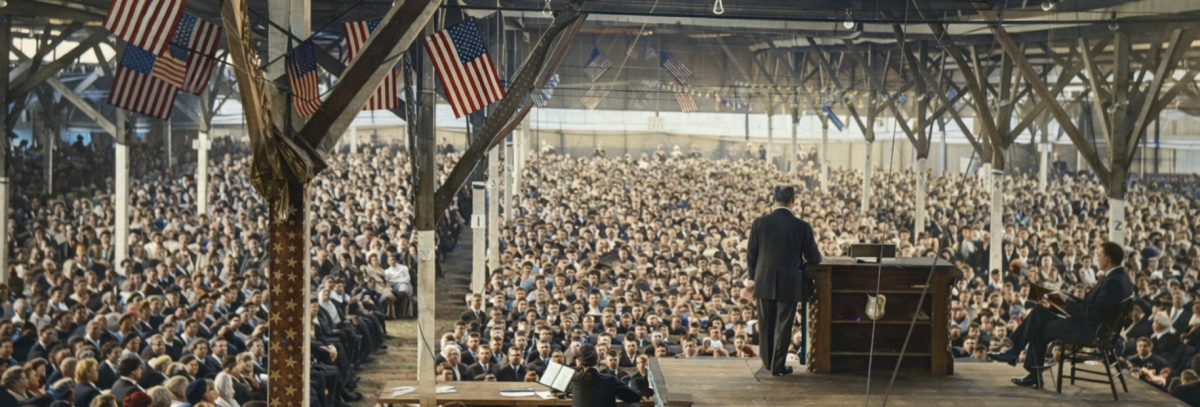
Gibson City, Illinois was a small Ford County town of about twenty-five hundred people. In the summer of 1907 the local committee invited Billy Sunday to hold a revival, and the campaign opened on Thursday, June 13. The town had built a temporary tabernacle. The choir had been organized. The cottage prayer meetings had been running for weeks. By the time Sunday left Gibson City a month later in mid-July, more than eleven hundred people would have come forward as converts and Sunday’s purse would come in at thirty-six hundred dollars — entirely standard numbers for a Sunday revival by 1907.
What was not standard was what happened to the Sunday family during those four weeks.
A son and a brother
On the opening day of the Gibson City campaign — June 13, 1907 — Helen Sunday gave birth to a son. They named him Paul. Helen and the baby were in Chicago. Billy was in central Illinois, standing on the platform of a tabernacle a hundred and fifty miles south of his wife and his newborn, preaching his opening sermon to a Gibson City audience that had been waiting for him for weeks.
A few weeks later, sometime in early July, a telegram reached him in Gibson City. His brother had died in Iowa. The funeral was being arranged.
There is no surviving record of which brother it was, or what he died of, or how old he was. The Sunday family records of this period are not detailed enough to recover those facts. What the contemporary newspaper record does confirm is that Sunday received the news in the middle of the Gibson City campaign, and that he made the decision not to leave for the funeral.
He stayed. He preached.
What he gave up
The Gibson City campaign also cost Sunday something else that summer. He had declined several Chautauqua bookings to do the revival. In 1907 the Chautauqua circuit was where Sunday was earning the bulk of his summer income — he would deliver eighty-six lectures that season for about forty-three thousand dollars in total, the equivalent of more than a million and a half dollars today. By choosing a four-week revival in a town of twenty-five hundred people in the middle of his peak earning season, he was knowingly giving up a substantial piece of his year.
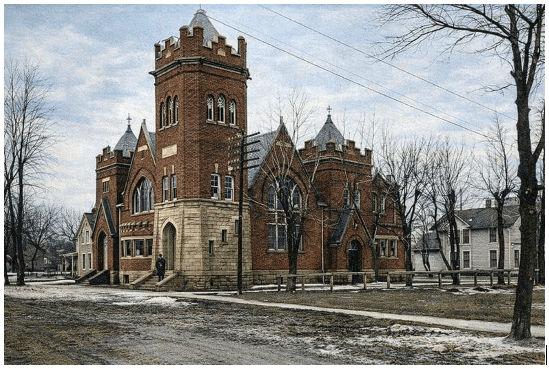
The Gibson City committee had asked for him. He had said yes. By the time the campaign opened on June 13 he had committed to staying. His son’s birth on that opening day did not change the commitment. His brother’s death a few weeks later did not change it either. The Iowa Lyceum Bureau had sued him for breach of contract back in late June for missing a single Chautauqua date he had walked away from in order to extend a different revival. Sunday’s defense in that lawsuit had been straightforward: his evangelistic work, he said, ought to have preference over Chautauqua dates.
Gibson City was the same principle applied. Sunday had given a town his word. He kept it. The town got him for four weeks. His family did not.
What he preached
Two sermons from the Gibson City campaign were transcribed in regional newspapers in August and so survive into the record. One was based on a verse from the Gospel of John, chapter seven, verse seventeen — “If any man will do his will, he shall know of the doctrine, whether it be of God, or whether I speak of myself.” It was a sermon about willingness, about the believer’s choice to step forward. The other, transcribed a week later, was a sermon titled simply “Hell.”
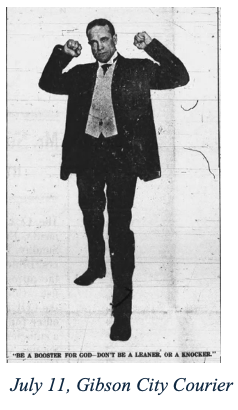
Neither sermon mentioned the brother. Neither sermon mentioned the baby. Neither sermon mentioned the funeral Sunday had not attended. Whatever the inner cost of those four weeks was, Sunday did not preach it from the Gibson City platform. He preached, as he always did, on the standard themes — the willingness of the human heart, the reality of God’s judgment, the inescapability of the choice he was demanding his audience to make.
The Gibson City crowd would not have known. The newspaper editors who later transcribed and reprinted his sermons would not have known. The Champion Daily News of July 15, when it reported the close of the campaign with its eleven hundred converts and Sunday’s purse and the standard summary statistics, did not mention the brother or the baby. The only people who knew, that summer, were Sunday and Helen and a few members of the team.
The cost of saying yes
A few weeks after Gibson City closed, Sunday traveled to Joliet, Illinois to open the brand-new Chautauqua assembly at Dellwood Park. The auditorium was a new four-thousand-seat steel structure — the most expensive Chautauqua building in the country. Sunday spoke on the opening night, August 30, on a sermon titled “Grounders Hot Off the Bat.” A reporter for the Joliet Daily News watched him closely and wrote a piece the next day called “Billy Sunday As He Is, Spoke.” The piece is preserved in full and is hard to read in light of what had just happened to him a few weeks earlier:
He still looks more like a baseball player than a preacher, talks more in the manner of a heavy hitter than a gentleman of the cloth, and, judging from his frenzied utterances, thinks more like one as well. He works as hard on the stage as he ever did on the diamond, and his voice is worn nearly to shreds by long-continued gospel shouting.
The voice worn nearly to shreds. The hay fever that had been getting worse all summer. The dropped handkerchief in front of four thousand people. And then, at the end of his Joliet appearance, the announcement that Sunday made to the press: he was going to cut back on Chautauqua speaking after the season. The constant travel was eating into the rest he needed for his evangelistic work.
It is, in retrospect, the closest thing in the record to Billy Sunday saying out loud what Gibson City had cost him. The constant travel. The schedule. The yes-after-yes-after-yes to revival committees and Chautauqua bureaus and ministerial associations. The decision, made each time, to honor the commitment over the family. He did not, in fact, cut back in 1908. The summer Chautauqua schedule for the next year was already being booked. The big-city revivals were already being negotiated. The arc of his life had committed itself.
What we do not know
The historical record does not tell us what Helen said to Billy when she got to him after the Gibson City campaign closed. It does not tell us whether Billy made it to Iowa to see his brother’s grave that fall, or whether he ever did. It does not tell us how Paul’s first weeks of life unfolded in Chicago while his father was preaching a hundred and fifty miles away. It does not tell us what Sunday thought about, alone in his hotel rooms during the campaign, after the choir went home and Fred Fischer locked up the tabernacle and the Gibson City town fell quiet for the night.
What the record does tell us is that Sunday’s three other children — George, William Jr., and Helen, all of whom had been born in earlier years — would later grow up with a father who was almost never home. Paul, born on the opening day of the Gibson City revival, would grow up the same way. He would die young, in his twenties, in 1930 — twenty-three years after the campaign that opened on the day he was born.
All four Sunday children would, in different ways, struggle with the absence of their father during their childhoods. Three would predecease their parents. Helen and Billy outlived almost everyone they raised.
The Gibson City decision is in the record as just one moment among hundreds. The brother’s name does not survive. The funeral details are gone. The eleven hundred and fifty conversions and the thirty-six hundred dollar purse and the cottage prayer meetings are all preserved in the local Champion Daily News and the regional papers. The four weeks of Sunday preaching to the Gibson City audience while his newborn was in Chicago and his brother was being buried in Iowa are not preserved anywhere except in the gap between the dates.
He had said yes to the Gibson City committee. He kept his word. The committee got what they had been promised. He preached the campaign. He filled the tabernacle. He saw the conversions to the end. He drew his purse. He moved on to the next town.
It was a cost he chose to pay. It is also one of the quietest pieces of the Billy Sunday story, and one of the hardest to look at squarely. He paid it more than once.
Sources: Bloomington Weekly Pantagraph, June 14, 1907; The Davenport Daily Times, July 4 and July 17, 1907; The Joliet Herald News, July 9, 1907; Gibson City Courier, July 12, 1907; The Champion Daily News, July 15, 1907; The Joliet Daily News, August 31, 1907.
How to cite this post
Chicago: McNutt, Kraig. “The Gibson City Decision, c. 1907.” Evangelist Billy Sunday (1862–1935), June 23, 2026. https://evangelistbillysunday.com/2026/06/23/the-gibson-city-decision-c-1907/.
MLA: McNutt, Kraig. “The Gibson City Decision, c. 1907.” Evangelist Billy Sunday (1862–1935), 23 June 2026, evangelistbillysunday.com/2026/06/23/the-gibson-city-decision-c-1907/.
APA: McNutt, K. (2026, June 23). The Gibson City decision, c. 1907. Evangelist Billy Sunday (1862–1935). https://evangelistbillysunday.com/2026/06/23/the-gibson-city-decision-c-1907/
Turabian: McNutt, Kraig. “The Gibson City Decision, c. 1907.” Evangelist Billy Sunday (1862–1935). June 23, 2026. https://evangelistbillysunday.com/2026/06/23/the-gibson-city-decision-c-1907/.


