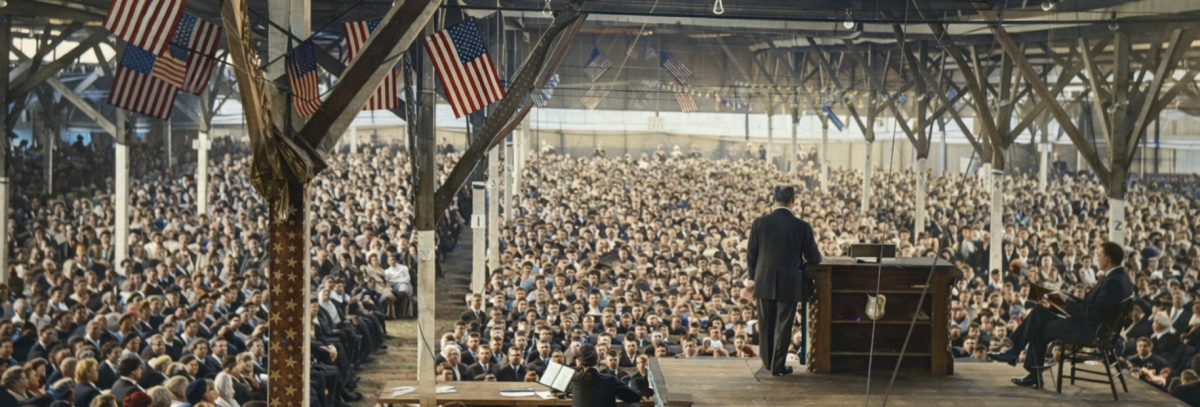
The year Billy Sunday became Billy Sunday: 1902

Twelve months that took a 40-year-old former baseball player from regional tent revivalist to publicly recognized “foremost of Evangelists” in America.

On January 18, 1902, William A. Sunday opened a five-week revival in the small Iowa town of Audubon. By the end of December, when he started his next campaign in Glidden, Iowa, he had preached eleven multi-week campaigns across four states, taken in roughly $7,500 in personal purses, watched at least 3,000 people walk down the aisle as converts, and become the subject of a serious national newspaper conversation about whether he might be the next Dwight L. Moody.
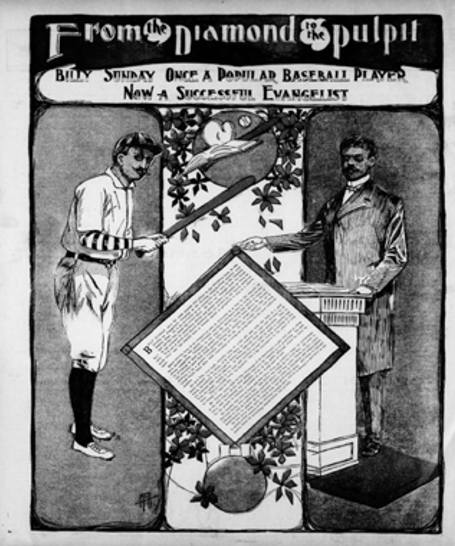

The Pittsburg Press. Aug 31, 1902:34. 

He was 40 years old. He had been an independent evangelist for less than six years. And 1902 is the year — more than any other in his pre-Chautauqua decade — when you can actually watch him stop being a regional curiosity and start becoming a national figure.

A businessman’s revival

The most consequential thing Sunday did in 1902 had nothing to do with theology. It had to do with the way he organized a revival meeting.

At Fairmount, Indiana — a town of barely 2,000 people where Sunday preached from March 20 through April 28 — The Indianapolis News documented what it called Sunday’s “new and practical idea that appeals to business men.” The local supporters calculated four weeks of campaign expenses at $825. They organized a stock company for exactly that amount and sold shares to attendees, with basket contributions buying up the stock. Sunday took the last Sunday’s contributions as his personal compensation. When it was announced that the closing basket was for him, $1,640 was dropped into it.

It was a self-funding revival. Local risk underwritten by local capital, the evangelist’s purse paid by the same people who had benefited from his preaching, and the whole arrangement transparent enough that newspaper editors thought it was newsworthy. Sunday would refine this model for the next decade. By 1907 he would be the highest-paid evangelist in America, and the Fairmount stock-company structure — extended, scaled, professionalized — was the engine that got him there.

The 1902 archive shows him testing the model in five other towns. At Audubon in January and February he drew a $1,500 purse and 434 converts on a four-denomination joint sponsorship. At Atlantic, Iowa in February and March, $1,400. At Fairmount itself, $1,600. At Wheaton, Illinois in May, $813. At Iowa Falls in October, $749. At Woodstock, New York in December, $600. The purses were not uniform — Wheaton and Iowa Falls underdelivered, Fairmount overdelivered — but the structure was the same. And the numbers were big enough that they were getting noticed.

The leap up the aisle

In May of 1902 Sunday brought his revival to Wheaton, Illinois, and preached out of Gary Memorial Church with a 100-voice choir under his music director Fred G. Fischer. He stayed four weeks. He preached afternoon and evening every day for thirty days — over sixty sermons in all. He took apart Sabbath-breaking, named the Chicago Golf Club by name, and went after dance and card playing.

On June 4, the Omaha Daily News carried this sentence, buried halfway down a column that described his preaching at Wheaton:

On another occasion while preaching he made a run, leaped high into the air and landed twenty feet up the aisle, ran around the church, kept on preaching and shouted that he wanted to get in among the people to wake them up.

This is, as far as the curated newspaper record goes, the first contemporary documentation of the pulpit theatrics that would define Billy Sunday’s preaching for the next three decades. The leaping. The running. The breaking through the formal boundary between pulpit and pew. The athletic identity of his old baseball career — repurposed into evangelism in a way no preacher in American history had quite done before.

He had been preaching for six years. He was 40 years old. And he had just figured out the move.

“Foremost of Evangelists”

By late June of 1902, after closing a three-week campaign at Farmington, Illinois — Sunday’s smallest purse of the year at just $200 — a newspaper described him as the “foremost of Evangelists.” The phrase was almost certainly premature. There were better-known revivalists working the country in 1902. But the fact that any newspaper would apply that phrase to him, in print, in 1902, is the data point that matters.

The recognition got louder over the summer. In late June and early July he appeared at Winona Lake, Indiana for the first National Young People’s Bible Conference — the inaugural year of an event Sunday would return to for the rest of his life. J. Wilbur Chapman, the senior evangelist who had been Sunday’s mentor and employer through the 1890s, was also on the program. They were peers now.

On July 26 the Muscatine Journal carried what may be the most revealing single article of Sunday’s 1902 year. It was a ministry update in which Sunday spoke about his own income, by campaign, in his own words:

“God has been good to us,” is the way Mr. Sunday puts it. “He gave us $600 for a month’s work in Belvidere, Illinois; $200 for the same length of time in Farmington, and even frosty Wheaton, where there are costly Chicago millionaires, we drew $800 in thirty days.”

It was the kind of disclosure most preachers would never make. Sunday was happy to make it. The same article went on to say that out in Iowa, where Sunday had converted “more than 10,000 persons” over his ministry, “people assert that he is destined to be a greater evangelist than Mr. Moody.”

Two weeks later, on August 10, The Missoulian carried the more definitive number. Since Sunday had become an evangelist — going independent from Chapman’s organization in 1896 — he had taken in approximately $12,000 total. For context, a successful lawyer or doctor in 1902 made between $3,000 and $5,000 a year. The most successful corporate executives in America made between $10,000 and $25,000 a year. Sunday, at six years into his independent ministry, was on a trajectory to enter the top tier of American earners within another year or two. The Missoulian was not the only newspaper running these numbers. The story was syndicating.

A poem from Iowa

Somewhere along the way that spring — probably during the Atlantic, Iowa campaign in March — a writer named J.F. Lewis published a poem in a small Iowa newspaper called The Telegraph. The Leon Journal-Reporter reprinted it on April 17. Three years later, in 1905, The Des Moines Register reprinted it again. It is the earliest known poetic tribute to Billy Sunday:

Oh, Billy he’s a dandy,
A spade, a spade, he calls;
He’s a powerful hard hitter —
He practiced on base balls.

He trained with old Pap Anson,
A name well known to fame,
And they tell us Billy Sunday
Put up a pretty good game.

His triumphs in his present league,
The angels doth record;
His diamond is the world of sin,
His captain is the Lord,
And when the season’s ended
And the last ball has been passed,
I’ll bet you Billy Sunday
A home run makes at last.

There is no surviving record of who J.F. Lewis was. But the existence of the poem in 1902, in a small Iowa town newspaper, is itself the story. The baseball-to-pulpit framing — the conversion of athletic identity into religious metaphor — was already so well-established in Sunday’s public persona by April 1902 that an Iowa newspaper poet could turn out a quick eight-stanza tribute and assume his readers would get every reference.

The fall slowdown

The second half of 1902 was thinner. After the burst of June and July recognition, Sunday took two unusual engagements — a mid-August week at a Presbyterian church in Philadelphia, where the local paper said “at every meeting he has made hits that brought a run of Christians across home plate,” and a three-week revival at Harvard, Massachusetts in September that produced 190 converts. Both events were small. Neither generated the kind of headlines the spring campaigns had.

Then back to the Iowa rhythm: Iowa Falls in October at the Metropolitan Opera House (200 converts, a $749 purse), Woodstock, New York in November and early December (350 converts, $600 purse), and finally the December opening at Glidden, Iowa. The year ended quietly, on the small-town circuit where it had begun.

But the trajectory had changed permanently. The Chautauqua bookings — which would explode into the cornerstone of Sunday’s summer schedule starting in 1903 — were already being negotiated. The income story was syndicating. The pulpit-theatrics moment had been documented. The stock-company business model had been printed in a major Indianapolis newspaper for other preachers and other communities to read and copy. And a working evangelist in his own state was being told he might be greater than Moody.

What 1902 actually was

It is tempting to read 1902 as just one more year in a long apprenticeship. Sunday would not become a household name until the big-city campaigns of the 1910s — Pittsburgh, Philadelphia, New York. But that reading misses what the contemporary newspaper record actually shows.

1902 was the year Sunday’s preaching style locked into its mature form, with the Wheaton leap recorded in print for the first time. It was the year his revival business model was documented at Fairmount and explicitly described as a model other communities should imitate. It was the year his earnings reached a level that made him a serious financial story in regional papers. It was the year the Moody comparison entered print. It was the year a small-town Iowa poet wrote eight stanzas about him. It was the year he stood alongside J. Wilbur Chapman at Winona Lake not as Chapman’s protégé but as Chapman’s peer.

Most of the work of becoming the Billy Sunday of American memory was still ahead of him — the Chautauqua circuit, the steel-tabernacle campaigns, Homer Rodeheaver, the great urban revivals. But the architecture was now in place. By the time he opened his next revival at Glidden in December, the man who would fill 20,000-seat tabernacles a decade later was already, recognizably, the same man. 1902 was the year he became him.

How to cite this post

Chicago: McNutt, Kraig. “The Year Billy Sunday Became Billy Sunday: 1902.” Evangelist Billy Sunday (1862–1935), June 5, 2026. https://evangelistbillysunday.com/2026/06/05/the-year-billy-sunday-became-billy-sunday-1902/.
MLA: McNutt, Kraig. “The Year Billy Sunday Became Billy Sunday: 1902.” Evangelist Billy Sunday (1862–1935), 5 June 2026, evangelistbillysunday.com/2026/06/05/the-year-billy-sunday-became-billy-sunday-1902/.

APA: McNutt, K. (2026, June 5). The year Billy Sunday became Billy Sunday: 1902. Evangelist Billy Sunday (1862–1935). https://evangelistbillysunday.com/2026/06/05/the-year-billy-sunday-became-billy-sunday-1902/

Turabian: McNutt, Kraig. “The Year Billy Sunday Became Billy Sunday: 1902.” Evangelist Billy Sunday (1862–1935). June 5, 2026. https://evangelistbillysunday.com/2026/06/05/the-year-billy-sunday-became-billy-sunday-1902/.

Billy Sunday’s revival pulpit, 1902–1909

A sermon-by-sermon look at what Billy preached when he wasn’t on a Chautauqua platform — drawn from contemporary newspaper coverage across eight formative years.

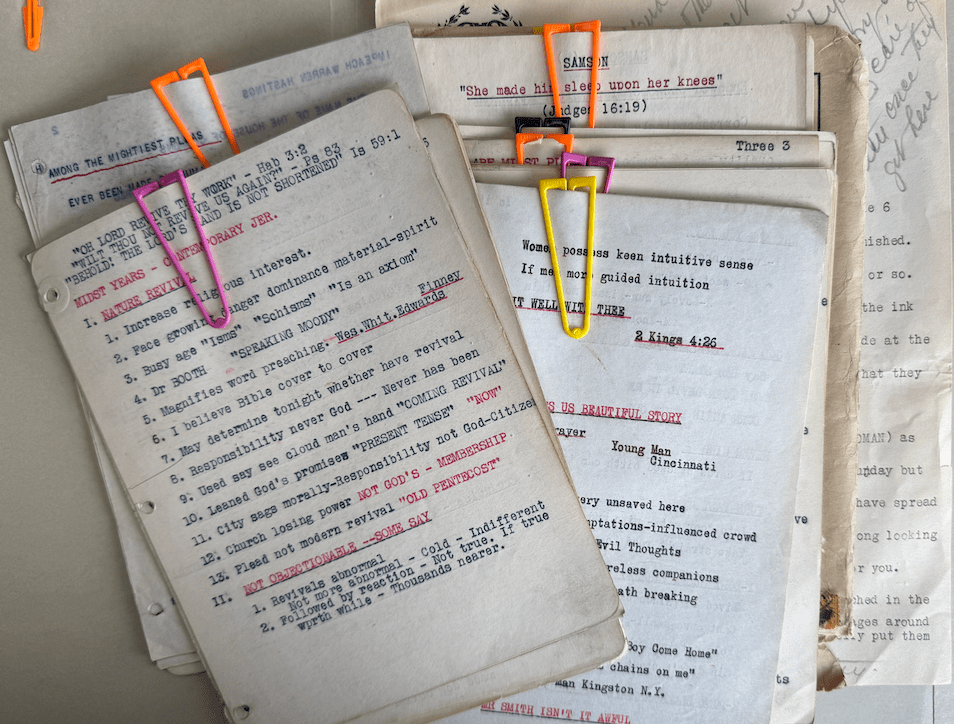
Billy Sunday sermon notes. Grace College. Morgan Library. 2025

By the time Billy Sunday stepped onto a Chautauqua stage in 1903, he had already been preaching revival meetings for nearly a decade. The Chautauqua circuit got the broadside posters, the souvenir programs, and the syndicated newspaper coverage — but the revivals were where the real work happened: multi-week tabernacle campaigns, day-after-day preaching, and the slow accumulation of converts that built his reputation. The titles below are what newspapers actually named when they covered those revivals (and a handful of related events). Where the press only gave a topic or a Bible text, that’s all we get.

1902 — Wheaton, Illinois

No formal titles, but the Chicago Tribune and the Waterloo Courier flagged the subjects Sunday was hitting that May:

  • Sabbath-breaking (with specific shots at the Chicago Golf Club)
  • Dance
  • Card playing

A June 4 Omaha Daily News dispatch — the first newspaper record of his pulpit theatrics — describes him leaping twenty feet up the church aisle mid-sermon. The titles weren’t memorable yet; the delivery already was.

1903 — Marengo, Illinois

On Sunday, March 29, Billy preached to men only while Helen Sunday preached to women only. Sixty converts that day. No titles preserved for either sermon — but Helen’s appearance is one of the earliest documented instances of her in a public preaching role, three years before her formal full-time commitment to the campaign trail.

1904 — Rockford, Illinois

Across fifty services in a 5,000-seat tabernacle, two key sermons stood out in the press coverage:

  • “Square your lives by the Bible”
  • A denunciation of evolution as “all rot” and a “damnable theory”

The evolution sermon is significant. This is the first public documented instance of Sunday taking on evolution — six full years before the Modernist-Fundamentalist controversy reached its peak.

1904 — Richmond, Indiana

Sunday afternoon, September 4, at the Chautauqua Grove (a revival-style setting on the Chautauqua grounds), Sunday preached on a text from the Gospels:

  • Text: “Heaven and earth shall pass away, but My word shall not pass away”

The Daily Palladium described his manner as “full of fire, enthusiasm, truth, with an unusual use of the language which is startling in effect.” A second evening address followed; no title preserved.

1905 — Mason City, Iowa

January 29 men-only afternoon:

  • “Chickens Come Home to Roost” / “Hot Cakes on the Griddle”

Fifty immediate conversions from a crowd of two thousand men. The double-titling in the press suggests Sunday may have used either phrase to refer to the same sermon — or that he riffed between the two metaphors during delivery. Either way, this is the earliest colorful, slangy sermon title in the archive — a hint of the homespun pulpit voice that would define his later style.

1906 — Rochester, Minnesota

Opening weekend (Saturday December 30, 1905 and Sunday December 31), three sermons in the span of a day and a half:

  • “Revival” (opening Saturday evening)
  • “Christian Warfare” (Sunday afternoon)
  • “Answered Skeptics” (Sunday evening)

Opening night quote, captured by the Olmsted County Democrat: “I don’t pretend to preach like your preachers, if I did, you wouldn’t need me.”

1906 — Prophetstown, Illinois

Among the major sermons in this 28-day campaign — which converted 714 people in a town of just 1,200 — was:

  • “Evolution a Sham”

Two years after Rockford, the evolution sermon now had a formal title and a regular slot in the revival rotation.

1906 — Salida, Colorado

When the revival tent collapsed under snow in early October, Sunday relocated to a local church and then to a 400-seat opera house. Among the featured talks:

  • A eulogy for Abraham Lincoln
  • A tribute to President Theodore Roosevelt
  • “Read good books and keep good company” — a moral admonition: “Every gambler and drunkard became so by imitating the gang he went with.”

1907 — Kankakee, Illinois

The Streator Times for January 26, 1907 carried extended transcription under the headline “REV. BILLY SUNDAY DEFINES WHAT HE TERMS SOCIETY OF THE PRESENT DAY” — a sermon comparing high-society Pompeii imagery to back-room beer joints, with the famous line:

I fear that cursed gang of society more than I do all the town loafers in that beer joint.

1907 — Fairfield, Iowa

The densest single-day sermon documentation in the entire 1902–1909 run came on Sunday, April 28, when Sunday preached three sermons in a single day — each anchored on a different Bible text. Adding the campaign opener three weeks earlier, the Fairfield set looks like this:

  • Opening sermon (April 4) — “Revive Us Again”
  • April 28 morning — John 14:15–16, “If ye abide in me…”
  • April 28 afternoon — “Choose you this day whom you will serve”
  • April 28 evening — Hebrews 9:27, “It is appointed unto man once to die”

1907 — Gibson City, Illinois

Both of these were preached during the Gibson City revival (June 13 – July 14) and transcribed in regional newspapers in August:

  • Sermon on John 7:17 (transcribed August 23)
  • Sermon on “Hell” (transcribed August 30)

Worth noting: Sunday’s brother died in early July during this campaign, and Billy could not leave the revival to attend the funeral. His son was also born on the opening day of the same campaign — a stark personal bookend to the month.

1909 — Spokane, Washington

The first revival Sunday ever held in a city of more than 100,000. Two sermons stand out:

  • “Tomorrow” — preached as the final sermon. This is the first documented use of “Tomorrow” as a closing sermon, the dramatic emotional close that would become a signature pattern of his big-city campaigns.
  • “Booze” — delivered twice during the campaign, tied directly to a local political moment: 110 representative men were sent on a special train to Olympia to lobby for a county-unit option bill while Sunday gave the sermon.

1909 — Springfield, Illinois

During a campaign that produced 4,729 converts over six weeks, one sermon was singled out by the press for its size and effect:

  • “Judgment” — a Sunday afternoon sermon preached to 8,000 men. 300 conversions from that single message.

On the final day, April 11, Sunday saw 774 conversions in a single day — the largest single-day total of his career to that point. The title of that sermon wasn’t preserved.

Patterns worth noting

Across eight years of revival work, the named sermon archive divides cleanly into three groups:

Named sermons

Roughly ten distinct titles documented across the period: “Chickens Come Home to Roost,” “Revival,” “Christian Warfare,” “Answered Skeptics,” “Evolution a Sham,” “Revive Us Again,” “Choose you this day whom you will serve,” “Tomorrow,” “Booze,” “Judgment.” These are the sermons newspapers cared enough to name.

Scripture-anchored, title unknown

Six sermons documented only by their Bible text: John 14:15–16, Hebrews 9:27, John 7:17, the “Hell” sermon, “Heaven and earth shall pass away,” and “Square your lives by the Bible.” The press recorded the verse but not the rhetorical hook.

Topic-only documentation

A larger group documented only by subject: Sabbath-breaking, dance, card playing, evolution, the Lincoln eulogy, the Roosevelt tribute, the “Society of the Present Day” sermon. The newspaper covered what he talked about, not what he called it.

Two milestones stand out from this sermon archive. The first is the evolution opposition, traceable from 1904 Rockford forward — Sunday was hitting evolution on the revival circuit a full half-decade before it would become a national fundamentalist flashpoint. The second is the premiere of “Tomorrow” at Spokane in February 1909, used for the first time as a final sermon. That single rhetorical pattern — the emotional closing call framed around the word tomorrow — would anchor his big-city campaigns for the next twenty years.

A note on what’s missing: the multi-week revivals at Decatur (1908), Cedar Rapids (1909), and Joplin (1909) collectively produced hundreds of sermons that the press summarized in numbers — 178 messages at Cedar Rapids alone — but rarely titled individually. Future digging in local Iowa and Missouri papers for those campaigns may surface a richer sermon catalog.

Source: data curated from contemporary newspaper coverage, Sunday family records, and the Wheaton archives, compiled in the Sunday Master Speaking List, 2026.

How to cite this post

Chicago: McNutt, Kraig. “Billy Sunday’s Revival Pulpit, 1902–1909.” Evangelist Billy Sunday (1862–1935), June 1, 2026. https://evangelistbillysunday.com/2026/06/01/billy-sundays-revival-pulpit-1902-1909/.

MLA: McNutt, Kraig. “Billy Sunday’s Revival Pulpit, 1902–1909.” Evangelist Billy Sunday (1862–1935), 1 June 2026, evangelistbillysunday.com/2026/06/01/billy-sundays-revival-pulpit-1902-1909/.

APA: McNutt, K. (2026, June 1). Billy Sunday’s revival pulpit, 1902–1909. Evangelist Billy Sunday (1862–1935). https://evangelistbillysunday.com/2026/06/01/billy-sundays-revival-pulpit-1902-1909/

Turabian: McNutt, Kraig. “Billy Sunday’s Revival Pulpit, 1902–1909.” Evangelist Billy Sunday (1862–1935). June 1, 2026. https://evangelistbillysunday.com/2026/06/01/billy-sundays-revival-pulpit-1902-1909/.

Billy Sunday’s Own Account of His Conversion (1902)

“Lord, If You Ever Helped Mortal Man…”

One of the things I love most about researching Billy Sunday is when we can let him speak for himself.

Tucked inside The founding of Pacific Garden Mission: over thirty-five years contribute to the Master’s service by Sarah D. Clarke is a brief autobiographical sketch written by Sunday in September 1902. It is not polished theology. It is not retrospective myth-making. It reads like a man remembering the night that changed everything.

He begins with Chicago.

“Fifteen years ago one Sunday night I walked down State street, Chicago, in company with several baseball players… We entered a saloon, drank, and passed on to the corner of State and VanBuren…”

Then something happened.

A small band from Pacific Garden Mission was singing on the street. Sunday sat on the curb and listened.

“I had heard those songs from mother back in Iowa, in the Methodist Sunday School in Ames, Iowa, and God painted on the canvas of my memory the scenes and recollections of other days and faces. I bowed my head in shame and the tears rolled down my cheeks like rivers of water.”

The song that broke him was “Where is my wandering boy to-night.”

Col. Clarke invited the men to the Mission. Sunday’s response was immediate:

“I arose and said, ‘Boys, good-by, I’m done with this way of living.’”

That sentence is vintage Sunday. Abrupt. Decisive. No hedging.

But what follows is equally revealing.

The next morning, newspapers reported his church membership. He dreaded facing his teammates. He confessed:

“I would rather have faced a six-shooter…”

Yet when he arrived, the first to greet him was Mike Kelly.

“With a heart as tender as a woman’s… he took me by the hand and said: ‘That’s a grand thing to do, “Bill.” If I can help you let me know.’”

Cap Anson, Ed Williamson, Fred Pfeffer, Jno. Clarkson, Tom Burns, Dalrymple — they all encouraged him. And if they swore in his presence, “they would immediately ask my pardon.”

This detail matters. It corrects the caricature. Sunday did not convert in isolation from the baseball world. He converted in it.

Then comes one of the most famous episodes of his early testimony — the Detroit game.

Bottom of the ninth. Two out. Men on second and third. Charley Bennett at bat.

“I offered up a prayer and said, ‘Lord, if You ever helped mortal man, help me get that ball.’ I leaped the bench, looked over my shoulder, threw out my hand and the ball struck and stuck. The game was ours.”

Then the line that perfectly captures Sunday’s theology-by-experience:

“I am sure the Lord helped me catch that ball. This deduction may not be according to theology, but it’s according to experience.”

That is pure Billy Sunday — unfiltered, confident, experiential, unapologetic.

After baseball, he attended Northwestern University “where I picked up some Methodist enthusiasm and vim to counteract the stiff, staid Presbyterianism.” That phrase alone tells you how he would preach for the next thirty years.

He left professional baseball, became assistant secretary of the Chicago Y.M.C.A., then joined Rev. J. Wilbur Chapman in evangelistic work. Of Chapman he writes:

“All I am today as an evangelist I owe to Dr. Chapman and to Prof. R. R. Lloyd… with whom I studied privately.”

Notice that. Sunday never claimed to be self-made. He acknowledged formation, mentorship, study.

This 1902 piece is significant for another reason. It predates the massive tabernacles, the sawdust trails, the millions who would hear him preach. It shows us Sunday before the fame hardened into legend.

What do we see?

  • A mother’s hymns remembered.
  • A curbside conviction.
  • Public courage in a locker room.
  • A prayer in right field.
  • A man mentored, trained, and sent.

If you want to understand Billy Sunday, start here.

Not with the headlines.

Not with the critics.

Not even with the later statistics.

Start on a Chicago curb, with a baseball player weeping while a gospel song drifts through the night air.

And listen to him say it himself:

“Boys, good-by, I’m done with this way of living.”

Adapted from: The founding of Pacific Garden Mission : over thirty-five years contribute to the Master’s service / by Sarah D. Clarke

Billy Sunday family c. 1902

This image was likely take around 1902 because the oldest boy, George was born in 1892. He looks around 8-9 years old here. The other child must be Billy, Jr., born in 1901. The older woman is Helen’s mother. I colorized the image.