A first professional photograph, a tent under snow, and the wife of a baseball evangelist boarding the train for good.
In late March of 1906, a brief notice appeared in the Bureau County Tribune. Mrs. William A. Sunday, the wife of the well-known evangelist, had announced she would henceforth be joining her husband on the campaign trail. The notice carried her own words:
Hereafter I shall accompany my husband. I can be a great help to him, taking charge of women Bible classes, organizing girl Bible classes and giving personal care to converted persons.

It is one of the most consequential single sentences in the entire Billy Sunday archive. Helen Sunday — known to friends as “Ma” Sunday in the years to come — was, until that announcement, a Chicago-area pastor’s wife who had spent most of her married life keeping her household running while Billy traveled. From that moment on, she would be on the road with him. She would be his organizational lieutenant, his front office, his backstage manager, and ultimately the steadiest center of his entire ministry.
Without Helen, there is no Billy Sunday of American memory. The campaigns get smaller. The big-city tabernacles never happen. The Rodeheaver era never quite assembles. The household engine that powered the next thirty years of Sunday’s career was not in place yet on the morning of March 28, 1906. It was in place on the morning of March 30. The change in his career happened in the space of those two days.
A photograph in Freeport
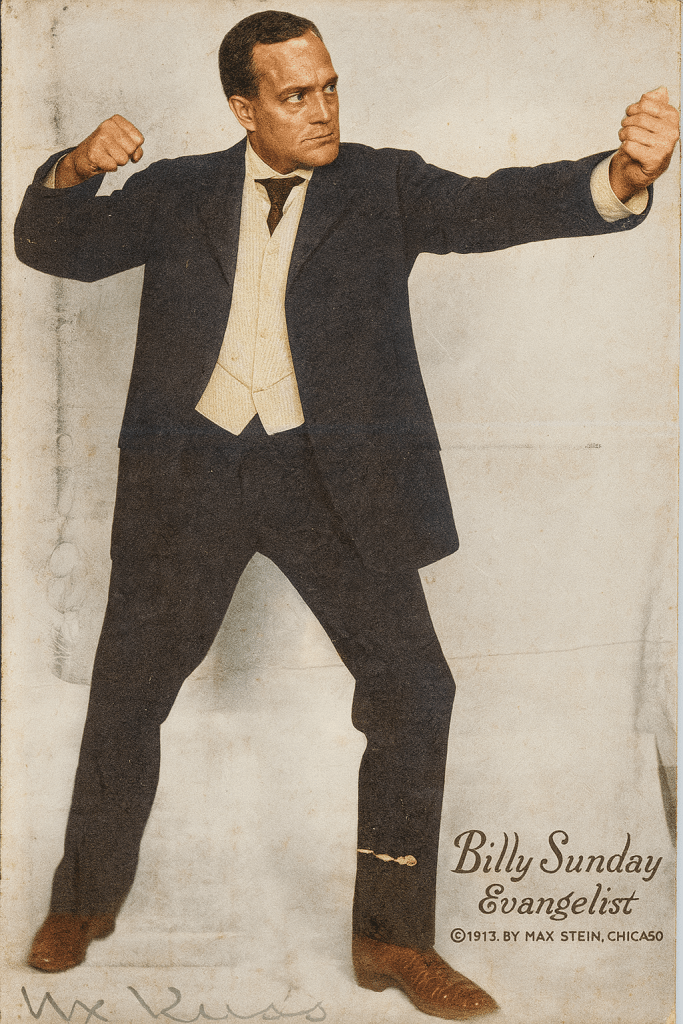
A few weeks earlier, on February 13, 1906, the Freeport Journal-Standard had published a photograph. It showed a clean-shaven man in his early forties wearing a dark suit, looking just past the camera with the slightly unfocused expression that early-twentieth-century professional portraits always required. It was the first professional photograph of Billy Sunday to appear in a newspaper.
A photograph in print, in 1906, meant something different than it does now. Printing technology was just becoming able to reproduce photographs in regional newspapers at workable cost. To have your photograph carried — not a sketch, not an engraving, but an actual halftone reproduction — meant your name had reached a tier where readers would recognize the face and where the paper thought running the picture would help sell copies. Sunday had reached that tier.
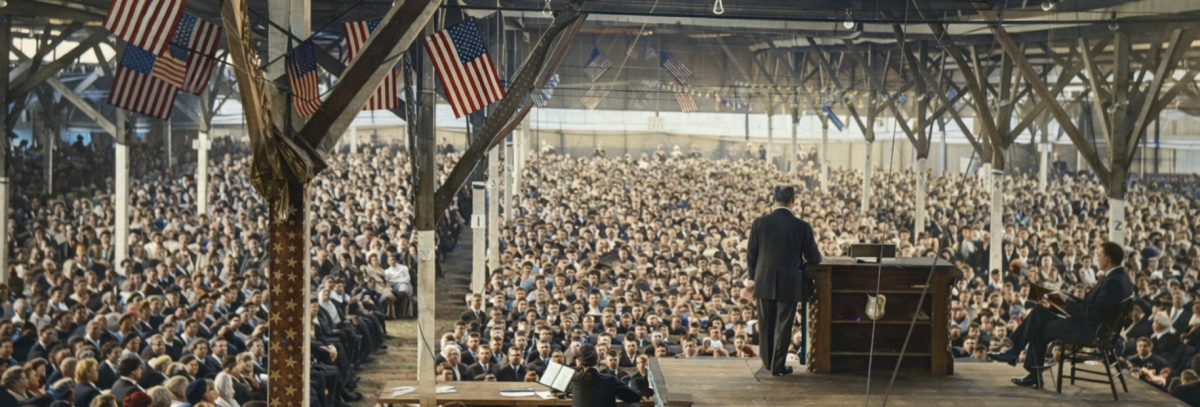
The photograph appeared while he was in the middle of a four-week revival at Princeton, Illinois — a small town in Bureau County where he was preaching in a temporary tabernacle that held thirty-six hundred. By the time the Princeton campaign closed in mid-March, over two thousand people had come forward as converts. The local U.B. pastor, a visiting minister from Freeport, told the papers the town was “aflame with the revival spirit.” Another eyewitness called Sunday “a storm, a whirlwind, a cyclone, hurricane, a tornado, a — well, everything indicative of power.”
The highest paid evangelist in America
By the end of March, the Princeton campaign had produced something else: a headline. On March 30, 1906, the Bureau County Tribune ran a piece under the title “Billy Sunday the Highest Paid Evangelist in America.” It was the first time that phrase had appeared in print about Sunday. It would not be the last.
The article tried to make the math human. Since October of 1905, the paper said, Sunday had earned an average of two dollars and sixteen cents per convert. The number sounded almost comical when laid out that way — pennies and dimes per soul saved — but the implication was clear. Sunday was running an evangelistic ministry that produced consistent measurable output for predictable cost. The towns where he held his campaigns understood it. The papers understood it. And, increasingly, the bookings reflected it.
Sometime in the early months of 1906, a Chicago-area booking manager named H.M. Holbrook formalized what had been an informal summer schedule the year before. Holbrook announced he had “exclusive rights to Billy Sunday” and would place him as the headline attraction at seven Chautauquas that summer: Belvidere, Sterling, Freeport, Sycamore, Janesville, Sandwich, and Valparaiso, Indiana. The Chautauqua decade was officially organized.
Prophetstown
In June Sunday took his summer revival to Prophetstown, Illinois — a small town of about twelve hundred people served by exactly three churches. The campaign ran four weeks and produced over seven hundred conversions. By any honest accounting, more than half the town walked down an aisle.
The numbers are the kind that defy plausibility until you remember what a small-town revival in 1906 actually looked like. Sunday preached against evolution under the title “Evolution a Sham” — the formal naming of a sermon he had been delivering in less polished form since at least Rockford in 1904. He preached against dance, against card playing, against the local saloons. People came in from twenty miles in every direction. The Sterling Standard carried sermon-by-sermon coverage. The numbers grew from a few hundred conversions in the first week to over seven hundred by the end of June.
Sunday’s purse at Prophetstown was about twenty-three hundred dollars. The town’s three churches reorganized to absorb the new members. The local saloons reported almost no business during the revival weeks. The pattern was now mature, repeating, and exportable.
The Chautauqua summer
The 1906 summer Chautauqua run took Sunday across the upper Midwest at a pace that would have broken most preachers. Belvidere on June 22 to a crowd of eight thousand. Globe Park in Freeport on July 8, where Sunday spoke twice in a single day and the local paper said his afternoon sermon was the best he had ever preached there. Jacksonville on July 15, where his single talk raised five thousand dollars for the local YMCA that had recently closed its doors. Janesville on July 29 to four thousand listeners. A handful of other Iowa and Illinois Chautauquas in early August. Sycamore on August 26, where he spoke twice and the local paper made sure to note that Sunday had posed for an imprinted postcard now in circulation as a souvenir.
The pattern that had only been a hypothesis a year earlier — that Sunday could sustain crowds across a multi-week Chautauqua circuit using a small rotation of well-tested sermons — was now an established fact. The Baseball sermon anchored most of the dates. “Nuts for Skeptics” made its first documented appearance at Muscatine in early August. The two-sermon Chautauqua rotation that would carry Sunday through 1907 was beginning to take shape.
Salida in the snow
In September Sunday went west again. The Salida, Colorado revival ran through October — five weeks in a mountain town at altitude. The campaign drew six hundred converts. It also drew weather. The tabernacle tent collapsed under early snow. The October 3 and 4 services moved indoors to a local church. The closing night service had to be moved a second time, to a four-hundred-seat opera house far too small for the crowd that wanted to attend.
Sunday’s closing services at Salida included an unusual range of subjects. He preached a eulogy of Abraham Lincoln. He delivered a tribute to President Theodore Roosevelt. And he closed with one of the moral admonitions he liked best: “Read good books and keep good company. Every gambler and drunkard became so by imitating the gang he went with.”
Kewanee, twice
The fall return brought Sunday to Kewanee, Illinois for a six-week revival in a new local armory — a venue large enough to handle the crowds that an earlier tent could not. Twenty-seven hundred and sixty-eight converts. Four hundred and five of those came forward on the closing night. Sunday’s purse came in at five thousand dollars — by far his largest revival purse to date.
Four days after the revival ended, Sunday returned to Kewanee for a single Chautauqua talk. The offering for that single talk was five thousand, three hundred dollars — more than he had been paid for the entire six-week revival. The Richmond-Item carried the figure on December 6. It was the kind of number that did not exist in the Sunday archive a year earlier and that would, from this point on, become routine.
The story of the two Kewanee engagements told you everything you needed to know about where Sunday’s career was going. The revival was the old model — multi-week, slow-building, institution-deepening, expensive in time and emotional capital. The Chautauqua was the new model — one talk, one offering, the same money or better. Sunday could no longer pretend he was not paying attention to the difference.
Worthington in the cold
December brought Sunday to Worthington, Minnesota for what would be his last revival of 1906 and his first of 1907. The Advance-Herald summed up the man and his methods with a single arresting metaphor: “His sermons are a bombardment having the rapidity of the gatling gun and the force of the big 12-inch rifle.”
More than a thousand converts came forward across the five weeks. The temporary tabernacle, ninety feet by a hundred and fifty, accommodated thousands. Sunday’s musical director Fred Fischer ran the music. A tabernacle caretaker named Siebert kept the building in shape. The Sunday operation was small — still just a handful of people moving from town to town — but it was now durable enough that the team had names that appeared in newspaper accounts of the campaign.
What changed
Most years in Billy Sunday’s pre-1910 career can be understood as gradual shifts. 1906 is the exception. By the time the year was over, four things had changed permanently.
Helen Sunday was on the road. The single most consequential change of the year, and arguably of his entire career. The ministry was no longer just Billy.
The first professional photograph existed. Sunday now had a public face. Postcards bearing his image were beginning to circulate as souvenirs. He was no longer a name in a newspaper. He was a recognizable person.
The Chautauqua circuit was formally organized. Holbrook’s seven-site bookings turned what had been a flexible summer experiment into a contracted commercial operation. The booking bureau model would shape the next four years of Sunday’s life.
The Chautauqua money had become a serious rival to the revival money. The Kewanee comparison — one Chautauqua talk that paid more than a six-week revival — was the moment Sunday could no longer ignore. The economics were starting to point at a different shape of ministry. By the summer of 1907, he would deliver more than eighty Chautauqua lectures in a single season, and the gravitational center of his career would shift away from the tabernacle and toward the platform.
In some ways 1906 was Sunday’s last year of the old life. The revivals were still the dominant form. The campaigns still ran four to six weeks. The team was still small enough to fit in a single railway car. By the summer of 1907 the picture would already be different. By 1909 the picture would be barely recognizable from this one.
But in 1906 Helen got on the train. And once she was on the train, everything else was a matter of time.
How to cite this post
Chicago: McNutt, Kraig. “The Year Helen Sunday Packed Her Bags: 1906.” Evangelist Billy Sunday (1862–1935), June 13, 2026. https://evangelistbillysunday.com/2026/06/13/the-year-helen-sunday-packed-her-bags-1906/.
MLA: McNutt, Kraig. “The Year Helen Sunday Packed Her Bags: 1906.” Evangelist Billy Sunday (1862–1935), 13 June 2026, evangelistbillysunday.com/2026/06/13/the-year-helen-sunday-packed-her-bags-1906/.
APA: McNutt, K. (2026, June 13). The year Helen Sunday packed her bags: 1906. Evangelist Billy Sunday (1862–1935). https://evangelistbillysunday.com/2026/06/13/the-year-helen-sunday-packed-her-bags-1906/
Turabian: McNutt, Kraig. “The Year Helen Sunday Packed Her Bags: 1906.” Evangelist Billy Sunday (1862–1935). June 13, 2026. https://evangelistbillysunday.com/2026/06/13/the-year-helen-sunday-packed-her-bags-1906/.

 Evangelist Billy Sunday (1862-1935)