MRS. ASHER “MOTHERS” OTHERS AND LOVES ALL, c.1916

Mrs. William Asher, the director of the extension department of the business women’s work, seems to me to be just like the mother of the Sunday party—not that she is older than the rest, for she isn’t—but she has an abundance of gray hair which is now almost white and this gives her a very motherly appearance. Then her eyes, too, carry out the idea for they are heavy with pity for all of the suffering and sorrow that she has seen. It just happens that Mrs. Asher is the same age as Mrs. Sunday and everybody knows that that isn’t old. In Mrs. Ashers’ case, as in that of many persons, grief caused her gray hair, for within three months of each other her mother and her sister died.

“Yes, Mr. Asher and I and the Sundays are old friends,” she said in response to a question. “Years ago out in Chicago, which is my native city, we all worked in the same church. Mr. Asher was the assistant pastor, Mrs. Sunday was superintendent of the intermediate department of the Sunday school, and I sang in the choir and taught also. My friendship for Mrs. Sunday was cemented when her mother died. Mrs. Sunday was grief-stricken, of course. I sang at the funeral.”

Mrs. Asher not only sang at the funeral, but did all within her power to make the last days of the mother of Mrs. Sunday as pleasant as they could be.

There is no doubt that all of the members of the Sunday party have had unusual experiences and Mrs. Asher has been no exception. Practically all of her life, Mrs. Asher has been in evangelistic work. When she was a little girl of 11 years old, she was converted in the famous Moody Church in Chicago. Many persons have been converted under interesting circumstances; but few come into the church in an atmosphere such as surrounds the old Moody Church.

Years ago Mrs. Asher met and married William Asher, who was at that time a Pullman conductor on the run between Chicago and New York City. His uncle was a railroad man and had given the young man a start in life, but Mr. Asher soon realized that he was working on the wrong track. Giving up his position, he went to a theological seminary, where he studied and was ordained a minister.

It seems that opportunities in the case of Mr. Asher the opportunity came soon. DeWitt Talmage, the famous minister, needed an assistant and Mr. Asher was selected to fill this place, which he held for several years. Afterward he resigned to take up Bethel work in Duluth, Minn.

Dr. Wilbur Chapman was in Chicago conducting a religious revival one time and the Ashers became interested in his work.

“We were so interested in fact that Dr. Chapman asked and we did,” said Mrs. Asher here. “During the first five years of our connection with him we did saloon work. This was work that had been practically unattempted before. We had a little portable organ and with this we would go into the saloons and sing. We always got the consent of the owner of the saloon first before we went. The owner always understood the conditions upon which we worked. We did not do reform work, but we merely went to sing.”

“Was it very hard?” was suggested.

“Harder than you can imagine. Only those who have attempted it have any adequate idea of what it means,” she replied. Many a time Mr. and Mrs. Asher would be put out and their little organ thrown out of

This was trying work, but they stuck to it for five years, a long time for any person to spend in such a gruelling occupation. At the end of the five years they left the work, not because it was hard, but because larger opportunities for greater and more effective work offered themselves. The new work was arduous, though it did not have the hardships attendant upon it that the saloon work had. On several of Dr. Chapman’s trips around the world the Ashers accompanied him.

But the story of the relations with the Sundays is now the topic of perhaps greater interest. After the death of Mrs. Sunday’s mother, the bond between Mrs. Sunday and Mrs. Asher became closer. They worked together in the little church until Mr. Sunday entered upon his career as a revivalist. In 1911 they came together again and since then they have been engaged in the same work.

Mrs. Asher does splendid work among the women and girls of the factories, shops and mills and the girls grow to love her.

“We try to get the girl to realize her responsibility to herself to lead a Christian life and then to other girls around her. We want her to lead a life that will count for something in the love of those who live and work with her.”

Mr. Asher does a work that is of great value to Mr. Sunday, and of great benefit to the towns that Mr. Sunday cannot cover, and that are longing for a revival. To these towns Mr. Asher goes and conducts religious services. Just at present he is at work in Phelps, New York, although he is spending today in Trenton.

The Times (Trenton, New Jersey) · Sun, Jan 16, 1916 · Page 6 Downloaded on Mar 10, 2026

Miss Miller was once preacher on prairies, c.1916

In the world of business, men who go along with poor methods, lack of punctuality, slovenliness and all kinds of slipshod ways are regarded as “out of it,” but that idea is not so prevalent in the religious world, possibly because so many religious world workers unconsciously use these methods.

Miss Frances Miller, the director of business women’s work in the central district, uses no slipshod methods. One could scarcely meet a more hustling person in religious work than Miss Miller, excepting, of course, “Billy” himself. Some think that long association with his work has moulded Miss Miller’s naturally active temperament into the form that it now has.

Miss Miller is the youngest and oldest member of the Sunday party. Youngest in the point of years, but oldest in the length of time that she has been a member of the party. For 11 years she has been doing the work for business women that she is doing today and in that time she has become an authority in her line.

Born in the great northwest, where people just naturally have a swing and vim which those in the East don’t seem to have, she grew up in this atmosphere, and has developed all of the hustling qualities of a true Westerner.

From the standpoint of training Miss Miller is surely equipped to carry on the work which she has in charge. “I studied at the Presbyterian College in Cedar Rapids, and later graduated from the Congregational College in Fargo, North Dakota. From there I went to the Moody Institute, in Chicago,” she recently said.

There’s a kind of open secret about Miss Miller. She is an ordained minister, but she doesn’t always tell it because she thinks that if people knew that they they won’t warm up to the things that she wants them to, because they are afraid that she will preach to them. Don’t worry, Miss Miller’s preaching is something to listen to. It is her own individual brand, with a little of “Billy’s” thrown in.

After completing her religious education, Miss Miller was sent to the frontier by the Home Missionary Society, where she remained for two years. And those two years on the frontier were no joke. She had two parishes 12 miles apart from each other and each Sunday, in clear or stormy weather, she would drive from one in the morning where she preached to the other, where she would preach in the evenings.

That’s a wild black country out there, and many times she would drive for miles and never see a creature. The hardships, too, in that little circuit of hers were very severe, almost more than she could bear. After finishing two years as a preacher she came home, discouraged and feeling that the religious calling was a pretty hard one.

She hadn’t been home very long, when Dr. R. A. Torrey wanted her to assist in his evangelistic work. She refused, however, feeling that it was too much. Dr. Torrey knew a good thing when he saw though, and was not to be put off, and one day he wired to her: “Come tomorrow. I have you on the program for tomorrow morning,” and she went.

Just about 11 years ago she joined the Sunday party and has been helping business women and girls ever since. In this she has been very successful, due to the fact that she has a real message to give to the women and girls, and because of her splendid personality.

Miss Miller has a hobby. She love’s horses and almost every day in Syracuse one could see her out for her morning’s canter. Since she has been in Trenton she has not been riding, although she hopes for a gallop or two before she goes from here to Baltimore, the place of the next campaign.

The Times (Trenton, New Jersey) · Sun, Jan 16, 1916 · Page 6 Downloaded on Mar 10, 2026

MISS SAXE FAMOUS AS BIBLE TEACHER, c.1916

MISS SAXE FAMOUS AS BIBLE TEACHER

Miss Grace Saxe, court stenographer, religious press reporter for Colonel Roosevelt, writer of religious text books, Bible teacher, tourist and general favorite wherever she goes, is the Bible teacher and leader of the prayer meetings of the Sunday campaign.

One has only to talk with Miss Grace Saxe just a few minutes to feel altogether assured that she has had many interesting experiences and has gotten every possible advantage from them. She is known in many countries in Europe and is considered by many persons to be the finest Bible teacher in the world at the present time. That is no idle compliment and the people of Trenton are now having an opportunity to hear this famous woman. She has not always been in Bible work, however, for several years ago she was leading a sternuous life as court reporter in St. Louis.

About this time her interest in Bible study and Bible teaching was aroused and she went to the Moody Institute to study. The famous revivalists, Dr. R. A. Torrey and Charles Alexander, were then stirring the country with their services and Miss Saxe became interested in their work. At the close of their evangelistic work in this country she went abroad with them and assisted them for two years.

Knowing that she could tell many fascinating stories about her travels and her work, the writer asked her about them one day and had a delightful chat discussing her adventures.

“I was with Dr. Torrey and Mr. Alexander for two years,” said Miss Saxe, “in England, Ireland, Scotland, Paris and Germany. I did not teach in Germany and only taught English speaking people in Paris.”

After completing her work with the evangelists she returned to London and for two years contributed to the London Christian, the oldest religious publication in the world, a series of articles on Bible study in the Old Testament. The Old Testament by the way is of engrossing interest to Miss Saxe, and once a Jewish girl came to interview her. It happened that the girl was well versed in the Old Testament and they discussed it to the exclusion of the usual interview.

But to revert to her work. At the invitation of a friend Miss Saxe went to Egypt intending to remain only a short time traveling. Her fame as a Bible teacher had already spread far even then and the missionaries hearing that she was in Egypt prevailed upon her to hold a series of Bible classes in Cairo, Alexandria, and other missionary stations. This she did, teaching the natives by means of an interpreter.

The missionaries in Palestine had also learned of what she was doing in Egypt and requested her to come to them and undertake the same work. She accepted the invitation and taught in Palestine for two months.

“When I finished my teaching, my friend and I took a driving trip north from Jerusalem to the Sea of Galilee and to Damascus and returned by the way of Baalbeck where we stopped wherever we chose and stayed as long as we cared to. Many of the famous places mentioned in the Bible we visited and during our stay there we would read everything that the Bible said about the place.”

It may be as a result of this trip that Miss Saxe can talk so fascinatingly about the places of the Old Testament.

After rambling about Palestine in this way she and her friend returned to Egypt for a summer conference.

“It is very hot in Egypt in the summer,” she said, “and almost all the missionaries go to the coast which costs them no more than to stay in the interior. They offered to stay in the interior the summer that I was in Egypt if I would conduct a Bible class. We had, of course, no adequate place in which to hold such a course and my friend sent to London for an immense tent. This arrived and was erected and for six weeks I gave four courses of Bible study. We held not only a Bible class but really a religious revival. I talked to many natives who would come to the tent, by means of my interpreter.”

At this time Colonel Roosevelt was expected to come out of the jungle and was scheduled to make several addresses in various mission stations. The religious press of America cabled to Egypt for the missionaries to get a stenographer to take down the Colonel’s talks. Stenographers do not abound in Egypt, however, and the task was easier said than done. The missionaries knew of my work as a reporter and cabled back to know if I would go, and the message came back to go ahead. So off I started and went up the Nile farther than I would have gone if I had not been going to meet the Colonel. I arrived several days before he did. Finally he came out of the jungle and I reported all of his addresses for the religious press.”

Miss Saxe then returned to this country and about four years ago became connected with the Sunday party, and has been the director of the prayer meetings and the Bible classes ever since. It is under her management that the plan for the block prayer meetings has been worked out and at the end of each campaign she organizes as many of these groups as desire to be organized into permanent Bible classes.

She is a woman of gracious personality and becomes extremely well liked wherever she goes. She is above medium height with black hair and dark eyes. Her smile is very cordial and her manner most delightful.

Of course, no story of Miss Saxe is complete without a mention of her fondness for cats. Many persons have a pet of some kind and a kitten is Miss Saxe’s favorite of all animals. There are days, of course, when she does not see her pet at all and when he is entrusted to the mercies of some one else. The little feline leads a happy life in spite of that and is doubtless proud of being the pet of so illustrious a person.

In Trenton, this animal is “John,” a gray and white kitten, named in honor of three of the Times Staff members.

The Times (Trenton, New Jersey) · Sun, Jan 16, 1916 · Page 6 Downloaded on Mar 10, 2026

https://www.newspapers.com/image/1194099094/The Times (Trenton, New Jersey) · Sun, Jan 16, 1916 · Page 6 Downloaded on Mar 10, 2026

Frederick George Fischer, c.1909

Note: The following is from the 1909 Billy Sundat souvenir program, c. 1909.

Frederick George Fischer

Fred G. Fischer

THE Rev. W. A. Sunday says that “Fred” Fischer (he always calls him by the pet name of “Fred”) is the best chorus conductor in the world. The evangelist ought to know. He has been with all the great evangelists from Moody and Sankey to Torrey and Chapman, and is acquainted with the most successful chorus leaders and soloists in the work to-day. Mr. Sunday’s high ideals of what the leader of gospel song in his meetings, at least, must approximate unto are attainable only by those who are born leaders of men. He is after results, and believes the gospel can be sung into people as well as preached into them.

He has been with Mr. Sunday nine years. That alone speaks volumes. He has qualities that wear well. He is first of all a Christian and always a gentleman. He has proved resourceful enough to stand the strain, the changes and the demands of the years. He knows what the people want and gives it to them.

When Mr. Fischer leaves a city all the choirs and congregations uniting in the meetings note the impulse of his splendid work. They want to sing. So a revival in congregational singing takes place. And every local chorus leader knows better how to conduct a chorus and what people like to sing or listen to.

Nature and art have done much for this remarkable man, but the grace of God has done more. And it is noticeable that he never allows his chorus or himself to sing for entertainment or simply to kill time. The motive which dominates Fred Fischer is responsible for the remarkable results, and stands the test of time. For no one is so cordially welcomed wherever he has been than Fischer.

Frederick George Fischer was born at Mendota, Ill., July 11, 1872. His mother, who was a sister of Peter Bilhorn, (of the well known Bilhorn Bros., publishers, Chicago) was burned to death when Fred was a year and a half old. When ten years of age the family moved to Laramie, Wyo. He entered the big moulding works in that city and became an expert mechanic in the bolts and nuts department. At eighteen he was converted in the Baptist church at Laramie, and was awakened to his inheritance, a rare voice, and to his call to a wider service, the evangelistic field. Failing sight forced the diffident young man to mention his ambition to his uncle, Peter Bilhorn, who discovering his nephew possessed a voice worth cultivating, gave Fred every advantage for its cultivation, always with the object in view of using his voice to the glory of God.

After studying voice culture under such masters as F. W. Root, Frank Webster, and W. W. Hinshaw, in Chicago, Mr. Fischer started out on the strength of his Lord’s commission “to sing the gospel to every creature.”

In January, 1900, Mr. Fischer’s chance came. He was ready in all but an adequate wardrobe. And those who have been accustomed to see the always immaculately dressed and groomed musical director since he has been with Mr. Sunday, have no idea of the struggle he had to look decent, nine years ago, when Sunday wired him to take charge at Bedford, Iowa. He split the only coat he had under the arms in his anxiety to make things go, and to show he could “deliver the goods” he knew Sunday wanted. He made good, and has kept on doing so ever since. Mr. Oliver and Fred Fischer are the only musical directors Mr. Sunday has had in his nearly seventeen years of public work.

What there is in his line Mr. Fischer knows by heart. His audiences will do what he asks them because he has a purpose in some of his strange requests. Everything Fischer does leads up to decision and service for Christ. And that is why when the invitation is given, and half his chorus will sometimes leave to work among the undecided, this modest, patient, and loyal gentleman sticks to his post, and the true reason why,—everybody loves Fred Fischer.

Did converts of Billy Sunday campaigns ‘stick”?

Three years after the Carthage meetings, a Mattoon, Illinois newspaper said that 80% of Carthage converts were still “living the new life. While two years after Keokuk, 75% of the converts “are still leading the new life.”
– JG-TC: Journal Gazette and Times-Courier (Mattoon, Illinois) · Mon, Mar 19, 1906 · Page 1.

Five years after the Belvidere revival of September 1901, a Belvidere newspaper reported that membership of Belvidere Methodist church in 1901 was 500 persons, and five years later it was 850, showing the ‘stickiness’ of Sunday converts over a long period of time.
– Belvidere Daily Republican (Belvidere, Illinois) · Mon, Mar 26, 1906 · Page 2.

On Billy preaching . . . c.1906

A person who witnessed Billy preaching at Princeton, Illinois, said this of the Evangelist’s preaching:

“When it comes to preaching Billy is a storm, a whirlwind, a cyclone, hurricane, a tornado, a-well, everything indicative of power. He preaches like his life depended upon it. He preaches like he had it to do.” Adding, “As long as Rev. William A. Sunday stays on track and labors to call men back to the old path – the gospel path – he should be allowed to work without opposition from Christian people, even if his methods are sensational and unique and his language at times is shocking.”

Bureau County Tribune (Princeton, Illinois) · Fri, Mar 9, 1906 · Page 3.

February 11 – March 11, 1906. Princeton, Illinois – Billy Sunday

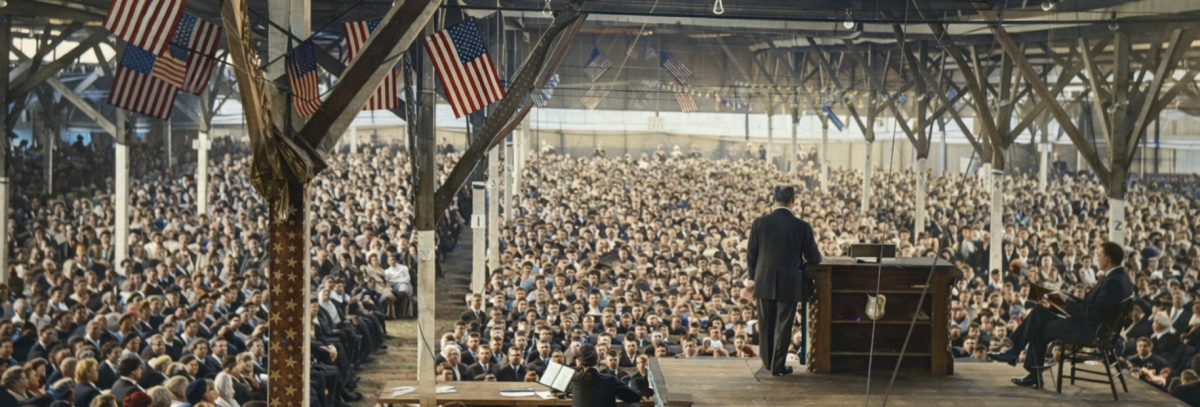
From February 11 to March 11, 1906, evangelist Billy Sunday conducted a major revival campaign in Princeton, drawing sustained crowds and producing significant conversion totals that reinforced his growing reputation as one of the most effective evangelists in the Midwest. A temporary tabernacle seating approximately 3,600 people was filled nightly, indicating the strong regional interest in Sunday’s preaching and the extensive cooperation of local churches.

The meetings quickly produced measurable results. One report noted 919 conversions in a single day on February 24, illustrating the intense response often seen at the height of Sunday’s campaigns. Despite severe winter weather—including one of the worst storms of the season on March 3—attendance and participation remained strong. By March 8, newspapers reported 1,298 converts, and by the close of the revival on March 11, the total number of recorded conversions had reached 2,325.

Contemporary observers described the atmosphere in Princeton as spiritually charged. A visiting pastor reported that the “city was aflame with the revival spirit,” while others praised Sunday’s dynamic preaching style, likening his delivery to a “storm” or “cyclone” in its intensity. His methods, though sometimes criticized as sensational, were widely regarded by supporters as effective in reaching large audiences—especially men—who might otherwise avoid church.

The Princeton campaign also contributed to Sunday’s rapidly expanding influence across the region. Shortly afterward, newspapers noted that since October 1905 he had reportedly received about $12,000 in offerings and recorded 9,000 conversions, with 20,000 conversions attributed to his work across the Rock River Valley of Illinois. The Princeton meetings thus formed a significant chapter in the early expansion of Sunday’s evangelistic career.

Sources:
The Dixon Evening Telegraph, March 2, 1906, p. 5.
Bureau County Tribune (Princeton, IL), March 9, 1906, p. 3.
Freeport Journal-Standard (Freeport, IL), February 26, 1906, pp. 1, 5; March 8, 1906, p. 4.
Journal Gazette and Times-Courier (Mattoon, IL), March 19, 1906, p. 1.

Billy Sunday: the man and his methods (period newspaper, c.1905)

The Man and His Methods.

“It is impossible to describe William A. Sunday. He simply gets there. While he shocks some of the staid old deacons by his rough and ready way of putting things, the great throng stand on and applaud. He has a wonderful gift of street slang and he uses the choicest of it. He can preach using as fine English as any man in the country, but he is dreadfully lonesome doing it. He likes to employ language people best understand.

He is a slight man, weighing less than 140 pounds, but is wiry and as scienced as Jeffries. He is a bundle of nerves, and from the moment he throws a beautiful fur coat from his shoulders to the close of the meeting every nerve is put in play. Those who hear him go away stating that he cannot stand it long to work with the nerve force he does, but he has stood it for eight years and is as able today as he was in the beginning. He pleads, he entreats, he prays and weeps, and the crowd are with him. Few men have the power to sway crowds like Sunday. He can cause them to break out in peals of laughter and can make them weep copiously as he appeals to sympathy. He is great on storytelling and can embellish with all the facial expressions necessary. He is so agile on the stage that without any trouble at all he can lean over backward and touch his head to the floor, and, if occasion demanded, could turn a flip with the best of them.

It is this that undoubtedly arouses the curious and those who wish to be entertained. But it doesn’t end there. He can preach powerful sermons. If you go once you go twice and if you go twice, you will find that at the close of his month’s services you have been present at about every service.”

– The Sioux City Journal (Sioux City, Iowa) · Sun, Feb 26, 1905 · Page 9.

January 13 – February 12, 1905. Mason City, Iowa – Billy Sunday revival

January 13 – February 12, 1905. Mason City, Iowa

Billy Sunday conducted a month-long revival campaign in Mason City, Iowa, from January 13 to February 12, 1905, during a period when the city’s population was only about 8,300 and total church membership was roughly 3,000. A temporary tabernacle constructed of rough boards and tar paper—heated by six furnaces to withstand winter conditions—served as the central venue for the meetings.

Attendance was substantial for a community of Mason City’s size. One January meeting drew 2,000 men, while associate evangelist Ira E. Honeywell simultaneously addressed 1,000 women in a separate gathering. During a notable men’s meeting on January 29, Sunday delivered a forceful sermon condemning social vices; more than 50 men responded for prayer and conversion. The revival continued despite severe winter weather, including temperatures reported at twenty below zero.

By the campaign’s conclusion, the meetings had produced approximately 700 conversions, including 200 on the final day. Sunday received a $1,800 love offering, while an additional $2,500 was raised for campaign expenses and $800 for the city’s poor. Contemporary newspapers widely reported the revival and praised Sunday’s energetic preaching style and his unusual ability to sway large crowds.

Billy Sunday on the Chautauqua Circuit: The Brief but Notable Season of 1910

In the summer of 1910, Billy Sunday stood at an interesting crossroads in his rapidly expanding ministry. By this point he was already nationally known as one of America’s most electrifying evangelists. Cities across the country were beginning to build large tabernacles to accommodate the crowds that flocked to hear him preach. Yet during the summer months—when revival campaigns often paused—Sunday occasionally appeared on the Chautauqua circuit, the great American network of traveling lecture assemblies that combined education, entertainment, reform movements, and religion.

Unlike many lecturers who spent the entire season touring the circuit, Sunday’s 1910 Chautauqua schedule was surprisingly limited. He appeared only at a handful of assemblies, and his comments to the press make clear that this was intentional. Sunday had been offered lucrative opportunities to spend the entire summer lecturing. One newspaper reported that he declined an offer of $20,000 to devote the season to Chautauqua work, explaining that the exhausting schedule would leave him unable to conduct revival campaigns in the fall.

“The report that I am to retire is all pure nonsense… I refused $20,000 to give my time to Chautauqua work this summer, as I would be worn out and could not preach before January.”

Sunday’s priority remained evangelistic preaching. Nevertheless, the few Chautauqua appearances he did make during the summer of 1910 provide a fascinating glimpse into his growing national popularity and the remarkable drawing power he already possessed.


Whidbey Island: The Northwestern Chautauqua Assembly

Sunday’s Chautauqua engagements began on July 24, 1910, at the Northwestern Chautauqua Assembly on Whidbey Island, Washington.

At this gathering Sunday delivered a message titled “Forces that Win.” Like many of his sermons, it blended moral exhortation with vivid biblical storytelling. Reports indicate he illustrated his message with the story of David and Goliath, a favorite example of spiritual courage overcoming overwhelming odds.

Even among the prominent lecturers and performers typical of a Chautauqua program, Sunday stood out. His dynamic speaking style—rapid delivery, colorful language, and dramatic physical movement—contrasted sharply with the more measured lecture format audiences often expected.


Hillsboro–Litchfield: A Midwestern Assembly

In early August Sunday appeared at the Hillsboro–Litchfield Chautauqua, running from August 4 through August 11. These regional Chautauqua assemblies usually featured a mixture of lectures, concerts, political discussions, and religious addresses.

Sunday’s presence on such programs reflected the growing recognition that he was not merely a revivalist but also one of the most compelling public speakers in the country.


Maxwelton, Washington: Crowds Even in Small Communities

On August 6, Sunday spoke at the Maxwelton Chautauqua in Washington, addressing a crowd estimated at 4,500 people.

The size of the audience is striking. Maxwelton itself was a small community, yet thousands gathered to hear Sunday speak. Even outside the large urban revival campaigns for which he would soon become famous, his reputation alone was enough to draw impressive crowds.


Patterson Springs: Record-Breaking Interest

Another Chautauqua stop came on August 10 at Patterson Springs. Newspapers noted that Sunday had previously delivered a lecture there that produced $3,600 in ticket receipts, reportedly a record for a single Chautauqua lecture.

This financial success reveals something important about Sunday’s role in the Chautauqua movement. He was not just a preacher filling a religious slot in the program. He was one of the circuit’s major attractions, capable of drawing large audiences and generating significant revenue.

Even so, Sunday resisted becoming primarily a Chautauqua lecturer. His heart remained in revival work.


Lake Whatcom: The “Human Interest” Lecturer

On August 24, Sunday appeared at the Washington Assembly Chautauqua near Lake Whatcom. Promotional material advertised him as delivering the program’s “human interest” lecture, a category that perfectly suited his style.

Sunday’s talks often mixed humor, storytelling, social criticism, and passionate moral appeal. He could move easily from a humorous anecdote to a blistering denunciation of vice, particularly the liquor trade. This blend of entertainment and moral seriousness made him an ideal Chautauqua speaker.


Richmond, Indiana: A Crowd of Eight Thousand

Sunday’s most dramatic Chautauqua appearance of 1910 came on August 28 at the Richmond, Indiana Chautauqua.

The crowd numbered roughly 8,000 people, and Sunday delivered one of his most famous temperance sermons, “Booze.”

Contemporary accounts describe a performance that was nothing short of theatrical. Once fully warmed up, Sunday removed his coat and launched into an explosive denunciation of the saloon. At one point he grabbed a red flag representing the liquor trade, hurled it to the ground, and stamped on it before triumphantly seizing the American flag to symbolize moral victory.

Such dramatic gestures were typical of Sunday’s style. Critics sometimes mocked them as stage tricks, but audiences loved them. They reinforced his reputation as the relentless enemy of alcohol and social vice.


Why the 1910 Season Was Short

One of the most interesting aspects of Sunday’s Chautauqua activity in 1910 is how limited it was.

Rumors circulated in the press that he might be retiring from public speaking altogether. In reality, the opposite was true. Sunday simply refused to devote the entire summer to the lecture circuit.

He explained that constant Chautauqua travel would leave him exhausted and unable to conduct the revival campaigns that he believed were his true calling. Instead, he used the summer months partly for rest and partly for select speaking engagements before returning to the intense schedule of fall revivals.

This decision proved wise. Later in 1910 Sunday conducted major campaigns in New Castle, Pennsylvania, and Waterloo, Iowa, drawing enormous crowds and recording thousands of conversions.


A Glimpse of Sunday’s Expanding Influence

Though brief, Billy Sunday’s 1910 Chautauqua season reveals several important aspects of his rising influence.

First, it demonstrates the extraordinary demand for him as a public speaker. Even isolated appearances drew crowds in the thousands.

Second, it shows that he was already a major figure in the reform movements of the era—especially the temperance crusade.

Finally, it highlights Sunday’s own priorities. While many speakers made their careers on the Chautauqua circuit, Sunday viewed it as secondary. His passion remained revival preaching and evangelism.

In hindsight, the summer of 1910 marks a moment when Billy Sunday could have easily become one of the most lucrative lecturers in America. Instead, he chose the harder path—returning to the sawdust floors of revival tabernacles and the exhausting pace of evangelistic campaigns.

And in doing so, he continued building the ministry that would soon make him the most famous evangelist in America.