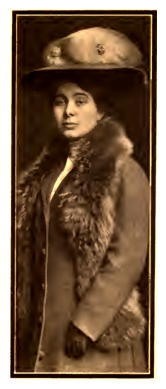
Women’s Wok for Women – Miss Miller (Billy Sunday’s campaign team, c.1909)

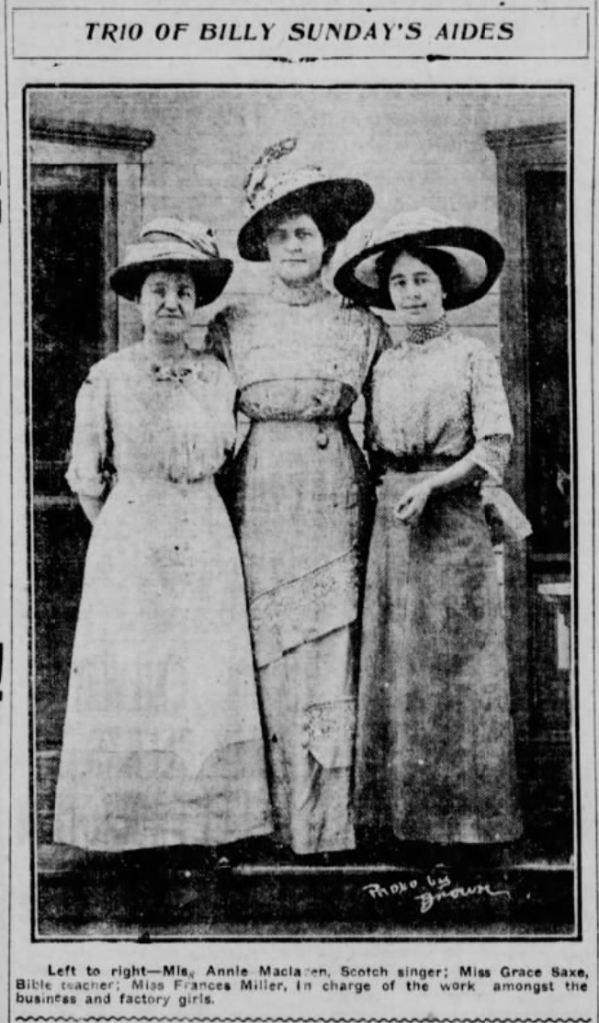
Some one has said “To make ‘soul winners’ out of church members” is the business of Miss Francis Miller with the Sunday party. Her greatest opportunity comes each afternoon at the close of Mr. Sunday’s sermon. Christians of all ages and experience gather before her on the platform to be instructed how to use the Bible in meeting the excuses and answering the questions of sinners. She is an expert in teaching how to diagnose the sinner’s heart and apply the specific Scripture remedy chapter and verse. For years she was a passive church member when a sermon on “Personal Work” by Billy Sunday opened her eyes to a great responsibility. Mr. Alexander led her into Bible study and Grace Saxe made her eager to do Bible work. She carries ordination in the Congregational church and has had experience in pastoral work. Miss Miller’s work in other places is being duplicated in Cedar Rapids.

Miss Miller’s Bible work in connection with the revivals conducted by Mr. Sunday has ripened in the school of experience. At first she came on the ground at the close of the revival and organized union Bible study classes. Experiments of this kind at Knoxville, Iowa, Kewanee and Kankakee, Ill., revealed that the work done in this way could not be made of permanent value without local leaders, which was not always available. The experiment was tried out beginning in advance of the revival. Miss Miller went to Muscatine and Galesburg two weeks before Mr. Sunday to prepare the personal workers for his coming. Later Miss Miller worked during the three last weeks of the meetings and then remained two weeks after the close to organize the local Bible class work upon a permanent basis. This was the plan pursued at Springfield where forty-five district or neighborhood Bible classes were formed with a central training class for the leaders. These classes were interrupted by the summer vacation period but the classes took up their work this fall with about one thousand members working in the various districts. A class was formed among the so-called “society girls,” the girls of leisure, in well to-do homes. They call it “The Worth While Bible Class,” and they have been aggressive in Y.W.C.A. and associated charity work. One Bible class in Springfield supplanted a card club. The girls gave up their cards for Bibles. There was no breaking up of existing social ties but a change of bonds. No new social lines were drawn but a new directive of interest was taken. Many girls who have been stimulated to take up personal work have gone to Moody Institute for training. Word comes from Boulder, Col. that sixty high school girls hold regular Bible study meetings in the high school building. Miss Miller is one of the busiest workers of the Sunday party. She meets with the home girls of leisure at 10 a.m. The fifty gathered at the home of Mrs. Frank Watson Friday may be regarded as typical; at 11:15 three days of the week she meets the Coe college girls; at 12:15 she talks about 150 high school girls at St. Paul’s M.E. church; at 3:00 holds a personal workers’ class for everybody and at 6:30 for clerks, teachers and others. Careful plans are being made to insure systematic Bible study after the close of the big revival.

The Cedar Rapids Gazette. Thu, Nov 18, 1909 ·Page 5


Miss Frances Miller
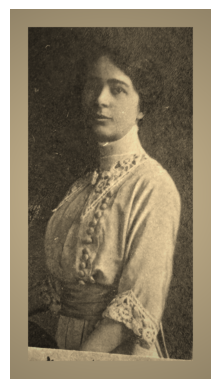
TRUE today as it ever has been, the title, “church member,” or “Christian,” are not synonymous with “soul winning.” Miss Miller, with Bible in hand, finger on chapter and verse, persuades you—yes, convinces you they should be—that they are. To make “soul winners” out of church members is her business with Mr. Sunday’s party, and she does it. Skilled herself through years of study and practice, she stands before her class of hundreds, each afternoon at the close of Mr. Sunday’s sermon and schools them to meet the excuses and questions of the sinner, not as the quack with the patent cure all, but as the trained physician who diagnoses, then prescribes. With clear, logical reasonings, deduced from Scripture, carried by a clear, far-reaching voice, she instructs how to diagnose the sinner’s heart and apply the specific Scripture remedy with chapter and verse.

Miss Miller herself was not always a soul-winning church member. For five years she was not. A church member, simply, she thinks, because she was asked to be. Reared in a Christian home, honest at heart, she was ready. When Billy Sunday, about sixteen years ago, broke the truth to her in a sermon on “Personal Work,” she surrendered to it. Mr. Alexander led her into Bible study and Grace Saxe made her want to do Bible work.

She was born in Minnesota, grew up in North Dakota, lived in Illinois, was educated in the high school at Waterloo, Iowa, and college at Fargo, N. D., and afterwards taking a two years’ course and finals in the Bible Institute in Chicago.

She spent a summer with Mr. Williams and Mr. Alexander, organizing Bible classes, etc., one of which at Vinion, Ia., still continues, and that is over ten years ago. Her first year out of college she had charge of two Congregational churches near Valley City, N. D., and later was ordained a member of the Congregational church.

Besides “personal work” classes she teaches systematic Bible study classes, special prayer meetings in Y.M.C.A., laundries, shops, high schools, etc., at times and places convenient for the many who cannot attend the regular services. Morning and afternoon she does it, conducting four or more meetings a day and plunges into the vast tabernacle in the evening hunting for someone to lead to her Christ.

Her Bible is pre-eminently a part of a great revival campaign in supplementing the preaching by preparing intelligent workers and grounding converts in the Scriptures. Thus two of the weakest spots, two chief causes of failure in modern revival work, are cared for.

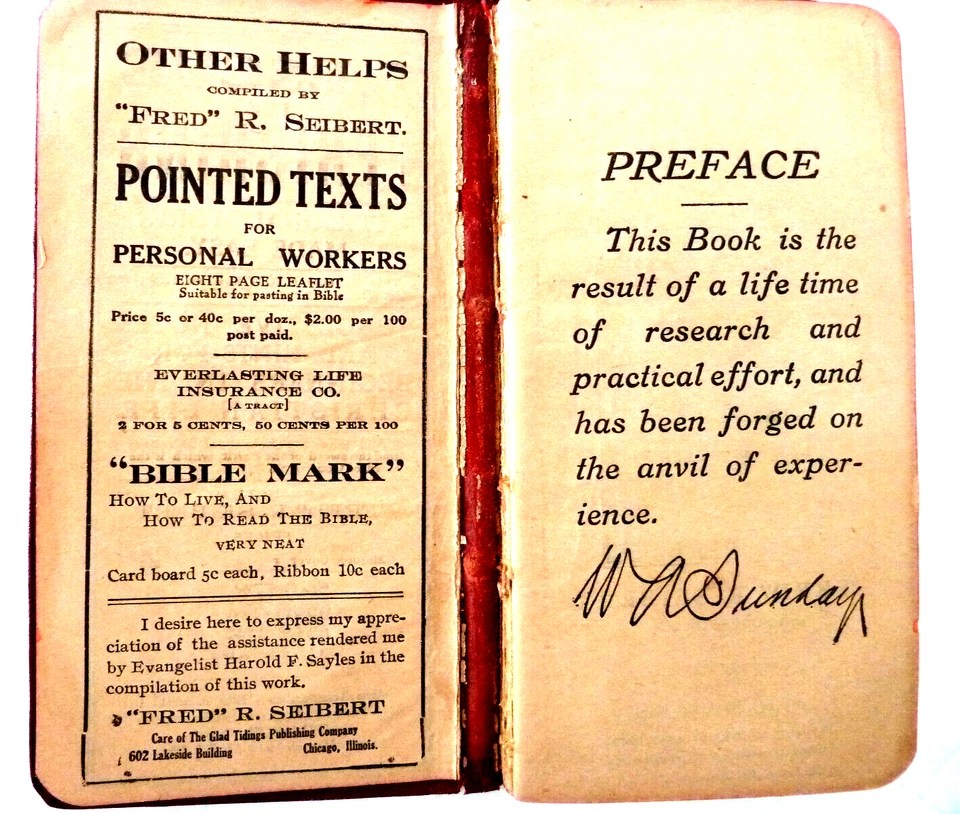
The 1909 Springfield souvenir campaign booklet
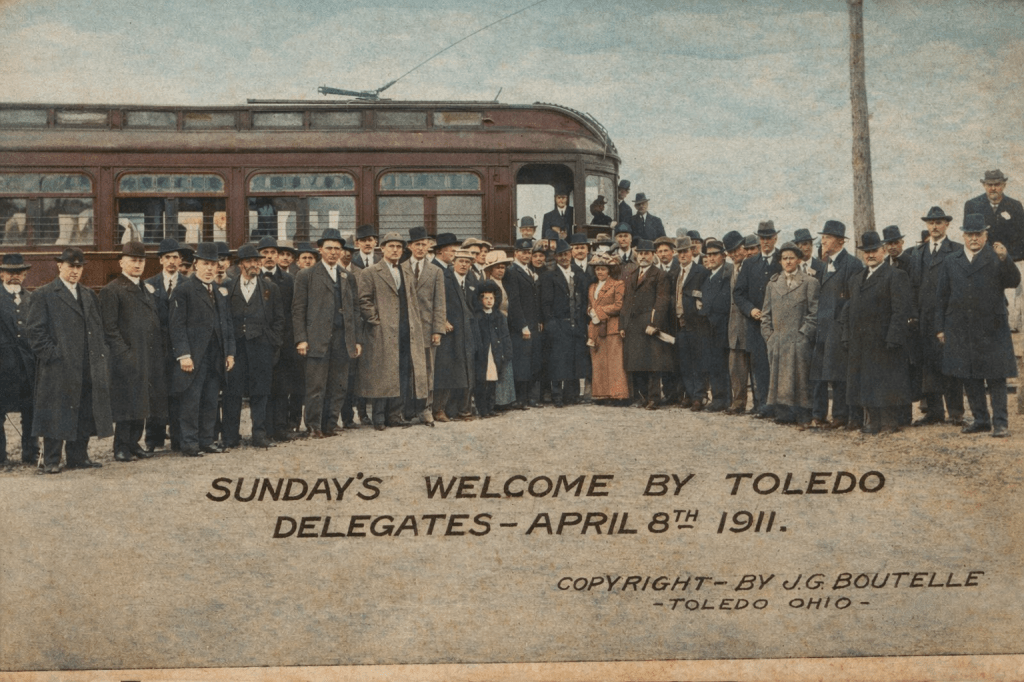
Postcard shows Toledo welcomes Billy and company in April 1911

Colorized by owner.

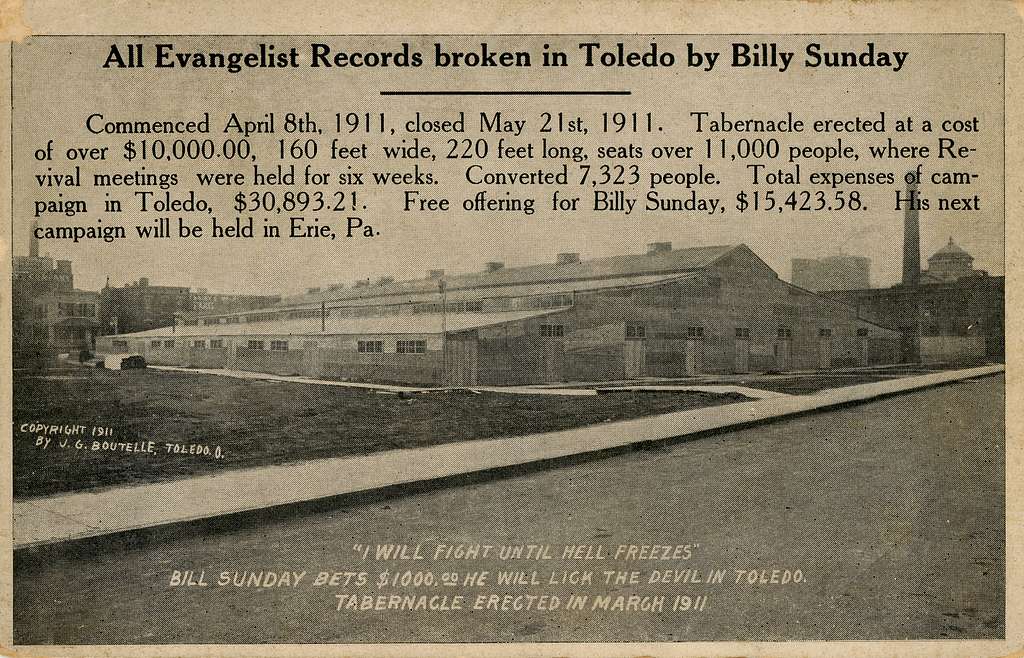
Billy Sunday’s Toledo Campaign (April 9 – May 21, 1911)

Billy Sunday’s 1911 revival in Toledo, Ohio, was one of the most anticipated evangelistic events the city had ever seen. Running for six intense weeks—from April 9 to May 21—the campaign opened with extraordinary momentum. On opening Sunday alone, more than 30,000 people attended three services, immediately signaling the citywide interest and spiritual hunger surrounding Sunday’s arrival.

The revival was held in a massive temporary tabernacle measuring 160 by 220 feet, with seating for 7,000 people, plus an additional 1,000 seats in the choir loft. Night after night, the structure filled with working men and women, families, and curious onlookers drawn by Sunday’s reputation for plainspoken preaching, moral urgency, and energetic delivery.

Organizers initially hoped for 20,000 conversions, a figure reflecting Toledo’s size and the scale of the meetings. While that expectation proved optimistic, the final results were still remarkable: 7,323 people publicly professed conversion, surpassing Sunday’s previous record at New Castle. The response confirmed Toledo as one of the strongest campaigns of his early national prominence.

Financial support from the city was equally notable. Total offerings reached $14,423.58, breaking Sunday’s earlier giving record of $10,000 at New Castle. Newspapers emphasized that these contributions came largely from people of ordinary means, underscoring the grassroots character of Sunday’s appeal and the broad civic buy-in to the revival.

By the time the campaign concluded in late May, Toledo had experienced weeks of sustained attention on spiritual renewal, personal reform, and public morality. Though it fell short of early conversion projections, the Toledo campaign stood as a record-setting and influential moment in Billy Sunday’s rise as America’s most prominent evangelist of the Progressive Era.

July 1911 – Hannibal Courier-Post – Billy as Chautauqua headliner

Hannibal, Missouri paper

“BILLY” SUNDAY

Revivalist and Chautauqua Headliner

Image credit: author

Thomas E. Green, well known to Chautauqua audiences published in the June 1910 issue of Hampton’s Magazine, an article on “Revivals and Revivalists.” The whole article is full of interest. Chautauqua Committees who have booked Billy Sunday will do well to secure it, as it furnishes splendid material for publicity. He quotes the following estimates of Sunday’s work in places where he has held meetings: The leading pastor in the converted city, a man of ripe judgment, said: “I looked forward to this thing with a great deal of anxiety. When the evangelist came he quite captured me. He is unique. There is only one of his class, and probably it is well that it is so, but he showed himself sincere and honest. There were 736 conversions, and in addition about 1,500 have united with the churches.”

A very hard-headed banker told me: “The cost to the city was something over $16,000. The evangelist got over $7,000, but he earned every cent of it. If a lot of preachers in this country would do as much in five years as he did in five weeks, and work half as hard, they might be entitled to as much return.”

A leading editor said: “His sermon on ‘booze’ was I believe, the greatest individual effort I ever heard from the platform. He talked to six thousand men, and held them as in the hollow of his hand. Up in our bindery I understand all the boys and girls were converted and they are sure a happy bunch.”

I know of one mid-Western manufacturing city in which a fervid revival was held by one of the greatest revivalists of the day. It was not a “bad town” in the beginning. It was a “river town,” however—a “liberal town.” The saloons had never been officially closed even under state law of the stringent anti-saloon sort. For a city of 25,000 people it was what is called “wide open.” The revivalist came, and for six weeks his work went on. At the next city election, as a direct result of the revival, the people voted out a “liberal” administration, and voted in a “closed town” administration. The saloons were closed, and the town is so well pleased they are likely to remain closed, for a long time.

I have known Billy Sunday ever since the days when he came to the old Chicago Ball Club, the days when with my athletic ardor yet unabated I was “Chaplain” of the League.

Billy played rattling good ball, championship form, and he has kept the same standard during a phenomenal career. His meetings are enormous in size and results. His “thank offerings” are the largest any evangelist has ever received.

“Drunkenness, gambling, adultery, theatre going, dancing, and card playing are damning America, and nothing can save it from ruin but a revival of religion,’ says Billy Sunday.

“You think, then, that our popular amusements and recreations are wrong?”

I know it. Dancing is nothing but a hugging match set to music. It’s the hotbed of licentiousness whether in a fashionable parlor or in a dive. More girls are ruined by it than by all other things combined. Talk about the poetry of motion! It’s just a devilish snare of souls. Let men dance with men and women with women, and the thing wouldn’t last fifteen minutes. The slum dance is better than the club dance, because they wear more clothes at it.”

“Sow bridge whist and you reap gamblers. The man who sits at a table and bets a thousand on a jack pot is no more a gambler than the society belle who plays bridge for a prize.”

That’s Billy Sunday, America’s greatest evangelist. On the platform he “plays ball.” Attitude, gestures, method—he crouches, rushes, whirls, bangs his message out, as if he were at the bat in the last inning, with two men out and the bases full. And he can go into any city in America and for six weeks talk to six thousand people twice a day, and simply turn that community inside out.

Hannibal Courier-Post. Hannibal, Missouri · Thursday, July 27, 1911

Grace Saxe’s Prayerbook, c 1911

Source – the author of this article is probably the wife to Evangelist M.B. Williams.

Grace Sax joined the Sunday team in February 191. She immediately assumed the leader of the cottage prayer meetings, as well as Bible teaching and training local churches to handle the fruit of the Sunday revivals.

The Liverpool Evening Review. Wed. Sept 18, 1912:1. Grace is in the center.

This article in a 1911 newspaper gives a glimpse of the importance of prayer to Grace.

Miss Saxe then held up little blank book which is called “Answered Prayer.”

She calls it, “A Record of the Footsteps of a Prayer Hearing and Prayer Answering God.” It is divided into four blank columns headed. First, date of asking; second, the request; third, the special promise pleaded; fourth, date when answered.

In this record she puts only the prayers which to man’s eyes it seem impossible to have answered. All of her prayers, she says, have not been answered thus far—many of them have however been answered fully.

“There are conditions to fulfill if prayers are to be answered.” These seven conditions she has in the back of her “Answered Prayer”

1. Personal condition, Psalm 66:18,

2. Forgiving Spirit, Mark 11:25,

3. Spiritual Motive, James 4:3.

4. Asking, Matthew 7:7,

5. Asking in Faith, Mark 11:24,

6. Asking according to God’s will (not to interfere with His plans) 1 John 5:14,

7. Asking in Jesus name, John 16:23. “Pray so that if it were written we could ask Jesus to sign it.”

In our prayers Miss Saxe suggests that the following should be the form of approach to God: Adoration, Confession, Thanksgiving, Supplication.

Taking the first letters of these words in order, we spell the word Acts. In Genesis 32:9-12 we find that order observed in Jacob’s prayer. In conclusion Miss Saxe suggested the reading of Andrew Murray’s ‘With Christ in the School of Prayer.’—Mrs. A. R. Williams.

Source – the author of this article is probably the wife to Evangelist M.B. Williams.

The following story was printed in a paper on March 3rd, 1915:

“One of the special features of the meeting yesterday afternoon came when Miss Grace Saxe, of Sunday’s party, rushed from the platform and threw her arms around the shoulders of a woman trail hitter. Miss Saxe later explained that the woman was a relative, living in this city, and that she has been praying for her to come to the front since the opening of the campaign.”

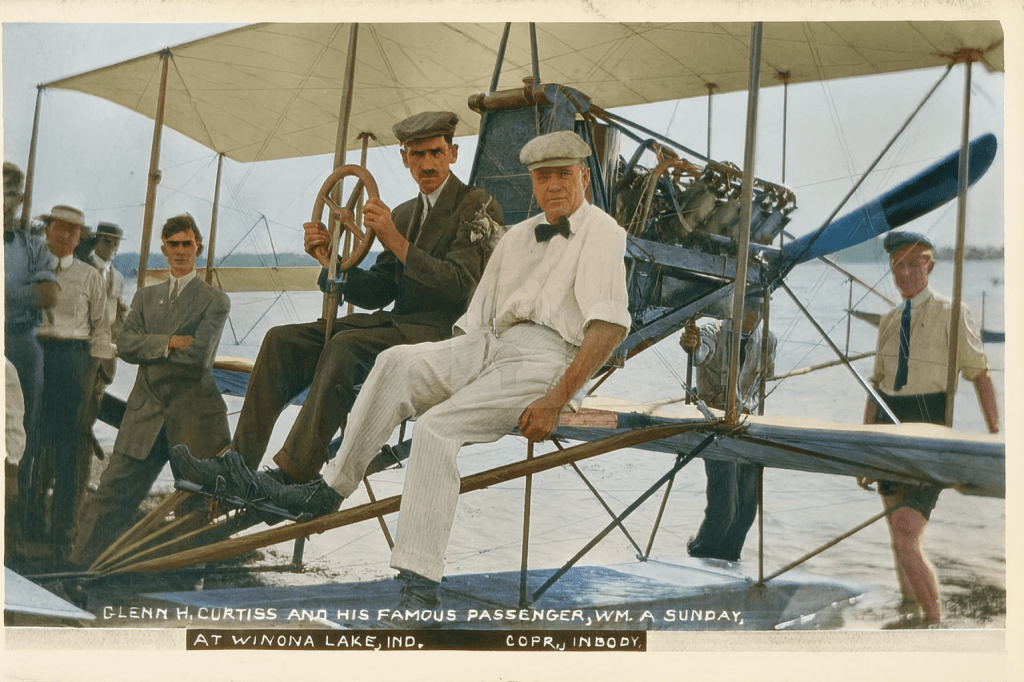
“BILLY” SUNDAY FLIES IN AIRSHIP, 1911

“BILLY” SUNDAY FLIES IN AIRSHIP

EVANGELIST TAKES TWO-MILE RIDE OVER WINONA LAKE WITH CURTIS

Warsaw, Ind., July 14.-“Billy” Sunday and Glen H. Curtiss, two of the world’s greatest sky pflots, few tagether in the Curtiss hydro-aero. plane on Winona lake today. The evangelist, who is spending, a few days at his Winona home, accepted the aviator’s invitation at the last moment. ” He didn’t flinch as the big air craft sped over the lake a distance of at least two miles. More than 15,000 people saw the three successful flights that were – made by Curtiss.

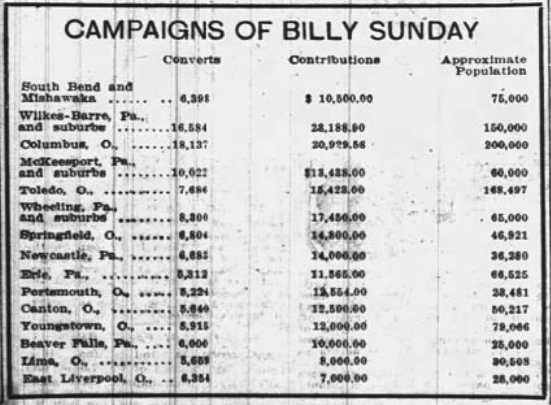
Campaigns of Billy Sunday (published June 1913)

Location
South Bend & Mishawaka
Wilkes-Barre, PA
Columbus, OH
McKeesport, PA
Toledo, OH
Whelling, PA
Springfield, OH
Newcastle, PA
Erie, PA
Porstmouth, OH
Canton, OH
Youngstown, OH
Beaver Falls, PA
Lima, OH
East Liverpool, OH
Converts
6,391
16,584
18,137
10,022
7,684
8,300
6,804
6,683
5,312
5,224
5,640
5,915
6,000
5,669
6,354
Contributions
 $      10,500.00  $      28,188.90  $      20,929.58  $      13,438.00  $      15,423.00  $      17,450.00  $      14,800.00  $      14,000.00  $      11,565.00  $      12,554.00  $      12,500.00  $      12,000.00  $      10,000.00  $         8,000.00  $         7,000.00
Approx. Pop.
75,000
150,000
200,000
60,000
163,497
65,000
46,921
36,380
66,525
23,481
50,217
79,066
25,000
30,508
25,000

South Bend Tribune. Mon, Jun 16, 1913 ·Page 12

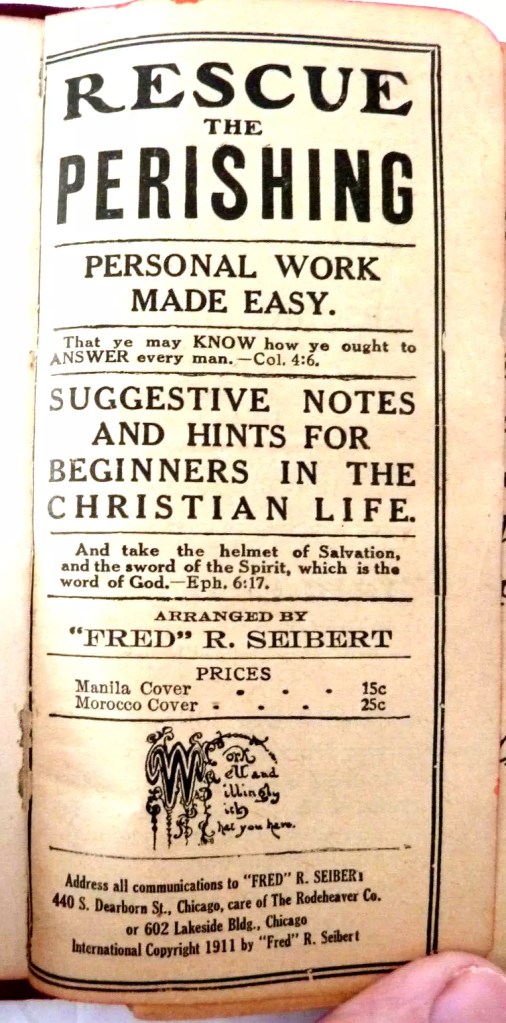
Rescue the Perishing ‘personal worker’s’ resource during Billy Sunday campaigns, c. 1911

RESCUE THE PERISHING

PERSONAL WORK MADE EASY.

That ye may KNOW how ye ought to ANSWER every man.—Col. 4:6.

SUGGESTIVE NOTES AND HINTS FOR BEGINNERS IN THE CHRISTIAN LIFE.

And take the helmet of Salvation, and the sword of the Spirit, which is the word of God.—Eph. 6:17.

ARRANGED BY “FRED” R. SEIBERT

Author’s Collection

Books Proving Handy.

Those who assist in the personal work at the tabernacle are finding that the little book on this line of endeavor sold by Fred Seibert to be of much value. The ex-cowboy, in addition to selling the book on personal work, handles the hymnals and has for sale two of Billy Sunday’s sermons, ‘Moral Lepers’ and ‘Three Groups.’

The South Bend Tribune. Mon, May 12, 1913 ·Page 9

Toledo, 1911 campaign statistics

This image is in the public domain.

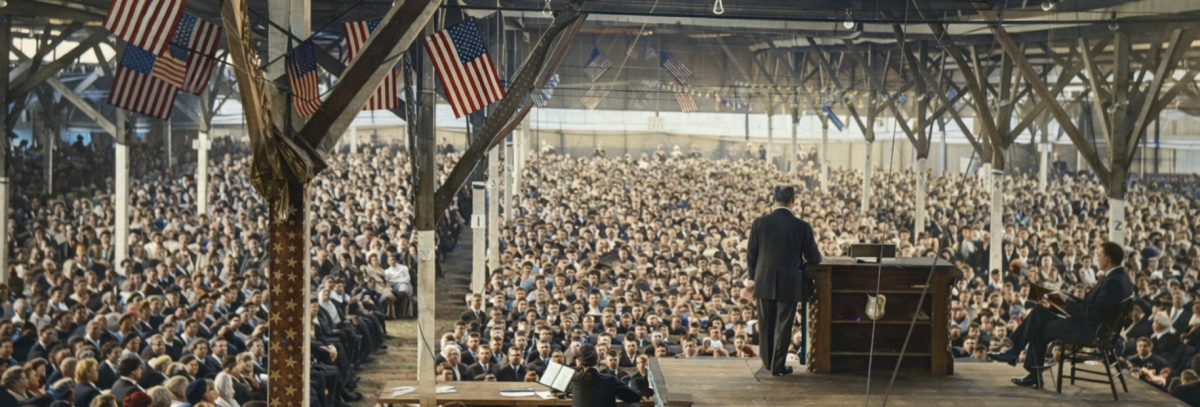
In early 1911, the city of Toledo, Ohio, found itself at the center of a spiritual and cultural whirlwind when Billy Sunday brought his revival campaign to town. Running from January 29 to March 12, this six-week crusade marked a significant moment not just in Sunday’s ministry, but in the broader urban revival movement sweeping America in the early 20th century.

To accommodate the expected crowds, a massive wooden tabernacle seating around 9,000 was constructed along Jefferson Avenue, near downtown. Though the city’s population at the time was just under 170,000, more than 350,000 people flooded into the tabernacle over the course of the campaign. It was not unusual for Sunday to preach three or four times a day to packed audiences, some standing in the aisles or spilling outside the structure just to hear his voice thunder through the open air.

Sunday’s preaching style in Toledo was vintage Billy—fiery, theatrical, and unforgettable. He ran across the stage, leapt onto chairs, punched the air, and peppered his sermons with vivid imagery and baseball metaphors. Among the messages he delivered were some of his most iconic: “Booze,” “Backsliding,” “If Hell is a Joke,” and “The Ten Commandments.” His attack on the saloon business in “Booze” especially struck a chord in a city known for its proliferation of taverns and political corruption. “I want to preach so plainly,” he declared, “that the man who runs may read, and that even the saloonkeeper will know that I mean him!”

The results were staggering. Over 18,000 individuals reportedly made decisions for Christ, and local churches saw a dramatic uptick in attendance and membership. The spiritual momentum didn’t stop at the altar. Sunday’s relentless promotion of Prohibition, moral reform, and church revitalization left an indelible mark on Toledo’s civic and religious landscape.

The local press—especially The Toledo Blade—covered the revival extensively, offering daily summaries and commentary. While some editorials criticized Sunday’s bluntness and emotionalism, many praised the campaign’s influence on the moral climate of the city. Business leaders, city officials, and pastors saw firsthand the social power of mass evangelism, and Sunday’s reputation as a national revivalist soared.

Toledo was more than a successful campaign—it was a turning point. It proved that Sunday could handle large urban centers with complex political, economic, and moral challenges. It set the stage for even bigger crusades in Detroit, Boston, and New York, and solidified his status as one of the most influential evangelists of his time.