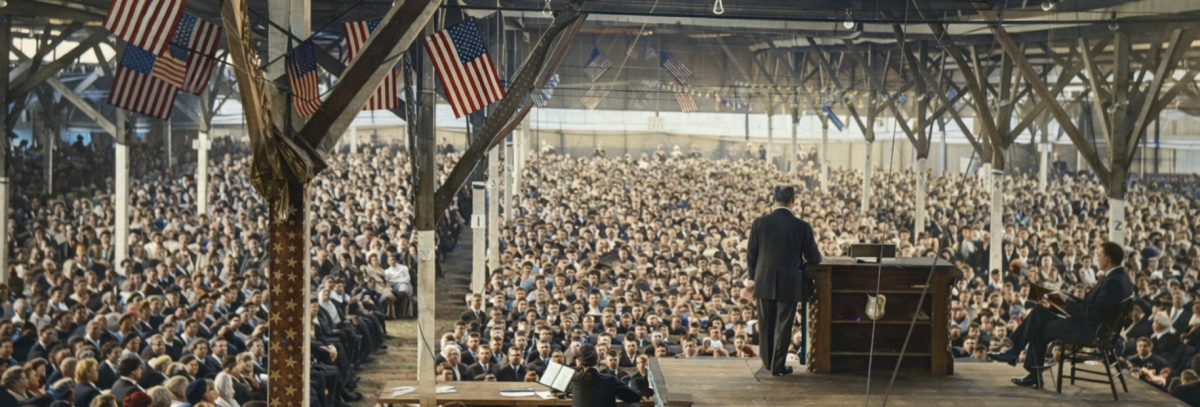
Fourth in a series drawn from Lindsay Denison’s profile of Billy Sunday in The American Magazine, September 1907.
For three hundred years, Lindsay Denison observed, Americans had been accustomed to discussing God and the soul in the stately cadences of the King James Bible. To depart from that vocabulary had come to feel almost like sacrilege. Billy Sunday departed from it completely.
He talked about God and salvation, Denison wrote, exactly the way people talked to one another six days a week — across a shop counter, over the dinner table, out on the street. That was the scandal of his preaching, and it was also the secret of it.
The Devil who came from Missouri
The clearest example in the article is a stretch of Sunday’s sermon on “Temptation,” built on Satan’s effort to corrupt Christ in the wilderness.
Sunday had no patience for the modern, comfortable idea that the Devil was merely a figure of speech — a poetic personification of human sin. People who said so, and especially the ministers who said so, he flatly called liars, because to him they were calling the Bible itself a lie. There was a Devil, he insisted, and he was no fool: a smooth operator who was, at that very moment, running up and down the aisles of the tabernacle trying to keep sinners indifferent to their own salvation.
Then came the part that made audiences gasp and laugh at once. Sunday staged the wilderness temptation as a piece of street theater. The Devil swaggers up to a weary, hungry, lonely Christ, looks him over from sweat-stained brow to dusty hem, and sneers. And when Christ admits who he is, the Devil laughs and throws down a challenge in the slang of a Missouri skeptic: he’s not so easily fooled, Christ will have to show him — turn these stones into bread and produce the goods.
To stage Satan as a wisecracking “show-me” doubter was, by every standard of nineteenth-century pulpit decorum, outrageous. Denison watched the ministers seated behind Sunday wince. But he also watched the crowd, and he came to understand that their laughter and applause were not the jeering of sinners at sacred things. It was the delight of plain people hearing the old Bible stories made suddenly new, real, and as immediate as the incidents of their own daily lives.
The pointing finger
If the Missouri Devil was Sunday at his most entertaining, another passage shows him at his most uncomfortable — and most effective.
Mid-sermon, he would single out individuals in the crowd. Without naming names, he turned an accusing finger on a man who had spent sixty dollars on tobacco in two years while his wife went without a new dress; on a woman pouring time and money into fancy hats and card parties while her husband fled badly cooked meals and her children ran wild in the streets; on a respectable citizen and what he really bought behind the druggist’s counter; on a group of boys at the back who slid down in their seats as he spoke. Each thrust landed on someone, and the whole congregation felt the danger that the next one might land on them.
It was a remarkable bit of crowd control — intimate, theatrical, and faintly terrifying. Denison noted heads quailing and boys shrinking down their benches. Sunday had turned the anonymous safety of a large audience into the exposed feeling of being known.
A whole body in the pulpit
Sunday did not preach with his voice alone. Denison describes a man with the lope of a professional athlete and the tense springiness of a cat, a penetrating voice pitched just short of harshness.
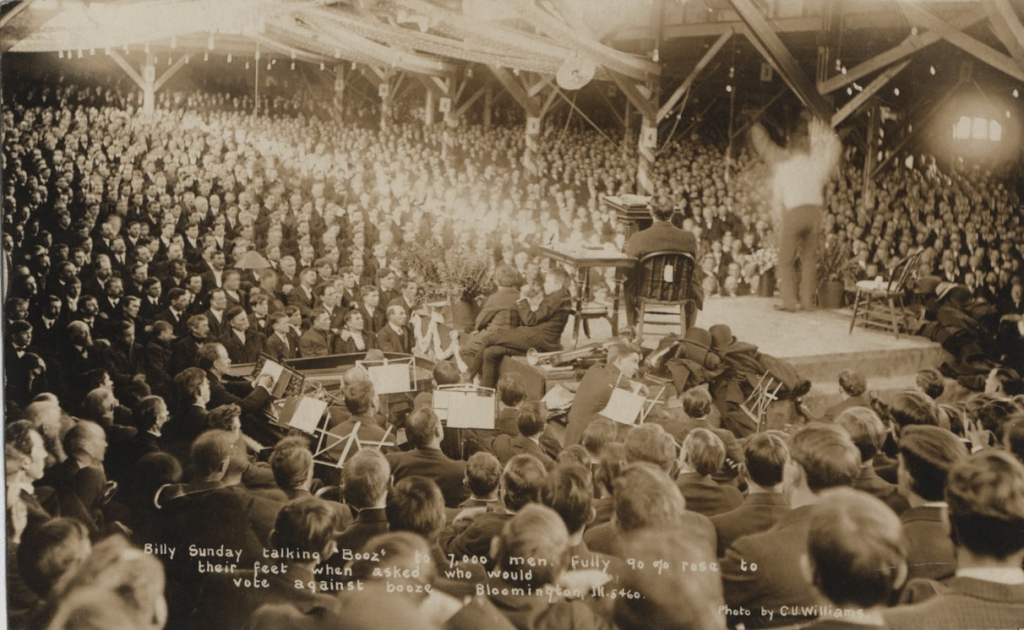
In his very first Fairfield sermon, growing overheated, he peeled off his coat, then his waistcoat, then his tie and collar — and even then his gestures grew so violent that sweat flew from his brow and ears as he beat the pulpit and tossed his head until he was hoarse. He acted out the gait and gestures of every character in his stories. When he preached on the wages of drink, he seized a chair and swung it over his head to dramatize a drunkard’s violence, then dashed it to the platform so hard the legs splintered. The performance was physical, even alarming, and it riveted the room.
Fear as the engine
For all the humor and showmanship, Denison was clear-eyed about the machinery underneath. Sunday preached the old, old doctrine of damnation, and he got his results by inspiring fear and gloom in the hearts of sinners — the fear of sudden death with torment waiting beyond it.
He spoke of the love of Christ, too, and with real tenderness. But even that he turned into a weapon: a tender reproach aimed at the hard-hearted, a way of making the unrepentant feel the full weight of what they were refusing. The joy came later, as a revival neared its close; the early going was meant to frighten.
Why the commonness worked
It would be easy to read all this — the slang, the theatrics, the chair-smashing — as mere sensationalism. Denison resists that reading, and his reason is worth holding onto.
No man, he wrote, could talk to three thousand sensible people night after night for a month in such language and hold them, unless they believed he was honest. The vehemence and the commonplace vocabulary would have defeated themselves if Sunday’s sincerity had not shone unmistakably from his face. The plainness was not a trick laid over the message. It was the message — proof, to the people in those benches, that salvation was meant for ordinary folks like them and not only for the genteel and the instinctively religious.
That conviction is the thread connecting Sunday’s pulpit to everything else about his revivals — including, as we’ll see next, the music.
Next in the series: Combs, Megaphones, and “Old Kentucky Home” — the music of a Billy Sunday revival.

 Evangelist Billy Sunday (1862-1935)