The year Billy Sunday went east: 1908

A Pennsylvania steel-valley revival, a lawsuit over his own sermons, a deaf interpreter, and the summer Billy stopped being just a Midwesterner.

A Pennsylvania steel-valley revival, a lawsuit over his own sermons, a deaf interpreter, and the summer Billy stopped being just a Midwesterner.

On a Friday in May of 1908, Billy Sunday stepped off a train in Sharon, Pennsylvania — a steel-mill town in the Shenango Valley along the Ohio border, eighty miles north of Pittsburgh. He had never preached this far east before. Every revival of his career up to that point had been in Iowa, Illinois, Indiana, Minnesota, Missouri, or one of the closer western states. The Sharon campaign was something new: a seven-week revival in a Pennsylvania industrial valley, and the first real test of whether the Sunday revival method would translate beyond the small Midwestern county-seat towns where he had built it.

By the time he left Sharon in late June, nearly five thousand people had come forward as converts. The campaign had drawn more than fourteen thousand dollars in offerings. A new mission was pledged for the city. And Sunday had given up the Chautauqua circuit for half the summer to make it work. The New Castle Herald, on the second day of the campaign, had already named the thing that mattered:

He has stirred up enthusiasm that has never before been evidenced in this town.

It was a quiet observation, written by a small-paper reporter who had no way of knowing that Sharon was the first piece of a much larger pivot. But the eastern industrial cities were where Sunday’s mature career would unfold. Sharon was the rehearsal.

Bloomington opens the year

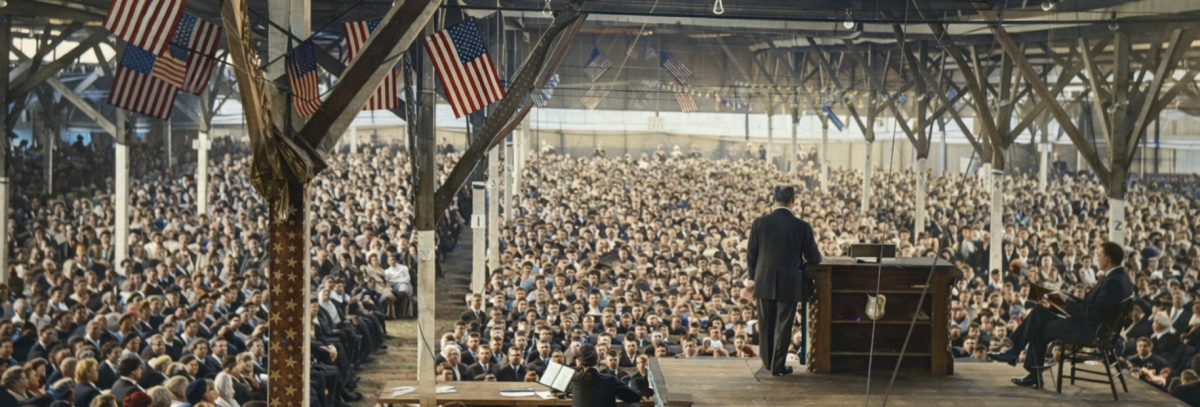
The year began at Bloomington, Illinois — a town of about twenty thousand people in central Illinois. The campaign had been organized so thoroughly that the local committee opened the tabernacle on December 26, 1907, three days before Sunday himself arrived. When he stepped onto the platform on Sunday morning the twenty-ninth, three thousand people were already waiting, and they greeted him with what the Muscatine Journal called “the Chautauqua salute” — a waving of white handkerchiefs across the auditorium. It was the first time the gesture had been used to welcome him at a revival, but it would not be the last.
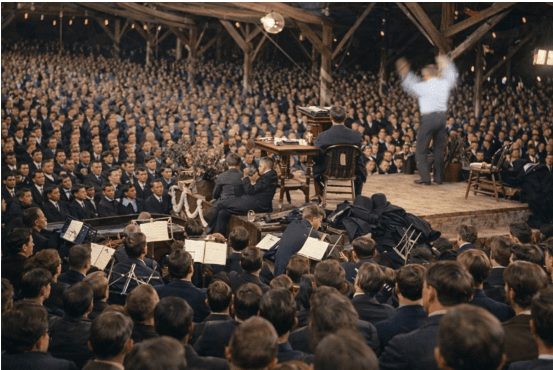
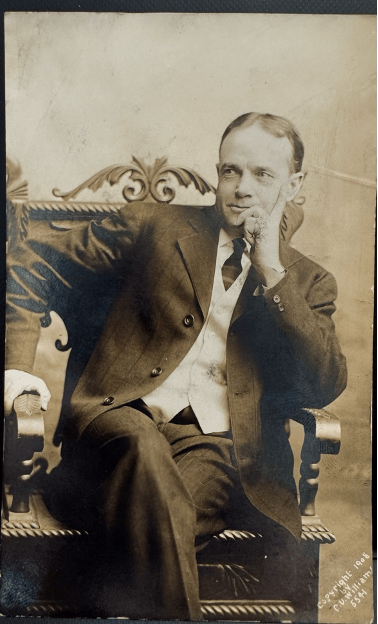
Colorized version of a 1908 Bloomington image. Billy Sunday in action.

Eleven thousand people attended his three services that opening Sunday. Forty-five hundred came to the morning meeting alone. A five-hundred-voice choir carried the music. By the time the campaign closed five and a half weeks later, more than four thousand of those who had come had walked down the aisle as converts. Sunday’s purse came in at $7,773.19 — by some margin the largest revival purse of his career to date. And Helen, by now a fixture on the road with him, was preaching her own Sunday afternoon meetings to fourteen hundred women at the Second Presbyterian Church.

The closing sermon was titled “Always Be Ready to Give an Answer,” taken from First Peter chapter three. It would, in the months to come, become one of the most-printed sermons of Sunday’s career.

Decatur and the printed sermons

Sunday moved directly from Bloomington to Decatur, Illinois — another central Illinois town, this one with a population of about thirty-one thousand. The campaign ran for five and a half weeks, from early February into mid-March, probably in a temporary tabernacle erected inside Decatur’s Fairview Park. By the end of it, more than six thousand people had come forward as converts. Sunday’s purse came in at over eleven thousand dollars — surpassing the Bloomington record set just weeks earlier.

But the Decatur revival had a wrinkle that the contemporary papers found themselves writing about for months afterward. The Decatur Herald — a local newspaper — had been running Sunday’s sermons in print throughout the campaign. After Sunday left town, a Decatur printing concern collected those newspaper transcriptions and published them as a book. The book sold. Sunday had not authorized it.

He spent the next several months trying to stop the publication and, when he could not, decided to buy the copyright outright. The story finally surfaced publicly in September. According to the Freeport Daily Bulletin of September 5, Sunday paid the Decatur printing concern thirty-five hundred dollars for full possession of the copyright to his own sermons.

It was the kind of transaction that did not exist in the world of itinerant revivalism before 1908. Most evangelists were happy to have their sermons reprinted anywhere they could be reprinted. Sunday had decided, by the middle of his Pennsylvania campaign, that his sermons were worth more controlled than free. By later that year his own publishing operation was issuing sermon manuscripts under titles like “What Shall the End Be,” “The Three Groups,” and “The Moral Leper” — small printed pamphlets carrying the formal byline “William Ashley Sunday.” Sunday had become, alongside everything else, a publishing concern.

A March ticket for the Booze sermon

On Wednesday, March 18, 1908, Sunday made the short trip from Decatur to Clinton, Iowa for a single evening engagement at the local Presbyterian Church. The occasion was a local-option meeting — a temperance vote that DeWitt County voters would soon be asked to weigh in on. Sunday’s contribution was a single sermon, his now-famous “Booze.” The local committee printed numbered tickets in cream paper.
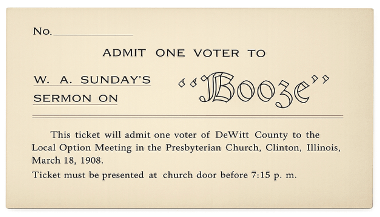
The phrasing made the political stakes plain. The sermon was a campaign event. The audience was specifically registered DeWitt County voters. The doors closed at 7:15 sharp. Sunday’s “Booze” sermon — already by 1908 a fixture of his Chautauqua repertoire — was being deployed as direct political advocacy on the eve of a temperance referendum. The line between revival preacher and political organizer, never very thick in Sunday’s career, had just become almost invisible.

Charleston and the deaf interpreter

After Clinton, Sunday spent the rest of March and most of April at Charleston, Illinois — another central Illinois revival, five weeks in a four-thousand-seat tabernacle that drew twenty-five hundred conversions and around two hundred and twenty thousand cumulative attendees. His purse came in at fifty-five hundred dollars. The Decatur Herald and Review called it “the greatest religious awakening that Charleston has ever known and one of the greatest revivals that has ever taken place in Illinois.” On the final night, the crowd refused to leave the tabernacle even after Sunday had gone home — the Herald reporter watched them stand around the platform “trying to shake the great minister’s hand for the last time.”

The Charleston campaign also produced one of the most quietly moving details in the entire 1908 record, though it would not make it into print until the next year’s Springfield souvenir booklet. A Charleston-based teacher at the State School for the Deaf, Professor Frank Reed Jr., had begun attending Sunday’s services with a delegation of deaf students. Reed stood up in the audience and signed Sunday’s sermons to the deaf attendees in real time. The visual rhythms of Reed’s interpretation became, for the hearing audience around him, almost a parallel performance.

Prof. Reed stood up and repeated to the mutes just what Mr. Sunday said, and it was a very unique and interesting sight to watch the movements and gestures of the interpreter. He would enter into the spirit of Mr. Sunday’s discourse… The expression on the faces of the mutes would brighten up as he said something amusing.

Between thirty and forty deaf attendees converted across that campaign and the Springfield campaign that followed in 1909. At the offering, when the deaf delegation contributed ten dollars, Sunday paused his sermon to address it from the platform: “If men who could not hear a word of what I say were contributing to this extent, what ought some of you fellows down there do who hear it all?”

Sharon, Pennsylvania

The eastward turn began on May 1, 1908. Sunday opened a seven-week revival in Sharon, Pennsylvania — a steel-mill town in the Shenango Valley along the Ohio border. The decision to take the Sharon engagement cost him most of his usual Chautauqua summer income, and the Sunday camp itself flagged this in a margin note: “this revival eliminated Billy’s opportunity to supplement his income from chautauquas; a significant diversion for several years.”

Sunday was forty-five years old. The Chautauqua circuit had been paying him more than forty thousand dollars in summers by now. He had announced the previous August that he was going to cut back on the platform work. And now he was choosing, for the first time, to forgo a major piece of the summer revenue in order to preach a long campaign in a place he had never been. The Sharon decision was the first time Sunday’s revival ambitions clearly outweighed his Chautauqua income. It would not be the last.

The Sharon campaign drew nearly five thousand converts. The freewill offering for Sunday came in at $6,448.45, with total collected offerings reaching over fourteen thousand dollars. A new local mission was pledged. The local New Castle Herald, in its earliest coverage, captured what Sharon was seeing for the first time:

His eccentric methods of delivering the gospel and his homely statements have hit their mark and today everybody in Sharon is talking of Billy Sunday, the old-time baseball player.

Sunday had stepped outside his Midwestern comfort zone and found a Pennsylvania industrial city that responded to him the same way Iowa farm towns did. The early evidence said the Sunday method traveled. The full proof would come in the urban tabernacle campaigns of the 1910s. But the test case was Sharon.

A compressed Chautauqua summer

Sunday returned to the platform circuit at the end of June for a sharply truncated summer. He had less than two months. He still managed to deliver Chautauqua talks at more than twenty different sites across Illinois, Iowa, Indiana, Ohio, Michigan, Missouri, and Pennsylvania. The four-sermon rotation that had crystallized the previous year carried him: “Get on the Water Wagon,” “Forces That Win,” “The Devil’s Boomerang,” and “Nuts for Skeptics to Crack.”

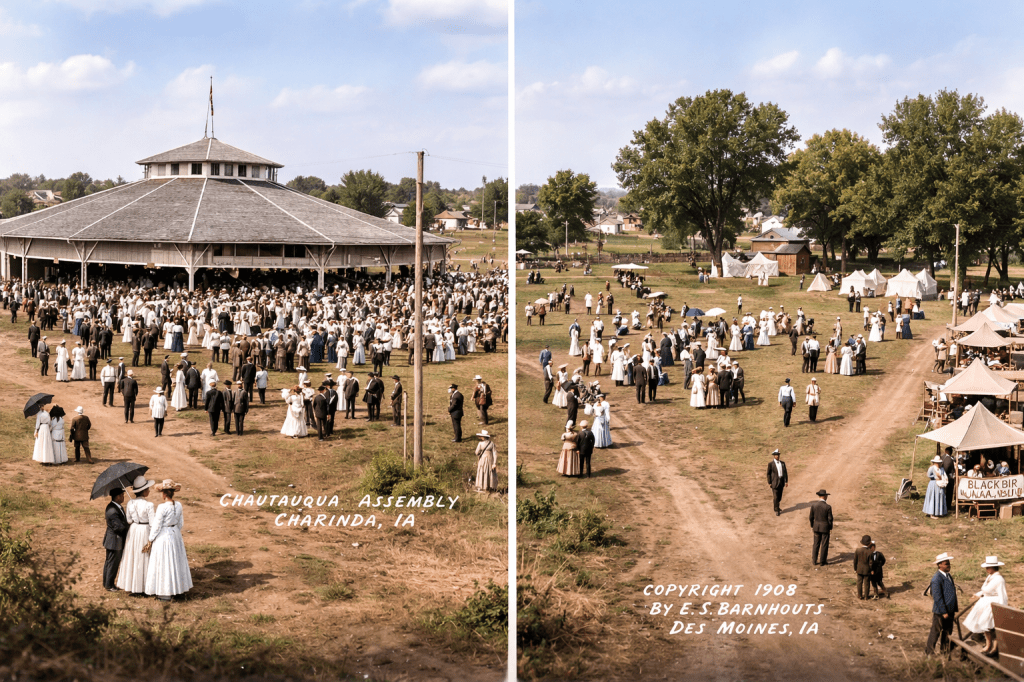
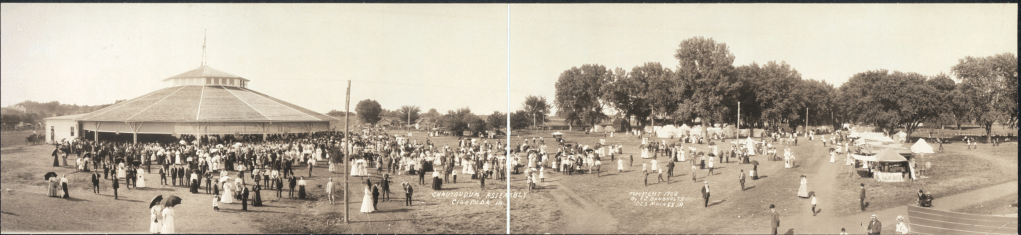
A few stops stood out. On August 9 at Patterson Springs, Illinois — declared “Billy Sunday Day” by the local committee — ten thousand people came to hear his “Booze” sermon. Helen was with him. Sunday was in real physical pain from what he described to reporters as a “carbuncle,” and he and Helen left town on the 7:30 a.m. train the next morning, exhausted. At Coshocton, Ohio on July 31, he was paid two hundred and fifty dollars for a two-hour talk and fifteen hundred people came to hear it. At Clarinda, Iowa on August 6, he spoke at a brand-new ten-thousand-dollar steel auditorium that held over four thousand. He stayed long enough afterward to umpire a baseball game.

Lincoln Chautauqua in Macon County, Illinois on August 15 produced one of the strangest preserved artifacts of Sunday’s middle period: a newspaper advertisement showing him in a head-and-shoulders portrait with his arms crossed, captioned “Meet Me At Lincoln Chautauqua: Saturday Afternoon, Billy Sunday.” It is, as much as anything in the 1908 archive, the moment when the Sunday brand became a commercial graphic asset that booking committees were placing in regional papers to sell admission.

Jacksonville and the G.A.R. veterans

Sunday’s fall return brought him to Jacksonville, Illinois for a six-week revival running from late September through early November. The campaign drew over twenty-five hundred converts and a freewill offering for Sunday of $7,279. By mid-October, more than 131,000 people had already attended services. The campaign was strong enough that multiple regional papers covered the closing service, repeating the same figures back and forth across the state.

From the Jacksonville pulpit Sunday delivered one of the tribute lines that the Freeport Daily Journal would reprint in November and that would become characteristic of his entire later career — a deliberate appeal to Civil War veterans of the Grand Army of the Republic:

If there are any public favors to be shown, are any offices to be filled, I want you young fellows to stand back and make room for the gray-haired veterans of the sixties. I want you to understand that there is but one piece of jewelry to which Billy Sunday takes off his hat, and that is the bronze button worn by the Grand Army of the Republic.

In 1908 the Civil War was still living memory for half the people in Sunday’s audiences. The Civil War veterans were now in their late sixties and early seventies — Sunday himself was forty-five — and were still organized in active local G.A.R. chapters in nearly every Northern town. Sunday’s tribute to them was both deeply felt and shrewdly calculated. The line traveled. The Freeport paper printed it. Other papers picked it up. And it remained one of the signature Sunday quotes for the rest of his life.

Ottumwa and the skin-flint complaint

The year ended at Ottumwa, Iowa. Six weeks in the local opera house, from early November through mid-December. Thirty-five hundred conversions. Sunday’s purse came in at seven thousand dollars.

The Ottumwa campaign also produced a moment of public criticism that the Minnesota New Ulm Review later reprinted, and that captures the kind of opposition Sunday now drew everywhere he went. The complaint, attributed to an unnamed correspondent in Ottumwa before Sunday’s arrival, ran like this:

Sunday’s skin-flint brand of religion is a money-getter to the sorrow of many a town. Let’s make Ottumwa the exception. Sunday uses his religion as his method of hypnotizing people, for he knows that in the heat of religious fervor people will give up money when you can’t get it from them in any other way. So, he uses religion.

It was the kind of complaint that had been following Sunday since the Charles City Herald editorial of 1907 had called him “a sideshow to the Chautauqua.” By 1908 it was a familiar pattern: regional papers running detailed positive coverage of his revivals; other regional papers running pointed editorial criticism that questioned his methods, his motives, and especially his money. Sunday rarely responded publicly to either. He just kept moving.

What 1908 changed

If the easy story of Billy Sunday’s career runs “small-town revivalist becomes big-city evangelist in the 1910s,” 1908 is the year where the move starts. Four things changed.

The eastern pivot. Sharon was the first sustained revival east of Ohio. He gave up half a summer of Chautauqua money to make it work. The Sunday method, transplanted to a Pennsylvania steel valley, performed exactly the way it had performed in the Iowa river towns. The proof of concept was now in hand.

The published sermon library. By the end of 1908, Sunday was operating a small publishing concern that issued sermon manuscripts under his own byline. The Decatur lawsuit had been the catalyst. The lesson was that his sermons had become an intellectual-property asset worth defending, and one that could carry his voice into towns where he himself would never preach.

The Helen Sunday women’s ministry. Helen’s Bloomington women’s meetings — fourteen hundred women, gathered at Second Presbyterian, on Sunday afternoons during the main revival — were now a documented and reportable part of the Sunday operation. She was no longer just on the road with Billy. She had her own platform alongside his.

The political-religious fusion. The Clinton temperance ticket, the G.A.R. veterans tribute, the local-option organizing folded into revival sermons, the integrated approach of revival-as-civic-mobilization — these were all visible in earlier years, but in 1908 they consolidated. Sunday was now a political force in every town he visited, in addition to being a religious one. His sermons sold pamphlets, mobilized voters, and built G.A.R. constituencies all at once.

By the time Sunday left Ottumwa just before Christmas to prepare for the Spokane, Washington campaign opening on December 25 — his first revival in a city of more than a hundred thousand people — the architecture of his mature ministry was effectively in place. Eastern cities. Published sermons. Helen running her own meetings. The platform-and-pulpit double income engine. The four-sermon Chautauqua rotation. The deaf interpreter. The G.A.R. tribute. The political mobilization. The carbuncle.

Spokane was the test of whether the whole thing would scale to a real American city. The answer would arrive within six weeks. But the architecture that would carry that test had been built in 1908.

How to cite this post

Chicago: McNutt, Kraig. “The Year Billy Sunday Went East: 1908.” Evangelist Billy Sunday (1862–1935), June 17, 2026. https://evangelistbillysunday.com/2026/06/17/the-year-billy-sunday-went-east-1908/.
MLA: McNutt, Kraig. “The Year Billy Sunday Went East: 1908.” Evangelist Billy Sunday (1862–1935), 17 June 2026, evangelistbillysunday.com/2026/06/17/the-year-billy-sunday-went-east-1908/.

APA: McNutt, K. (2026, June 17). The year Billy Sunday went east: 1908. Evangelist Billy Sunday (1862–1935). https://evangelistbillysunday.com/2026/06/17/the-year-billy-sunday-went-east-1908/

Turabian: McNutt, Kraig. “The Year Billy Sunday Went East: 1908.” Evangelist Billy Sunday (1862–1935). June 17, 2026. https://evangelistbillysunday.com/2026/06/17/the-year-billy-sunday-went-east-1908/.
Billy Sunday in Spokane (1908–1909): When the Revival Hit the Inland Empire


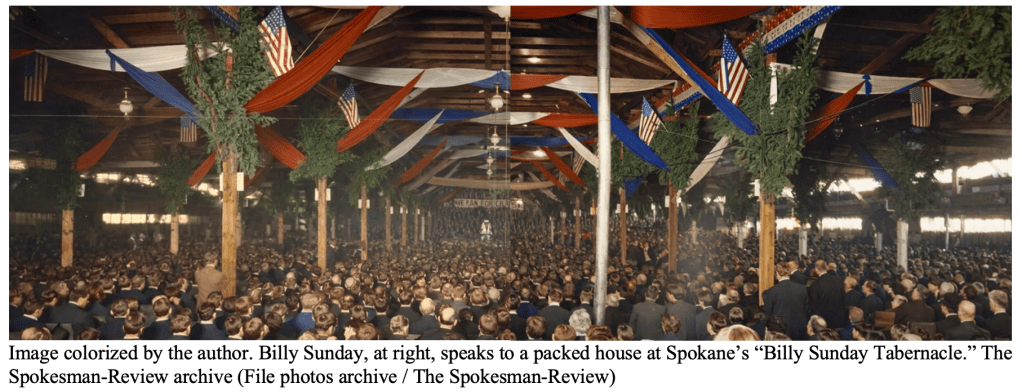
When Billy Sunday arrived in Spokane on Christmas Day, 1908, expectations were already high—and confusion lingered. Earlier reports had announced a December 20 opening. That date came and went. But on December 25, the Sunday party finally arrived, and Spokane discovered that the delay mattered little. The revival that followed would become one of the most significant religious events in the city’s early twentieth-century history.

Opening night attendance was estimated at 8,000 people, filling the newly constructed tabernacle on Christmas Day. The Spokesman-Review reported the crowd the following morning, setting the tone for what would unfold over the next six weeks .

A City Drawn In

The Spokane campaign officially ran from December 25, 1908, to February 10, 1909. In that span, Sunday recorded 5,666 converts, with the single largest night producing 446 responses. Offerings totaled $15,000 to cover campaign expenses, and Sunday’s personal purse amounted to $10,000—figures that place Spokane among his more successful revivals of the era .

The tabernacle itself had been erected in early December, even before Sunday arrived, and disassembly began almost immediately after the meetings concluded. It was a temporary structure for what proved to be a lasting civic event.

Attendance figures tell only part of the story. According to the Daily Herald, the revival spilled far beyond the tabernacle walls. Hundreds of prayer meetings and semi-public gatherings sprang up across the city. Homes were opened for religious meetings. Crowds swelled so large at times that police were required to control access to the tabernacle. The paper described the total attendance as “hundreds of thousands,” calling some of the gatherings among the largest in Spokane’s history .

Methods, Manhood, and Controversy

Sunday’s style continued to provoke strong reactions—both admiration and criticism. Rev. T. H. Fertig, a Spokane minister, offered one of the most telling assessments in February 1909. He contrasted Sunday with what he saw as the overly academic bent of modern clergy, arguing that Sunday had carried his “manhood” from baseball into the pulpit. Fertig admitted that many of Sunday’s methods were objectionable, but insisted they bore the unmistakable stamp of originality and personal force. Seminary training, he warned, too often erased individuality rather than refining it .

That tension—between polished theology and raw persuasion—was a recurring theme wherever Sunday preached. Spokane proved no exception.

Measurable Impact on Churches

The post-revival accounting offers a rare snapshot of how different congregations interpreted the results.

Some churches reported substantial growth. First Methodist Church received 270 new members, while First Methodist (reported separately in another account) claimed as many as 360. Emmanuel Baptist added 45 converts. First Baptist expected at least 80. Central Christian welcomed approximately 60. Westminster Congregational received 30, and Plymouth Congregational added about 50 new members .

Other responses were more restrained. All Saints Episcopal Church reported 12 new members. Holy Trinity Episcopal Church reported none, with its minister expressing concern about conversions driven by fear rather than conviction. Our Lady of Lourdes likewise expected no new members as a result of the campaign .

The uneven distribution underscores a reality often lost in revival mythology: success was not universally defined, nor universally embraced.

Social and Civic Effects

Beyond church rolls, Spokane newspapers noted broader social effects. One headline captured the contrast succinctly: “Beer Sales Fall. Bibles in Demand.” While such claims invite scrutiny, they reflect how contemporaries interpreted the revival’s moral influence .

Financially, the churches emerged ahead. After expenses were met, including nearly $12,000 in costs and the feeding and sheltering of hundreds of homeless men during a severe cold wave, local churches anticipated a surplus of $2,000 to $3,000. These funds came from post-expense collections and tabernacle bonds that were allowed to lapse in favor of the churches .

The revival also intersected directly with political reform. During the campaign, 110 representative men traveled to Olympia to lobby for a county-unit local-option bill, coinciding with Sunday’s repeated delivery of his fiery “Booze” sermon. For supporters, this fusion of evangelism and activism marked one of the revival’s most consequential achievements .

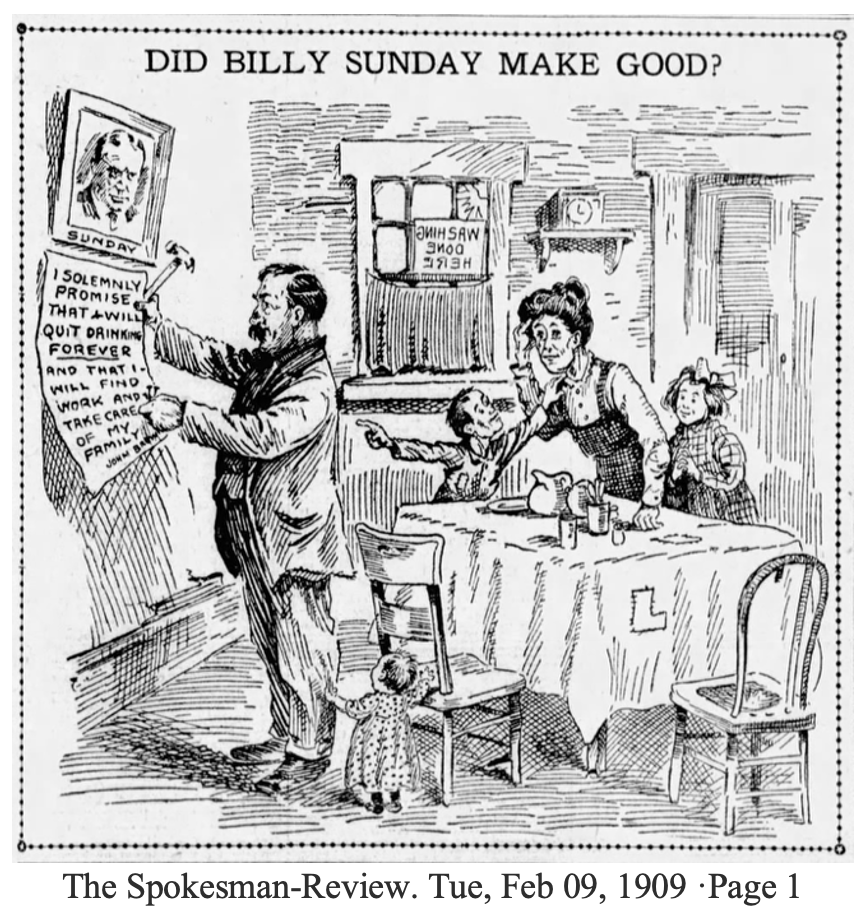
Did Billy Sunday “Make Good”?

As the meetings drew to a close, Spokane’s press asked the question directly—illustrated in editorial cartoons and front-page reflections. By February 1909, the answer, at least in terms of attendance, conversions, and civic impact, appeared clear.

Spokane did not merely host Billy Sunday. For six winter weeks, it reorganized itself around him. Whether one applauded his methods or questioned them, the revival left behind measurable change, lasting debate, and a vivid example of early twentieth-century evangelical power at its height.

For Billy Sunday, Spokane was another city on a relentless circuit. For Spokane, it was a season that reshaped its religious and moral landscape—if only for a time.


Rev. Billy Sunday grills ministers, 1908

A Richmond, Indiana newspaper (1908)

Gathering of Winona Divines Rated With a Bunch of Bums.

BETTER BE COG WHEEL

And Stop Trying to Be a Whistle Is Sunday’s Advice to Them.

Lake, Ind., Aug. 22.—”I preach to this bunch just I do to a lot of bums, and I don’t see any difference in you. You ministers criticise me, but as long as God puts His mark of approval on my work it is up to you to keep your mouths shut. If God wants you to be a cog wheel you had better stop trying to be a whistle. Some people are all front door. Open it and you are in the back yard. Many a man goes to a seminary and is filled up with a lot of stuff that is of no more use to him than a crane’s legs would be to a setting hen.”

Such was the rhetoric and classical language in which the Rev. “Billy” Sunday the base ball evangelist, addressed the Bible conference at Winona Lake. He told gray-headed ministers how to succeed and grilled those who did not agree with his methods.

Called Rev. Smith “Gyp.”

He talked like a whirlwind and whisked up and down the gamut of Christian effort like a $25,000 limousine. He slapped the distinguished English evangelist, the Rev. Gypsy Smith on the back and called him “Gyp.” “Gyp” smiled a sour smile and looked as pleasant as he could.

While the message of Rev. Billy was as hot and peppery as chili sauce, it was received with fervent “amens” from over the auditorium and at the close “Gypsey” Smith gave his shoulder a pat of approval and Dr. Chapman smiled his approval.

Dr. Chapman said: “Unless a man is born with preach in him he will never get there. Too many preachers are more interested in drawing their salaries than in saving souls. Show me an earnest man and I will show you a man that is making the gang sit up and take notice. The earnest pastor does not sit around and wear out the seat of his pants waiting for something to turn up. The only thing that will turn up for him is the sod in the grave yard.”

The Richmond Item. Sat, Aug 22, 1908 ·Page 2

Are you gonna ‘take the count to the Devil’ asks Billy?

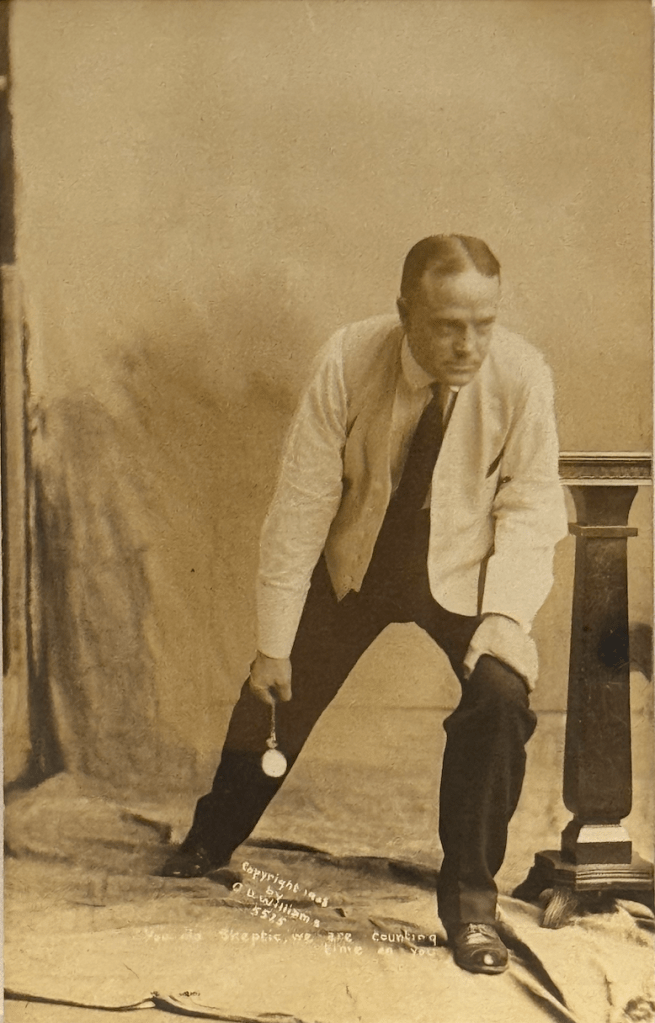
THIS IS HOW BILLY FINDS OUT IF YOU ARE GOING TO “TAKE THE COUNT”

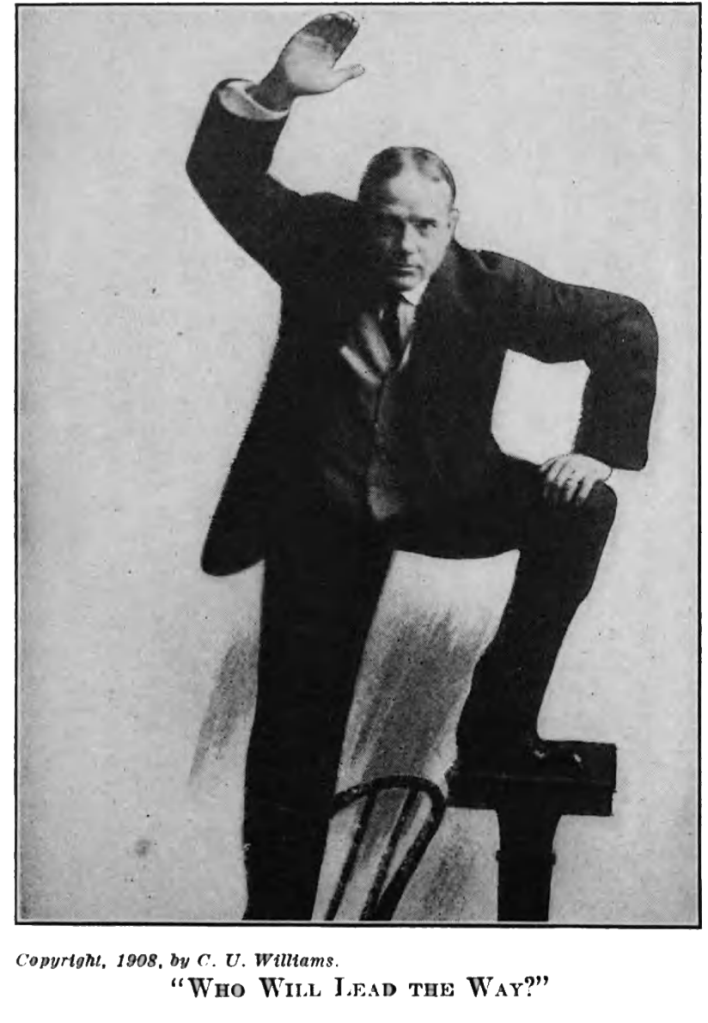
BILLY SUNDAY IN UNUSUAL POSE.

Billy Sunday in a famous pose.
C. 1908. Author’s Collection.

The above is a characteristic position for Billy Sunday to assume during one of his meetings for men only.

He bends over until his right knee nearly touches the floor of his platform; then he pulls out his watch and inquires if you are going to “take the count” for the devil.

Sunday’s sermons are filled with such unusual features as this, but they are never so plentiful as in the men’s sermons. There is no doubt about it the evangelist is at his best in these talks. He always bends every energy to the end of impressing his male audience with the truth of what he is saying, and in this he never fails.

The South Bend Tribune. Thu, Jun 05, 1913 ·Page 10

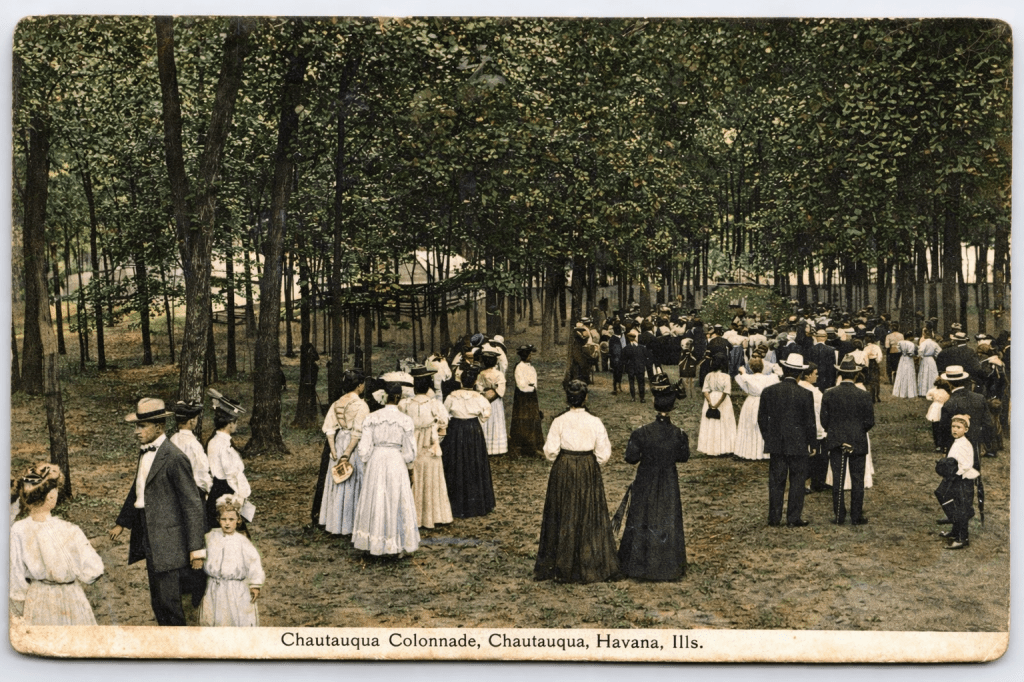
Billy Sunday postcard from Havana, Illinois chautauqua (c 1908)

There seems to be no record of Sunday hosting an evangelistic campaign at Havana, Illinois. This postcard is titled “Billy Sunday addressing 4,000 people at Chautauqua, Havana, Illinois.”

This appearance was part of the broader Chautauqua movement, which brought religious, educational, and cultural programming to communities across the United States.​

While Havana isn’t listed among the cities where Sunday held his major revival campaigns, his participation in the Chautauqua there reflects his widespread influence and the popularity of his preaching style. These events often featured prominent speakers and were significant cultural gatherings in early 20th-century America.

1908 Havana, Illinois Chautauqua

Results from Freeport, ILL revival?

The Pantagraph. Sat, Jan 25, 1908 ·Page 5

[Refers to previous year’s campaign in Freeport.]

AFTERMATH OF SUNDAY’S WORK IN FREEPORT

SITUATION NINE MONTHS AFTER REVIVAL.

How Many of the Converts Have “Stuck” —General Effect on Some of the City—Bloomington Men to the Front.

(By Staff Correspondent.)

Freeport, Ill., Jan. 23.—Less than a year ago Rev. William Sunday, who is now holding forth in union revival meetings in Bloomington, waged war on sin and unrighteousness in this city, nicknamed the town of beer and pretzels. How have the converts stuck? Have they remained true to the public confession made when they stepped forward and gave Billy Sunday a shake of the hand? The answer must be yes or no. This is true of all revivals and the meetings conducted by the great evangelist named above are no exception. His converts remain steadfast or backslide just as those of other leaders, great or small, have in the many years gone by.

A Benefit Certainly.

No matter what the critics may say of Billy Sunday the man, or of his methods, the results of his protracted meetings are beneficial to a city. It has helped Freeport and it will likewise benefit the city of Bloomington. The fact that he has made some men in this city better citizens, law-abiding and self-respecting men, cannot be denied and the city is now much more the gainer by their residence here.

Are Marked Men.

Walk down Stephenson street, the principal business and residence thoroughfare, in company with a Freeporter, and mention the name of Billy Sunday and he will, in nine cases out of ten, raise his finger and point out a convert won by this evangelist. They are marked men, and one hears this remark often: “There goes one of Billy’s converts.” He won for Christ men and women in all walks of life, many of whom united with the church, all denominations adding to the membership roll. Some remained true but a short time, yet even so, the step they took was in the right direction and indicated a previous good thought and good thoughts build up and make character.

A Good Judge.

Perhaps there is no one in a city who knows the people, their history and life better than the newspaper man. A local newspaper writer said: “Billy Sunday did more good in this town than I thought he could and it seems to be a lasting benefit. While, of course, many backslide, some as soon as the evangelist departed, others have remained true to their vow and have become leaders in church work. Really more “stuck” by far than I expected.

It is said one of the leading business men of the town, who used to go on periodical sprees, after hearing Billy Sunday’s sermon on “Booze” became converted and his friends have been congratulating him on his stick-to-it-tive-ness.

About Usual Number.

Another resident said as the result of the meetings conducted here last year about the average number of converts are continuing steadfast. The pastors, following Mr. Sunday’s departure, put their shoulders to the wheel and took up the work where the evangelist left off.

They got young people into the church and put them to work, so on the whole it must be admitted that Freeport was made a better city by the religious awakening under the leadership of the man who is arousing such interest in things religious in Bloomington.

A Comparison.

This city has a population of 20,000 in round numbers and, being the center of 26,000,000 people, all within 400 miles, had a good territory from which to draw the crowds to hear Mr. Sunday, whose meetings continued from April 28 to June 4 of last year. Yet the attendance was small compared to that in Bloomington. The tabernacle was not quite so large and the crowds were not so immense. The people did not hang from rafters and almost by the eyebrows as is the case in Bloomington. In fact, the record shows an average attendance of only 2200 at a meeting, while the 5000 mark was only reached one evening, on June 3.

It took over three weeks to raise the amount needed for the expenses of running the meetings, about an equal sum as required in Bloomington. The Rev. Mr. Sunday called the people here, who are chiefly Germans, the “stingy Dutch,” but before his meetings closed the purse strings were loosened like they had not been in years past. The people of this city did well by Mr. Sunday. He on one occasion declared the curse of Freeport to be “the set of infidels who live here.”

Amount Paid Mr. Sunday.

The first converts were secured May 11, when sixteen went forward, and the largest number at any one time 184, on May 30, the total number of converts being 1365. Up to January 28 in Bloomington the total number of converts was 2,000, with a total attendance on that date of 20,000. The people of Freeport gave Billy Sunday $3064.38 for his services, extending over a period of five weeks and three days.

Helped Y.M.C.A.

Mr. Sunday remained over one day to help the Y. M. C. A., which had a debt of $11,500 hanging over it. Secretary Ralph Smedley, of the local Y. M. C. A., formerly of Bloomington, had just assumed charge at this time and had secured, with the assistance of others, some $9000 in pledges. Mr. Sunday at his farewell meeting raised $2000 and all pledges were announced at this meeting, showing a sum total of $12,000 secured by the Y. M. C. A., placing the association on a substantial footing.

Bloomington Men to the Front.

Heading two of the most important institutions which go to make any city are two Bloomington young men, Mr. Ralph Smedley, secretary of the Y. M. C. A., and Mr. Wilbur Coons, secretary of the Freeport Business Men’s Association. So successful has been Mr. Smedley in his work that the committee in search of a secretary for the Business Men’s Association made straight for Bloomington to find their man. And if the town needs others there are plenty more at home like these. No lack of material in the Evergreen City. Mr. Smedley received his training in the work while educational secretary of the Bloomington Y. M. C. A. and is making good progress. Under his leadership all departments of work have taken on new life and the membership is steadily growing. The register now shows 432 and they are passing toward the 500 mark.

Secretary Coons, who was a member of the Bloomington Bulletin editorial staff and a first-class newspaper man, has only recently taken up his new duties here. He has just issued a new circular setting forth the advantages of this city which is growing rapidly. It is largely a manufacturing town, several very large establishments being located here. Here are also the largest windmill factories in the world. The Business Men’s Association has over 150 members and owns fine factory sites. There are over thirty miles of paved streets, nine of these are of brick laid since 1902, and twenty-one of macadam.

Sermon: Literal and Eternal Hell Absolutely

The Pantagraph. Fri, Jan 17, 1908 ·Page 6

LITERAL AND ETERNAL HELL ABSOLUTELY

THAT’S WHAT SUNDAY PREACHES

Evangelist Insists He Will Resign From Ministry Before He Would Cut it Out of Sermons.

UNIQUE DISCOURSE YESTERDAY AFTERNOON.

Large Crowds Continue to Throng the Tabernacle—Roll of Converts Increased—Revival News Notes.

Sunday believes absolutely that there is a hell and says he intends to fearlessly preach it as long as he remains in the ministry. Last night at the tabernacle in one of his characteristic sermons he said before he would omit the reality of hell from his preaching that he would resign from the ministry. “It’s up to you to accept or reject the gospel; it’s God or nothing,” said Sunday.

Last night the regulation crowd of 5,000 filled the tabernacle and heard Sunday preach on “How Shall We Escape if We Neglect So Great Salvation?” It is remarkable how Sunday attracts the populace. It takes a speaker of more than ordinary ability and power to draw two or three thousand people every afternoon and again each evening five or six thousand people to hear him preach, but Mr. Sunday possesses those qualities. His magnetic personality and peculiar eccentricities as a public orator combine to make up his extraordinary drawing force. After last night’s powerful sermon forty-six persons went forward and made the profession of faith.

The Sermon.

My text tonight assumes the form of a question, and although it seems to be a paradox it is absolutely unanswerable,” said Mr. Sunday. “I could go to the leading merchant in the town and when I would ask him he could tell me the principles by which to build business to success, but if I would ask him the question of my text I would gaze into a face that would give no reply. I might go to your leading physician and he could explain to me all about materia medica, about hygiene, about medical jurisprudence and about obstetrics, but if I would ask him this question I would gaze into a face of blank despair. I might go to the office of your most brilliant lawyer, a man that can interpret the law before the supreme court, a man with brains enough to codify the state laws and that knows all about organic and constitutional law, yet if I would ask him my question-text I would go down the stairs without a reply. If I could go to the lost world and the souls there could cease their shrieks long enough for me to ask this question, I would come back without an answer. If an angel of God would come to the tabernacle and I would ask it the question it would fly back and fold its wings like a tired dove in the presence of God without speaking a word.

“How Shall We Escape?”

“The text is found in the second chapter of Hebrews and the third verse—’How shall we escape if we neglect so great salvation?’ There is absolutely no escape; there is absolutely no answer to the question.

“Our first thought about salvation is saving from punishment. True, but you are not beginning to live unless you are a Christian. You have been merely existing. The one who lives in sin is driving the dagger into his own heart, for all that is polluting and corrupting and debasing comes through sin, yet men follow it. All that is noble and uplifting comes through Jesus Christ, yet men spurn Him.

God’s Plan.

“God has given us so many things. He knew we needed air—He gave it to us. He knew we needed water—He gave it to us. He knew that we needed eyes and ears and lungs and hands and feet, and He gave them to us. And He has salvation ready if we want it. And I have no patience with any who puts his asinine judgment up against God’s and says that he knows best. Of course there is a hell, the plan of salvation contains it. There would be no good in leaving hell out. I am not the author of the plan of salvation, but I am here to preach it as it is, whether it is pleasant to you or not. Because you do not believe in hell, that doesn’t make any difference. That don’t make you immune. A fact is a fact, whether you believe it or not. Because you don’t believe in God and heaven and hell and the divinity of Christ, don’t change the facts or scheme of salvation because you didn’t have sense and decency enough to believe. You can’t fix God’s word to suit yourself. You can’t blue-pencil His plan of salvation. You have to take it as it is or leave it. I have no doctrine. I preach God’s word. I have no use for a man who has a doctrine. Let him preach God’s.

The Truth of Hell.

“I don’t say that I’ve seen hell and I don’t intend to try and see it just to convince you. I don’t want to find out whether the fire in hell is like that in your stove or whether the word fire is an emblem chosen to represent conditions as bad. I am faithful and true to God’s trust and I never expect to know whether or not hellfire burns.

It is to the class who expect some time to be Christians that I am especially preaching tonight. This is the man who acknowledges that God has a claim on him and who sometimes expects to change and be a Christian. But that man who may be too late and who may find death before him before he has time to change. The church can only answer the question of hell in one way. He that believeth in Christ is saved, and he that believeth not is damned. If there is no hell, preachers are taking money under false pretenses.

“Is There a Hell?”

“In preaching hell and making reference to it I encounter a difficulty. Men and women don’t like to accept it. They think they cannot be happy with a hell, therefore they say there is no hell and think that settles it. Some people think they could be happy if hell was fixed like a big club with an ice chest full of Anheuser-Busch, Schlitz, and Pabst, with a button handy so they could call a servant if they wanted anything, and then could sit down, sip lemonade and puff a twenty-five-cent straight.

“Suppose I met three men walking on a road toward a precipice. To the first I say, ‘This is a dangerous road, and if you go on you will plunge over the precipice to death,’ but he doesn’t thank me.

He just sneers and walks on. The second asks, ‘Have you ever been to the end?’ and when I admit I have not, he says I don’t know what I am talking about, then. The third says that he knows it, but that he intends to turn off just this side of the precipice.

‘I meet three journeying from the cradle to the grave. The first curses and damns me when I speak to him of Christ and tries to show that he knows more than God. He ends in hell. A fellow told me to go there the other day and I told him if he wanted to go he could just pack up, but I wasn’t going. Whatever hell is, I don’t want to test its reality. It must be an awful place or God wouldn’t open a plan of salvation in order to keep us out. The second man asks me if I’ve ever been there to find out, and the third tells me that he believes he is a sinner, believes the bible is the word of God, believes in hell, but that he will repent before he dies.

‘Why put it off? Nearly everybody expects to become a Christian before he dies. Almost nobody wants to spend eternity in hell. I only met two men who believed in a literal hell who said they expected to spend eternity, and they were both converted.

‘How God will damn I do not know. But I do not want to go to hell. How shall we escape if we neglect so great salvation? You can depend on it, there is no escape.

‘What is the use of churches and religion and temples and tabernacles, if there is no hell? Why open up a plan to save you if there is no hell? But, my friends, if heaven is eternal, hell is eternal. Don’t make God out a liar. Just take His word. You can’t find the truth from ethical and philosophical lines. You can’t settle a spiritual truth by scientific revelations. God has set before you an open door. You can accept or reject. God will never have another plan for you. It is accept Jesus Christ or nothing. Don’t shut your eyes to God’s danger signals.

Don’t rush like stampeded cattle to destruction. Don’t try to test the reality of hell.

The Plan of Salvation.

Wonder of wonders is the plan of salvation. So simple it is that a child can grasp it and so complex that scientists are puzzled. You can better afford to neglect anything else than your salvation. Neglect your health, your business, your education, rather than your salvation.

There are multitudes in hell who did not expect to go there, but who waited too long. I have seen men and women in Bloomington grasp the backs of the seats to steady themselves. I have seen them turn pale as I have hurled the truth at them. I have done my part. If you won’t take advantage of a thing when you may, don’t complain when it gets beyond you. A man can’t afford to trifle with God. The greatest calamities of the world have come from neglect—Johnstown, Ashtabula, Martinique—multitudes have had no more intention of spending eternity in hell than you have, yet they waited too long, and they are there. It is not that you have failed to hear, but that you have failed to heed. It is the only salvation; Mother Eddy or any of the rest of the bunch have nothing like it. The scheme of it shows God’s love. If you are damned, you have only yourself to blame. God has provided. You won’t go to hell because you are a sinner, but because you have failed to repent that sin. The bitterest dregs of hell that you will taste will be the thought that you have no one to blame but yourself.

eformation Not Salvation.

Oh, said a wrinkled browed, stoop shouldered, gray bearded old gambler to me. I’ll tell you what I’ll do, Bill. I’ll quit gambling.

Good I said. And I booze fight a little, not very much for no gambler can and keep ahead of the game but I booze fight a little, and I’ll cut that out.

Good. And I’ll stop my impure living.

Good. And I’ll quit my cussing.

I said. And what else? Well, I guess that’s about all, isn’t it? he asked.

Won’t you accept Jesus Christ? I said.

Why, I won’t have to, will I, if I live straight? he asked.

Say, and Sunday seized his bible to illustrate his point. Suppose you reach the age of accountability at this point, and he indicated a spot, and you are here when you reform and will be over here when you die. Your reformation counts all right from this point where you reformed to where you die, but what about the sins you committed from the time you reached the age of accountability? Your reformation doesn’t wipe them away and the only way they can be wiped away is through Jesus.

Just Faith.

No matter who you are—no matter how smart you are, you are damned and I tell you in your teeth you are damned. You can talk about salvation by refinement and culture. You can go to hell with all your culture. It is not worth a snap of your finger. By repentance and faith is the only way. If God could do no more than simply pardon a man, it would not be so much. But God pardons and justifies—makes you as if you had not sinned.

Don’t forget the story of the rich man and Lazarus. The rich man was a good fellow. He was not a bad man. He was just too busy to pay attention to God. He was like a lot of business men I met at the banquet at the Illinois the other night—cracking good fellows but too busy for God—and the rich man went to hell and cried aloud there for help. In hell you will carry with you the fact that you had the chance and failed to take it. You will remember in hell—God pity you. You are hurtling back every tender thought—every offer—God pity you.

In the name of my God and my Christ, I hurl to you a life line tonight.

A Sunday Prayer.

The sermon was closed with the following prayer: “Jesus, it seems too good to be true that you would provide salvation for us. But God to see men and women pass it up. That is staggering to me. I could understand why you would not love us; why you would not provide salvation for us, but Lord: to step in and provide salvation, to send prophets and priests, and to send Christian mothers to weep and beg and importune us to receive it and to see men pass it by and shake their heads. Jesus, I do not know what to do; I do not know what to say. Lord, I pray men and women may yield and say ‘I give up; I have neglected it long enough; there is too much at stake. My heart may stop tonight; my lungs may congest; there might be a blood clot on my brain. Lord, I will do it now.’ The trumpet may sound for me tonight and might shake a shroud round me tonight. What will it profit a man to gain the whole world and lose his soul? Give me the answer. Give me the answer. Give me the answer. What will it profit you if you gained McLean county and lose your soul?”