When is a revival needed? – Billy Sunday

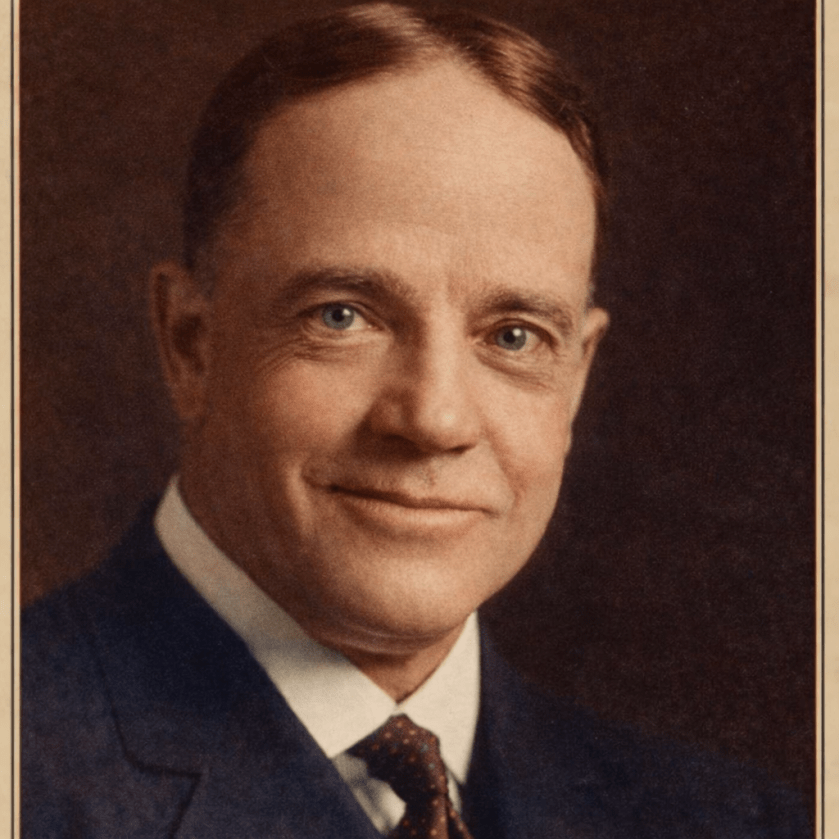
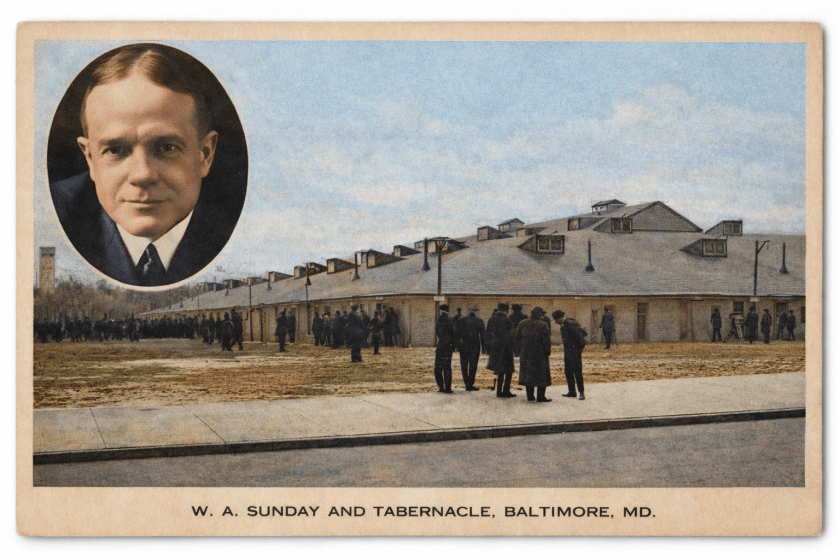
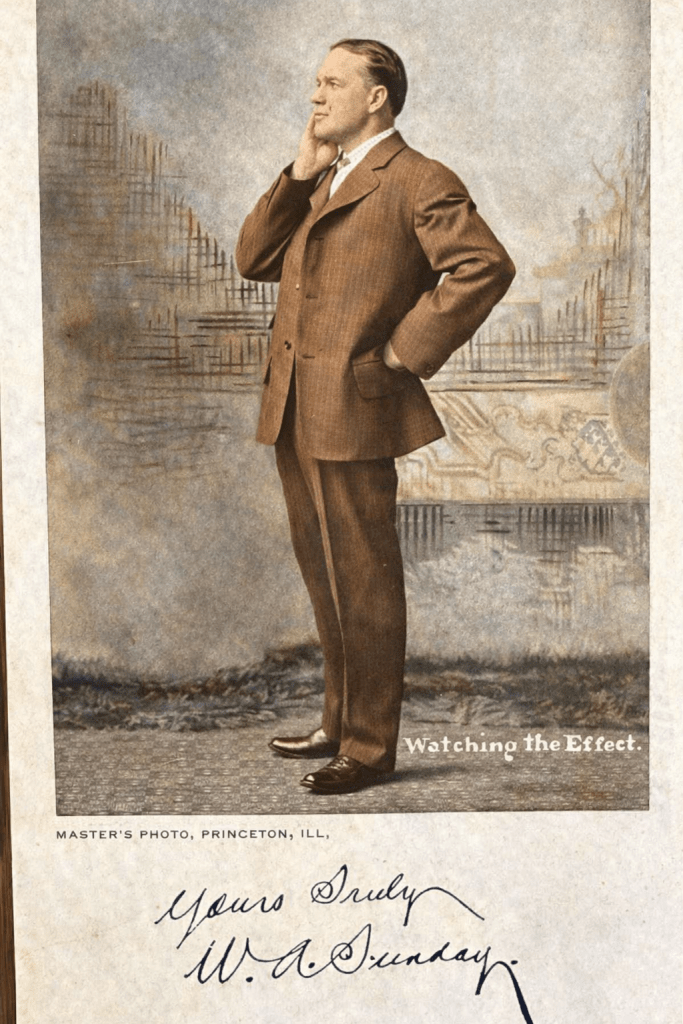
Colorized picture from 1915. This was Billy’s favorite picture at the time.

“A revival is needed when the worldly spirit is in the church of God. It isn’t necessary to do something grossly inconsistent. A ship is all right in the sea, but all wrong when the sea is in her. The church of God is all right in the world, but all wrong when the world is in the church. Some people come to church on Sunday morning and on Monday morning they take a header into the world and the church never sees them again until Sunday morning. They squat and take up a little space in the pew and stay there and put a little money on the plate, but you never see them again until Sunday morning. I tell you, I believe half of the church members could die and the church wouldn’t lose anything of its spiritual force; it would lose them in numbers, but it wouldn’t lose anything in spiritual power.

I tell you, my friends, we need a panic in religion; the world don’t need informing; it needs reforming. We are going to the devil over culture clubs, as if the world needed informing; it don’t need anything of the kind. There are people who go to church and go to a certain denomination because their wife goes there. They got their religion and their property in their name. They go to that church.”

Cited in: Philadelphia Evening Public Ledger. January 6, 1915:6.

From a sermon on A Defense of Revivals, from Habakkuk 3:2. January 5, 1915. Philadelphia.

What a revival does? – Billy Sunday

Cited in: The Evening Public Ledger. January 5, 1915: 5.

“What is a revival? Now listen to me. A revival does two things. First, it returns the church from her backsliding; and, second, it causes the conversion of men and women; and it always includes the conviction of sin on the part of the church. What a spell the devil seems to cast over the church today!

“I suppose the people here are pretty fair representatives of the church of God, and if everybody did what you do there would never be a revival. Suppose I did no more than you do, then no people would ever be converted through my efforts; I would fold my arms and rust out. A revival helps to bring the unsaved to Jesus Christ.

“God Almighty never intended that the devil should triumph over the church. He never intended that the saloons should walk roughshod over Christianity. And if you think that anybody is going to frighten me, you don’t know me yet.

“I will cram it down their throats in this town for the miserable lies they hurl against me up and down the streets of this city. Don’t you forget it. You bet your life. You bet, and they will get it.

“When is a revival needed? When the individuals are careless and unconcerned. If the church was down on her face in prayer they would be more concerned with the fellow outside. The church has degenerated into a third-rate amusement joint with religion left out.

“When is a revival needed? When carelessness and unconcern keep the people asleep. It is must the duty of the church to awaken and work and labor for the men and women of this city as it is the duty of the fire department to arouse when the call sounds. What would you think of the fire department of Philadelphia if it slept while the town burned? You would condemn it and I will condemn you if you sleep and let men and women go to hell. It is just as much your business to be awake. The church of God is asleep today; it is turned into a dormitory, and has taken the devil’s opiates.”

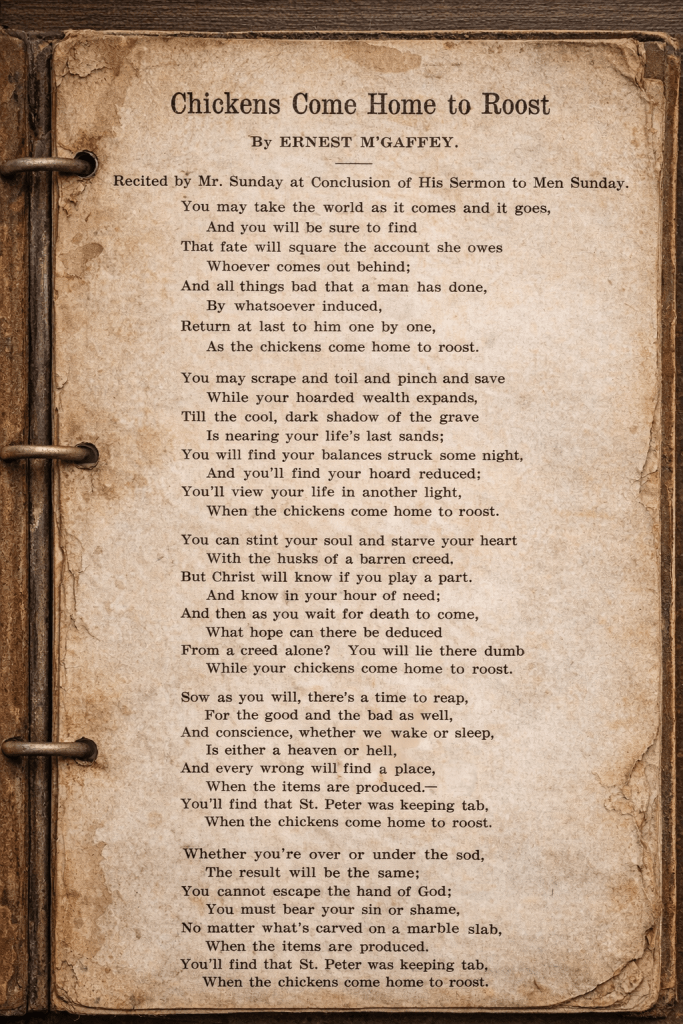
Sermon: When chickens come home to roost

One of Billy’s favorite sermons was When chickens come home to Roost. He would preach it often and usually in the first 1-2 weeks of a revival.

What was the sermon about?

In “Chickens Come Home to Roost,” Billy Sunday argues that sin is never isolated or harmless—it inevitably returns with consequences that grow over time. What begins as a small compromise develops into habit, then character, and ultimately destruction. He emphasizes that sin corrupts the individual internally before it manifests outwardly, dulling the conscience and weakening the will. Sunday also stresses that sin is not merely personal; it affects families, communities, and even nations. He dismantles common excuses—denial, delay, and comparison—and insists that no one escapes moral accountability. The sermon builds toward an urgent appeal: repentance must happen now, before sin’s consequences fully mature and bring irreversible damage.

Representative Quote:
“Your sin may seem quiet tonight, but it will rise up tomorrow and demand its wages.”

How did Billy’s Baltimore revival sermons compare to his Trenton campaign (both in 1916)?

From Trenton to Baltimore: How Billy Sunday’s Preaching Evolved in 1916

When Billy Sunday concluded his revival campaign in Trenton, New Jersey, in February 1916, he had already delivered an extraordinary number of sermons in just a few winter weeks. Soon afterward he moved south to begin what would become an even larger campaign in Baltimore, Maryland.

A comparison of the sermon lists from the two cities reveals something fascinating about Sunday’s preaching strategy. While the evangelist was famous for repeating certain signature sermons from city to city, the Baltimore campaign shows a noticeable shift in emphasis and structure compared with Trenton.

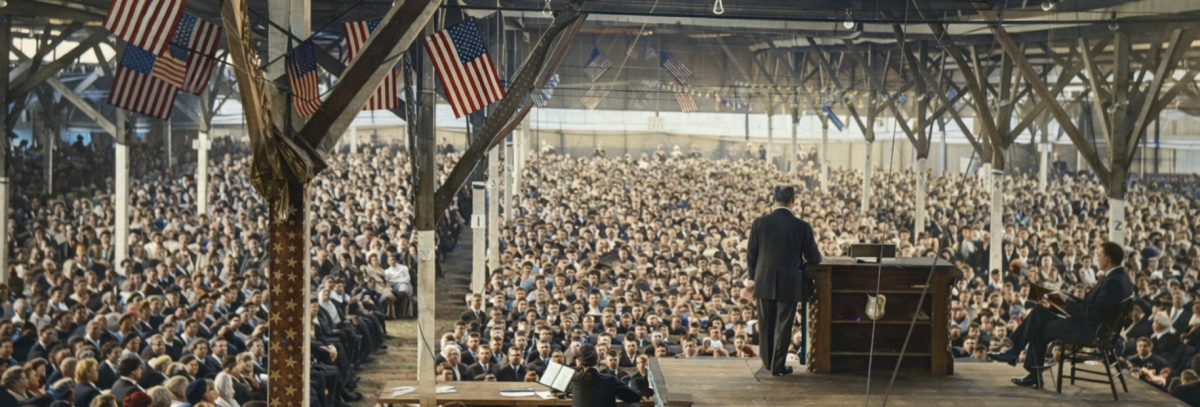
The Baltimore Tabernacle

The Trenton Campaign: Classic Revival Preaching

The Trenton sermons follow the pattern of a traditional evangelistic revival. Many of the titles focus directly on conversion, repentance, and the urgency of salvation. Messages such as What Must I Do to Be Saved?, After Death, Judgment, Rich Young Ruler, and What Shall the End Be? formed the backbone of Sunday’s preaching.

These sermons were part of Sunday’s well-known revival repertoire. In Trenton he rotated them rapidly, returning to the themes of judgment, repentance, and personal decision again and again. Titles like Backsliding, Get Right, Choose Ye This Day, and Be Sure Your Sins Will Find You Out show how directly he pressed the audience toward a response.

This approach reflected the classic revival method: present the danger of sin, call for repentance, and invite listeners to make a public decision.

Baltimore: A Broader and More Structured Campaign

When Sunday arrived in Baltimore later in February, the preaching program became noticeably broader. While the evangelistic messages remained, the sermon list shows a wider range of topics and a more deliberate sequence of themes.

Several sermons addressed revival within the church itself, including The Need of Revivals, Revive Thy Work, and The Restoration of the Church. Others focused on Christian living, such as Following Christ, Positive and Negative Religion, and Show Thyself a Man.

New Sermons Appear

The Baltimore list also introduces several sermons that do not appear in the Trenton campaign. Messages such as The Authenticity of the Bible, God’s Battle Line, The Temptation of Christ, Love Your Enemies, and The Incarnation of Christ reveal a more doctrinal dimension to the preaching.

In other words, Baltimore was not only about winning converts. It also included teaching aimed at strengthening believers and encouraging churches.

The Core Sermons Remained

Despite these differences, Sunday’s core sermons appear in both campaigns. Titles such as Dr. Jekyll and Mr. Hyde, The Fig Tree, Samson, The Atonement, Choose Ye This Day, and What Must I Do to Be Saved? were staples of his preaching for years.

These messages formed the foundation of Sunday’s evangelistic ministry, and he carried them from city to city with remarkable consistency.

A Larger Revival

The Baltimore campaign also dwarfed Trenton in size. By the time the meetings ended in April, reported attendance had reached 1,376,000 people across the entire series of services.

Such a large audience may explain the broader range of sermons. A major metropolitan revival like Baltimore required not only evangelistic appeals but also teaching, church renewal, and special meetings addressing different audiences.

Two Cities, One Evangelist

Taken together, the Trenton and Baltimore sermon lists provide a revealing glimpse into Billy Sunday’s methods. Trenton shows the evangelist operating in his classic revival mode—pressing the claims of the gospel with urgency and repetition. Baltimore shows him expanding that message into a wider program of preaching that addressed both unbelievers and the church itself.

In both cities, however, the heart of the message remained the same. Whether speaking in a smaller industrial city like Trenton or in a large urban center like Baltimore, Billy Sunday continued to deliver the message that had defined his ministry from the beginning: a call to repentance, faith, and a transformed life.

How did Billy Sunday sum up his own theology (c.1916)?

“My theology is really summed up in four letters: H-e-l-p. I am here to do my best to help the people in this old world live better, and to show them the way to do it. Some people can see no way out for the sinner except through the police court or the potter’s field. I have come to tell you there is another way—through repentance and belief in the Lord Jesus Christ.

“Some people have put their trust in government, but there is no salvation through government. They all have failed to suppress vice and develop virtue, America as well as the rest. Others put their trust in education. You can dot every hill with a schoolhouse and put a university in every block and it will save no one unless it is combined with virtue and faith.

Source: April 13, 1916. Baltimore Sun (p.6)

Sermon: David and Nathan, 2 Samuel 12

Billy Sunday preached the sermon of David and Nathan often during 1915-1916, using it in Kansas City, Baltimore, Philly, and Omaha.

Billy was fond of using narrative passages of Scripture to apply to a gospel sitting.

In this sermon, Billy Sunday argues that the Bible’s credibility is demonstrated by its honesty in revealing both the virtues and sins of its central figures. This transparency proves Scripture is not fabricated but divinely truthful. From this foundation, he emphasizes the universality and progressive nature of sin, showing how it enslaves individuals and shapes character over time. Sunday rejects the idea that morality, religious rituals, or personal effort can remove sin, insisting that only Christ provides true forgiveness and transformation. Genuine salvation, he argues, results in a changed life, not mere outward reform. The sermon builds toward an urgent appeal for repentance and new birth, calling listeners to abandon self-deception and receive the cleansing and renewal that only God can provide.

June 4, 1916. The Kansas City Star.

Here are some noteworthy quotes from the sermon

“God tells both sides of the story. He doesn’t whitewash His saints—He shows you the black spots as well as the bright.”

“A man doesn’t become a criminal in a day; he practices himself into it. Sin is a habit before it is a headline.”

“You can’t whitewash your heart with good works—sin soaks through. It takes the blood of Christ to make it clean.”

“If a man is born again and lives like the devil, then either he isn’t born again—or the Bible isn’t true.”

“Revivals Grew by Little”: How Billy Sunday’s Campaigns Slowly Expanded, c.1916

When the revival campaign of Billy Sunday reached Kansas City in 1916, observers could easily assume that the evangelist’s enormous crowds and national reputation had appeared overnight. But a reflective article in the The Kansas City Star reminded readers that Sunday’s success had actually grown slowly and deliberately over many years.

The Baltimore Tabernacle

The paper explained that there was nothing sudden or “mushroom-like” about the rise of the Sunday revivals.

“There is nothing ‘mushroom’ in the growth of the Billy Sunday meetings.”

Instead, the evangelist’s methods and audience steadily developed over time. In the early years, when Sunday first began holding revival meetings, his audiences often found little that seemed unusual.

“Early audiences found nothing spectacular in the sermons of the revivalist.”

Those early campaigns were also modest in scale. At first, Sunday and his team believed that smaller communities were the natural limit of their work.

“We used to think that the town of ten thousand population was our limit.”

As the years passed, however, confidence grew. The team gradually moved into larger towns and then into major cities. The article recalled how Sunday’s organization expanded step by step—building larger tabernacles and reaching larger crowds with each campaign.

“All the time we were gradually adding to our party and building larger tabernacles.”

By 1916, the scale had changed dramatically. Cities once thought far beyond reach were now the focus of massive campaigns.

“Here we are and New York City is in sight with a tabernacle seating twenty-five thousand.”

The article also emphasized that Sunday’s preaching style had developed its own distinctive character. His revival methods were not borrowed directly from older traditions but shaped by his own personality and experience.

The writer noted that Sunday had “thrown out the life line in a fashion distinctly unique.”

Another aspect of his ministry that caught the attention of reporters was the structure of the campaigns themselves. A typical revival lasted about a month, with the message unfolding gradually over time.

In the early weeks, Sunday often avoided direct appeals for conversion, instead using stories and humor to gain the attention of his audience. Only later did the preaching intensify.

By the third week, the article explained, Sunday would devote his sermons to confronting sin and pressing listeners toward repentance. The final week focused on urging people to make a decision.

Even the physical setting reflected Sunday’s distinctive approach. Unlike some revivalists, he rejected the traditional “mourner’s bench” used in earlier revival meetings. Instead, converts were invited to come forward and sit in chairs while he spoke with them personally.

The article also noted that Sunday was not closely tied to any one denomination. While he often expressed appreciation for various churches, his ministry remained broadly interdenominational.

By the time Kansas City hosted the campaign in 1916, Billy Sunday had become one of the most recognizable religious figures in America. Yet the newspaper’s reflection reminded readers that the movement had not been built in a single moment.

It had grown—campaign by campaign, city by city, and year by year.

And in the process, Billy Sunday had created a revival method that was unmistakably his own.

“Ma Sunday” Takes the Pulpit in Kansas City (1916)

During the 1916 revival campaign of Billy Sunday in Kansas City, one of the most striking moments came when the evangelist’s wife, Helen Amelia Thompson Sunday—known widely as “Ma Sunday”—took the pulpit herself.

A report in the The Kansas City Star described her address as unmistakably in the style of her famous husband: energetic, blunt, and deeply challenging to church members.

The newspaper noted that Kansas City audiences had not heard her preach before, but the reaction was immediate. Speaking rapidly and with confidence, she quoted Scripture freely, used expressive gestures, and even thumped the pulpit for emphasis.

By the end of her half-hour address, the reporter observed, “she was perspiring freely,” a familiar description for anyone who had watched Billy Sunday preach.

Her message was aimed squarely at professing Christians, not skeptics or outsiders. She criticized believers whose lives contradicted their testimony.

“The professed Christian who forgets his vows every time a joy ride is offered… is a liar—she said liar—every time testimonials are called for.”

Like her husband, Ma Sunday believed revival depended not only on converting sinners but also on awakening the church. In her view, too many Christians expected evangelists to do the spiritual work while they remained passive.

“Don’t you think that we are going to carry the load and let you sit back and say, ‘I hope you have a good meeting.’”

Instead, she challenged church members to take personal responsibility for the spread of the gospel. Her message emphasized the role of ordinary believers as witnesses for Christ.

She even offered a striking calculation:

“If every church member would win one person to God a year in twenty-five years the world would be saved.”

But she also warned that careless Christian living could damage the church’s influence.

“The church member who proves himself a liar every time he testifies is more harm than good to the church.”

At one point she posed a simple question to the audience: how many people were praying for others? Only a few hands rose. Yet when she asked how many were professed Christians, nearly every hand went up. The contrast, she implied, revealed the problem.

Another theme in her address was the temptation of worldly distractions. She criticized believers who treated recreation as more important than spiritual discipline.

“Lots of Christians forget every time they have a chance to go joy riding.”

Her solution was straightforward: prayer and active participation in the revival effort.

“Get a prayer list… I don’t mean to show around and talk about, but to pray for.”

She also defended the unusual style of her husband’s ministry. Critics often accused Billy Sunday of being theatrical or unconventional. Ma Sunday reminded her listeners that religious leaders throughout the Bible had often acted outside ordinary expectations.

“The Pharisees tried to trip up Jesus for doing things out of the ordinary… Mr. Sunday has lots of authority for doing things out of the ordinary.”

Her address illustrated an important aspect of the Sunday revival campaigns: they were family efforts. While Billy Sunday delivered the dramatic evening sermons, Ma Sunday frequently reinforced the message by speaking directly to believers about prayer, personal responsibility, and spiritual integrity.

In Kansas City that spring of 1916, the newspaper report made one thing clear. The revival was not powered by one voice alone.

Ma Sunday had her own message—and she delivered it with the same urgency and conviction that had made the Sunday campaigns famous across America.

The Kansas City Star. May 9, 1916:4.

“Why the Church Is Weak”: Billy Sunday’s Blunt Message to Kansas City (1916)

When Billy Sunday preached in Kansas City during his 1916 revival campaign, his sermons often struck directly at the spiritual condition of the church itself. One message, reported by the The Kansas City Star, carried a sharp and revealing title: “Why the Church Is Weak.”

Sunday did not begin by blaming society, politics, or culture. Instead, he argued that the church’s weakness came from within.

“The sermon by Billy Sunday this afternoon had for its subject this verse from Judges xvi, 20: ‘He wist not that the spirit of the Lord had departed from him.’”

Drawing from the story of Samson, Sunday warned that the modern church could lose its spiritual power without even realizing it. In his view, the problem was not a lack of organization, buildings, or membership.

“Nothing in the world can substitute for the spirit of God.”

For Sunday, the church had become timid. Instead of confronting sin, it had grown cautious and respectable. He charged that many congregations had traded spiritual authority for social approval.

“The church is afraid of men and women; we are to be in the world, but not of the world.”

The evangelist insisted that the church had gradually surrendered its moral courage. Leaders often hesitated to rebuke wrongdoing among their members, even when it was obvious.

“Leading church members lead in nothing but card parties and society functions.”

To Sunday, such compromises drained the church of its influence. A church that tolerated worldliness could no longer confront it.

He argued that the true strength of Christianity had never been found in numbers or wealth. The early church, he reminded his audience, possessed little of either.

“God’s church has not increased correspondingly in power as it has in numbers… it has decreased in spiritual power.”

Sunday contrasted the modern church with the first believers described in the book of Acts. They had no impressive buildings, no social prestige, and little money. Yet they possessed something far greater—spiritual conviction.

“There was a time when the church had more members than she has today; there never was a time when she had more money than she has today… but there was a time when she had more spiritual power than she has today.”

Another cause of weakness, Sunday argued, was the church’s tendency to accommodate fashionable society. Rather than confronting sin, some congregations had become comfortable with it.

“That is why many a preacher is a failure today; he is a compromiser.”

Sunday spoke especially bluntly about moral compromise among church members. When churches tolerated behavior they should have challenged, they undermined their own witness.

“We have lost our power because we have compromised.”

But the evangelist did not end his message with criticism. He pointed his listeners toward the remedy: a return to genuine spiritual life. The church needed renewed faith, repentance, and courage.

He concluded with a simple but urgent appeal. If the church wanted to regain its strength, it needed to return to prayer and dependence upon God.

“If there’s anything the church of God needs it is to climb the stairs and get in an upper room.”

In the packed tabernacle that afternoon, Sunday’s message was unmistakable. The problem facing the church was not outside pressure or hostile culture. It was the quiet erosion of conviction within.

And until the church rediscovered the spiritual power that marked its earliest days, Sunday warned, its influence would continue to fade.

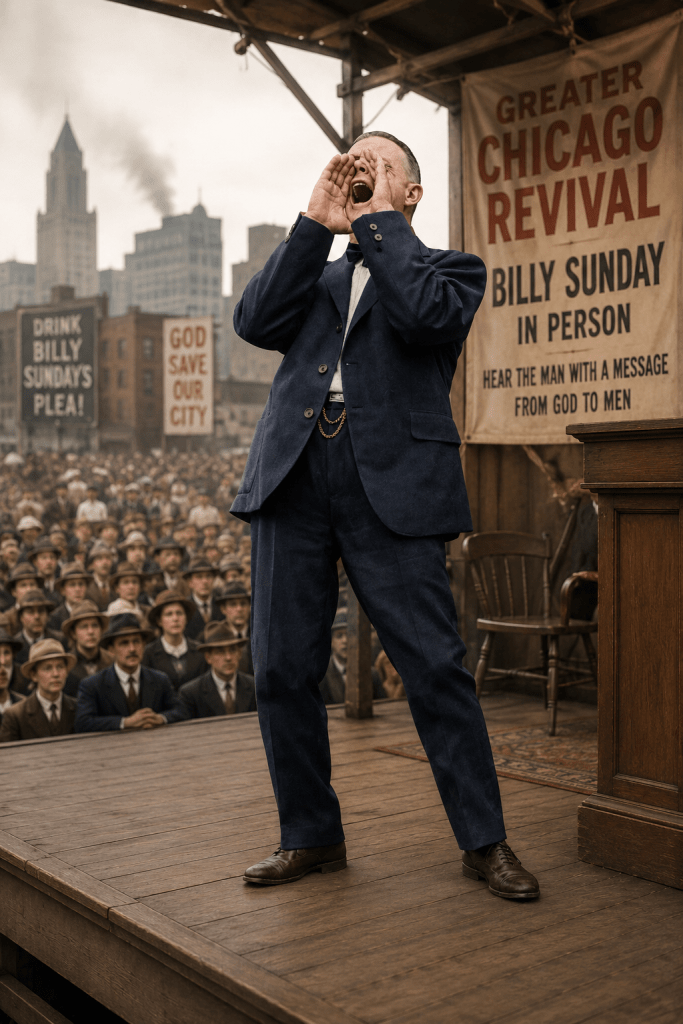
Billy Sunday as an Actor: How a Kansas City Newspaper Explained His Method (1916)

When Billy Sunday arrived in Kansas City during his 1916 revival campaign, reporters tried to explain what made his preaching so electrifying. One article in the The Kansas City Star offered an unusual perspective. Rather than describing Sunday simply as a preacher, the writer analyzed him as something closer to a dramatic performer.

The article was titled “Billy Sunday as an Actor,” and it attempted to dissect the evangelist’s method from a theatrical standpoint. What the reporter saw was not merely a sermon but a kind of living drama unfolding on the sawdust platform.

According to the writer, Sunday had the ability to bring invisible scenes vividly to life:

“Mr. Sunday, erect and eloquent, is addressing some jury which is corporeally invisible, but which instantly lives before the eyes.”

In other words, Sunday’s sermons created mental pictures so vivid that listeners could almost see the courtroom of heaven forming before them. The preacher might begin by placing his audience before the bar of divine judgment, describing the sinner standing before God.

But the sermon did not stay in one place for long. Sunday constantly shifted roles, turning the message into a dramatic sequence of scenes. One moment he might portray a bartender leaning over a counter; the next he was the drunken customer staggering through the gutter.

The article described these rapid transitions with striking clarity:

“Then he becomes a barkeeper… And in another instant he is the drunkard—‘a dirty rum guzzler’—cringing, broken, swaying to the gutter.”

Through pantomime, gestures, and changes in voice, Sunday acted out moral situations that his audience immediately recognized.

The reporter concluded that Sunday’s preaching relied heavily on what he called melodrama. But the word was not meant as criticism so much as explanation. Melodrama, the article observed, was easy for ordinary people to understand because it dealt in clear moral conflict.

“Melodrama has nothing to do with character and is easy to understand,” the writer noted. “It is the drama of situation.”

That description captures something essential about Billy Sunday’s preaching. His sermons did not revolve around abstract theological debates. Instead, they focused on recognizable human stories: the drunkard, the wandering son, the sinner facing judgment.

Another feature the reporter noticed was Sunday’s physical intensity. The evangelist rarely stood still. He ran, leaped, stamped his foot, pointed accusingly, and pounded the pulpit for emphasis. The effect, the article suggested, was almost like watching an athlete or dancer.

One colorful comparison even likened him to the famed ballet performer Vaslav Nijinsky—an extraordinary metaphor for a revival preacher.

Perhaps the most perceptive observation in the article concerned the simplicity of Sunday’s language. The reporter noted that his words were blunt, Anglo-Saxon, and forceful:

“Short, pungent… Saxon derivatives of English… packed full of powerful stimulus.”

This plainspoken style, filled with vivid phrases and sharp imagery, helped Sunday communicate with audiences drawn from every social class.

In the end, the Kansas City writer recognized something that many critics missed. Billy Sunday’s sermons were not merely lectures about religion. They were dramatic moral confrontations, staged in front of thousands of listeners each night.

On the bare platform of a temporary tabernacle, without scenery or props, Sunday created entire scenes through voice, motion, and imagination. His preaching was not simply heard—it was seen and felt.

And that, the reporter concluded, was the secret of his remarkable power over a crowd.

Adapted from: The Kansas City Star. May 4, 1916:2.