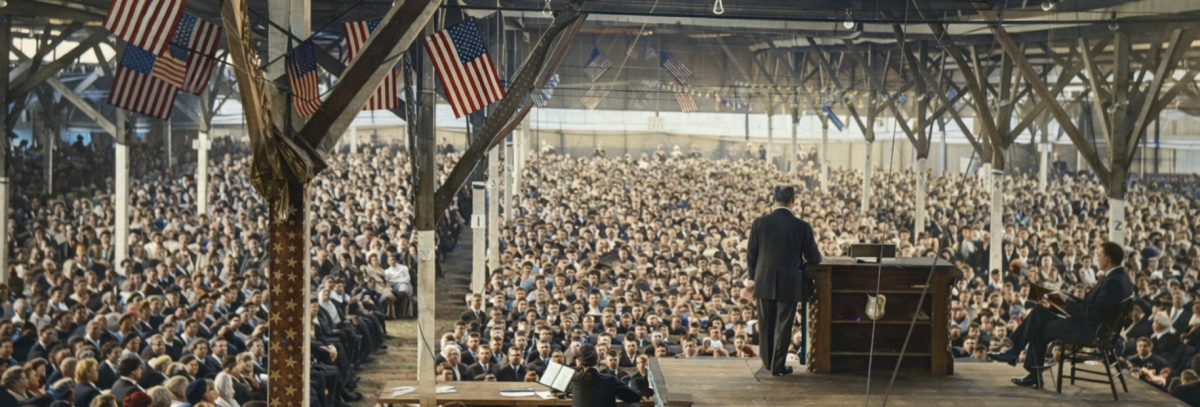
What Billy Sunday Borrowed from Chapman — and What He Made His Own

When Billy Sunday stepped out on his own as an evangelist in 1896, he did not start from nothing. He started from a kit. Much of that kit had been handed to him by the man he had served as advance agent and understudy, the polished Presbyterian revivalist J. Wilbur Chapman. Sunday himself never hid this. The interesting question is not whether he borrowed — it is what he borrowed, how long he kept it, and what he eventually built in its place.
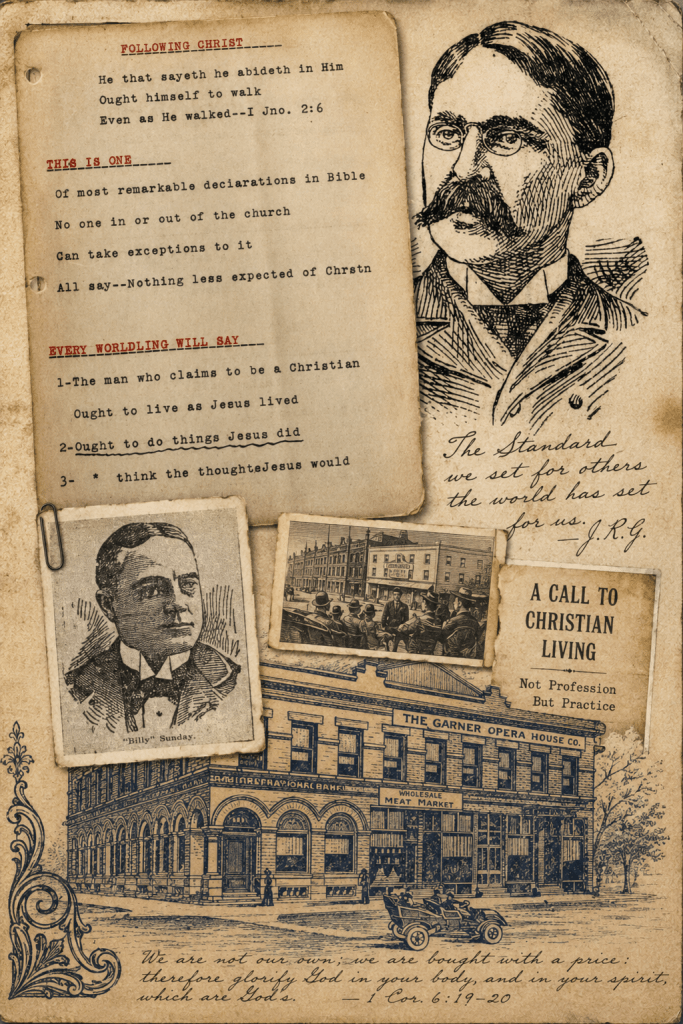
A close comparison of Sunday’s early preaching record against Chapman’s own published sermon portfolio lets us answer that question with something better than impression. The picture that emerges is not a story of a man trapped inside his mentor’s material. It is a story of an apprentice spending down an inheritance and, year by year, replacing it with a voice that was unmistakably his own.

The starting kit, 1895

In the years he was still working closest to Chapman, Sunday’s preaching looks the most borrowed. Several of his 1895 titles are not merely similar to Chapman’s — they are the same sermon. “Is It Well With Thee?” runs on the same text Chapman used. “How Shall We Escape?” matches Chapman title-for-title and verse-for-verse. The sermon on receiving the Holy Spirit lands on the same subject Chapman had already put into print.

The rest of 1895 is standard revival stock of the period — the familiar parables of the lost sheep, the publican and the Pharisee, Zaccheus, the laborers in the vineyard. This is not yet a body of original work. It reads like a young evangelist preaching the sermons he had heard his mentor preach, in the order he had learned them.

1896: the borrowed frame, the new flesh

The year Sunday went solo, his sermon list more than doubles. The reason is simple and human: a man running his own multi-week campaign suddenly needs enough material to fill it, and the cheapest place to find that material was the well he already knew. So the Chapman skeleton is still doing real work in 1896 — the surrendered-life sermon on Kadesh-Barnea, the cluster on the unpardonable sin, the sermon on Christ’s first converts, the warnings to backsliders, the “decide now, don’t wait until tomorrow” appeal.

But 1896 is also the year you can first hear the other Billy Sunday — the one the country would eventually pack tabernacles to see. Alongside the inherited sermons sit titles with no parallel anywhere in Chapman’s portfolio: a sermon against drink, a broadside against the “isms and cults,” and a pair of plain, muscular talks about effort and preparation. The frame is still Chapman’s. The flesh on it is starting to be Sunday’s.

1897: the gospel of judgment turns personal

By 1897 the balance has tipped. Only one clear Chapman carryover survives in the record, and the center of gravity has moved hard toward judgment, hell, and eternity — “After death, the judgment,” “There is a hell,” “Where will you spend eternity?” — together with a frontal attack on infidelity and loose living.

This is the emerging Sunday brand, and it is worth noting what it is not. It is not Chapman’s measured, doctrinal, teaching voice. Chapman the careful Presbyterian taught his hearers what a Christian is and what the gospel means. Sunday kept the part of Chapman that pressed for a decision and quietly dropped the part that paused to instruct. He kept the closer and let go of the teacher.

The Chautauqua years: Chapman all but disappears

Now jump ahead to Sunday on the Chautauqua circuit between 1901 and 1911 — the popular lecture platform where he spoke to general crowds rather than revival congregations. Here the transformation is nearly complete.

Across more than two dozen documented Chautauqua appearances, the old Chapman material has effectively vanished. In its place stands a repertoire that is entirely, recognizably Sunday’s: the baseball talk, the temperance assault under titles like “The Devil’s Boomerang” and “Get on the Water Wagon,” the skeptic-bashing of “Nuts for Skeptics to Crack,” and the brisk motivational lecture “Forces That Win.” Conversion-and-judgment preaching, the very heart of the revival sermons, almost never appears on this stage. The platform audience came for a performance and a point of view, not an altar call, and Sunday gave them exactly that.

And yet one thread runs all the way through. The single Chapman sermon still standing on the Chautauqua circuit is “How Shall We Escape?” — the same sermon that had been a word-for-word borrowing back in 1895. It is at once the strongest early borrowing and the lone survivor a half-decade later. Of everything Chapman handed him, essentially this one sermon endured. The rest he had outgrown.

What was actually his

So which sermons were truly Sunday’s own — the small original core he built on while the borrowed material fell away?

The most reliable test is not simply “absent from Chapman’s list.” It is durability: which non-Chapman subjects appeared early and survived into his independent, mature preaching. By that measure, three themes stand out, and all three are visible by 1896:

  • Drink. The early anti-saloon sermon becomes the most-repeated subject of his Chautauqua years. If any single theme is the signature of the independent Billy Sunday, this is it.
  • Skepticism and infidelity. The early swipe at “isms and cults” hardens into a recurring, crowd-pleasing attack on doubt and unbelief.
  • Effort and will. The plain talks on having a mind to work and on need, opportunity, and preparation point straight ahead to “Forces That Win.”

These are the sermons that were his, because these are the ones he kept when he no longer had to lean on anyone. The borrowed gospel of judgment got him started; this original core is what he became.

A note on the work behind this

This comparison rests on a sermon-by-sermon crosswalk of Sunday’s documented early titles against Chapman’s published portfolio, sorted into tiers — word-for-word borrowings, shared subjects, looser thematic echoes, and sermons original to Sunday. The early record (1895–1897) and the Chautauqua window (1901–1911) are well represented. The crusade years in between are still being reconstructed, and as that record fills in, parts of this picture may sharpen or shift. But the overall shape is already clear: Billy Sunday left his mentor carrying a borrowed kit, drew on it hardest in his first solo year, and over the following decade made himself almost entirely into his own creation.

How to cite this post

Chicago: McNutt, Kraig. “What Billy Sunday Borrowed from Chapman, and What He Made His Own.” Evangelist Billy Sunday (1862–1935), May 30, 2026. https://evangelistbillysunday.com/2026/05/30/what-billy-sunday-borrowed-from-chapman-and-what-he-made-his-own/.
MLA: McNutt, Kraig. “What Billy Sunday Borrowed from Chapman, and What He Made His Own.” Evangelist Billy Sunday (1862–1935), 30 May 2026, evangelistbillysunday.com/2026/05/30/what-billy-sunday-borrowed-from-chapman-and-what-he-made-his-own/.
APA: McNutt, K. (2026, May 30). What Billy Sunday borrowed from Chapman, and what he made his own. Evangelist Billy Sunday (1862–1935). https://evangelistbillysunday.com/2026/05/30/what-billy-sunday-borrowed-from-chapman-and-what-he-made-his-own/

Turabian: McNutt, Kraig. “What Billy Sunday Borrowed from Chapman, and What He Made His Own.” Evangelist Billy Sunday (1862–1935). May 30, 2026. https://evangelistbillysunday.com/2026/05/30/what-billy-sunday-borrowed-from-chapman-and-what-he-made-his-own/.
Stories of three other Evangelists: predecessors to Billy Sunday

The Ways and Works of Moody, Gypsy Smith and Chapman—Men Whose Methods Were as Different as Their Personalities.

By WILLIAM RADER

Cited in: The Philadelphia Evening Ledger. January 8, 1915:8.


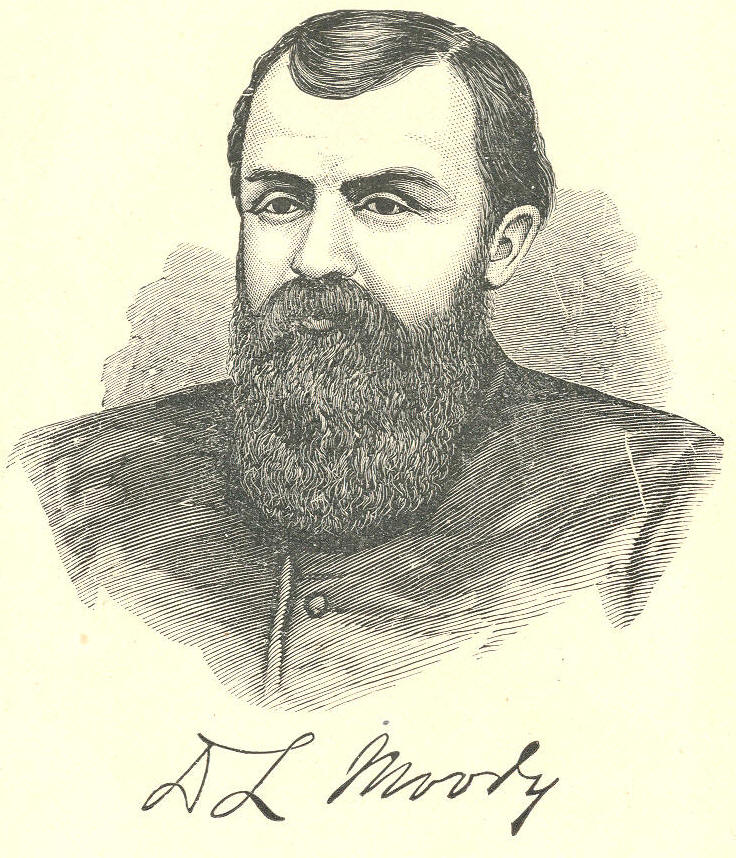
DWIGHT L. MOODY sleeps on Round Top, at Northfield, Mass. A few miles away, in Swanzey, N. H., is a simple shaft which marks the grave of Denman Thompson, of “The Old Homestead.” It is probable that the two men never met, but they were not unlike in appearance. Both were big, hearty Americans with good appetites, warm hearts and filled with loving kindness. The one spoke fiction on the stage as if it were truth; the other—to repeat a thought of Garrick—spoke truth on the pulpit as if it were fiction.

When Moody was a clerk in a Chicago shoe store, he became interested in religion through Dr. Edward N. Kirk and Edward Kimball. Without college or theological training, he began his great work and preached the gospel throughout the English-speaking world.


In the Old Pennsylvania R. R. Depot

One of his notable campaigns was in Philadelphia. The meetings were held in the abandoned freight depot of the Pennsylvania Railroad, used afterward as the Wanamaker store. The building was provided with seats to accommodate 10,000.

A striking incident of Moody’s Philadelphia campaign was the meeting set apart especially for intemperate men and women. His tender appeal to that assemblage is still remembered by Philadelphians who heard him.

Singing helped the preaching of Moody. The songs of Sankey grew to be as famous as the sermons of Moody. A hymnal was published which caused Moody and Sankey much trouble, since it was reported that they received royalties from the sale. Certain watchdogs of the moneybag believe that the blackest sin on the calendar is for a preacher or evangelist to make money. Every evangelist must make it plain that he is not a grafter.

Mr. Moody was the greatest evangelist-preacher of his generation. He did not use the best grammar, but he had common sense. Who could forget his sermons on “Sowing and Reaping,” “The New Birth” and “Repentance”?


Everybody Sing!

There was no claptrap in the Moody method, no straining for effects, but conviction, point and directness, and irresistible persuasiveness. He did not shatter the icicle of sin with well-directed aim, but melted it with words hot with a passion for redemption.

The first time I heard Moody he did what I thought at the time a sensational act. It was in Tremont Temple, Boston. Anxious to see him, as a student at Andover, I went early and took a seat near the front. The big choir on the platform was being trained while the people gathered. An old gentleman sat on one side of me, a lady the other. Moody soon appeared. He was announced by a man reading a paper in the audience, and asked him to put it away and join in the singing. “Everybody sing!” he shouted. “Everybody get a book!” He announced a hymn, but the singing was very unsatisfactory, and he had the people sing it over several times. Seeing I had no book and showing annoyance, he took fair aim and threw a hymn book as straight as a bullet at me. It took me in the stomach, and I think it raised me about two feet from the pew, but my consternation was no whit greater than the surprise of those who sat with me. We were strangers, but we all sang out of the same book, and Moody from that moment was an acknowledged master.

He was a man-finder. He discovered Henry Drummond and introduced him to the American people. He found a great preacher in Campbell Morgan, of London, and made him at home in the American pulpit. He took keen interest in liberal and conservative.

The Northfield conferences, which continue to this day, furnished an opportunity for testing the mettle of promising men in England and this country. A number enjoy an international reputation who owe their start to the insight of Mr. Moody.

He was a builder of institutions. The Y. M. C. A. work throughout the country was assisted by him. He raised great sums of money for the work. The Mount Hermon schools for young men and women are one of his memorials. His evangelistic work reached its zenith in his British campaign and at the World’s Fair in Chicago.


The Stolen Overcoat

The last time I heard Moody he made an impassioned plea in behalf of criminals and prisoners, and while he was making it an ex-convict stole his valuable new overcoat. It was a study in practical theology to observe the effect of this disappointment upon the great preacher, who, while furious at first, finally submitted to the inevitable with grace that an evangelist is supposed to possess.


Gypsy Smith is one of my favorite evangelists. He is a full-blooded gypsy, swarthy skin and beautiful brown eyes. Socially he is “a hail fellow well met,” one of the ripe fruits of the Moody-Sankey British campaign. He has a sense of humor and a wit that is irresistible. His voice is musical, and it is a treat to hear him sing.

Gypsy Smith uses faultless English. I asked him how he acquired this gift of English diction, and he said that after leaving the gypsy camp he was placed in a refined English home, where he heard the best grammar. If you have ever heard Gypsy Smith’s great sermon on “With the Stripes” you have listened to a discourse that has all the qualities of great preaching.


A Cultivated Gypsy

He is the perfect gentleman on the platform, winsome, attractive, eloquent, cultured and sympathetic. As a maker of sermons he has no equal. His breadth of scholarship, depth of feeling and height of intellectual reach make him a superior man in the field of higher evangelism.

Rodney is his real name. He is of the Tachine Roman gypsy tribe, and his mother was a fortune-teller. The life in the tent has enriched his imagination, given him a strong body and aided him in living a clean, pure life, and not since the day John Bright has any man appeared in England who has more perfectly revealed the possibilities of Anglo-Saxon speech.


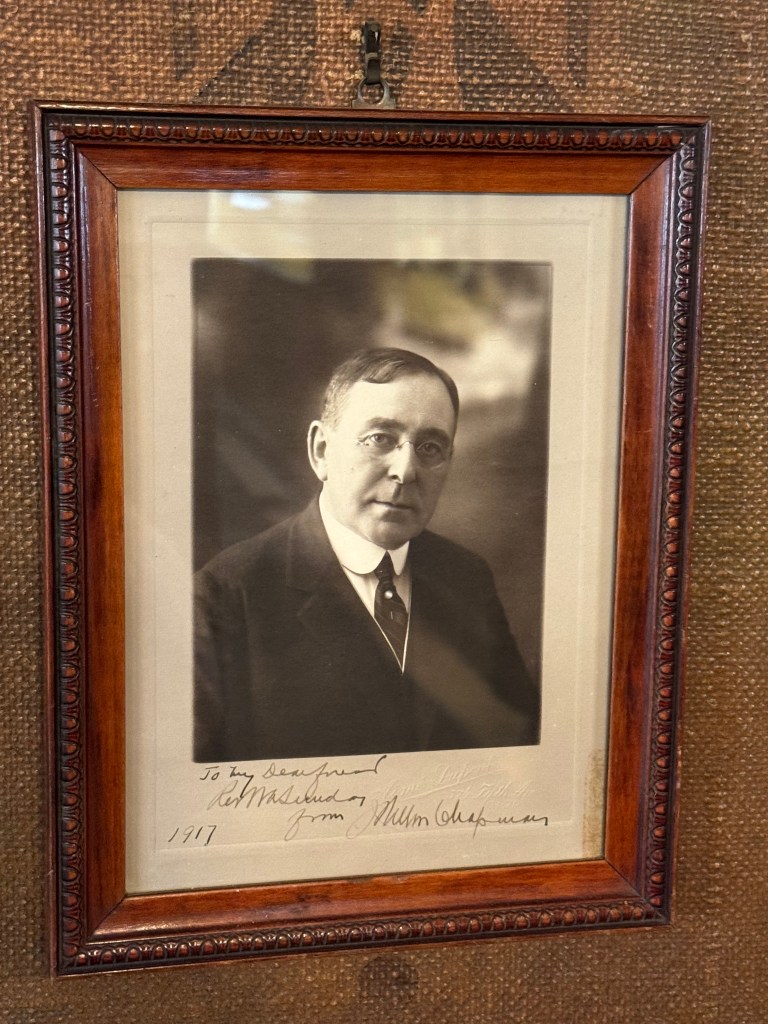
J. Wilbur Chapman was a Philadelphia pastor. For some years he was the pastor of Bethany Presbyterian Church; then he became a world evangelist.

Picture of Chapman inscribed to Billy, hanging in his Winona Lake home.

Doctor Chapman’s approach to the masses may be likened to the sun eating its way through a snowdrift. Here is a quiet, modest, devout man who takes a passage of scripture and illuminates it with his interpretations. His sermons search and reach as the leaven works its way through a meal. Doctor Chapman is not the sort of man who creates a big furore, though his campaign in Australia and Great Britain made a profound impression. He is unostentatious, with a charming modesty, intense in his mission, with deep convictions, while a man of sweetness and light, is on occasion a real son of thunder.

The popular response to evangelists is a matter which compels a study of the human mind and of the organized preparation of every great evangelistic effort. The multitudes do not fill large tabernacles to hear a man talk, but to hear him talk about religion. The sea of public feeling is tossed while wave crests and eddies by emotional religion. It is a question whether these men could gather such crowds to listen to a lecture on Browning or Shakespeare. I believe that if the press and literary men should back the movement Rudyard Kipling or Bernard Shaw or Theodore Roosevelt might fill for a period of time a vast audience discussing a literary or secular subject.


Doctor Wanted

It must be conceded, however, that men are interested in matters which concern their destiny. Wicked men have a strange desire to hear a good man denounce them; people—most of them—like to see the dog.

All men have spasms of goodness; aspiration loves company. A man with a rope on a stormy sea will have no trouble attracting attention. Perhaps the attitude of the public toward the evangelist is best illustrated by the scene on the Atlantic when it was sinking. Jews, Catholics, Protestants and skeptics gathered in the cabin. Moody, with one arm clasping the pillar, read the 91st Psalm. Then he went to his berth and fell asleep. Men who give help and comfort will have the multitude, for people are sheep—they follow a shepherd.


DEFIANCE

Let life its legioned army throw
Against my pennoned castle walls,
With curse and jibe and bitter groan
Its band of lowly seneschals;

But when the dust of conflict blows
And sounds the bugle o’er the lea,
They shall not find me fallen, dead;
They shall not kill the love in me!

Tho stained with blood of bleeding heart
Up in the ramparts’ evening breeze,
My banner floats the same as yore
Above the brooding cypress trees.

The sun has set; the shadows fade;
The night comes silent from the sea;
They shall not find me fallen, dead;
They shall not kill the love in me!

—Alonzo Harbaugh, in New York World

Billy Sunday’s Own Account of His Conversion (1902)

“Lord, If You Ever Helped Mortal Man…”

One of the things I love most about researching Billy Sunday is when we can let him speak for himself.

Tucked inside The founding of Pacific Garden Mission: over thirty-five years contribute to the Master’s service by Sarah D. Clarke is a brief autobiographical sketch written by Sunday in September 1902. It is not polished theology. It is not retrospective myth-making. It reads like a man remembering the night that changed everything.

He begins with Chicago.

“Fifteen years ago one Sunday night I walked down State street, Chicago, in company with several baseball players… We entered a saloon, drank, and passed on to the corner of State and VanBuren…”

Then something happened.

A small band from Pacific Garden Mission was singing on the street. Sunday sat on the curb and listened.

“I had heard those songs from mother back in Iowa, in the Methodist Sunday School in Ames, Iowa, and God painted on the canvas of my memory the scenes and recollections of other days and faces. I bowed my head in shame and the tears rolled down my cheeks like rivers of water.”

The song that broke him was “Where is my wandering boy to-night.”

Col. Clarke invited the men to the Mission. Sunday’s response was immediate:

“I arose and said, ‘Boys, good-by, I’m done with this way of living.’”

That sentence is vintage Sunday. Abrupt. Decisive. No hedging.

But what follows is equally revealing.

The next morning, newspapers reported his church membership. He dreaded facing his teammates. He confessed:

“I would rather have faced a six-shooter…”

Yet when he arrived, the first to greet him was Mike Kelly.

“With a heart as tender as a woman’s… he took me by the hand and said: ‘That’s a grand thing to do, “Bill.” If I can help you let me know.’”

Cap Anson, Ed Williamson, Fred Pfeffer, Jno. Clarkson, Tom Burns, Dalrymple — they all encouraged him. And if they swore in his presence, “they would immediately ask my pardon.”

This detail matters. It corrects the caricature. Sunday did not convert in isolation from the baseball world. He converted in it.

Then comes one of the most famous episodes of his early testimony — the Detroit game.

Bottom of the ninth. Two out. Men on second and third. Charley Bennett at bat.

“I offered up a prayer and said, ‘Lord, if You ever helped mortal man, help me get that ball.’ I leaped the bench, looked over my shoulder, threw out my hand and the ball struck and stuck. The game was ours.”

Then the line that perfectly captures Sunday’s theology-by-experience:

“I am sure the Lord helped me catch that ball. This deduction may not be according to theology, but it’s according to experience.”

That is pure Billy Sunday — unfiltered, confident, experiential, unapologetic.

After baseball, he attended Northwestern University “where I picked up some Methodist enthusiasm and vim to counteract the stiff, staid Presbyterianism.” That phrase alone tells you how he would preach for the next thirty years.

He left professional baseball, became assistant secretary of the Chicago Y.M.C.A., then joined Rev. J. Wilbur Chapman in evangelistic work. Of Chapman he writes:

“All I am today as an evangelist I owe to Dr. Chapman and to Prof. R. R. Lloyd… with whom I studied privately.”

Notice that. Sunday never claimed to be self-made. He acknowledged formation, mentorship, study.

This 1902 piece is significant for another reason. It predates the massive tabernacles, the sawdust trails, the millions who would hear him preach. It shows us Sunday before the fame hardened into legend.

What do we see?

  • A mother’s hymns remembered.
  • A curbside conviction.
  • Public courage in a locker room.
  • A prayer in right field.
  • A man mentored, trained, and sent.

If you want to understand Billy Sunday, start here.

Not with the headlines.

Not with the critics.

Not even with the later statistics.

Start on a Chicago curb, with a baseball player weeping while a gospel song drifts through the night air.

And listen to him say it himself:

“Boys, good-by, I’m done with this way of living.”

Adapted from: The founding of Pacific Garden Mission : over thirty-five years contribute to the Master’s service / by Sarah D. Clarke

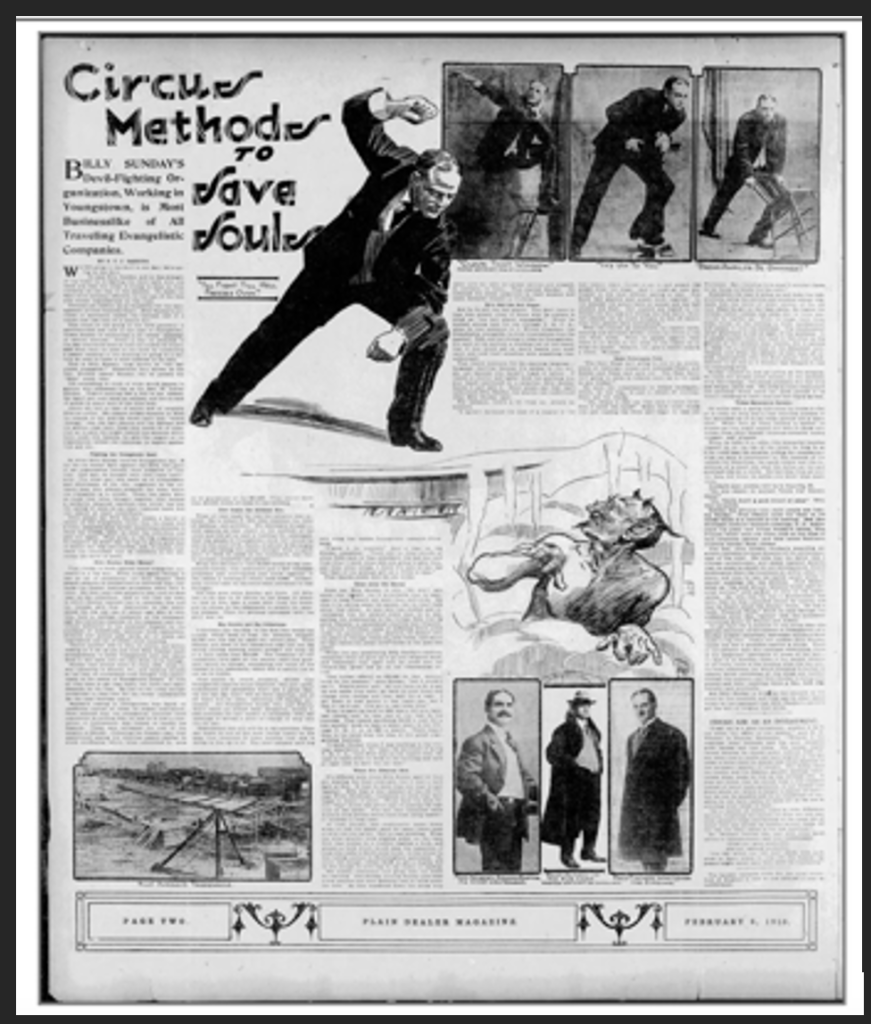
The Youngstown, Ohio (early 1910) Sunday-revival

The Cleveland Plain Dealer. Feb 6, 1910  

Billy Sunday Comes to Youngstown: A City on Fire (January–February 1910)

When Billy Sunday rolled into Youngstown, Ohio, in January 1910, he did not arrive quietly—and Youngstown did not receive him quietly either.

From the very first night, it was clear that this industrial city, filled with steel mills, rail yards, immigrants, laborers, and restless energy, was primed for revival. Sunday began his campaign on January 8, 1910, and within hours it was obvious that this would be no ordinary meeting.

A city floods the tabernacle

On opening night, 5,000 people packed the tabernacle, according to the New Castle News (Jan. 10, 1910). The very next evening, crowds swelled to 7,000, as reported by The Pittsburgh Post (Jan. 10, 1910). The word had spread fast: Billy Sunday was in town, and Youngstown wanted in.

As the weeks unfolded, the numbers only grew more astonishing.

By February 4, the campaign had already recorded 2,221 conversions. That same night, 15,000 people attempted to crowd into a tabernacle that could seat only 7,000—a vivid picture of spiritual hunger and civic excitement. The Cleveland Press marveled at the scene, noting the crush of humanity trying simply to hear Sunday preach.

Youngstown had become a revival city.

The dramatic final Sunday

The campaign reached its crescendo on February 20, 1910.

That final day, 10,000 people attended, while 6,000 more were turned away for lack of space. The Marion Daily Star reported that 5,900 total conversions had been recorded over the course of the meetings, including 970 decisions on the closing day alone.

It was a stunning finish—one of those great climactic Sundays that made Sunday’s name synonymous with American revivalism.

At the conclusion of the campaign, Sunday received his customary purse of 10,000 dollars, a significant sum in 1910 and a sign both of the city’s appreciation and of the scale of the event.

What Youngstown reveals about Billy Sunday

The Youngstown campaign illustrates several hallmarks of Billy Sunday’s ministry:

  • mass appeal: from night one, thousands came. This was not a slow build—it was a tidal wave.
  • urban impact: Youngstown, a gritty industrial center, responded with remarkable intensity, showing that Sunday’s message resonated far beyond small towns or rural communities.
  • public spectacle and spiritual urgency: the overflow crowds on multiple occasions suggest that this was as much a civic event as a religious one.
  • measured results: newspapers tracked conversions closely, giving us concrete numbers that help modern historians gauge the scope of the revival.

Most of all, Youngstown demonstrates why Sunday was “the man for the moment.” In an era of rapid industrial change, social tension, and moral anxiety, he spoke with clarity, fire, and confidence—and cities like Youngstown listened.

More than a century later, the Youngstown campaign stands as one of the great urban revivals of Sunday’s early career. The numbers are impressive, but the deeper story is about a city temporarily transformed—its people stirred, challenged, and moved to decision.

J. Wilbur Chapman on Billy Sunday

Writing just days after the Youngstown campaign ended, J. Wilbur Chapman offered this striking tribute to Sunday in The Dayton Herald (Feb. 23, 1910):

“Some of the sermons he preaches now are not mine. I love him. I know his sincerity and passion for Jesus. I thank God for his ministry. Most of us are too dignified. Let rules of grammar and conventionality be broken if souls can be saved. As soon as he begins to speak the doors will be closed so you can’t get out. You’ve got to take your dose for once. If ever a man was called to preach; if ever a man had the seal of God’s approval on his ministry, that man is Sunday. I take off my hat to any man that can turn men to Jesus Christ.”