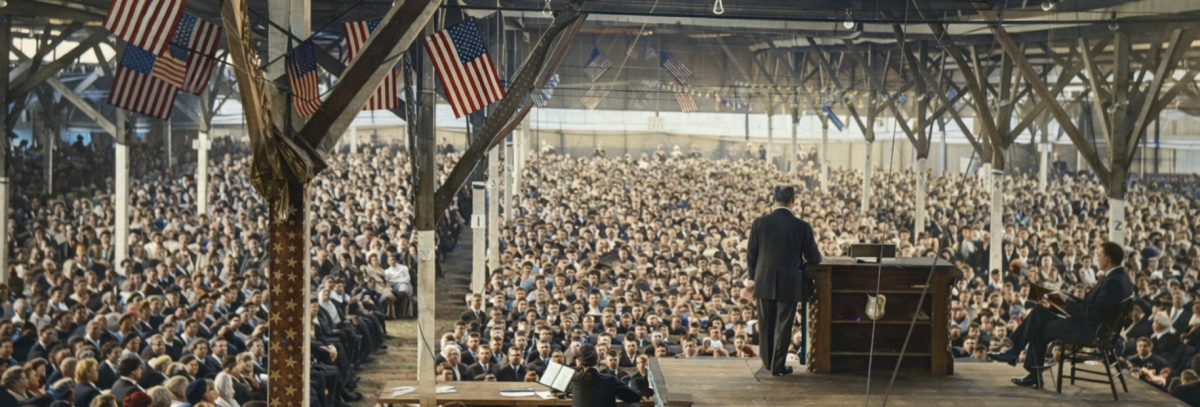
Fifth in a series drawn from Lindsay Denison’s profile of Billy Sunday in The American Magazine, September 1907.
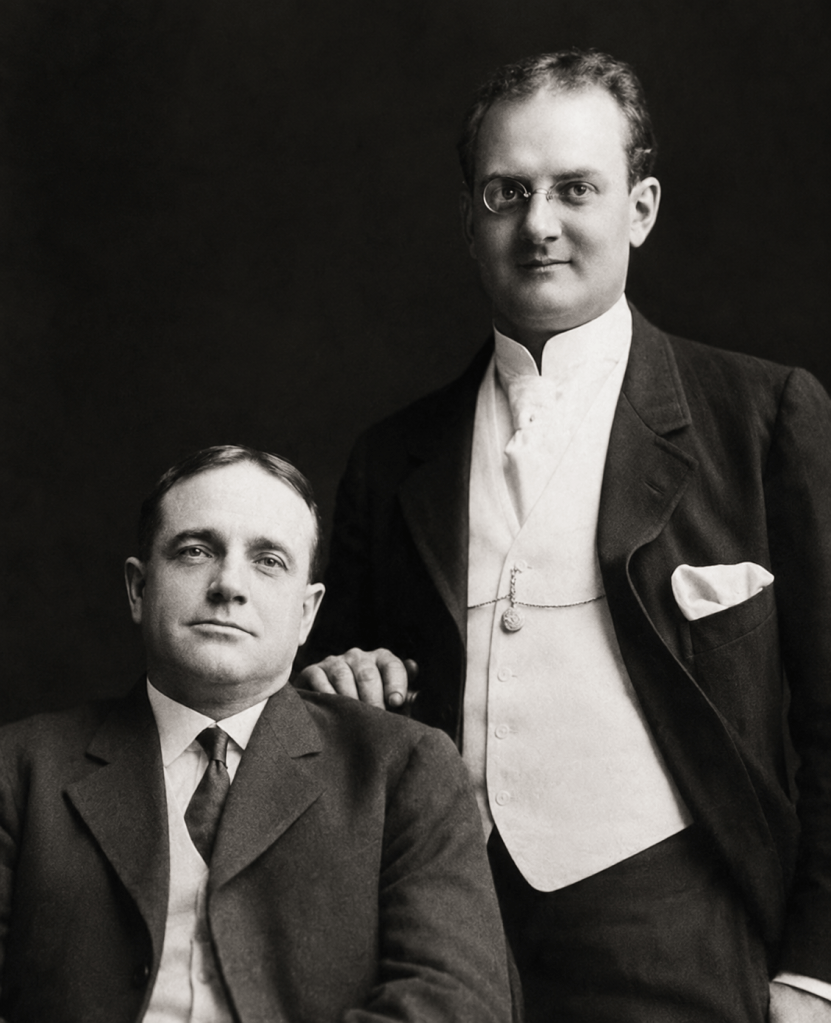
If Billy Sunday provided the thunder of a revival, the man beside him provided the music — and it was every bit as unconventional as the preaching. His name was Frederic G. Fischer, and Lindsay Denison’s 1907 profile makes clear that the singing in a Sunday meeting was no solemn warm-up. It was a show in its own right.
Sacred words, familiar tunes
Fischer’s guiding idea was simple and, to many traditionalists, slightly shocking: meet ordinary people where their ears already were. Rather than impose formally religious music on a crowd, he set sacred words to tunes the audience already knew and loved — the same instinct, Denison noted, that drove the Salvation Army to go to the people for their music instead of forcing church music upon them.
The song book was full of these thinly disguised melodies. One hymn ran close enough to a popular music-hall number of the day — Vesta Victoria’s “Waiting at the Church” — that a sophisticated city visitor might startle to hear it drifting out of the tabernacle at night. Stephen Foster’s “Suwannee River” carried new words of praise. So did “Old Kentucky Home,” reworked into a hymn pointing toward the New Jerusalem.
To purists, dressing parlor and minstrel tunes in religious clothing bordered on sacrilege. To Fischer, it was evangelism: a melody a farmer already hummed was a melody that would carry the message home with him.
Anything that makes a joyful noise
Fischer barred no instrument capable of joyful sound. At some services the Fairfield Brass Band sat right in with the choir. Cornet solos were dropped into the proceedings again and again.
And then there were the props. The choir was issued tin megaphones, snatched up on Fischer’s signal to multiply the volume of praise. Toward the end of the meetings, singers were asked to bring combs from home; supplied with tissue paper, they produced a novel buzzing music that delighted the crowd. Fischer thought nothing of announcing that the congregation might like to whistle a chorus — and choir and crowd alike would oblige with complete enthusiasm.
This was not church music as anyone in genteel New England would have recognized it. It was closer to a band concert, a sing-along, and a tent show rolled together — exactly the point.
The day the ministers had to sing
The single best Fischer scene in the article is a small comic masterpiece, and it shows the man’s playful streak.
The Fairfield high-school students were seated in a body to one side, the grammar-school children in the rows up front. Fischer drilled the various sections of the room through the verses of a hymn one at a time — the whole audience on one stanza, the high-schoolers on another, the little ones piping the next in their trebles — until each group moved with real thrill and vim.
Then he sprang his trap. He turned to the students and asked how they’d like to hear the ministers sing the last verse. The front benches howled their joyful approval. And so the seven clergymen on the platform — shaking their heads at Fischer, frowning at one another, hanging back — were forced to line up and sheepishly quaver out the final stanza. The roar of delighted applause that sent them blushing back to their seats must, Denison guessed, have reassured them. It is a glimpse of a revival that knew how to laugh at itself, and of a music director happy to engineer the joke.
Master of the room
For all the fun, Fischer was no mere entertainer. His real gift surfaced at the emotional climax of the revival’s final night, when the great altar-call surge sent converts streaming down every aisle and the room dissolved into a roar of singing, weeping, and shouting.
In that chaos, it was Fischer who took charge and organized the noise into something. He stood just behind Sunday, directing the choir and the two pianists stationed at each end of the platform, catching each of the preacher’s whispered suggestions and gliding one hymn into the next — humming here, swelling into triumph there — so that the emotional current never broke. When the energy threatened to spill over into a hundred dangerous rushes toward the platform, Fischer channeled it: have them sing the tune, then whistle it, then hum it.
It was, in its way, as skilled a performance as Sunday’s own. The preacher worked the souls; Fischer worked the room that held them. Together they built an experience that small-town audiences had simply never had before — and would not soon forget.
Next in the series: The Business of Revival — tabernacles, guarantees, and the “grafter” question.

 Evangelist Billy Sunday (1862-1935)