“Fix It Up With God Afterward”: The Footrace That Tested a New Convert

Third in a series drawn from Lindsay Denison’s profile of Billy Sunday in The American Magazine, September 1907.


A new convert’s faith is rarely tested by something so simple as a temptation to sin. More often it is tested by an obligation he took on before he believed — a promise made by the old self that the new self has to honor or break. For Billy Sunday, that test came in the form of a footrace, a pile of other men’s money, and Cap Anson refusing to take no for an answer.

It is one of the best stories in Lindsay Denison’s 1907 profile, and Sunday told it on himself.
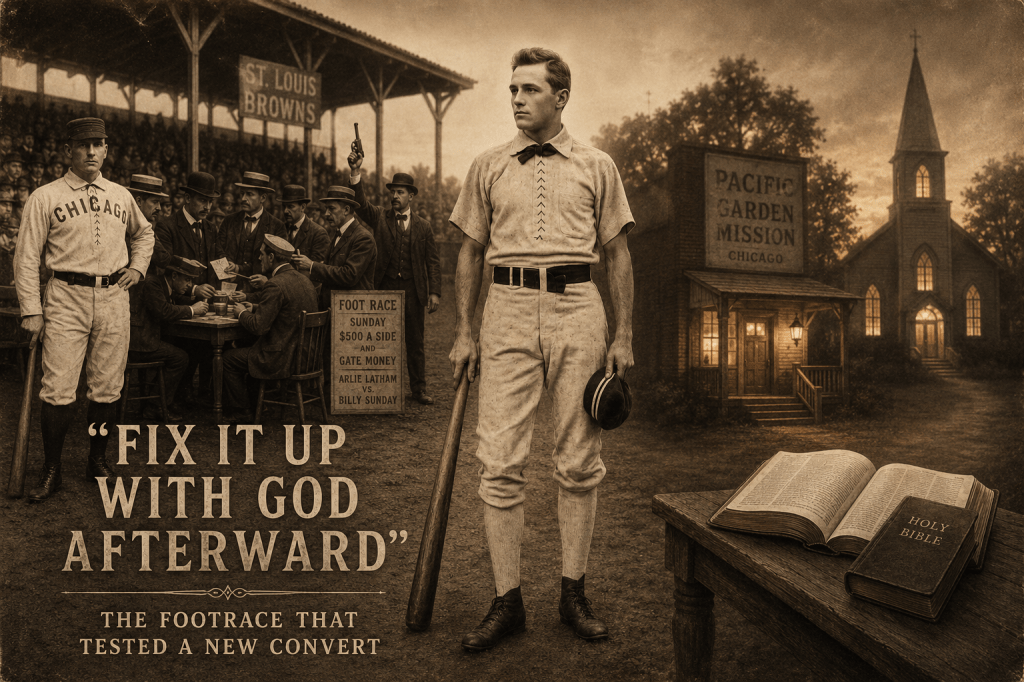
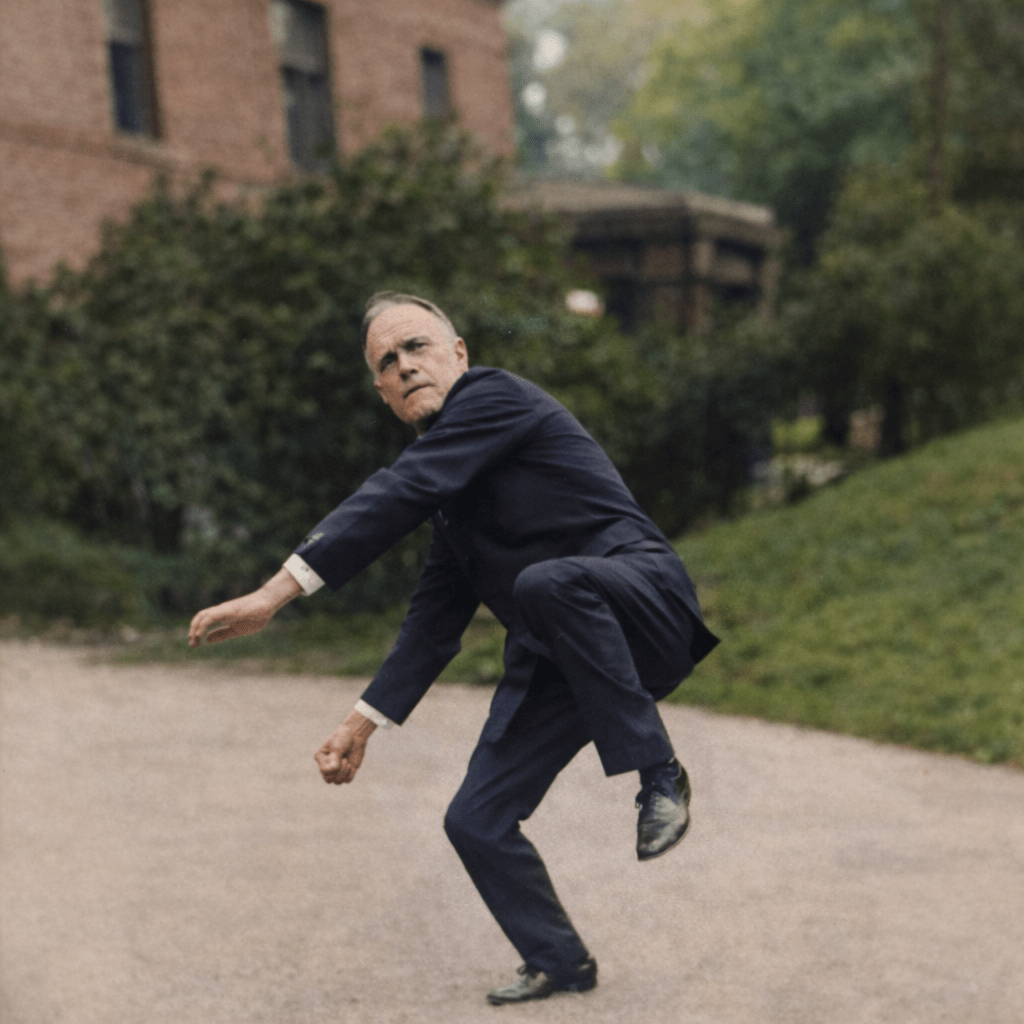
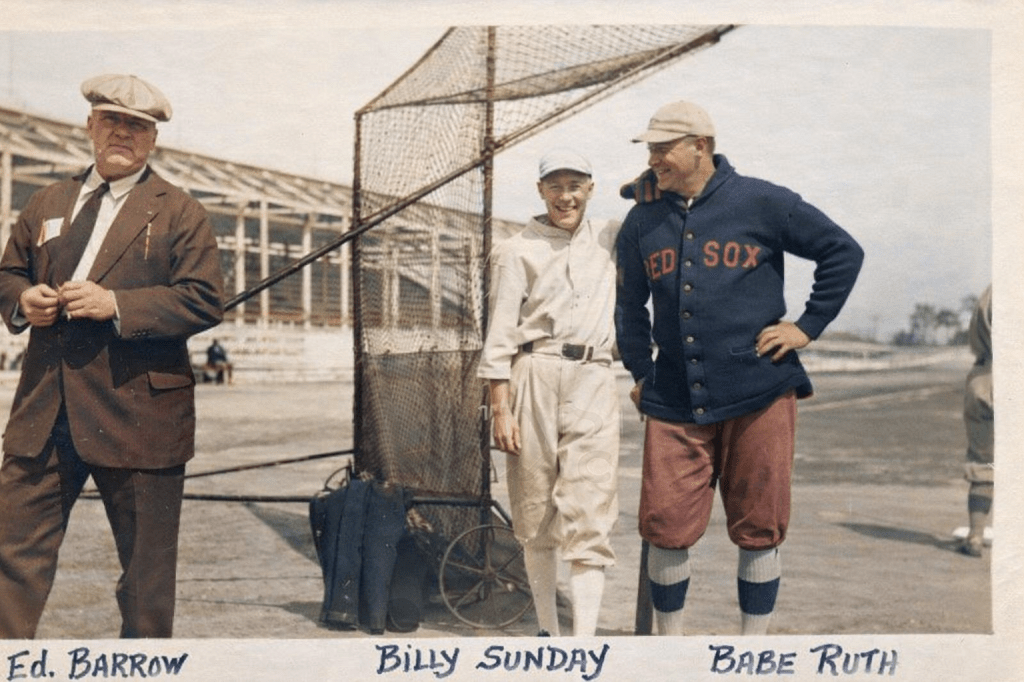
AI-generated image based on the story in this blogpost.

The bet

Before his conversion, Sunday had been matched in a hundred-yard race against Arlie Latham of the St. Louis Browns. The stakes were serious: $500 a side plus the gate money, with the race to be run in St. Louis on a Sunday at the close of the season. His captain, Cap Anson, had backed him heavily — and so had a great many of Anson’s friends. By Sunday’s own recollection, something like $75,000 was riding on the outcome.

Then Sunday walked into the Pacific Garden Mission and everything changed. Suddenly a man who had just resolved to live as Christ would have him live found himself committed to running a high-stakes gambling spectacle — on a Sunday, no less.

The prayer that wouldn’t resolve

This is the detail that makes the episode ring true. Sunday did not simply decide. He agonized.

He prayed over the race night after night, he told Denison, and still could not see his way clear. There was no clean answer. Backing out would betray Anson and the friends who had staked their money on him in good faith, long before his conversion. Going through with it meant a new Christian publicly running a Sunday gambling match. Either road ran against something he valued.

Unable to resolve it in prayer, he finally went to Anson and told him flatly that the captain would have to let him out of the race.

Anson’s answer

Anson would not hear of it. His first move was to needle Sunday’s pride — he wasn’t going to turn yellow and quit, was he? Sunday tried to explain himself. Anson wouldn’t listen.

What Anson said next is, in its rough way, one of the most quietly fascinating lines in the whole article — a piece of folk theology from a man who admitted he wasn’t much for religion. He told Sunday he’d backed him for thousands, and so had his friends, and then he reasoned it out: he didn’t believe God would want Sunday to begin his new life by throwing down his friends over a contract he’d signed before he ever went with God. So here was the plan. Sunday should go down to St. Louis, run the race — and then fix it up with God afterward.

It is the line that gives this post its title, and it deserves a moment’s attention. Anson, the irreligious ballplayer, was making a genuine moral argument: that a debt of honor incurred by the old self still binds the new one, and that a faith worth having shouldn’t begin with a betrayal. Whether or not the theology holds, the loyalty behind it is unmistakable.

“And, well, friends — I did”

So Sunday did exactly that. He went to St. Louis. He ran the race. He won it.

And then he came straight back to Chicago, went before the session of his church, and owned up to the whole thing. When the elders heard the full story, they let him off. He went on to serve as an elder of that same church for a good many years afterward.

What makes the story land is the order of operations. Sunday did not arrive at a tidy principle and then act on it. He wrestled, failed to find an answer, deferred to a friend’s blunt counsel, did the deed, and then submitted himself to his church’s judgment after the fact. It is conversion as a real human process — messy, compromised, and honest about the compromise — rather than a clean before-and-after.

Why he told it

It is worth asking why Sunday repeated a story that, on its face, shows him running a Sunday gambling race as a brand-new Christian. The answer is probably the same reason it works on us a century later: it made him believable.

A preacher who claimed to have gone instantly spotless from the moment he rose off that curb would have been easy to disbelieve and easy to resent. A preacher who admitted he prayed over a problem for nights, couldn’t crack it, ran the race anyway, and then went and confessed it — that man was telling the truth about how hard the early going had been. The audiences who heard him preach trusted him in part because he handed them stories like this one.

The footrace, in other words, was not a blemish Sunday hid. It was evidence he offered.


Next in the series: Preaching the Devil in Plain English — inside Billy Sunday’s pulpit style.
From Center Field to the Pulpit: The Conversion of Billy Sunday

Second in a series drawn from Lindsay Denison’s profile of Billy Sunday in The American Magazine, September 1907.


Before he was the man who made New England shiver and the cornfields cheer, Billy Sunday was a poor boy from Iowa with a dead father and a gift for running.

Lindsay Denison’s 1907 profile lays out the bare facts of that early life with a plainness that almost undersells them. Sunday was born in 1863 in Storey, in Ames County, Iowa. His father was a Union soldier, killed in battle before the boy was even born. He grew up in the Davenport Soldiers’ Orphans’ Home and was later apprenticed out to Col. John Scott — a state senator and former lieutenant-governor — before learning the furniture trade in Marshalltown.

It was an unremarkable beginning for a man who would become anything but unremarkable. And the thing that lifted him out of it was not religion. It was baseball.

Discovered by Cap Anson

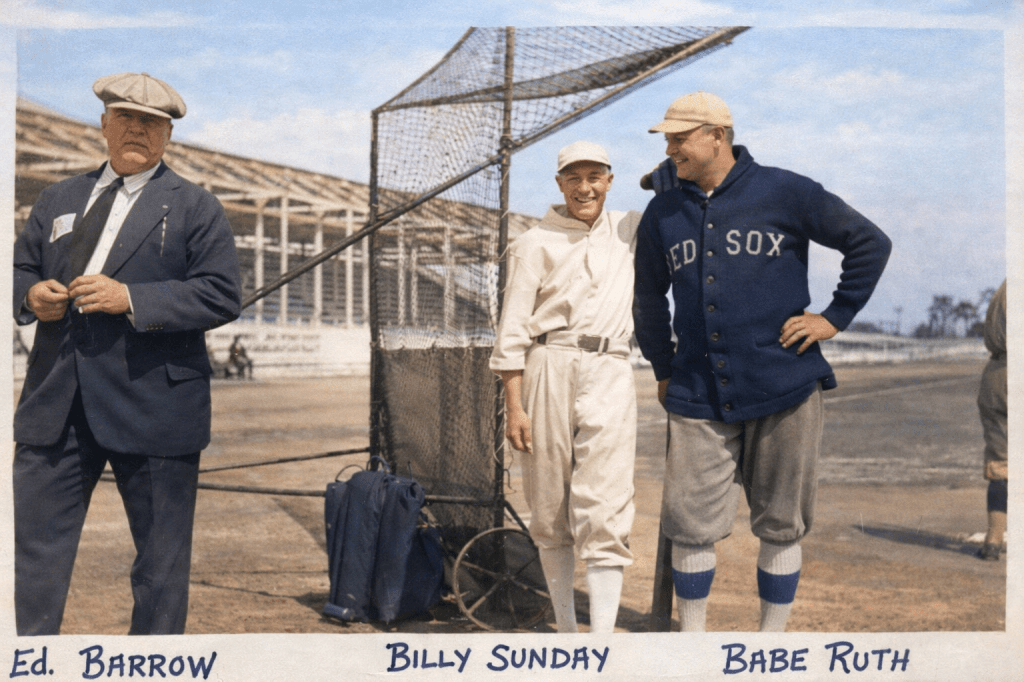
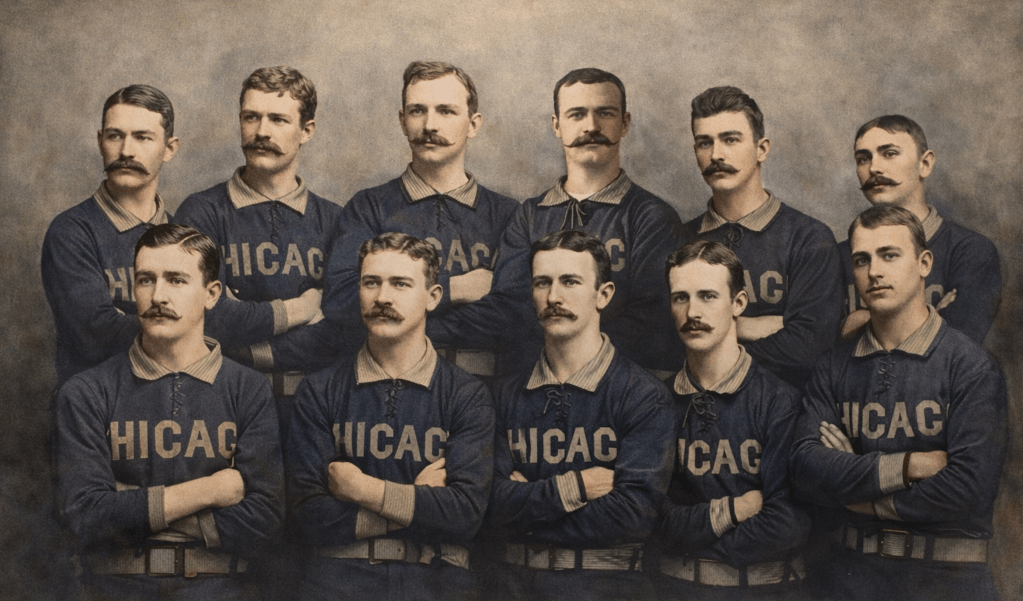
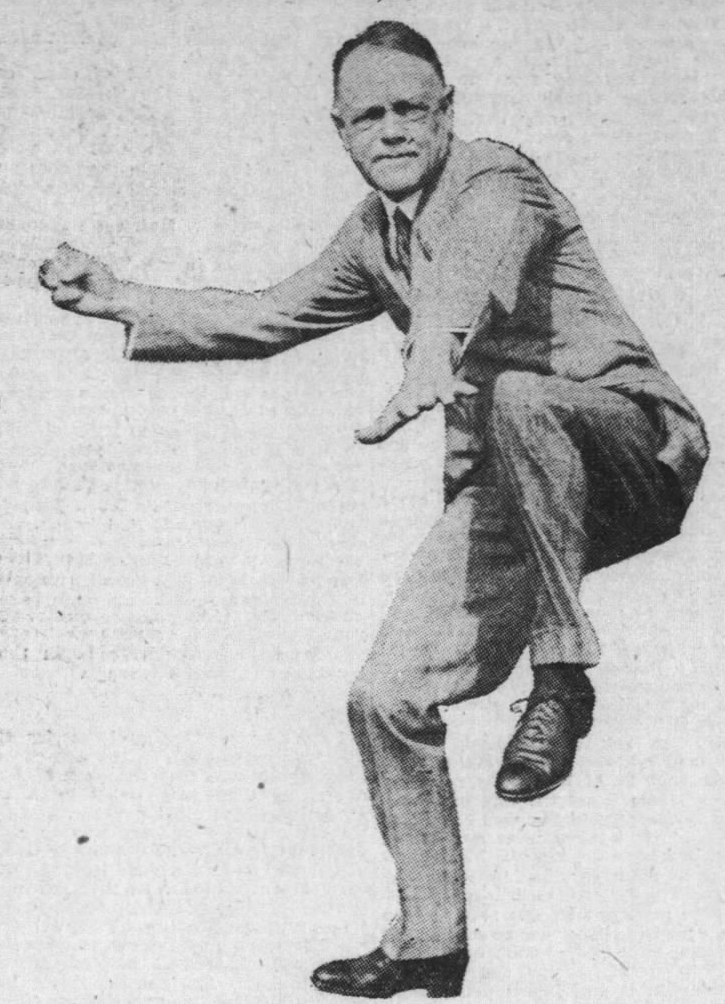
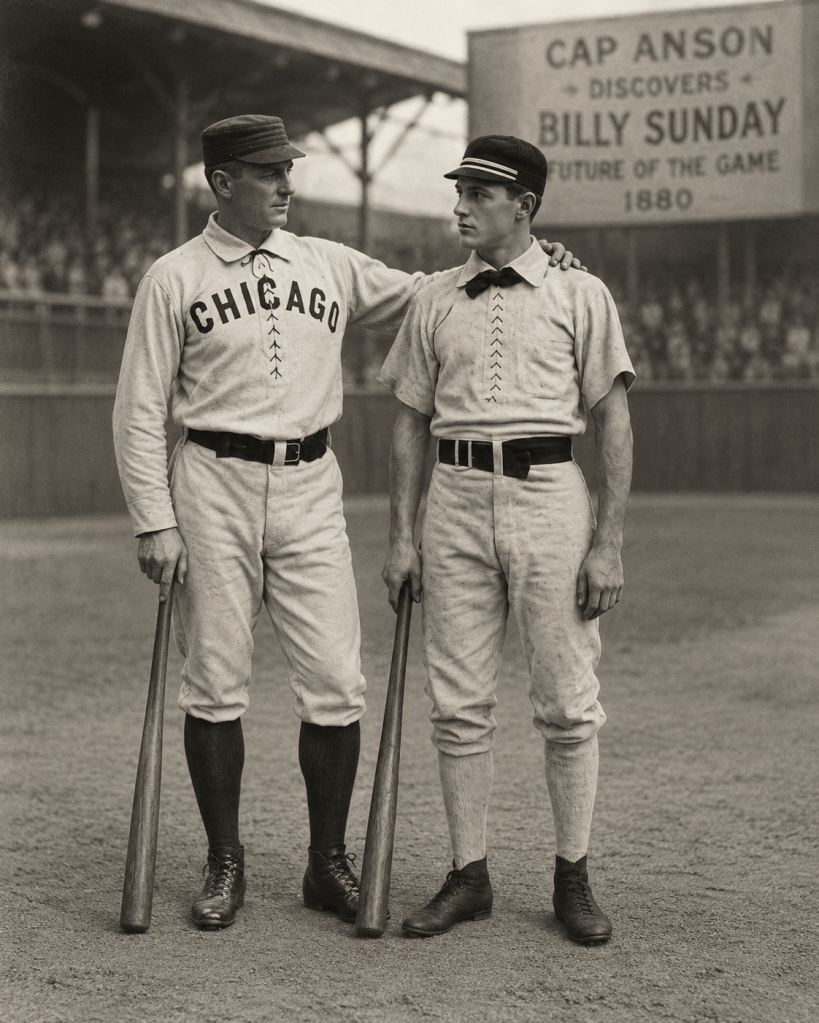
AI-generated from period images of Anson and Sunday.

While Sunday was working in Marshalltown, the famous Captain Anson of the Chicago White Stockings spotted the makings of a great ballplayer in him. Anson brought him to Chicago in 1883, and for the next five years Sunday played right field for one of the dominant teams of the era — fast enough that Denison calls him the quickest base-runner the National League ever knew.

He was, in short, a professional athlete in his prime in a major American city. Which makes what happened next all the more surprising.

The curb on Van Buren Street

The conversion story is the hinge of Sunday’s entire life, and Denison opens the whole article with it.

One afternoon — nineteen years before the article was written — Sunday sat with three fellow ballplayers on a curb on Van Buren Street in Chicago, directly across from the Pacific Garden Mission. The men were Mike Kelly, Johnny Ward, and Buck Ewing, all famous names of early baseball. The mission’s windows were open, and the sound of the organ and the hymns rolled out into the street.

When the singing stopped, Sunday told the others he guessed he didn’t want another drink. He waved them a laughing good-bye, crossed the street, and walked into the mission. Ever since, Denison writes, he had been trying to live as he believed Christ would have him live.

There was no thunderclap in the telling — just a man getting up off a curb and walking toward something. The drama would come later.

What the ballplayers thought

Sunday’s own account of the aftermath is one of the most human passages in the article, and it turns on fear. The shakiest moment, he admitted, came the day the Chicago papers broke the news of his joining the church, as he walked down to the ballgrounds dreading what his teammates would say.

He needn’t have worried. Anson shook his hand and said, “Good for you, Billy.” Mike Kelly told him to stick to it. Fred Pfeffer and John Clarkson were just as warm. And George Gore — the one Sunday feared most — grabbed him with both hands and told him it was the best thing he had ever done. Finding that men he respected respected him the more for becoming a Christian, Sunday said, braced him up more than he could express.

(One more test of that new faith was still ahead of him — a footrace, a heavy bet, and a memorable bit of advice from Cap Anson. That’s a story worth its own post, and it’s coming next.)

The cost of the calling

What Denison documents next is the part that answered, years in advance, the critics who would later call Sunday a money-grubber.

After Chicago, Sunday played three more seasons with the Pittsburgh and Philadelphia clubs of the National League, preaching from a pulpit on Sunday nights in whatever town he found himself, firing a locomotive between seasons to stay in condition, and taking courses at Northwestern University. Then, in 1891 — in answer, he believed, to prayer about his future — he secured his release from the Philadelphia team.

Cincinnati immediately offered him $500 a month to keep playing. He turned it down. Instead he became director of the Chicago YMCA at $83 a month — and during the hard times of 1893, his salary went unpaid for seven months running. He was so poor he walked downtown in the morning and home again at night because he could not afford the car fare.

Sunday recalled all this to Denison with a touch of grim humor that says everything about how the later “grafter” accusations stung him: nobody, he noted, was calling him a grafter in those days.

From the YMCA to the pulpit

The final step came four years before the article appeared, when the Presbytery of Chicago received Sunday into the ministry. He had served for a time under the Rev. Dr. J. Wilbur Chapman, one of the leaders of the wave of evangelization then sweeping the Mississippi valley — the mentor under whom the ballplayer-turned-secretary finished becoming a preacher.

From an orphanage in Iowa to right field in Chicago to a tabernacle pulpit in a hundred small towns: it is an improbable arc, and Denison tells it as one. The boy who got up off a curb because he didn’t want another drink had, within two decades, become the man the whole Middle West was talking about.


Next in the series: “Fix It Up With God Afterward” — the footrace, Cap Anson, and the bet that tested a new convert.

When did Billy Sunday play professional baseball?

Billy Sunday played professional baseball from 1883 to 1890.

Here is the basic timeline of his baseball career:

1883–1887 — Chicago White Stockings (National League)

  • Discovered by manager Cap Anson while playing for a local amateur team in Marshalltown, Iowa.
  • Joined the Chicago White Stockings (now the Chicago Cubs) in 1883.
  • Known more for speed and defense in the outfield than for hitting.
  • Played on the 1885 and 1886 National League championship teams.

1888–1890 — Pittsburgh Alleghenys (National League)

  • Traded to Pittsburgh in 1888.
  • Continued as an outfielder and base runner.

1890 — Philadelphia Phillies (Players’ League)

  • Jumped to the short-lived Players’ League in 1890 with the Philadelphia Phillies.
  • This was his final season in professional baseball.

Career Snapshot

  • Years: 1883–1890
  • Teams:
    • Chicago White Stockings (1883–1887)
    • Pittsburgh Alleghenys (1888–1890)
    • Philadelphia Phillies – Players’ League (1890)
  • Position: Outfielder
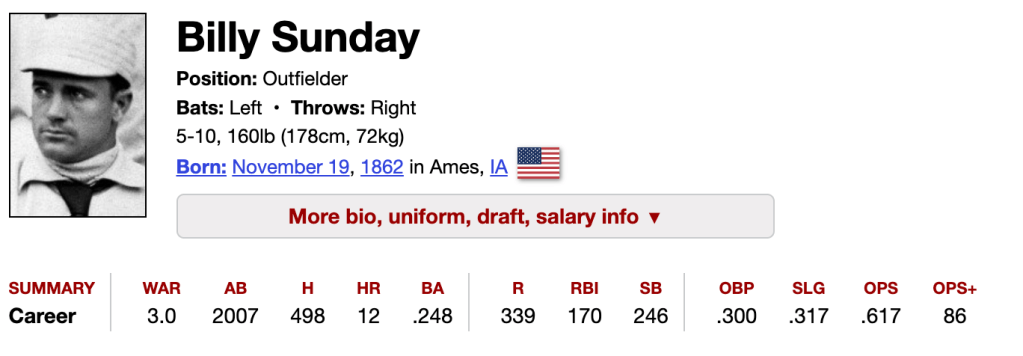
  • Batting Average: .248
  • Games Played: 499
  • Stolen Bases: 95

After Baseball

After leaving baseball in 1890, Sunday worked briefly with the Chicago YMCA, where his speaking ability began to emerge. Within a few years he joined the evangelistic team of J. Wilbur Chapman, launching the ministry that eventually made him the most famous evangelist in America before Billy Graham.

After Baseball

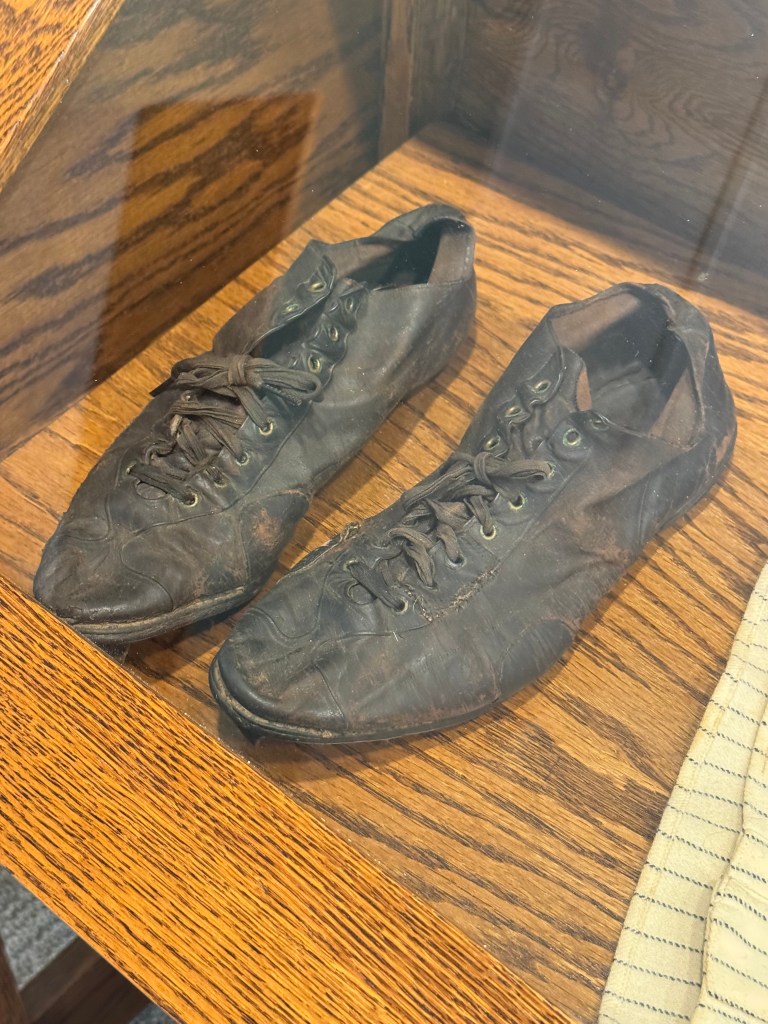
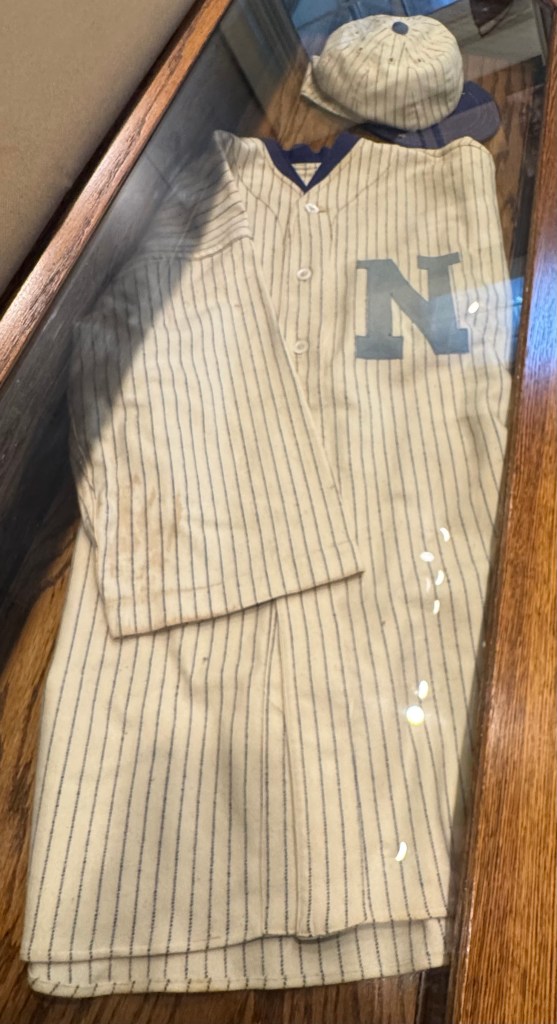
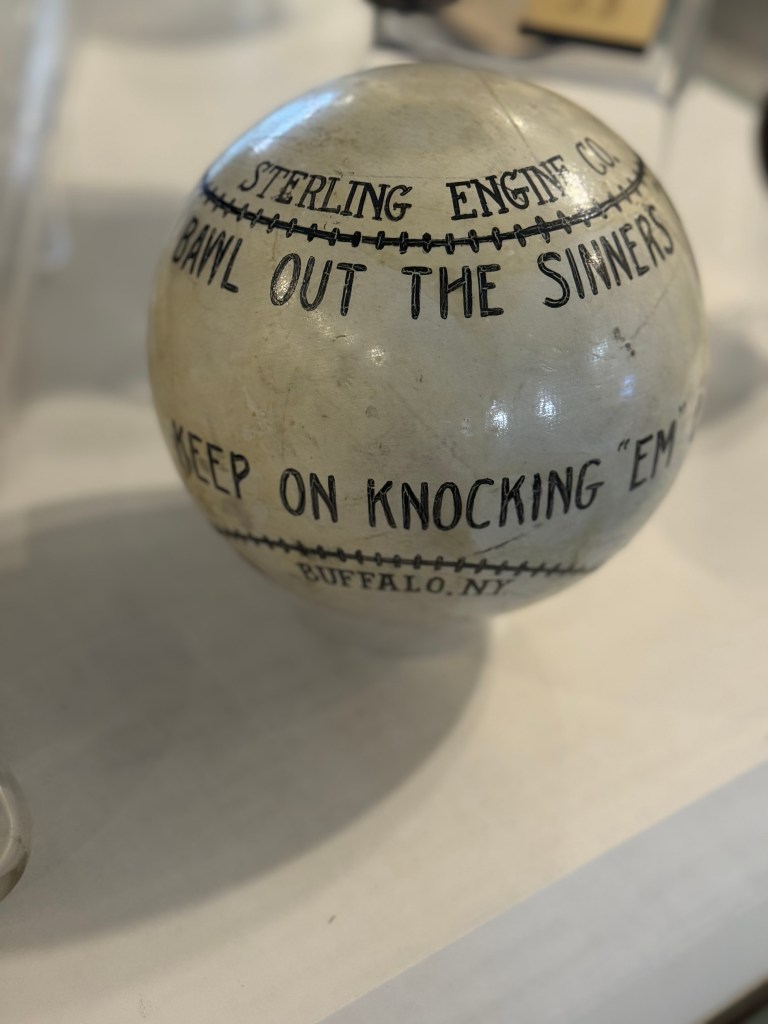
Here is a photo gallery of baseball related images associated with Billy Sunday.

“Striking Out” Satan (February 18, 1889) Chicago Tribune.

“STRIKING OUT” SATAN.

BILLY SUNDAY, THE NOTED BALL TOSSER, TURNS EVANGELIST.

The Famous Centre-Fielder Addresses a Large Crowd at Farwell Hall – He Didn’t Even Allow the “Father of Sin” to Reach First Base – Advising His Hearers to Watch Their “Error Columns” – Forty-eight Converts Made.

Centre Fielder Billy Sunday made a three-base hit at Farwell Hall last night. There is no other way of expressing the success that accompanied his first appearance in Chicago as an evangelist.

Young men who dodged the boys distributing pamphlets at the door of the hall were confronted with these words blazing in scarlet letters on the big bulletin board:

“William A. Sunday, the base-ball player.”

And about 500 of them who didn’t know much about Billy’s talents as an evangelist, but could remember him galloping to second base with his cap in his hand, went inside. They heard a rattling fifteen minutes’ talk.

Mr. Sunday, who has grown a red mustache since his marriage, appeared in a becoming black suit and looked a little shy. It was his first public appearance here as an evangelist. In private he had often tried to do quiet work among the ball players, but, after dulling his weapons on the adamantine surface of “Silver” Flint’s moral character, he gave up the task, and for several winters has been preparing for a public trial of his skill in saving souls.

His talk last night was the most successful of the year. He aimed straight at the young men in front of him, giving them the truth in plain, earnest language, and when he finished forty-eight youths raised their hands to show that they had been converted. Sunday looked as pleased as a man who has stolen third.

AT THE BAT.

His talk was from the text: “Is the Young Man Safe?”

“Is he safe?” said Mr. Sunday. “Do you think he is safe, boys – do you think he is safe? I answer no. This is a big city. It is full of temptations. No young man is safe in it without Christ. With Him there is security. Without Him – O! think of the pitfalls and iniquity that drag young men down to sin and death.”

The little ball player walked across the stage with the springing gait of an athlete, and turned suddenly on his audience: “There are a great many questions of vast importance to us as individuals and as a Nation—questions that call for men of keen intellect and for thought—such questions as the tariff and labor. Vast and important as these are, they sink to oblivion when compared to the question of your soul’s future home. Ah! my boy, that is the big question. Christ calls across a chasm of 1,800 years: ‘Son, give me thine heart.’ Today the seat of war is confined to no one nation or battlefield. It rages all over this earth, on the Hudson, on the Mississippi, on the Nile, on the Danube. It is the battle against sin. Ever since Cain slew Abel in the Garden of Eden that battle has been raging, and it will rage so long as the earth stands. What side are you on?

“Think of the thousands that fall in the battle of life, no hope, no home, no heaven. Look at it right, boys. Satan doesn’t want to get a young man who after a while may dispute with him the realm of everlasting meanness. You bet he doesn’t. It is the generous young man, the warm-hearted young man, the ardent young man, the sociable young man who is in danger, my friends. He’s the fellow that Satan behind the bat wants to catch napping. He’s the chap that the Devil in the box wants to pull on with a snake curve. Hold your base. Wait for your ball.”

“WATCH THE ERROR COLUMN.”

Sunday was in earnest. He grew eloquent. “Say to yourself, O my friends, God helping me, I will take my Bible, light for all darkness, balm for all wounds, grand, glorious, the best book you ever owned. If you haven’t got a Bible now, my lads, get one. It will show you the paths of safety and warn you of the danger of the paths of sin: ‘Whoso putteth his trust in the Lord shall be safe.’

“Is there a voice within you saying: ‘What did you do that for? Why did you go there? What did you mean by that?’ Is there a memory in your soul that makes you tremble—is there such a memory, fellows? God only knows all our hearts. He is familiar with the catalogues of our sins. How many hits have you made and where do you stand in the error column?”

Mr. Sunday then led the audience in singing the hymn:

Safe in the arms of Jesus,

Safe from corroding care,

Safe from the world’s temptation,

Sin cannot harm me there.

Forty-eight persons acknowledged the effect of Mr. Sunday’s manly and earnest talk—the best showing made at a Farwell Hall Sunday night service in a year. After the regular meeting an experience meeting was held in the rear of the hall, where Mr. Sunday led in prayer and shook hands with the converts.

“I wish Anson were here,” he said. “What an evangelist the old man would make. No, I’m glad I didn’t take the long trip. I can do more good here bringing souls to Christ. I will play in Pittsburg next summer.”

“Say, how he did line old Satan’s delivery out of the lot,” said a young man at the door. “He hit the ball on the nose every time.”

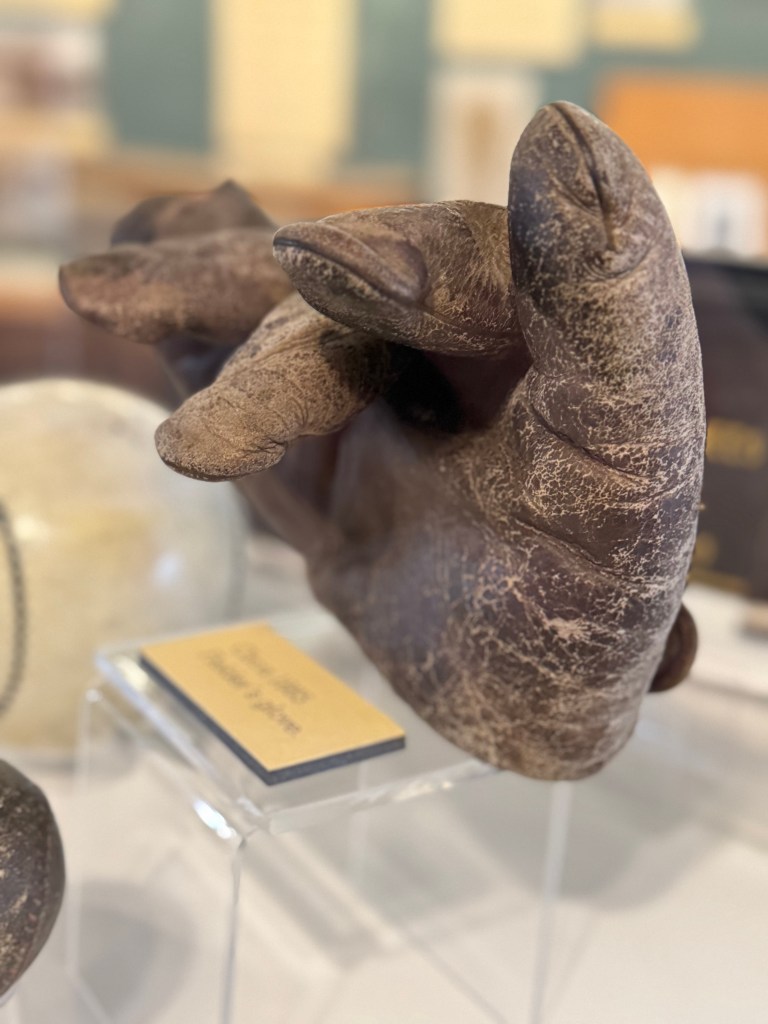
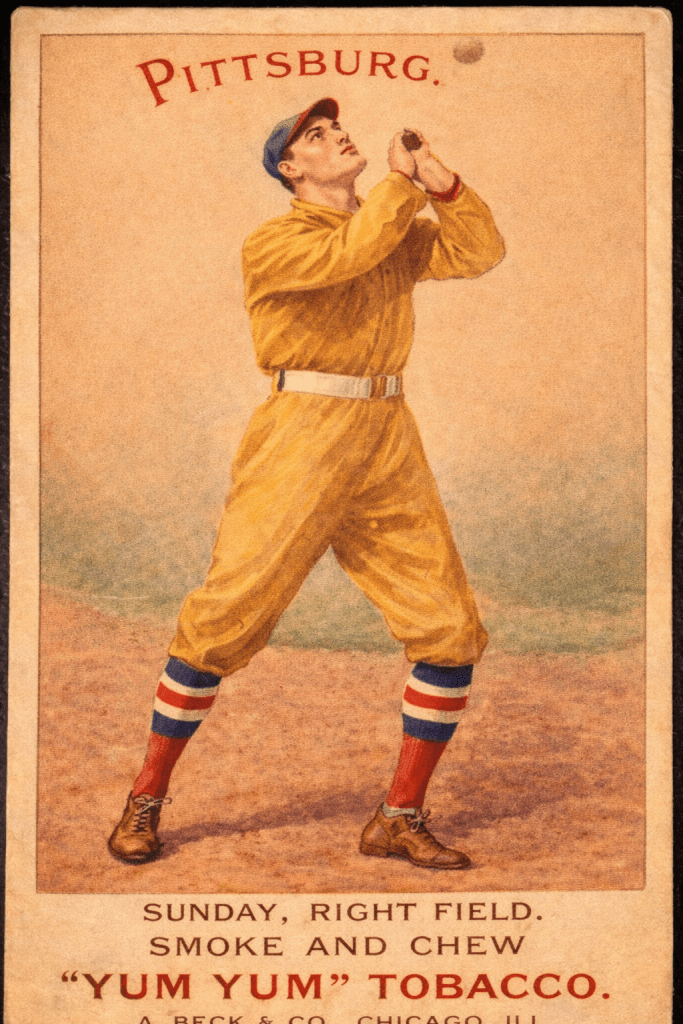
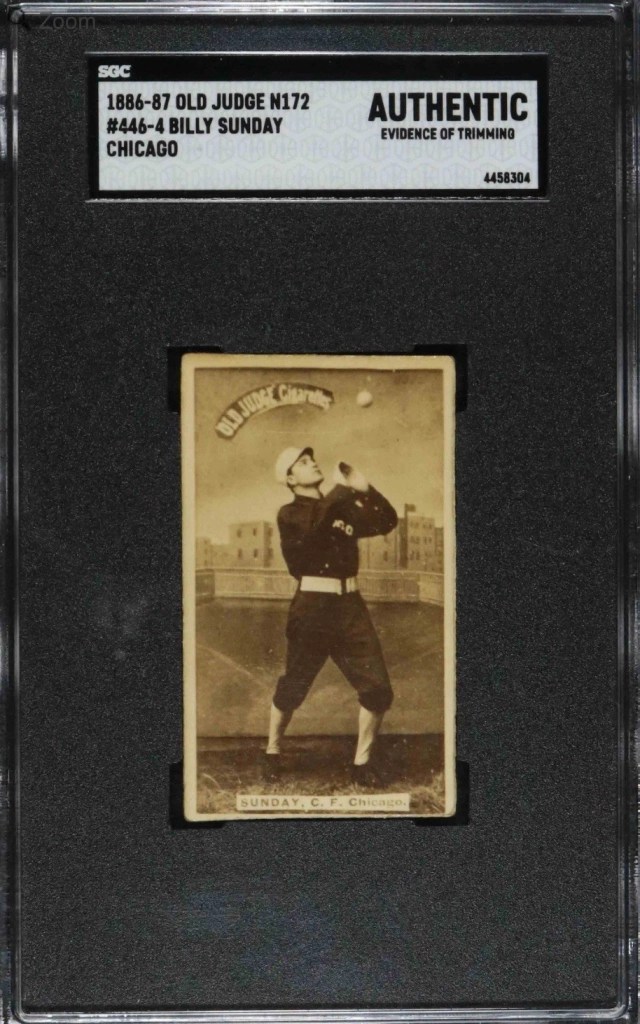
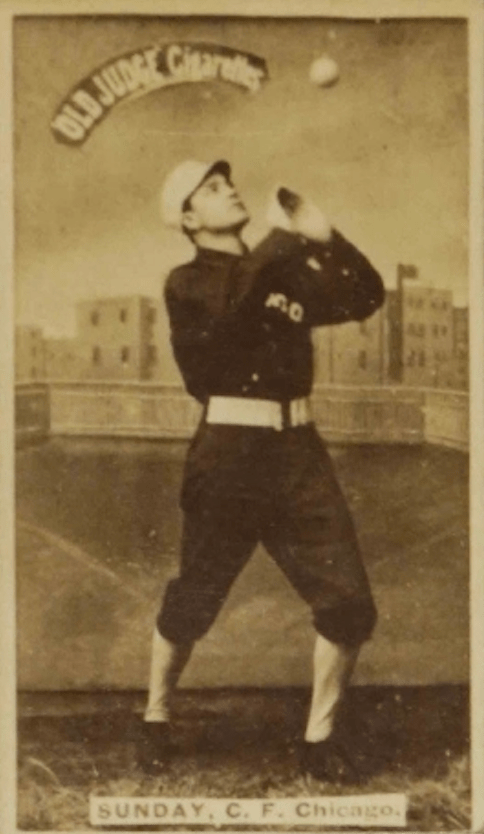
Late 1880’s baseball glove?

Many fielders in professional baseball in the mid to late 1880’s did not wear a glove. It was even seen ‘unmanly’ by some. The Billy Sunday museum home in Winona Lake has a glove on display that may have been his personal glove when he played. It looks much like the glove below. His baseball card below shows a glove similar to what is pictured here as well.