Former professional baseball player-turned urban evangelist. Follow this daily blog that chronicles the life and ministry of revivalist preacher William Ashley "Billy" Sunday (1862-1935)
Why America’s Greatest Revivalist Preached to the Crowds
I actually think this has the potential to become one of the stronger essays on EvangelistBillySunday.com. The key is notto argue that Billy Sunday was consciously following Samuel Lane Loomis. We simply don’t know that. Instead, we can argue something stronger historically:
Billy Sunday’s ministry became one of evangelical Protestantism’s most visible responses to the urban crisis that Loomis had identified a generation earlier.
That is a defensible historical argument.
Background is AI-generated.
Billy Sunday and the Modern City
Why America’s Greatest Revivalist Preached to the Crowds
“The city had become America’s greatest mission field—and Billy Sunday intended to meet it there.”
When Billy Sunday launched his ministry in the late 1890s, America was changing faster than most people could comprehend.
Small farming communities were giving way to booming cities. Factories drew workers from the countryside. Immigrants poured into urban neighborhoods. Streetcars stretched cities outward, skyscrapers climbed upward, and millions of people suddenly found themselves surrounded by strangers rather than neighbors.
To many Americans, these changes represented remarkable progress.
To many Protestant leaders, however, they also represented an unprecedented spiritual challenge.
Few understood that challenge more clearly than Samuel Lane Loomis.
A Warning Before Billy Sunday Arrived
In 1887, nearly a decade before Billy Sunday conducted his first independent revival campaigns, Presbyterian minister Samuel Lane Loomis published Modern Cities and Their Religious Problems.
His concern was straightforward.
America’s cities were growing faster than the Church was adapting.
The methods that had served rural America for generations were proving inadequate for crowded neighborhoods where churches competed with saloons, theaters, political machines, and the relentless pace of modern life.
Loomis believed the city itself had become the nation’s greatest missionary field.
The Church, he argued, must stop waiting for people to come through its doors and instead find new ways to reach the people where they lived.
Although there is no evidence Billy Sunday ever read Loomis’s book, history suggests that his ministry became one of the clearest answers to the challenge Loomis described.
Billy Sunday Understood the City
Billy Sunday’s revival campaigns were never random.
As his ministry expanded during the first two decades of the twentieth century, he increasingly focused on America’s growing cities.
Chicago.
Pittsburgh.
Philadelphia.
Scranton.
Columbus.
Syracuse.
New York.
These were not simply convenient locations.
They were places where America’s future was being written.
They were centers of industry, immigration, commerce, politics—and moral struggle.
Sunday instinctively recognized that if the gospel could influence the city, it could influence the nation.
Taking the Church to the People
Loomis criticized churches that expected the city to come to them.
Billy Sunday reversed the equation.
Rather than relying on existing church buildings, he erected enormous temporary wooden tabernacles capable of seating thousands.
These structures became impossible to ignore.
They stood in the heart of the city, inviting businessmen, factory workers, immigrants, politicians, homemakers, laborers, and curious skeptics to hear the gospel.
In effect, Billy Sunday took the Church into the public square.
A United Church for a Divided City
Another concern Loomis raised was the fragmentation of Protestant churches.
Individual congregations often labored independently while cities expanded around them.
Billy Sunday’s solution was cooperation.
Months before each campaign, committees representing dozens—and often hundreds—of churches organized every aspect of the coming revival.
Pastors who ordinarily worked independently prayed together.
Business leaders served together.
Volunteers visited homes together.
Choirs brought together singers from many denominations.
Sunday did not erase denominational differences.
He simply reminded Christians that the city was larger than any one congregation.
Speaking to Urban Problems
Critics sometimes portray Billy Sunday as a preacher obsessed with alcohol.
History tells a richer story.
Sunday addressed nearly every moral challenge associated with modern urban life.
He preached against drunkenness because he believed it devastated families.
He condemned political corruption because he believed dishonesty weakened public trust.
He confronted gambling because he saw it exploiting the vulnerable.
He denounced sexual immorality because he believed it fractured marriages and homes.
His sermons were not disconnected moral lectures.
They were directed toward the realities Americans encountered every day in rapidly growing cities.
Organized for a Modern World
One of the greatest misconceptions about Billy Sunday is that he relied solely on emotion.
In reality, his campaigns were remarkably organized.
Advance teams arrived months before meetings began.
To Understand Billy Sunday, You Must First Understand the American City
“Billy Sunday didn’t simply preach against sin. He preached into a nation struggling to hold itself together.”
Background of image AI-generated
One of the greatest mistakes we can make in studying Billy Sunday is viewing him in isolation.
Too often, we imagine Sunday as a colorful evangelist—a former professional baseball player who sprinted across the platform, smashed chairs for emphasis, and denounced liquor with unmatched enthusiasm. Those things are certainly true. But if that is all we see, we miss the larger story.
Billy Sunday was not merely a personality. He was a product of his time, and perhaps more importantly, he became one of the defining voices responding to one of the greatest social transformations in American history.
To understand Billy Sunday, we must first understand the America in which he preached.
A Nation Turned Upside Down
Between 1820 and 1920, the United States experienced astonishing change.
Millions left rural communities for rapidly growing cities. Waves of immigrants arrived from around the world. Railroads connected distant regions into a single national economy. Factories replaced farms. Skyscrapers reshaped city skylines. Electric lights, streetcars, telephones, and mass-produced goods transformed everyday life.
For many Americans, progress was exhilarating.
For others, it was deeply unsettling.
The close-knit communities that had once provided moral accountability were disappearing. In their place emerged crowded neighborhoods where neighbors were strangers, saloons flourished, political corruption thrived, prostitution was visible, crime increased, and families often struggled simply to survive.
Many Americans wondered whether the nation’s moral foundations were beginning to crumble.
Paul Boyer and the Search for Moral Order
Historian Paul Boyer explored this remarkable period in his influential book Urban Masses and Moral Order in America, 1820–1920.
Boyer argued that countless Protestant leaders were driven by a single concern: how could moral order be preserved in a rapidly urbanizing nation?
They did not simply preach sermons.
They built institutions.
Sunday schools multiplied. Rescue missions opened. YMCA chapters expanded. Bible societies distributed millions of Scriptures. Temperance organizations grew. City missions sought to reach neighborhoods that traditional churches struggled to influence.
These efforts represented far more than isolated ministries.
Together they formed a broad movement attempting to answer one pressing question:
How do you preserve Christian character in a society that is changing faster than anyone imagined possible?
Billy Sunday Arrives
Into this world stepped Billy Sunday.
He did not invent concerns about drunkenness, gambling, prostitution, broken homes, or political corruption. Those issues had occupied Protestant leaders for decades.
What Sunday did possess was an extraordinary ability to communicate those concerns with unusual passion, clarity, humor, and urgency.
He could hold thousands spellbound.
He spoke the language of ordinary people.
He transformed moral conviction into unforgettable images and memorable phrases.
Most importantly, he persuaded millions that the battle for America’s future was not merely political or economic.
It was spiritual.
More Than an Evangelist
Modern readers sometimes reduce Billy Sunday to a caricature—a loud prohibitionist or an emotional revival preacher.
That misses the larger historical reality.
Sunday saw himself as calling individuals to faith in Jesus Christ. Yet he also believed transformed individuals could renew homes, churches, communities, businesses, and ultimately the nation itself.
His revivals therefore addressed both the soul and society.
When Sunday preached against alcohol, he was not merely attacking a beverage.
He believed alcohol destroyed families.
When he denounced dishonesty in business, he was defending integrity.
When he challenged men to become faithful husbands and fathers, he was calling them back to responsibilities he believed were essential to a healthy civilization.
Whether one agrees with every conclusion he reached, it is impossible to understand his ministry apart from these broader concerns.
The Organization Behind the Evangelist
There is another important lesson Boyer helps us see.
Billy Sunday’s ministry was astonishingly well organized.
Long before modern event management became commonplace, Sunday’s campaigns mobilized entire cities.
Committees recruited volunteers.
Thousands joined mass choirs.
Newspapers covered meetings daily.
Business leaders participated.
Churches cooperated across denominational lines.
Follow-up systems helped connect new converts with local congregations.
None of this happened accidentally.
Sunday inherited nearly a century of organizational innovation developed by evangelical Protestants seeking to reach growing American cities.
His campaigns represented the maturity of that movement.
Reading Billy Sunday with Fresh Eyes
When we understand the world Billy Sunday inherited, we begin asking better questions.
Instead of asking only, “Why did Billy Sunday preach so forcefully?”
We ask:
Why were millions eager to hear him?
Why did civic leaders invite him?
Why did newspapers devote front-page coverage to his meetings?
Why did entire cities build temporary wooden tabernacles capable of seating thousands?
The answers lie not simply in Billy Sunday himself but in the anxieties and aspirations of the nation he served.
America was searching for moral stability amid extraordinary change.
Billy Sunday became one of the most recognizable voices offering an answer.
Looking Beyond the Caricature
History deserves better than caricature.
Billy Sunday was neither merely a religious celebrity nor simply a crusader against alcohol.
He stood at the intersection of faith, culture, urbanization, and one of the most significant periods of transformation in American history.
Understanding that larger story does not require us to agree with every sermon he preached.
It does require us to appreciate why so many Americans believed his message mattered.
If we wish to understand Billy Sunday fairly, we must first understand the world that shaped both his audience and his ministry.
Only then can we appreciate why, for millions of Americans, Billy Sunday was far more than an evangelist.
He became a voice calling a rapidly changing nation back to what many believed were its moral and spiritual foundations.
The Opportunity of the Century: D.L. Moody and the 1893 World’s Fair
How an evangelist who thought his life was ending built the largest gospel campaign of his generation in the shadow of the Chicago World’s Fair.
Evangelist Dwight Lyman Moody of Chicago.
In the summer of 1893, the eyes of the world were on Chicago. The World’s Columbian Exposition — built to mark four centuries since Columbus first reached the Americas — had transformed a stretch of lakefront into a gleaming “White City” of domes, lagoons, and electric light. From May 1 to October 31, millions streamed through its gates.
To many Chicago Christians, the Fair looked like something to fight. It stayed open on Sundays. Worse, its Parliament of Religions gathered the faiths of the world onto one stage, giving Buddhism, Hinduism, and Islam a hearing on American soil. A boycott seemed the godly response.
Dwight L. Moody saw it the other way around. If the world was coming to Chicago, then the world was coming to his door — and he meant to be ready. He called it the opportunity of the century, and he would spend the next six months proving he meant it.
A Vow on a Sinking Ship
Moody almost wasn’t there for any of it.
Earlier that same year, while in London, a doctor had warned him that his heart was failing and that he needed to ease off his relentless schedule. Moody had resolved to do exactly that. Then came the voyage home aboard the steamship Spree — and the announcement, mid-ocean, that the ship was going down.
What followed, by his own account, changed everything:
“No one on earth knows what I passed through at the thought that probably my work was finished, and that I would never again have the privilege of preaching the Gospel of Jesus Christ… I made a vow that if God would let me live and bring me back to America, I would go back to Chicago, and at this World’s Fair, preach the Gospel with all the power He would give me.”
He survived. And he did not treat the second chance lightly. Back home in Northfield, he called the students of Mount Hermon and Northfield together at six o’clock one morning and asked them — if they had any regard for him at all — to pray that God would anoint him for the work ahead. He wanted to preach, he told them, as he had never preached before.
Albumen Photograph 1895 – SS Spree W. Sander & Sohn Photographen Geestemunde
Building the Machine
What Moody launched was not a revival meeting. It was a campaign, run with the logistics of an army on the move.
At its peak, somewhere between 200 and 300 workers were in active service, organized under experienced lieutenants Moody had personally summoned. Beneath them labored more than 200 students from the Bible Institute. Sites had to be booked, speakers selected, advertising placed, money raised. Moody deployed secretaries and leaned on the religious press to spread the word. Daily expenses swung wildly — anywhere from $800 to $20,000 a day to cover personnel and volunteers alike.
At the center sat the Bible Institute at 80 Institute Place, near La Salle and Chicago Avenues, where lectures ran every morning in a hall that seated 350 and was, by all accounts, always full. In July alone, nearly forty preachers, evangelists, and singers were cooperating in the work, their efforts multiplied by 250 students fanning out across the city in an endless round of house-to-house visiting.
By one estimate, the campaign held roughly 120 gospel meetings every week — fifteen on weekdays and as many as thirty on Sundays — bringing 30,000 to 40,000 people under the sound of the Gospel on a single Sunday.
The Chicago Bible Institute building, c. early 1900’s
Opening Day
The campaign began on the morning of Sunday, May 7, 1893. Moody preached that day at the Chicago Avenue Church — the congregation now known as Moody Church — in both the morning and the evening. His subject was the elder brother in the parable of the Prodigal Son: a pointed choice, given how many Chicago believers still saw the whole enterprise as something to resist rather than rejoice over. For Moody, the opposition was almost a cause for celebration.
Through the long months that followed, the church held praise services every night, alongside a series of free conferences — a steady heartbeat under the sprawling work happening everywhere else.
Theaters, Halls, and a Door That Stayed Shut
Moody wanted Chicago’s grandest venue, the Auditorium Theatre at Michigan Avenue and Congress Street. He offered $18,500 — roughly half a million dollars in today’s money — for the use of its hall each day. He was refused.
So he improvised. Where churches sat too far from the crowds, he simply rented theaters instead — an innovation that scandalized some and worked beautifully. Before the campaign ended, his operation had occupied a staggering range of spaces: the Haymarket, Empire, Standard, Columbia, Hooley’s, Windsor, Tattersall’s, and Vaudeville theaters; the Central Music Hall and the Grand Opera House; hotel tabernacles, exposition buildings, Turner Hall, Forepaugh’s circus tent, YMCA buildings, the Pacific Garden Mission, and dozens upon dozens of churches across the city and its suburbs — Presbyterian, Congregational, Baptist, Methodist, Lutheran, and more, in English and a half-dozen other languages.
It was at the Standard Theater that a young C.I. Scofield — later famous for his reference Bible — took his turn in the pulpit.
Central Music Hall. Chicago. Stereoview.
Light in a Dark Place
For years, one corner of the city had weighed on Moody’s heart: the district around West Madison and Halsted Streets, clustered around the Haymarket, Standard, and Empire theaters. It was a neighborhood of saloons, brothels, gambling dens, and “all kinds of vile resorts” — and it was here he aimed much of his early energy.
He rented a four-story building and turned the ground floor into a mission hall, quartering thirty of his students in the rooms above. The location did the recruiting itself: planted on a busy thoroughfare, it could hardly help catching the throngs passing by.
The daily rhythm was unrelenting. At 2 p.m. the hall opened for singing and conversation while workers visited the neighborhood house to house. From seven to eight came a gospel meeting, preceded by half an hour of singing and followed by an hour of personal conversation with anyone troubled by what they’d heard. At ten, a fresh relay of workers held a second meeting, then spent the hour to midnight talking with the anxious and the unsaved. The whole machine was built around a single insight: reach the people whose only other evening destination was the saloon.
Something Better Than Buffalo Bill
The most astonishing scene of the entire campaign may have unfolded under a circus tent.
Moody secured Forepaugh’s enormous circus tent near the lakefront — a venue that could swallow a crowd of 15,000 — and on one Sunday morning some 18,000 people packed in. “We got something better than Buffalo Bill,” went the line, a wink at the Wild West show drawing crowds elsewhere in the city.
One witness left a vivid account: clowns, grooms, circus riders, gamblers and drinkers, pickpockets, and ordinary men, women, and children all swept into one vast assembly. The sea of faces struck him as both glad and solemn. Moody preached that morning from Luke 19:10 — “the Son of Man is come to seek and to save that which was lost.” In a fitting touch, he is said to have reunited a lost child with her father during one of the services.
Forepaugh’s circus tent
The Flying Artillery
If the theaters and tents were the campaign’s infantry, the gospel wagon was its cavalry.
Under evangelist J.C. Davis and gospel singer H.H. Higgins — joined at times by William Robertson of Edinburgh and a crew of trained Institute workers — a gospel carriage rolled through Chicago morning, afternoon, and evening. The vehicle itself drew a crowd: a handsome carriage, well-dressed speakers, a tiny seventeen-pound organ, a lantern hung out at dusk, and a fold-down platform off the back. But what held people, one reporter noted, was the plain, vigorous, practical preaching. No one spoke long; there was plenty of good singing; and the same crowd that gathered at the start was often still there ninety minutes later.
One afternoon Moody climbed aboard himself to test, as it were, that arm of the service. The wagon was driven from district to district, stopping wherever a crowd could be gathered. The singers would ring out a hymn, Moody would lay out the way of salvation in a five-minute address, give a warm invitation to the evening service at the Standard Theater, and move on — ten different meetings in the space of a few hours. He called it the flying march.
A Note on the Gospel Wagon
The idea was older than 1893. Mentions surface as early as the 1870s, and by 1886 the concept had spread to several cities. In Washington, D.C., the Central Union Mission ran a “gospel wagon” every Sunday — on weekdays just an ordinary bus, transformed for the Sabbath by a small cabinet organ and a band of singers who went out to “hunt for sinners” along the wharves and near the ballgrounds. That same year in Brooklyn, the evangelist Ferdinand Schiverea, barred from street preaching, sidestepped the police by acquiring a peddler’s license and a wagon painted over with Scripture, intending to “sell” Bibles for a nominal sum and preach to whoever gathered. Moody didn’t invent the gospel wagon — but few used it on the scale he did.
Gospel wagon. The Brethren Archive.
Meetings for Everyone
The campaign refused to settle into one mold. There were meetings for men and meetings for women, for children and for soldiers. There were temperance meetings and jail meetings, open-air gatherings and cottage gatherings. And because the Fair had drawn the whole world to Chicago, there were meetings in the languages of that world — for Poles, Jews, Arabs, the French, and others.
Downtown, at the Central Music Hall on the corner of State and Randolph, Moody’s team rented the auditorium for two hours each day, holding a service from eleven to one. There Dr. J. Wilbur Chapman led a forward movement uniting the Third Presbyterian Church with half a dozen others. As the Fair built toward its climax in the final weeks, hundreds of thousands more would pass through.
A Campaign of Prayer
For all its theaters and wagons and ledgers, those closest to the work insisted it was something else at its core. As one chronicler put it, it was a campaign of prayer as much as a campaign of preaching and song.
The money tells part of why. As expenses mushroomed, Moody reckoned he could spend $8,000 a day — some $200,000 today — just to run the Mission Hall. At one point the campaign found itself $7,000 in arrears, and the team gave itself to prayer. Then word came that the Northfield Conference had sent $6,000 in support. Moody was touched to the heart. “Let’s wake up this whole city,” he had said, and he poured renewed energy into concerts of prayer to do it.
Every night, the human side of that campaign came home to roost. Moody made a habit of gathering his tired co-workers in his room at the Bible Institute — for refreshments, for reports of the day, and to talk through the work. One by one they came in from churches and theaters and halls and tents, some near midnight, and the commander-in-chief had a word for each. Nothing brightened his face like a report of a soul saved. On Sunday nights, after the crowded labors of the day, they bowed together in thanksgiving before going to rest.
The Reckoning
When the Fair finally closed its gates on October 31, the numbers were almost hard to believe. By the campaign’s own accounting, roughly 1.9 million people had attended its evangelistic events. Week after week, an estimated 100,000 souls were “brought within reach of the gospel.”
At the closing meeting, Moody gave the credit where he had always insisted it belonged — not to the organization, not to the theaters or the tents or the wagons, but to God.
The doctor in London had told him to slow down. Instead, with what he believed were borrowed days, Moody built the largest gospel campaign of his life in the middle of the largest gathering Chicago had ever seen — and answered the question he’d carried up from the deck of a sinking ship.
In the summer of 1907, Billy Sunday’s son was born on the opening day of a revival. A few weeks later, in the middle of the same revival, his brother died. Sunday did not go to the funeral.
Gibson City, Illinois was a small Ford County town of about twenty-five hundred people. In the summer of 1907 the local committee invited Billy Sunday to hold a revival, and the campaign opened on Thursday, June 13. The town had built a temporary tabernacle. The choir had been organized. The cottage prayer meetings had been running for weeks. By the time Sunday left Gibson City a month later in mid-July, more than eleven hundred people would have come forward as converts and Sunday’s purse would come in at thirty-six hundred dollars — entirely standard numbers for a Sunday revival by 1907.
What was not standard was what happened to the Sunday family during those four weeks.
A son and a brother
On the opening day of the Gibson City campaign — June 13, 1907 — Helen Sunday gave birth to a son. They named him Paul. Helen and the baby were in Chicago. Billy was in central Illinois, standing on the platform of a tabernacle a hundred and fifty miles south of his wife and his newborn, preaching his opening sermon to a Gibson City audience that had been waiting for him for weeks.
A few weeks later, sometime in early July, a telegram reached him in Gibson City. His brother had died in Iowa. The funeral was being arranged.
There is no surviving record of which brother it was, or what he died of, or how old he was. The Sunday family records of this period are not detailed enough to recover those facts. What the contemporary newspaper record does confirm is that Sunday received the news in the middle of the Gibson City campaign, and that he made the decision not to leave for the funeral.
He stayed. He preached.
What he gave up
The Gibson City campaign also cost Sunday something else that summer. He had declined several Chautauqua bookings to do the revival. In 1907 the Chautauqua circuit was where Sunday was earning the bulk of his summer income — he would deliver eighty-six lectures that season for about forty-three thousand dollars in total, the equivalent of more than a million and a half dollars today. By choosing a four-week revival in a town of twenty-five hundred people in the middle of his peak earning season, he was knowingly giving up a substantial piece of his year.
Gibson City, ILL. Presbyterian Church. C. 1910
The Gibson City committee had asked for him. He had said yes. By the time the campaign opened on June 13 he had committed to staying. His son’s birth on that opening day did not change the commitment. His brother’s death a few weeks later did not change it either. The Iowa Lyceum Bureau had sued him for breach of contract back in late June for missing a single Chautauqua date he had walked away from in order to extend a different revival. Sunday’s defense in that lawsuit had been straightforward: his evangelistic work, he said, ought to have preference over Chautauqua dates.
Gibson City was the same principle applied. Sunday had given a town his word. He kept it. The town got him for four weeks. His family did not.
What he preached
Two sermons from the Gibson City campaign were transcribed in regional newspapers in August and so survive into the record. One was based on a verse from the Gospel of John, chapter seven, verse seventeen — “If any man will do his will, he shall know of the doctrine, whether it be of God, or whether I speak of myself.” It was a sermon about willingness, about the believer’s choice to step forward. The other, transcribed a week later, was a sermon titled simply “Hell.”
Neither sermon mentioned the brother. Neither sermon mentioned the baby. Neither sermon mentioned the funeral Sunday had not attended. Whatever the inner cost of those four weeks was, Sunday did not preach it from the Gibson City platform. He preached, as he always did, on the standard themes — the willingness of the human heart, the reality of God’s judgment, the inescapability of the choice he was demanding his audience to make.
The Gibson City crowd would not have known. The newspaper editors who later transcribed and reprinted his sermons would not have known. The Champion Daily News of July 15, when it reported the close of the campaign with its eleven hundred converts and Sunday’s purse and the standard summary statistics, did not mention the brother or the baby. The only people who knew, that summer, were Sunday and Helen and a few members of the team.
The cost of saying yes
A few weeks after Gibson City closed, Sunday traveled to Joliet, Illinois to open the brand-new Chautauqua assembly at Dellwood Park. The auditorium was a new four-thousand-seat steel structure — the most expensive Chautauqua building in the country. Sunday spoke on the opening night, August 30, on a sermon titled “Grounders Hot Off the Bat.” A reporter for the Joliet Daily News watched him closely and wrote a piece the next day called “Billy Sunday As He Is, Spoke.” The piece is preserved in full and is hard to read in light of what had just happened to him a few weeks earlier:
He still looks more like a baseball player than a preacher, talks more in the manner of a heavy hitter than a gentleman of the cloth, and, judging from his frenzied utterances, thinks more like one as well. He works as hard on the stage as he ever did on the diamond, and his voice is worn nearly to shreds by long-continued gospel shouting.
The voice worn nearly to shreds. The hay fever that had been getting worse all summer. The dropped handkerchief in front of four thousand people. And then, at the end of his Joliet appearance, the announcement that Sunday made to the press: he was going to cut back on Chautauqua speaking after the season. The constant travel was eating into the rest he needed for his evangelistic work.
It is, in retrospect, the closest thing in the record to Billy Sunday saying out loud what Gibson City had cost him. The constant travel. The schedule. The yes-after-yes-after-yes to revival committees and Chautauqua bureaus and ministerial associations. The decision, made each time, to honor the commitment over the family. He did not, in fact, cut back in 1908. The summer Chautauqua schedule for the next year was already being booked. The big-city revivals were already being negotiated. The arc of his life had committed itself.
What we do not know
The historical record does not tell us what Helen said to Billy when she got to him after the Gibson City campaign closed. It does not tell us whether Billy made it to Iowa to see his brother’s grave that fall, or whether he ever did. It does not tell us how Paul’s first weeks of life unfolded in Chicago while his father was preaching a hundred and fifty miles away. It does not tell us what Sunday thought about, alone in his hotel rooms during the campaign, after the choir went home and Fred Fischer locked up the tabernacle and the Gibson City town fell quiet for the night.
What the record does tell us is that Sunday’s three other children — George, William Jr., and Helen, all of whom had been born in earlier years — would later grow up with a father who was almost never home. Paul, born on the opening day of the Gibson City revival, would grow up the same way. He would die young, in his twenties, in 1930 — twenty-three years after the campaign that opened on the day he was born.
All four Sunday children would, in different ways, struggle with the absence of their father during their childhoods. Three would predecease their parents. Helen and Billy outlived almost everyone they raised.
The Gibson City decision is in the record as just one moment among hundreds. The brother’s name does not survive. The funeral details are gone. The eleven hundred and fifty conversions and the thirty-six hundred dollar purse and the cottage prayer meetings are all preserved in the local Champion Daily News and the regional papers. The four weeks of Sunday preaching to the Gibson City audience while his newborn was in Chicago and his brother was being buried in Iowa are not preserved anywhere except in the gap between the dates.
He had said yes to the Gibson City committee. He kept his word. The committee got what they had been promised. He preached the campaign. He filled the tabernacle. He saw the conversions to the end. He drew his purse. He moved on to the next town.
It was a cost he chose to pay. It is also one of the quietest pieces of the Billy Sunday story, and one of the hardest to look at squarely. He paid it more than once.
Sources: Bloomington Weekly Pantagraph, June 14, 1907; The Davenport Daily Times, July 4 and July 17, 1907; The Joliet Herald News, July 9, 1907; Gibson City Courier, July 12, 1907; The Champion Daily News, July 15, 1907; The Joliet Daily News, August 31, 1907.
MLA: McNutt, Kraig. “The Gibson City Decision, c. 1907.” Evangelist Billy Sunday (1862–1935), 23 June 2026, evangelistbillysunday.com/2026/06/23/the-gibson-city-decision-c-1907/.
The summer a New York reporter boarded a train for southeast Iowa to find out what Billy Sunday actually did — and came back having seen something he had never seen at a Yale-Harvard boat race.
Sometime in April of 1907, a man named Lindsay Denison stepped off a train at the depot in Fairfield, Iowa. He had come from New York. He was a writer for The American Magazine, a glossy monthly with several hundred thousand readers — one of the major national magazines of the period. He had been sent to a southeast Iowa town of about five thousand people to write about a former major-league baseball player turned evangelist named William A. Sunday. The piece he eventually filed, titled “The Rev. Billy Sunday and His War on the Devil,” ran in the September 1907 issue as the magazine’s lead article. It is the longest and most carefully observed contemporary account of Billy Sunday’s revival method that survives from his pre-1910 ministry.
It is also one of the strangest things to read in 2026. Denison had walked into Fairfield as a sophisticated New York journalist expecting to write a polite ethnographic piece about Midwestern revivalism. He walked out having seen Sunday smash a chair on a platform to demonstrate a drunkard murdering his child, watched 1,118 people in a town of five thousand walk down an aisle to confess Christ, heard Sunday pray for newspaper editors who had called him a grafter — asking the Lord to “take along a bottle of disinfectant” and “wear rubber gloves” — and seen a closing-night service that he could only compare to the celebration after a Yale-Harvard boat race.
I have seen many a university foot-ball victory celebration; I have seen several riots of joy after a Yale-Harvard boat race; I was in the headquarters of District Attorney Jerome of New York when the word came, on election night, that he had beaten independently the candidates of all the regular parties. But I have never seen any crowd more beside itself than was the congregation of the tabernacle when that meeting was over.
It is one of the most extraordinary single sentences ever written about an American religious event. A national-magazine reporter putting a small-town Iowa revival closing service alongside the most famous celebrations of the early twentieth century — Yale-Harvard, an election-night district-attorney upset, the rolling crowds of Ivy League football season — and ranking it first.
A town and a reporter
Fairfield was not an obvious revival town. Denison described it carefully — and with the slight condescension that New York writers in 1907 reserved for Midwestern county seats — as “a little more conventional and a little less given to emotion in its enthusiasms than most towns of the great middle west.” It was prosperous, well-painted, and full of New England transplants who said “shawn’t” and “cawn’t” to one another at the curb. It was a prohibition town. It had Judson College. It had what Denison called “a sense of righteousness rather exceeding that of most New England villages.” Sunday himself had approached it with misgivings. He told the local committee that Fairfield was “likely to be a tough proposition” because it was already a town of church members.
Denison was no friend of revivalism going in. The Brooklyn-born reporter had been writing for The American Magazine since its 1906 founding and was part of the broader muckraker movement that included Ida Tarbell, Lincoln Steffens, and Ray Stannard Baker. The magazine was edited by men with very little patience for old-time religion. Denison arrived expecting to write a piece that would tell his New York readers what was actually happening in the small towns of the Mississippi Valley. He had no particular reason, before he arrived, to be impressed.
What he found in the tabernacle
The first sermon Denison heard, Sunday ripped off his coat, his waistcoat, his tie, and his collar. By the time it was over, the drops of sweat were flying from his brow and ears. The pulpit was being beaten on. The Devil was being execrated. Six weeks later, when the campaign closed, Denison had filled a notebook with what may be the most carefully transcribed Sunday sermon excerpts that survive from this period.
He watched Sunday do the long sermon on temptation, with Sunday playing the role of the Devil himself in the wilderness — “Are you the man that’s been going up and down the country passing as the Son of God?” — while pointing across the audience at a man who had spent sixty dollars on tobacco in two years while telling his wife he could not afford a new dress for her. He watched Sunday point at a different man and accuse him of buying alcohol “back of the drug store prescription counter” under the pretext of “buying medicine for the baby.” He watched a row of teenage boys slide down on their benches in modest panic when Sunday turned and called them out about “that girl over at Ottumwa.” He watched the seven Fairfield ministers — Methodists and Baptists and Presbyterians and the rest — first wince at the methods, then huddle to discuss whether to allow the revival to continue, and then, by the end, leap to their feet at Sunday’s call for the audience to “give Christ the Chautauqua salute.”
Most strikingly, Denison watched Sunday physically act out a Pentecost-era sermon about a Chicago workingman named George who came home drunk on a Saturday night, beat his wife unconscious on the bedroom floor while the little curly-haired baby cried “Papa, don’t hurt Mamma!” — and then, in Denison’s transcription, Sunday seized a chair from the platform, swung it over his head, smashed it down onto the floor to demonstrate the killing blow, and let the legs splinter as he gasped through the rest of the story. The same Sunday who would, on the closing day, be cheered for half an hour by three thousand people standing on their tables.
Rev. Pearse Pinch breaks first
The first Fairfield minister to fully convert to Sunday’s methods, as Denison documented him, was the Rev. Pearse Pinch of the local Congregationalist Church. At the close of one of the meetings he gave Denison a quote that is perhaps the cleanest single articulation in the entire archive of how a traditional Midwestern Protestant minister came to terms with Billy Sunday:
Why, my dear sir, the man has trampled all over me and my theology. He has kicked my teachings up and down that platform like a football. He has outraged every ideal I have had regarding my sacred profession. But what does that count, as against the results he has accomplished? My congregation will be increased by hundreds. I didn’t do it. Sunday did it. It is for me to humble myself and thank God for his help. He is doing God’s work. That I do know!
Pinch’s words capture the central tension of Sunday’s career better than perhaps any other contemporary statement. The man’s methods were impossible. His theology was, by most professional standards, embarrassing. He talked to people about God the way other people talked across a counter or a dinner table. And yet the results talked. The congregations grew. The deathbed conversions held. The drunkards stopped drinking. The new church members joined and stayed. By 1906 the published stickiness studies were showing 75 to 80 percent of converts still in the faith years later. Pearse Pinch could either keep his theology and watch his church empty, or trample on his theology and watch his church fill. He chose the second.
The Brighton editors prayer
The most quotable single passage Denison preserved from the Fairfield campaign was Sunday’s prayer about the editors of a small patent-inside newspaper in nearby Brighton, who had called him a “grafter” in print. The prayer is worth reading in full:
Oh, dear Lord Jesus, save Fairfield! Bless Mount Pleasant, Stockport and Birmingham and Batavia and—er—bless— [the evangelist opened his eyes, turned around and in an ordinary conversational tone questioned his secretary]: What was that town we went to the other day, over there on the railroad, Honeywell? Oh, yes, Eldon. [Again closing his eyes and presuming the higher pitched tone of addressing the Almighty]—Bless Eldon, dear Lord, and Packwood and Richland and Pleasant Plain. And O dear Lord, if you think its any use, you might tackle those Brighton editors. But, dear Lord, be careful—take along a bottle of disinfectant. I don’t know as you can do much with them, Jesus, but if you think its worth while, try it, Lord, try it! And if you try it, here’s a pointer, Lord, wear rubber gloves.
Denison watched the audience react to the prayer. “From the bowed heads there rolled up a queer smothered clucking sound, followed by a cheerful roar of amens mingled with fervent assurances: ‘Yes, Lord, that’s right.'” Mingling with the crowd after the benediction, he heard not one congregant complain about the wording. Several came up to him and congratulated each other “that those ‘limbs of Satan had been set out like they deserved.'”
It is the kind of prayer that should not work and yet, when you read it carefully in Denison’s transcription, exposes exactly how Sunday actually worked. The pause to consult his secretary on the name of a small town. The shift from conversational tone back into formal prayer cadence. The wry humor in the middle. The genuine pastoral concern for actual towns Sunday had visited and would visit again. And the closing flourish — the rubber gloves — that turned the whole prayer from polite Christian charity into the kind of communal score-settling that the Fairfield audience went home talking about. Sunday’s prayers, like his sermons, were never quite what the traditional pastors expected them to be. They worked anyway. They worked because they worked.
The closing service
The Fairfield campaign closed on a Sunday in May with three services: a morning meeting open to all, an afternoon meeting for men only (Sunday’s “Booze” sermon, drawing the entire local company of state militia in full uniform along with the workmen of the Iowa Malleable Iron Works), and a final night meeting. Denison sat through all three. The afternoon meeting produced eighty conversions, and Sunday’s preaching had been so effective that the next morning the two express companies in Fairfield had to report that three barrels of beer consigned to local citizens had been repudiated on delivery. The agents had written in the official remarks column of the delivery records: “Cause.—Influence of sermons of Rev. W. Sunday.”
The night meeting was something different. By six o’clock — a half hour before the doors opened — long streams of disappointed people were already trudging back to town in the rain because they could not get inside. The tabernacle was packed by people who had skipped supper. By the time Sunday closed the night with his sermon on “To-morrow” — the same sermon that, two years later, he would use to invent his signature closing call at Spokane — the audience was in a state that Denison described as “tense fervor” that made “the very air tingle.”
The conversions came from every direction. “Girls and old women; gray-bearded veterans and school boys in their first trousers; rich men and poor.” Denison watched Fred Seibert, the former cowpuncher who handled the Sunday operation’s logistics, drag a shy weak-faced boy down the aisle by his collar. He watched a shabbily dressed red-haired girl with her hat knocked askew run to the third bench and throw her arms around the boy’s neck, weeping. He watched Frederic Fischer, Sunday’s music director, organize the postservice singing into a kind of structured euphoria — first hymns, then whistled choruses, then the same melodies hummed.
When the final count came in — 1,118 souls won for Christ in the Fairfield campaign — Denison wrote down the comparison that has made his article unforgettable: he had never seen any American crowd more beside itself, not at Yale-Harvard, not at an election-night party headquarters, not at a college football victory.
“Bless our friend Denison”
The last public mention Sunday made of Lindsay Denison from the Fairfield pulpit came in the closing prayer at the final night meeting. Sunday had a habit of working through the towns and people he wanted to bless by name. The closing Fairfield prayer ran past the city marshals, the county officers, the doctors and lawyers, the grocers and dry goods merchants, the bankers, the livery men, the barbers, the blacksmiths, the newspaper men, the hotels, the schoolteachers, the restaurant keepers — and then:
Bless our friend Denison, who has come all the way from New York for THE AMERICAN MAGAZINE.
It is one of the more touching small moments in the entire Sunday archive. The evangelist taking a moment in the closing prayer of a six-week revival to ask God’s blessing on the New York reporter who had just spent a month sitting at the press table, watching Sunday do everything Sunday did, and writing it down for several hundred thousand American Magazine readers. Denison had come prepared to be a skeptic. Sunday treated him as a brother. And Denison, when he sat down to write his eight-thousand-word piece six weeks later, gave Sunday what may still be the fairest, most observant, and most affectionate full-length portrait of his preaching method that exists from his entire career.
What it meant
The Denison piece changed what Billy Sunday was. Until September of 1907, Sunday was a regional phenomenon — known across the upper Midwest, written up in the small county-seat papers and the regional dailies, occasionally noted in Chicago or St. Louis. After the American Magazine piece, he was a national figure. The magazine’s circulation reached hundreds of thousands of subscribers in every part of the country. Sunday’s name, his methods, his theology, his sermon excerpts, his prayer about the Brighton editors, his physical chair-smashing, his closing-night Yale-Harvard-grade audience euphoria — all of it now circulated in places that Sunday himself had never visited and would not visit for years.
The piece did not invent Billy Sunday. It documented him at exactly the moment when his career was about to scale beyond the small-town circuit and into the cities. The 1908 Sharon revival in Pennsylvania, the 1909 Spokane breakthrough, the great urban tabernacle campaigns of the 1910s — all of them were already coming, with or without the American Magazine. But the Denison piece is the closest thing we have to a definitive contemporary portrait of Sunday at the exact moment when his small-town method had been fully refined and was about to be deployed against the major American cities.
Lindsay Denison watched the whole thing for six weeks and went back to New York to write it up. He saw what he saw and he reported what he reported. The piece he filed is, more than a century later, one of the half-dozen most useful primary sources we have for understanding what Billy Sunday actually did in front of an audience. The chair-smashing. The rubber gloves prayer. The three barrels of beer returned to sender. The Yale-Harvard comparison. The Rev. Pearse Pinch acknowledging that his theology had been kicked around like a football and that he was going to thank God for it anyway.
Bless our friend Denison.
Source: Lindsay Denison, “The Rev. Billy Sunday and His War on the Devil,” The American Magazine, Vol. LXIV, No. 5, September 1907, illustrated with photographs by Masters of Princeton, Ill. and others. All direct quotations are from Denison’s article.
MLA: McNutt, Kraig. “Lindsay Denison Goes to Fairfield, c. 1907.” Evangelist Billy Sunday (1862–1935), 21 June 2026, evangelistbillysunday.com/2026/06/21/lindsay-denison-goes-to-fairfield-c-1907/.
A horsewhipping at the pulpit, a governor’s conversion, a record offering at Patterson Springs, and a chance meeting on a Kansas Chautauqua platform that would change the rest of his life.
On Christmas Day of 1908, Billy Sunday and his family stepped off a train at Spokane, Washington. They had been expected five days earlier. The Spokane campaign committee had built an eight-thousand-seat wooden tabernacle for the occasion at a cost of more than four thousand dollars, and the city had been waiting since December 20.
Sunday was about to preach the first revival of his career in an American city of more than one hundred thousand people. Up to that point, every revival he had ever conducted had been in a town of under fifty thousand — usually under twenty thousand, and often under five thousand. Spokane was a real city: railroad terminus, regional commercial center, a population of well over a hundred thousand spread across several rapidly growing residential districts. The question that the Spokane campaign was going to answer was whether the revival method Sunday had built in Iowa river towns and Illinois county seats would actually scale.
By the time he left Spokane in mid-February of 1909, he had his answer. Over five thousand six hundred people had come forward as converts. His purse came in at ten thousand dollars. The local saloons were reporting almost no business. Newspapers across the country were running headlines like “Beer Sales Fall. Bibles in Demand.” Roger Bruns, who would later write the standard scholarly biography of Sunday, summarized the moment this way: Spokane was where “the focus was now on where Billy could reach the masses.”
The Sunday method scaled. The big city wanted what the small town had been getting. 1909 became, almost overnight, the year that turned a Midwestern revivalist into an American institution.
A first city, a first “Tomorrow”
The Spokane campaign produced a number of firsts. The first big-city tabernacle. The first major lobbying operation built around a Sunday revival — one hundred and ten “representative men” sent on a special train to Olympia to lobby the Washington state legislature for a county-unit option bill while Sunday gave his “Booze” sermon back home, twice. The first organized homeless-relief effort attached to a Sunday campaign, during a cold wave that hit Spokane mid-campaign. Sunday personally helped feed and shelter hundreds of homeless men through the local churches.
Spokjane, Washing Sunday campaign
And, on the final day of the campaign, the first use of “Tomorrow” as a closing sermon. The sermon that would, more than any other Sunday delivered in his entire career, become his signature emotional closing. The text was simple: do not put off until tomorrow what you must decide today. The delivery, by every contemporary description, was relentless. The Spokane Spokesman-Review of February 11 carried the headline that captured what had just happened in their city: “Beer Sales Fall. Bibles in Demand.”
The detailed church-by-church convert tally from Spokane is the kind of thing that makes the modern researcher pause. Emmanuel Baptist took in 45 new members. First Methodist Episcopal, 360. First Methodist, 270. Westminster Congregational, 30. Central Christian, about 60. First Baptist, over 80. Plymouth Congregational, about 50. All Saints Episcopal, 12. Holy Trinity Episcopal and Our Lady of Lourdes, none. The Sunday method had divided Spokane’s churches into those that could metabolize the revival’s converts and those that could not.
Springfield: a governor and an assault
The Spokane campaign closed February 10. Sunday opened his next revival in Springfield, Illinois on February 26 — sixteen days later. The Springfield campaign would run six weeks, draw over six hundred thousand cumulative attendees, and produce forty-seven hundred conversions, including a remarkable seven hundred and seventy-four conversions on the final day. Sunday’s purse came in at ten thousand seven hundred and thirty-four dollars. The total offering for the campaign reached over twenty thousand.
Two moments from Springfield stand out among everything that happened in 1909. The first occurred during the very opening of the campaign. Eight thousand people were in the tabernacle for the first night. As Sunday stood at the pulpit beginning his opening sermon, a man named Sherman Potts — a religious fanatic from near Lexington, Illinois, who had previously been committed to the Jacksonville insane asylum — walked up the center aisle, climbed onto the platform, and began horsewhipping Billy Sunday.
Sunday did what a man who had spent his twenties as a major-league outfielder might be expected to do. He leaped from the platform, knocked Potts to the ground, and held him there. The choir, on the platform behind, kept singing. The tabernacle did not empty. The Britt News of Iowa carried the story on March 4. The Spokane Chronicle, when it picked the piece up months later, ran a lengthy article on Potts himself. The assault did not interrupt the revival. The papers, in fact, treated it as a story about Sunday’s coolness under attack.
The second moment occurred on the final day, April 11. Governor Charles Deneen of Illinois and his family were among the seven hundred and seventy-four conversions that day. Governor Deneen joined First Methodist Episcopal Church in Springfield. A sitting state governor being converted at a Billy Sunday revival was a story that traveled — and a quiet political proof of how thoroughly Sunday had now entered the country’s mainstream civic life.
Sunday himself was unsatisfied with the Springfield numbers. His private take, later reported in the press, was that “personal work was not begun early enough.” Forty-seven hundred conversions, six hundred thousand cumulative attendance, twenty thousand dollars in offerings, the governor of Illinois joining the church on the final day — and Sunday thought he had not done enough. He was, by this point, his own hardest critic.
Marshalltown comes home
After Springfield, Sunday returned to Marshalltown, Iowa — a town of just over thirteen thousand people where he had briefly lived in the early 1890s. It was, in every sense, a homecoming campaign. The five-thousand-seat wooden tabernacle stood at the corner of Third and Main. The campaign ran six weeks, from late April through June 6. Over a hundred and ninety-eight thousand people attended. Two thousand and twenty-six conversions. Five hundred and twenty-eight cottage prayer meetings — small house gatherings, scattered through the town’s neighborhoods, that did much of the slow personal-work that the public revival services could not. Sunday’s purse: a little over six thousand dollars.
The campaign closed, as the Marshalltown Times-Republican put it, in a “blaze of glory” — thirteen thousand two hundred people present on the final day. Sunday had come back to the town where he had once been a young husband trying to make ends meet, and now drew an attendance figure equal to the entire population of the town.
The Marshalltown campaign also produced a recurring data anomaly that would surface in nearly every contemporary press report. The final conversion count appeared as 2,026 in one paper, 1,987 in a decorative stats card that circulated regionally, and 2,000 as a round-number summary in others. The Marshalltown press wars over which number was correct went on for weeks. The truth was probably in the neighborhood of two thousand. The truth was also that nobody really knew, because the Sunday operation by 1909 was generating numbers faster than even friendly reporters could verify them.
Winfield, Kansas: the man at the piano
The summer Chautauqua circuit took Sunday across Minnesota, Iowa, Kansas, Nebraska, Missouri, and Illinois. He delivered his now-fully-rotated four sermons — “Booze,” “Forces That Win,” “Nuts for Skeptics to Crack,” and the various baseball variants — to crowds of two thousand to ten thousand at a stretch, two or three towns a week.
On July 15, 1909, Sunday spoke at the Winfield, Kansas Chautauqua. His sermon was “Forces That Win.” Season tickets to the Chautauqua cost two dollars. Sunday’s appearance fee came in at five hundred dollars.
Two hours after Sunday finished his afternoon sermon, a Pennsylvania-born musician took the platform. His name was Homer Rodeheaver. He was thirty-three years old, a trombonist and gospel singer, traveling the Chautauqua circuit as a paid performer with his own small musical troupe. He performed for the Winfield crowd at four o’clock that Wednesday afternoon. Sunday was almost certainly in the audience. Roger Bruns, who has reconstructed this moment carefully, treats it as the first documented encounter between the two men.
Within months, Sunday had hired Rodeheaver to lead revival singing and choirs effective the following year. The partnership that began at Winfield, Kansas in July 1909 would last more than two decades. Rodeheaver would become the most recognizable musical figure in American revival ministry — the man whose trombone, choir-leading style, and gospel-song repertoire would carry Sunday’s tabernacle services for the rest of Billy’s preaching life. Without Rodeheaver, there is no big-city Sunday revival of the 1910s. Without Rodeheaver, there is no “Brighten the Corner Where You Are” or “I Walked Today Where Jesus Walked” reaching the audiences they reached.
And it all started on a Wednesday afternoon in a Kansas Chautauqua tent.
Patterson Springs and a record check
Three weeks later, on August 10, 1909, Sunday spoke at the Patterson Springs Chautauqua in central Illinois. He had also spoken there two days earlier on August 8. On the second appearance, the ticket receipts from the Sunday afternoon lecture alone came in at three thousand six hundred dollars.
It was, as a regional newspaper would note a year later, the largest single Chautauqua-lecture take in American history. Williams Jennings Bryan’s previous record had been twenty-four hundred dollars at Carthage, Missouri the year before. Sunday had broken it by a thousand and two hundred dollars. The Patterson Springs receipts traveled. The Hastings (Nebraska) Daily Tribune would still be writing about the record a year later.
Whatever the cumulative arithmetic of Sunday’s Chautauqua career had been — and the 1907 totals of $43,500 across eighty-six lectures were already known — the Patterson Springs receipts crystallized a particular kind of public fact: Billy Sunday, on any given afternoon, was the most commercially valuable single speaker on the American lecture platform.
Boulder and the team budget
In early September, Sunday opened a five-week revival in Boulder, Colorado. Four-thousand-seat tabernacle. About fifteen hundred conversions. Sunday’s purse came in at thirty-five hundred dollars.
The Boulder revival is most useful, in retrospect, for what it reveals about the Sunday operation’s internal financial structure by 1909. A Spokane Chronicle item from September 3 published the team-pay schedule for the Boulder campaign in full. Fisher, the singer, was being paid thirty-five dollars a week. Ackley, the musical director, thirty dollars a week. Mrs. Miller, the pianist, one hundred dollars a month. Siebert, the tabernacle caretaker, three dollars a day. The Sunday operation now had ten people on the payroll. Mr. Gill was directing the tabernacle construction itself. The offerings on the last day of the campaign — by long-established Sunday practice — went to him personally.
Most evangelists working in 1909 were essentially solo operators, working with a song leader and maybe a piano player they paid from their own purse. The Sunday operation was, by Boulder, a small business. Ten salaried positions. A tabernacle-construction supervisor. A musical director. A separate musical director’s deputy. Mrs. Miller on piano. Siebert handling the daily logistics. By 1909 standards, this was a substantial organization, and it was beginning to look much more like the operations of the mature 1910s big-city revivals than like the small-town Iowa tent campaigns of a decade earlier.
Cedar Rapids, a Gazette appreciation, and Sunday’s stamina
The fall return brought Sunday to Cedar Rapids, Iowa for six weeks from October 10 through November 21. The campaign drew 320,000 cumulative attendees, 2,906 conversions, and a purse of $7,080. Ninety-eight general meetings plus eighty special meetings designed for particular groups. Sixteen hundred cottage prayer meetings — three times the number Marshalltown had produced earlier in the year.
The Cedar Rapids Gazette on November 20 ran an editorial titled “Billy Sunday and His Work — An Appreciation” that captured better than almost any other contemporary piece what newspapers had now come to feel about him:
There are many of us who are never going to fully reconcile ourselves to some of Mr. Sunday’s methods, to his dramatic stunts, to his use of slang… After all, why should we greatly concern ourselves about his methods? He gets results… Billy Sunday is a man among men — and men admire him. Thousands of men do not sit spellbound at the feet of a religious sissy.
The line “Thousands of men do not sit spellbound at the feet of a religious sissy” was the line that traveled. Sunday’s audiences across the entire decade had been disproportionately male, and his appeal to men — the baseball stories, the slang, the muscular delivery, the dropped jackets and rolled sleeves — was central to what made him work. The Cedar Rapids editorial put the case for Sunday in language that even his critics could mostly accept. He gets results.
Joplin closes the year
From late November through the first days of 1910, Sunday held a five-week revival at Joplin, Missouri. Six-thousand-seat wooden tabernacle. Two hundred and seventy-three thousand cumulative attendees. Almost three thousand conversions, with 278 in the final service alone. About six thousand people attended each evening meeting; another five hundred attended each afternoon. Thousands were turned away nightly from a tabernacle that was simply not large enough.
The arithmetic of Joplin, like the arithmetic of Marshalltown and Spokane and Springfield and Cedar Rapids and Patterson Springs, was the arithmetic of an American revival operation that had completely outgrown the small-town format it was built on. The tabernacle was full nightly. The town was overwhelmed. Sunday and his ten-person operation closed out 1909 the way they had opened it — with more people wanting in than the building could hold.
What changed in 1909
If 1907 was the year that broke Billy Sunday and 1908 was the year he went east, 1909 is the year he became the public figure he would be for the rest of his life. Five things consolidated.
The big-city tabernacle. Spokane proved the revival method scaled. The format that had made him in Iowa river towns worked just as well in a Pacific Northwest railroad metropolis. Within five years, Sunday would be filling the same kind of purpose-built wooden tabernacles in Pittsburgh, Philadelphia, and New York.
Homer Rodeheaver. The Winfield meeting was the most consequential personnel decision Sunday ever made. Rodeheaver’s trombone, baritone, and choir-leading style would carry the musical side of Sunday’s revivals for the next twenty years.
“Tomorrow” enters the repertoire. The Spokane closing sermon premiered the sermon that would become the most-preached closing call of Sunday’s career. The dramatic emotional close that defined every big-city revival of the 1910s started here.
The Sunday operation became a business. Ten salaried team members. Specialized roles. Detailed payroll. Tabernacle construction supervisors. By Boulder, the Sunday camp had the kind of organizational chart that would be perfectly recognizable to anyone managing a touring company today.
The political register completed. The Spokane local-option lobbying. The Springfield Governor-Deneen conversion. The Marshalltown cottage prayer meetings as community organizing. Sunday was, by 1909, simultaneously a religious figure, a temperance crusader, a civic mobilizer, and a public-policy advocate. The categories had merged.
When Sunday closed his Joplin campaign on January 2, 1910, the architecture of the rest of his career was now in place. The big-city tabernacles. Rodeheaver at the music stand. Helen running her own parallel ministry. The “Tomorrow” closing call. The ten-person organization. The political-religious fusion. The Patterson Springs commercial record. The press appreciation. The cottage prayer meetings. The hundreds of thousands in cumulative attendance.
The Billy Sunday of American memory — the one who would fill twenty-thousand-seat tabernacles in Pittsburgh, who would dine with Theodore Roosevelt, who would campaign for prohibition across the country — that Billy Sunday was now fully assembled. The 1910s would scale him. But everything he scaled was put in place in 1909.
He was forty-six years old. He had been an evangelist for thirteen years. He had four hundred sermons in his head and the country in front of him.
MLA: McNutt, Kraig. “The Year the City Took Billy Sunday: 1909.” Evangelist Billy Sunday (1862–1935), 19 June 2026, evangelistbillysunday.com/2026/06/19/the-year-the-city-took-billy-sunday-1909/.
Seventh in a series drawn from Lindsay Denison’s profile of Billy Sunday in The American Magazine, September 1907.
By the final Sunday of the Fairfield revival, Billy Sunday had already brought nearly nine hundred people to a public profession of faith — more than any of the town’s ministers had believed possible. It would have been a triumph to stop there. Sunday had no intention of stopping. Lindsay Denison describes him on that last day as gripped by a fierce, almost savage zeal to gather in everyone still outside the fold.
What followed was, in Denison’s words, an unforgettable experience — and it makes the emotional climax of this whole series.
Three services in one day
Sunday’s custom was to preach three times on his final Sunday. The first, at half past ten in the morning, was open to all. The third, at night, was for everybody. In between came an afternoon service for men only — while Mrs. Sunday or one of the other helpers held a parallel meeting for women in one of the churches.
The men’s meeting, Denison thought, was in one sense the most impressive of the three. Much of the Fairfield company of the state militia sat on the platform in full uniform, many of them already Sunday converts. A great block of seats held the workmen of the Iowa Malleable Iron Works. The Odd Fellows, the Red Men, and the Woodmen filled reserved sections. The big barn-like room was packed wall to wall, with hundreds of men standing in the aisles.
The subject was “Booze.”
The banker who went first
When Sunday finished — whispering directions all the while to Honeywell about clearing the front benches to receive converts — he threw out the challenge: who would be the first to stand up for God and lead the way?
The answer came in a figure no one could miss. One of the town’s leading bankers rose and strode down the aisle, head erect and eyes shining, and behind him came farmers, storekeepers, lawyers, physicians, farm boys, and laborers. Sunday leaned far out over the edge of the platform, swaying his arms rhythmically as if to sweep the entire congregation forward with him, while the ministers and personal workers moved through the rows laboring with those still in doubt. Eighty men were converted in that single afternoon meeting.
The effect reached past the tabernacle walls. The next day, the agents of the two express companies had to report that three barrels of beer consigned to Fairfield citizens were refused on delivery — and in the “remarks” column of their paperwork, they noted the cause plainly: the influence of Sunday’s sermons.
A town that couldn’t get in
The crowds began gathering for the night meeting almost as soon as the men’s meeting let out, a little after four o’clock — though the evening service would not begin until half past six. By six, long streams of disappointed people were already tramping back downtown through the rain, having failed to get close enough even to hear Sunday’s voice.
Inside, the air itself seemed to tingle. Sunday, hoarse from a week of open-air preaching in the surrounding towns, could at times barely raise more than a husky whisper — yet every syllable carried. He spoke of how doubting parents and hesitating children might save one another, of the double blessing that came to anyone who brought a loved one out of the darkness, and, above all, of the nearness of death.
His text was a single word: To-morrow.
The veil and the coffin
The closing was vintage Sunday — fear wielded with terrible precision. To-night, he told them, when the last song was sung and the lights switched off and the tabernacle stood dark, the sinner’s chance would be gone. To-morrow, he warned, the doctor’s buggy might be standing at your gate, the family gathered with handkerchiefs to their eyes, the doctor turning to say, “He is gone.” Borrowing a line from the evangelist Moody, he pictured the unrepentant carried off as a corpse without Christ, in a coffin without Christ, to a grave without Christ. If only God would draw back the veil between a man and his own coffin, Sunday cried, he would leap back in horror to find it within arm’s reach. But you say “To-morrow.”
Then came the appeal, and the slow hypnotic sweep of his arms out over the benches. They came from every direction — girls and old women, gray-bearded veterans and schoolboys in their first long trousers, rich men and poor. Honeywell and the Rev. Mr. Cole ran up the aisles with arms outstretched to welcome them, while Sunday reached down to take each hand and give his blessing and the choir glided from hymn to hymn, sometimes humming, sometimes shouting in triumph.
The picture that stayed
Denison confesses that the reporters stopped taking notes. Everyone in the room was on his feet; some were standing on the tables. And out of the whole turmoil, he says, one small picture stood clear.
Fred Seibert had broken through the crowd at the back, dragging by the collar a weak-faced, loose-lipped boy — shambling along shamefaced but not unwilling. Sunday clapped him on the back; Honeywell settled him three rows from the front. Then, from a far corner on the left, came a muffled scream. A shabbily dressed girl came crowding out into the aisle and ran forward, tears streaming down her face, her hat knocked askew and her red hair hanging loose over her shoulder. She barely touched Sunday’s hand. She ran to the third bench, threw herself on the boy’s shoulder, wrapped her arms around his neck, and hid her face against his. She was still there, motionless, when a shout from another corner announced one more soul won.
Denison had seen college football celebrations, the riots of joy after a Yale–Harvard boat race, a famous New York district attorney’s election-night headquarters. He had never, he wrote, seen a crowd more beside itself than the Fairfield tabernacle that night.
The noise was formless until Fischer took hold of it and shaped it. There were a hundred surges toward the platform and Billy Sunday; people kept calling for three cheers for him. And when the final tally was announced — 1,118 Fairfield souls won from the Devil for Christ — it seemed, Denison wrote, as though the very roof were tugging at its rafters.
Next in the series: What 1907 Tells Us About the Rise of Billy Sunday — a closing reflection.
A Pennsylvania steel-valley revival, a lawsuit over his own sermons, a deaf interpreter, and the summer Billy stopped being just a Midwesterner.
A Pennsylvania steel-valley revival, a lawsuit over his own sermons, a deaf interpreter, and the summer Billy stopped being just a Midwesterner.
On a Friday in May of 1908, Billy Sunday stepped off a train in Sharon, Pennsylvania — a steel-mill town in the Shenango Valley along the Ohio border, eighty miles north of Pittsburgh. He had never preached this far east before. Every revival of his career up to that point had been in Iowa, Illinois, Indiana, Minnesota, Missouri, or one of the closer western states. The Sharon campaign was something new: a seven-week revival in a Pennsylvania industrial valley, and the first real test of whether the Sunday revival method would translate beyond the small Midwestern county-seat towns where he had built it.
By the time he left Sharon in late June, nearly five thousand people had come forward as converts. The campaign had drawn more than fourteen thousand dollars in offerings. A new mission was pledged for the city. And Sunday had given up the Chautauqua circuit for half the summer to make it work. The New Castle Herald, on the second day of the campaign, had already named the thing that mattered:
He has stirred up enthusiasm that has never before been evidenced in this town.
It was a quiet observation, written by a small-paper reporter who had no way of knowing that Sharon was the first piece of a much larger pivot. But the eastern industrial cities were where Sunday’s mature career would unfold. Sharon was the rehearsal.
Bloomington opens the year
The year began at Bloomington, Illinois — a town of about twenty thousand people in central Illinois. The campaign had been organized so thoroughly that the local committee opened the tabernacle on December 26, 1907, three days before Sunday himself arrived. When he stepped onto the platform on Sunday morning the twenty-ninth, three thousand people were already waiting, and they greeted him with what the Muscatine Journal called “the Chautauqua salute” — a waving of white handkerchiefs across the auditorium. It was the first time the gesture had been used to welcome him at a revival, but it would not be the last.
Colorized version of a 1908 Bloomington image. Billy Sunday in action.
Eleven thousand people attended his three services that opening Sunday. Forty-five hundred came to the morning meeting alone. A five-hundred-voice choir carried the music. By the time the campaign closed five and a half weeks later, more than four thousand of those who had come had walked down the aisle as converts. Sunday’s purse came in at $7,773.19 — by some margin the largest revival purse of his career to date. And Helen, by now a fixture on the road with him, was preaching her own Sunday afternoon meetings to fourteen hundred women at the Second Presbyterian Church.
The closing sermon was titled “Always Be Ready to Give an Answer,” taken from First Peter chapter three. It would, in the months to come, become one of the most-printed sermons of Sunday’s career.
Decatur and the printed sermons
Sunday moved directly from Bloomington to Decatur, Illinois — another central Illinois town, this one with a population of about thirty-one thousand. The campaign ran for five and a half weeks, from early February into mid-March, probably in a temporary tabernacle erected inside Decatur’s Fairview Park. By the end of it, more than six thousand people had come forward as converts. Sunday’s purse came in at over eleven thousand dollars — surpassing the Bloomington record set just weeks earlier.
But the Decatur revival had a wrinkle that the contemporary papers found themselves writing about for months afterward. The Decatur Herald — a local newspaper — had been running Sunday’s sermons in print throughout the campaign. After Sunday left town, a Decatur printing concern collected those newspaper transcriptions and published them as a book. The book sold. Sunday had not authorized it.
He spent the next several months trying to stop the publication and, when he could not, decided to buy the copyright outright. The story finally surfaced publicly in September. According to the Freeport Daily Bulletin of September 5, Sunday paid the Decatur printing concern thirty-five hundred dollars for full possession of the copyright to his own sermons.
It was the kind of transaction that did not exist in the world of itinerant revivalism before 1908. Most evangelists were happy to have their sermons reprinted anywhere they could be reprinted. Sunday had decided, by the middle of his Pennsylvania campaign, that his sermons were worth more controlled than free. By later that year his own publishing operation was issuing sermon manuscripts under titles like “What Shall the End Be,” “The Three Groups,” and “The Moral Leper” — small printed pamphlets carrying the formal byline “William Ashley Sunday.” Sunday had become, alongside everything else, a publishing concern.
A March ticket for the Booze sermon
On Wednesday, March 18, 1908, Sunday made the short trip from Decatur to Clinton, Iowa for a single evening engagement at the local Presbyterian Church. The occasion was a local-option meeting — a temperance vote that DeWitt County voters would soon be asked to weigh in on. Sunday’s contribution was a single sermon, his now-famous “Booze.” The local committee printed numbered tickets in cream paper.
The phrasing made the political stakes plain. The sermon was a campaign event. The audience was specifically registered DeWitt County voters. The doors closed at 7:15 sharp. Sunday’s “Booze” sermon — already by 1908 a fixture of his Chautauqua repertoire — was being deployed as direct political advocacy on the eve of a temperance referendum. The line between revival preacher and political organizer, never very thick in Sunday’s career, had just become almost invisible.
Charleston and the deaf interpreter
After Clinton, Sunday spent the rest of March and most of April at Charleston, Illinois — another central Illinois revival, five weeks in a four-thousand-seat tabernacle that drew twenty-five hundred conversions and around two hundred and twenty thousand cumulative attendees. His purse came in at fifty-five hundred dollars. The Decatur Herald and Review called it “the greatest religious awakening that Charleston has ever known and one of the greatest revivals that has ever taken place in Illinois.” On the final night, the crowd refused to leave the tabernacle even after Sunday had gone home — the Herald reporter watched them stand around the platform “trying to shake the great minister’s hand for the last time.”
The Charleston campaign also produced one of the most quietly moving details in the entire 1908 record, though it would not make it into print until the next year’s Springfield souvenir booklet. A Charleston-based teacher at the State School for the Deaf, Professor Frank Reed Jr., had begun attending Sunday’s services with a delegation of deaf students. Reed stood up in the audience and signed Sunday’s sermons to the deaf attendees in real time. The visual rhythms of Reed’s interpretation became, for the hearing audience around him, almost a parallel performance.
Prof. Reed stood up and repeated to the mutes just what Mr. Sunday said, and it was a very unique and interesting sight to watch the movements and gestures of the interpreter. He would enter into the spirit of Mr. Sunday’s discourse… The expression on the faces of the mutes would brighten up as he said something amusing.
Between thirty and forty deaf attendees converted across that campaign and the Springfield campaign that followed in 1909. At the offering, when the deaf delegation contributed ten dollars, Sunday paused his sermon to address it from the platform: “If men who could not hear a word of what I say were contributing to this extent, what ought some of you fellows down there do who hear it all?”
Sharon, Pennsylvania
The eastward turn began on May 1, 1908. Sunday opened a seven-week revival in Sharon, Pennsylvania — a steel-mill town in the Shenango Valley along the Ohio border. The decision to take the Sharon engagement cost him most of his usual Chautauqua summer income, and the Sunday camp itself flagged this in a margin note: “this revival eliminated Billy’s opportunity to supplement his income from chautauquas; a significant diversion for several years.”
Sunday was forty-five years old. The Chautauqua circuit had been paying him more than forty thousand dollars in summers by now. He had announced the previous August that he was going to cut back on the platform work. And now he was choosing, for the first time, to forgo a major piece of the summer revenue in order to preach a long campaign in a place he had never been. The Sharon decision was the first time Sunday’s revival ambitions clearly outweighed his Chautauqua income. It would not be the last.
The Sharon campaign drew nearly five thousand converts. The freewill offering for Sunday came in at $6,448.45, with total collected offerings reaching over fourteen thousand dollars. A new local mission was pledged. The local New Castle Herald, in its earliest coverage, captured what Sharon was seeing for the first time:
His eccentric methods of delivering the gospel and his homely statements have hit their mark and today everybody in Sharon is talking of Billy Sunday, the old-time baseball player.
Sunday had stepped outside his Midwestern comfort zone and found a Pennsylvania industrial city that responded to him the same way Iowa farm towns did. The early evidence said the Sunday method traveled. The full proof would come in the urban tabernacle campaigns of the 1910s. But the test case was Sharon.
A compressed Chautauqua summer
Sunday returned to the platform circuit at the end of June for a sharply truncated summer. He had less than two months. He still managed to deliver Chautauqua talks at more than twenty different sites across Illinois, Iowa, Indiana, Ohio, Michigan, Missouri, and Pennsylvania. The four-sermon rotation that had crystallized the previous year carried him: “Get on the Water Wagon,” “Forces That Win,” “The Devil’s Boomerang,” and “Nuts for Skeptics to Crack.”
A few stops stood out. On August 9 at Patterson Springs, Illinois — declared “Billy Sunday Day” by the local committee — ten thousand people came to hear his “Booze” sermon. Helen was with him. Sunday was in real physical pain from what he described to reporters as a “carbuncle,” and he and Helen left town on the 7:30 a.m. train the next morning, exhausted. At Coshocton, Ohio on July 31, he was paid two hundred and fifty dollars for a two-hour talk and fifteen hundred people came to hear it. At Clarinda, Iowa on August 6, he spoke at a brand-new ten-thousand-dollar steel auditorium that held over four thousand. He stayed long enough afterward to umpire a baseball game.
Lincoln Chautauqua in Macon County, Illinois on August 15 produced one of the strangest preserved artifacts of Sunday’s middle period: a newspaper advertisement showing him in a head-and-shoulders portrait with his arms crossed, captioned “Meet Me At Lincoln Chautauqua: Saturday Afternoon, Billy Sunday.” It is, as much as anything in the 1908 archive, the moment when the Sunday brand became a commercial graphic asset that booking committees were placing in regional papers to sell admission.
Jacksonville and the G.A.R. veterans
Sunday’s fall return brought him to Jacksonville, Illinois for a six-week revival running from late September through early November. The campaign drew over twenty-five hundred converts and a freewill offering for Sunday of $7,279. By mid-October, more than 131,000 people had already attended services. The campaign was strong enough that multiple regional papers covered the closing service, repeating the same figures back and forth across the state.
From the Jacksonville pulpit Sunday delivered one of the tribute lines that the Freeport Daily Journal would reprint in November and that would become characteristic of his entire later career — a deliberate appeal to Civil War veterans of the Grand Army of the Republic:
If there are any public favors to be shown, are any offices to be filled, I want you young fellows to stand back and make room for the gray-haired veterans of the sixties. I want you to understand that there is but one piece of jewelry to which Billy Sunday takes off his hat, and that is the bronze button worn by the Grand Army of the Republic.
In 1908 the Civil War was still living memory for half the people in Sunday’s audiences. The Civil War veterans were now in their late sixties and early seventies — Sunday himself was forty-five — and were still organized in active local G.A.R. chapters in nearly every Northern town. Sunday’s tribute to them was both deeply felt and shrewdly calculated. The line traveled. The Freeport paper printed it. Other papers picked it up. And it remained one of the signature Sunday quotes for the rest of his life.
Ottumwa and the skin-flint complaint
The year ended at Ottumwa, Iowa. Six weeks in the local opera house, from early November through mid-December. Thirty-five hundred conversions. Sunday’s purse came in at seven thousand dollars.
The Ottumwa campaign also produced a moment of public criticism that the Minnesota New Ulm Review later reprinted, and that captures the kind of opposition Sunday now drew everywhere he went. The complaint, attributed to an unnamed correspondent in Ottumwa before Sunday’s arrival, ran like this:
Sunday’s skin-flint brand of religion is a money-getter to the sorrow of many a town. Let’s make Ottumwa the exception. Sunday uses his religion as his method of hypnotizing people, for he knows that in the heat of religious fervor people will give up money when you can’t get it from them in any other way. So, he uses religion.
It was the kind of complaint that had been following Sunday since the Charles City Herald editorial of 1907 had called him “a sideshow to the Chautauqua.” By 1908 it was a familiar pattern: regional papers running detailed positive coverage of his revivals; other regional papers running pointed editorial criticism that questioned his methods, his motives, and especially his money. Sunday rarely responded publicly to either. He just kept moving.
What 1908 changed
If the easy story of Billy Sunday’s career runs “small-town revivalist becomes big-city evangelist in the 1910s,” 1908 is the year where the move starts. Four things changed.
The eastern pivot. Sharon was the first sustained revival east of Ohio. He gave up half a summer of Chautauqua money to make it work. The Sunday method, transplanted to a Pennsylvania steel valley, performed exactly the way it had performed in the Iowa river towns. The proof of concept was now in hand.
The published sermon library. By the end of 1908, Sunday was operating a small publishing concern that issued sermon manuscripts under his own byline. The Decatur lawsuit had been the catalyst. The lesson was that his sermons had become an intellectual-property asset worth defending, and one that could carry his voice into towns where he himself would never preach.
The Helen Sunday women’s ministry. Helen’s Bloomington women’s meetings — fourteen hundred women, gathered at Second Presbyterian, on Sunday afternoons during the main revival — were now a documented and reportable part of the Sunday operation. She was no longer just on the road with Billy. She had her own platform alongside his.
The political-religious fusion. The Clinton temperance ticket, the G.A.R. veterans tribute, the local-option organizing folded into revival sermons, the integrated approach of revival-as-civic-mobilization — these were all visible in earlier years, but in 1908 they consolidated. Sunday was now a political force in every town he visited, in addition to being a religious one. His sermons sold pamphlets, mobilized voters, and built G.A.R. constituencies all at once.
By the time Sunday left Ottumwa just before Christmas to prepare for the Spokane, Washington campaign opening on December 25 — his first revival in a city of more than a hundred thousand people — the architecture of his mature ministry was effectively in place. Eastern cities. Published sermons. Helen running her own meetings. The platform-and-pulpit double income engine. The four-sermon Chautauqua rotation. The deaf interpreter. The G.A.R. tribute. The political mobilization. The carbuncle.
Spokane was the test of whether the whole thing would scale to a real American city. The answer would arrive within six weeks. But the architecture that would carry that test had been built in 1908.
MLA: McNutt, Kraig. “The Year Billy Sunday Went East: 1908.” Evangelist Billy Sunday (1862–1935), 17 June 2026, evangelistbillysunday.com/2026/06/17/the-year-billy-sunday-went-east-1908/.
Last in a series drawn from Lindsay Denison’s profile of Billy Sunday in The American Magazine, September 1907.
Over the past seven posts, we’ve followed Lindsay Denison’s 1907 profile through a single revival in a single Iowa town — the conversion on a Chicago curb, the footrace that tested it, the plain-English preaching, the carnival-bright music, the money and the “grafter” charge, and the overwhelming final day in Fairfield. It remains to ask what the whole thing meant, and where it sat in the larger story of the man.
Denison asked the same question, and his answer is the most quietly important passage in the article.
“Merely a repetition”
The Fairfield revival, for all its drama, was not unique. It was, Denison wrote, merely a repetition of scenes that had already played out in a score of towns across Iowa, Illinois, Wisconsin, Minnesota, and Colorado — and that scores more towns in those states would yet know. Sunday’s calendar was booked solid three years ahead, and organizations both religious and secular kept coming to beg a place on his “future list.”
In other words, what a New York reporter had traveled west to witness as a marvel was, by 1907, already Billy Sunday’s settled routine. He had a circuit, a method, a company, a system — and a waiting list.
A small part of something larger
Then Denison widened the lens in a way that reframes everything. Sunday, he insisted, was really only a small part of a much broader spiritual ferment moving through the middle of the country. From Pittsburgh to Denver, from Duluth to New Orleans, the impulse to read the Bible, to pray, and to enlist one’s neighbors in the Christian army was spreading and growing more intense.
Sunday was not the whole movement. He was its most spectacular general. And what the movement would ultimately come to, Denison declined to predict — it was, he said, no part of his business to guess.
But, he added, it was worth watching.
Caught at the threshold
That line is the reason this 1907 article rewards a closer look. Read it carefully and you realize Denison was describing a man on the cusp.
Consider the geography of the situation. Sunday’s actual labors were confined to small towns in the rural Midwest — Fairfield had about five thousand people; he moved on from it to Knoxville, another small Iowa town, after only four days’ rest. Yet here was a national magazine, based a thousand miles east, sending a reporter “all the way from New York,” as Sunday noted in his own closing prayer, to explain this Midwestern phenomenon to readers who had likely never heard of him.
That gap — between where Sunday worked and who had now come to write about him — is the signature of a regional figure crossing into national awareness. The article is not documentation of a man already at the summit. It is an early national notice of a man about to climb one, arriving just before the ascent steepened. The largest and most famous campaigns of his career, the ones in major cities that would make him a household name, still lay ahead. In 1907 he was an extraordinarily successful small-town evangelist whom the wider country was just beginning to discover.
In that sense, Denison’s “worth watching” was better advice than perhaps even he knew.
The defense of plain language
Denison closed his profile not with a prediction but with a defense — and it is a fitting note to end this series on, too.
To most readers, he acknowledged, the methods seemed impossible to take seriously as religion: the circus-freak ushers and concert-hall tunes, the shirt-sleeve oratory and melodramatic impersonation, the Scripture rendered into a traveling salesman’s slang. These were not the means by which most people imagined the souls of the world would be won.
And yet, Denison reminded his readers, there had once been those who looked down on the plain speech of the Apostle Paul. The Saviour himself had rebuked the people who clung to their own traditions while rejecting the commandment of God. Denison let the apostle have nearly the last word, citing Paul’s declaration that God had chosen the foolish and the weak and the despised things of the world to confound the wise and the mighty.
It is the deepest defense of Billy Sunday in the whole article, and it goes well beyond results. The argument is not merely that the crude methods worked. It is that crudeness, plainness, even foolishness in the eyes of the refined had always been one of the ways the gospel reached people — and that the genteel critics wincing in the front rows of the tabernacle were standing, whether they knew it or not, in a very old tradition of standing in the way.
A snapshot worth keeping
That is what makes this 1907 article such a valuable document. It catches Billy Sunday whole, at a hinge moment — the ballplayer fully transformed into the preacher, the method fully formed, the national spotlight just beginning to swing his way.
A century and more later, we know what Denison could only sense: that the man on that platform in Fairfield was at the beginning of one of the most remarkable rises in American religious history. He told us it was worth watching.
He was right.
This concludes the series on Lindsay Denison’s 1907 American Magazine profile of Billy Sunday. Thank you for following along.
A brother’s funeral he could not attend. A newborn son. A lawsuit. A carriage wreck. A converted entire police force. And the summer he finally said enough.
On a day in early July of 1907, somewhere in the Gibson City, Illinois tabernacle, Billy Sunday was handed a telegram. His brother had died. The funeral was being arranged in Iowa. The Gibson City revival was three weeks deep and at the height of its drawing power. The local committee had paid for the tabernacle, organized the choir, raised the expenses, and was counting on him to finish.
Sunday did not go to the funeral. He stayed and preached.
Within a few weeks of that decision, his wife Helen would give birth to their son Paul. The baby was born on the opening day of the Gibson City campaign. Sunday had been there for neither the birth of his son nor the death of his brother. He had been on a platform.
By the end of August he would, for the first time in his career, announce that he intended to cut back on the work that had taken him from those two events. He would announce it from a 4,000-seat steel auditorium in Joliet, Illinois at the close of a Chautauqua season that had seen him deliver eighty-six lectures in roughly thirty different towns and earn the equivalent, in 2026 dollars, of about a million and a half dollars. He was forty-four years old. He had been running this schedule for eleven years. He was, by the contemporary newspaper record, the highest-paid evangelist in America. And he was exhausted.
Kankakee in winter
The year began at Kankakee, Illinois — a town of about fifteen thousand people in the Illinois prairie, an hour south of Chicago. The campaign ran from mid-January through the middle of February in a four-thousand-seat tabernacle with a three-hundred-and-fifty-voice choir.
The Streator Times of January 26 published an extended excerpt from one of his sermons under the heading “Rev. Billy Sunday Defines What He Terms Society of the Present Day.” It was an extraordinary piece of Sunday writing, full of the period’s sense that something was slipping in American life. He drew a contrast between the brilliant drawing rooms of society women playing progressive euchre and the back rooms of “stale beer joints” where four “blear-eyed, vermin-covered old soaks” played penny ante. Then he delivered the line that the Times made sure to print:
I fear that cursed gang of society more than I do all the town loafers in that beer joint.
It was a long way from the cheerful baseball-evangelist anecdotes that had filled the Chautauqua dates the summer before. Sunday at Kankakee was in his serious mode — a working revivalist preaching for six weeks straight to crowds of three and four thousand in subzero Illinois cold, naming evils he could see in the towns he was visiting.
Spring in southern Illinois and Iowa
From late February through May, Sunday worked his way through southern Illinois and Iowa. Murphysboro for six weeks. Fairfield, Iowa for five. Knoxville, Iowa for five. Each campaign followed the same pattern: a temporary tabernacle, a choir of two or three hundred voices, a six-week timetable, and a thousand or more conversions by the closing service.
Fairfield produced what may be the most detailed single-day sermon record in Sunday’s pre-1910 career. On Sunday, April 28, he preached three separate sermons in a single day — morning, afternoon, and evening — each anchored on a different text. Earlier that month he had opened the Fairfield campaign with a sermon called “Revive Us Again.” It was the kind of Sunday-disciplined preaching that the Chautauqua circuit never quite asked of him. Four sermons in a row from four different texts. He could still do it.
The Knoxville campaign produced sixty sermons in five weeks and a thousand cards signed. It also produced a small but telling detail in the local paper: someone who had been converted during the campaign was sent to an asylum shortly after. The Sunday revival method, for all its successes, had limits that the campaign committees did not always discuss publicly. The Iowa newspaper noted the case and moved on.
Gibson City
From mid-June through mid-July, Sunday preached at Gibson City, Illinois — a small Ford County town of about twenty-five hundred people. The revival drew over a thousand conversions. Sunday’s purse came in at thirty-six hundred dollars. The economic terms by 1907 were no longer remarkable for him; they were standard.
What made Gibson City unforgettable in the Sunday family record was that it bracketed both ends of life. Paul Sunday was born on the first day of the campaign. Sunday’s brother died near its midpoint. Sunday declined several Chautauqua offers in order to finish the campaign — a sign that the revivals still had first claim on his schedule even as the Chautauqua money grew larger. But his brother’s funeral was the cost of finishing.
There is no surviving record of what Sunday said about it publicly. Two sermons from the Gibson City campaign — one on John 7:17 and one titled simply “Hell” — were transcribed in the regional press over the next month. The papers ran them as significant sermons, the kind worth preserving. Neither sermon mentioned the brother, the baby, or the funeral Sunday had missed. Whatever he was carrying that summer, he was carrying it on the platform.
The lawsuit
On June 28, Sunday was supposed to be in Des Moines, Iowa, opening a slot at the Midland Chautauqua. He did not show. The Iowa Lyceum Bureau, which had booked him, sued him for five thousand dollars for breach of contract. Newspapers picked the story up immediately. Quad-City Times, Des Moines Register, Richmond Item.
Sunday’s defense, when he gave it, was straightforward. His evangelistic work, he said, ought to have preference over Chautauqua dates. If a revival ran long, or a town needed him for an extra week, he was going to honor that. The Chautauqua bureau could sue him if it wanted to.
The case never went anywhere notable in the public record. But the spectacle of it was something new. Sunday was no longer just an itinerant preacher who could be expected to keep his commitments because his name and reputation depended on it. He was now a commercially booked entertainer with contracts that could be litigated. The Iowa Lyceum Bureau had not bought a sermon. It had bought a calendar slot. And when Sunday treated the slot as flexible, the Bureau treated the contract as enforceable.
The lawsuit told you something else about where Sunday’s life had gone. He had become the kind of person who could be sued.
The 86-lecture summer
Once the Gibson City revival ended in mid-July, Sunday’s Chautauqua summer began. By the time it ended at Joliet at the end of August, he had spoken at roughly thirty different towns across Illinois, Iowa, Indiana, Wisconsin, Ohio, and Missouri. The eighty-six lectures total was reported later, in a July 1910 retrospective, and the figure is so large that it strains belief — until you do the arithmetic. About six weeks of summer Chautauqua. Two or three talks at most stops. A few sites where Sunday spoke five or six times across a week. The number works out.
The bookings paid roughly forty-three thousand dollars in 1907 dollars. In current dollars, perhaps a million and a half. After bureau commissions and travel expenses, perhaps a million two. Most of this came in checks of two hundred to three hundred dollars per lecture, occasionally rising to five hundred or six hundred when the local committee had organized a special gate. By Bryan’s standards as a Chautauqua speaker, the rate was modestly higher. By any other measure, the figure was staggering.
Two of the eighty-six lectures took place on August 14 in Oskaloosa, Iowa. On the way back to his hotel that evening, the carriage Sunday was riding in was in a bad wreck. Sunday was bruised but unhurt. The story went out over the wires anyway, and by the next morning newspapers in five states were running headlines about how Billy Sunday had been “badly injured” in an “overturned carriage.” Sunday kept his schedule. The next morning he was at Aurora, Illinois — where a different paper had announced he had canceled because of hay fever. The two stories crossed in the wires. Either Sunday had been hurt or he had hay fever or both or neither. He was, by his own account, just tired.
A steel auditorium and an announcement
The summer ended at Dellwood Park, just outside Joliet, Illinois, where a brand-new Chautauqua assembly opened on August 30. The venue was something the Chautauqua circuit had never seen: a steel auditorium with four thousand seats and what the builders called “perfect acoustic properties.” Sunday spoke at the opening at 8:15 in the evening. The opening sermon was called “Grounders Hot Off the Bat” — a baseball talk, with a baseball title for the first and only time in the curated record.
The next day the Joliet Daily News published a piece called “Billy Sunday as He Is, Spoke.” The headline was a deliberate pun. The reporter had watched Sunday at close range and was unsparing:
Billy Sunday is like his discourse: unpolished in appearance. He still looks more like a baseball player than a preacher, talks more in the manner of a heavy hitter than a gentleman of the cloth, and, judging from his frenzied utterances, thinks more like one as well. He works as hard on the stage as he ever did on the diamond, and his voice is worn nearly to shreds by long-continued gospel shouting.
The auditorium, the reporter noted, was not packed. Joliet seemed to have been “frightened off by Sunday’s reputation for vigorous execution.” Sunday had hay fever. When a sympathetic listener tossed him a handkerchief during his sermon, he muffed the catch. The retired ballplayer dropped a fly ball in front of four thousand people.
It was during this Joliet engagement that Sunday made his announcement. He was going to cut back on Chautauqua speaking after this season. The constant travel was depriving him of the rest he needed for his evangelistic work. The newspaper of August 30 carried the news as a routine item. Whether Sunday himself believed it at the time is harder to know. The next summer, in 1908, he would deliver Chautauqua lectures again. By 1909 he would be back at full schedule. He would not actually retreat from the platform. But he had said the words. He had reached his limit.
Galesburg and Muscatine
Sunday took a few weeks off after the summer ended. Then in late September he opened a five-week revival at Galesburg, Illinois — eighteen thousand people, a five-thousand-seat tabernacle, two thousand five hundred and eighty conversions, a closing-night crowd of eight thousand plus standing room outside. His purse came in at six thousand three hundred and forty dollars, sixteen hundred of which he turned around and gave back to the local YMCA.
The Galesburg campaign drew attendees from seventy different towns. After it ended, the local newspapers wrote about the “Bible famine” that followed — the Presbyterian church alone took in sixty new members, and the Baptists and Methodists between them took in another two hundred. A Gibson City paper, looking back at the campaign a week after it closed, said one-tenth of Galesburg had professed conversion during Sunday’s stay.
November and the first half of December went to Muscatine, Iowa — five weeks in a purpose-built tabernacle, thirty-six hundred conversions, six thousand seven hundred and eighty-five dollars in Sunday’s pocket, seventy-four sermons preached. The campaign averaged out to a remarkable two dollars and sixty-three cents per soul converted, a number the local paper printed with what seems to be genuine satisfaction. The Muscatine News-Tribune of December 15 used the phrase “the largest revival in our history.” The Muscatine Journal the next day went further — it called it “the greatest revival in the nation’s history.” Both papers were, almost certainly, wrong about the second claim. But they meant what they said, and the readers seemed to agree.
Carrying it al
The 1907 year is the one in which the cumulative weight of Sunday’s choices becomes hard to look away from. The brother’s funeral he could not attend. The newborn son. The lawsuit. The carriage wreck and the false injury rumors. The eighty-six Chautauqua lectures. The five revival campaigns. The pulled voice and the hay fever and the dropped handkerchief in front of four thousand people. The announcement at Joliet that he would cut back, and the everyone-knew-it-wouldn’t-take quality of the announcement when he made it.
He was making more money than any evangelist in American history had ever made. He was preaching to more people in a single summer than most pastors preached to in a lifetime. He was the subject of newspaper feature stories from Idaho to Indiana. The same newspaper that ran his Joliet headline ran his Galesburg revival report a few weeks later. The same press that ran the lawsuit story ran the Muscatine “greatest revival” story. He was everywhere.
And he was, somewhere underneath all of it, a forty-four-year-old man who had not been in Iowa to bury his brother and had not been in Chicago to see his son born. The next two years would bring some of the biggest revivals of his career — Spokane, Springfield, Cedar Rapids, the early relationship with Homer Rodeheaver. They would also bring more of the same exhaustion that the Joliet announcement had named out loud. Whatever broke in Billy Sunday in 1907 did not get put back together. It got worked around.
The Muscatine paper called it the greatest revival in the nation’s history. It was the greatest revival of Sunday’s hardest year.
MLA: McNutt, Kraig. “The Year That Broke Billy Sunday: 1907.” Evangelist Billy Sunday (1862–1935), 15 June 2026, evangelistbillysunday.com/2026/06/15/the-year-that-broke-billy-sunday-1907/.
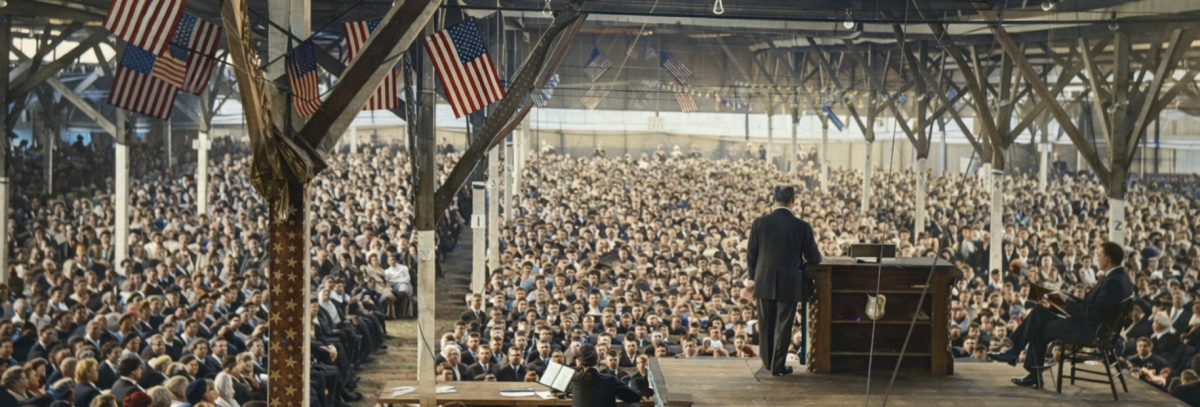
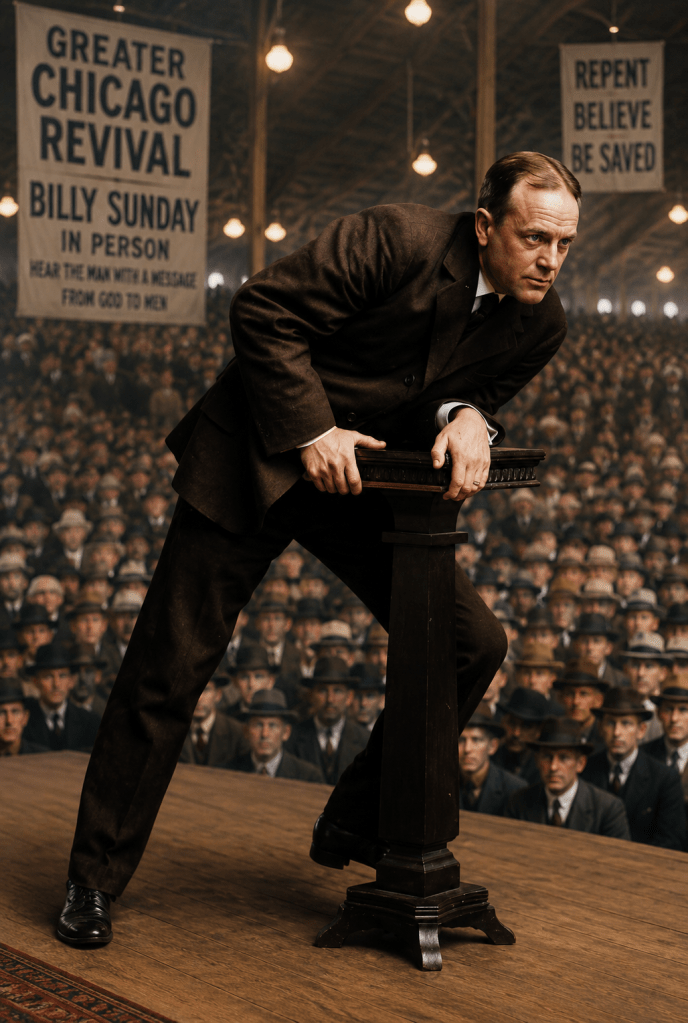
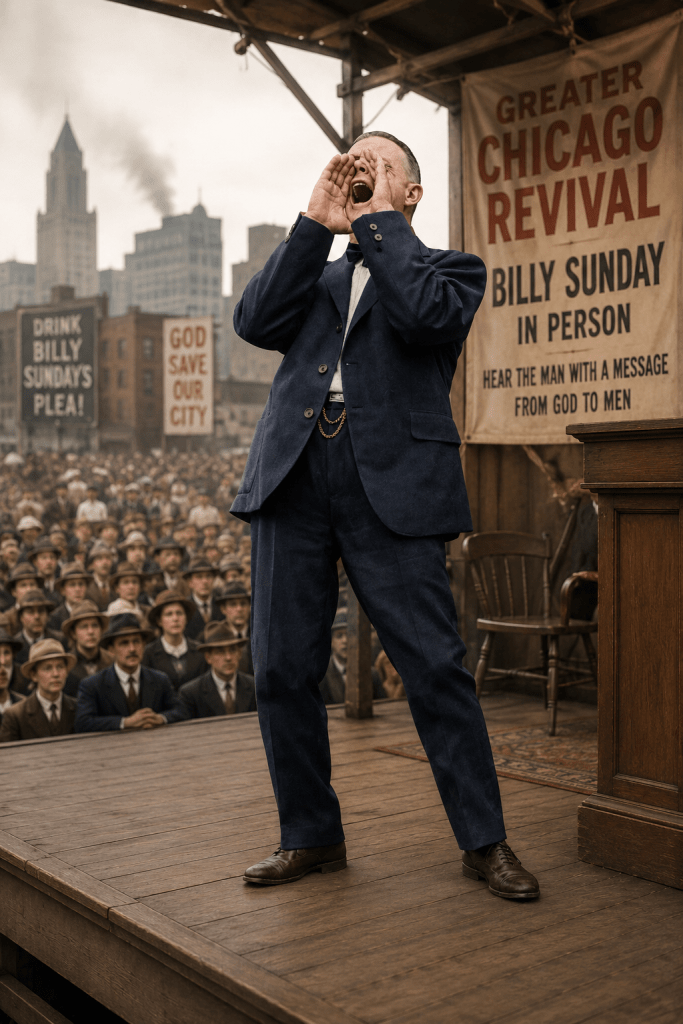
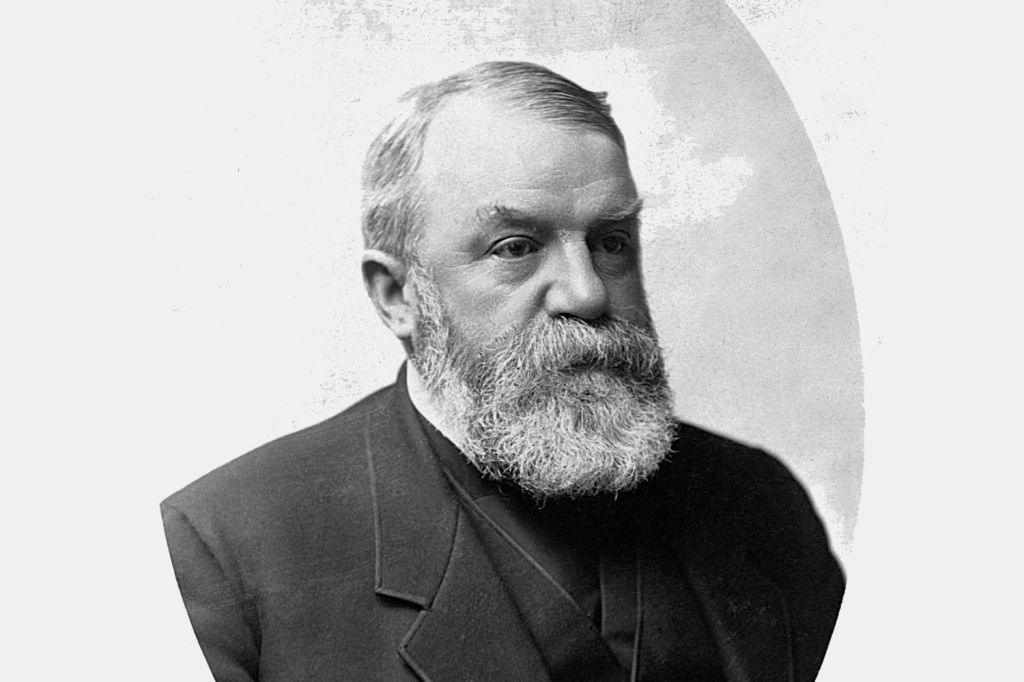
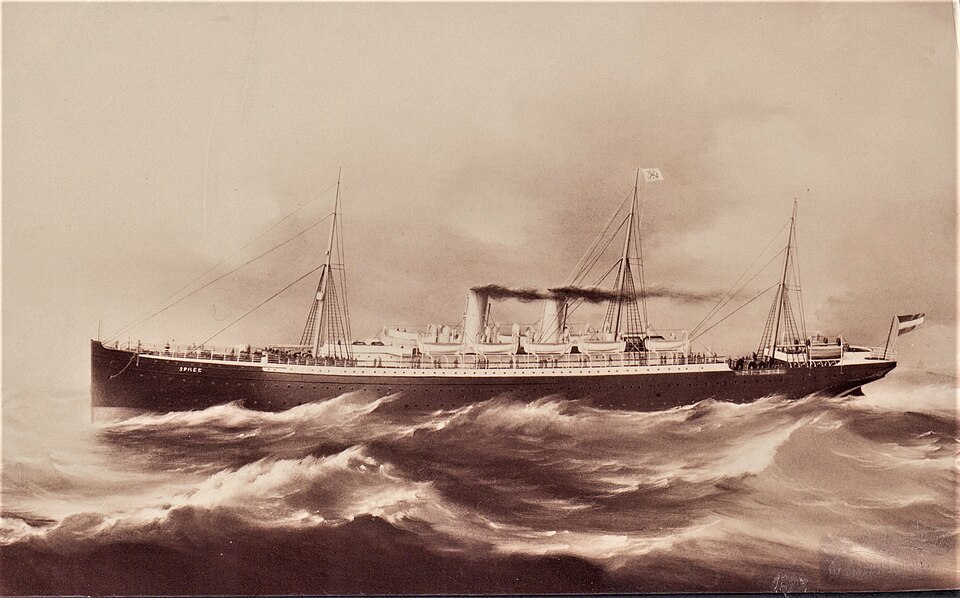
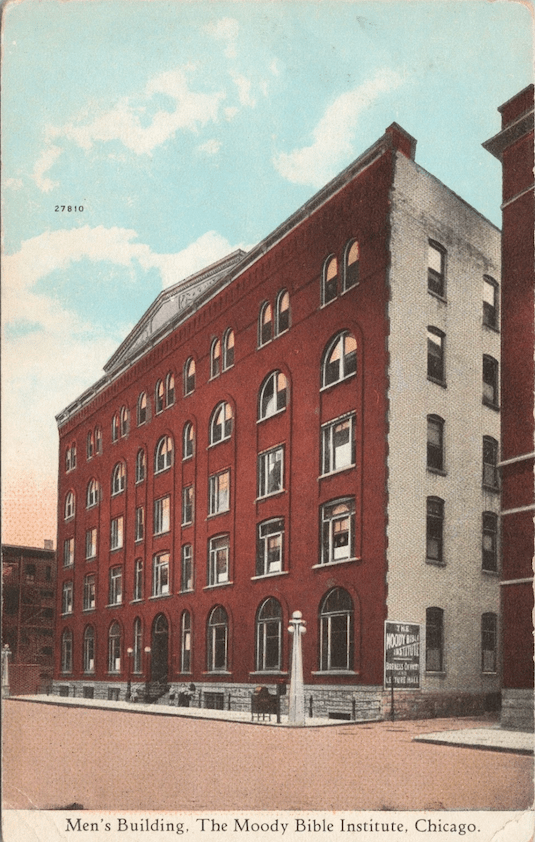
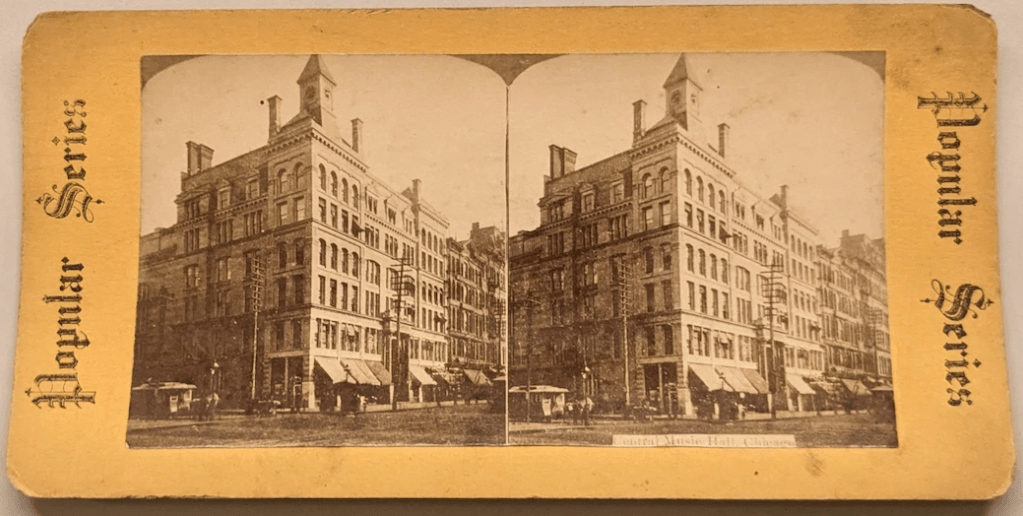
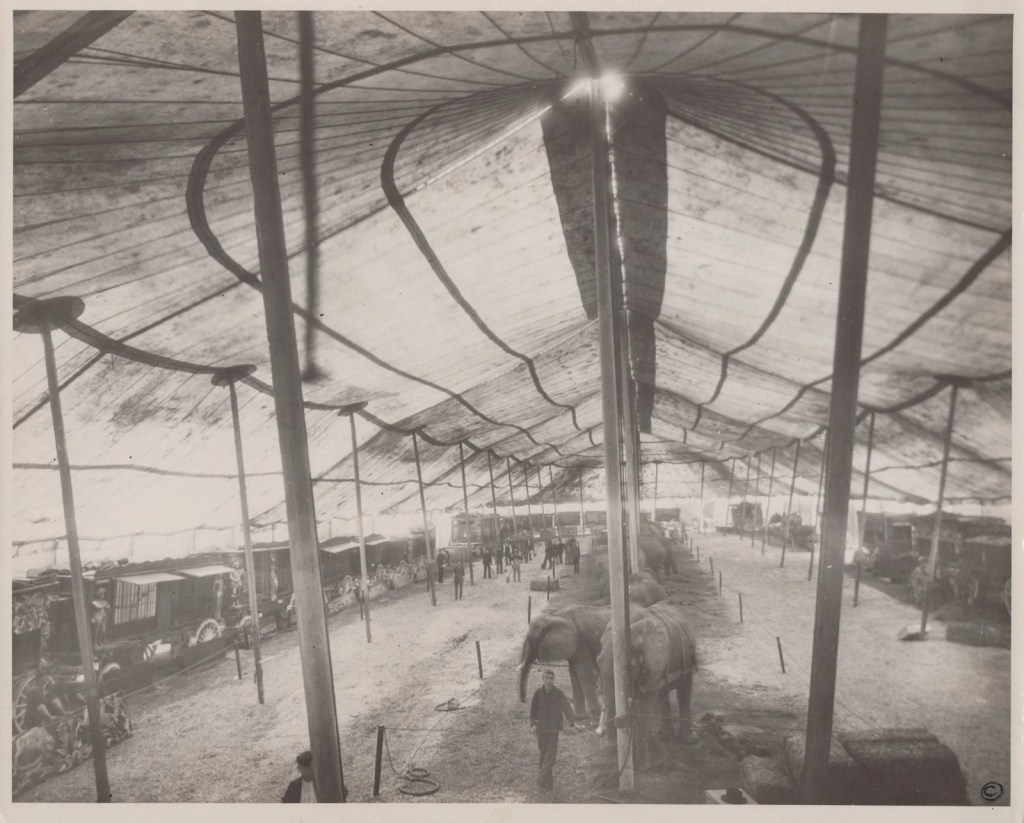
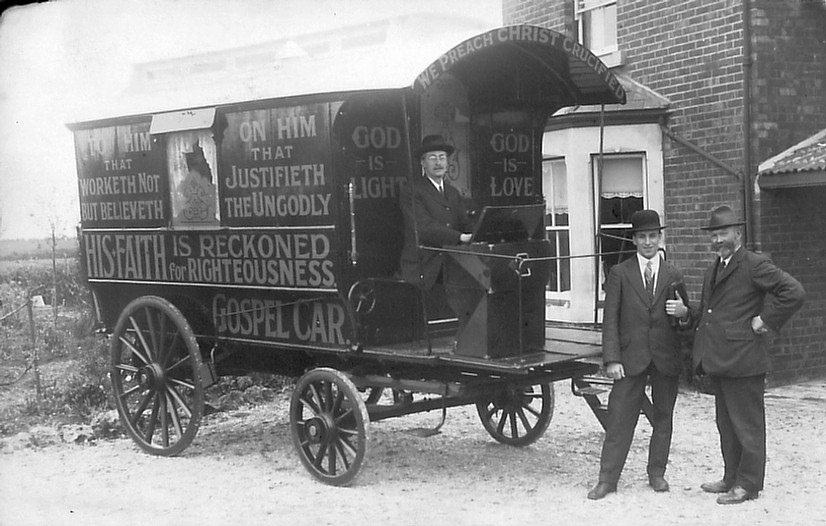
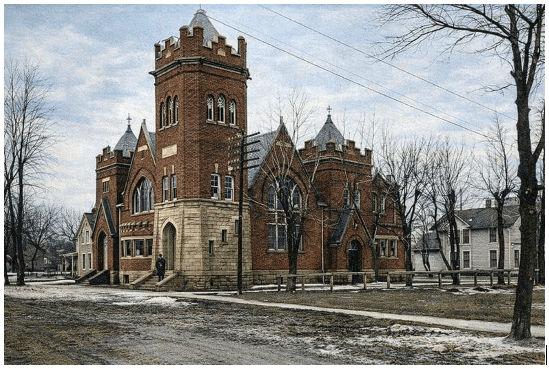
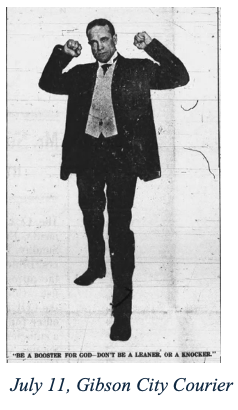
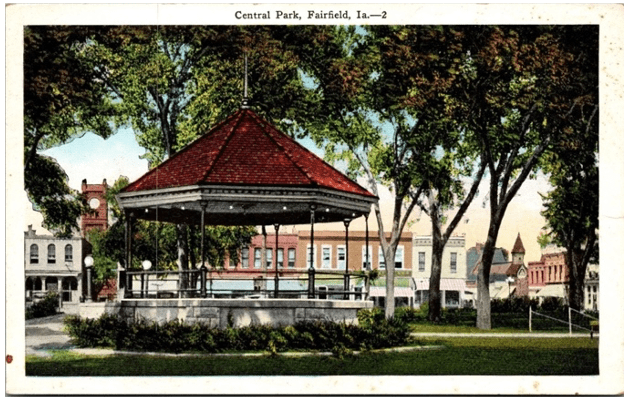
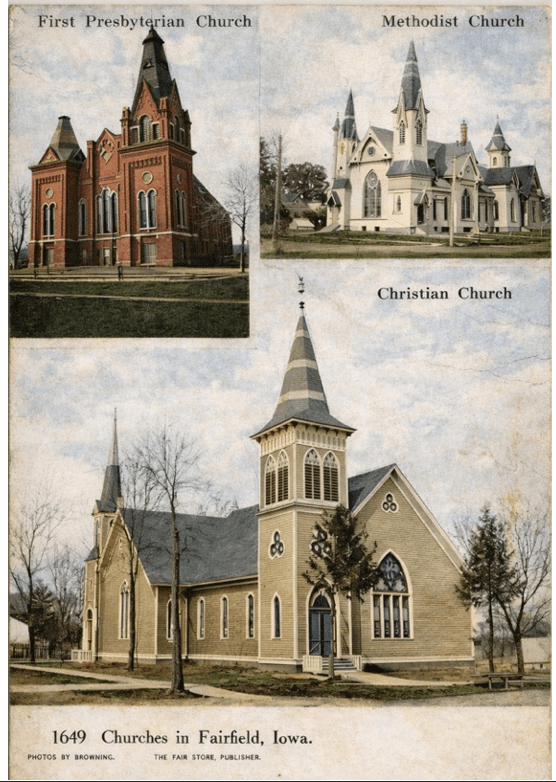
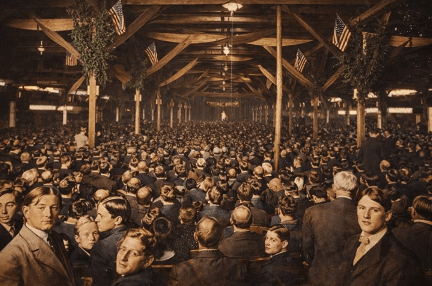
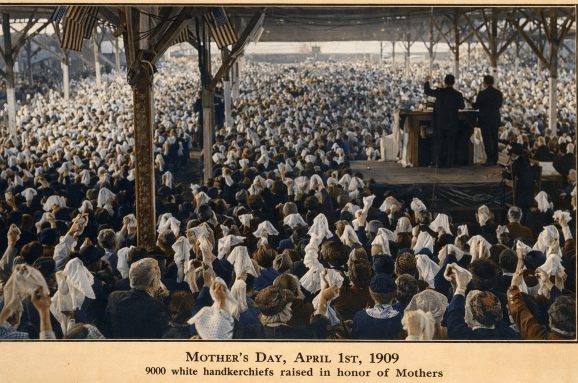
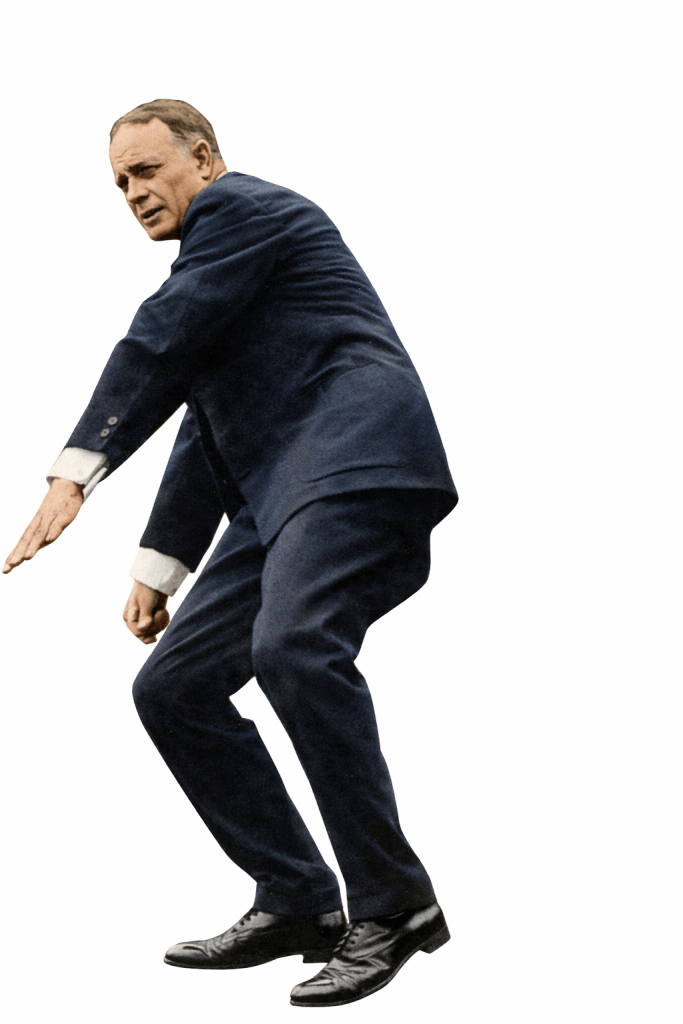
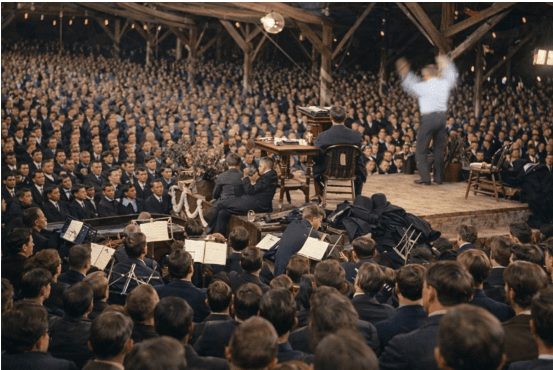
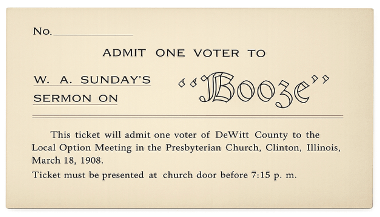
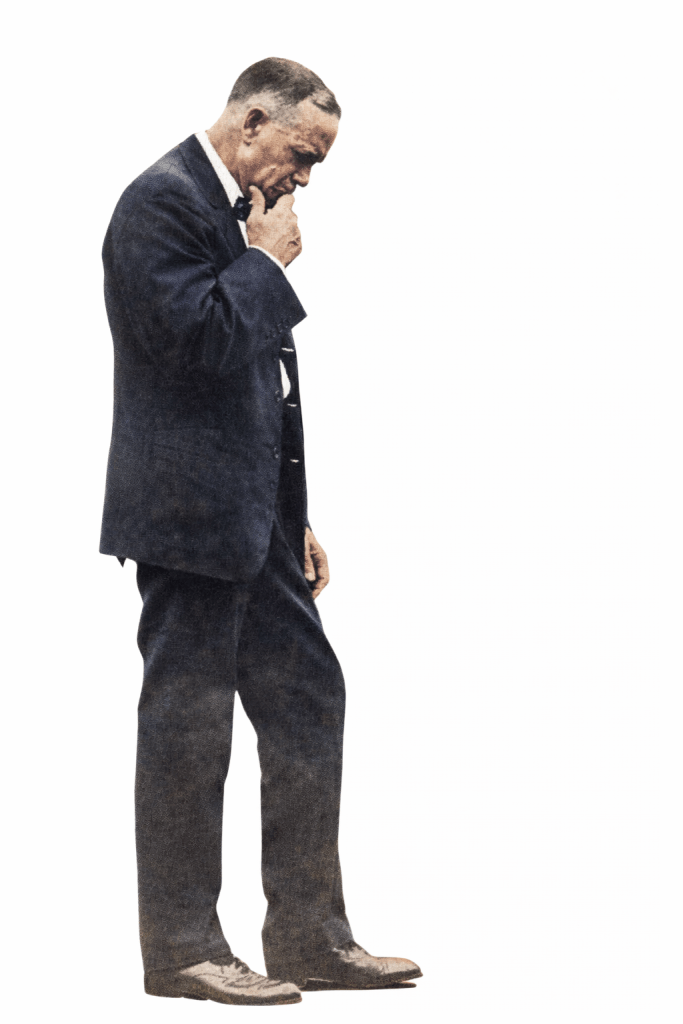
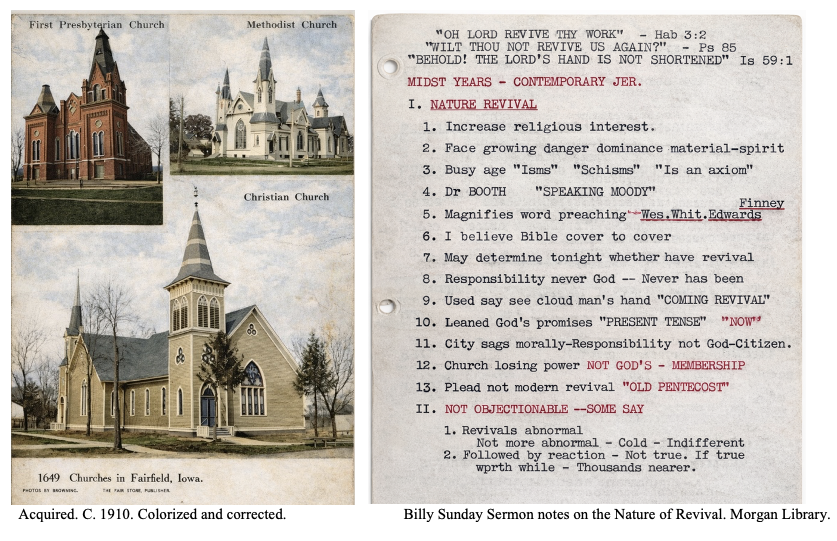
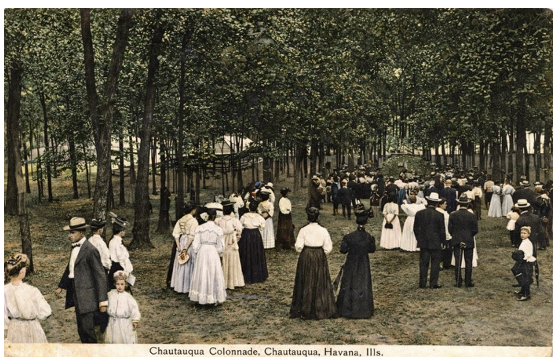
 Evangelist Billy Sunday (1862-1935)