Former professional baseball player-turned urban evangelist. Follow this daily blog that chronicles the life and ministry of revivalist preacher William Ashley "Billy" Sunday (1862-1935)
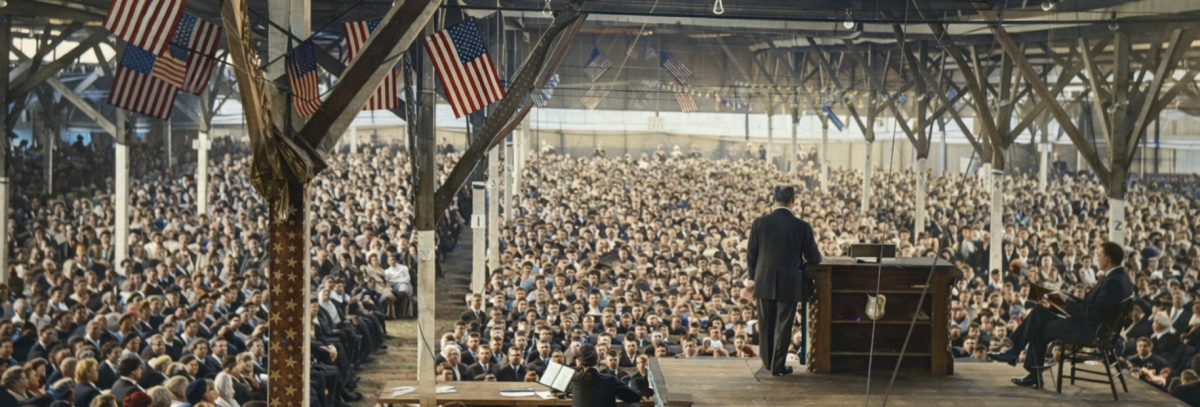
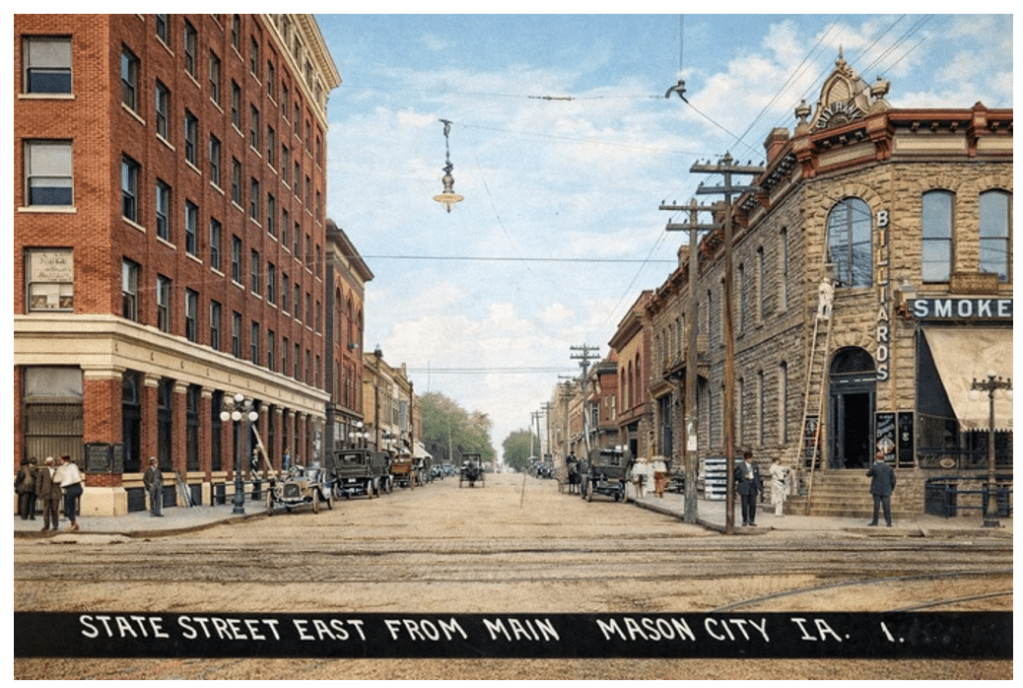
Billy Sunday conducted a month-long revival campaign in Mason City, Iowa, from January 13 to February 12, 1905, during a period when the city’s population was only about 8,300 and total church membership was roughly 3,000. A temporary tabernacle constructed of rough boards and tar paper—heated by six furnaces to withstand winter conditions—served as the central venue for the meetings.
Attendance was substantial for a community of Mason City’s size. One January meeting drew 2,000 men, while associate evangelist Ira E. Honeywell simultaneously addressed 1,000 women in a separate gathering. During a notable men’s meeting on January 29, Sunday delivered a forceful sermon condemning social vices; more than 50 men responded for prayer and conversion. The revival continued despite severe winter weather, including temperatures reported at twenty below zero.
By the campaign’s conclusion, the meetings had produced approximately 700 conversions, including 200 on the final day. Sunday received a $1,800 love offering, while an additional $2,500 was raised for campaign expenses and $800 for the city’s poor. Contemporary newspapers widely reported the revival and praised Sunday’s energetic preaching style and his unusual ability to sway large crowds.
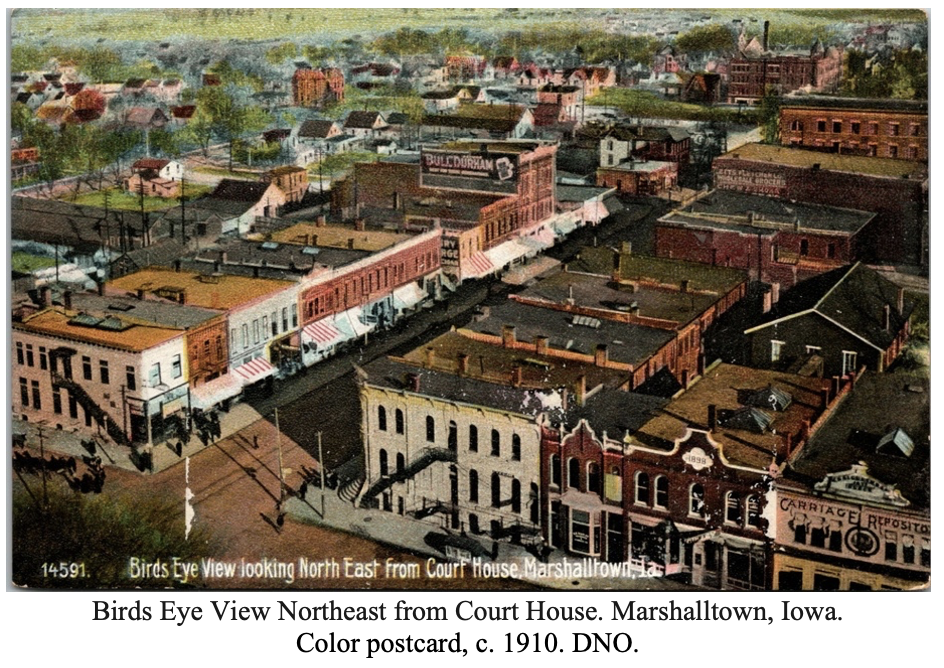
Fresh off a successful campaign in Springfield, Billy Sunday and his team rolled into Marshalltown in late April of 1909. This was not foreign soil. It was home turf.
Sunday had been raised in Iowa, shaped by its churches, and had even lived briefly in Marshalltown in the early 1890s while learning the mechanics of evangelistic work. By 1909 he returned not as an unknown ballplayer-turned-preacher, but as a nationally rising evangelist whose methods were becoming increasingly organized, efficient, and powerful.
Marshalltown was the right kind of proving ground. Large enough to sustain a six-week revival. Small enough to rally around one of its own.
The Setting: A City Poised for Revival
Marshalltown in 1910 had a population of 13,374—a fraction of Springfield’s 51,678. It was a growing industrial town, commercially strong, strategically located, and connected by rail. It was not metropolitan. But it was energetic.
A wooden tabernacle was erected at the corner of Third and Main, seating 5,000. The Sunday machine was now running at full stride.
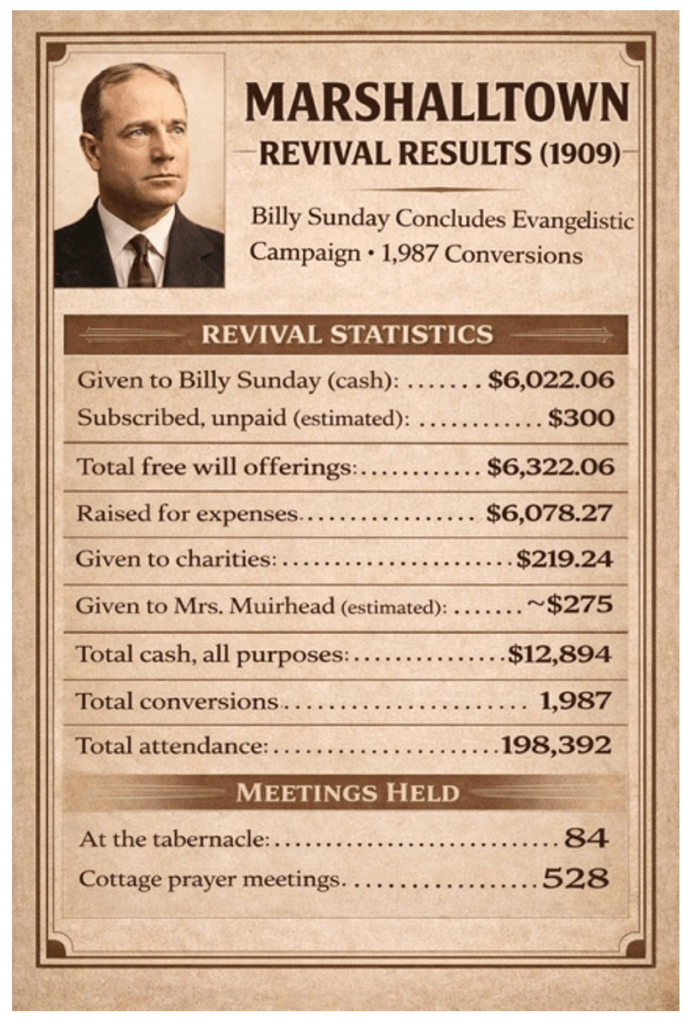
Opening night—April 25—saw over 12,000 people attend across all services. On the final day, June 6, Sunday preached to 13,200. In a town of just over 13,000 residents, that level of saturation is staggering.
By campaign’s end:
2,000 total conversions (125 on the final day)
84 tabernacle meetings
528 cottage prayer meetings
Nearly 200,000 in total attendance
For six weeks, Marshalltown was consumed by revival.
The Money and the Machine
The final purse for Sunday was $6,139. Total funds raised during the campaign reached $12,894.
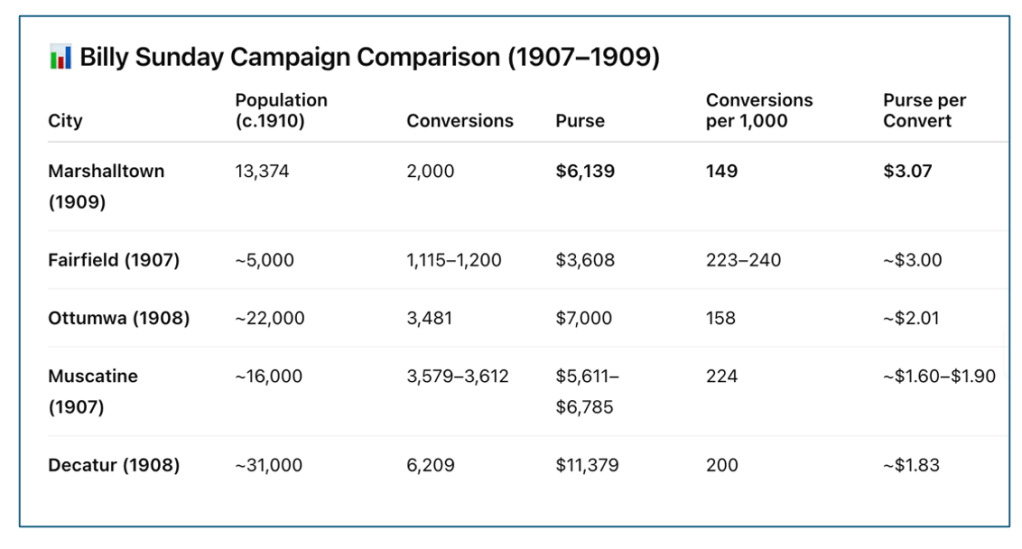
For comparison, that purse nearly matched Muscatine’s and approached Ottumwa’s from the previous year. Financially, Marshalltown demonstrated strong committee organization and enthusiastic backing. This was not a struggling campaign.
It was disciplined. Systematic. Mature.
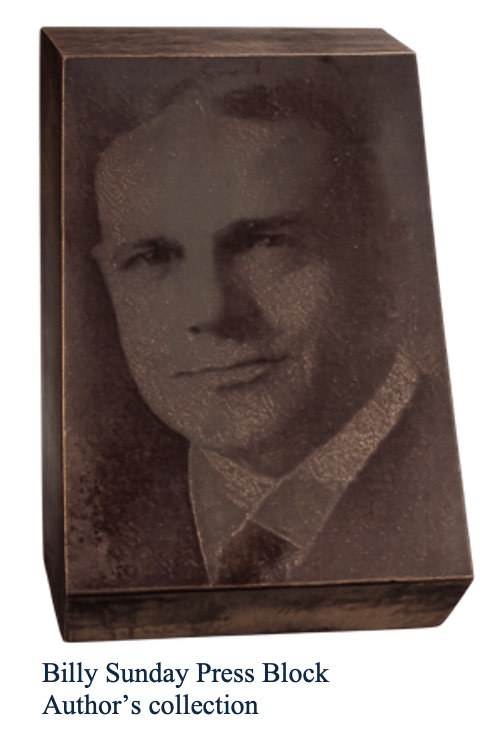
The press block used to print Sunday’s image during this period—now in my collection—reflects that growing sophistication. By 1909, Sunday was no longer improvising revivals. He was executing them.
Did Marshalltown “Underperform”?
One skeptical paper, the Davenport Weekly Democrat and Leader, suggested that Marshalltown’s results did not compare favorably with Fairfield, Ottumwa, Muscatine, and Decatur.
On the surface, that seems correct.
Measured per capita:
Marshalltown: ~149 converts per 1,000 residents
Fairfield: over 220 per 1,000
Muscatine: about 224 per 1,000
Decatur: around 200 per 1,000
Ottumwa: about 158 per 1,000
In raw totals, Marshalltown trailed Muscatine (3,579–3,612), Ottumwa (3,481), and especially Decatur (6,209).
So yes—the numbers were not dominant.
But numbers alone miss something important.
The Press: Praise and Pushback
The reaction was revealing.
The Audubon Republican declared the meetings closed in a “blaze of glory.” It reported over 500 cottage prayer meetings and said the town had been “thoroughly stirred up.”
The Marshalltown Evening Times-Republican went further, calling Sunday:
“One of the splendid prophets of the elder time…”
“One of the greatest revivalists in existence.”
“One of the plainest, simplest and happiest of men…”
Meanwhile, the skeptical Davenport Weekly Democrat and Leader offered sharper commentary. It described Sunday as a “contortionist of uncommon ability” with “remarkable versatility,” while acknowledging the “magnetic power of Mr. Sunday.”
Its most fascinating observation was psychological:
“The psychology of it all is that the people who are not regular attendants at churches must be reached not as individuals but in mass. They like to be moved by each other; and it is probable that this explains the success Mr. Sunday attains. He is helped greatly by the excitement and the enthusiasm of the crowds…”
That critique reads today like an astute analysis of mass evangelism. It wasn’t merely preaching. It was momentum. Atmosphere. Collective energy.
Sunday understood something about crowds that many pastors did not.
What Marshalltown Really Proved
Marshalltown was not Sunday’s most explosive campaign numerically.
But it demonstrated something perhaps more important in 1909:
Massive attendance penetration in a modest city
Financial stability and strong committee structure
Organizational maturity (over 600 total meetings)
National press attention—positive and critical
Marshalltown proved that Sunday could saturate an entire city.
Critics were talking. Admirers were praising. Nearly 200,000 attendances in six weeks ensured that no one in town was untouched by the revival’s presence.
He was no longer just holding meetings.
He was creating civic events.
A Blaze of Glory
The revival closed the way many Sunday campaigns did—intense, loud, emotional, decisive. A blaze of glory.
Marshalltown may not have produced the highest per-capita conversion rate of his Iowa stops. But it stands as a revealing moment in his rise.
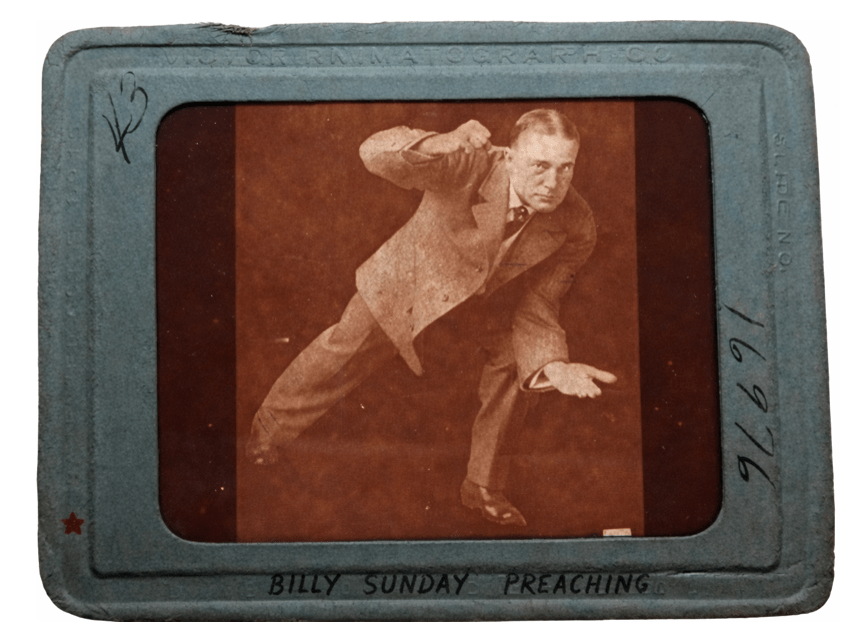
Magic lantern slide. Author’s collection.
By 1909, Billy Sunday was refining his method. The tabernacle system was humming. The prayer networks were mobilized. The press was watching closely.
And Iowa—his Iowa—was watching one of its own step onto a larger stage.
Marshalltown mattered because it showed that Sunday’s machine worked not just in isolated bursts, but in sustained, organized, city-wide saturation.
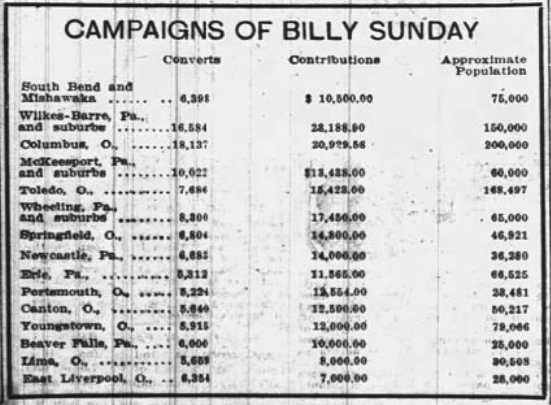
Location South Bend & Mishawaka Wilkes-Barre, PA Columbus, OH McKeesport, PA Toledo, OH Whelling, PA Springfield, OH Newcastle, PA Erie, PA Porstmouth, OH Canton, OH Youngstown, OH Beaver Falls, PA Lima, OH East Liverpool, OH
Here’s a blog-ready narrative reflecting on the 1904–1905 campaign data from Billy Sunday’s early revivals:
Billy Sunday’s Early Impact: What the 1904–1905 Campaign Numbers Reveal
By Kraig McNutt
Before Billy Sunday became a national sensation—packing tabernacles in Philadelphia and Pittsburgh—he cut his evangelistic teeth in smaller Midwestern towns. The data from his 1904–1905 revival campaigns offers a fascinating glimpse into the early momentum of a man who would become America’s most celebrated evangelist of the early 20th century.
Here’s what the numbers reveal.
Small Towns, Big Spiritual Response
Many of the towns on Sunday’s early itinerary were small agricultural or industrial communities scattered across Iowa, Illinois, Minnesota, and Colorado. Places like Exira, Iowa and Audubon, Iowa boasted modest populations—yet hundreds came forward to respond to Sunday’s message.
Centerville, Iowa (1905): 900 conversions
Sterling, Illinois (1904): 1,678 conversions
Macomb, Illinois (1905): 1,880 conversions
Dixon, Illinois (1905): 1,875 conversions
These numbers are especially impressive when viewed through the lens of population density. In many cases, Sunday was reaching 10–20% or more of the town’s residents. His message wasn’t simply heard—it reshaped the spiritual landscape of entire communities.
Collections: A Window into Support and Sustainability
While conversion data was consistently recorded, collections (monetary offerings) were only occasionally noted:
Centerville, Iowa: $1,500
Keokuk, Iowa: $2,200
Dixon, Illinois: $2,000
Macomb, Illinois: $3,100
These figures indicate that even in smaller towns, there was strong financial support for revival efforts. The money likely covered the costs of tabernacle construction, music, printed materials, and Sunday’s own ministry team.
These generous gifts also reflect the deep gratitude communities felt for the spiritual impact they experienced.
Consistent Fruit Across the Heartland
Across 22 cities recorded between 1904 and 1905, Sunday saw tens of thousands make public professions of faith. The median number of conversions hovers around 900–1,000 per town. For a relatively unknown evangelist in his early 40s, this marks a period of accelerating credibility and growing influence.
It was this consistency—town after town, soul after soul—that built the foundation for Billy Sunday’s national platform just a few years later.
A Revival Rooted in the Midwest
It’s no accident that Sunday’s early years focused on Iowa, Illinois, and Minnesota—regions that mirrored his own upbringing and values. These were towns where the church was central, alcohol was a public enemy, and personal salvation was not just a religious idea, but a community matter.
Sunday’s fiery oratory, moral clarity, and theatrical flair found fertile ground in these heartland soils.
Final Thought: The Humble Beginnings of a National Voice
The revival fires Billy Sunday lit in places like Bedford, Harlan, and Canon City were more than regional events—they were launchpads. These early campaigns showed that revival could still grip a town, change hearts, and reorder lives.
In 1904 and 1905, he wasn’t yet preaching to hundreds of thousands—but he was proving that he could.
And history shows—he would.
Enjoying this kind of historical insight? Subscribe to the blog or check out more posts at EvangelistBillySunday.com
In the early 20th century, few public figures stirred the American soul quite like Billy Sunday. A former professional baseball player turned dynamic evangelist, Sunday launched revival campaigns that were part gospel meeting, part moral crusade, and entirely unforgettable.
But beyond the sawdust trails and thunderous preaching, what do the numbers tell us about his real impact?
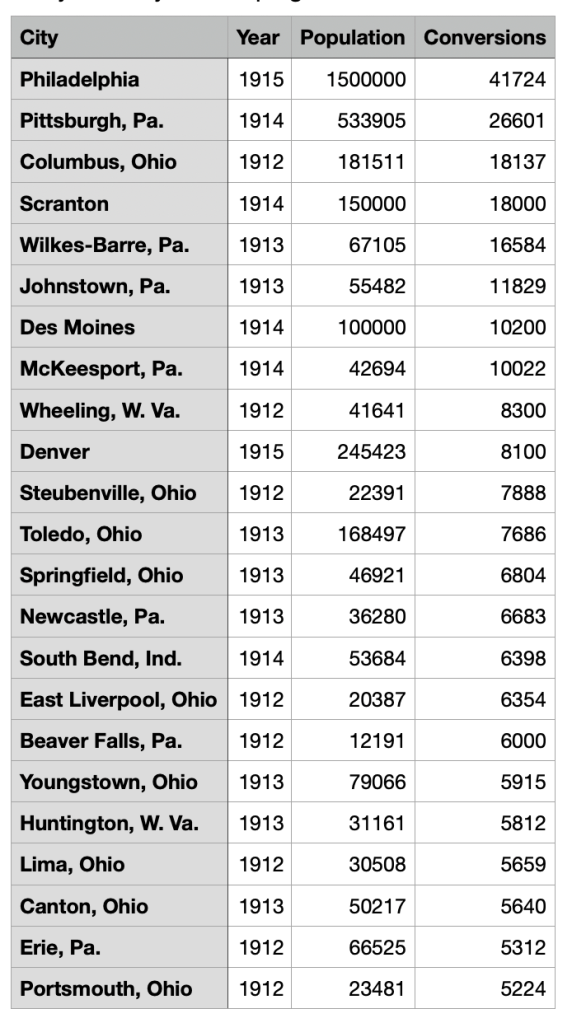
Let’s dive into an analysis of over twenty of Sunday’s campaigns—spanning from the industrial sprawl of Philadelphia to the steel towns of Ohio and Pennsylvania—to find out.
Big Cities, Big Numbers
Unsurprisingly, the nation’s largest cities saw the highest total conversions:
Philadelphia (1915): 41,724 conversions
Pittsburgh, PA (1914): 26,601 conversions
Columbus, OH (1912): 18,137 conversions
Impressive, no doubt. But when measured per capita, a surprising truth emerges…
The Real Revival Was in Small-Town America
Here’s where it gets fascinating:
Beaver Falls, PA (1912): 6,000 conversions in a city of 12,191 – nearly 49%!
East Liverpool, OH (1912): 6,354 conversions in a population of 20,387 – over 31%
Steubenville, OH (1912): 7,888 conversions out of 22,391 – over 35%
In these towns, Sunday didn’t just stir hearts—he helped reshape the entire community’s spiritual identity.
A Strategy Rooted in the Industrial Heartland
Most of Sunday’s campaigns concentrated in:
Pennsylvania
Ohio
West Virginia
Indiana
Why here?
These regions were filled with working-class cities grappling with the social challenges of industrialization: alcoholism, labor unrest, poverty, and moral uncertainty.
Sunday’s sermons, full of vivid illustrations and uncompromising moral appeals, landed powerfully in these settings. He spoke their language, addressed their fears, and challenged their habits.
His Peak Impact Years: 1912–1914
Many of the most spiritually responsive campaigns occurred just before World War I:
Scranton (1914)
Wilkes-Barre (1913)
McKeesport (1914)
Des Moines (1914)
Johnstown (1913)
This was Sunday’s sweet spot—a season where both momentum and message aligned. Before the war brought cultural upheaval, Sunday’s campaigns offered a moral anchor to cities teetering on the edge of change.
The Bottom Line: Revival by the Numbers
Across 23 cities analyzed:
Total population: 3,559,070
Total conversions: 250,872
Average conversion rate:~7.05%
That’s 1 in every 14 people making a spiritual decision.
But the real story is this: Sunday’s numerical reach was greatest in big cities, but his transformational impact was most profound in smaller towns where community bonds were tighter, distractions were fewer, and the message spread like wildfire.
Final Thoughts: When Revival Was a Shared Story
Billy Sunday didn’t have Instagram reels or livestream sermons. He had sawdust floors, a voice like thunder, and a message about Jesus that could shake a city.
And in towns like Beaver Falls, East Liverpool, and Steubenville, it did more than shake—it changed lives. Not in abstract theological terms, but in the daily rhythms of work, family, and community.
In these places, revival wasn’t just a moment. It was a movement.
 Evangelist Billy Sunday (1862-1935)