To Understand Billy Sunday, You Must First Understand the American City
“Billy Sunday didn’t simply preach against sin. He preached into a nation struggling to hold itself together.”
One of the greatest mistakes we can make in studying Billy Sunday is viewing him in isolation.
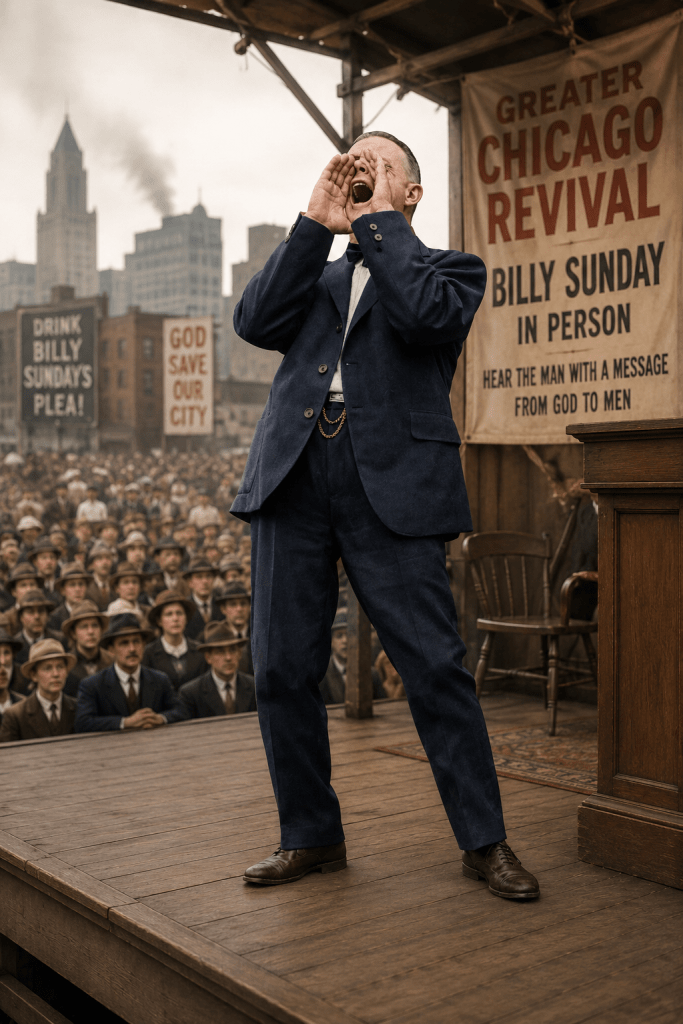
Too often, we imagine Sunday as a colorful evangelist—a former professional baseball player who sprinted across the platform, smashed chairs for emphasis, and denounced liquor with unmatched enthusiasm. Those things are certainly true. But if that is all we see, we miss the larger story.
Billy Sunday was not merely a personality. He was a product of his time, and perhaps more importantly, he became one of the defining voices responding to one of the greatest social transformations in American history.
To understand Billy Sunday, we must first understand the America in which he preached.
A Nation Turned Upside Down
Between 1820 and 1920, the United States experienced astonishing change.
Millions left rural communities for rapidly growing cities. Waves of immigrants arrived from around the world. Railroads connected distant regions into a single national economy. Factories replaced farms. Skyscrapers reshaped city skylines. Electric lights, streetcars, telephones, and mass-produced goods transformed everyday life.
For many Americans, progress was exhilarating.
For others, it was deeply unsettling.
The close-knit communities that had once provided moral accountability were disappearing. In their place emerged crowded neighborhoods where neighbors were strangers, saloons flourished, political corruption thrived, prostitution was visible, crime increased, and families often struggled simply to survive.
Many Americans wondered whether the nation’s moral foundations were beginning to crumble.
Paul Boyer and the Search for Moral Order
Historian Paul Boyer explored this remarkable period in his influential book Urban Masses and Moral Order in America, 1820–1920.
Boyer argued that countless Protestant leaders were driven by a single concern: how could moral order be preserved in a rapidly urbanizing nation?
They did not simply preach sermons.
They built institutions.
Sunday schools multiplied. Rescue missions opened. YMCA chapters expanded. Bible societies distributed millions of Scriptures. Temperance organizations grew. City missions sought to reach neighborhoods that traditional churches struggled to influence.
These efforts represented far more than isolated ministries.
Together they formed a broad movement attempting to answer one pressing question:
How do you preserve Christian character in a society that is changing faster than anyone imagined possible?
Billy Sunday Arrives
Into this world stepped Billy Sunday.
He did not invent concerns about drunkenness, gambling, prostitution, broken homes, or political corruption. Those issues had occupied Protestant leaders for decades.
What Sunday did possess was an extraordinary ability to communicate those concerns with unusual passion, clarity, humor, and urgency.
He could hold thousands spellbound.
He spoke the language of ordinary people.
He transformed moral conviction into unforgettable images and memorable phrases.
Most importantly, he persuaded millions that the battle for America’s future was not merely political or economic.
It was spiritual.
More Than an Evangelist
Modern readers sometimes reduce Billy Sunday to a caricature—a loud prohibitionist or an emotional revival preacher.
That misses the larger historical reality.
Sunday saw himself as calling individuals to faith in Jesus Christ. Yet he also believed transformed individuals could renew homes, churches, communities, businesses, and ultimately the nation itself.
His revivals therefore addressed both the soul and society.
When Sunday preached against alcohol, he was not merely attacking a beverage.
He believed alcohol destroyed families.
When he denounced dishonesty in business, he was defending integrity.
When he challenged men to become faithful husbands and fathers, he was calling them back to responsibilities he believed were essential to a healthy civilization.
Whether one agrees with every conclusion he reached, it is impossible to understand his ministry apart from these broader concerns.
The Organization Behind the Evangelist
There is another important lesson Boyer helps us see.
Billy Sunday’s ministry was astonishingly well organized.
Long before modern event management became commonplace, Sunday’s campaigns mobilized entire cities.
Committees recruited volunteers.
Thousands joined mass choirs.
Newspapers covered meetings daily.
Business leaders participated.
Churches cooperated across denominational lines.
Follow-up systems helped connect new converts with local congregations.
None of this happened accidentally.
Sunday inherited nearly a century of organizational innovation developed by evangelical Protestants seeking to reach growing American cities.
His campaigns represented the maturity of that movement.
Reading Billy Sunday with Fresh Eyes
When we understand the world Billy Sunday inherited, we begin asking better questions.
Instead of asking only, “Why did Billy Sunday preach so forcefully?”
We ask:
Why were millions eager to hear him?
Why did civic leaders invite him?
Why did newspapers devote front-page coverage to his meetings?
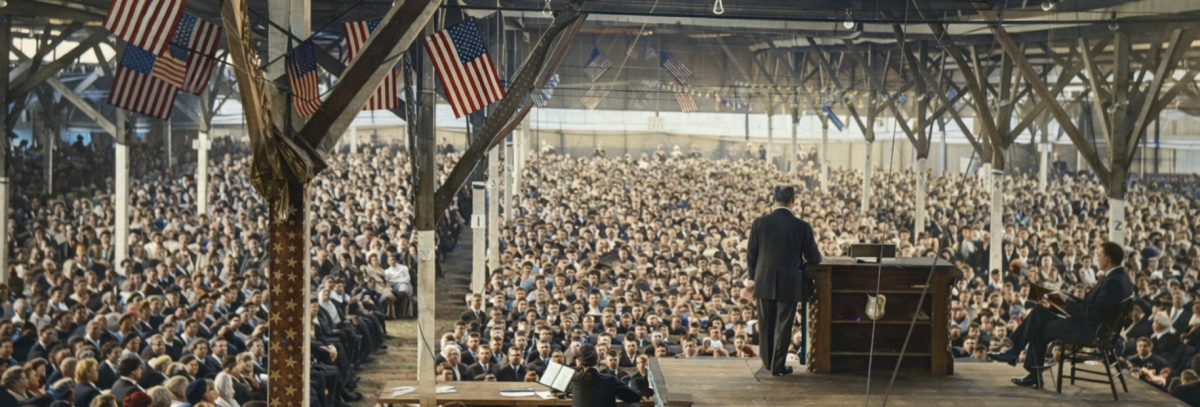
Why did entire cities build temporary wooden tabernacles capable of seating thousands?
The answers lie not simply in Billy Sunday himself but in the anxieties and aspirations of the nation he served.
America was searching for moral stability amid extraordinary change.
Billy Sunday became one of the most recognizable voices offering an answer.
Looking Beyond the Caricature
History deserves better than caricature.
Billy Sunday was neither merely a religious celebrity nor simply a crusader against alcohol.
He stood at the intersection of faith, culture, urbanization, and one of the most significant periods of transformation in American history.
Understanding that larger story does not require us to agree with every sermon he preached.
It does require us to appreciate why so many Americans believed his message mattered.
If we wish to understand Billy Sunday fairly, we must first understand the world that shaped both his audience and his ministry.
Only then can we appreciate why, for millions of Americans, Billy Sunday was far more than an evangelist.
He became a voice calling a rapidly changing nation back to what many believed were its moral and spiritual foundations.

 Evangelist Billy Sunday (1862-1935)