The summer Billy Sunday found the platform: 1903

A year of small towns, growing purses, and the quiet beginning of the Chautauqua decade that would change everything.

If 1902 was the year Billy Sunday became Billy Sunday, then 1903 was the year he started learning what kind of Billy Sunday he was going to be. The previous year had handed him three breakthroughs: a documented preaching style, a working business model, and a public conversation about whether he might be the next Moody. 1903 was the year he had to do something with all of that.

By the documented record, he held only seven multi-week campaigns and Chautauqua appearances that year — a smaller schedule than 1902. But every one of them mattered, and one of them, a single afternoon talk in September, opened the door to the decade-long platform run that would carry him from regional tent revivalist to national headliner.

Osceola and Marengo: the work continues

The year opened where the previous one had ended — in a small Illinois town, in cold weather, in a four-week revival campaign. At Osceola, between January and February, Sunday drew a $710 purse against $1,100 in campaign expenses and recorded 410 conversions. The local paper noted that he was making “several times over” the salary of a professional baseball player. The Leon Journal-Reporter put a finer point on it in mid-January: he was “attracting enormous congregations.”

From there to Marengo, Illinois in March, where something quietly remarkable happened on Sunday, March 29. Billy preached to men only. Helen Sunday preached to women only. Sixty converts came forward that day across the two services.
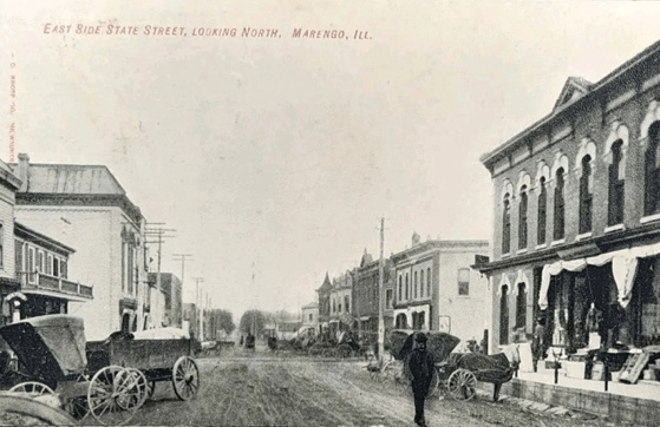
Marengo, Illinois. c. 1910

Helen had been managing the Sunday household for years, and she would eventually become her husband’s chief organizational lieutenant on the road. But March 29, 1903 is, as far as the curated newspaper record shows, one of the earliest documented occasions when she stepped into a public preaching role of her own. The Belvidere Daily Republican noted it without much fanfare. Three years later, when she announced she would join Billy on the campaign trail full-time, she described her future role as taking “charge of women Bible classes, organizing girl Bible classes and giving personal care to converted persons.” Marengo 1903 was the prototype. She had already been doing it.

Centerville: a town transformed

The defining revival of 1903 came in June at Centerville, Iowa — a small county seat in the southern Iowa coalfields. Sunday preached there for just over two weeks, between June 14 and June 30, and the impact on the town was, by every contemporary measure, immense.

851 conversions across the campaign. 615 of them came in the final week. 219 on Sunday, June 28 alone. 230 on the closing night, June 30. The crowds were enormous for a town that size. On June 29 Sunday preached to 1,500 people, some of whom had driven more than twenty miles to be there. At the men-only meeting earlier in the campaign, 1,200 men came; 155 of them were converted in a single service. Sunday’s purse for the two-week run was $1,500.

But the more telling numbers came after he left town. The Evening Times-Republican reported on July 11 that 428 new church members had joined Centerville’s congregations as a direct result of the revival. First United Methodist alone took in 67. One Centerville church’s regular weekly offering more than doubled in the weeks after Sunday’s departure. Almost every denomination in town began discussing new building plans to accommodate the new attendance. And on July 23, the Oskaloosa Herald reported that a brand new Centerville YMCA had been founded with 150 members — expanding to 250 within a few days.

This was the model working at full force. A two-week campaign generating not just conversions but durable institutional change — new church members, new buildings under discussion, a new YMCA chapter. The Centerville revival also produced one of the period’s most quotable Sunday biographical glimpses. Speaking with a reporter from the Evening Times-Republican on June 26, Sunday described his own childhood: he had been “raised in an infidel neighborhood up in Story County. His grandfather was an infidel and never went to church. Cursings and damnings were heard on all hands.” It is the kind of personal-origin detail that rarely surfaces in his own words elsewhere.

There was also a political dimension. During the Centerville campaign, more than 100 attendees withdrew their names from a local saloon-approval petition — early evidence that Sunday’s revivals were not just spiritual events but civic interventions that reshaped local temperance politics. Toward the close of the campaign Sunday ordered a new tent capable of seating 2,000 people. The local press, with characteristic dry wit, observed that he “proposes that no guilty man escape.”

“The splendid success which has been achieved by “Billy” Sunday at Centerville and at other points in Iowa as an evangelist is contradictory to the conclusions of those who have contended that revivals are a thing of the past and no longer efficacious. They are as effective now as they ever have been, with this difference that a larger share of ability and personality is required to influence the unsaved and bring them to repentance and salvation. People are wider read and more intelligent than they were. A higher order of clerical ability is exacted, and the church is supplying it. Strong, forceful, able and broad-minded evangelists are in greater demand that at any time heretofore and are invariably as successful in winning converts to Christianity as they ever have been.”

The Courier (Waterloo, Iowa) · Wed, Jul 8, 1903 · Page 4.

The summer turn

The most consequential thing Sunday did in 1903 occurred in August and September. He took his first Chautauqua bookings.

On August 9 he appeared at Bloomington, Illinois — a single date on the Bloomington Chautauqua program. On September 7 he appeared at Ottawa, Illinois, where the Dwight Star and Herald reported that his subject was a denunciation of two-faced church gossipers. Both engagements were modest by the standards he would soon set. But both put him onto the summer platform circuit that would, by 1909, be paying him $43,000 a year and putting him in front of audiences of 8,000 to 15,000 in a single afternoon.

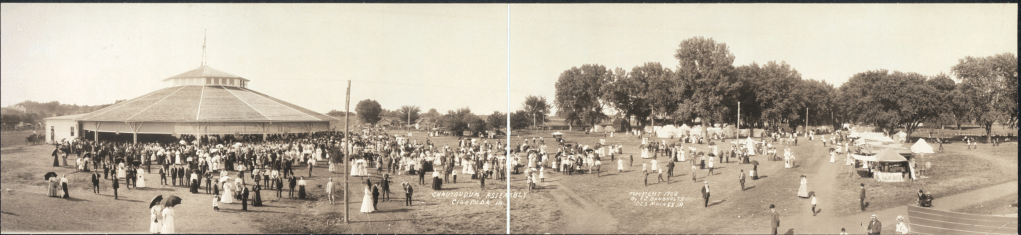
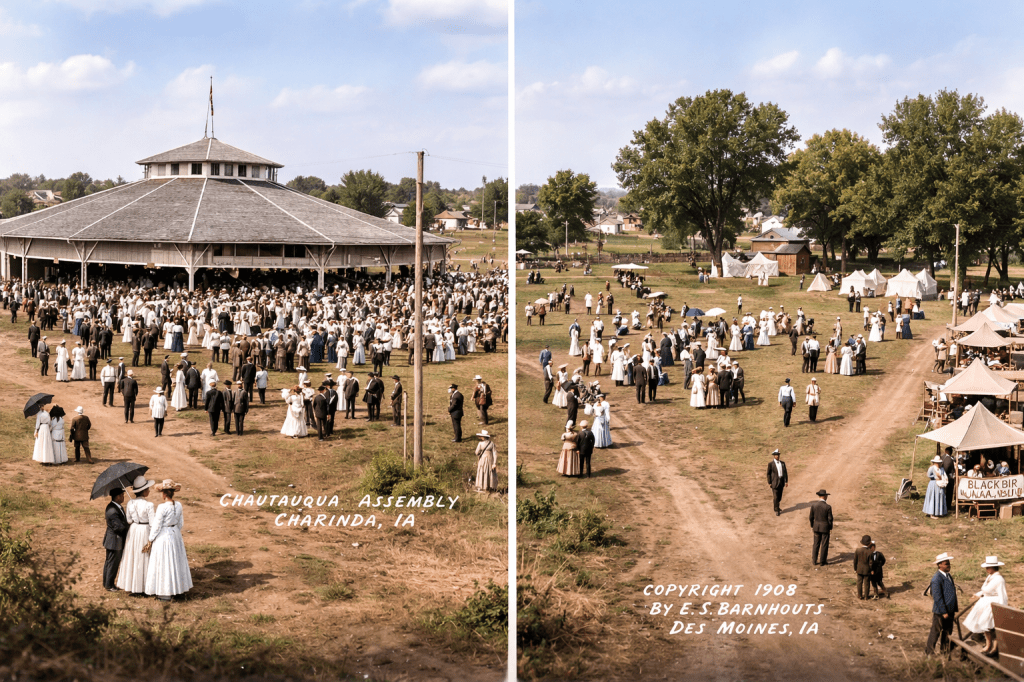
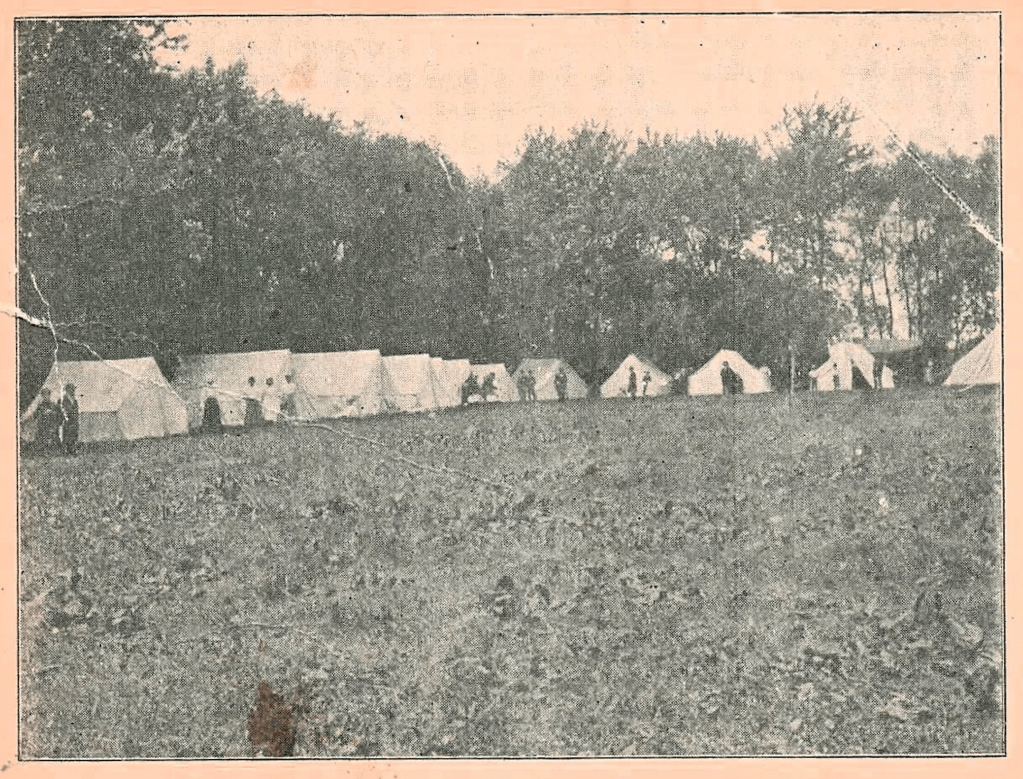
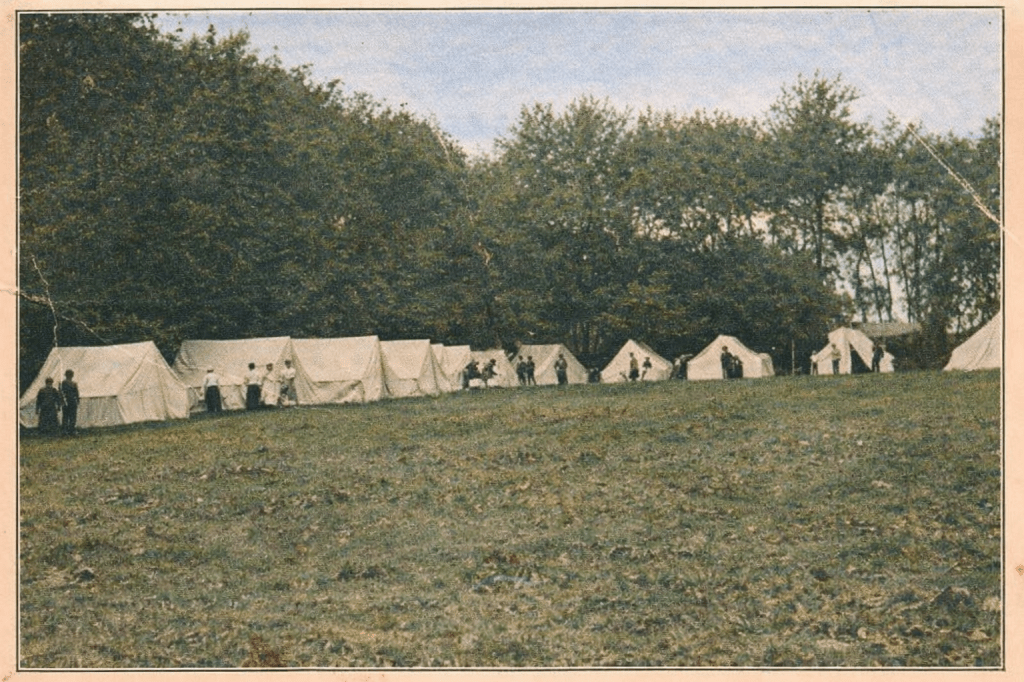
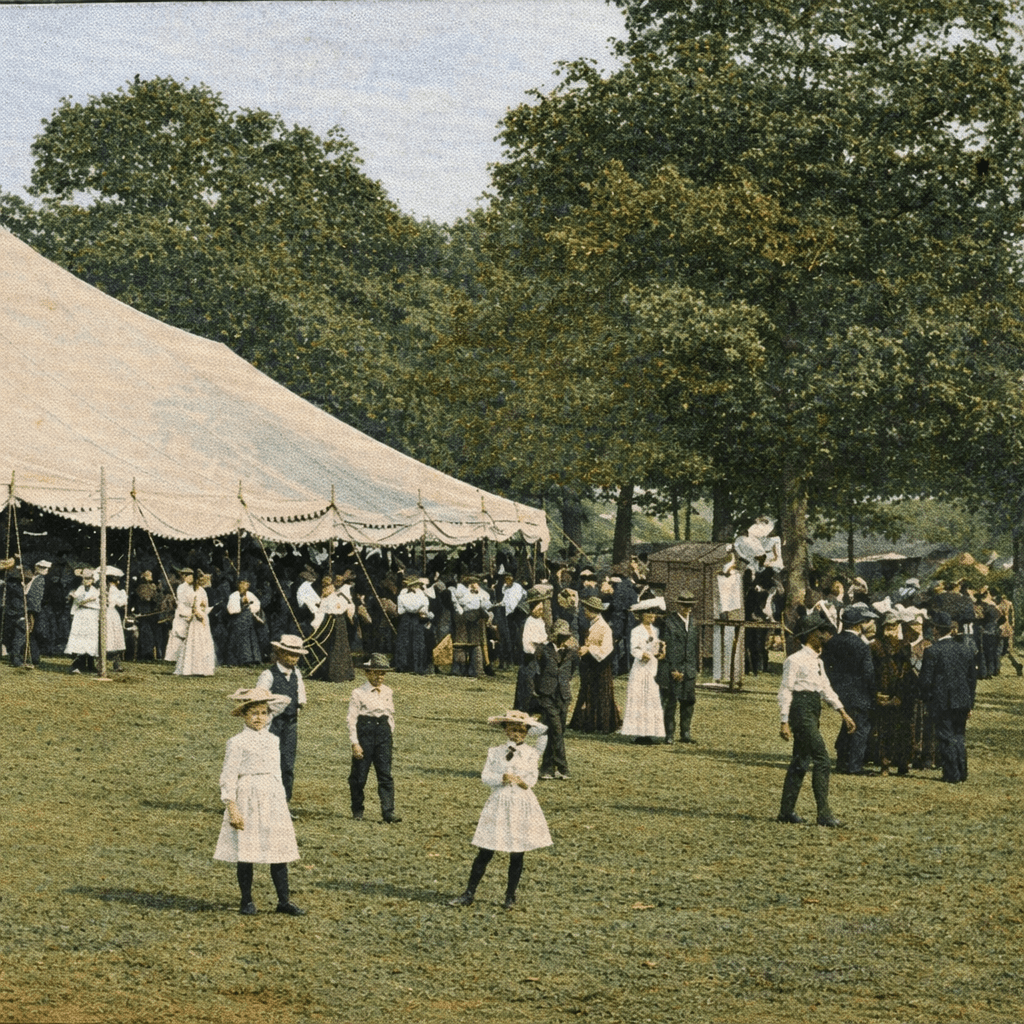
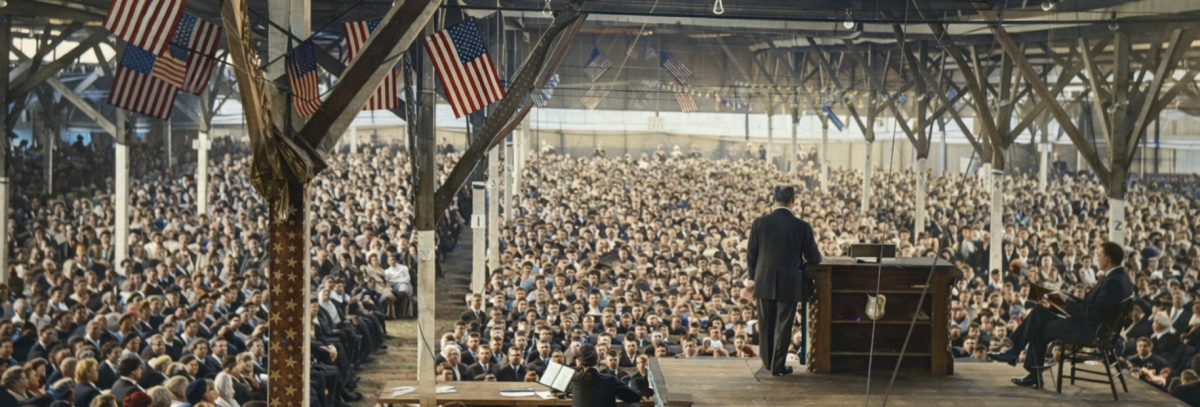
The Chautauqua movement in 1903 was already a national institution. Each summer, thousands of small Midwestern towns hosted ten-day Chautauqua assemblies under canvas — featuring lectures, music, religious programming, scientific demonstrations, and visiting speakers. The platform was hungry for evangelists who could draw a crowd without alienating the family-friendly audience. Sunday’s blend of muscular preaching, ex-baseball-player charisma, and crowd-tested theatricality turned out to be exactly what the format wanted.

A 1903 Sunday Chautauqua appearance was just a single afternoon talk — a long way from the multi-week revival campaigns that had been his core work. But the summer tour had one advantage that the revival circuit did not: scale. A single revival meant one town for a month. A single Chautauqua summer meant a dozen towns in three months, each with its own audience, its own newspaper coverage, and its own check. By September of 1903, Sunday had taken the first steps onto a platform that would carry him through the next decade.

Carthage: a new high

The fall return to revival work brought Sunday to Carthage, Illinois, where he preached from October through November 1 in a pole-and-canvas tabernacle built near the town square by local volunteers. His purse for the month-long campaign was $2,100 — at the time, the largest he had ever received. The Muncie Star Press flagged this as an editor’s note, treating the figure as newsworthy in its own right.

Three years later, in March 1906, the Mattoon Journal Gazette and Times-Courier would publish a stickiness analysis of Sunday’s earlier revivals — looking at how many of his converts remained in the faith years after the campaigns ended. Carthage came in at 80 percent still “living the new life” three years later. It was one of the strongest results in the entire study.

For a 41-year-old evangelist still mostly working the small-town Midwest circuit, the $2,100 Carthage purse was a meaningful threshold. The previous high had been Fairmount’s $1,600 the prior spring. Carthage put Sunday’s compensation on a clear trajectory — by 1907 he would routinely draw $6,000 purses, by 1909 over $10,000 — and the fact that the Muncie paper flagged the figure as “largest ever” tells us the regional press was already keeping score.

What 1903 was for

It is tempting to read 1903 as a quiet year. Only seven documented engagements survive in the curated archive, none of them generated the kind of national press coverage Sunday’s 1902 ministry totals had attracted, and the Chautauqua bookings looked at the time like modest summer side work. The story of 1903, if you were skimming the year for headlines, is thinner than 1902 on its face.

But three things happened in 1903 that mattered more than the headline count suggests, and each one set up something that would define Sunday’s career for the next decade.

Centerville proved the institutional model worked. The 1902 Fairmount campaign had shown that the stock-company funding mechanism could work. Centerville, a year later, showed that the durable institutional effects — new church members, new buildings, new YMCA chapters, lasting political consequences — were not flukes. Sunday’s revivals were not just emotional events. They were civic re-engineering exercises that small towns wanted and would pay for.

Carthage put Sunday’s earnings on a new escalator. $2,100 in a single month, on a model where the local stock company underwrote expenses and the closing collection went to Sunday personally, was no longer a regional curiosity. It was the kind of money that could only come from a campaign delivering real economic value to a town and its churches. By the end of 1903 Sunday was no longer asking communities whether they could afford to host him. He was being courted.

Bloomington and Ottawa opened the Chautauqua door. Two modest summer engagements in 1903. Twenty Chautauqua appearances in 1906. Eighty-six lectures in 1907. The Chautauqua decade — the platform run that would make Sunday a national-newspaper name well before the urban tabernacle campaigns of the 1910s — began with those two unassuming afternoons. Without 1903 there is no 1907. Without 1907 there is no 1909 Spokane, no Patterson Springs $3,600 record, no first meeting with Homer Rodeheaver at Winfield, Kansas.

The 1902 narrative had been about emergence — about a 40-year-old preacher publicly figuring out who he was. The 1903 narrative is harder to see because the changes are quieter. But by the time Sunday closed his Carrollton, Illinois campaign in November and moved on to start the Jefferson, Iowa campaign in mid-December, the trajectory of his ministry was no longer in question. The next ten years were already implied in the platforms he had just learned how to stand on.

The Chautauqua had a hold of him now. So did the small-town Midwest. And so, increasingly, did the watching national press.

All dates, figures, purse amounts, conversion counts, and contemporary press quotations in this post are drawn from the Sunday Master Speaking List, an ongoing research database compiled from period newspapers and archival sources, 2025–2026.

How to cite this post

Chicago: McNutt, Kraig. “The Summer Billy Sunday Found the Platform: 1903.” Evangelist Billy Sunday (1862–1935), June 7, 2026. https://evangelistbillysunday.com/2026/06/07/the-summer-billy-sunday-found-the-platform-1903/.
MLA: McNutt, Kraig. “The Summer Billy Sunday Found the Platform: 1903.” Evangelist Billy Sunday (1862–1935), 7 June 2026, evangelistbillysunday.com/2026/06/07/the-summer-billy-sunday-found-the-platform-1903/.

APA: McNutt, K. (2026, June 7). The summer Billy Sunday found the platform: 1903. Evangelist Billy Sunday (1862–1935). https://evangelistbillysunday.com/2026/06/07/the-summer-billy-sunday-found-the-platform-1903/

Turabian: McNutt, Kraig. “The Summer Billy Sunday Found the Platform: 1903.” Evangelist Billy Sunday (1862–1935). June 7, 2026. https://evangelistbillysunday.com/2026/06/07/the-summer-billy-sunday-found-the-platform-1903/.
The year Billy Sunday became Billy Sunday: 1902

Twelve months that took a 40-year-old former baseball player from regional tent revivalist to publicly recognized “foremost of Evangelists” in America.

On January 18, 1902, William A. Sunday opened a five-week revival in the small Iowa town of Audubon. By the end of December, when he started his next campaign in Glidden, Iowa, he had preached eleven multi-week campaigns across four states, taken in roughly $7,500 in personal purses, watched at least 3,000 people walk down the aisle as converts, and become the subject of a serious national newspaper conversation about whether he might be the next Dwight L. Moody.


The Pittsburg Press. Aug 31, 1902:34. 

He was 40 years old. He had been an independent evangelist for less than six years. And 1902 is the year — more than any other in his pre-Chautauqua decade — when you can actually watch him stop being a regional curiosity and start becoming a national figure.

A businessman’s revival

The most consequential thing Sunday did in 1902 had nothing to do with theology. It had to do with the way he organized a revival meeting.

At Fairmount, Indiana — a town of barely 2,000 people where Sunday preached from March 20 through April 28 — The Indianapolis News documented what it called Sunday’s “new and practical idea that appeals to business men.” The local supporters calculated four weeks of campaign expenses at $825. They organized a stock company for exactly that amount and sold shares to attendees, with basket contributions buying up the stock. Sunday took the last Sunday’s contributions as his personal compensation. When it was announced that the closing basket was for him, $1,640 was dropped into it.

It was a self-funding revival. Local risk underwritten by local capital, the evangelist’s purse paid by the same people who had benefited from his preaching, and the whole arrangement transparent enough that newspaper editors thought it was newsworthy. Sunday would refine this model for the next decade. By 1907 he would be the highest-paid evangelist in America, and the Fairmount stock-company structure — extended, scaled, professionalized — was the engine that got him there.

The 1902 archive shows him testing the model in five other towns. At Audubon in January and February he drew a $1,500 purse and 434 converts on a four-denomination joint sponsorship. At Atlantic, Iowa in February and March, $1,400. At Fairmount itself, $1,600. At Wheaton, Illinois in May, $813. At Iowa Falls in October, $749. At Woodstock, New York in December, $600. The purses were not uniform — Wheaton and Iowa Falls underdelivered, Fairmount overdelivered — but the structure was the same. And the numbers were big enough that they were getting noticed.

The leap up the aisle

In May of 1902 Sunday brought his revival to Wheaton, Illinois, and preached out of Gary Memorial Church with a 100-voice choir under his music director Fred G. Fischer. He stayed four weeks. He preached afternoon and evening every day for thirty days — over sixty sermons in all. He took apart Sabbath-breaking, named the Chicago Golf Club by name, and went after dance and card playing.

On June 4, the Omaha Daily News carried this sentence, buried halfway down a column that described his preaching at Wheaton:

On another occasion while preaching he made a run, leaped high into the air and landed twenty feet up the aisle, ran around the church, kept on preaching and shouted that he wanted to get in among the people to wake them up.

This is, as far as the curated newspaper record goes, the first contemporary documentation of the pulpit theatrics that would define Billy Sunday’s preaching for the next three decades. The leaping. The running. The breaking through the formal boundary between pulpit and pew. The athletic identity of his old baseball career — repurposed into evangelism in a way no preacher in American history had quite done before.

He had been preaching for six years. He was 40 years old. And he had just figured out the move.

“Foremost of Evangelists”

By late June of 1902, after closing a three-week campaign at Farmington, Illinois — Sunday’s smallest purse of the year at just $200 — a newspaper described him as the “foremost of Evangelists.” The phrase was almost certainly premature. There were better-known revivalists working the country in 1902. But the fact that any newspaper would apply that phrase to him, in print, in 1902, is the data point that matters.

The recognition got louder over the summer. In late June and early July he appeared at Winona Lake, Indiana for the first National Young People’s Bible Conference — the inaugural year of an event Sunday would return to for the rest of his life. J. Wilbur Chapman, the senior evangelist who had been Sunday’s mentor and employer through the 1890s, was also on the program. They were peers now.

On July 26 the Muscatine Journal carried what may be the most revealing single article of Sunday’s 1902 year. It was a ministry update in which Sunday spoke about his own income, by campaign, in his own words:

“God has been good to us,” is the way Mr. Sunday puts it. “He gave us $600 for a month’s work in Belvidere, Illinois; $200 for the same length of time in Farmington, and even frosty Wheaton, where there are costly Chicago millionaires, we drew $800 in thirty days.”

It was the kind of disclosure most preachers would never make. Sunday was happy to make it. The same article went on to say that out in Iowa, where Sunday had converted “more than 10,000 persons” over his ministry, “people assert that he is destined to be a greater evangelist than Mr. Moody.”

Two weeks later, on August 10, The Missoulian carried the more definitive number. Since Sunday had become an evangelist — going independent from Chapman’s organization in 1896 — he had taken in approximately $12,000 total. For context, a successful lawyer or doctor in 1902 made between $3,000 and $5,000 a year. The most successful corporate executives in America made between $10,000 and $25,000 a year. Sunday, at six years into his independent ministry, was on a trajectory to enter the top tier of American earners within another year or two. The Missoulian was not the only newspaper running these numbers. The story was syndicating.

A poem from Iowa

Somewhere along the way that spring — probably during the Atlantic, Iowa campaign in March — a writer named J.F. Lewis published a poem in a small Iowa newspaper called The Telegraph. The Leon Journal-Reporter reprinted it on April 17. Three years later, in 1905, The Des Moines Register reprinted it again. It is the earliest known poetic tribute to Billy Sunday:

Oh, Billy he’s a dandy,
A spade, a spade, he calls;
He’s a powerful hard hitter —
He practiced on base balls.

He trained with old Pap Anson,
A name well known to fame,
And they tell us Billy Sunday
Put up a pretty good game.

His triumphs in his present league,
The angels doth record;
His diamond is the world of sin,
His captain is the Lord,
And when the season’s ended
And the last ball has been passed,
I’ll bet you Billy Sunday
A home run makes at last.

There is no surviving record of who J.F. Lewis was. But the existence of the poem in 1902, in a small Iowa town newspaper, is itself the story. The baseball-to-pulpit framing — the conversion of athletic identity into religious metaphor — was already so well-established in Sunday’s public persona by April 1902 that an Iowa newspaper poet could turn out a quick eight-stanza tribute and assume his readers would get every reference.

The fall slowdown

The second half of 1902 was thinner. After the burst of June and July recognition, Sunday took two unusual engagements — a mid-August week at a Presbyterian church in Philadelphia, where the local paper said “at every meeting he has made hits that brought a run of Christians across home plate,” and a three-week revival at Harvard, Massachusetts in September that produced 190 converts. Both events were small. Neither generated the kind of headlines the spring campaigns had.

Then back to the Iowa rhythm: Iowa Falls in October at the Metropolitan Opera House (200 converts, a $749 purse), Woodstock, New York in November and early December (350 converts, $600 purse), and finally the December opening at Glidden, Iowa. The year ended quietly, on the small-town circuit where it had begun.

But the trajectory had changed permanently. The Chautauqua bookings — which would explode into the cornerstone of Sunday’s summer schedule starting in 1903 — were already being negotiated. The income story was syndicating. The pulpit-theatrics moment had been documented. The stock-company business model had been printed in a major Indianapolis newspaper for other preachers and other communities to read and copy. And a working evangelist in his own state was being told he might be greater than Moody.

What 1902 actually was

It is tempting to read 1902 as just one more year in a long apprenticeship. Sunday would not become a household name until the big-city campaigns of the 1910s — Pittsburgh, Philadelphia, New York. But that reading misses what the contemporary newspaper record actually shows.

1902 was the year Sunday’s preaching style locked into its mature form, with the Wheaton leap recorded in print for the first time. It was the year his revival business model was documented at Fairmount and explicitly described as a model other communities should imitate. It was the year his earnings reached a level that made him a serious financial story in regional papers. It was the year the Moody comparison entered print. It was the year a small-town Iowa poet wrote eight stanzas about him. It was the year he stood alongside J. Wilbur Chapman at Winona Lake not as Chapman’s protégé but as Chapman’s peer.

Most of the work of becoming the Billy Sunday of American memory was still ahead of him — the Chautauqua circuit, the steel-tabernacle campaigns, Homer Rodeheaver, the great urban revivals. But the architecture was now in place. By the time he opened his next revival at Glidden in December, the man who would fill 20,000-seat tabernacles a decade later was already, recognizably, the same man. 1902 was the year he became him.

How to cite this post

Chicago: McNutt, Kraig. “The Year Billy Sunday Became Billy Sunday: 1902.” Evangelist Billy Sunday (1862–1935), June 5, 2026. https://evangelistbillysunday.com/2026/06/05/the-year-billy-sunday-became-billy-sunday-1902/.

MLA: McNutt, Kraig. “The Year Billy Sunday Became Billy Sunday: 1902.” Evangelist Billy Sunday (1862–1935), 5 June 2026, evangelistbillysunday.com/2026/06/05/the-year-billy-sunday-became-billy-sunday-1902/.

APA: McNutt, K. (2026, June 5). The year Billy Sunday became Billy Sunday: 1902. Evangelist Billy Sunday (1862–1935). https://evangelistbillysunday.com/2026/06/05/the-year-billy-sunday-became-billy-sunday-1902/

Turabian: McNutt, Kraig. “The Year Billy Sunday Became Billy Sunday: 1902.” Evangelist Billy Sunday (1862–1935). June 5, 2026. https://evangelistbillysunday.com/2026/06/05/the-year-billy-sunday-became-billy-sunday-1902/.

Four sermons, every town: how Billy Sunday cracked the Chautauqua circuit

Between 1903 and 1909, Billy Sunday turned the summer Chautauqua platform into a repeatable performance machine. The secret was simpler than anyone expected.

In September of 1903, Billy Sunday stood on a Chautauqua platform at Ottawa, Illinois and preached against two-faced church gossipers. It was, as far as the newspaper record can tell us, his first Chautauqua engagement that anyone bothered to write up by subject. There was no title, no famous catchphrase, no broadside poster — just a single afternoon talk by a former baseball player turned evangelist, slotted somewhere between a band concert and a temperance lecture in a small Illinois town.

Six years later, in the summer of 1909, Sunday was delivering the same four sermons in twelve different towns across nine states, packing 6,000-seat tabernacles and pulling $500 paydays per lecture. He had figured out the trick. The trick was this: stop writing new sermons.

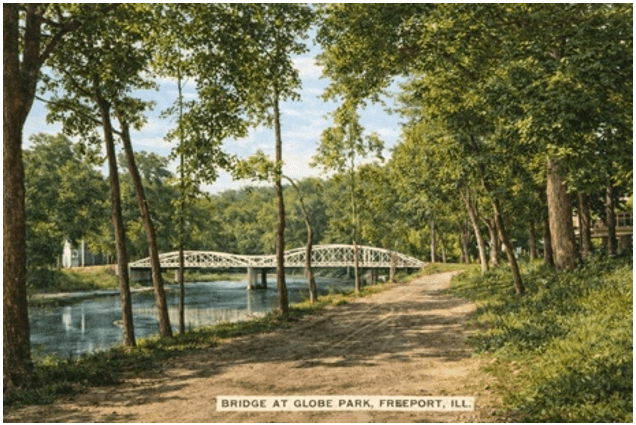
1907 Postcard. Globe Park. Freeport, Illinois.

The platform problem

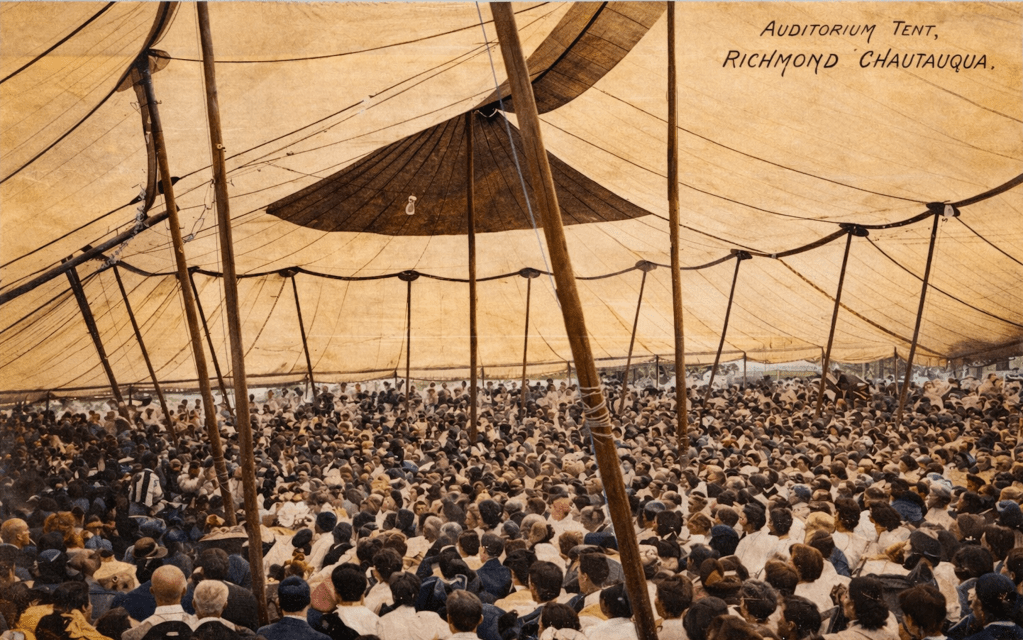
Chautauquas were the strangest preaching venue of Sunday’s career. Unlike his weeks-long revival campaigns — where he could pace himself, develop themes across services, and let an emotional arc build over a month in one town — the Chautauqua format was a one-and-done. You arrived in town, walked onto the platform, gave one talk (maybe two), collected your purse, and left for the next town the following morning. The audience came expecting entertainment as much as religion. They had paid a quarter at the gate and were sitting under canvas alongside crop demonstrations and a forty-piece band. The pressure to perform was relentless, and so was the pace.

Most evangelists who tried the Chautauqua circuit either burned out fast or watered down their content into harmless inspiration. Sunday did neither. He treated the circuit as a laboratory and, over six summers, ran an experiment: which sermons worked everywhere, in front of any crowd, in any town?

The experimental years

The first surviving titled Chautauqua sermon came in August 1904, when Sunday closed out the Sycamore, Illinois assembly with “Old Time Religion.” It was a safe choice — a familiar phrase, a sentimental hook. But it tested the format, and Sunday took notes.

By the following summer, in 1905, he was experimenting more aggressively. At Globe Park in Freeport he preached on Baseball and the Atonement on alternating days, splitting the rhetorical register between personal-story-as-evangelism and straight theology. At Springfield he tried “The Bible” as a stand-alone theme. And at Sterling on July 16, 1905, in front of a crowd of 15,000 — the largest he had ever drawn to a platform — he set aside the sermon entirely and spent half an hour publicly demolishing Elbert Hubbard, the East Coast magazine editor who had recently called him a “grafter.” Coat off, vest off, sleeves rolled, fist in the air. The audience cheered almost every sentence. It was theater, not preaching, and Sunday seems to have realized two things at once: the Chautauqua crowd loved confrontation, and his own personality could carry a platform as well as any sermon he wrote.

By August of 1905 he had decided. A Rockford newspaper carried the announcement: Sunday was “so pleased with the results of his work among the Chautauquas during the summer that he has decided to devote a portion of all summers in the future to Chautauqua work.” He signed with a booking bureau. He was, formally, a Chautauqua headliner now.

The year everything became baseball

1906 is the year you can see Sunday’s strategy lock into place. Of his five documented Chautauqua appearances that summer, four featured “Baseball.” Belvidere on June 22 — 8,000 attendees at a 2:30 afternoon talk. Globe Park on July 8 — anchored on a text from First John, of all things. Janesville on July 29 — 4,000 spell-bound listeners. Sycamore on August 26 — spoke twice. The sermon was the same; the towns were different. Sunday had stopped writing new material and started repeating what worked.

At Muscatine on August 4 he debuted a second sermon: “Nuts for Skeptics.” It was a defense-of-the-faith talk aimed at the educated doubt that the Chautauqua audience — middle-class, literate, often Methodist — was most likely to bring with them. With Baseball anchoring the front half of his rotation and “Nuts for Skeptics” handling the back half, Sunday now had two reliable sermons. Two was already more than most evangelists managed.

The brutal summer of 1907

In 1907 Sunday delivered 86 Chautauqua lectures across roughly 30 sites for about $43,500 in earnings — the equivalent of roughly $1.5 million in 2026 dollars. He was the highest-paid evangelist in America that year, and possibly the highest-paid Chautauqua attraction of any kind. He was also exhausted.

The 1907 newspaper record is strangely thin on sermon titles. Of those 86 lectures, only three titles survive in the curated archive: “The Devil’s Boomerang” at Miami Valley, Ohio on July 23; “Amusements” at Sycamore on August 25; and “Grounders Hot Off the Bat” at the brand-new 4,000-seat steel auditorium at Joliet’s Dellwood Park on August 30. The thin record is itself telling — newspapers were so used to seeing Sunday on every regional platform that they had stopped describing what he preached. He was just Billy Sunday. He was the show.

“The Devil’s Boomerang” matters in retrospect, because it appears to be the first version of what would become the most-delivered sermon of Sunday’s Chautauqua career. The temperance crusade was tightening across the Midwest, and Sunday had found a sermon — eventually retitled simply “Booze” or sometimes “Get on the Water Wagon” — that channeled it. The third sermon in his rotation was now in place.

At Joliet at the end of August, after the steel-auditorium opening, Sunday told the press he was going to cut back on Chautauqua speaking after the season. The constant travel — overnight trains, missed sleep, hay fever, the relentless pace of a fresh town every day or two — was eating into the rest he needed for his revival work. He was 44 years old.

The full rotation

He did not, in fact, cut back. The 1908 Chautauqua titles have not survived in the archive, but by the summer of 1909 Sunday was running a tighter, more disciplined, and more deliberate rotation than ever. Across nine documented summer Chautauqua engagements between July 5 and August 25, 1909, he delivered just four sermons:

Booze — the temperance sermon, preached at Waterloo, Winfield, Trenton, Shelbyville, Petersburg, and originally scheduled at Clinton. Sometimes titled “Get on the Water Wagon.” The most-delivered Chautauqua sermon in Sunday’s archive.

Nuts for Skeptics to Crack — the defense-of-the-faith sermon. Albert Lea, Kearney, Litchfield. The expanded title is the only thing that changed between its 1906 debut and 1909.

Forces that Win — the surprise addition. Three appearances in 1909 (Winfield, Litchfield, Shelbyville), no documented earlier instances. Sunday appears to have developed it specifically for the 1909 summer circuit. The mystery sermon.

Baseball — still in the rotation but no longer dominant. By 1909, the temperance movement had given Sunday a sharper, more politically resonant sermon, and the personal-story sermon receded.

Four sermons. Nine engagements. Maybe two or three of these sermons were on offer at any given stop. The audience got whichever one Sunday thought would land best in their town. At Clinton on August 25, after he had already been booked to preach “Booze,” he changed his mind on the platform and switched to “Skepticism” instead — reading the room, pulling a different sermon from the rotation. The mid-stride change is the cleanest proof of the system: he was not preaching from notes that night. He was performing a known piece from memory, and he picked the one he wanted.

What the rotation tells us

It is tempting to read this as evidence of laziness or commercialism. Sunday found four sermons that worked, the argument might go, and ran them into the ground for the money. But the archive does not support that reading.

What Sunday was actually doing was solving a problem that traveling preachers had wrestled with for a century: how do you sustain emotional and rhetorical intensity across a punishing travel schedule, in front of audiences who have never heard you before? Moody used the same handful of sermons for decades. Sankey sang the same hymns. Sam Jones rotated a fixed set. Sunday’s innovation was not the repetition itself — it was the deliberate, almost engineering-grade winnowing process he ran from 1903 through 1908 to identify which sermons survived contact with audiences of every kind. By 1909 the rotation was tested. The Big Four were not lazy choices. They were the four sermons that had outlasted every other sermon he ever tried on a Chautauqua platform.

There is one more thing worth noticing. The arc of the four sermons traces the arc of American Protestantism between 1903 and 1909 with surprising precision. Baseball — the personal-conversion-story sermon — anchors the rotation early, when Sunday is still selling himself as a novelty. Nuts for Skeptics — the apologetics sermon — comes online in 1906, the same year that liberal theology and the rise of Higher Criticism are pressing hardest on evangelical preachers. Booze rises in 1907 and dominates by 1909, as the temperance movement accelerates toward what would become national prohibition in 1919. Forces that Win arrives in 1909 with no documented backstory — possibly Sunday’s own attempt to articulate what made his methods succeed, possibly a Memorial Day style civic sermon, possibly something else entirely. Whatever it was, it joined the rotation at exactly the moment when Sunday was preparing to make his transition to the big-city revivals that would define the rest of his career.

Four sermons. Every town. The Chautauqua circuit taught Billy Sunday what the big-city campaigns would soon prove: that a small, refined repertoire delivered with overwhelming conviction beats a large, polished one delivered with caution. By the time he walked off the Clinton, Illinois platform on August 25, 1909, with “Skepticism” still ringing in the audience’s ears, the apprenticeship was over. The career-defining decade was about to begin.

All sermon titles, dates, attendance figures, and contemporary press quotations in this post are drawn from the Sunday Master Speaking List, an ongoing research database compiled from period newspapers and archival sources, 2025–2026.

How to cite this post

Chicago: McNutt, Kraig. “Four Sermons, Every Town: How Billy Sunday Cracked the Chautauqua Circuit.” Evangelist Billy Sunday (1862–1935), June 3, 2026. https://evangelistbillysunday.com/2026/06/03/four-sermons-every-town-how-billy-sunday-cracked-the-chautauqua-circuit/.

MLA: McNutt, Kraig. “Four Sermons, Every Town: How Billy Sunday Cracked the Chautauqua Circuit.” Evangelist Billy Sunday (1862–1935), 3 June 2026, evangelistbillysunday.com/2026/06/03/four-sermons-every-town-how-billy-sunday-cracked-the-chautauqua-circuit/.

APA: McNutt, K. (2026, June 3). Four sermons, every town: How Billy Sunday cracked the Chautauqua circuit. Evangelist Billy Sunday (1862–1935). https://evangelistbillysunday.com/2026/06/03/four-sermons-every-town-how-billy-sunday-cracked-the-chautauqua-circuit/

Turabian: McNutt, Kraig. “Four Sermons, Every Town: How Billy Sunday Cracked the Chautauqua Circuit.” Evangelist Billy Sunday (1862–1935). June 3, 2026. https://evangelistbillysunday.com/2026/06/03/four-sermons-every-town-how-billy-sunday-cracked-the-chautauqua-circuit/.

What Billy Sunday Borrowed from Chapman — and What He Made His Own

When Billy Sunday stepped out on his own as an evangelist in 1896, he did not start from nothing. He started from a kit. Much of that kit had been handed to him by the man he had served as advance agent and understudy, the polished Presbyterian revivalist J. Wilbur Chapman. Sunday himself never hid this. The interesting question is not whether he borrowed — it is what he borrowed, how long he kept it, and what he eventually built in its place.

A close comparison of Sunday’s early preaching record against Chapman’s own published sermon portfolio lets us answer that question with something better than impression. The picture that emerges is not a story of a man trapped inside his mentor’s material. It is a story of an apprentice spending down an inheritance and, year by year, replacing it with a voice that was unmistakably his own.

The starting kit, 1895

In the years he was still working closest to Chapman, Sunday’s preaching looks the most borrowed. Several of his 1895 titles are not merely similar to Chapman’s — they are the same sermon. “Is It Well With Thee?” runs on the same text Chapman used. “How Shall We Escape?” matches Chapman title-for-title and verse-for-verse. The sermon on receiving the Holy Spirit lands on the same subject Chapman had already put into print.

The rest of 1895 is standard revival stock of the period — the familiar parables of the lost sheep, the publican and the Pharisee, Zaccheus, the laborers in the vineyard. This is not yet a body of original work. It reads like a young evangelist preaching the sermons he had heard his mentor preach, in the order he had learned them.

1896: the borrowed frame, the new flesh

The year Sunday went solo, his sermon list more than doubles. The reason is simple and human: a man running his own multi-week campaign suddenly needs enough material to fill it, and the cheapest place to find that material was the well he already knew. So the Chapman skeleton is still doing real work in 1896 — the surrendered-life sermon on Kadesh-Barnea, the cluster on the unpardonable sin, the sermon on Christ’s first converts, the warnings to backsliders, the “decide now, don’t wait until tomorrow” appeal.

But 1896 is also the year you can first hear the other Billy Sunday — the one the country would eventually pack tabernacles to see. Alongside the inherited sermons sit titles with no parallel anywhere in Chapman’s portfolio: a sermon against drink, a broadside against the “isms and cults,” and a pair of plain, muscular talks about effort and preparation. The frame is still Chapman’s. The flesh on it is starting to be Sunday’s.

1897: the gospel of judgment turns personal

By 1897 the balance has tipped. Only one clear Chapman carryover survives in the record, and the center of gravity has moved hard toward judgment, hell, and eternity — “After death, the judgment,” “There is a hell,” “Where will you spend eternity?” — together with a frontal attack on infidelity and loose living.

This is the emerging Sunday brand, and it is worth noting what it is not. It is not Chapman’s measured, doctrinal, teaching voice. Chapman the careful Presbyterian taught his hearers what a Christian is and what the gospel means. Sunday kept the part of Chapman that pressed for a decision and quietly dropped the part that paused to instruct. He kept the closer and let go of the teacher.

The Chautauqua years: Chapman all but disappears

Now jump ahead to Sunday on the Chautauqua circuit between 1901 and 1911 — the popular lecture platform where he spoke to general crowds rather than revival congregations. Here the transformation is nearly complete.

Across more than two dozen documented Chautauqua appearances, the old Chapman material has effectively vanished. In its place stands a repertoire that is entirely, recognizably Sunday’s: the baseball talk, the temperance assault under titles like “The Devil’s Boomerang” and “Get on the Water Wagon,” the skeptic-bashing of “Nuts for Skeptics to Crack,” and the brisk motivational lecture “Forces That Win.” Conversion-and-judgment preaching, the very heart of the revival sermons, almost never appears on this stage. The platform audience came for a performance and a point of view, not an altar call, and Sunday gave them exactly that.

And yet one thread runs all the way through. The single Chapman sermon still standing on the Chautauqua circuit is “How Shall We Escape?” — the same sermon that had been a word-for-word borrowing back in 1895. It is at once the strongest early borrowing and the lone survivor a half-decade later. Of everything Chapman handed him, essentially this one sermon endured. The rest he had outgrown.

What was actually his

So which sermons were truly Sunday’s own — the small original core he built on while the borrowed material fell away?

The most reliable test is not simply “absent from Chapman’s list.” It is durability: which non-Chapman subjects appeared early and survived into his independent, mature preaching. By that measure, three themes stand out, and all three are visible by 1896:

  • Drink. The early anti-saloon sermon becomes the most-repeated subject of his Chautauqua years. If any single theme is the signature of the independent Billy Sunday, this is it.
  • Skepticism and infidelity. The early swipe at “isms and cults” hardens into a recurring, crowd-pleasing attack on doubt and unbelief.
  • Effort and will. The plain talks on having a mind to work and on need, opportunity, and preparation point straight ahead to “Forces That Win.”

These are the sermons that were his, because these are the ones he kept when he no longer had to lean on anyone. The borrowed gospel of judgment got him started; this original core is what he became.

A note on the work behind this

This comparison rests on a sermon-by-sermon crosswalk of Sunday’s documented early titles against Chapman’s published portfolio, sorted into tiers — word-for-word borrowings, shared subjects, looser thematic echoes, and sermons original to Sunday. The early record (1895–1897) and the Chautauqua window (1901–1911) are well represented. The crusade years in between are still being reconstructed, and as that record fills in, parts of this picture may sharpen or shift. But the overall shape is already clear: Billy Sunday left his mentor carrying a borrowed kit, drew on it hardest in his first solo year, and over the following decade made himself almost entirely into his own creation.

How to cite this post

Chicago: McNutt, Kraig. “What Billy Sunday Borrowed from Chapman, and What He Made His Own.” Evangelist Billy Sunday (1862–1935), May 30, 2026. https://evangelistbillysunday.com/2026/05/30/what-billy-sunday-borrowed-from-chapman-and-what-he-made-his-own/.

MLA: McNutt, Kraig. “What Billy Sunday Borrowed from Chapman, and What He Made His Own.” Evangelist Billy Sunday (1862–1935), 30 May 2026, evangelistbillysunday.com/2026/05/30/what-billy-sunday-borrowed-from-chapman-and-what-he-made-his-own/.

APA: McNutt, K. (2026, May 30). What Billy Sunday borrowed from Chapman, and what he made his own. Evangelist Billy Sunday (1862–1935). https://evangelistbillysunday.com/2026/05/30/what-billy-sunday-borrowed-from-chapman-and-what-he-made-his-own/

Turabian: McNutt, Kraig. “What Billy Sunday Borrowed from Chapman, and What He Made His Own.” Evangelist Billy Sunday (1862–1935). May 30, 2026. https://evangelistbillysunday.com/2026/05/30/what-billy-sunday-borrowed-from-chapman-and-what-he-made-his-own/.

Billy Sunday on the Chautauqua Circuit: The Brief but Notable Season of 1910

In the summer of 1910, Billy Sunday stood at an interesting crossroads in his rapidly expanding ministry. By this point he was already nationally known as one of America’s most electrifying evangelists. Cities across the country were beginning to build large tabernacles to accommodate the crowds that flocked to hear him preach. Yet during the summer months—when revival campaigns often paused—Sunday occasionally appeared on the Chautauqua circuit, the great American network of traveling lecture assemblies that combined education, entertainment, reform movements, and religion.

Unlike many lecturers who spent the entire season touring the circuit, Sunday’s 1910 Chautauqua schedule was surprisingly limited. He appeared only at a handful of assemblies, and his comments to the press make clear that this was intentional. Sunday had been offered lucrative opportunities to spend the entire summer lecturing. One newspaper reported that he declined an offer of $20,000 to devote the season to Chautauqua work, explaining that the exhausting schedule would leave him unable to conduct revival campaigns in the fall.

“The report that I am to retire is all pure nonsense… I refused $20,000 to give my time to Chautauqua work this summer, as I would be worn out and could not preach before January.”

Sunday’s priority remained evangelistic preaching. Nevertheless, the few Chautauqua appearances he did make during the summer of 1910 provide a fascinating glimpse into his growing national popularity and the remarkable drawing power he already possessed.


Whidbey Island: The Northwestern Chautauqua Assembly

Sunday’s Chautauqua engagements began on July 24, 1910, at the Northwestern Chautauqua Assembly on Whidbey Island, Washington.

At this gathering Sunday delivered a message titled “Forces that Win.” Like many of his sermons, it blended moral exhortation with vivid biblical storytelling. Reports indicate he illustrated his message with the story of David and Goliath, a favorite example of spiritual courage overcoming overwhelming odds.

Even among the prominent lecturers and performers typical of a Chautauqua program, Sunday stood out. His dynamic speaking style—rapid delivery, colorful language, and dramatic physical movement—contrasted sharply with the more measured lecture format audiences often expected.


Hillsboro–Litchfield: A Midwestern Assembly

In early August Sunday appeared at the Hillsboro–Litchfield Chautauqua, running from August 4 through August 11. These regional Chautauqua assemblies usually featured a mixture of lectures, concerts, political discussions, and religious addresses.

Sunday’s presence on such programs reflected the growing recognition that he was not merely a revivalist but also one of the most compelling public speakers in the country.


Maxwelton, Washington: Crowds Even in Small Communities

On August 6, Sunday spoke at the Maxwelton Chautauqua in Washington, addressing a crowd estimated at 4,500 people.

The size of the audience is striking. Maxwelton itself was a small community, yet thousands gathered to hear Sunday speak. Even outside the large urban revival campaigns for which he would soon become famous, his reputation alone was enough to draw impressive crowds.


Patterson Springs: Record-Breaking Interest

Another Chautauqua stop came on August 10 at Patterson Springs. Newspapers noted that Sunday had previously delivered a lecture there that produced $3,600 in ticket receipts, reportedly a record for a single Chautauqua lecture.

This financial success reveals something important about Sunday’s role in the Chautauqua movement. He was not just a preacher filling a religious slot in the program. He was one of the circuit’s major attractions, capable of drawing large audiences and generating significant revenue.

Even so, Sunday resisted becoming primarily a Chautauqua lecturer. His heart remained in revival work.


Lake Whatcom: The “Human Interest” Lecturer

On August 24, Sunday appeared at the Washington Assembly Chautauqua near Lake Whatcom. Promotional material advertised him as delivering the program’s “human interest” lecture, a category that perfectly suited his style.

Sunday’s talks often mixed humor, storytelling, social criticism, and passionate moral appeal. He could move easily from a humorous anecdote to a blistering denunciation of vice, particularly the liquor trade. This blend of entertainment and moral seriousness made him an ideal Chautauqua speaker.


Richmond, Indiana: A Crowd of Eight Thousand

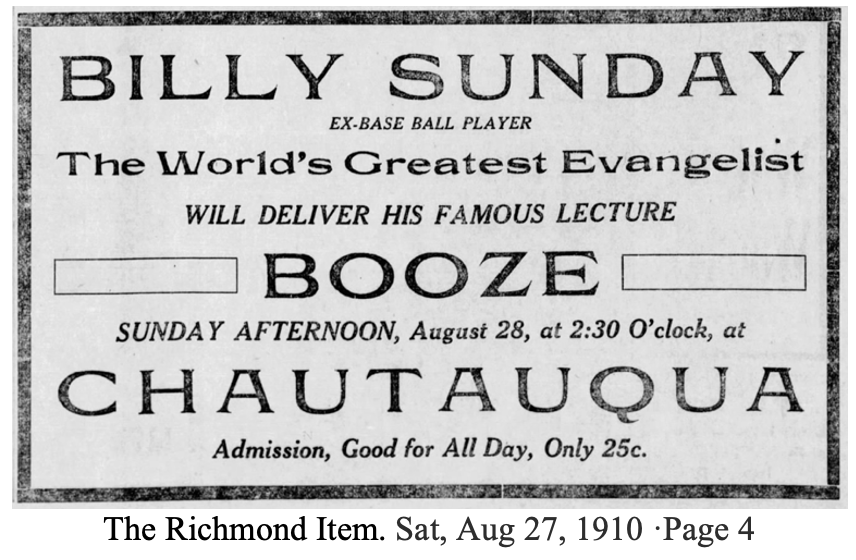
Sunday’s most dramatic Chautauqua appearance of 1910 came on August 28 at the Richmond, Indiana Chautauqua.

The crowd numbered roughly 8,000 people, and Sunday delivered one of his most famous temperance sermons, “Booze.”

Contemporary accounts describe a performance that was nothing short of theatrical. Once fully warmed up, Sunday removed his coat and launched into an explosive denunciation of the saloon. At one point he grabbed a red flag representing the liquor trade, hurled it to the ground, and stamped on it before triumphantly seizing the American flag to symbolize moral victory.

Such dramatic gestures were typical of Sunday’s style. Critics sometimes mocked them as stage tricks, but audiences loved them. They reinforced his reputation as the relentless enemy of alcohol and social vice.


Why the 1910 Season Was Short

One of the most interesting aspects of Sunday’s Chautauqua activity in 1910 is how limited it was.

Rumors circulated in the press that he might be retiring from public speaking altogether. In reality, the opposite was true. Sunday simply refused to devote the entire summer to the lecture circuit.

He explained that constant Chautauqua travel would leave him exhausted and unable to conduct the revival campaigns that he believed were his true calling. Instead, he used the summer months partly for rest and partly for select speaking engagements before returning to the intense schedule of fall revivals.

This decision proved wise. Later in 1910 Sunday conducted major campaigns in New Castle, Pennsylvania, and Waterloo, Iowa, drawing enormous crowds and recording thousands of conversions.


A Glimpse of Sunday’s Expanding Influence

Though brief, Billy Sunday’s 1910 Chautauqua season reveals several important aspects of his rising influence.

First, it demonstrates the extraordinary demand for him as a public speaker. Even isolated appearances drew crowds in the thousands.

Second, it shows that he was already a major figure in the reform movements of the era—especially the temperance crusade.

Finally, it highlights Sunday’s own priorities. While many speakers made their careers on the Chautauqua circuit, Sunday viewed it as secondary. His passion remained revival preaching and evangelism.

In hindsight, the summer of 1910 marks a moment when Billy Sunday could have easily become one of the most lucrative lecturers in America. Instead, he chose the harder path—returning to the sawdust floors of revival tabernacles and the exhausting pace of evangelistic campaigns.

And in doing so, he continued building the ministry that would soon make him the most famous evangelist in America.

July 1911 – Hannibal Courier-Post – Billy as Chautauqua headliner

Hannibal, Missouri paper

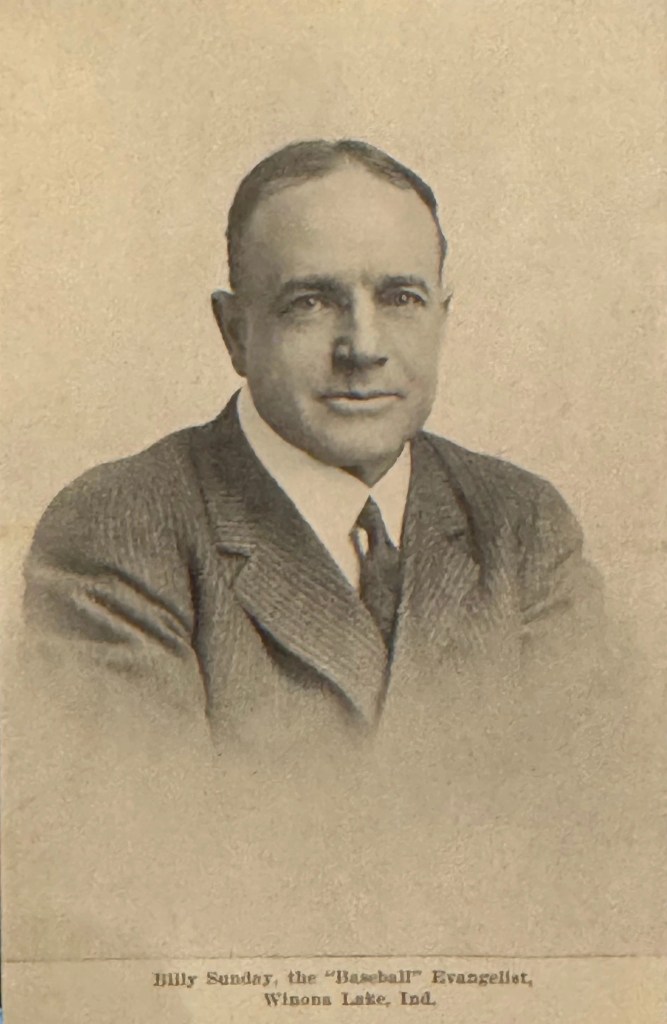
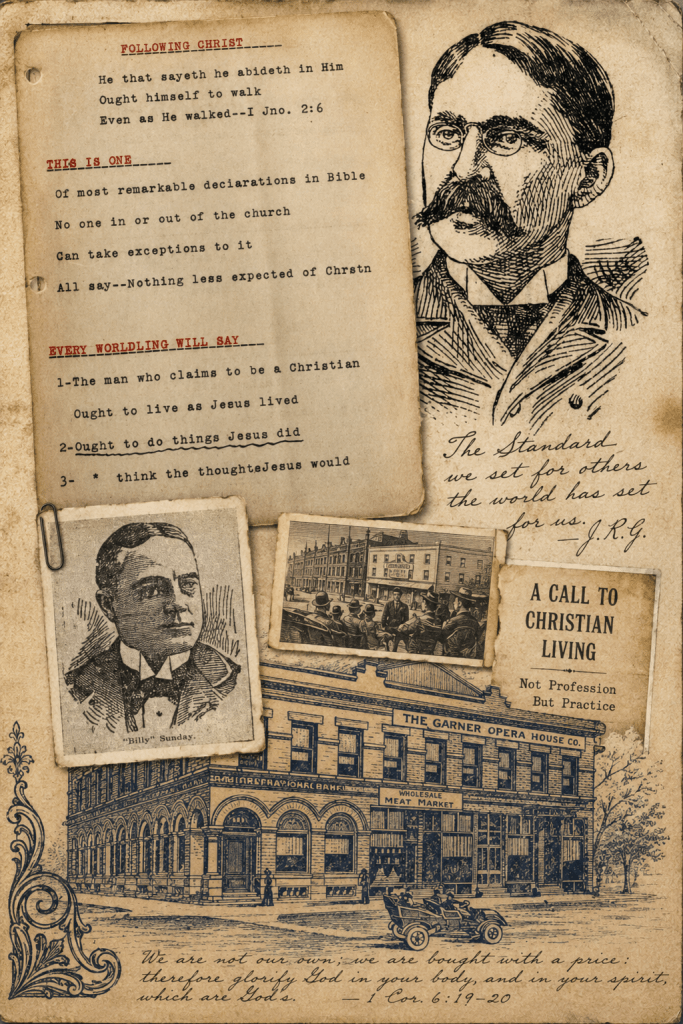
“BILLY” SUNDAY

Revivalist and Chautauqua Headliner

Image credit: author

Thomas E. Green, well known to Chautauqua audiences published in the June 1910 issue of Hampton’s Magazine, an article on “Revivals and Revivalists.” The whole article is full of interest. Chautauqua Committees who have booked Billy Sunday will do well to secure it, as it furnishes splendid material for publicity. He quotes the following estimates of Sunday’s work in places where he has held meetings: The leading pastor in the converted city, a man of ripe judgment, said: “I looked forward to this thing with a great deal of anxiety. When the evangelist came he quite captured me. He is unique. There is only one of his class, and probably it is well that it is so, but he showed himself sincere and honest. There were 736 conversions, and in addition about 1,500 have united with the churches.”

A very hard-headed banker told me: “The cost to the city was something over $16,000. The evangelist got over $7,000, but he earned every cent of it. If a lot of preachers in this country would do as much in five years as he did in five weeks, and work half as hard, they might be entitled to as much return.”

A leading editor said: “His sermon on ‘booze’ was I believe, the greatest individual effort I ever heard from the platform. He talked to six thousand men, and held them as in the hollow of his hand. Up in our bindery I understand all the boys and girls were converted and they are sure a happy bunch.”

I know of one mid-Western manufacturing city in which a fervid revival was held by one of the greatest revivalists of the day. It was not a “bad town” in the beginning. It was a “river town,” however—a “liberal town.” The saloons had never been officially closed even under state law of the stringent anti-saloon sort. For a city of 25,000 people it was what is called “wide open.” The revivalist came, and for six weeks his work went on. At the next city election, as a direct result of the revival, the people voted out a “liberal” administration, and voted in a “closed town” administration. The saloons were closed, and the town is so well pleased they are likely to remain closed, for a long time.

I have known Billy Sunday ever since the days when he came to the old Chicago Ball Club, the days when with my athletic ardor yet unabated I was “Chaplain” of the League.

Billy played rattling good ball, championship form, and he has kept the same standard during a phenomenal career. His meetings are enormous in size and results. His “thank offerings” are the largest any evangelist has ever received.

“Drunkenness, gambling, adultery, theatre going, dancing, and card playing are damning America, and nothing can save it from ruin but a revival of religion,’ says Billy Sunday.

“You think, then, that our popular amusements and recreations are wrong?”

I know it. Dancing is nothing but a hugging match set to music. It’s the hotbed of licentiousness whether in a fashionable parlor or in a dive. More girls are ruined by it than by all other things combined. Talk about the poetry of motion! It’s just a devilish snare of souls. Let men dance with men and women with women, and the thing wouldn’t last fifteen minutes. The slum dance is better than the club dance, because they wear more clothes at it.”

“Sow bridge whist and you reap gamblers. The man who sits at a table and bets a thousand on a jack pot is no more a gambler than the society belle who plays bridge for a prize.”

That’s Billy Sunday, America’s greatest evangelist. On the platform he “plays ball.” Attitude, gestures, method—he crouches, rushes, whirls, bangs his message out, as if he were at the bat in the last inning, with two men out and the bases full. And he can go into any city in America and for six weeks talk to six thousand people twice a day, and simply turn that community inside out.

Hannibal Courier-Post. Hannibal, Missouri · Thursday, July 27, 1911

When the Tent Met the Tabernacle: How Chautauqua Shaped Billy Sunday’s Evangelism

When the Tent Met the Tabernacle: How Chautauqua Shaped Billy Sunday’s Evangelism

In the annals of American religious and cultural life, few figures loom as large—or as loud—as Billy Sunday. Baseball player turned fiery evangelist, Sunday crisscrossed the country in the early 20th century, preaching repentance with the speed of a sprinter and the flair of a vaudevillian. But while his legacy is often associated with revivalism, the DNA of another cultural institution runs unmistakably through his ministry: the Chautauqua movement.

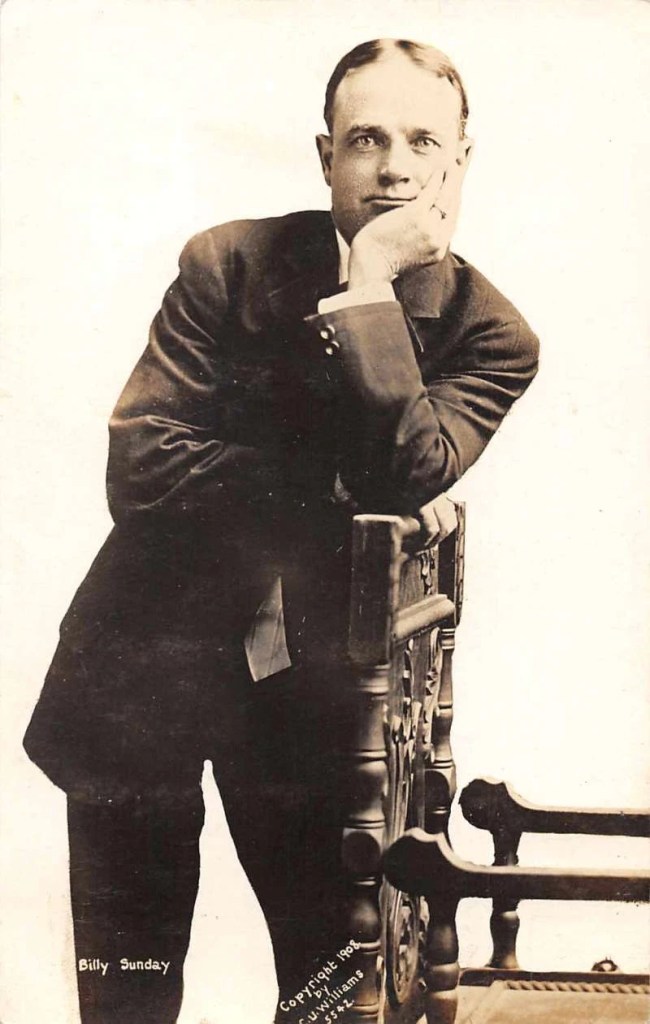
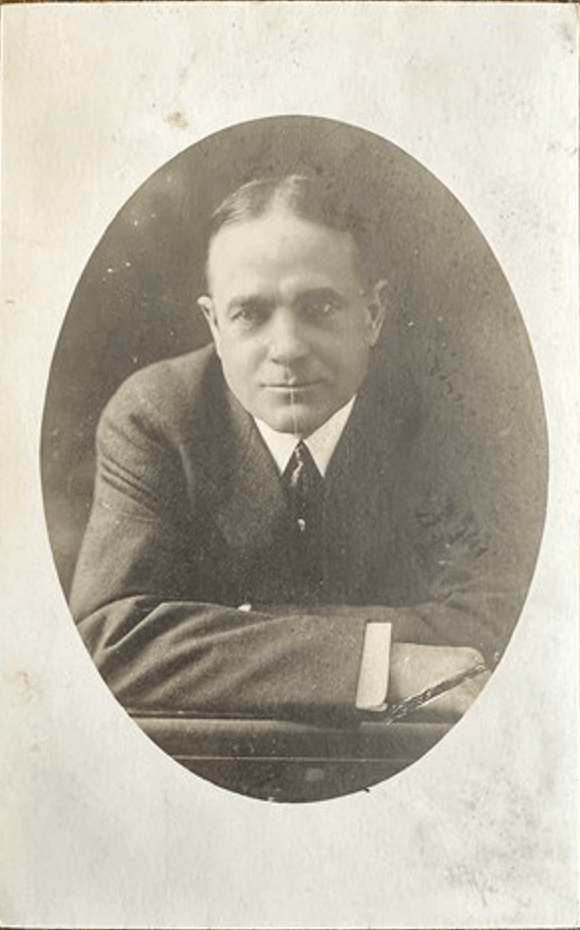
Billy Sunday, postcard.
Author’s collection.

At first glance, Chautauqua and revivalism might seem like distant cousins. One promoted moral uplift through lectures, music, and education. The other sought soul transformation through emotional preaching, altar calls, and fervent prayer. But in the figure of Billy Sunday, these two worlds converged. His campaigns became a kind of hybrid phenomenon: part Chautauqua, part revival, and fully American.

The Chautauqua Tradition: A Traveling Feast of Ideas and Morals

Founded in 1874 on the shores of Chautauqua Lake, New York, by Methodist minister John H. Vincent and inventor Lewis Miller, the original Chautauqua Assembly was conceived as a summer Bible training camp for Sunday School teachers. But it quickly evolved into something broader: a nationwide movement combining education, religion, entertainment, and civic virtue.

Chautauquas—especially circuit Chautauquas—toured rural America with tents, stages, and full programming that brought lectures, concerts, and clean entertainment to small-town audiences. They celebrated middle-class Protestant values, offering inspiration in digestible, family-friendly form.

Enter Billy Sunday

By the late 1890s, Billy Sunday had left baseball behind and was learning the ropes of itinerant evangelism. His early mentors, J. Wilbur Chapman and R.A. Torrey, both had connections to the broader Chautauqua scene. Torrey especially was a regular Chautauqua speaker, bringing theology to the people in accessible form.

Sunday’s own gifts—storytelling, humor, physical theatrics, and moral fervor—were tailor-made for the Chautauqua stage. Though he would later distinguish himself through large-scale revivals and sawdust trails, his early career intersected directly with the Chautauqua movement.

Vawter’s Influence on Sunday

One of the pivotal figures behind Sunday’s deeper involvement with the Chautauqua model was Keith Vawter, the mastermind of the circuit Chautauqua system. According to scholar John E. Tapia, Vawter recognized Sunday’s potential to reach mass audiences and personally encouraged him to join the Redpath Chautauqua circuit. Vawter believed Sunday’s electrifying delivery, athletic stage presence, and moral seriousness would resonate strongly with Chautauqua crowds. Sunday accepted Vawter’s invitation in 1910, a move that proved strategic. Through the Chautauqua platform, Sunday expanded his audience, sharpened his performance style, and laid the groundwork for the national revival campaigns that would follow.

Evidence of Sunday at Chautauquas

Thanks to primary sources and local records, we now know that Billy Sunday didn’t just resemble a Chautauqua speaker—he was one:

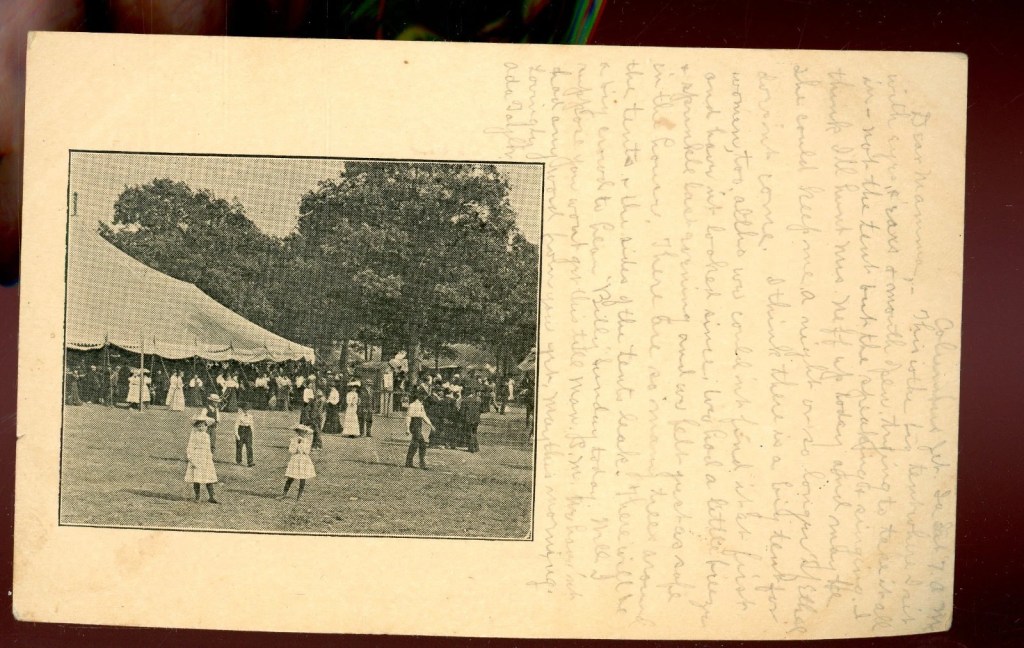
Clarinda, Iowa (August 6, 1908) – A postcard written by a local resident records hearing a “Billy Sunday lecture” at the Clarinda Chautauqua. Not a sermon—a lecture. The terminology matters. It shows that Sunday knew how to tailor his message to fit the expectations of a Chautauqua crowd: moral, inspiring, and educational.

Glenwood Park Chautauqua, New Albany, Indiana (c. 1910) – Sunday spoke at this established Chautauqua venue, likely during his period of growing regional fame. He was still accessible to small- to mid-sized communities, many of whom relied on Chautauqua programs to deliver cultural and religious content. Citation source that documents this: New Albany Evening Tribune, July 28, 1911.

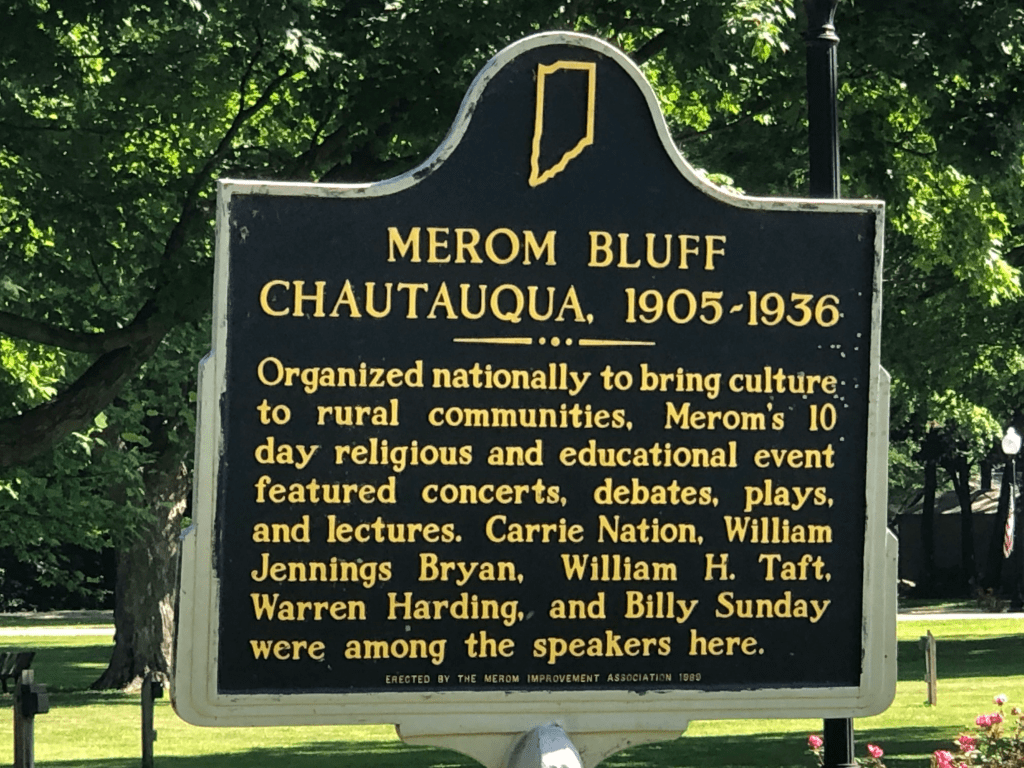
Merom Bluff, Indiana (1905–1936 window) – A historical marker affirms that Billy Sunday was among the Chautauqua speakers at this prominent Indiana site, which also hosted Union Christian College and later became a Christian conference center.

Style and Structure: Chautauqua Meets Revival

Billy Sunday’s campaigns began to take on the structure and tone of a Chautauqua assembly:

  • Large tent gatherings or temporary tabernacles, much like Chautauqua’s traveling canvas venues.
  • Multi-day programs with scheduled content: music, oratory, public testimonials.
  • Musical programs and choirs, often with well-known gospel singers.
  • Printed programs and media promotion, echoing Chautauqua’s organized outreach and civic coordination.

Yet Sunday brought something extra—a sense of urgency that Chautauquas, with their genteel tone, typically lacked. He fused the moral inspiration of Chautauqua with the soul-piercing call of revivalism. His tabernacles weren’t just tents for listening; they were arenas for decision.

Cultural Cross-Pollination

Chautauquas were formative in shaping expectations for public religious discourse. They taught small-town America that religion could be engaging, moral talk could be entertaining, and spiritual renewal didn’t have to be confined to Sunday morning.

Billy Sunday absorbed this atmosphere. And then he supercharged it.

  • He was more animated than the average Chautauqua speaker.
  • More confrontational than the typical reformer.
  • But he drew from the same well: public performance for private transformation.

Legacy: The Best of Both Worlds

By the time Sunday’s revivals were drawing tens of thousands in cities like Chicago and Philadelphia, they had become national spectacles—but their format still bore the fingerprints of Chautauqua:

  • A well-run operation.
  • A mixture of culture, faith, and public engagement.
  • A populist appeal that transcended denominations and drew in families, skeptics, and civic leaders alike.

His campaigns offered what Chautauqua promised—but with an eternal decision point at the center.

Conclusion: When the Tent Met the Tabernacle

To understand Billy Sunday is to recognize that he wasn’t merely a revivalist in the tradition of Charles Finney or Dwight Moody. He was also a cultural performer in the lineage of Chautauqua. His ministry represents a moment when two great American traditions—moral uplift through public culture and urgent gospel proclamation—merged under one tent.

Billy Sunday didn’t just inherit the Chautauqua model; he transformed it. In doing so, he left behind not only converts, but a new standard for religious communication in the public square: part educator, part entertainer, part prophet.