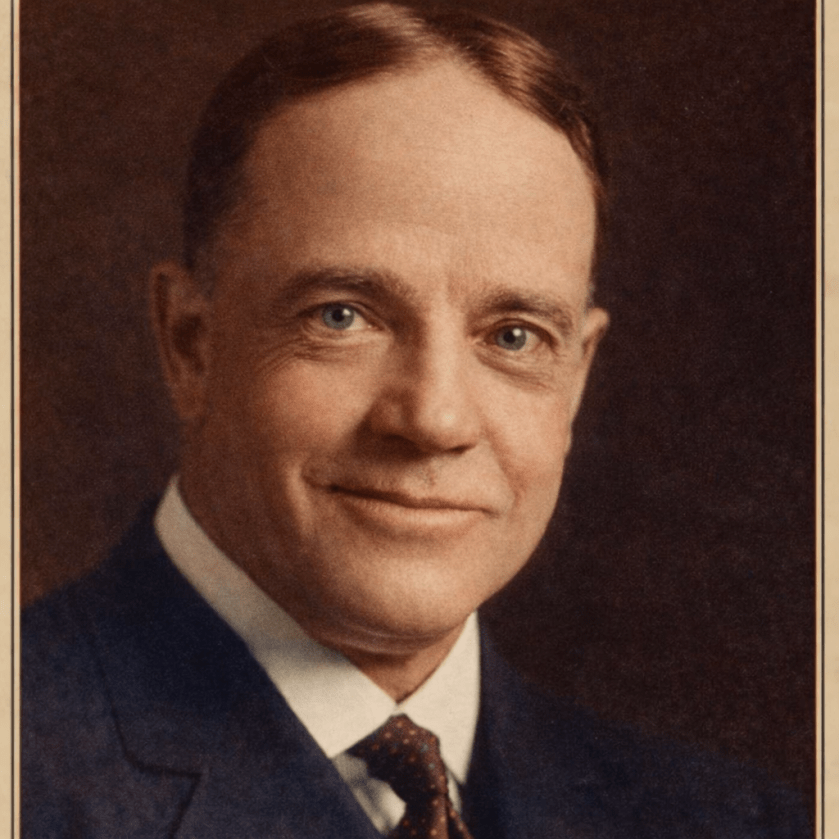
Former professional baseball player-turned urban evangelist. Follow this daily blog that chronicles the life and ministry of revivalist preacher William Ashley "Billy" Sunday (1862-1935)
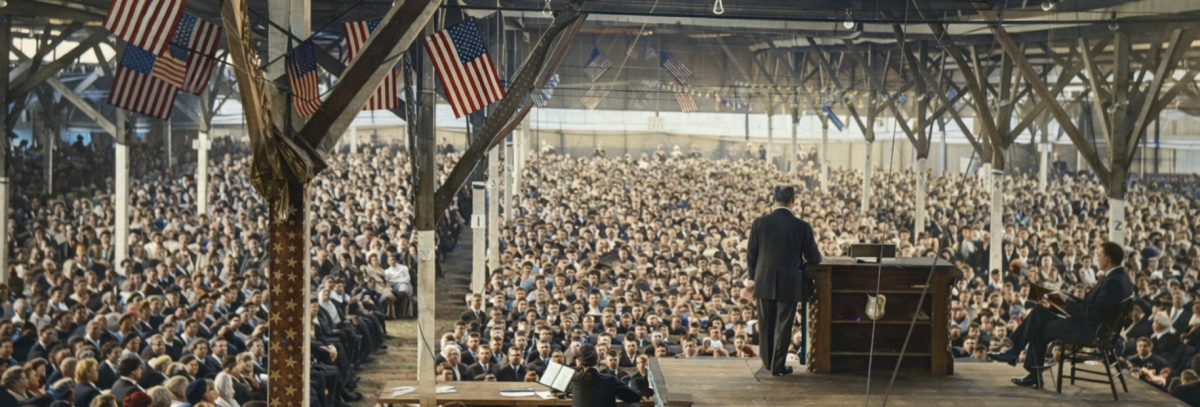
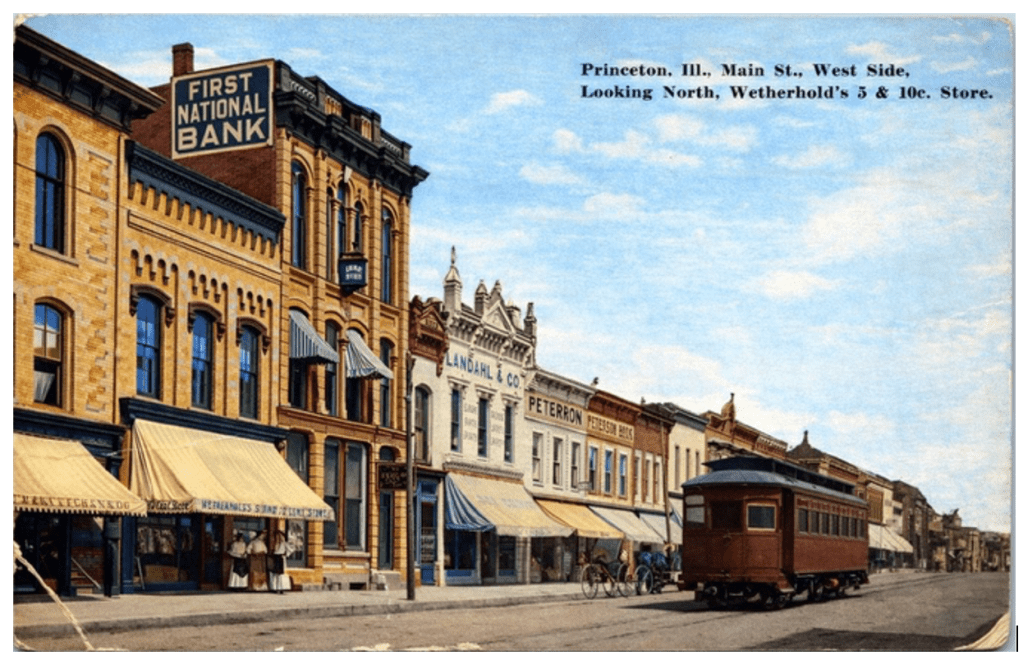
From February 11 to March 11, 1906, evangelist Billy Sunday conducted a major revival campaign in Princeton, drawing sustained crowds and producing significant conversion totals that reinforced his growing reputation as one of the most effective evangelists in the Midwest. A temporary tabernacle seating approximately 3,600 people was filled nightly, indicating the strong regional interest in Sunday’s preaching and the extensive cooperation of local churches.
The meetings quickly produced measurable results. One report noted 919 conversions in a single day on February 24, illustrating the intense response often seen at the height of Sunday’s campaigns. Despite severe winter weather—including one of the worst storms of the season on March 3—attendance and participation remained strong. By March 8, newspapers reported 1,298 converts, and by the close of the revival on March 11, the total number of recorded conversions had reached 2,325.
Contemporary observers described the atmosphere in Princeton as spiritually charged. A visiting pastor reported that the “city was aflame with the revival spirit,” while others praised Sunday’s dynamic preaching style, likening his delivery to a “storm” or “cyclone” in its intensity. His methods, though sometimes criticized as sensational, were widely regarded by supporters as effective in reaching large audiences—especially men—who might otherwise avoid church.
The Princeton campaign also contributed to Sunday’s rapidly expanding influence across the region. Shortly afterward, newspapers noted that since October 1905 he had reportedly received about $12,000 in offerings and recorded 9,000 conversions, with 20,000 conversions attributed to his work across the Rock River Valley of Illinois. The Princeton meetings thus formed a significant chapter in the early expansion of Sunday’s evangelistic career.
Sources: The Dixon Evening Telegraph, March 2, 1906, p. 5. Bureau County Tribune (Princeton, IL), March 9, 1906, p. 3. Freeport Journal-Standard (Freeport, IL), February 26, 1906, pp. 1, 5; March 8, 1906, p. 4. Journal Gazette and Times-Courier (Mattoon, IL), March 19, 1906, p. 1.
And Why the Offer Destroys the Claim That He Preached for Money
One of the most common criticisms leveled against evangelist Billy Sunday is that he preached for money.
Critics point to the generous love offerings that were sometimes taken at the close of his revival campaigns and conclude that Sunday must have been motivated by financial gain. It is an easy accusation to make. But historical evidence tells a very different story.
One remarkable document from 1917 puts the matter in perspective.
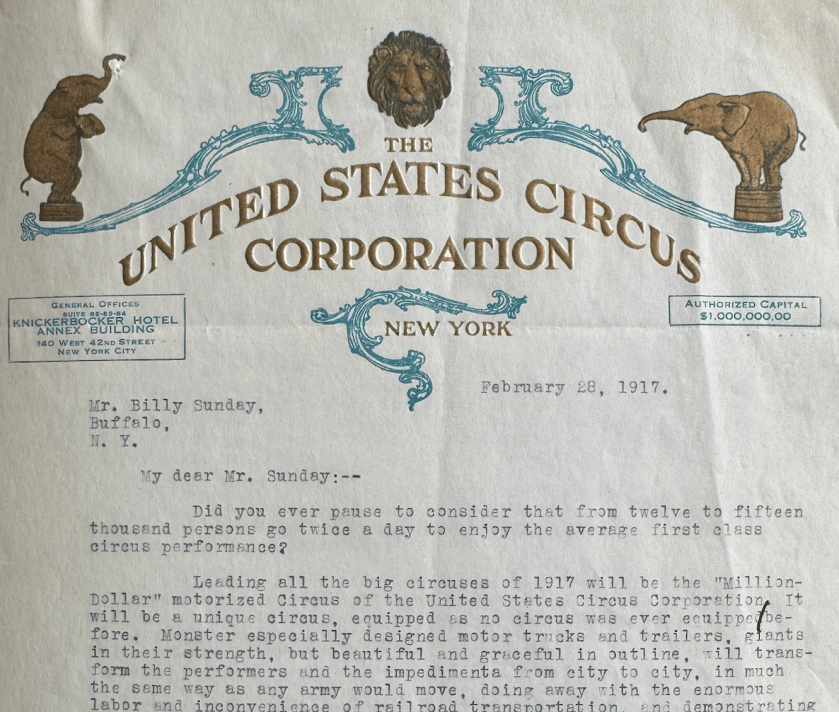
On February 28, 1917, Billy Sunday received an extraordinary letter from the president of the United States Circus Corporation. The proposal was simple, bold, and almost unbelievable.
The circus wanted Billy Sunday to join the show.
Original 1917 contract. Grace College. Morgan Library.
The letter opened by reminding Sunday of the enormous audiences that circuses attracted:
“Did you ever pause to consider that from twelve to fifteen thousand persons go twice a day to enjoy the average first class circus performance?”
The promoter explained that the company was launching what he called a “Million-Dollar” motorized circus, equipped with fleets of specially designed trucks and trailers that would carry the show from city to city.
The scale was enormous. Tens of thousands of people attended circus performances daily.
And the circus president believed Billy Sunday could preach to them.
Then came the offer.
“I… offer you a weekly salary of $14,000, or $2,000 a day, for as many weeks of the coming summer season as you can give.”
To grasp how staggering this proposal was, consider the numbers.
If Sunday had accepted the offer and worked for roughly ninety to one hundred days during the summer season, he would have earned between $180,000 and $200,000 in 1917.
Adjusted for inflation, that is roughly $4 million today.
In return, the circus would provide transportation, luxury touring cars for Sunday and his staff, and access to massive crowds across the country.
The promoter even suggested that Sunday hold revival meetings on Sundays as part of the circus program.
But here is the crucial point.
The proposal made no provision for Sunday to keep offerings from those meetings. In fact, the letter suggested that the proceeds from Sunday services could go largely or entirely to charity.
The circus wanted Billy Sunday not as a fundraiser—but as an attraction.
A headline act.
A revivalist who could preach to the largest audiences in America.
And yet Billy Sunday refused.
The Economics of Sunday’s Real Ministry
Now compare this circus offer to the income Sunday actually received during the same years.
During the summer Chautauqua season, Sunday could deliver 50 to 70 speaking engagements.
Typical speaking fees ranged from $250 to $500 per engagement.
That means a strong Chautauqua season might produce:
$12,500 on the low end
$35,000 on the high end
Even at the very top of that range, the circus contract would have paid five to six times more.
In other words, if Billy Sunday had been motivated primarily by money, the decision would have been obvious.
He could have become the highest-paid religious speaker in America simply by joining a circus.
Instead, he chose the sawdust trail.
He chose the revival tabernacle.
He chose the ministry that demanded months of exhausting preaching, travel, prayer meetings, counseling, and organization.
And he did it for far less money than the circus was willing to pay.
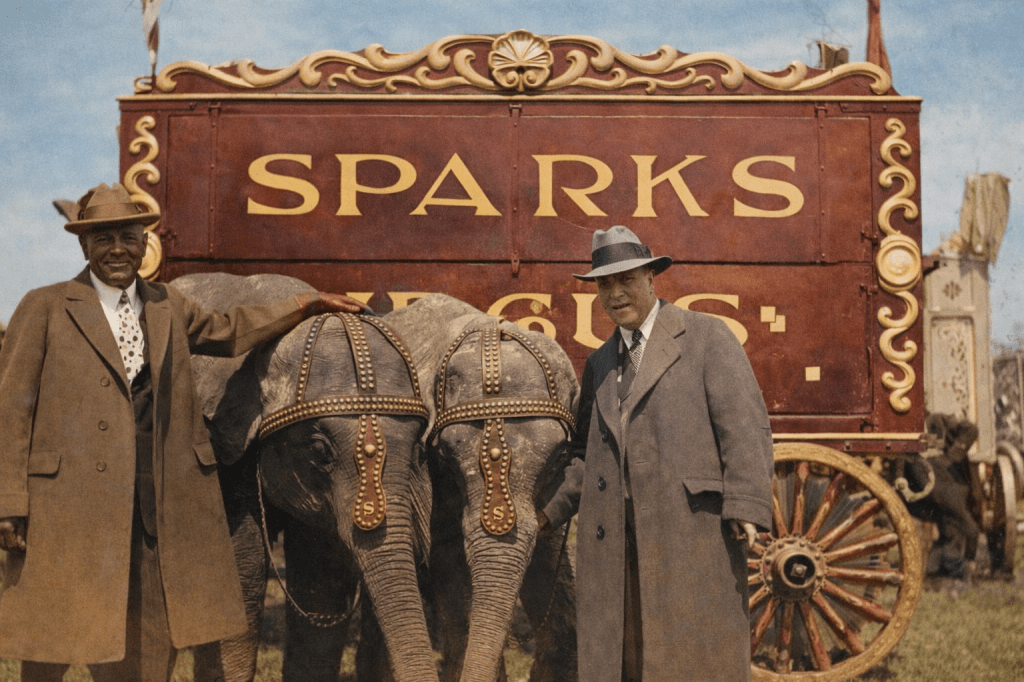
Rare original Sparks Bros Circus photograph showing evangelist Billy Sunday and Charles Sparks.
Why the Critics Miss the Point
Billy Sunday never pretended that money did not matter. Revival campaigns required large temporary tabernacles, choirs, staff members, and enormous logistical efforts.
But Sunday consistently refused opportunities that would have turned his preaching into entertainment.
The 1917 circus contract proves it.
The entertainment industry was willing to pay him millions in today’s dollars to headline the largest traveling show in America.
He said no.
The same evangelist who was accused of preaching for money walked away from a fortune.
And that fact should cause us to reconsider the narrative that Sunday’s critics often repeat.
Billy Sunday may have been many things—a fiery preacher, a former baseball player, a relentless evangelist—but the historical record shows that he was not in the ministry merely for the money.
If he had been, the circus would have had its star.
Instead, the revival fires continued to burn.
Did you know?
“It may not be generally known, but ‘Billy’ Sunday supports a mission on Van Buren street, Chicago, paying all the expenses of maintaining it out of his own pocket. He is also educating twenty boys and paying for it with his own money. These boys are waifs he has picked up out of the street. In this he is following the plan of the late Sam Jones, who in his lifetime educated hundreds of poor boys and made useful citizens out of them.”
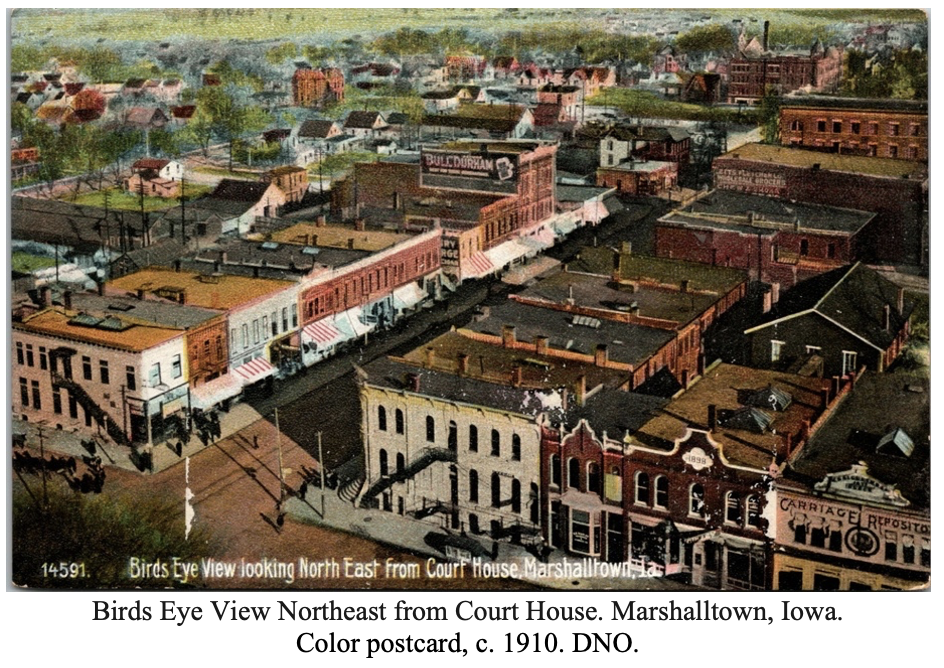
Fresh off a successful campaign in Springfield, Billy Sunday and his team rolled into Marshalltown in late April of 1909. This was not foreign soil. It was home turf.
Sunday had been raised in Iowa, shaped by its churches, and had even lived briefly in Marshalltown in the early 1890s while learning the mechanics of evangelistic work. By 1909 he returned not as an unknown ballplayer-turned-preacher, but as a nationally rising evangelist whose methods were becoming increasingly organized, efficient, and powerful.
Marshalltown was the right kind of proving ground. Large enough to sustain a six-week revival. Small enough to rally around one of its own.
The Setting: A City Poised for Revival
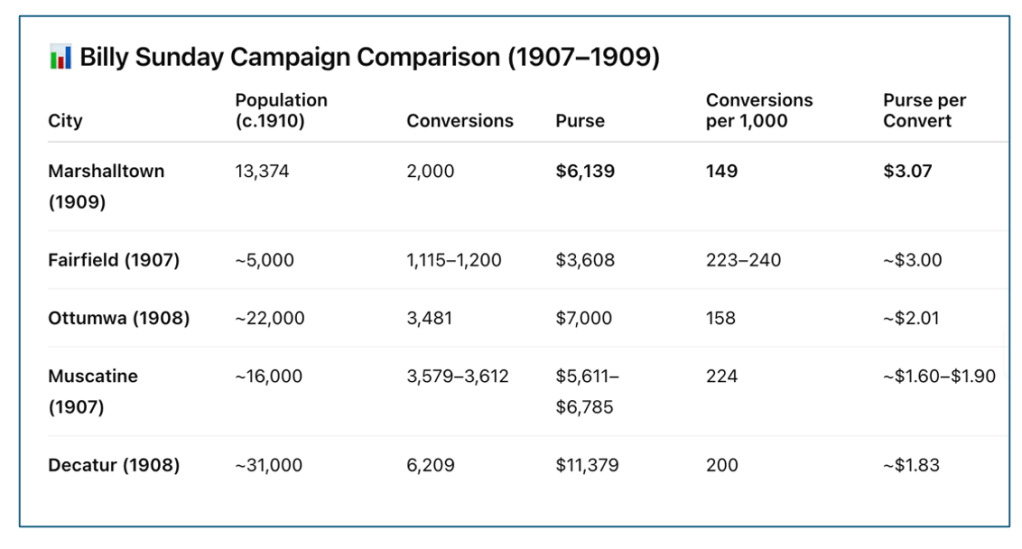
Marshalltown in 1910 had a population of 13,374—a fraction of Springfield’s 51,678. It was a growing industrial town, commercially strong, strategically located, and connected by rail. It was not metropolitan. But it was energetic.
A wooden tabernacle was erected at the corner of Third and Main, seating 5,000. The Sunday machine was now running at full stride.
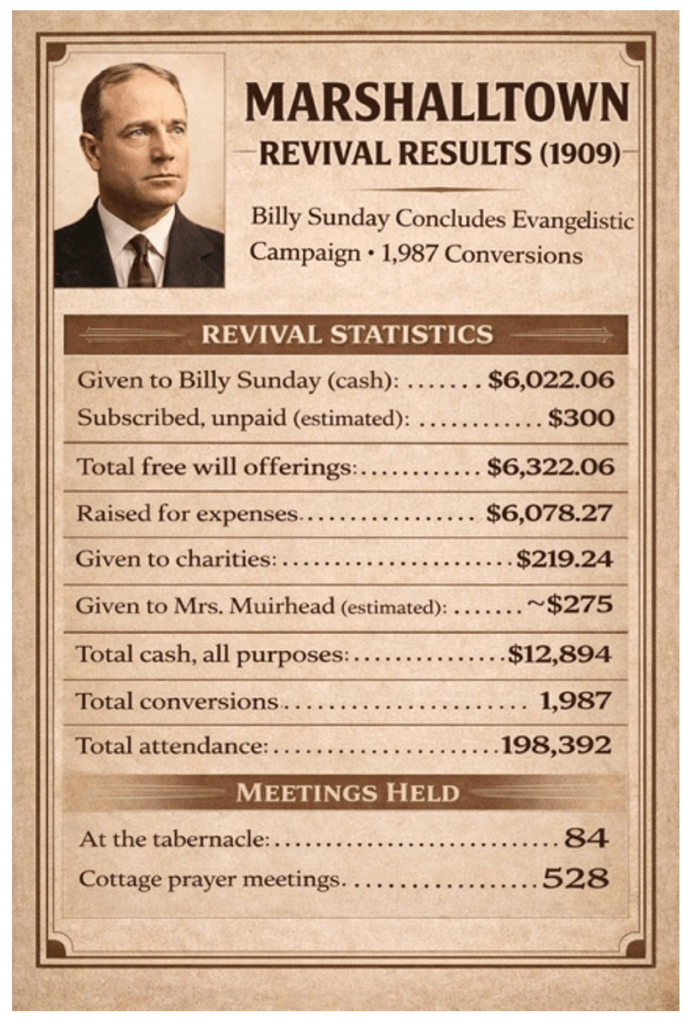
Opening night—April 25—saw over 12,000 people attend across all services. On the final day, June 6, Sunday preached to 13,200. In a town of just over 13,000 residents, that level of saturation is staggering.
By campaign’s end:
2,000 total conversions (125 on the final day)
84 tabernacle meetings
528 cottage prayer meetings
Nearly 200,000 in total attendance
For six weeks, Marshalltown was consumed by revival.
The Money and the Machine
The final purse for Sunday was $6,139. Total funds raised during the campaign reached $12,894.
For comparison, that purse nearly matched Muscatine’s and approached Ottumwa’s from the previous year. Financially, Marshalltown demonstrated strong committee organization and enthusiastic backing. This was not a struggling campaign.
It was disciplined. Systematic. Mature.
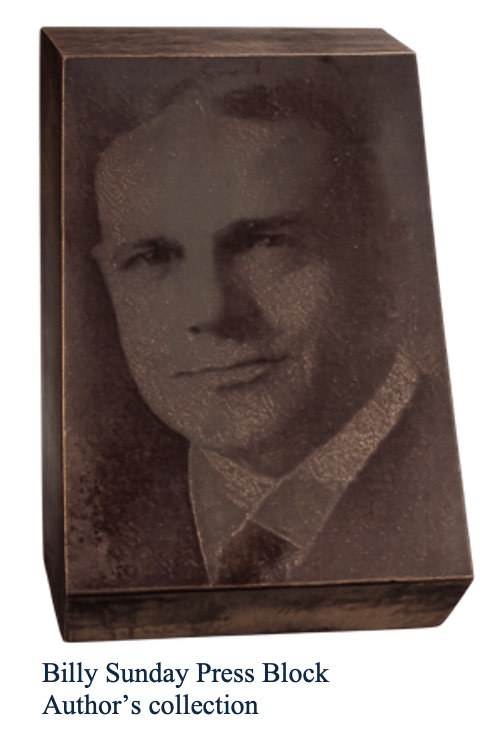
The press block used to print Sunday’s image during this period—now in my collection—reflects that growing sophistication. By 1909, Sunday was no longer improvising revivals. He was executing them.
Did Marshalltown “Underperform”?
One skeptical paper, the Davenport Weekly Democrat and Leader, suggested that Marshalltown’s results did not compare favorably with Fairfield, Ottumwa, Muscatine, and Decatur.
On the surface, that seems correct.
Measured per capita:
Marshalltown: ~149 converts per 1,000 residents
Fairfield: over 220 per 1,000
Muscatine: about 224 per 1,000
Decatur: around 200 per 1,000
Ottumwa: about 158 per 1,000
In raw totals, Marshalltown trailed Muscatine (3,579–3,612), Ottumwa (3,481), and especially Decatur (6,209).
So yes—the numbers were not dominant.
But numbers alone miss something important.
The Press: Praise and Pushback
The reaction was revealing.
The Audubon Republican declared the meetings closed in a “blaze of glory.” It reported over 500 cottage prayer meetings and said the town had been “thoroughly stirred up.”
The Marshalltown Evening Times-Republican went further, calling Sunday:
“One of the splendid prophets of the elder time…”
“One of the greatest revivalists in existence.”
“One of the plainest, simplest and happiest of men…”
Meanwhile, the skeptical Davenport Weekly Democrat and Leader offered sharper commentary. It described Sunday as a “contortionist of uncommon ability” with “remarkable versatility,” while acknowledging the “magnetic power of Mr. Sunday.”
Its most fascinating observation was psychological:
“The psychology of it all is that the people who are not regular attendants at churches must be reached not as individuals but in mass. They like to be moved by each other; and it is probable that this explains the success Mr. Sunday attains. He is helped greatly by the excitement and the enthusiasm of the crowds…”
That critique reads today like an astute analysis of mass evangelism. It wasn’t merely preaching. It was momentum. Atmosphere. Collective energy.
Sunday understood something about crowds that many pastors did not.
What Marshalltown Really Proved
Marshalltown was not Sunday’s most explosive campaign numerically.
But it demonstrated something perhaps more important in 1909:
Massive attendance penetration in a modest city
Financial stability and strong committee structure
Organizational maturity (over 600 total meetings)
National press attention—positive and critical
Marshalltown proved that Sunday could saturate an entire city.
Critics were talking. Admirers were praising. Nearly 200,000 attendances in six weeks ensured that no one in town was untouched by the revival’s presence.
He was no longer just holding meetings.
He was creating civic events.
A Blaze of Glory
The revival closed the way many Sunday campaigns did—intense, loud, emotional, decisive. A blaze of glory.
Marshalltown may not have produced the highest per-capita conversion rate of his Iowa stops. But it stands as a revealing moment in his rise.
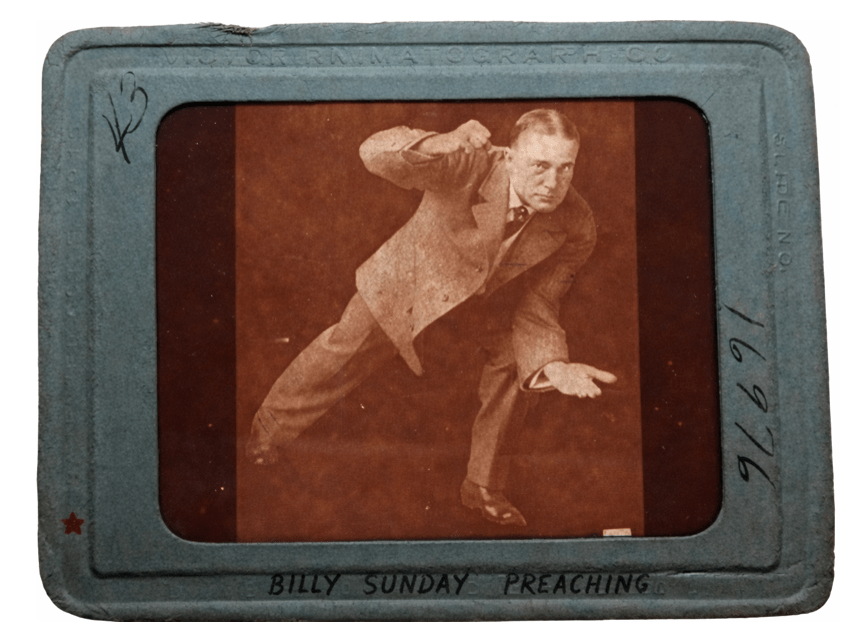
Magic lantern slide. Author’s collection.
By 1909, Billy Sunday was refining his method. The tabernacle system was humming. The prayer networks were mobilized. The press was watching closely.
And Iowa—his Iowa—was watching one of its own step onto a larger stage.
Marshalltown mattered because it showed that Sunday’s machine worked not just in isolated bursts, but in sustained, organized, city-wide saturation.
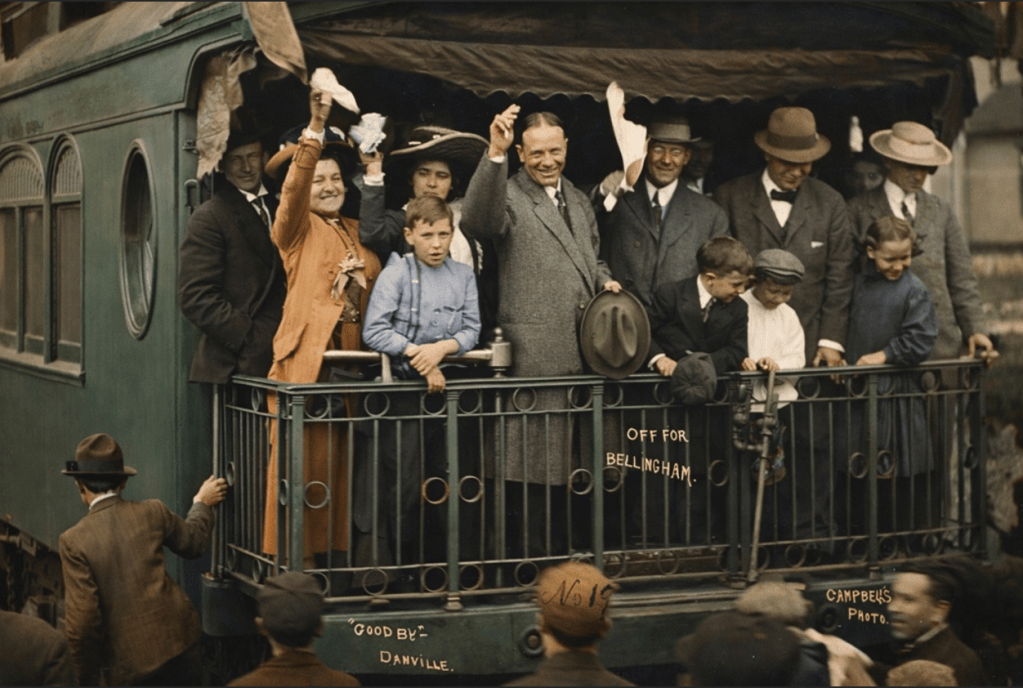
After wrapping up in Danville, Illinois (early April 1910), Billy and his family left for Bellingham aboard a train.
When Billy Sunday arrived in Bellingham, Washington, in the spring of 1910, the city knew something significant was about to happen.
His campaign formally began on April 17, 1910, and was scheduled to run for six weeks through May 29. Even before the opening service, anticipation was high. On April 16, The Bellingham Herald placed the coming revival on the front page, signaling that this was not just another religious meeting but a major civic event.
From the start, the campaign drew extensive attention. Local and regional newspapers covered Sunday’s meetings with unusual depth and frequency. By May 2, The Seattle Star was featuring the revival prominently on its own front page, evidence that Sunday’s influence extended far beyond Bellingham into the broader Pacific Northwest.
One of the most remarkable days came on Sunday, May 1. That evening, approximately 15,000 people crowded into the tabernacle and surrounding grounds to hear Sunday preach. The turnout was stunning for a city of Bellingham’s size at the time. Collections that day totaled $3,201.10, a substantial sum in 1910, reflecting both the generosity of the crowd and the financial scale of Sunday’s campaigns. That same service also recorded 140 conversions, showing that this was not merely spectacle but a movement that claimed measurable spiritual results.
Interest in Sunday’s work went beyond daily newspaper reports. On May 8, The Bellingham Herald devoted magazine-style coverage to the revival, suggesting that the meetings had become a defining moment in the city’s public life rather than a passing event.
Perhaps the most revealing glimpse into Sunday himself came from an interview published in The Daily Herald of Everett on May 18 under the title “Billy Sunday: His Methods, His Ideas and His Work.” In it, Sunday rejected the idea that his success came from showmanship or gimmicks. He explained his approach in characteristically plain terms:
“I haven’t any tricks. I’m just an old-fashioned preacher. I tell people in plain words the simple truth, that they are lost in sin and need salvation. I just preach the Bible – that’s all.”
That statement captures the heart of his appeal in Bellingham. He did not present himself as a social reformer, a political activist, or a religious entertainer. He came as a straightforward revival preacher who believed that the Bible, clearly proclaimed, could still change lives.
By the time the campaign concluded on May 29, Bellingham had experienced six weeks of intense preaching, packed crowds, and sustained public attention. For many residents, these meetings likely became a defining memory of the year 1910—a season when their city was temporarily at the center of a national religious movement.
The Bellingham campaign illustrates why Billy Sunday was such a powerful figure in early twentieth-century America. He could command enormous crowds, attract front-page coverage, inspire generous giving, and still insist that his effectiveness rested not on method but on message. In Bellingham, as in so many other cities, Sunday left behind not just statistics, but stories of a community stirred by revival.
Citation: The South Bend Tribune. Mon, Jun 16, 1913 ·Page 1
SOUTH BEND’S RELIGIOUS CAMPAIGN PROVES TO
BE MOST NOTABLE IN HISTORY OF ALL INDIANA
AIR OF SADNESS PREDOMINATES AT CLOSING MEETING OF BILLY SUNDAY’S BIG REVIVAL.
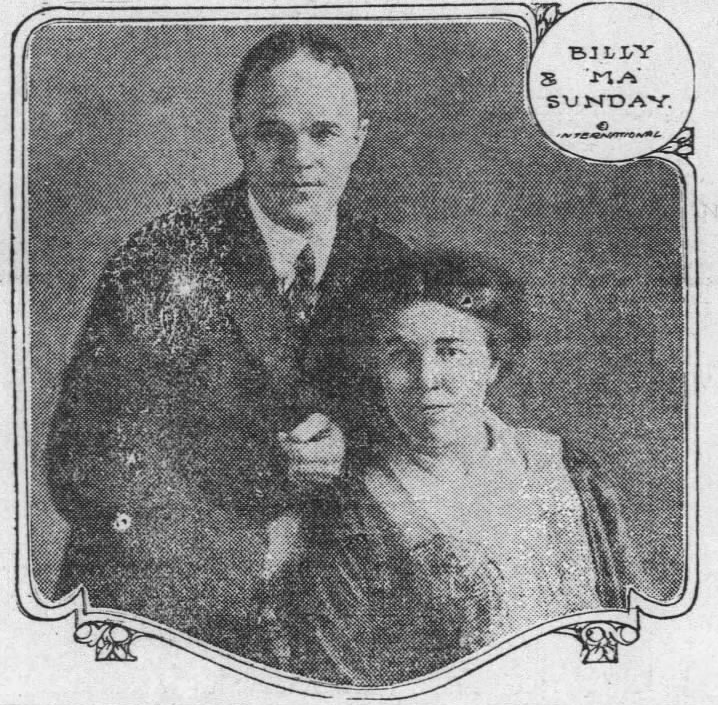
“BOSS” AND “MA” SAY THEIR LAST FAREWELL
Hundreds Cheer Evangelist and His Wife on Rear of Car as They Leave City—Other Thousands Disappointed by Early Departure—Last Day of Services Proves to be Remarkable One—Over 30,000 Present.
RESULTS IN BRIEF.
Conversions.
Previous conversions ………. 5,455
Saturday and Sunday ………. 943
Grand total ………. 6,398
Attendance.
Previous attendance ………. 519,550
Saturday and Sunday ………. 46,500
Grand total ………. 566,050
Collections.
Special offering for Billy Sunday ………. $10,500.00
Collections for local institutions ………. 737.98
Fund for campaign expenses ………. 18,500.00
Grand total ………. $24,737.98
The taking of the offering for Billy Sunday was one of the features of the closing day of the campaign. Seventeen or more different people and concerns of South Bend and Mishawaka gave donations of $100. The largest was $200, given by Samuel Murdock, of Lafayette, Ind., one of the owners of the Chicago, South Bend & Northern Indiana railway. The donations of $100, which have been recorded thus far, are from the following: South Bend and Mishawaka Ministerial association; Mrs. George Wyman; Mrs. M. V. Belser; citizens of Kingston, Pa.; by George L. Newell; Folding Paper Box company; Stephenson Underwear mills; E. G. Eberhart; Stephenson Manufacturing company; C. C. Shafer; Col. George M. Studebaker; Mr. Clement Studebaker; a friend; Clement Studebaker, Jr.; J. D. Oliver; Mrs. George Ford; C. A. Carlisle and the Mishawaka Woolen Manufacturing company. The $50 donations, which have been reported to those in charge of the campaign finances, are as follows: Mrs. J. C. Ellsworth; W. O. Davies; F. H. Badet; Mr. and Mrs. W. H. Thompson; J. C. Bowsher; McBrillan & Jackson; S. P. Studebaker and Mrs. Ida M. Stull, and the U. B. Memorial church.
Billy Sunday’s seven weeks’ fight against the devil in St. Joseph county became religious history to-day after the baseball evangelist had shown 6,393 people the road to salvation and approximately $10,500 had been raised for him.
The final curtain was rung down last night and the hard working little evangelist, with his wife, said goodbye to South Bend at 10 o’clock this morning. With a check for the $10,500 tucked away in an inside coat pocket, Billy boarded at 10 o’clock Northern Indiana Interurban car for his home at Winona.
A thousand people saw him off. Hundreds waved their hats and handkerchiefs at the evangelist, his wife, and Rev. William Asher, as the car moved out of the station and down Michigan street. All three stood on the rear platform bowing and smiling in response.
It is estimated a crowd of 8,000 or 10,000 people would have been at the car to say goodbye but the evangelist, leaving an hour earlier than he expected, disappointed many. The Northern Indiana company agreed to run the car through to Winona to insure the evangelist he would be able to eat lunch under his own roof.
State’s Greatest Revival.
With Sunday’s farewell prayer and a general handshaking all around at the tabernacle last night the meetings, which undoubtedly constituted Indiana’s greatest religious campaign, came to a close. The meetings ended quietly and with that heavy solemnity, which told plainer than words what it meant to the people to bid farewell to “Billy,” “Mr.” Ready, “Mac,” Ackley and all the rest.
Tears started in the eyes of many a man, and many a woman, as farewells were said on the platform. Hundreds crowded near the revival leaders to shake their hands and the number to about Homer Rodeheaver, director of the great chorus of 1,000 voices became so large, the people had to be formed in a line and were compelled to move rapidly as soon as they had said goodbye.
Completely worn out, Mr. and Mrs. Sunday were conducted from the tabernacle without notice to the eager thousands, who wanted one more glimpse last word of farewell. The evangelist was forced to permit, however, because of his weakened condition, to leave the building as soon as possible.
Individual contributions to the collections at the Sunday tabernacle yesterday were rather meager, comparing them with those of the usual opening Sundays of the evangelist’s meetings. There was not a coin of a larger denomination than $1 in the collection, which ranged all the way down to pennies.
It was estimated by “Joe” Spiece, the tabernacle builder, 19,000 people attended the three meetings yesterday. A collection of $421.51 was contributed, making an average of 2.2 cents per capita for the entire day.
Source: The South Bend Tribune. Mon, Apr 28, 1913 ·Page 1
As reported below in the Palladium-Item. Mon, May 29, 1922 ·Page 1
GIVE SUNDAY $10,718 ON FINAL NIGHT
“Fine, That’s Dandy, You Did Great” Evangelist Declares as Total Amount Is Read by Chairman.
5,007 ARE CONVERTED
REVIVAL DATA
Sunday’s offering $10,718.04
Campaign expenses $17,000.00
Trail Hitters 5,876
Attendance 247,250
Tabernacle sermons 75
Total sermons 76
Prayer meetings 352
Richmond presented Billy Sunday with $10,718.04 as a result of the final collections on Sunday, and the donations were received during the week from persons who did not expect to be in Richmond on Sunday.
“Fine, that’s dandy, you did great,” Sunday said as the total amount was read by Ed Wilson, treasurer of the campaign, who handed a draft for that amount to Mr. Sunday.
“I saw more tears tonight than I ever seen in any town for a long time, and if we could just continue for two weeks more we could just more than make things hum” Sunday said.
On the last Sunday in Charleston, the collections were announced as $34,658.
“The papers in this town have done better in covering this campaign from every angle than any other city I have been in.” – Billy Sunday
Thanks Local People
Thanks for the services of the men and women who had taken part in the campaign, were given before and after the sermon.
“If the other people had stood behind the campaign here with the enthusiasm and loyalty that the newspapers have shown and the committees have taken their part, the campaign here would have been a big success,” Rev. E. Howard Brown, pastor of the East Main Street Friends meetings, said in asking for the envelopes.
“I have envelopes here showing that most of the different churches did not get in their reports, and we have a number of men and women who came forward and signed cards saying that they accepted Jesus as their personal savior, and the denominations probably have their records.”
Creates Big Racquet
Will Romey, junior, on behalf of the boys who had been singing in the choir, presented Mr. Sunday with a record the chorus leader with a record of the boys’ singing, and the audience applauded.
Before the sermon all of the members of the party were called to the platform to say goodbye to the audience. Only Albert Peterson was absent, he having left last Wednesday to attend the funeral of his grandmother at Ottumwa, Iowa. “Pete’s all right, pure gold,” Sunday declared.
As the members of the party were leaving the platform Mrs. Sunday placed her hand on Mr. Sunday’s shoulder, and said, “If you see the members of the party are pure gold too, from here down through the list.”
The audience applauded.
Thanks Newspapers
Mr. Sunday said, “The papers in this town have done better in covering this campaign from every angle than any other city I have been in.”
He continued, “If it hadn’t been for the automobiles that they loaned to the party during the campaign, Mrs. Asher, George Sunday, and Bob Matthews, sang their final punctuating melodies, and the audience joined in singing the last hymn of the other musical number of greatest interest was Mr. Brown’s singing of “I Am Praying for You.”
The chorus sang the first and second phrases while the big, long floor of the tabernacle sang the second and last phrases. The music that echoed down the longer stretches of the tabernacle, was like a choir in a huge cathedral, and the music seemed to chance to carry through long rows of columns.
WHAT SUNDAY DID AT WILKES-BARRE [February 23-April 13, 1913]
OFFICIAL OF CAMPAIGN MAKES STATEMENT ON RESULTS.
CITY BETTER GENERALLY
Business Was Improved, Politics Was Elevated and Social Life Was Raised to Higher Standard Says Man in Interview.
The Tribune’s Special Service.
WILKES-BARRE, Pa., May 6.
The Sunday party has gone from Wilkes-Barre to South Bend, Ind.
Exterior view of the Billy Sunday Tabernacle. Wilkes-Barre Times Leader. Friday, February 21, 1913.
The tabernacle is being torn down day by day. The thousands who gathered beneath its roof to hear the greatest winner of souls in this generation have scattered and gone about doing the duties of their individual lives, but Wilkes-Barre and the Wyoming Valley will never be the same as it was a few months ago, before Billy Sunday came to this city. The moral and social life of the community has been given a new moral tone to the extent of which cannot be estimated for years.
This is the statement of Rev. J. W. Parkin, chairman of the Wilkes-Barre Ministerial Evangelistic committee, which had charge of the recent campaign in this city.
Moral Awakening.
“The most conservative,” he declared, “will admit that there has been a moral awakening the like of which has never been experienced here before. It is absolutely impossible to measure the immense amount of good that was accomplished, but I am sure that there is not one that regrets the hours and time and even money spent in planning for this campaign.”
“What,” he was asked, “do you consider the result of this visit on business here? You know it was prophesied that he would injure business.”
“An honest business could not have received greater help than came through the Sunday campaign,” was Mr. Parkhurst’s opinion. “A moral awakening such as we have had could not help but improve business. This has been evidenced in many ways, but particularly in the fact that people now realize more keenly than ever their obligations to each other and to the community. Hundreds of merchants have stated that accounts which they had considered closed because of inability to collect have been paid. There is a greater feeling of mutual respect now between employers and employes.
Politics Elevated.
“And politics; what about that? Do you think the campaign will have any influence on the politics of the country?”
“Well, I’m not much of a politician,” said the campaign leader, “but it seems reasonable to me to suppose that when a man finds himself in the position of a candidate for office he will be more careful in the future than ever before that there will not be any question about his private or business life.
There are many men in this city who have never been heavy drinkers for years who have bound themselves to abstinence. Hundreds of others who have been more or less indifferent or lukewarm in their opinion of intemperance have been aroused to a more active interest.”
“The moral wave,” he declared, “has been given a refining influence that is going to raise the standard of the community. Wilkes-Barre needed just such an indictment to make it realize where it was leading. I know hundreds of young people who have ‘cleaned house’ since Mr. Sunday came here.
‘You consider then that the people who criticized Mr. Sunday and his methods have been answered by the results which have been attained?’ was asked.
‘The critics have had nothing to offer that will accomplish the same amount of good that has been accomplished by Mr. Sunday.’
February 22, 1913
“Immediately following Columbus, Mr. Sunday opened a series of meetings at Wilkes-Barre, Pa., the farthest east of any district in which he had ever worked. The campaign opened on Washington’s Birthday—February 22—1913. Rev. W. M. Randles, pastor of the Bethesda Congregational church, gives the number of converts as 16,348, and the free-will offering as $23,527.66. In only this one respect did the Wilkes-Barre campaign exceed that of Columbus.”

 Evangelist Billy Sunday (1862-1935)