Twenty-below-zero weather, a half-hour roast of a New York editor, a tent collapse in Colorado, and the summer Sunday decided he was a Chautauqua man.
In late January of 1905, somewhere inside a tabernacle built of rough boards and tar paper at Mason City, Iowa, six furnaces were going full blast. The temperature outside had dropped to twenty below zero. Inside, a women-only Saturday afternoon meeting drew a thousand women, while Billy Sunday — across town in the larger tabernacle — was preaching to two thousand men on a sermon he called “Chickens Come Home to Roost.”
Fifty of those men were converted that single afternoon. Eight hundred dollars was raised before the campaign ended for the poor of the city, a line item Sunday quietly added to his revival economics that year and never abandoned. By the time he left Mason City in February, he had spent five weeks doing the kind of work that newspapers in 1905 still didn’t quite have a name for. He was a revivalist. He was a temperance crusader. He was, increasingly, a regional celebrity. And he was about to become, in a way he had not been before, a national platform attraction.
A different kind of revival economy
The first thing to notice about 1905 is that Sunday was now thinking about his revivals as more than just spiritual events. They were starting to behave like community investments.
The Mason City campaign collected money for the poor. The Aledo, Illinois campaign in October produced a careful public breakdown of where every dollar went — expenses paid first, then Sunday’s compensation. The line he liked to use, and that local papers loved to print, was that he “takes nothing until all expenses are paid.” His associate evangelist Ira E. Honeywell — a man who would serve quietly on Sunday’s team for the next twelve years — was running the women’s parallel meetings.
A theme was emerging. Sunday’s revivals had stopped being a one-man traveling show and started being a small organization arriving in town with a sustainable economic model behind it. The towns paid for their own tabernacles. They underwrote their own expenses. They saw the books. And by the end of a campaign, they had not just new church members but a small but real institutional legacy — money raised for the poor, donations to local YMCAs, building plans being discussed.
Canon City and the State Penitentiary
In late March Sunday left the Midwestern winter behind and went to Colorado. The Canon City campaign ran from late March through late April under canvas — a hundred feet by a hundred fifty, with three thousand seats. He preached to coal miners and ranch hands and the families of penitentiary employees.
On a Sunday in mid-April, Sunday entered the Colorado State Penitentiary and preached four times in a single day to the inmates. Nearly 250 of them came forward as converts. The afternoon Sunday service in the tabernacle that same day drew nine thousand people. Even allowing for the inevitable exaggeration in revival-attendance figures of the era, that kind of crowd was extraordinary for a town the size of Canon City.
Around this same period, a small Iowa town called Fort Dodge took an entirely different posture toward Sunday. The local committee voted down an invitation for him to hold meetings, saying he was “not the type to appeal to the average person.” The vote made the papers across several states. Sunday, characteristically, made no public response. He had work in Colorado.
Macomb and the system
Sunday’s late-spring campaign at Macomb, Illinois drew the closest contemporary description we have of how his revival method worked, end to end. The Muscatine Journal of May 20, 1905 laid the whole thing out.
A united local ministry would invite Sunday, and the various churches would form a stock company to raise money for a temporary tabernacle. The structure would be sized to the town — anywhere from twenty-five hundred to four thousand seats. Before Sunday’s arrival there would be cottage prayer meetings, extra prayer meetings, and union services. A chorus choir would be organized. Sunday’s musical director would arrive with his preferred hymn book, the one he used exclusively.
Then Sunday would begin. He worked the church members first. He raised the money for expenses. He went after the sinners. And, in the Journal’s deadpan phrasing, “he handles sin and all its connection without gloves.” For his compensation, he asked for the last Sunday’s collection — which, after a month of meetings, generally came to twenty-five hundred or three thousand dollars.
The article also offered a real criticism, the kind that Sunday’s supporters tended to dismiss but that the longer record bears out at least partially: “after he is gone comes the reaction and the pendulum swings back even to conditions worse than they were before he visits the town.” Whether that was generally true is a question that would take a few more years to answer. But by 1906, when newspapers started doing convert-stickiness analyses on Sunday’s earlier campaigns, the answer would turn out to be: usually not.
The Macomb campaign itself was Sunday’s largest revival to that point. Sixty-two sermons in thirty days. A final day of three hundred and four conversions. The previous campaign-best had been a hundred and seventy-seven.
The Hubbard roast at Sterling
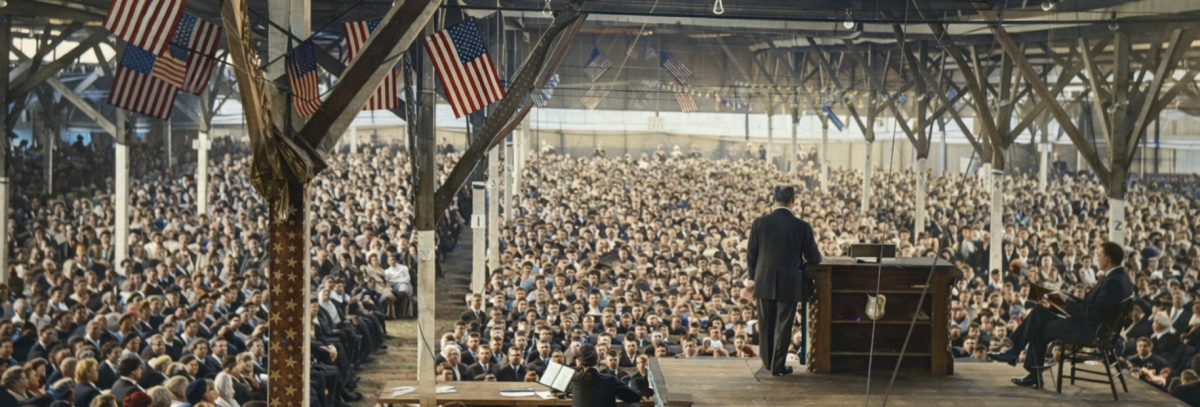
On July 16, 1905, at the Sterling Chautauqua, Billy Sunday stood on a wooden platform in front of fifteen thousand people. It was the largest audience of his platform career to that point — larger than any tabernacle he had yet preached in, larger than any revival service he had yet conducted, larger by some margin than anything that had come before.
He talked for two hours. About half of that time he spent on a sermon. The other half he spent on Elbert Hubbard.
Hubbard was the editor of an East Coast literary magazine called The Philistine. He was a celebrity of a particular Edwardian kind — an aesthete, an essayist, a self-appointed sophisticate who liked to take public swipes at preachers and politicians. He had recently called Sunday a “grafter.” Sunday had read it. And now he was on the largest platform of his life with a coat off, a vest off, and his sleeves rolled up.
He called Hubbard good for nothing. He called him indecent and pusillanimous. He called him a blot on humanity. He called The Philistine the work of the devil and a carbuncle on the neck of humanity. The crowd cheered nearly every sentence. The Quad-City Times of July 17 carried the whole thing.
The Hubbard roast was not really a sermon. It was theater. It was Sunday discovering — in front of fifteen thousand people — that his own personality, his combative instincts, his unfiltered Midwestern bluntness, could carry an outdoor platform as effectively as any sermon he had ever written. He had been preaching for nearly a decade. This was the day he became a public performer.
The summer decision
By late August Sunday had made up his mind. The Rockford Register Star of August 29 carried the announcement: Sunday was “so pleased with the results of his work among the Chautauquas during the summer that he has decided to devote a portion of all summers in the future to Chautauqua work.”
It was, in retrospect, the most consequential career decision he ever made before the great urban campaigns of the next decade. He had run the experiment. Sterling had given him his answer. Joliet, Cedar Lake, Pontiac, Springfield, Racine — every Chautauqua he had touched that summer had confirmed it. He could fill the platform.
A booking bureau started organizing his dates. The summer schedule for 1906 was already being negotiated. The next four years of Sunday’s life were beginning to take shape on a stationery letterhead somewhere in Chicago.
Salida and the snow
In the fall Sunday traveled back to Colorado for a five-week revival at Salida. It was a small mountain town. The campaign drew six hundred converts across its run. But the weather had its own ideas. The tent collapsed under early snow. The October 3 and 4 services had to be moved into a local church. The closing night on October 21 had to be relocated again — this time to a four-hundred-seat opera house. Sunday preached his closing service to a fraction of the people who wanted to hear him.
It was the kind of unglamorous logistical disaster that revival memoirs usually omit and contemporary newspapers usually emphasize. The Daily Sentinel out of Grand Junction covered every weather setback. Salida 1905 stayed in the regional memory as the campaign where the tent fell down and Sunday kept preaching anyway.
Burlington and the closing prayer
The Burlington, Iowa campaign closed out 1905 from early November through mid-December. The tabernacle held four thousand. Average daily attendance came to about six thousand. On the closing night, seven thousand people were inside and five thousand more stood outside.
Dr. G. Walter Barr — a Keokuk physician and journalist who had heard Sunday preach more than a hundred and seventy-five times and who would go on to publish a long, sympathetic study of Sunday’s methods in 1906 — wrote that the Burlington revival “exceeded anything in the history of revivalism in America and equaled the top of the wave in Wales, England and Australia.” Whether or not he was right about the comparison, the claim made the papers across the country.
On the closing night Sunday prayed a prayer that the Cedar Rapids Gazette printed in full the next morning. It is, for a man not generally remembered for the literary quality of his prayers, a striking piece of public speech:
O, Lord, save old Burlington; save old Burlington; save her Lord; let salvation sweep over her like a tidal wave. Let Thy love and mercy roll down through her streets like great rivers; let hundreds come to see their duty, and to take the right stand.
What 1905 was
The 1902 essay framed that year as the moment Sunday’s style locked in. The 1903 essay framed that year as the quiet pivot. The 1904 essay framed that year as the year he started taking positions on the modern world.
1905 was the year Sunday filled the platform. Fifteen thousand at Sterling. The largest audience of his life so far, and not a tabernacle audience that had taken weeks of cottage prayer meetings and ministerial visits to build, but an outdoor Chautauqua audience that just came. Came because they had read about him. Came because the bureau had advertised. Came because, by the summer of 1905, Billy Sunday was the kind of person a Midwestern audience now drove fifty miles to hear.
It was also the year he found out that he did not need a sermon to hold a crowd. The Hubbard roast had been pure personality — Sunday’s combative instincts loose on an outdoor platform with fifteen thousand people cheering. The implication was enormous. It meant that the constraints of the revival-tent format — the careful build-up, the cottage prayer meetings, the four-week emotional arc — were not the only way for Sunday to do what he did. There was another mode available: the platform mode, the personality mode, the single-afternoon mode. And the bureau organizing his 1906 schedule already knew it.
Sunday closed out the year preaching to twelve thousand people in a Burlington tabernacle. He opened 1906 in Rochester, Minnesota. The Chautauqua circuit was beginning to organize itself around him. The first professional photograph of him would appear in a Freeport newspaper in February. His wife Helen would announce at the end of March that she was joining him on the road full-time. The career-defining decade was opening.
1905 was the year that made all of it possible.
How to cite this post
Chicago: McNutt, Kraig. “The Summer Billy Sunday Filled the Platform: 1905.” Evangelist Billy Sunday (1862–1935), June 11, 2026. https://evangelistbillysunday.com/2026/06/11/the-summer-billy-sunday-filled-the-platform-1905/.
MLA: McNutt, Kraig. “The Summer Billy Sunday Filled the Platform: 1905.” Evangelist Billy Sunday (1862–1935), 11 June 2026, evangelistbillysunday.com/2026/06/11/the-summer-billy-sunday-filled-the-platform-1905/.
APA: McNutt, K. (2026, June 11). The summer Billy Sunday filled the platform: 1905. Evangelist Billy Sunday (1862–1935). https://evangelistbillysunday.com/2026/06/11/the-summer-billy-sunday-filled-the-platform-1905/
Turabian: McNutt, Kraig. “The Summer Billy Sunday Filled the Platform: 1905.” Evangelist Billy Sunday (1862–1935). June 11, 2026. https://evangelistbillysunday.com/2026/06/11/the-summer-billy-sunday-filled-the-platform-1905/.

 Evangelist Billy Sunday (1862-1935)