REVIVALS GREW BY LITTLE

THE YEARS HAVE SHOWN A DEVELOPMENT IN SUNDAY’S METHODS.

Ed., the following is an exact reprint from a 1916 article.
Early Audiences Found Nothing Spectacular in the Sermons of the Revivalist, and Towns of 10,000 Were the Limit Then.

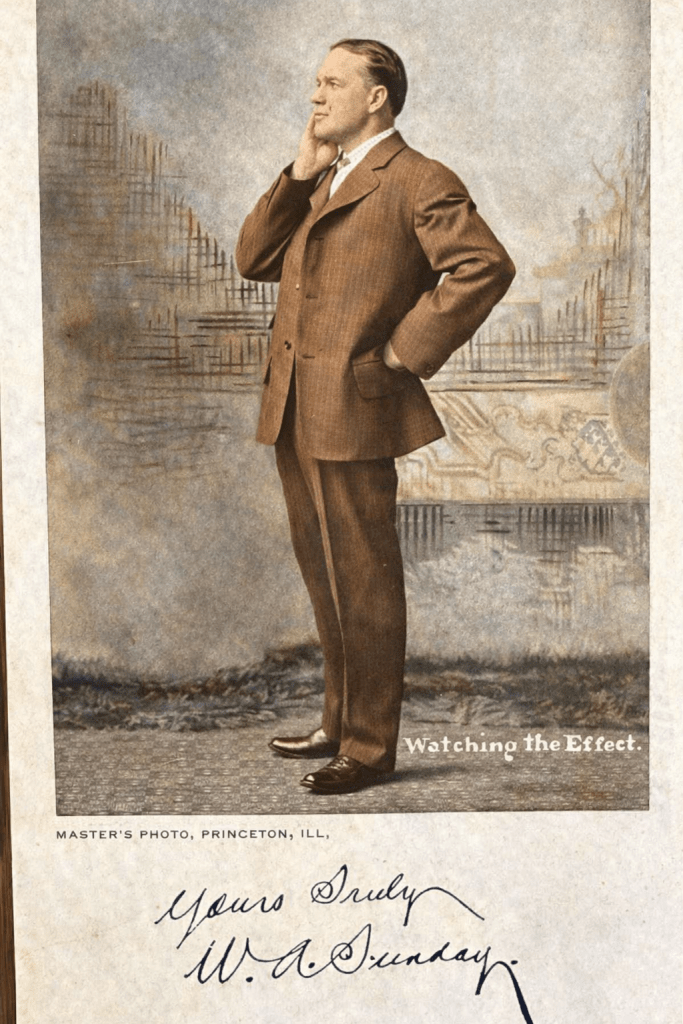
There is nothing “mushroom” in the growth of the Billy Sunday meetings. The gradual development of Sunday’s revival methods was recalled today to Ma Sunday by an old clipping from The Star of July 28, 1902.

The clipping was a reprint from the Brooklyn Eagle and it mentioned the fact that Sunday had made the large sum of $12,000 in a year. It said:

Mr. Sunday is not mercenary and he thinks more of converts than he does of money. He mentioned his Pitts to the interviewer simply because he had been asked if it had not been something in the start of a religious revival from the base salary of an American baseball player to the supreme income of a modern athlete and evangelist.

“God has been truly good to us,” was Mr. Sunday’s reply.

“We started our work in Bellingham at $1,500 for the same length of time. Farmington and other places were small, but they are mostly made up of millionaires, we drew $800 in thirty days.”

Ma Sunday smiled over it.

“We certainly would not have tackled Kansas City or Boston or New York City in those days,” she said.

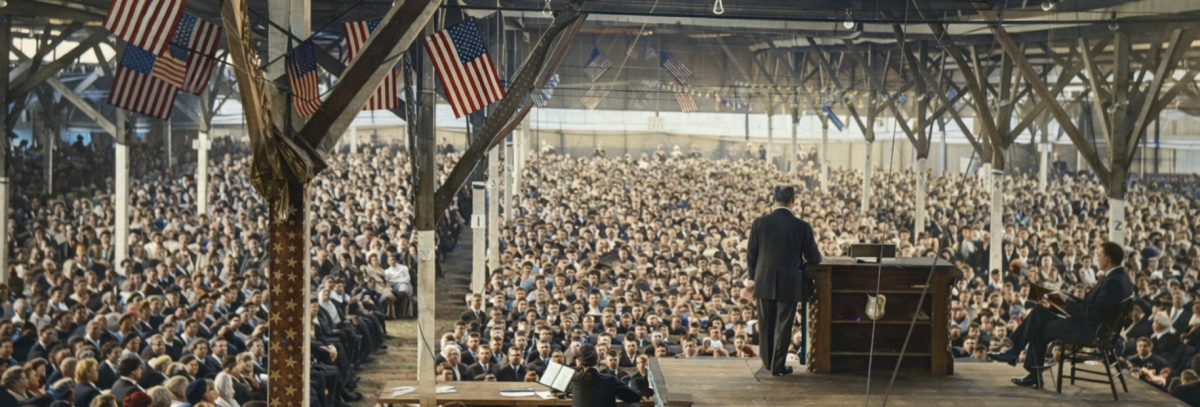
“We used to think that the town of ten thousand population was our limit. We felt that was as large as we could handle and to get above that would perhaps mean a failure. Then we began including the town of twenty thousand. All the time we were gradually adding to our party and building larger tabernacles, until here we are and New York City is in sight with a tabernacle seating twenty-five thousand.”

Fourteen years have also made changes in other ways, as the following extract from the same clipping shows:

Mr. Sunday’s revival methods are all in fashion distinctive to unique. No Sunday jumping, no frenzy and no hysterics among the converts at his meetings. He talks to his congregation in a sane and reasonable fashion. When he has them convinced that they are a pretty bad lot he asks them to come to the front. There are no mourner’s benches. Instead, there are chairs upon which to invite the penitents to sit while he circulates among them and talks to them individually. He takes the name of each subject and turns him over to the pastor of the denomination for which he expresses a preference and refuses to be longer responsible for his new charge. Sometimes it is estimated with no determination.

His plan is to stay a month in each place. For the first two weeks he does not “give” the invitation. He tells the people funny stories and amuses them with his strange and bizarre methods of preaching. The third week he devotes to the subject of sin as he has found it in the experience of whom he is talking. The fourth week he seeks the souls of the sinners and the penitents.

The singer is a tall, well dressed young chap, 40 years old, with the look of a man much younger. It is helpful he wears such neat clothing, for although he has no pretensions to preaching power, it is his warm, personal, but because he makes him different from other preachers.

KC Star. May 9, 1916 (5)

The Kansas City Star Tue, May 09, 1916 · Page 5
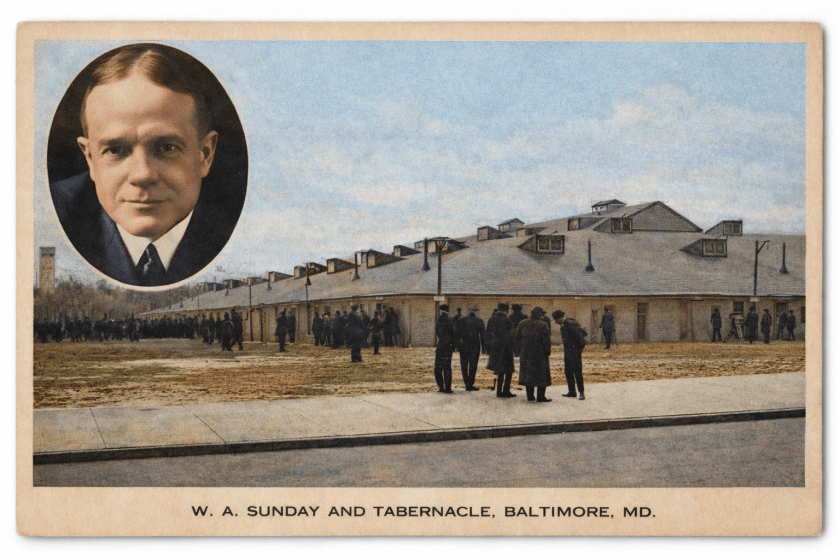
How did Billy’s Baltimore revival sermons compare to his Trenton campaign (both in 1916)?

From Trenton to Baltimore: How Billy Sunday’s Preaching Evolved in 1916

When Billy Sunday concluded his revival campaign in Trenton, New Jersey, in February 1916, he had already delivered an extraordinary number of sermons in just a few winter weeks. Soon afterward he moved south to begin what would become an even larger campaign in Baltimore, Maryland.

A comparison of the sermon lists from the two cities reveals something fascinating about Sunday’s preaching strategy. While the evangelist was famous for repeating certain signature sermons from city to city, the Baltimore campaign shows a noticeable shift in emphasis and structure compared with Trenton.

The Baltimore Tabernacle

The Trenton Campaign: Classic Revival Preaching

The Trenton sermons follow the pattern of a traditional evangelistic revival. Many of the titles focus directly on conversion, repentance, and the urgency of salvation. Messages such as What Must I Do to Be Saved?, After Death, Judgment, Rich Young Ruler, and What Shall the End Be? formed the backbone of Sunday’s preaching.

These sermons were part of Sunday’s well-known revival repertoire. In Trenton he rotated them rapidly, returning to the themes of judgment, repentance, and personal decision again and again. Titles like Backsliding, Get Right, Choose Ye This Day, and Be Sure Your Sins Will Find You Out show how directly he pressed the audience toward a response.

This approach reflected the classic revival method: present the danger of sin, call for repentance, and invite listeners to make a public decision.

Baltimore: A Broader and More Structured Campaign

When Sunday arrived in Baltimore later in February, the preaching program became noticeably broader. While the evangelistic messages remained, the sermon list shows a wider range of topics and a more deliberate sequence of themes.

Several sermons addressed revival within the church itself, including The Need of Revivals, Revive Thy Work, and The Restoration of the Church. Others focused on Christian living, such as Following Christ, Positive and Negative Religion, and Show Thyself a Man.

New Sermons Appear

The Baltimore list also introduces several sermons that do not appear in the Trenton campaign. Messages such as The Authenticity of the Bible, God’s Battle Line, The Temptation of Christ, Love Your Enemies, and The Incarnation of Christ reveal a more doctrinal dimension to the preaching.

In other words, Baltimore was not only about winning converts. It also included teaching aimed at strengthening believers and encouraging churches.

The Core Sermons Remained

Despite these differences, Sunday’s core sermons appear in both campaigns. Titles such as Dr. Jekyll and Mr. Hyde, The Fig Tree, Samson, The Atonement, Choose Ye This Day, and What Must I Do to Be Saved? were staples of his preaching for years.

These messages formed the foundation of Sunday’s evangelistic ministry, and he carried them from city to city with remarkable consistency.

A Larger Revival

The Baltimore campaign also dwarfed Trenton in size. By the time the meetings ended in April, reported attendance had reached 1,376,000 people across the entire series of services.

Such a large audience may explain the broader range of sermons. A major metropolitan revival like Baltimore required not only evangelistic appeals but also teaching, church renewal, and special meetings addressing different audiences.

Two Cities, One Evangelist

Taken together, the Trenton and Baltimore sermon lists provide a revealing glimpse into Billy Sunday’s methods. Trenton shows the evangelist operating in his classic revival mode—pressing the claims of the gospel with urgency and repetition. Baltimore shows him expanding that message into a wider program of preaching that addressed both unbelievers and the church itself.

In both cities, however, the heart of the message remained the same. Whether speaking in a smaller industrial city like Trenton or in a large urban center like Baltimore, Billy Sunday continued to deliver the message that had defined his ministry from the beginning: a call to repentance, faith, and a transformed life.

How did Billy Sunday sum up his own theology (c.1916)?

“My theology is really summed up in four letters: H-e-l-p. I am here to do my best to help the people in this old world live better, and to show them the way to do it. Some people can see no way out for the sinner except through the police court or the potter’s field. I have come to tell you there is another way—through repentance and belief in the Lord Jesus Christ.

“Some people have put their trust in government, but there is no salvation through government. They all have failed to suppress vice and develop virtue, America as well as the rest. Others put their trust in education. You can dot every hill with a schoolhouse and put a university in every block and it will save no one unless it is combined with virtue and faith.

Source: April 13, 1916. Baltimore Sun (p.6)

When the Union Veterans Marched Up the Sawdust Trail, Maryland (c.1916)

Baltimore, April 1916

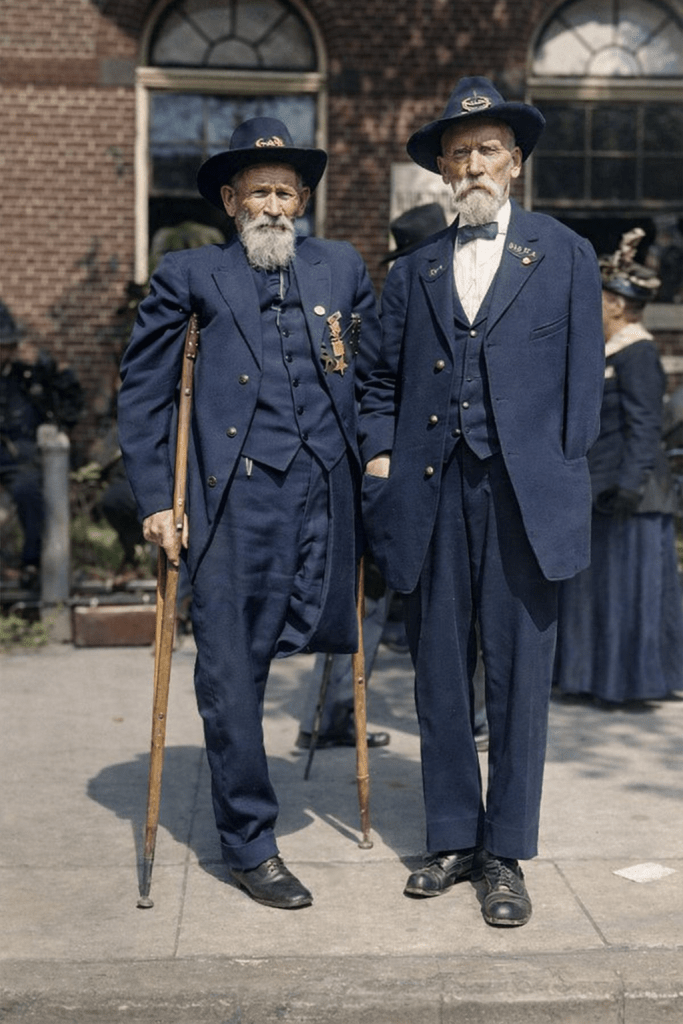
During Billy Sunday’s great revival in Baltimore in the spring of 1916, one evening at the tabernacle took on a distinctly historic tone. The sawdust aisles—normally filled with businessmen, laborers, and curious citizens—were suddenly occupied by a different kind of procession. A body of Union veterans of the Civil War, many gray with age but still proud of their service, marched forward together into the meeting.

1915 Civil War veterans, source unknown

According to the Baltimore Sun, nearly 500 veterans of the Grand Army of the Republic (GAR) attended the revival that night. The GAR, the powerful national organization of Union veterans, was still an important presence in American civic life in the early twentieth century. Though the war had ended more than fifty years earlier, the men who had fought to preserve the Union remained symbols of sacrifice and national memory.

The veterans were led by James E. Van Sant, commander of the Maryland Department of the GAR, along with E. R. Monfort of Iowa, who at the time served as Commander-in-Chief of the national organization. When they entered the tabernacle they were warmly received, and the crowd greeted them with enthusiastic applause.

The occasion had the character of both a patriotic ceremony and a revival meeting. The veterans arrived with a brass band, and when the musicians began to play familiar airs the audience responded with equal fervor. The strains of “Maryland, My Maryland” and “The Star-Spangled Banner” rang through the building, followed by old martial tunes such as “Yankee Doodle” and “Dixie.” The building reportedly shook with applause as the music echoed beneath the great wooden roof of the tabernacle.

The veterans also presented Billy Sunday with a gift—a ceremonial Old Glory mounted on an elaborately wrought brass standard. It was a gesture that connected the evangelist’s message with the patriotic ideals the veterans had fought to defend half a century earlier.

The evening was opened with prayer by Rev. B. F. Clarkson, chaplain of the Maryland GAR. Both Billy Sunday and his music director Homer Rodeheaver spoke warmly of the veterans and the sacrifices they had made for the nation. Rodeheaver added to the patriotic atmosphere by playing martial music and bugle calls on his trombone.

For the aging soldiers, the gathering was more than a nostalgic reunion. Many of them walked the same sawdust aisles as the younger men and women attending the revival. Their presence reminded the audience that the Civil War generation was rapidly passing from the scene. These men had once marched into battle for the Union; now they marched into a revival meeting in search of spiritual renewal.

By 1916, the Civil War was already receding into history, but its memory still held powerful emotional force. That night in Baltimore, the veterans’ appearance created a striking moment where patriotism, memory, and revival religion met under one roof.

The sight of those aged soldiers marching forward—flags waving, band playing, and the crowd cheering—must have been unforgettable. For one evening at least, the old warriors of the Union once again marched together, not onto a battlefield, but down the sawdust trail of Billy Sunday’s revival.

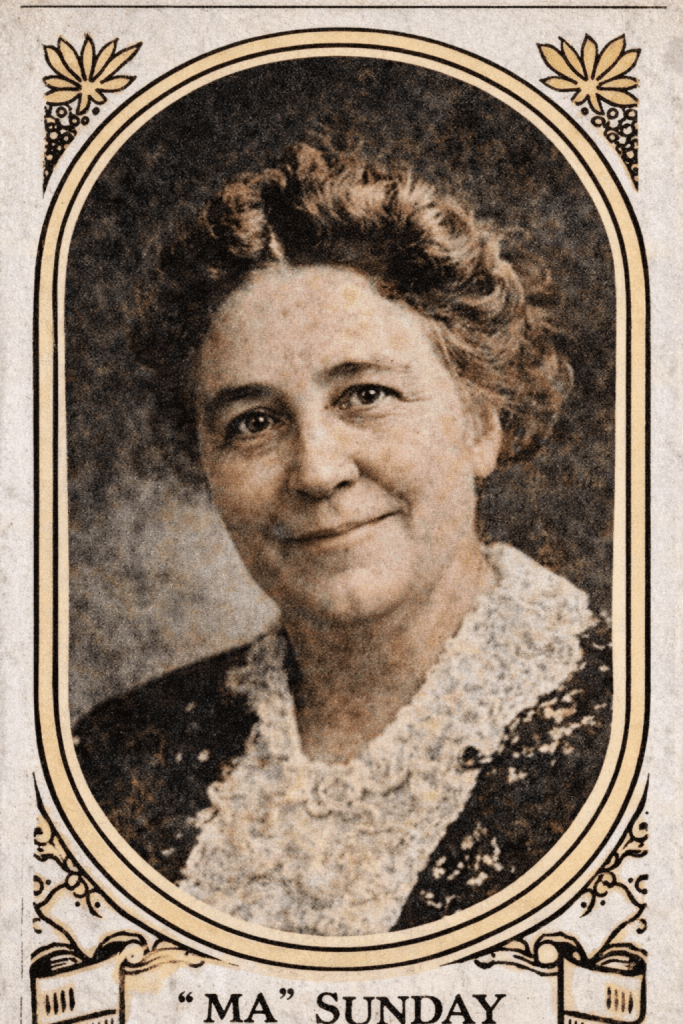
‘MA’ DOES MUCH TO HELP ‘PA’ IN HIS LABOR

Mrs. William A. Sunday always denies the statement so often and so lovingly made by her son, George, also of the party, that she is the ‘boss’ of the Sunday campaign, but that doesn’t do away with the fact that it was largely through her efforts that the wonderful system of the Sunday’s has been developed.

Along with her many charming feminine qualities Mrs. Sunday is a woman of unusual executive ability, and her keen ability to see the needs and apply the remedies required in work of this kind has made possible the plans whereby the campaigns are made so effective.

‘Do you not relieve Mr. Sunday many tasks, of seeing people, of making plans and of deciding questions concerning the work,’ Mrs. Sunday was asked.

‘Oh, Yes, we all give him as much help as we can, but in the last analysis it is ‘papa’ who decides, and we, of course, do all that I can in this line.’

It has even been said by people who ought to know that Mrs. Sunday frequently suggests phrases for some of his sermons, and also the subjects. This is what she says about that:

‘When I go around with ‘papa’ I don’t just sit and look about, but I think and plan. I frequently see things which might be of use to ‘papa’ and I tell him about them. He is always welcome to all that I have to give him, to every suggestion I can make.’

Besides the work which Mr. and Mrs. Sunday are doing and which they both consider ‘God’s work,’ the nearest thing to Mrs. Sunday’s heart is her home. Her children are very dear to her. By reason of campaigns held in cities far from their home in Winona Lake, Mr. and Mrs. Sunday see little of their children during the nine months when they are doing evangelistic work.

‘I make it a point to go back home two or three days at a time, just to be where we are at home,’ Mrs. Sunday declares. ‘One of my greatest sorrows is the fact that my boys must grow up without the direct influence of Mr. Sunday and myself.’

‘Do you ever feel unhappy about leaving home to begin a new campaign,’ Mrs. Sunday was asked.

‘Yes, we both feel that way sometimes, but the thought that this is the greatest work which we could be given to do, helps us. For several days before we leave home, however, Mr. Sunday is completely broken up, and frequently is unable to eat.’

The Sundays do not grudge the sacrifice that they give, but instead they enter into the work with vim and with an intense desire to ‘live up to what God expects them to do,’ as they express it.

Paul, the eight year old son of the Sundays, who broke an ankle while playing football in the autumn, has recovered and is back at school and back too at his favorite sports.

In a very different way, Mrs. Sunday has just as great getting powers as her husband and when she addresses a group of women her sincere manner, her definite message and her wide-awake methods win the immediate attention of her audience.

‘Ma’ has her trail hitters too, and when she extends the invitation to the women to accept Christ and to lead Christian lives many are eager to shake her hand and to promise better living in the future.

It is an interesting life that Mr. and Mrs. Sunday have led ever since they were married out in Chicago years ago. For two years after their marriage ‘Billy’ played ball but he finally gave that up to do permanent work in the Y. M. C. A., in which he had been working in the winter months. Soon after that he became assistant for Dr. Wilbur Chapman and upon the retirement of that evangelist from active revival work Mr. Sunday conducted revival services in towns outside of Chicago.

Since then he has been in revival work.

Mrs. Sunday was formerly Miss Helen Thompson, one of four daughters of pioneer Chicago business men. Before her marriage she was interested in the church and was an active worker and since that time she has always assisted Mr. Sunday in God’s work.

Cited from a period 1915 newspaper

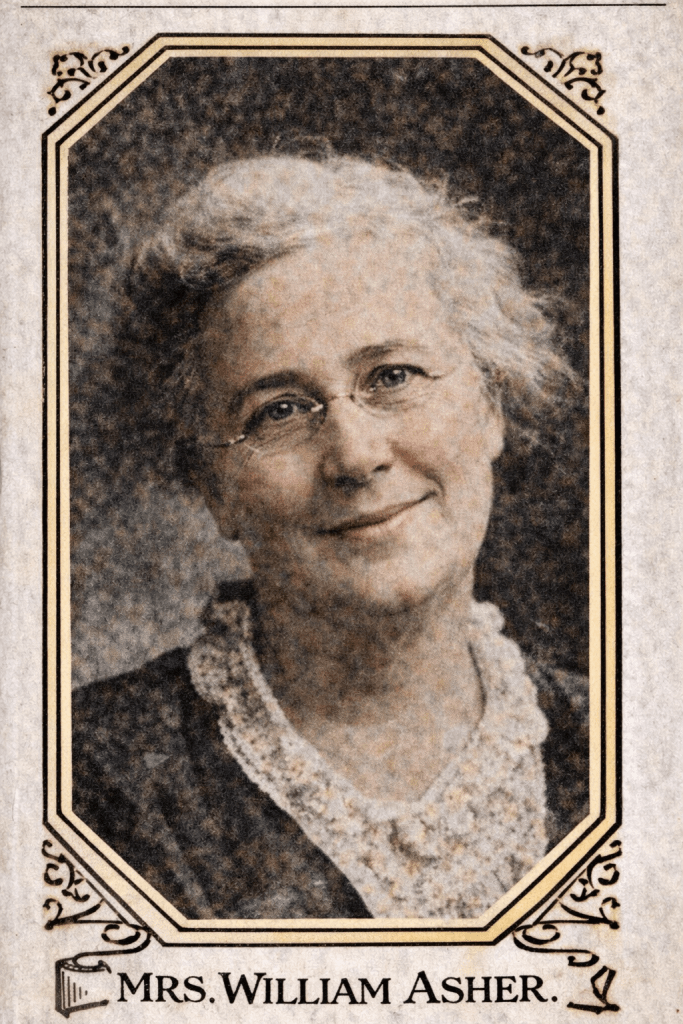
MRS. ASHER “MOTHERS” OTHERS AND LOVES ALL, c.1916

Mrs. William Asher, the director of the extension department of the business women’s work, seems to me to be just like the mother of the Sunday party—not that she is older than the rest, for she isn’t—but she has an abundance of gray hair which is now almost white and this gives her a very motherly appearance. Then her eyes, too, carry out the idea for they are heavy with pity for all of the suffering and sorrow that she has seen. It just happens that Mrs. Asher is the same age as Mrs. Sunday and everybody knows that that isn’t old. In Mrs. Ashers’ case, as in that of many persons, grief caused her gray hair, for within three months of each other her mother and her sister died.

“Yes, Mr. Asher and I and the Sundays are old friends,” she said in response to a question. “Years ago out in Chicago, which is my native city, we all worked in the same church. Mr. Asher was the assistant pastor, Mrs. Sunday was superintendent of the intermediate department of the Sunday school, and I sang in the choir and taught also. My friendship for Mrs. Sunday was cemented when her mother died. Mrs. Sunday was grief-stricken, of course. I sang at the funeral.”

Mrs. Asher not only sang at the funeral, but did all within her power to make the last days of the mother of Mrs. Sunday as pleasant as they could be.

There is no doubt that all of the members of the Sunday party have had unusual experiences and Mrs. Asher has been no exception. Practically all of her life, Mrs. Asher has been in evangelistic work. When she was a little girl of 11 years old, she was converted in the famous Moody Church in Chicago. Many persons have been converted under interesting circumstances; but few come into the church in an atmosphere such as surrounds the old Moody Church.

Years ago Mrs. Asher met and married William Asher, who was at that time a Pullman conductor on the run between Chicago and New York City. His uncle was a railroad man and had given the young man a start in life, but Mr. Asher soon realized that he was working on the wrong track. Giving up his position, he went to a theological seminary, where he studied and was ordained a minister.

It seems that opportunities in the case of Mr. Asher the opportunity came soon. DeWitt Talmage, the famous minister, needed an assistant and Mr. Asher was selected to fill this place, which he held for several years. Afterward he resigned to take up Bethel work in Duluth, Minn.

Dr. Wilbur Chapman was in Chicago conducting a religious revival one time and the Ashers became interested in his work.

“We were so interested in fact that Dr. Chapman asked and we did,” said Mrs. Asher here. “During the first five years of our connection with him we did saloon work. This was work that had been practically unattempted before. We had a little portable organ and with this we would go into the saloons and sing. We always got the consent of the owner of the saloon first before we went. The owner always understood the conditions upon which we worked. We did not do reform work, but we merely went to sing.”

“Was it very hard?” was suggested.

“Harder than you can imagine. Only those who have attempted it have any adequate idea of what it means,” she replied. Many a time Mr. and Mrs. Asher would be put out and their little organ thrown out of

This was trying work, but they stuck to it for five years, a long time for any person to spend in such a gruelling occupation. At the end of the five years they left the work, not because it was hard, but because larger opportunities for greater and more effective work offered themselves. The new work was arduous, though it did not have the hardships attendant upon it that the saloon work had. On several of Dr. Chapman’s trips around the world the Ashers accompanied him.

But the story of the relations with the Sundays is now the topic of perhaps greater interest. After the death of Mrs. Sunday’s mother, the bond between Mrs. Sunday and Mrs. Asher became closer. They worked together in the little church until Mr. Sunday entered upon his career as a revivalist. In 1911 they came together again and since then they have been engaged in the same work.

Mrs. Asher does splendid work among the women and girls of the factories, shops and mills and the girls grow to love her.

“We try to get the girl to realize her responsibility to herself to lead a Christian life and then to other girls around her. We want her to lead a life that will count for something in the love of those who live and work with her.”

Mr. Asher does a work that is of great value to Mr. Sunday, and of great benefit to the towns that Mr. Sunday cannot cover, and that are longing for a revival. To these towns Mr. Asher goes and conducts religious services. Just at present he is at work in Phelps, New York, although he is spending today in Trenton.

The Times (Trenton, New Jersey) · Sun, Jan 16, 1916 · Page 6 Downloaded on Mar 10, 2026

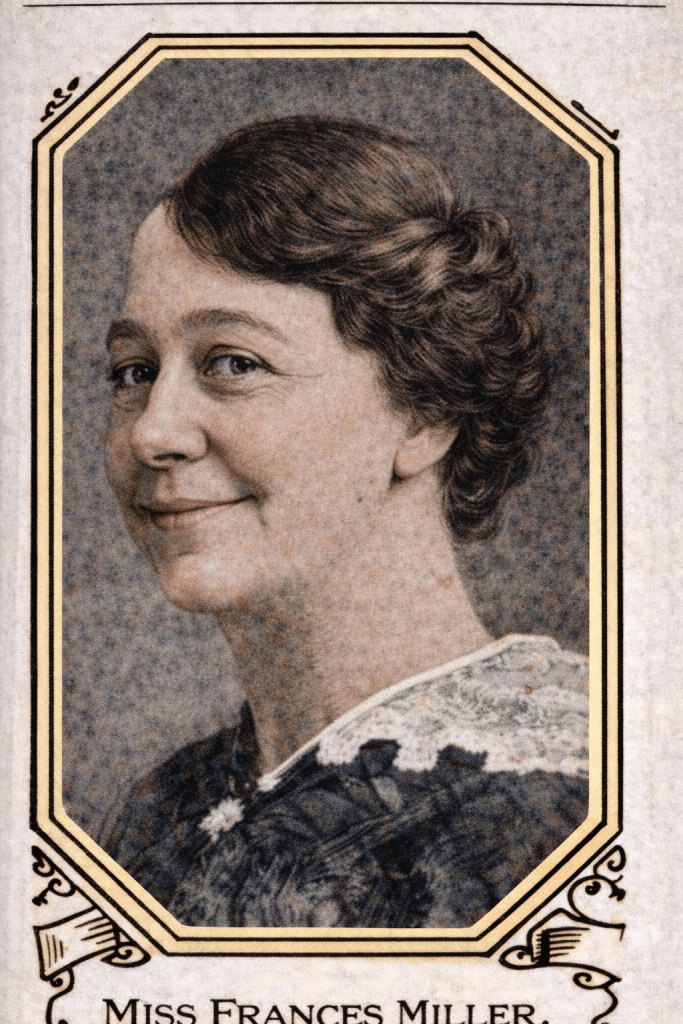
Miss Miller was once preacher on prairies, c.1916

In the world of business, men who go along with poor methods, lack of punctuality, slovenliness and all kinds of slipshod ways are regarded as “out of it,” but that idea is not so prevalent in the religious world, possibly because so many religious world workers unconsciously use these methods.

Miss Frances Miller, the director of business women’s work in the central district, uses no slipshod methods. One could scarcely meet a more hustling person in religious work than Miss Miller, excepting, of course, “Billy” himself. Some think that long association with his work has moulded Miss Miller’s naturally active temperament into the form that it now has.

Miss Miller is the youngest and oldest member of the Sunday party. Youngest in the point of years, but oldest in the length of time that she has been a member of the party. For 11 years she has been doing the work for business women that she is doing today and in that time she has become an authority in her line.

Born in the great northwest, where people just naturally have a swing and vim which those in the East don’t seem to have, she grew up in this atmosphere, and has developed all of the hustling qualities of a true Westerner.

From the standpoint of training Miss Miller is surely equipped to carry on the work which she has in charge. “I studied at the Presbyterian College in Cedar Rapids, and later graduated from the Congregational College in Fargo, North Dakota. From there I went to the Moody Institute, in Chicago,” she recently said.

There’s a kind of open secret about Miss Miller. She is an ordained minister, but she doesn’t always tell it because she thinks that if people knew that they they won’t warm up to the things that she wants them to, because they are afraid that she will preach to them. Don’t worry, Miss Miller’s preaching is something to listen to. It is her own individual brand, with a little of “Billy’s” thrown in.

After completing her religious education, Miss Miller was sent to the frontier by the Home Missionary Society, where she remained for two years. And those two years on the frontier were no joke. She had two parishes 12 miles apart from each other and each Sunday, in clear or stormy weather, she would drive from one in the morning where she preached to the other, where she would preach in the evenings.

That’s a wild black country out there, and many times she would drive for miles and never see a creature. The hardships, too, in that little circuit of hers were very severe, almost more than she could bear. After finishing two years as a preacher she came home, discouraged and feeling that the religious calling was a pretty hard one.

She hadn’t been home very long, when Dr. R. A. Torrey wanted her to assist in his evangelistic work. She refused, however, feeling that it was too much. Dr. Torrey knew a good thing when he saw though, and was not to be put off, and one day he wired to her: “Come tomorrow. I have you on the program for tomorrow morning,” and she went.

Just about 11 years ago she joined the Sunday party and has been helping business women and girls ever since. In this she has been very successful, due to the fact that she has a real message to give to the women and girls, and because of her splendid personality.

Miss Miller has a hobby. She love’s horses and almost every day in Syracuse one could see her out for her morning’s canter. Since she has been in Trenton she has not been riding, although she hopes for a gallop or two before she goes from here to Baltimore, the place of the next campaign.

The Times (Trenton, New Jersey) · Sun, Jan 16, 1916 · Page 6 Downloaded on Mar 10, 2026

MISS SAXE FAMOUS AS BIBLE TEACHER, c.1916

MISS SAXE FAMOUS AS BIBLE TEACHER

Miss Grace Saxe, court stenographer, religious press reporter for Colonel Roosevelt, writer of religious text books, Bible teacher, tourist and general favorite wherever she goes, is the Bible teacher and leader of the prayer meetings of the Sunday campaign.

One has only to talk with Miss Grace Saxe just a few minutes to feel altogether assured that she has had many interesting experiences and has gotten every possible advantage from them. She is known in many countries in Europe and is considered by many persons to be the finest Bible teacher in the world at the present time. That is no idle compliment and the people of Trenton are now having an opportunity to hear this famous woman. She has not always been in Bible work, however, for several years ago she was leading a sternuous life as court reporter in St. Louis.

About this time her interest in Bible study and Bible teaching was aroused and she went to the Moody Institute to study. The famous revivalists, Dr. R. A. Torrey and Charles Alexander, were then stirring the country with their services and Miss Saxe became interested in their work. At the close of their evangelistic work in this country she went abroad with them and assisted them for two years.

Knowing that she could tell many fascinating stories about her travels and her work, the writer asked her about them one day and had a delightful chat discussing her adventures.

“I was with Dr. Torrey and Mr. Alexander for two years,” said Miss Saxe, “in England, Ireland, Scotland, Paris and Germany. I did not teach in Germany and only taught English speaking people in Paris.”

After completing her work with the evangelists she returned to London and for two years contributed to the London Christian, the oldest religious publication in the world, a series of articles on Bible study in the Old Testament. The Old Testament by the way is of engrossing interest to Miss Saxe, and once a Jewish girl came to interview her. It happened that the girl was well versed in the Old Testament and they discussed it to the exclusion of the usual interview.

But to revert to her work. At the invitation of a friend Miss Saxe went to Egypt intending to remain only a short time traveling. Her fame as a Bible teacher had already spread far even then and the missionaries hearing that she was in Egypt prevailed upon her to hold a series of Bible classes in Cairo, Alexandria, and other missionary stations. This she did, teaching the natives by means of an interpreter.

The missionaries in Palestine had also learned of what she was doing in Egypt and requested her to come to them and undertake the same work. She accepted the invitation and taught in Palestine for two months.

“When I finished my teaching, my friend and I took a driving trip north from Jerusalem to the Sea of Galilee and to Damascus and returned by the way of Baalbeck where we stopped wherever we chose and stayed as long as we cared to. Many of the famous places mentioned in the Bible we visited and during our stay there we would read everything that the Bible said about the place.”

It may be as a result of this trip that Miss Saxe can talk so fascinatingly about the places of the Old Testament.

After rambling about Palestine in this way she and her friend returned to Egypt for a summer conference.

“It is very hot in Egypt in the summer,” she said, “and almost all the missionaries go to the coast which costs them no more than to stay in the interior. They offered to stay in the interior the summer that I was in Egypt if I would conduct a Bible class. We had, of course, no adequate place in which to hold such a course and my friend sent to London for an immense tent. This arrived and was erected and for six weeks I gave four courses of Bible study. We held not only a Bible class but really a religious revival. I talked to many natives who would come to the tent, by means of my interpreter.”

At this time Colonel Roosevelt was expected to come out of the jungle and was scheduled to make several addresses in various mission stations. The religious press of America cabled to Egypt for the missionaries to get a stenographer to take down the Colonel’s talks. Stenographers do not abound in Egypt, however, and the task was easier said than done. The missionaries knew of my work as a reporter and cabled back to know if I would go, and the message came back to go ahead. So off I started and went up the Nile farther than I would have gone if I had not been going to meet the Colonel. I arrived several days before he did. Finally he came out of the jungle and I reported all of his addresses for the religious press.”

Miss Saxe then returned to this country and about four years ago became connected with the Sunday party, and has been the director of the prayer meetings and the Bible classes ever since. It is under her management that the plan for the block prayer meetings has been worked out and at the end of each campaign she organizes as many of these groups as desire to be organized into permanent Bible classes.

She is a woman of gracious personality and becomes extremely well liked wherever she goes. She is above medium height with black hair and dark eyes. Her smile is very cordial and her manner most delightful.

Of course, no story of Miss Saxe is complete without a mention of her fondness for cats. Many persons have a pet of some kind and a kitten is Miss Saxe’s favorite of all animals. There are days, of course, when she does not see her pet at all and when he is entrusted to the mercies of some one else. The little feline leads a happy life in spite of that and is doubtless proud of being the pet of so illustrious a person.

In Trenton, this animal is “John,” a gray and white kitten, named in honor of three of the Times Staff members.

The Times (Trenton, New Jersey) · Sun, Jan 16, 1916 · Page 6 Downloaded on Mar 10, 2026

https://www.newspapers.com/image/1194099094/The Times (Trenton, New Jersey) · Sun, Jan 16, 1916 · Page 6 Downloaded on Mar 10, 2026

Sermon: David and Nathan, 2 Samuel 12

Billy Sunday preached the sermon of David and Nathan often during 1915-1916, using it in Kansas City, Baltimore, Philly, and Omaha.

Billy was fond of using narrative passages of Scripture to apply to a gospel sitting.

In this sermon, Billy Sunday argues that the Bible’s credibility is demonstrated by its honesty in revealing both the virtues and sins of its central figures. This transparency proves Scripture is not fabricated but divinely truthful. From this foundation, he emphasizes the universality and progressive nature of sin, showing how it enslaves individuals and shapes character over time. Sunday rejects the idea that morality, religious rituals, or personal effort can remove sin, insisting that only Christ provides true forgiveness and transformation. Genuine salvation, he argues, results in a changed life, not mere outward reform. The sermon builds toward an urgent appeal for repentance and new birth, calling listeners to abandon self-deception and receive the cleansing and renewal that only God can provide.

June 4, 1916. The Kansas City Star.

Here are some noteworthy quotes from the sermon

“God tells both sides of the story. He doesn’t whitewash His saints—He shows you the black spots as well as the bright.”

“A man doesn’t become a criminal in a day; he practices himself into it. Sin is a habit before it is a headline.”

“You can’t whitewash your heart with good works—sin soaks through. It takes the blood of Christ to make it clean.”

“If a man is born again and lives like the devil, then either he isn’t born again—or the Bible isn’t true.”

“Revivals Grew by Little”: How Billy Sunday’s Campaigns Slowly Expanded, c.1916

When the revival campaign of Billy Sunday reached Kansas City in 1916, observers could easily assume that the evangelist’s enormous crowds and national reputation had appeared overnight. But a reflective article in the The Kansas City Star reminded readers that Sunday’s success had actually grown slowly and deliberately over many years.

The Baltimore Tabernacle

The paper explained that there was nothing sudden or “mushroom-like” about the rise of the Sunday revivals.

“There is nothing ‘mushroom’ in the growth of the Billy Sunday meetings.”

Instead, the evangelist’s methods and audience steadily developed over time. In the early years, when Sunday first began holding revival meetings, his audiences often found little that seemed unusual.

“Early audiences found nothing spectacular in the sermons of the revivalist.”

Those early campaigns were also modest in scale. At first, Sunday and his team believed that smaller communities were the natural limit of their work.

“We used to think that the town of ten thousand population was our limit.”

As the years passed, however, confidence grew. The team gradually moved into larger towns and then into major cities. The article recalled how Sunday’s organization expanded step by step—building larger tabernacles and reaching larger crowds with each campaign.

“All the time we were gradually adding to our party and building larger tabernacles.”

By 1916, the scale had changed dramatically. Cities once thought far beyond reach were now the focus of massive campaigns.

“Here we are and New York City is in sight with a tabernacle seating twenty-five thousand.”

The article also emphasized that Sunday’s preaching style had developed its own distinctive character. His revival methods were not borrowed directly from older traditions but shaped by his own personality and experience.

The writer noted that Sunday had “thrown out the life line in a fashion distinctly unique.”

Another aspect of his ministry that caught the attention of reporters was the structure of the campaigns themselves. A typical revival lasted about a month, with the message unfolding gradually over time.

In the early weeks, Sunday often avoided direct appeals for conversion, instead using stories and humor to gain the attention of his audience. Only later did the preaching intensify.

By the third week, the article explained, Sunday would devote his sermons to confronting sin and pressing listeners toward repentance. The final week focused on urging people to make a decision.

Even the physical setting reflected Sunday’s distinctive approach. Unlike some revivalists, he rejected the traditional “mourner’s bench” used in earlier revival meetings. Instead, converts were invited to come forward and sit in chairs while he spoke with them personally.

The article also noted that Sunday was not closely tied to any one denomination. While he often expressed appreciation for various churches, his ministry remained broadly interdenominational.

By the time Kansas City hosted the campaign in 1916, Billy Sunday had become one of the most recognizable religious figures in America. Yet the newspaper’s reflection reminded readers that the movement had not been built in a single moment.

It had grown—campaign by campaign, city by city, and year by year.

And in the process, Billy Sunday had created a revival method that was unmistakably his own.