April 25 – June 6, 1909
Marshalltown, Iowa
Fresh off a successful campaign in Springfield, Billy Sunday and his team rolled into Marshalltown in late April of 1909. This was not foreign soil. It was home turf.
Sunday had been raised in Iowa, shaped by its churches, and had even lived briefly in Marshalltown in the early 1890s while learning the mechanics of evangelistic work. By 1909 he returned not as an unknown ballplayer-turned-preacher, but as a nationally rising evangelist whose methods were becoming increasingly organized, efficient, and powerful.
Marshalltown was the right kind of proving ground. Large enough to sustain a six-week revival. Small enough to rally around one of its own.
The Setting: A City Poised for Revival
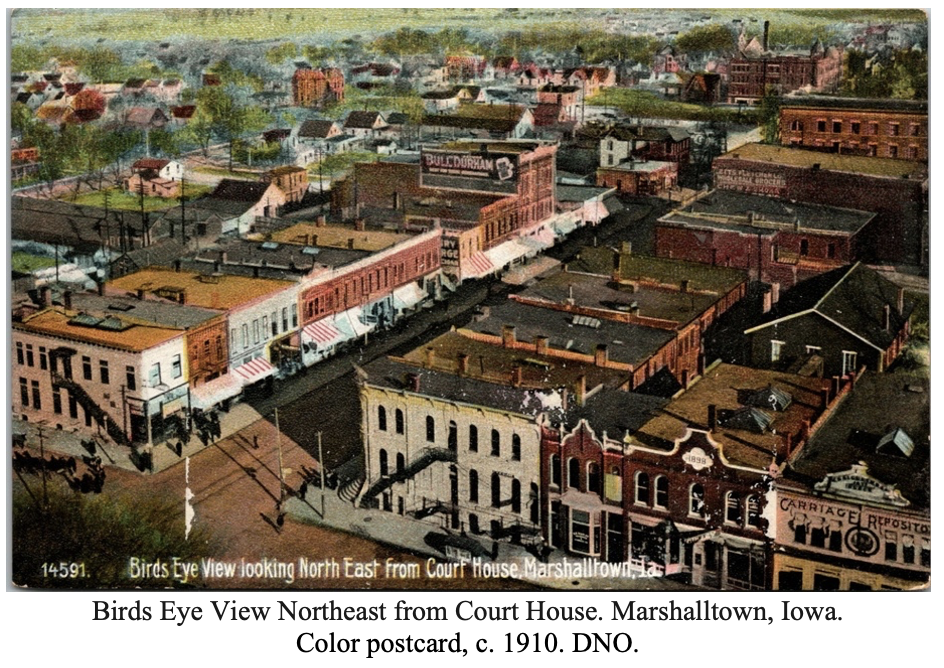
Marshalltown in 1910 had a population of 13,374—a fraction of Springfield’s 51,678. It was a growing industrial town, commercially strong, strategically located, and connected by rail. It was not metropolitan. But it was energetic.
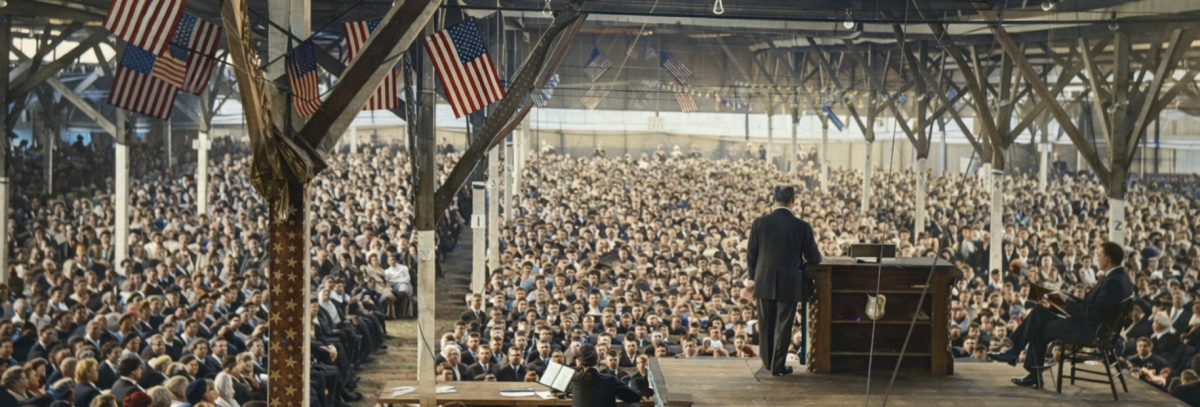
A wooden tabernacle was erected at the corner of Third and Main, seating 5,000. The Sunday machine was now running at full stride.
Opening night—April 25—saw over 12,000 people attend across all services. On the final day, June 6, Sunday preached to 13,200. In a town of just over 13,000 residents, that level of saturation is staggering.
By campaign’s end:
- 2,000 total conversions (125 on the final day)
- 84 tabernacle meetings
- 528 cottage prayer meetings
- Nearly 200,000 in total attendance
For six weeks, Marshalltown was consumed by revival.
The Money and the Machine
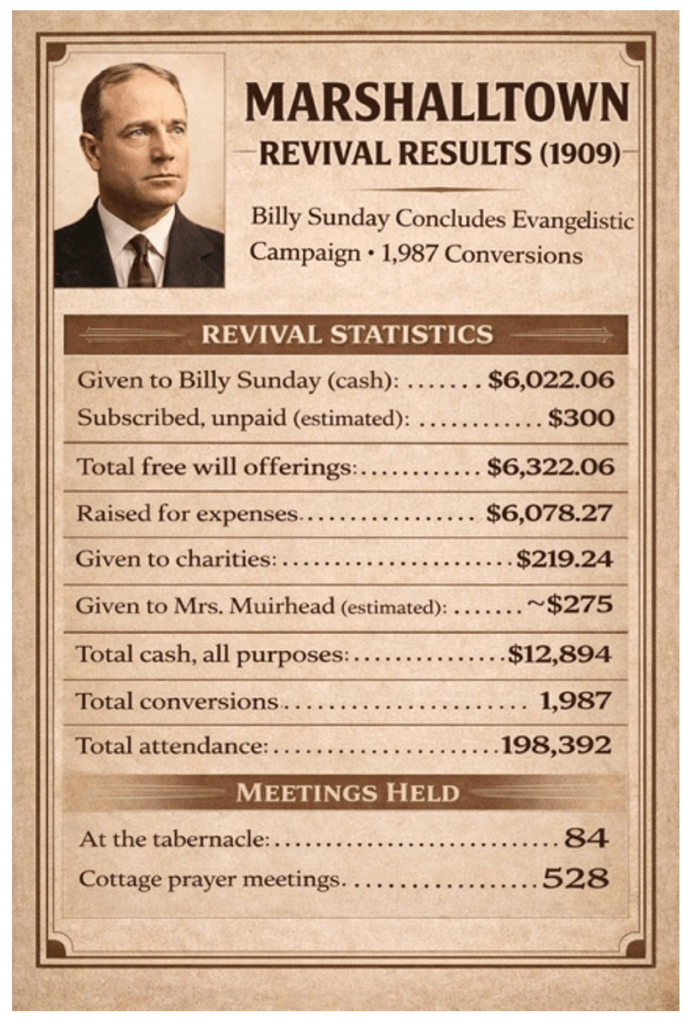
The final purse for Sunday was $6,139.
Total funds raised during the campaign reached $12,894.
For comparison, that purse nearly matched Muscatine’s and approached Ottumwa’s from the previous year. Financially, Marshalltown demonstrated strong committee organization and enthusiastic backing. This was not a struggling campaign.
It was disciplined. Systematic. Mature.
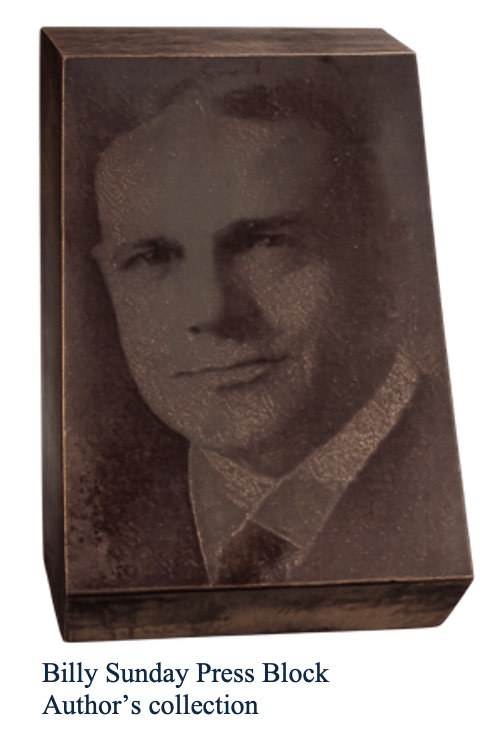
The press block used to print Sunday’s image during this period—now in my collection—reflects that growing sophistication. By 1909, Sunday was no longer improvising revivals. He was executing them.
Did Marshalltown “Underperform”?
One skeptical paper, the Davenport Weekly Democrat and Leader, suggested that Marshalltown’s results did not compare favorably with Fairfield, Ottumwa, Muscatine, and Decatur.
On the surface, that seems correct.
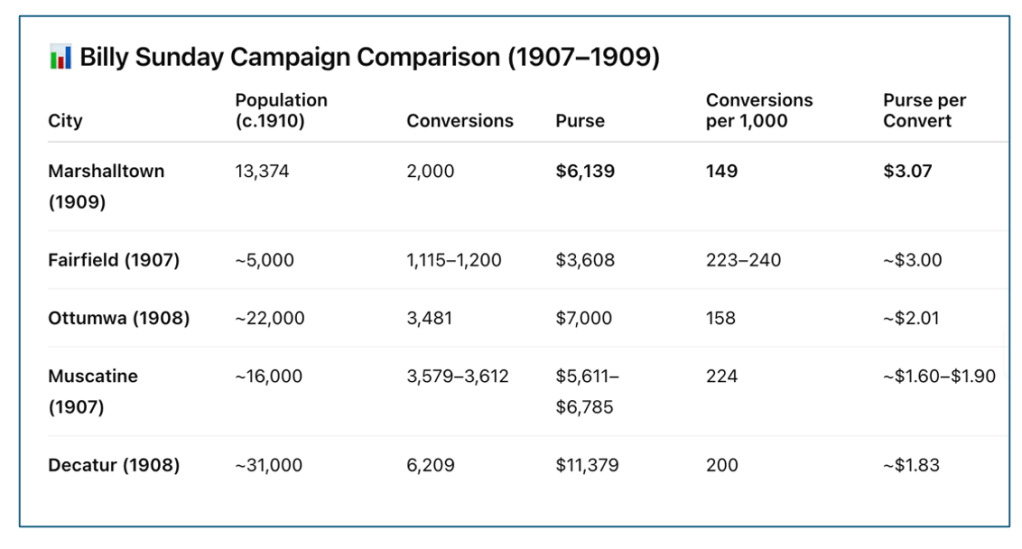
Measured per capita:
- Marshalltown: ~149 converts per 1,000 residents
- Fairfield: over 220 per 1,000
- Muscatine: about 224 per 1,000
- Decatur: around 200 per 1,000
- Ottumwa: about 158 per 1,000
In raw totals, Marshalltown trailed Muscatine (3,579–3,612), Ottumwa (3,481), and especially Decatur (6,209).
So yes—the numbers were not dominant.
But numbers alone miss something important.
The Press: Praise and Pushback
The reaction was revealing.
The Audubon Republican declared the meetings closed in a “blaze of glory.” It reported over 500 cottage prayer meetings and said the town had been “thoroughly stirred up.”
The Marshalltown Evening Times-Republican went further, calling Sunday:
- “One of the splendid prophets of the elder time…”
- “One of the greatest revivalists in existence.”
- “One of the plainest, simplest and happiest of men…”
Meanwhile, the skeptical Davenport Weekly Democrat and Leader offered sharper commentary. It described Sunday as a “contortionist of uncommon ability” with “remarkable versatility,” while acknowledging the “magnetic power of Mr. Sunday.”
Its most fascinating observation was psychological:
“The psychology of it all is that the people who are not regular attendants at churches must be reached not as individuals but in mass. They like to be moved by each other; and it is probable that this explains the success Mr. Sunday attains. He is helped greatly by the excitement and the enthusiasm of the crowds…”
That critique reads today like an astute analysis of mass evangelism. It wasn’t merely preaching. It was momentum. Atmosphere. Collective energy.
Sunday understood something about crowds that many pastors did not.
What Marshalltown Really Proved
Marshalltown was not Sunday’s most explosive campaign numerically.
But it demonstrated something perhaps more important in 1909:
- Massive attendance penetration in a modest city
- Financial stability and strong committee structure
- Organizational maturity (over 600 total meetings)
- National press attention—positive and critical
Marshalltown proved that Sunday could saturate an entire city.
Critics were talking. Admirers were praising. Nearly 200,000 attendances in six weeks ensured that no one in town was untouched by the revival’s presence.
He was no longer just holding meetings.
He was creating civic events.
A Blaze of Glory
The revival closed the way many Sunday campaigns did—intense, loud, emotional, decisive. A blaze of glory.
Marshalltown may not have produced the highest per-capita conversion rate of his Iowa stops. But it stands as a revealing moment in his rise.
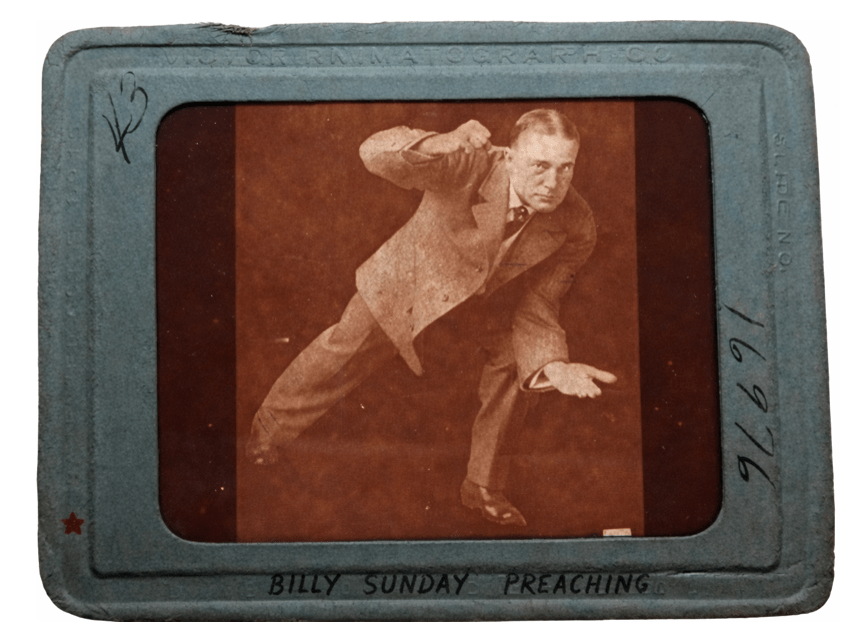
By 1909, Billy Sunday was refining his method. The tabernacle system was humming. The prayer networks were mobilized. The press was watching closely.
And Iowa—his Iowa—was watching one of its own step onto a larger stage.
Marshalltown mattered because it showed that Sunday’s machine worked not just in isolated bursts, but in sustained, organized, city-wide saturation.
For a hometown son, that was no small thing.
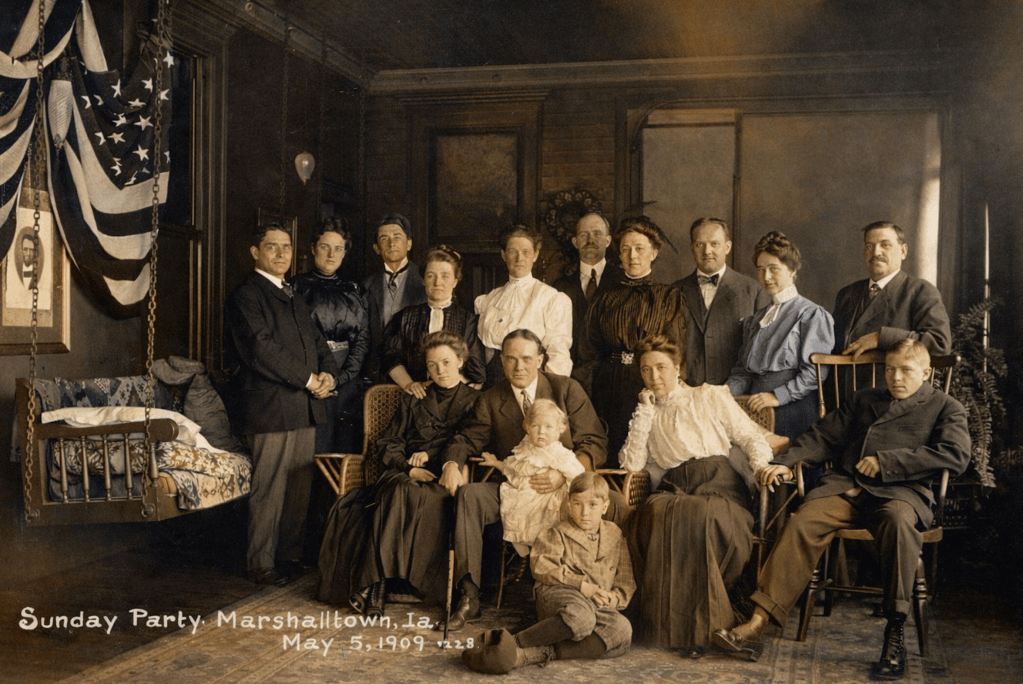
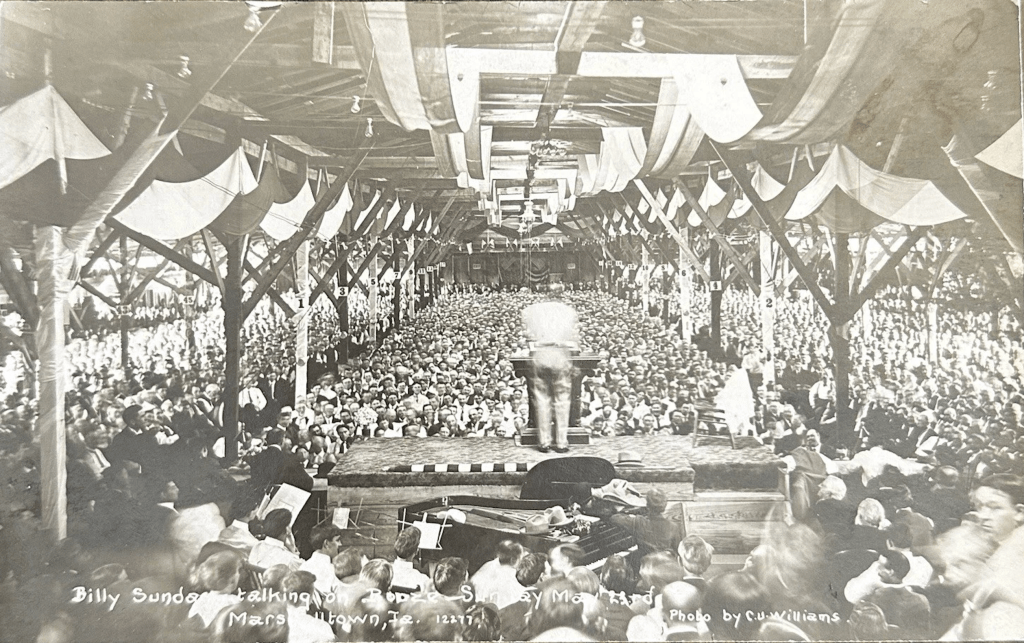

 Evangelist Billy Sunday (1862-1935)