The Opportunity of the Century: D.L. Moody and the 1893 World’s Fair
How an evangelist who thought his life was ending built the largest gospel campaign of his generation in the shadow of the Chicago World’s Fair.
In the summer of 1893, the eyes of the world were on Chicago. The World’s Columbian Exposition — built to mark four centuries since Columbus first reached the Americas — had transformed a stretch of lakefront into a gleaming “White City” of domes, lagoons, and electric light. From May 1 to October 31, millions streamed through its gates.
To many Chicago Christians, the Fair looked like something to fight. It stayed open on Sundays. Worse, its Parliament of Religions gathered the faiths of the world onto one stage, giving Buddhism, Hinduism, and Islam a hearing on American soil. A boycott seemed the godly response.
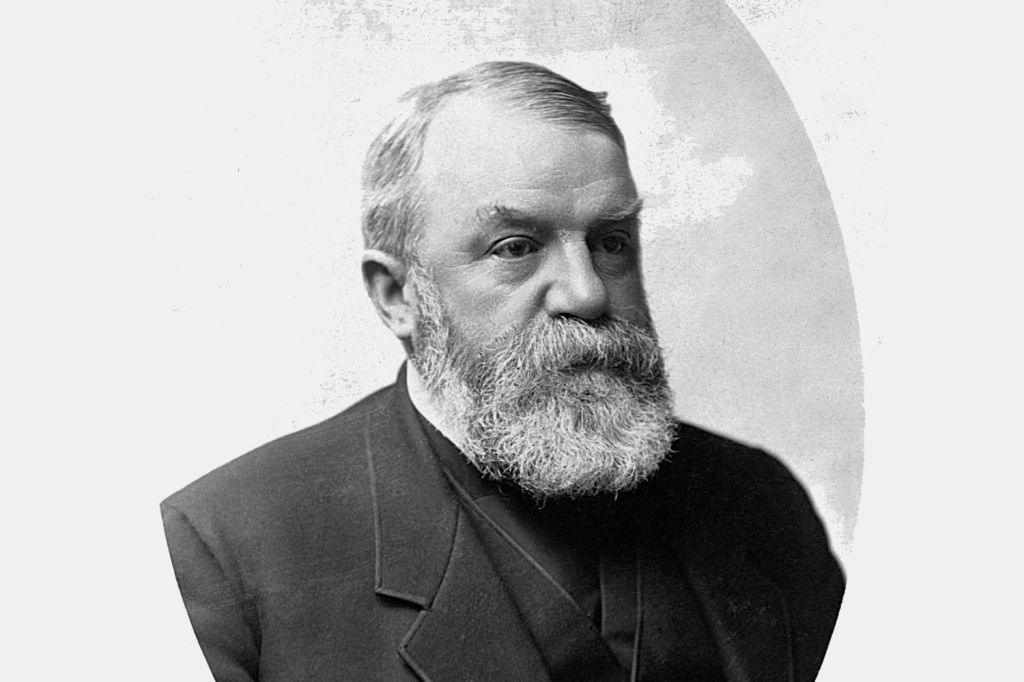
Dwight L. Moody saw it the other way around. If the world was coming to Chicago, then the world was coming to his door — and he meant to be ready. He called it the opportunity of the century, and he would spend the next six months proving he meant it.
A Vow on a Sinking Ship
Moody almost wasn’t there for any of it.
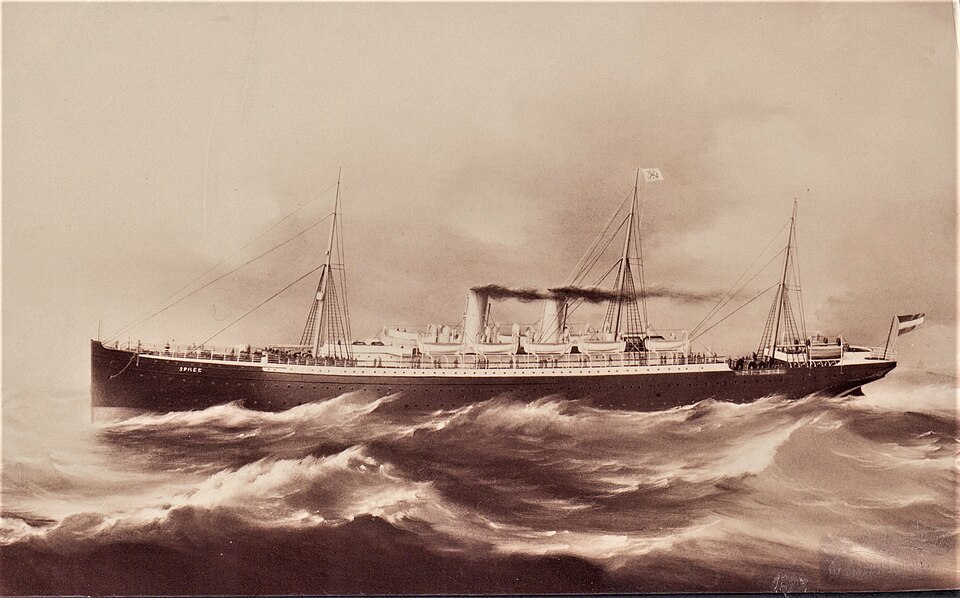
Earlier that same year, while in London, a doctor had warned him that his heart was failing and that he needed to ease off his relentless schedule. Moody had resolved to do exactly that. Then came the voyage home aboard the steamship Spree — and the announcement, mid-ocean, that the ship was going down.
What followed, by his own account, changed everything:
“No one on earth knows what I passed through at the thought that probably my work was finished, and that I would never again have the privilege of preaching the Gospel of Jesus Christ… I made a vow that if God would let me live and bring me back to America, I would go back to Chicago, and at this World’s Fair, preach the Gospel with all the power He would give me.”
He survived. And he did not treat the second chance lightly. Back home in Northfield, he called the students of Mount Hermon and Northfield together at six o’clock one morning and asked them — if they had any regard for him at all — to pray that God would anoint him for the work ahead. He wanted to preach, he told them, as he had never preached before.
Building the Machine
What Moody launched was not a revival meeting. It was a campaign, run with the logistics of an army on the move.
At its peak, somewhere between 200 and 300 workers were in active service, organized under experienced lieutenants Moody had personally summoned. Beneath them labored more than 200 students from the Bible Institute. Sites had to be booked, speakers selected, advertising placed, money raised. Moody deployed secretaries and leaned on the religious press to spread the word. Daily expenses swung wildly — anywhere from $800 to $20,000 a day to cover personnel and volunteers alike.
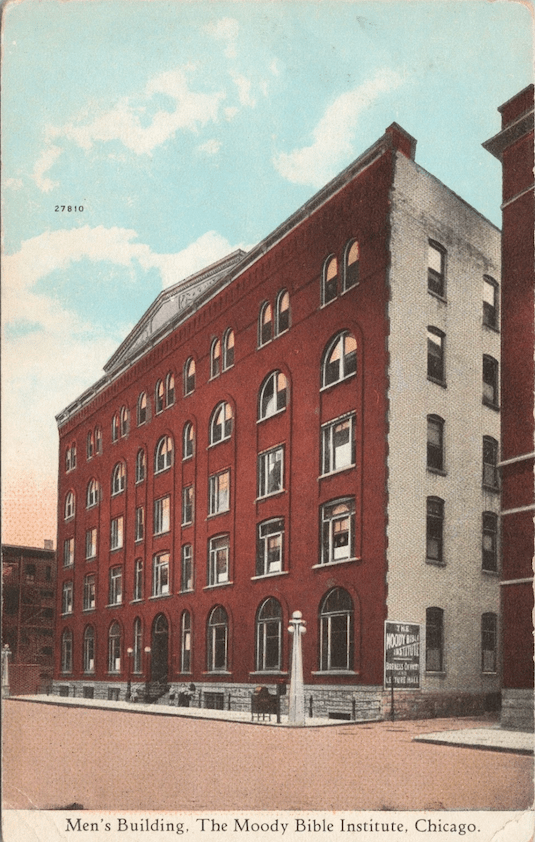
At the center sat the Bible Institute at 80 Institute Place, near La Salle and Chicago Avenues, where lectures ran every morning in a hall that seated 350 and was, by all accounts, always full. In July alone, nearly forty preachers, evangelists, and singers were cooperating in the work, their efforts multiplied by 250 students fanning out across the city in an endless round of house-to-house visiting.
By one estimate, the campaign held roughly 120 gospel meetings every week — fifteen on weekdays and as many as thirty on Sundays — bringing 30,000 to 40,000 people under the sound of the Gospel on a single Sunday.
Opening Day
The campaign began on the morning of Sunday, May 7, 1893. Moody preached that day at the Chicago Avenue Church — the congregation now known as Moody Church — in both the morning and the evening. His subject was the elder brother in the parable of the Prodigal Son: a pointed choice, given how many Chicago believers still saw the whole enterprise as something to resist rather than rejoice over. For Moody, the opposition was almost a cause for celebration.
Through the long months that followed, the church held praise services every night, alongside a series of free conferences — a steady heartbeat under the sprawling work happening everywhere else.
Theaters, Halls, and a Door That Stayed Shut
Moody wanted Chicago’s grandest venue, the Auditorium Theatre at Michigan Avenue and Congress Street. He offered $18,500 — roughly half a million dollars in today’s money — for the use of its hall each day. He was refused.
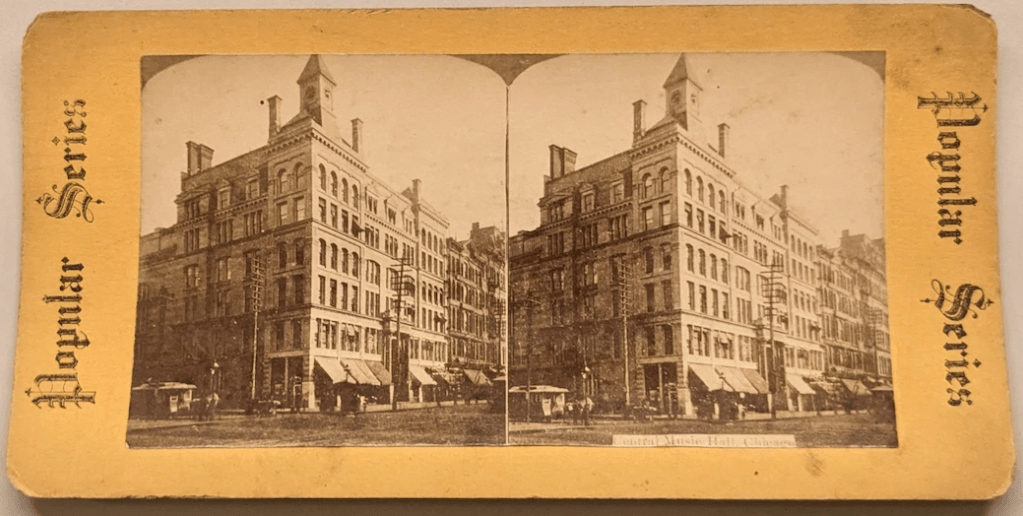
So he improvised. Where churches sat too far from the crowds, he simply rented theaters instead — an innovation that scandalized some and worked beautifully. Before the campaign ended, his operation had occupied a staggering range of spaces: the Haymarket, Empire, Standard, Columbia, Hooley’s, Windsor, Tattersall’s, and Vaudeville theaters; the Central Music Hall and the Grand Opera House; hotel tabernacles, exposition buildings, Turner Hall, Forepaugh’s circus tent, YMCA buildings, the Pacific Garden Mission, and dozens upon dozens of churches across the city and its suburbs — Presbyterian, Congregational, Baptist, Methodist, Lutheran, and more, in English and a half-dozen other languages.
It was at the Standard Theater that a young C.I. Scofield — later famous for his reference Bible — took his turn in the pulpit.
Light in a Dark Place
For years, one corner of the city had weighed on Moody’s heart: the district around West Madison and Halsted Streets, clustered around the Haymarket, Standard, and Empire theaters. It was a neighborhood of saloons, brothels, gambling dens, and “all kinds of vile resorts” — and it was here he aimed much of his early energy.
He rented a four-story building and turned the ground floor into a mission hall, quartering thirty of his students in the rooms above. The location did the recruiting itself: planted on a busy thoroughfare, it could hardly help catching the throngs passing by.
The daily rhythm was unrelenting. At 2 p.m. the hall opened for singing and conversation while workers visited the neighborhood house to house. From seven to eight came a gospel meeting, preceded by half an hour of singing and followed by an hour of personal conversation with anyone troubled by what they’d heard. At ten, a fresh relay of workers held a second meeting, then spent the hour to midnight talking with the anxious and the unsaved. The whole machine was built around a single insight: reach the people whose only other evening destination was the saloon.
Something Better Than Buffalo Bill
The most astonishing scene of the entire campaign may have unfolded under a circus tent.
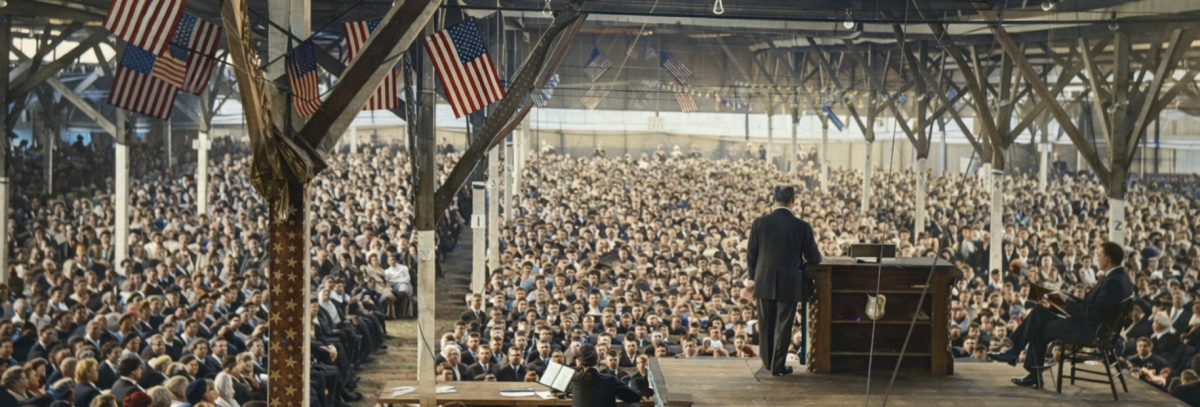
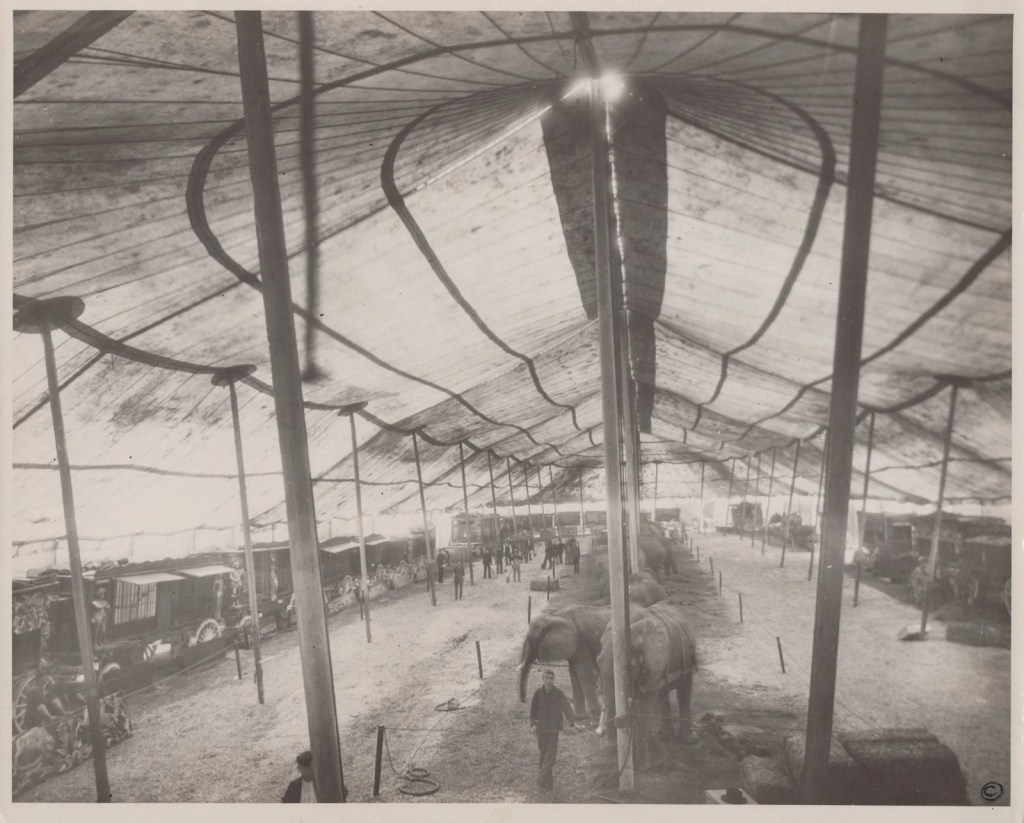
Moody secured Forepaugh’s enormous circus tent near the lakefront — a venue that could swallow a crowd of 15,000 — and on one Sunday morning some 18,000 people packed in. “We got something better than Buffalo Bill,” went the line, a wink at the Wild West show drawing crowds elsewhere in the city.
One witness left a vivid account: clowns, grooms, circus riders, gamblers and drinkers, pickpockets, and ordinary men, women, and children all swept into one vast assembly. The sea of faces struck him as both glad and solemn. Moody preached that morning from Luke 19:10 — “the Son of Man is come to seek and to save that which was lost.” In a fitting touch, he is said to have reunited a lost child with her father during one of the services.
The Flying Artillery
If the theaters and tents were the campaign’s infantry, the gospel wagon was its cavalry.
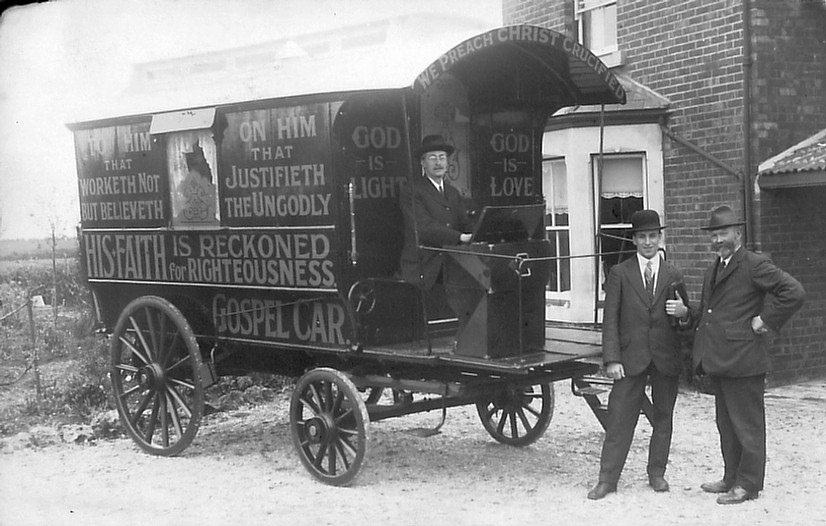
Under evangelist J.C. Davis and gospel singer H.H. Higgins — joined at times by William Robertson of Edinburgh and a crew of trained Institute workers — a gospel carriage rolled through Chicago morning, afternoon, and evening. The vehicle itself drew a crowd: a handsome carriage, well-dressed speakers, a tiny seventeen-pound organ, a lantern hung out at dusk, and a fold-down platform off the back. But what held people, one reporter noted, was the plain, vigorous, practical preaching. No one spoke long; there was plenty of good singing; and the same crowd that gathered at the start was often still there ninety minutes later.
One afternoon Moody climbed aboard himself to test, as it were, that arm of the service. The wagon was driven from district to district, stopping wherever a crowd could be gathered. The singers would ring out a hymn, Moody would lay out the way of salvation in a five-minute address, give a warm invitation to the evening service at the Standard Theater, and move on — ten different meetings in the space of a few hours. He called it the flying march.
A Note on the Gospel Wagon
The idea was older than 1893. Mentions surface as early as the 1870s, and by 1886 the concept had spread to several cities. In Washington, D.C., the Central Union Mission ran a “gospel wagon” every Sunday — on weekdays just an ordinary bus, transformed for the Sabbath by a small cabinet organ and a band of singers who went out to “hunt for sinners” along the wharves and near the ballgrounds. That same year in Brooklyn, the evangelist Ferdinand Schiverea, barred from street preaching, sidestepped the police by acquiring a peddler’s license and a wagon painted over with Scripture, intending to “sell” Bibles for a nominal sum and preach to whoever gathered. Moody didn’t invent the gospel wagon — but few used it on the scale he did.
Meetings for Everyone
The campaign refused to settle into one mold. There were meetings for men and meetings for women, for children and for soldiers. There were temperance meetings and jail meetings, open-air gatherings and cottage gatherings. And because the Fair had drawn the whole world to Chicago, there were meetings in the languages of that world — for Poles, Jews, Arabs, the French, and others.
Downtown, at the Central Music Hall on the corner of State and Randolph, Moody’s team rented the auditorium for two hours each day, holding a service from eleven to one. There Dr. J. Wilbur Chapman led a forward movement uniting the Third Presbyterian Church with half a dozen others. As the Fair built toward its climax in the final weeks, hundreds of thousands more would pass through.
A Campaign of Prayer
For all its theaters and wagons and ledgers, those closest to the work insisted it was something else at its core. As one chronicler put it, it was a campaign of prayer as much as a campaign of preaching and song.
The money tells part of why. As expenses mushroomed, Moody reckoned he could spend $8,000 a day — some $200,000 today — just to run the Mission Hall. At one point the campaign found itself $7,000 in arrears, and the team gave itself to prayer. Then word came that the Northfield Conference had sent $6,000 in support. Moody was touched to the heart. “Let’s wake up this whole city,” he had said, and he poured renewed energy into concerts of prayer to do it.
Every night, the human side of that campaign came home to roost. Moody made a habit of gathering his tired co-workers in his room at the Bible Institute — for refreshments, for reports of the day, and to talk through the work. One by one they came in from churches and theaters and halls and tents, some near midnight, and the commander-in-chief had a word for each. Nothing brightened his face like a report of a soul saved. On Sunday nights, after the crowded labors of the day, they bowed together in thanksgiving before going to rest.
The Reckoning
When the Fair finally closed its gates on October 31, the numbers were almost hard to believe. By the campaign’s own accounting, roughly 1.9 million people had attended its evangelistic events. Week after week, an estimated 100,000 souls were “brought within reach of the gospel.”
At the closing meeting, Moody gave the credit where he had always insisted it belonged — not to the organization, not to the theaters or the tents or the wagons, but to God.
The doctor in London had told him to slow down. Instead, with what he believed were borrowed days, Moody built the largest gospel campaign of his life in the middle of the largest gathering Chicago had ever seen — and answered the question he’d carried up from the deck of a sinking ship.

 Evangelist Billy Sunday (1862-1935)