Former professional baseball player-turned urban evangelist. Follow this daily blog that chronicles the life and ministry of revivalist preacher William Ashley "Billy" Sunday (1862-1935)
Three years after the Carthage meetings, a Mattoon, Illinois newspaper said that 80% of Carthage converts were still “living the new life. While two years after Keokuk, 75% of the converts “are still leading the new life.” – JG-TC: Journal Gazette and Times-Courier (Mattoon, Illinois) · Mon, Mar 19, 1906 · Page 1.
Five years after the Belvidere revival of September 1901, a Belvidere newspaper reported that membership of Belvidere Methodist church in 1901 was 500 persons, and five years later it was 850, showing the ‘stickiness’ of Sunday converts over a long period of time. – Belvidere Daily Republican (Belvidere, Illinois) · Mon, Mar 26, 1906 · Page 2.
The following article excerpt was carried in several newspapers in mid August 1910.
MIDDLE WEST HAS A RELIGIOUS FERMENT
In Chicago Itself Other World Matters Have the Floor.
“The rest of the country can hardly realize the breadth and the depth and the fervor of the spiritual tumult which is stirring the Middle West with Chicago as its center. Chicago newspapers regularly carry columns of sermons in their paid advertising columns. In Chicago street cars are displayed glaring placards advertising the “Book of Mormon,” and 48,000 copies have been sold in the city during the past two or three years. Billboards are covered with big four-sheet posters in colors, calling upon the public to attend great free mass meetings in the Coliseum, with a gospel choir of 2000 voices as the special attraction. Every Sunday morning the Auditorium—the largest theater in the city—is packed with the congregation of Central Church, and every Sunday evening Orchestra Hall is filled with people attending the religious services, which are supported by a voluntary club of Chicago business men. And during the clement season of each recent year scores of Middle West towns, with populations of ten and twenty thousand people, have practically dropped all their ordinary occupations and given themselves over for weeks at a time to a strange, fanatical religious ecstasy, under the acrobatic ministrations of “Billy” Sunday, baseball evangelist. And these are only the more normal the more nearly orthodox manifestations of the spiritual unrest.”—Henry M. Hyde in Collier’s.
Fresh off a successful campaign in Springfield, Billy Sunday and his team rolled into Marshalltown in late April of 1909. This was not foreign soil. It was home turf.
Sunday had been raised in Iowa, shaped by its churches, and had even lived briefly in Marshalltown in the early 1890s while learning the mechanics of evangelistic work. By 1909 he returned not as an unknown ballplayer-turned-preacher, but as a nationally rising evangelist whose methods were becoming increasingly organized, efficient, and powerful.
Marshalltown was the right kind of proving ground. Large enough to sustain a six-week revival. Small enough to rally around one of its own.
The Setting: A City Poised for Revival
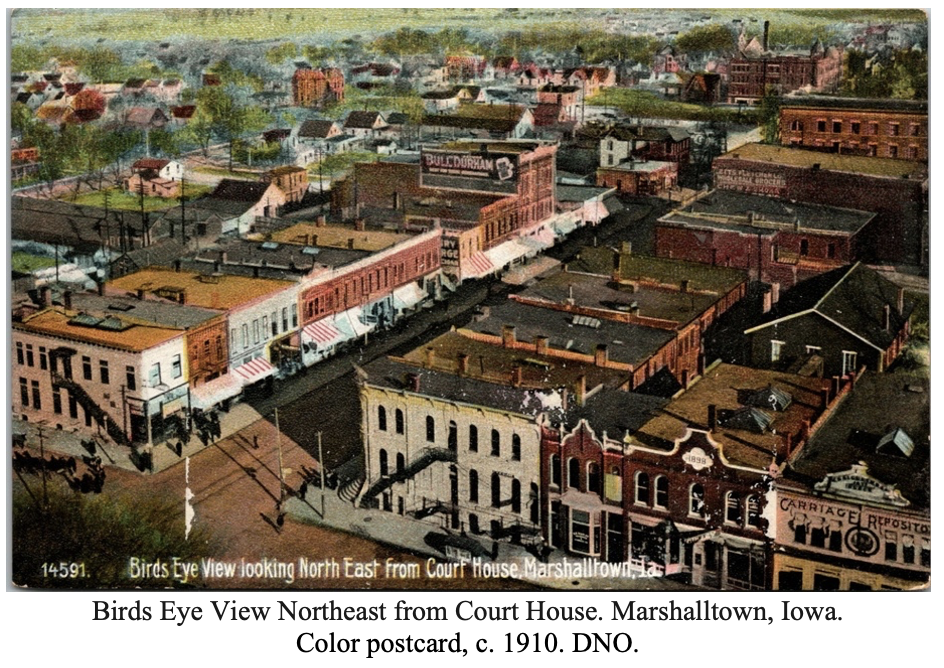
Marshalltown in 1910 had a population of 13,374—a fraction of Springfield’s 51,678. It was a growing industrial town, commercially strong, strategically located, and connected by rail. It was not metropolitan. But it was energetic.
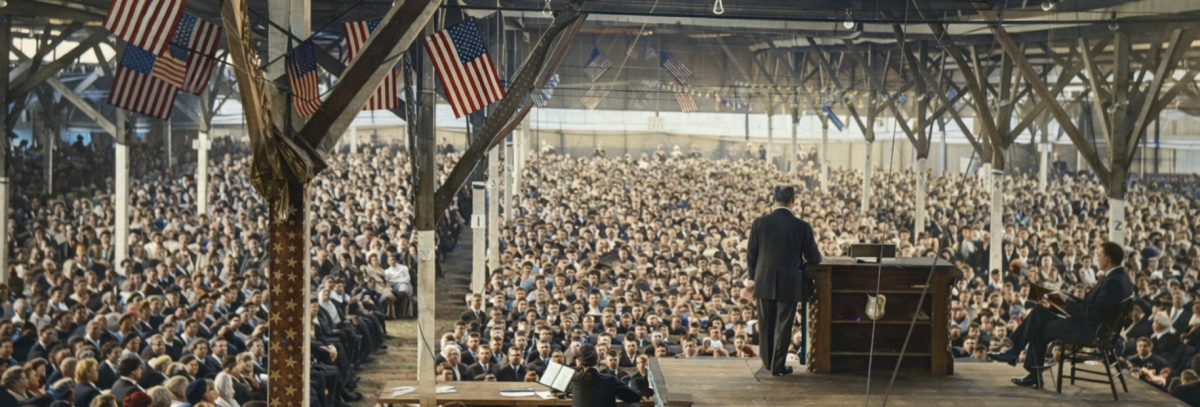
A wooden tabernacle was erected at the corner of Third and Main, seating 5,000. The Sunday machine was now running at full stride.
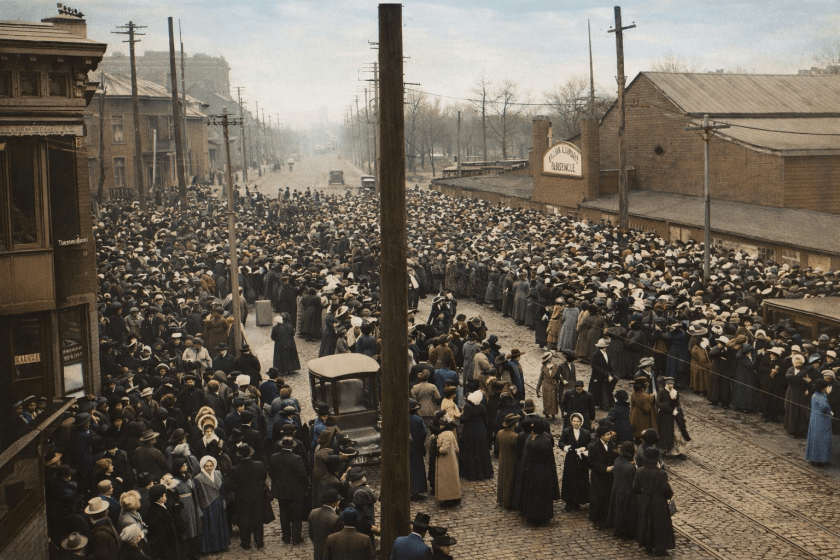
Opening night—April 25—saw over 12,000 people attend across all services. On the final day, June 6, Sunday preached to 13,200. In a town of just over 13,000 residents, that level of saturation is staggering.
By campaign’s end:
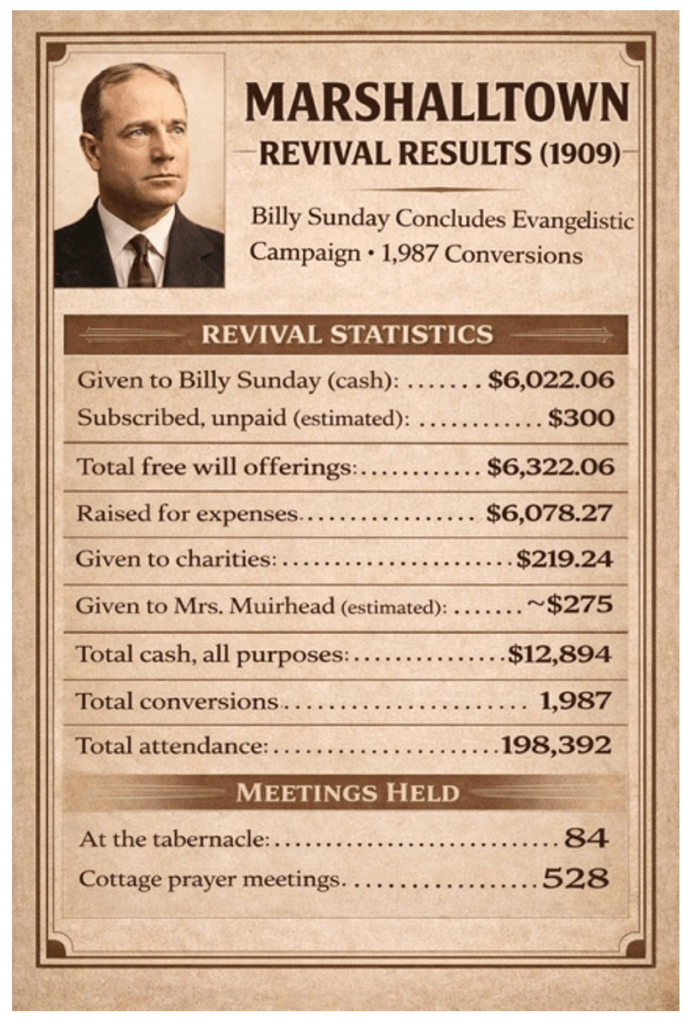
2,000 total conversions (125 on the final day)
84 tabernacle meetings
528 cottage prayer meetings
Nearly 200,000 in total attendance
For six weeks, Marshalltown was consumed by revival.
The Money and the Machine
The final purse for Sunday was $6,139. Total funds raised during the campaign reached $12,894.
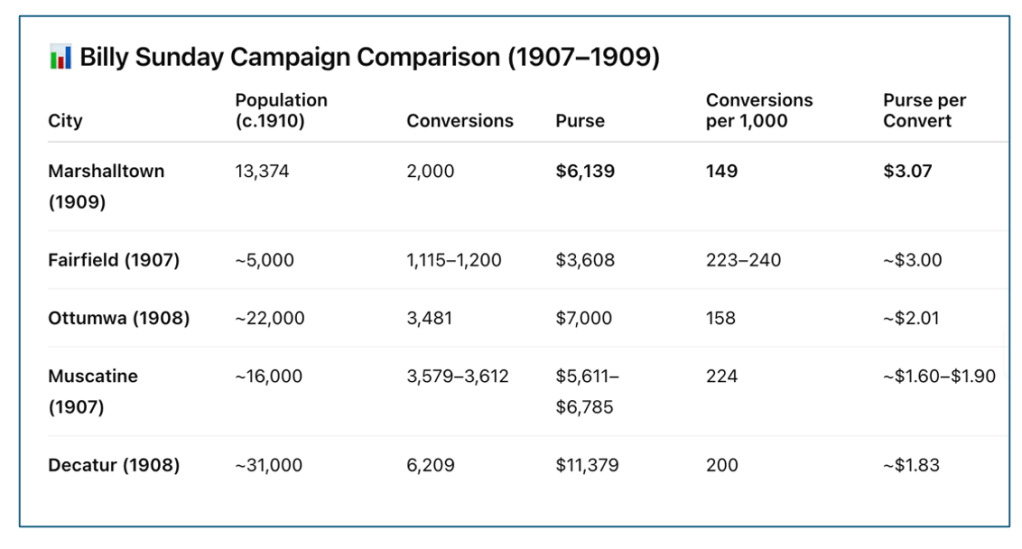
For comparison, that purse nearly matched Muscatine’s and approached Ottumwa’s from the previous year. Financially, Marshalltown demonstrated strong committee organization and enthusiastic backing. This was not a struggling campaign.
It was disciplined. Systematic. Mature.
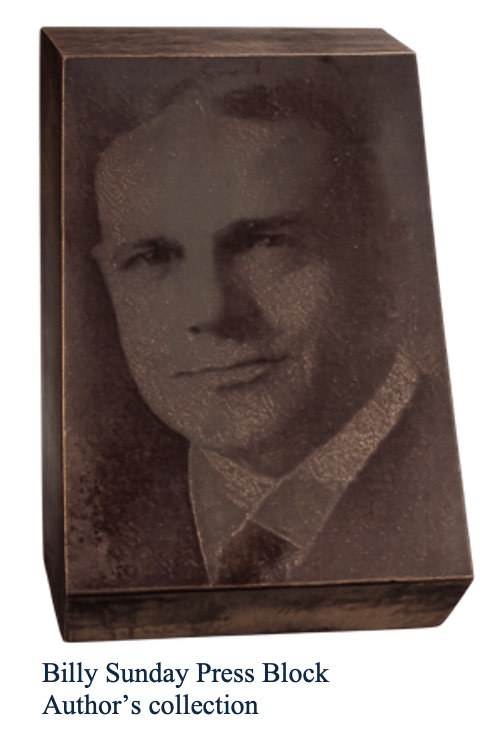
The press block used to print Sunday’s image during this period—now in my collection—reflects that growing sophistication. By 1909, Sunday was no longer improvising revivals. He was executing them.
Did Marshalltown “Underperform”?
One skeptical paper, the Davenport Weekly Democrat and Leader, suggested that Marshalltown’s results did not compare favorably with Fairfield, Ottumwa, Muscatine, and Decatur.
On the surface, that seems correct.
Measured per capita:
Marshalltown: ~149 converts per 1,000 residents
Fairfield: over 220 per 1,000
Muscatine: about 224 per 1,000
Decatur: around 200 per 1,000
Ottumwa: about 158 per 1,000
In raw totals, Marshalltown trailed Muscatine (3,579–3,612), Ottumwa (3,481), and especially Decatur (6,209).
So yes—the numbers were not dominant.
But numbers alone miss something important.
The Press: Praise and Pushback
The reaction was revealing.
The Audubon Republican declared the meetings closed in a “blaze of glory.” It reported over 500 cottage prayer meetings and said the town had been “thoroughly stirred up.”
The Marshalltown Evening Times-Republican went further, calling Sunday:
“One of the splendid prophets of the elder time…”
“One of the greatest revivalists in existence.”
“One of the plainest, simplest and happiest of men…”
Meanwhile, the skeptical Davenport Weekly Democrat and Leader offered sharper commentary. It described Sunday as a “contortionist of uncommon ability” with “remarkable versatility,” while acknowledging the “magnetic power of Mr. Sunday.”
Its most fascinating observation was psychological:
“The psychology of it all is that the people who are not regular attendants at churches must be reached not as individuals but in mass. They like to be moved by each other; and it is probable that this explains the success Mr. Sunday attains. He is helped greatly by the excitement and the enthusiasm of the crowds…”
That critique reads today like an astute analysis of mass evangelism. It wasn’t merely preaching. It was momentum. Atmosphere. Collective energy.
Sunday understood something about crowds that many pastors did not.
What Marshalltown Really Proved
Marshalltown was not Sunday’s most explosive campaign numerically.
But it demonstrated something perhaps more important in 1909:
Massive attendance penetration in a modest city
Financial stability and strong committee structure
Organizational maturity (over 600 total meetings)
National press attention—positive and critical
Marshalltown proved that Sunday could saturate an entire city.
Critics were talking. Admirers were praising. Nearly 200,000 attendances in six weeks ensured that no one in town was untouched by the revival’s presence.
He was no longer just holding meetings.
He was creating civic events.
A Blaze of Glory
The revival closed the way many Sunday campaigns did—intense, loud, emotional, decisive. A blaze of glory.
Marshalltown may not have produced the highest per-capita conversion rate of his Iowa stops. But it stands as a revealing moment in his rise.
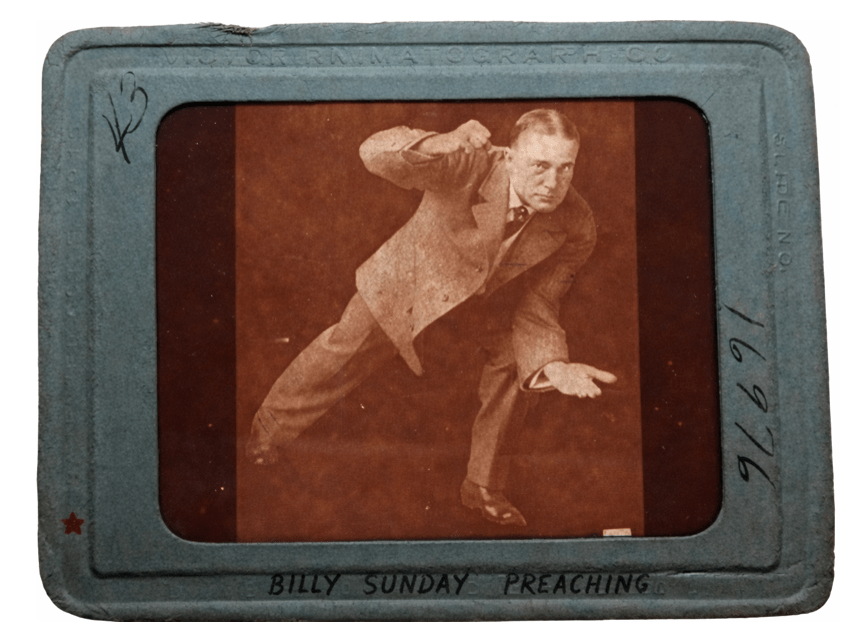
Magic lantern slide. Author’s collection.
By 1909, Billy Sunday was refining his method. The tabernacle system was humming. The prayer networks were mobilized. The press was watching closely.
And Iowa—his Iowa—was watching one of its own step onto a larger stage.
Marshalltown mattered because it showed that Sunday’s machine worked not just in isolated bursts, but in sustained, organized, city-wide saturation.
When the revival campaign of Billy Sunday reached Kansas City in 1916, observers could easily assume that the evangelist’s enormous crowds and national reputation had appeared overnight. But a reflective article in the The Kansas City Star reminded readers that Sunday’s success had actually grown slowly and deliberately over many years.
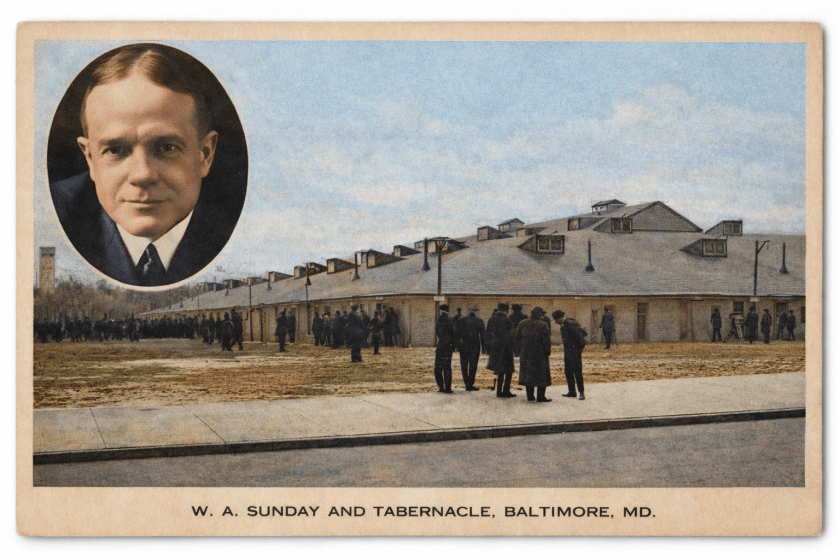
The Baltimore Tabernacle
The paper explained that there was nothing sudden or “mushroom-like” about the rise of the Sunday revivals.
“There is nothing ‘mushroom’ in the growth of the Billy Sunday meetings.”
Instead, the evangelist’s methods and audience steadily developed over time. In the early years, when Sunday first began holding revival meetings, his audiences often found little that seemed unusual.
“Early audiences found nothing spectacular in the sermons of the revivalist.”
Those early campaigns were also modest in scale. At first, Sunday and his team believed that smaller communities were the natural limit of their work.
“We used to think that the town of ten thousand population was our limit.”
As the years passed, however, confidence grew. The team gradually moved into larger towns and then into major cities. The article recalled how Sunday’s organization expanded step by step—building larger tabernacles and reaching larger crowds with each campaign.
“All the time we were gradually adding to our party and building larger tabernacles.”
By 1916, the scale had changed dramatically. Cities once thought far beyond reach were now the focus of massive campaigns.
“Here we are and New York City is in sight with a tabernacle seating twenty-five thousand.”
The article also emphasized that Sunday’s preaching style had developed its own distinctive character. His revival methods were not borrowed directly from older traditions but shaped by his own personality and experience.
The writer noted that Sunday had “thrown out the life line in a fashion distinctly unique.”
Another aspect of his ministry that caught the attention of reporters was the structure of the campaigns themselves. A typical revival lasted about a month, with the message unfolding gradually over time.
In the early weeks, Sunday often avoided direct appeals for conversion, instead using stories and humor to gain the attention of his audience. Only later did the preaching intensify.
By the third week, the article explained, Sunday would devote his sermons to confronting sin and pressing listeners toward repentance. The final week focused on urging people to make a decision.
Even the physical setting reflected Sunday’s distinctive approach. Unlike some revivalists, he rejected the traditional “mourner’s bench” used in earlier revival meetings. Instead, converts were invited to come forward and sit in chairs while he spoke with them personally.
The article also noted that Sunday was not closely tied to any one denomination. While he often expressed appreciation for various churches, his ministry remained broadly interdenominational.
By the time Kansas City hosted the campaign in 1916, Billy Sunday had become one of the most recognizable religious figures in America. Yet the newspaper’s reflection reminded readers that the movement had not been built in a single moment.
It had grown—campaign by campaign, city by city, and year by year.
And in the process, Billy Sunday had created a revival method that was unmistakably his own.
In 1918, Billy Sunday stepped into one of America’s most divisive debates — women’s suffrage. What drove him? What can we learn from that boldness?
A century later, his words still challenge us to consider what moral courage looks like in public life today.
This original 1918 newspaper article captures Billy Sunday’s public support for women’s right to vote. At a time when the nation was debating suffrage, Sunday’s words reveal both his moral clarity and his ability to speak into civic life with conviction and wit.
Evangelist Says He Favored Proposition Long Before It Became a Fad. To Open Suffrage Session With Prayer.
With the vote on the suffrage amendment coming tomorrow, Rev. William A. Sunday is another prominent individual who is taking the opportunity to reiterate his faith in “votes for women.”
In a signed statement which “Billy” Sunday gave Mrs. Lawrence Lewis, of the National Woman’s Party, last night, the evangelist says:
“It is nothing new for me to favor woman suffrage. I have been advocating it for years, even before it became popular. We are living today in a new era. If she is good enough to be our mother and our wife, good enough to preside over our home, to care for us in times of sickness and to share our joys and our sorrows, why should she be denied the privilege of voting?
“Today, more nearly than ever before, she bears equally with men the world’s burdens. What would the nations of the earth do without her aid, either in times of peace or war? Women are sharing equally with men the burdens and the sacrifices of this war.
“They are in the munitions factories and in the fields of agriculture and in all other departments of war service. Without their co-operation the war could not be waged to a successful conclusion. As they share in the burdens they should also share in the responsibilities of government.
“I see no reason why the men and women of the nation should not walk side by side in the matters of law enactment as well as in the home and social life.”
Mr. Sunday will offer the prayer at the opening of the House tomorrow when the suffrage vote is take.
<End of newspaper article>
Sunday’s endorsement came just months before Congress passed the 19th Amendment in 1919. His statement offers a glimpse into how revivalists connected moral reform with public policy—a reminder that faith and social conscience have always been intertwined in the American story.
 Evangelist Billy Sunday (1862-1935)