Former professional baseball player-turned urban evangelist. Follow this daily blog that chronicles the life and ministry of revivalist preacher William Ashley "Billy" Sunday (1862-1935)
Cited in: The Philadelphia Evening Ledger. January 5, 1915:5. – William Rader
Billy Sunday is not easily defined. Power conceals its secret. Psychologists would call it hypnotism; theologians, the power of the spirit; the ethical teacher, the gift of truth; the dramatist, the art of the player; while others declare:
His strength is as the strength of ten, Because his heart is pure.
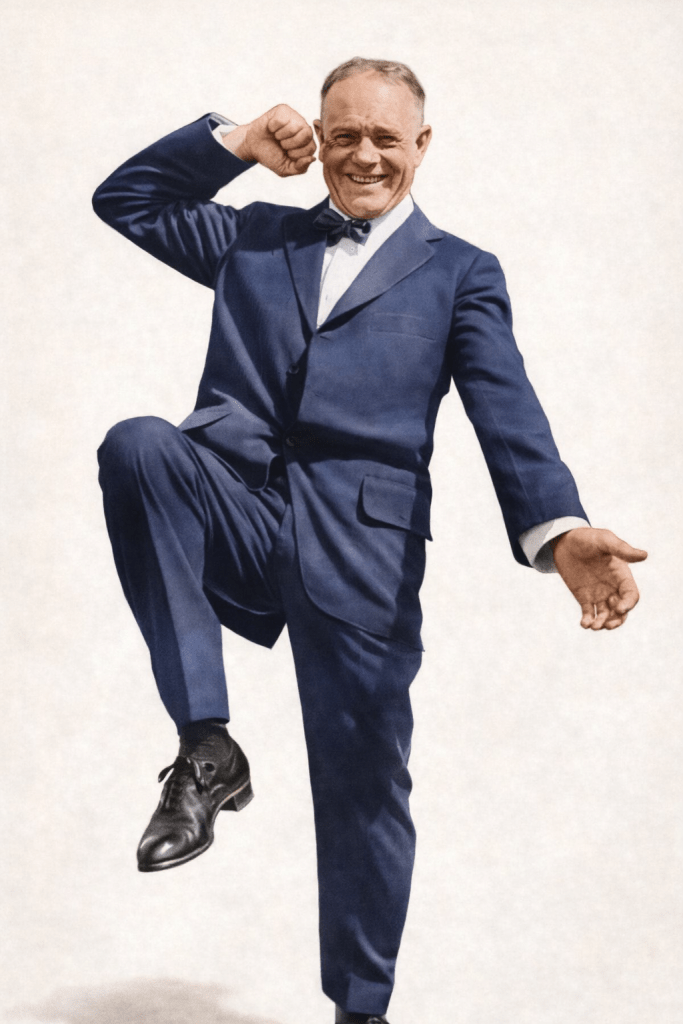
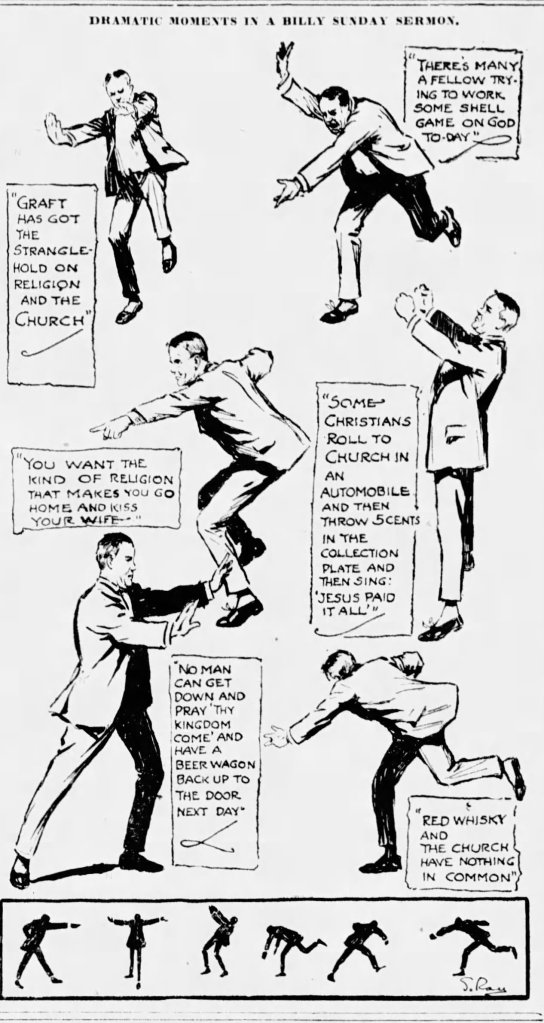
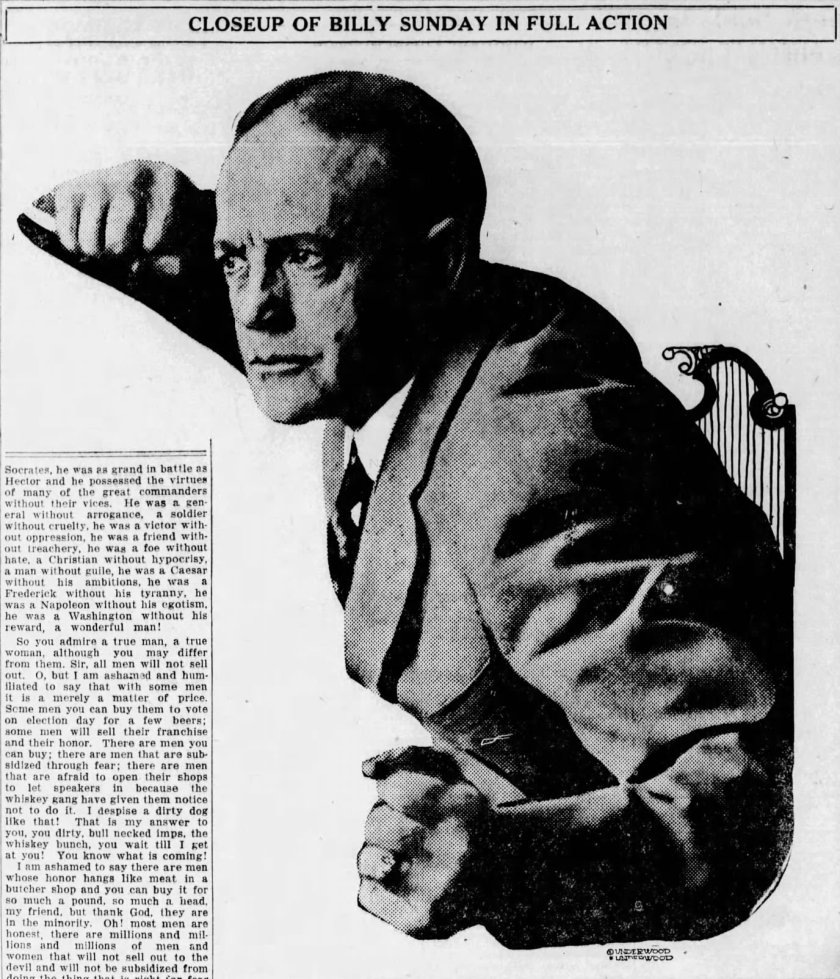
Billy Sunday is a good actor. Each sermon is carefully prepared, and some of it read from manuscript. Certain climaxes are illustrated. At one point he slides to a base; at another, kneels, or leaps upon the pulpit desk, or smashes a chair to pieces. Edward Everett did not more carefully prepare a speech with its proper gestures than does this evangelist build his sermons. The local color with which he decorates his main thought is taken from the city in which he speaks.
His imagination interested me. Speaking on “The Grenadier,” the consideration of his theme invited the use of the imagination, and he gave it full play. The sermon was an application of military attributes to practical life, a rebuke to the “wind-jammer” of the prayer meeting, and an appeal to the man who has taken an oath to be good to go out and honor it. He assailed the “saphead” who criticises the Church, and the description he gave of Daniel in the lion’s den and of the head of John the Baptist on a charger will not be forgotten.
I confess to a liking for his so-called slang. Most of it is plain English with a punch in it. It is the punch which preachers and editors and people who use words generally lack. Words are like shot, made to strike, and especially when used to influence great bodies of people. It is refreshing to hear a man say what he thinks and say it as he pleases—a thing most public men signally fail to do.
Curated from: The Philadelphia Evening Ledger. January 6, 1915:3.
You don’t just attend a Billy Sunday meeting—you step into it.
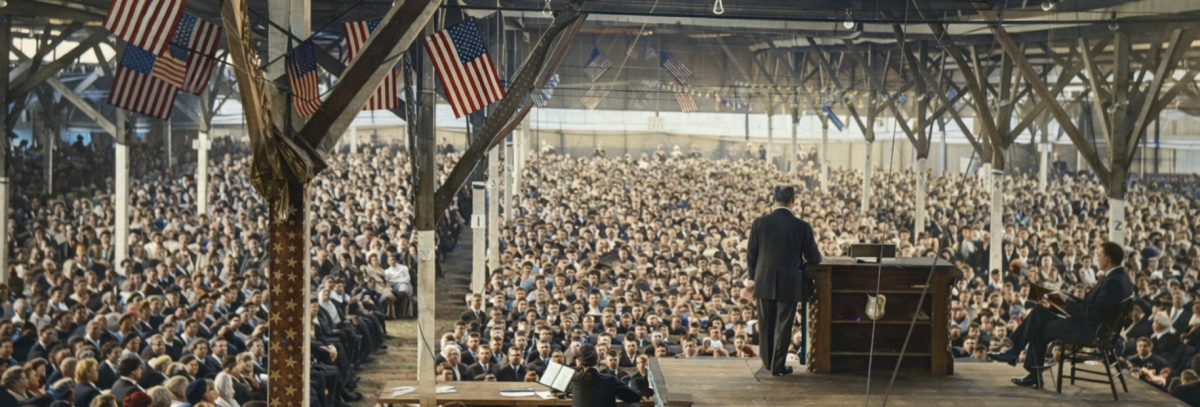
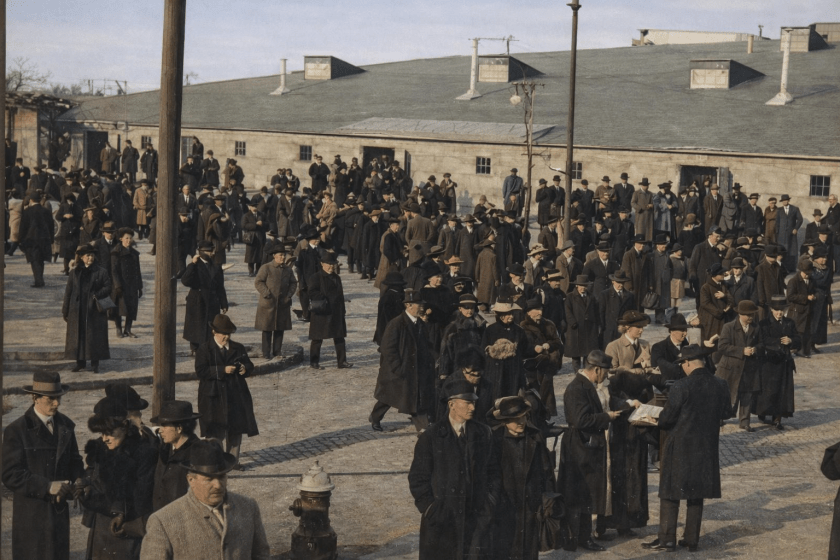
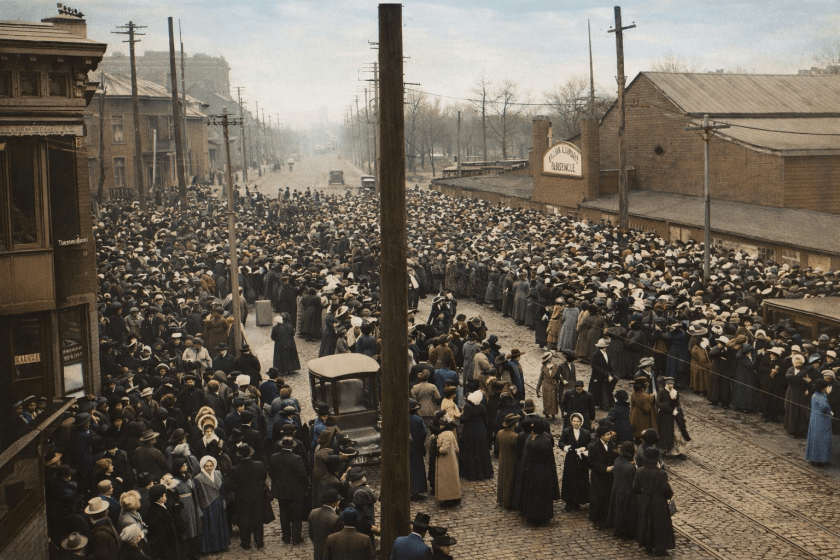
By the time I reached the tabernacle, the place was already alive. Not just crowded—alive. Policemen lined the edges, firemen stood ready, and yet there wasn’t even “the merest hint of disorder.” Whatever this thing was, it had structure. It had gravity. And it was pulling people in.
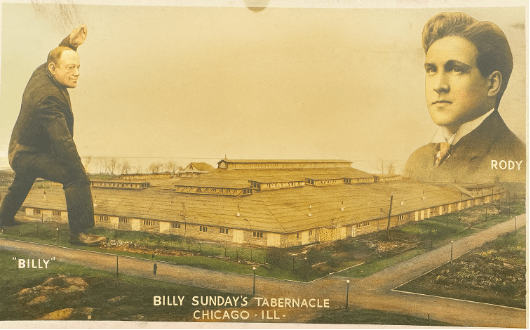
Colorized image of the Billy Sunday tabernacle in Philadelphia, c.1915.
Inside, the air carried that peculiar mixture of sawdust, sweat, and anticipation. Outside, though—that’s where you heard the real story.
A man near me, confident as a prophet, said to no one in particular:
“Billy Sunday has only started… it’s going to get worse and worse. He arouses more enthusiasm each day. If you don’t believe me, ask Scranton.”
That was the mood—this wasn’t the event. This was the beginning of the event.
The Crowd Watching the Crowd
It struck me quickly: people weren’t just watching Billy Sunday.
They were watching each other.
One visitor said it plainly:
“I was naturally interested in ‘Billy’ Sunday, and perhaps even more so in the crowd.”
And what a crowd it was.
A boy—no more than ten—hobbled in on crutches just to hear him. A sailor from the battleship Kansas had been waiting “for months” to catch a meeting. A woman stood nearby, nervous, almost whispering:
“Oh! no. I cannot give my name… my husband would throw a fit if he knew I had been in here.”
And yet—there she was.
That’s how you knew something was happening. Not just attendance—but risked attendance.
What People Were Saying
If you wanted to understand Billy Sunday, you didn’t start with the sermon.
You started with the talk afterward.
“What do you think of ‘Billy’?” someone asked.
The answers came quick, overlapping:
“Great.” “Some man.” “An ace.” “I like him because he goes after the hypocrites.”
Others reached for bigger words:
“Wonderful… splendid… marvelous.”
But not everyone could quite put their finger on it.
One woman, looking slightly dazed, said:
“I have had so many things fired at me in the last hour that I can’t quite set my bearings.”
That may have been the most honest response of all.
More Than a Sermon
There was something else in the air—something heavier than excitement.
A man, speaking to a small group of women, said what many were thinking:
“I would like to see ‘Billy’ Sunday wake this city up and get the rum out of it… Look how many homes he would make happy.”
And then, almost quietly, another moment:
In the northeast corner of the tabernacle, someone reported hearing a man say:
“This is my last drink.”
No sermon transcript can capture that.
That’s the sawdust trail doing its work.
The Unexpected Details
Not everything was solemn.
Someone joked about the sawdust itself:
“They say Mr. Sunday hates noise, and I know I am going to sneeze. I always do when around sawdust.”
Even the ministers weren’t immune to the moment. One well-known clergyman was said to amuse himself before preaching by reading The Fun of Getting Thin—and now, thanks to the crowds, “occupies two seats.”
And everywhere—evidence of men lingering longer than usual:
“There were enough cigar butts left in the gutters… to start a true second-hand cigar store.”
It wasn’t tidy.
It wasn’t polished.
But it was real.
Order in the Midst of It All
For all its energy, the thing held together.
The crowds were vast, but they moved. The police managed them. The firemen stood watch. The machinery of the city seemed, for a moment, to cooperate with something larger than itself.
One observer summed it up best:
“To get and hold a vast throng like this on a weekday for the purpose of hearing the gospel certainly is a tribute to the man himself.”
And It’s Only the Beginning
If you stood there long enough, listening—not to the sermon, but to the people—you began to realize something:
The revival hadn’t peaked.
It hadn’t even arrived yet.
It was building.
You could hear it in the confidence of the man who said, “ask Scranton.” You could see it in the boy on crutches. You could feel it in the nervous woman who came anyway. You could sense it in the man who muttered, “my last drink.”
Billy Sunday may have been the preacher.
But the city— the crowd— the conversations spilling out onto the streets—
They were becoming the message.
And Philadelphia, whether it knew it yet or not, was just getting started.
Three years after the Carthage meetings, a Mattoon, Illinois newspaper said that 80% of Carthage converts were still “living the new life. While two years after Keokuk, 75% of the converts “are still leading the new life.” – JG-TC: Journal Gazette and Times-Courier (Mattoon, Illinois) · Mon, Mar 19, 1906 · Page 1.
Five years after the Belvidere revival of September 1901, a Belvidere newspaper reported that membership of Belvidere Methodist church in 1901 was 500 persons, and five years later it was 850, showing the ‘stickiness’ of Sunday converts over a long period of time. – Belvidere Daily Republican (Belvidere, Illinois) · Mon, Mar 26, 1906 · Page 2.
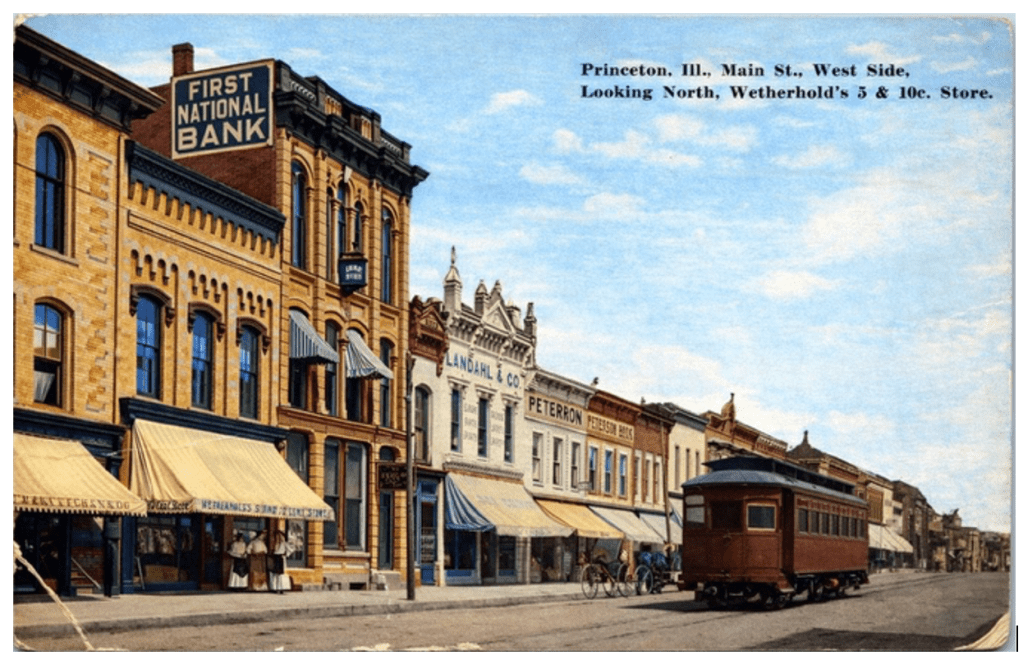
A person who witnessed Billy preaching at Princeton, Illinois, said this of the Evangelist’s preaching:
“When it comes to preaching Billy is a storm, a whirlwind, a cyclone, hurricane, a tornado, a-well, everything indicative of power. He preaches like his life depended upon it. He preaches like he had it to do.” Adding, “As long as Rev. William A. Sunday stays on track and labors to call men back to the old path – the gospel path – he should be allowed to work without opposition from Christian people, even if his methods are sensational and unique and his language at times is shocking.”
Bureau County Tribune (Princeton, Illinois) · Fri, Mar 9, 1906 · Page 3.
From February 11 to March 11, 1906, evangelist Billy Sunday conducted a major revival campaign in Princeton, drawing sustained crowds and producing significant conversion totals that reinforced his growing reputation as one of the most effective evangelists in the Midwest. A temporary tabernacle seating approximately 3,600 people was filled nightly, indicating the strong regional interest in Sunday’s preaching and the extensive cooperation of local churches.
The meetings quickly produced measurable results. One report noted 919 conversions in a single day on February 24, illustrating the intense response often seen at the height of Sunday’s campaigns. Despite severe winter weather—including one of the worst storms of the season on March 3—attendance and participation remained strong. By March 8, newspapers reported 1,298 converts, and by the close of the revival on March 11, the total number of recorded conversions had reached 2,325.
Contemporary observers described the atmosphere in Princeton as spiritually charged. A visiting pastor reported that the “city was aflame with the revival spirit,” while others praised Sunday’s dynamic preaching style, likening his delivery to a “storm” or “cyclone” in its intensity. His methods, though sometimes criticized as sensational, were widely regarded by supporters as effective in reaching large audiences—especially men—who might otherwise avoid church.
The Princeton campaign also contributed to Sunday’s rapidly expanding influence across the region. Shortly afterward, newspapers noted that since October 1905 he had reportedly received about $12,000 in offerings and recorded 9,000 conversions, with 20,000 conversions attributed to his work across the Rock River Valley of Illinois. The Princeton meetings thus formed a significant chapter in the early expansion of Sunday’s evangelistic career.
Sources: The Dixon Evening Telegraph, March 2, 1906, p. 5. Bureau County Tribune (Princeton, IL), March 9, 1906, p. 3. Freeport Journal-Standard (Freeport, IL), February 26, 1906, pp. 1, 5; March 8, 1906, p. 4. Journal Gazette and Times-Courier (Mattoon, IL), March 19, 1906, p. 1.
When Billy Sunday arrived in Kansas City during his 1916 revival campaign, reporters tried to explain what made his preaching so electrifying. One article in the The Kansas City Star offered an unusual perspective. Rather than describing Sunday simply as a preacher, the writer analyzed him as something closer to a dramatic performer.
The article was titled “Billy Sunday as an Actor,” and it attempted to dissect the evangelist’s method from a theatrical standpoint. What the reporter saw was not merely a sermon but a kind of living drama unfolding on the sawdust platform.
According to the writer, Sunday had the ability to bring invisible scenes vividly to life:
“Mr. Sunday, erect and eloquent, is addressing some jury which is corporeally invisible, but which instantly lives before the eyes.”
In other words, Sunday’s sermons created mental pictures so vivid that listeners could almost see the courtroom of heaven forming before them. The preacher might begin by placing his audience before the bar of divine judgment, describing the sinner standing before God.
But the sermon did not stay in one place for long. Sunday constantly shifted roles, turning the message into a dramatic sequence of scenes. One moment he might portray a bartender leaning over a counter; the next he was the drunken customer staggering through the gutter.
The article described these rapid transitions with striking clarity:
“Then he becomes a barkeeper… And in another instant he is the drunkard—‘a dirty rum guzzler’—cringing, broken, swaying to the gutter.”
Through pantomime, gestures, and changes in voice, Sunday acted out moral situations that his audience immediately recognized.
The reporter concluded that Sunday’s preaching relied heavily on what he called melodrama. But the word was not meant as criticism so much as explanation. Melodrama, the article observed, was easy for ordinary people to understand because it dealt in clear moral conflict.
“Melodrama has nothing to do with character and is easy to understand,” the writer noted. “It is the drama of situation.”
That description captures something essential about Billy Sunday’s preaching. His sermons did not revolve around abstract theological debates. Instead, they focused on recognizable human stories: the drunkard, the wandering son, the sinner facing judgment.
Another feature the reporter noticed was Sunday’s physical intensity. The evangelist rarely stood still. He ran, leaped, stamped his foot, pointed accusingly, and pounded the pulpit for emphasis. The effect, the article suggested, was almost like watching an athlete or dancer.
One colorful comparison even likened him to the famed ballet performer Vaslav Nijinsky—an extraordinary metaphor for a revival preacher.
Perhaps the most perceptive observation in the article concerned the simplicity of Sunday’s language. The reporter noted that his words were blunt, Anglo-Saxon, and forceful:
“Short, pungent… Saxon derivatives of English… packed full of powerful stimulus.”
This plainspoken style, filled with vivid phrases and sharp imagery, helped Sunday communicate with audiences drawn from every social class.
In the end, the Kansas City writer recognized something that many critics missed. Billy Sunday’s sermons were not merely lectures about religion. They were dramatic moral confrontations, staged in front of thousands of listeners each night.
On the bare platform of a temporary tabernacle, without scenery or props, Sunday created entire scenes through voice, motion, and imagination. His preaching was not simply heard—it was seen and felt.
And that, the reporter concluded, was the secret of his remarkable power over a crowd.
Adapted from: The Kansas City Star. May 4, 1916:2.
I believe profoundly in Mr. Sunday, in the purity of his motive, in the truth of his purpose, the sincerity of his aim, and the transparency of his ambition. He undoubtedly has a divine commission to preach the gospel and the people hear him gladly. Mr. Sunday has a remarkable personality. It is one of his big assets. He is in possession of that undefinable something, the influence of which men feel but cannot explain.
I believe that in Chicago Mr. Sunday’s personality will count for more than in other cities because it has a fuller chance to come to the fore, coming back, as he does, to his home city, the city of so many pleasant associations and sacred memories.
As published in the The Akron Beacon Journal. Sat, Jun 18, 1910 ·Page 3
Attorney W. S. Anderson of Youngstown, who defended Bert Petty, is a staunch supporter of “Billy” Sunday, the celebrated evangelist. He was one of Sunday’s many converts in Youngstown. Sunday spent six weeks in Youngstown this spring and Mr. Anderson says that the effect upon Youngstown was great and it has been lasting also.
“When I first went to hear him I was disgusted,” he said, “but I went several times more just out of curiosity and I grew to be a great admirer of his work. The first two weeks he spent in Youngstown he used a great deal of slang. This drew the crowds and when he had them coming he got down to work and his work was wonderful.”
Mr. Anderson says that all classes of people have been effected by Sunday’s work. “The lawyers are a pretty hard class of men to reach with religious services but Sunday did it. One night in his prayer he said, ‘Help the lawyers because we know they are a tough bunch.’ They were too, but many became followers of the evangelist.
“The work of Sunday can not be judged only by the number who came forward. It is the influence on all the people and their relations with one another.”
Mr. Anderson says Akron should get Billy Sunday here. “It will do the town a lot of good,” he said.
The church membership of Bellingham has been practically doubled as the result of the Rev. W. A. Sunday evangelistic campaign.
The meeting was fully attended, and perhaps the most remarkable feature of the session, was the enthusiasm with which the work of Rev.
W. A. Sunday in this city was referred to. Practically all of the pastors stated that their church membership had doubled, and in some cases almost trebled, while there is yet no sign of any cessation of the additions.
It is claimed now that the actual campaign itself has been but the start of a religious movement which is crystalizing in the different churches in a manner far beyond the highest expectation of the association.”
“First, he is natural, never tries to be another, is never affected. The champion of the diamond is in action for God. Second, he uses the word of God, knows it, believes it, and preaches it with consummate skill and commanding power. Third, he knows the heart of man, and helps every hearer to find and see one’s self. In papers, parts of his sermons may appear to be jokes, but they are no joke to the one whose soul is uncovered by them. A friend said Saturday, ‘I can’t laugh at the jokes, they are too awfully true.’ Another said, ‘Billy’s ‘darns’ aren’t nearly so large when you hear them as they appear to be in the press.” Mr. Sunday shows us the dead body of sin to which we are chained until we loath it and groan to be delivered from it.
Fourth, best and most important of all, he believes in and depends upon the Holy Spirit; who is here working in, working for, and working with Mr. Sunday, and every consecrated follower of God. Just so sure as these things be true, we shall see a great work in Scranton. Every lover of God and man ought to pray most earnestly that this may be fact as well as prophecy. We ought not to judge until we see and hear. Come to the tabernacle and you will wish that all of your family and friends were with you. Mr. Sunday is more than a man working with human skill. He is a man of God being used to help men. Years hence we shall regret it if we fail to hear Billy Sunday now.”
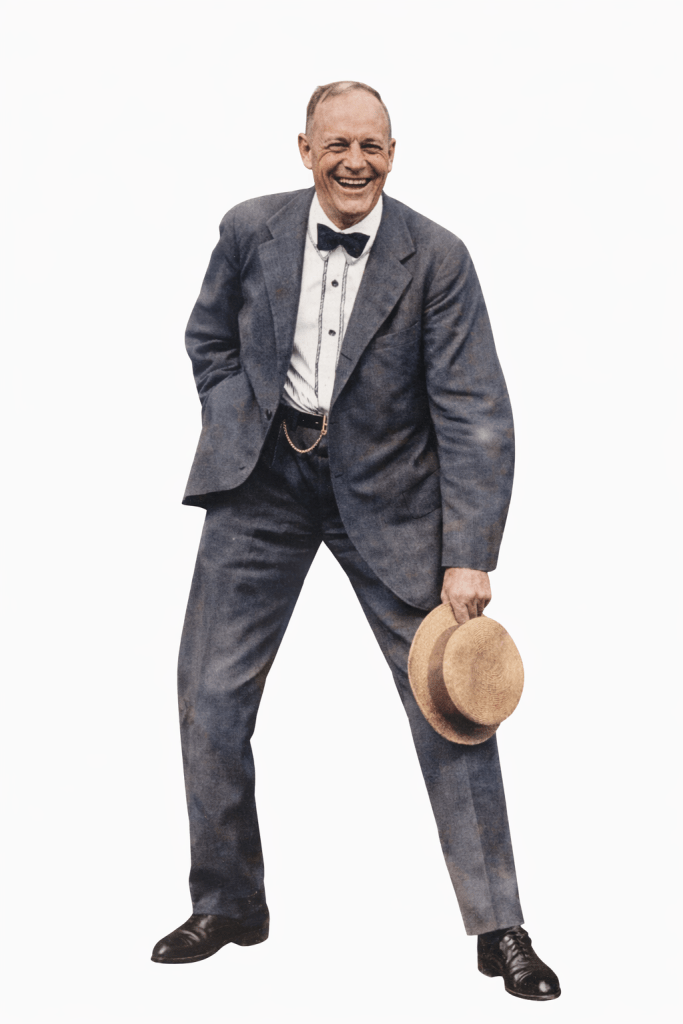
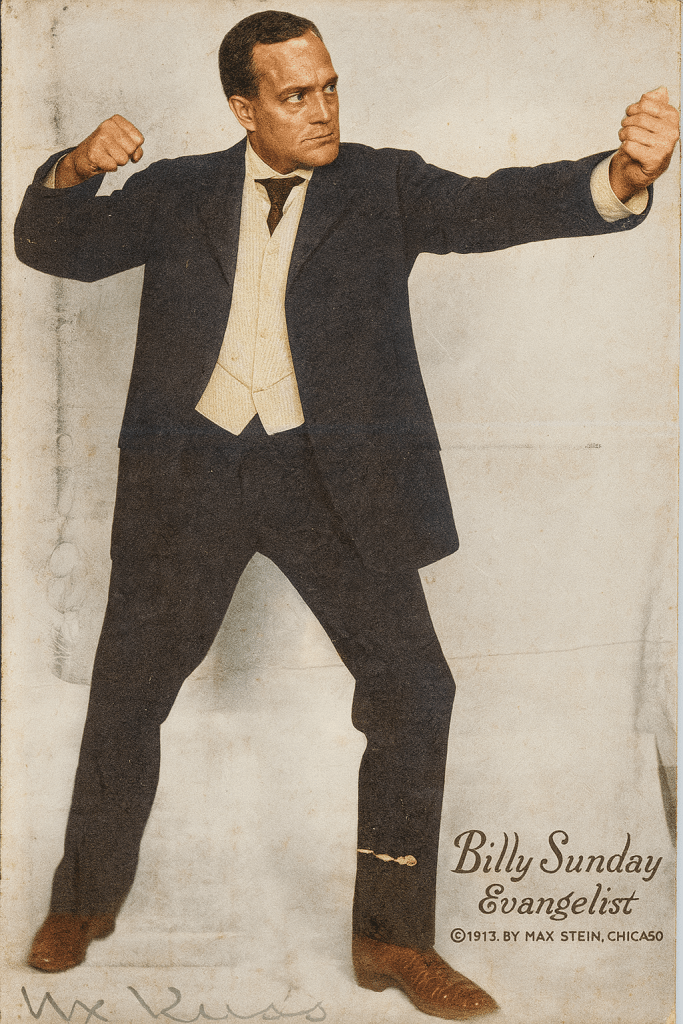
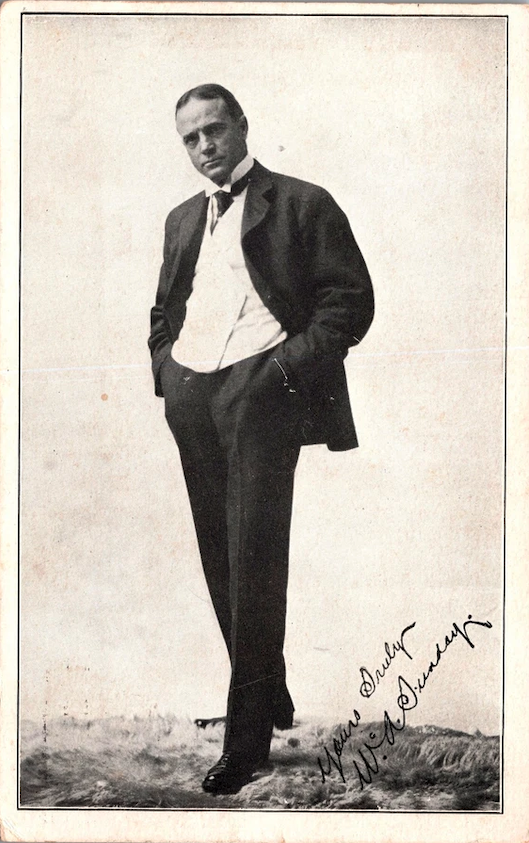
 Evangelist Billy Sunday (1862-1935)