“To-morrow”: Inside Billy Sunday’s Last Day in Fairfield

Seventh in a series drawn from Lindsay Denison’s profile of Billy Sunday in The American Magazine, September 1907.


By the final Sunday of the Fairfield revival, Billy Sunday had already brought nearly nine hundred people to a public profession of faith — more than any of the town’s ministers had believed possible. It would have been a triumph to stop there. Sunday had no intention of stopping. Lindsay Denison describes him on that last day as gripped by a fierce, almost savage zeal to gather in everyone still outside the fold.

What followed was, in Denison’s words, an unforgettable experience — and it makes the emotional climax of this whole series.
Three services in one day

Sunday’s custom was to preach three times on his final Sunday. The first, at half past ten in the morning, was open to all. The third, at night, was for everybody. In between came an afternoon service for men only — while Mrs. Sunday or one of the other helpers held a parallel meeting for women in one of the churches.

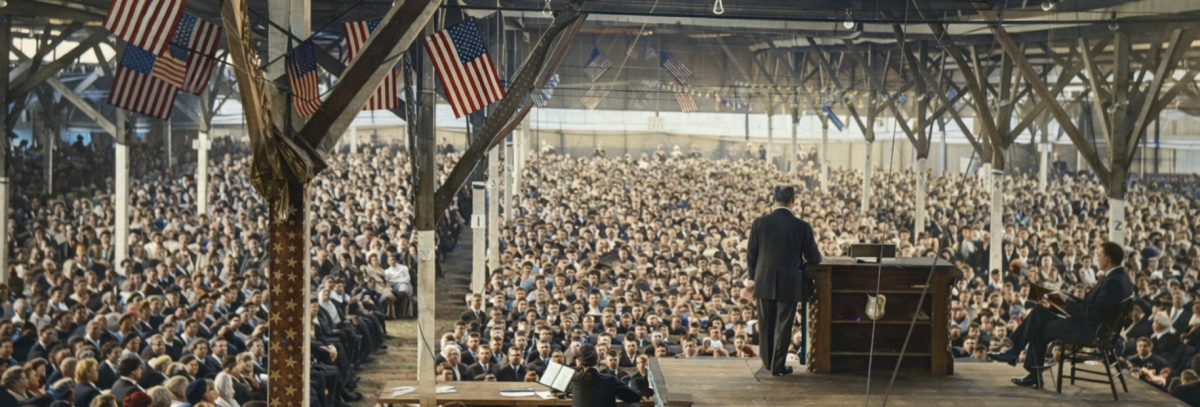
The men’s meeting, Denison thought, was in one sense the most impressive of the three. Much of the Fairfield company of the state militia sat on the platform in full uniform, many of them already Sunday converts. A great block of seats held the workmen of the Iowa Malleable Iron Works. The Odd Fellows, the Red Men, and the Woodmen filled reserved sections. The big barn-like room was packed wall to wall, with hundreds of men standing in the aisles.

The subject was “Booze.”

The banker who went first

When Sunday finished — whispering directions all the while to Honeywell about clearing the front benches to receive converts — he threw out the challenge: who would be the first to stand up for God and lead the way?

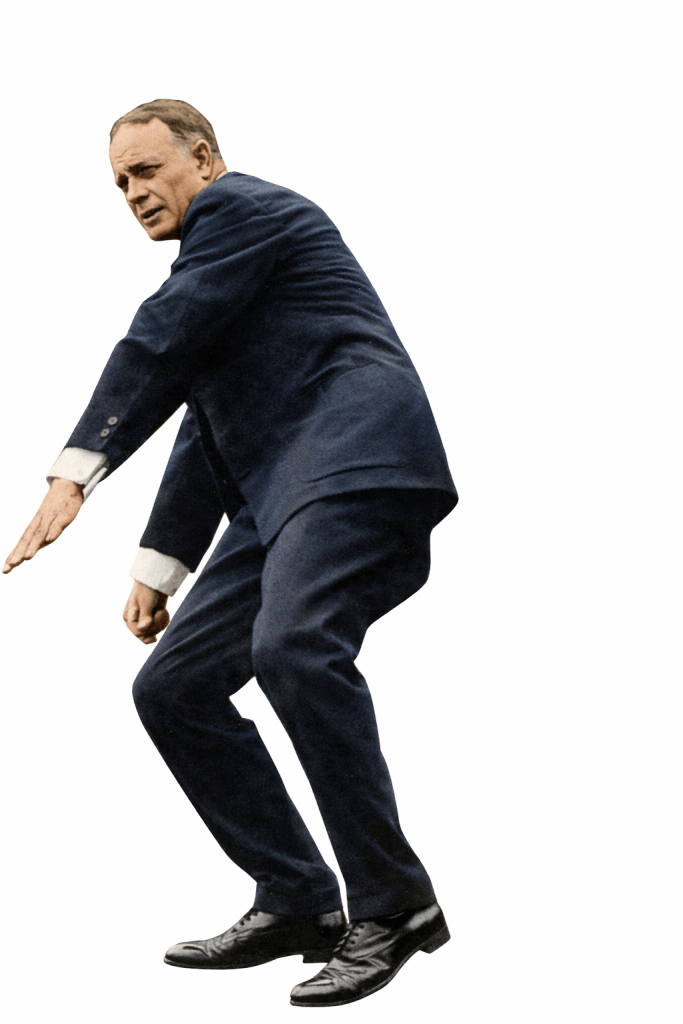
The answer came in a figure no one could miss. One of the town’s leading bankers rose and strode down the aisle, head erect and eyes shining, and behind him came farmers, storekeepers, lawyers, physicians, farm boys, and laborers. Sunday leaned far out over the edge of the platform, swaying his arms rhythmically as if to sweep the entire congregation forward with him, while the ministers and personal workers moved through the rows laboring with those still in doubt. Eighty men were converted in that single afternoon meeting.

The effect reached past the tabernacle walls. The next day, the agents of the two express companies had to report that three barrels of beer consigned to Fairfield citizens were refused on delivery — and in the “remarks” column of their paperwork, they noted the cause plainly: the influence of Sunday’s sermons.

A town that couldn’t get in

The crowds began gathering for the night meeting almost as soon as the men’s meeting let out, a little after four o’clock — though the evening service would not begin until half past six. By six, long streams of disappointed people were already tramping back downtown through the rain, having failed to get close enough even to hear Sunday’s voice.

Inside, the air itself seemed to tingle. Sunday, hoarse from a week of open-air preaching in the surrounding towns, could at times barely raise more than a husky whisper — yet every syllable carried. He spoke of how doubting parents and hesitating children might save one another, of the double blessing that came to anyone who brought a loved one out of the darkness, and, above all, of the nearness of death.

His text was a single word: To-morrow.

The veil and the coffin

The closing was vintage Sunday — fear wielded with terrible precision. To-night, he told them, when the last song was sung and the lights switched off and the tabernacle stood dark, the sinner’s chance would be gone. To-morrow, he warned, the doctor’s buggy might be standing at your gate, the family gathered with handkerchiefs to their eyes, the doctor turning to say, “He is gone.” Borrowing a line from the evangelist Moody, he pictured the unrepentant carried off as a corpse without Christ, in a coffin without Christ, to a grave without Christ. If only God would draw back the veil between a man and his own coffin, Sunday cried, he would leap back in horror to find it within arm’s reach. But you say “To-morrow.”

Then came the appeal, and the slow hypnotic sweep of his arms out over the benches. They came from every direction — girls and old women, gray-bearded veterans and schoolboys in their first long trousers, rich men and poor. Honeywell and the Rev. Mr. Cole ran up the aisles with arms outstretched to welcome them, while Sunday reached down to take each hand and give his blessing and the choir glided from hymn to hymn, sometimes humming, sometimes shouting in triumph.

The picture that stayed

Denison confesses that the reporters stopped taking notes. Everyone in the room was on his feet; some were standing on the tables. And out of the whole turmoil, he says, one small picture stood clear.

Fred Seibert had broken through the crowd at the back, dragging by the collar a weak-faced, loose-lipped boy — shambling along shamefaced but not unwilling. Sunday clapped him on the back; Honeywell settled him three rows from the front. Then, from a far corner on the left, came a muffled scream. A shabbily dressed girl came crowding out into the aisle and ran forward, tears streaming down her face, her hat knocked askew and her red hair hanging loose over her shoulder. She barely touched Sunday’s hand. She ran to the third bench, threw herself on the boy’s shoulder, wrapped her arms around his neck, and hid her face against his. She was still there, motionless, when a shout from another corner announced one more soul won.

Denison had seen college football celebrations, the riots of joy after a Yale–Harvard boat race, a famous New York district attorney’s election-night headquarters. He had never, he wrote, seen a crowd more beside itself than the Fairfield tabernacle that night.

The noise was formless until Fischer took hold of it and shaped it. There were a hundred surges toward the platform and Billy Sunday; people kept calling for three cheers for him. And when the final tally was announced — 1,118 Fairfield souls won from the Devil for Christ — it seemed, Denison wrote, as though the very roof were tugging at its rafters.


Next in the series: What 1907 Tells Us About the Rise of Billy Sunday — a closing reflection.
What 1907 Tells Us About the Rise of Billy Sunday

Last in a series drawn from Lindsay Denison’s profile of Billy Sunday in The American Magazine, September 1907.


Over the past seven posts, we’ve followed Lindsay Denison’s 1907 profile through a single revival in a single Iowa town — the conversion on a Chicago curb, the footrace that tested it, the plain-English preaching, the carnival-bright music, the money and the “grafter” charge, and the overwhelming final day in Fairfield. It remains to ask what the whole thing meant, and where it sat in the larger story of the man.

Denison asked the same question, and his answer is the most quietly important passage in the article.

“Merely a repetition”

The Fairfield revival, for all its drama, was not unique. It was, Denison wrote, merely a repetition of scenes that had already played out in a score of towns across Iowa, Illinois, Wisconsin, Minnesota, and Colorado — and that scores more towns in those states would yet know. Sunday’s calendar was booked solid three years ahead, and organizations both religious and secular kept coming to beg a place on his “future list.”

In other words, what a New York reporter had traveled west to witness as a marvel was, by 1907, already Billy Sunday’s settled routine. He had a circuit, a method, a company, a system — and a waiting list.

A small part of something larger

Then Denison widened the lens in a way that reframes everything. Sunday, he insisted, was really only a small part of a much broader spiritual ferment moving through the middle of the country. From Pittsburgh to Denver, from Duluth to New Orleans, the impulse to read the Bible, to pray, and to enlist one’s neighbors in the Christian army was spreading and growing more intense.

Sunday was not the whole movement. He was its most spectacular general. And what the movement would ultimately come to, Denison declined to predict — it was, he said, no part of his business to guess.

But, he added, it was worth watching.

Caught at the threshold

That line is the reason this 1907 article rewards a closer look. Read it carefully and you realize Denison was describing a man on the cusp.

Consider the geography of the situation. Sunday’s actual labors were confined to small towns in the rural Midwest — Fairfield had about five thousand people; he moved on from it to Knoxville, another small Iowa town, after only four days’ rest. Yet here was a national magazine, based a thousand miles east, sending a reporter “all the way from New York,” as Sunday noted in his own closing prayer, to explain this Midwestern phenomenon to readers who had likely never heard of him.

That gap — between where Sunday worked and who had now come to write about him — is the signature of a regional figure crossing into national awareness. The article is not documentation of a man already at the summit. It is an early national notice of a man about to climb one, arriving just before the ascent steepened. The largest and most famous campaigns of his career, the ones in major cities that would make him a household name, still lay ahead. In 1907 he was an extraordinarily successful small-town evangelist whom the wider country was just beginning to discover.

In that sense, Denison’s “worth watching” was better advice than perhaps even he knew.

The defense of plain language

Denison closed his profile not with a prediction but with a defense — and it is a fitting note to end this series on, too.

To most readers, he acknowledged, the methods seemed impossible to take seriously as religion: the circus-freak ushers and concert-hall tunes, the shirt-sleeve oratory and melodramatic impersonation, the Scripture rendered into a traveling salesman’s slang. These were not the means by which most people imagined the souls of the world would be won.

And yet, Denison reminded his readers, there had once been those who looked down on the plain speech of the Apostle Paul. The Saviour himself had rebuked the people who clung to their own traditions while rejecting the commandment of God. Denison let the apostle have nearly the last word, citing Paul’s declaration that God had chosen the foolish and the weak and the despised things of the world to confound the wise and the mighty.

It is the deepest defense of Billy Sunday in the whole article, and it goes well beyond results. The argument is not merely that the crude methods worked. It is that crudeness, plainness, even foolishness in the eyes of the refined had always been one of the ways the gospel reached people — and that the genteel critics wincing in the front rows of the tabernacle were standing, whether they knew it or not, in a very old tradition of standing in the way.

A snapshot worth keeping

That is what makes this 1907 article such a valuable document. It catches Billy Sunday whole, at a hinge moment — the ballplayer fully transformed into the preacher, the method fully formed, the national spotlight just beginning to swing his way.

A century and more later, we know what Denison could only sense: that the man on that platform in Fairfield was at the beginning of one of the most remarkable rises in American religious history. He told us it was worth watching.

He was right.


This concludes the series on Lindsay Denison’s 1907 American Magazine profile of Billy Sunday. Thank you for following along.

“To-morrow”: Inside Billy Sunday’s Last Day in Fairfield

Seventh in a series drawn from Lindsay Denison’s profile of Billy Sunday in The American Magazine, September 1907.


By the final Sunday of the Fairfield revival, Billy Sunday had already brought nearly nine hundred people to a public profession of faith — more than any of the town’s ministers had believed possible. It would have been a triumph to stop there. Sunday had no intention of stopping. Lindsay Denison describes him on that last day as gripped by a fierce, almost savage zeal to gather in everyone still outside the fold.

What followed was, in Denison’s words, an unforgettable experience — and it makes the emotional climax of this whole series.

Three services in one day

Sunday’s custom was to preach three times on his final Sunday. The first, at half past ten in the morning, was open to all. The third, at night, was for everybody. In between came an afternoon service for men only — while Mrs. Sunday or one of the other helpers held a parallel meeting for women in one of the churches.

The men’s meeting, Denison thought, was in one sense the most impressive of the three. Much of the Fairfield company of the state militia sat on the platform in full uniform, many of them already Sunday converts. A great block of seats held the workmen of the Iowa Malleable Iron Works. The Odd Fellows, the Red Men, and the Woodmen filled reserved sections. The big barn-like room was packed wall to wall, with hundreds of men standing in the aisles.

The subject was “Booze.”

The banker who went first

When Sunday finished — whispering directions all the while to Honeywell about clearing the front benches to receive converts — he threw out the challenge: who would be the first to stand up for God and lead the way?

The answer came in a figure no one could miss. One of the town’s leading bankers rose and strode down the aisle, head erect and eyes shining, and behind him came farmers, storekeepers, lawyers, physicians, farm boys, and laborers. Sunday leaned far out over the edge of the platform, swaying his arms rhythmically as if to sweep the entire congregation forward with him, while the ministers and personal workers moved through the rows laboring with those still in doubt. Eighty men were converted in that single afternoon meeting.

The effect reached past the tabernacle walls. The next day, the agents of the two express companies had to report that three barrels of beer consigned to Fairfield citizens were refused on delivery — and in the “remarks” column of their paperwork, they noted the cause plainly: the influence of Sunday’s sermons.

A town that couldn’t get in

The crowds began gathering for the night meeting almost as soon as the men’s meeting let out, a little after four o’clock — though the evening service would not begin until half past six. By six, long streams of disappointed people were already tramping back downtown through the rain, having failed to get close enough even to hear Sunday’s voice.

Inside, the air itself seemed to tingle. Sunday, hoarse from a week of open-air preaching in the surrounding towns, could at times barely raise more than a husky whisper — yet every syllable carried. He spoke of how doubting parents and hesitating children might save one another, of the double blessing that came to anyone who brought a loved one out of the darkness, and, above all, of the nearness of death.

His text was a single word: To-morrow.

The veil and the coffin

The closing was vintage Sunday — fear wielded with terrible precision. To-night, he told them, when the last song was sung and the lights switched off and the tabernacle stood dark, the sinner’s chance would be gone. To-morrow, he warned, the doctor’s buggy might be standing at your gate, the family gathered with handkerchiefs to their eyes, the doctor turning to say, “He is gone.” Borrowing a line from the evangelist Moody, he pictured the unrepentant carried off as a corpse without Christ, in a coffin without Christ, to a grave without Christ. If only God would draw back the veil between a man and his own coffin, Sunday cried, he would leap back in horror to find it within arm’s reach. But you say “To-morrow.”

Then came the appeal, and the slow hypnotic sweep of his arms out over the benches. They came from every direction — girls and old women, gray-bearded veterans and schoolboys in their first long trousers, rich men and poor. Honeywell and the Rev. Mr. Cole ran up the aisles with arms outstretched to welcome them, while Sunday reached down to take each hand and give his blessing and the choir glided from hymn to hymn, sometimes humming, sometimes shouting in triumph.

The picture that stayed

Denison confesses that the reporters stopped taking notes. Everyone in the room was on his feet; some were standing on the tables. And out of the whole turmoil, he says, one small picture stood clear.

Fred Seibert had broken through the crowd at the back, dragging by the collar a weak-faced, loose-lipped boy — shambling along shamefaced but not unwilling. Sunday clapped him on the back; Honeywell settled him three rows from the front. Then, from a far corner on the left, came a muffled scream. A shabbily dressed girl came crowding out into the aisle and ran forward, tears streaming down her face, her hat knocked askew and her red hair hanging loose over her shoulder. She barely touched Sunday’s hand. She ran to the third bench, threw herself on the boy’s shoulder, wrapped her arms around his neck, and hid her face against his. She was still there, motionless, when a shout from another corner announced one more soul won.

Denison had seen college football celebrations, the riots of joy after a Yale–Harvard boat race, a famous New York district attorney’s election-night headquarters. He had never, he wrote, seen a crowd more beside itself than the Fairfield tabernacle that night.

The noise was formless until Fischer took hold of it and shaped it. There were a hundred surges toward the platform and Billy Sunday; people kept calling for three cheers for him. And when the final tally was announced — 1,118 Fairfield souls won from the Devil for Christ — it seemed, Denison wrote, as though the very roof were tugging at its rafters.


Next in the series: What 1907 Tells Us About the Rise of Billy Sunday — a closing reflection.
The Business of Revival: Tabernacles, Guarantees, and the “Grafter” Question

Sixth in a series drawn from Lindsay Denison’s profile of Billy Sunday in The American Magazine, September 1907.


Sooner or later, every discussion of a famous revivalist arrives at the same question: what about the money? Lindsay Denison’s 1907 profile does not dodge it. In fact, it lays out the financial machinery of a Billy Sunday revival in unusual detail — and then takes the “grafter” charge head-on.

Chicago 1918 campaign

God helps those who help themselves

Sunday’s whole operation rested on a piece of practical theology: God helps those who help themselves. He had no intention of letting his revivals be dragged down by the constant whine of money-begging, so he built the funding in advance.

The process began only after the ministers of all a town’s evangelical churches signed a joint invitation and agreed to close their own churches and throw their full energy behind the revival. Once that was secured, the town had to put up real money. Typically a stock company was formed — an incorporated “Evangelical Association” — that issued shares to raise the necessary funds.

The list of what Sunday required was specific, and he printed it in a little pamphlet covering every detail. The town had to erect a wooden tabernacle with fixed seats. It had to guarantee board and lodging for Sunday and his entire company, cover their travel expenses, pay half of Fred Fischer’s salary, and handle the printing and advertising. On top of that, committees of church members had to be organized to serve as ushers, as personal workers pursuing converts, and as the choir.

A company to support

That company was not small. Beyond Mr. and Mrs. Sunday, it included Mr. and Mrs. Fischer; the Rev. T. E. Honeywell, secretary and associate evangelist; Miss Miller, a Bible-class teacher; and Fred Seibert — a former cow-puncher turned evangelist who handled most of the sexton’s duties between meetings and also sold the hymn books. Supporting that traveling staff, plus building a tabernacle from scratch, was a serious undertaking for a town of a few thousand.

The part the critics missed

Here is the distinction Denison is careful to draw, and it is the heart of the matter.

All of that up-front money — the shares, the tabernacle, the guarantees — went to expenses, not to Sunday’s pocket. He took none of it for himself. He even refused to guarantee that the collections taken at the services would be enough to repay the subscribers who had advanced the money. And yet, Denison reports, he had never once failed to raise enough within ten days or two weeks to square those accounts.

From the moment the guarantors were reimbursed until the final day of the revival, money was simply not mentioned — not by Sunday, not by anyone, with no collections taken at all. He deliberately minimized the money-raising in both time and eloquence.

“Give what you want to”

Sunday’s own income came from a single appeal on the very last day, made on the plain principle that the laborer is worthy of his hire. He explained that this closing collection was for himself, his family, and his helpers, standing in for the ordinary salaries and wages they might have earned in secular work. And he set no figure on it.

His pitch was disarmingly open-handed: people should give what they wanted to, in proportion to how much good they felt he had done the town. He could get along, he said, even if they gave nothing, because plenty of people had already been more generous than he deserved — though he added, pointedly, that those who labor for Christ ought to be able to live as well as those who labor for the Devil. Beyond that, it was up to them.

In Fairfield, the result was striking. After paying $3,200 to cover the revival’s expenses, the town gave Sunday a farewell thank-offering of $3,660. Even after the share he distributed among his helpers, Denison concluded, his own reward compared well with the salaries some big-city churches paid their pastors.

The grafter charge — and the rubber gloves

This was exactly the figure that drew sneers. Critics pointed to Sunday’s comfortable income, questioned his sincerity, and lumped him in with preachers better known for their finances than their good works.

Denison’s rebuttal is pointed: Sunday never raised money “for the Lord” and then quietly banked it to his own credit. The expense money was genuinely spent on the revival; his own pay came openly, once, at the end, with no pretense about what it was for. (As we saw earlier in this series, Sunday also had a long memory for the lean years — he liked to note that nobody called him a grafter back when the 1893 hard times left him too poor to afford trolley fare.)

He was, Denison admits, slow to discuss these criticisms, because he was apt to lose his temper over them — and sometimes did. When the editors of a small newspaper in nearby Brighton took it upon themselves to call him a grafter, Sunday held his wrath for three days. Then he aired it the only way the pulpit allowed: in a prayer.

Working down a list of surrounding towns he asked God to bless, he arrived at the Brighton editors and suggested the Almighty might tackle them too — but cautioned the Lord to be careful and take along a bottle of disinfectant, since he wasn’t sure much could be done with them. And if God did decide it was worth a try, Sunday added, here was a pointer: wear rubber gloves.

The congregation dissolved into smothered laughter and a roar of approving amens. It was not, perhaps, the most charitable prayer ever offered — but it tells you exactly how a proud man, stung by an accusation he believed unjust, defended his good name when he couldn’t quite manage to turn the other cheek.


Next in the series: “To-morrow” — inside Billy Sunday’s last day in Fairfield.

Combs, Megaphones, and “Old Kentucky Home”: The Music of a Billy Sunday Revival

Fifth in a series drawn from Lindsay Denison’s profile of Billy Sunday in The American Magazine, September 1907.


If Billy Sunday provided the thunder of a revival, the man beside him provided the music — and it was every bit as unconventional as the preaching. His name was Frederic G. Fischer, and Lindsay Denison’s 1907 profile makes clear that the singing in a Sunday meeting was no solemn warm-up. It was a show in its own right.

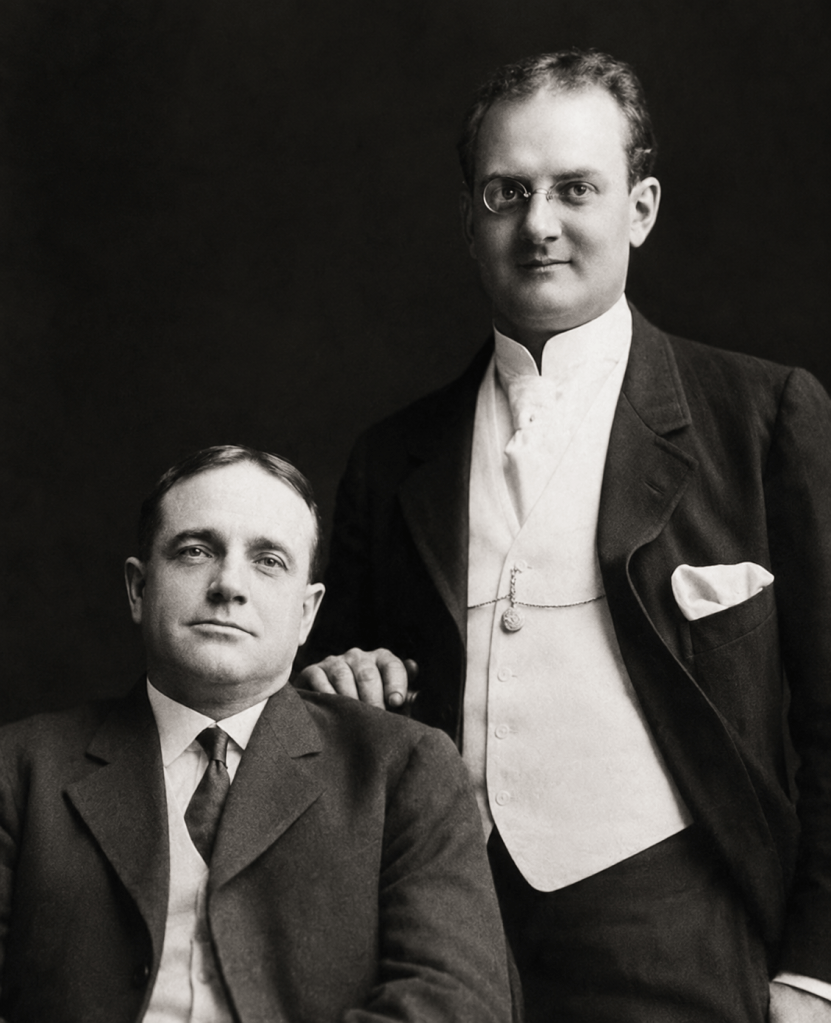
Billy Sunday (left) and Fred Fischer (right).

Sacred words, familiar tunes

Fischer’s guiding idea was simple and, to many traditionalists, slightly shocking: meet ordinary people where their ears already were. Rather than impose formally religious music on a crowd, he set sacred words to tunes the audience already knew and loved — the same instinct, Denison noted, that drove the Salvation Army to go to the people for their music instead of forcing church music upon them.

The song book was full of these thinly disguised melodies. One hymn ran close enough to a popular music-hall number of the day — Vesta Victoria’s “Waiting at the Church” — that a sophisticated city visitor might startle to hear it drifting out of the tabernacle at night. Stephen Foster’s “Suwannee River” carried new words of praise. So did “Old Kentucky Home,” reworked into a hymn pointing toward the New Jerusalem.

To purists, dressing parlor and minstrel tunes in religious clothing bordered on sacrilege. To Fischer, it was evangelism: a melody a farmer already hummed was a melody that would carry the message home with him.

Anything that makes a joyful noise

Fischer barred no instrument capable of joyful sound. At some services the Fairfield Brass Band sat right in with the choir. Cornet solos were dropped into the proceedings again and again.

And then there were the props. The choir was issued tin megaphones, snatched up on Fischer’s signal to multiply the volume of praise. Toward the end of the meetings, singers were asked to bring combs from home; supplied with tissue paper, they produced a novel buzzing music that delighted the crowd. Fischer thought nothing of announcing that the congregation might like to whistle a chorus — and choir and crowd alike would oblige with complete enthusiasm.

This was not church music as anyone in genteel New England would have recognized it. It was closer to a band concert, a sing-along, and a tent show rolled together — exactly the point.

The day the ministers had to sing

The single best Fischer scene in the article is a small comic masterpiece, and it shows the man’s playful streak.

The Fairfield high-school students were seated in a body to one side, the grammar-school children in the rows up front. Fischer drilled the various sections of the room through the verses of a hymn one at a time — the whole audience on one stanza, the high-schoolers on another, the little ones piping the next in their trebles — until each group moved with real thrill and vim.

Then he sprang his trap. He turned to the students and asked how they’d like to hear the ministers sing the last verse. The front benches howled their joyful approval. And so the seven clergymen on the platform — shaking their heads at Fischer, frowning at one another, hanging back — were forced to line up and sheepishly quaver out the final stanza. The roar of delighted applause that sent them blushing back to their seats must, Denison guessed, have reassured them. It is a glimpse of a revival that knew how to laugh at itself, and of a music director happy to engineer the joke.

Master of the room

For all the fun, Fischer was no mere entertainer. His real gift surfaced at the emotional climax of the revival’s final night, when the great altar-call surge sent converts streaming down every aisle and the room dissolved into a roar of singing, weeping, and shouting.

In that chaos, it was Fischer who took charge and organized the noise into something. He stood just behind Sunday, directing the choir and the two pianists stationed at each end of the platform, catching each of the preacher’s whispered suggestions and gliding one hymn into the next — humming here, swelling into triumph there — so that the emotional current never broke. When the energy threatened to spill over into a hundred dangerous rushes toward the platform, Fischer channeled it: have them sing the tune, then whistle it, then hum it.

It was, in its way, as skilled a performance as Sunday’s own. The preacher worked the souls; Fischer worked the room that held them. Together they built an experience that small-town audiences had simply never had before — and would not soon forget.


Next in the series: The Business of Revival — tabernacles, guarantees, and the “grafter” question.

Preaching the Devil in Plain English: Billy Sunday’s Pulpit Style

Fourth in a series drawn from Lindsay Denison’s profile of Billy Sunday in The American Magazine, September 1907.


For three hundred years, Lindsay Denison observed, Americans had been accustomed to discussing God and the soul in the stately cadences of the King James Bible. To depart from that vocabulary had come to feel almost like sacrilege. Billy Sunday departed from it completely.

He talked about God and salvation, Denison wrote, exactly the way people talked to one another six days a week — across a shop counter, over the dinner table, out on the street. That was the scandal of his preaching, and it was also the secret of it.

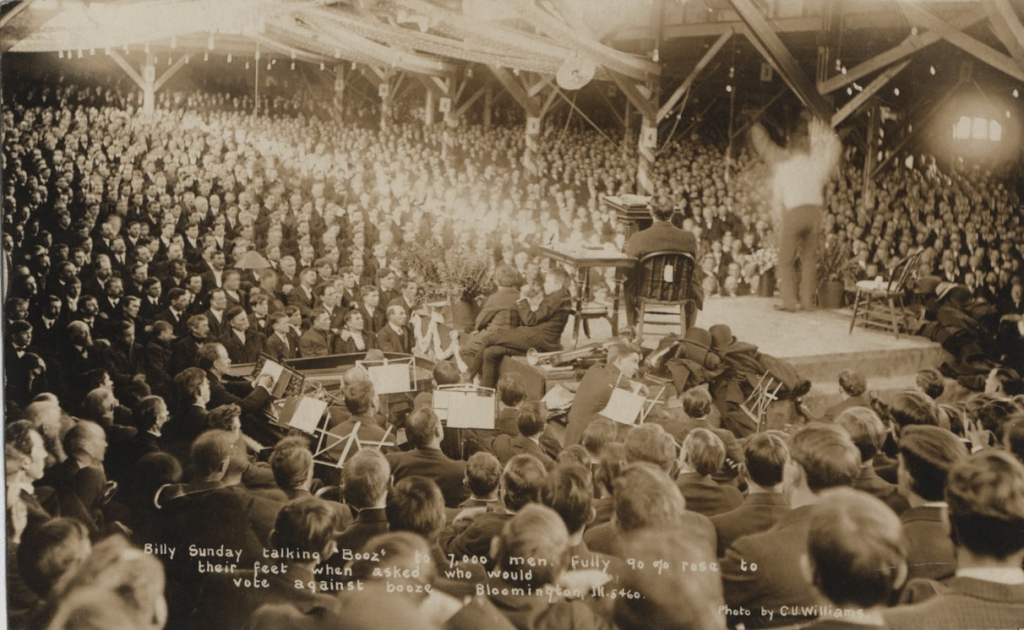
1908 period postcard of Billy Sunday preaching at Bloomington, Illinois.

The Devil who came from Missouri

The clearest example in the article is a stretch of Sunday’s sermon on “Temptation,” built on Satan’s effort to corrupt Christ in the wilderness.

Sunday had no patience for the modern, comfortable idea that the Devil was merely a figure of speech — a poetic personification of human sin. People who said so, and especially the ministers who said so, he flatly called liars, because to him they were calling the Bible itself a lie. There was a Devil, he insisted, and he was no fool: a smooth operator who was, at that very moment, running up and down the aisles of the tabernacle trying to keep sinners indifferent to their own salvation.

Then came the part that made audiences gasp and laugh at once. Sunday staged the wilderness temptation as a piece of street theater. The Devil swaggers up to a weary, hungry, lonely Christ, looks him over from sweat-stained brow to dusty hem, and sneers. And when Christ admits who he is, the Devil laughs and throws down a challenge in the slang of a Missouri skeptic: he’s not so easily fooled, Christ will have to show him — turn these stones into bread and produce the goods.

To stage Satan as a wisecracking “show-me” doubter was, by every standard of nineteenth-century pulpit decorum, outrageous. Denison watched the ministers seated behind Sunday wince. But he also watched the crowd, and he came to understand that their laughter and applause were not the jeering of sinners at sacred things. It was the delight of plain people hearing the old Bible stories made suddenly new, real, and as immediate as the incidents of their own daily lives.

The pointing finger

If the Missouri Devil was Sunday at his most entertaining, another passage shows him at his most uncomfortable — and most effective.

Mid-sermon, he would single out individuals in the crowd. Without naming names, he turned an accusing finger on a man who had spent sixty dollars on tobacco in two years while his wife went without a new dress; on a woman pouring time and money into fancy hats and card parties while her husband fled badly cooked meals and her children ran wild in the streets; on a respectable citizen and what he really bought behind the druggist’s counter; on a group of boys at the back who slid down in their seats as he spoke. Each thrust landed on someone, and the whole congregation felt the danger that the next one might land on them.

It was a remarkable bit of crowd control — intimate, theatrical, and faintly terrifying. Denison noted heads quailing and boys shrinking down their benches. Sunday had turned the anonymous safety of a large audience into the exposed feeling of being known.

A whole body in the pulpit

Sunday did not preach with his voice alone. Denison describes a man with the lope of a professional athlete and the tense springiness of a cat, a penetrating voice pitched just short of harshness.

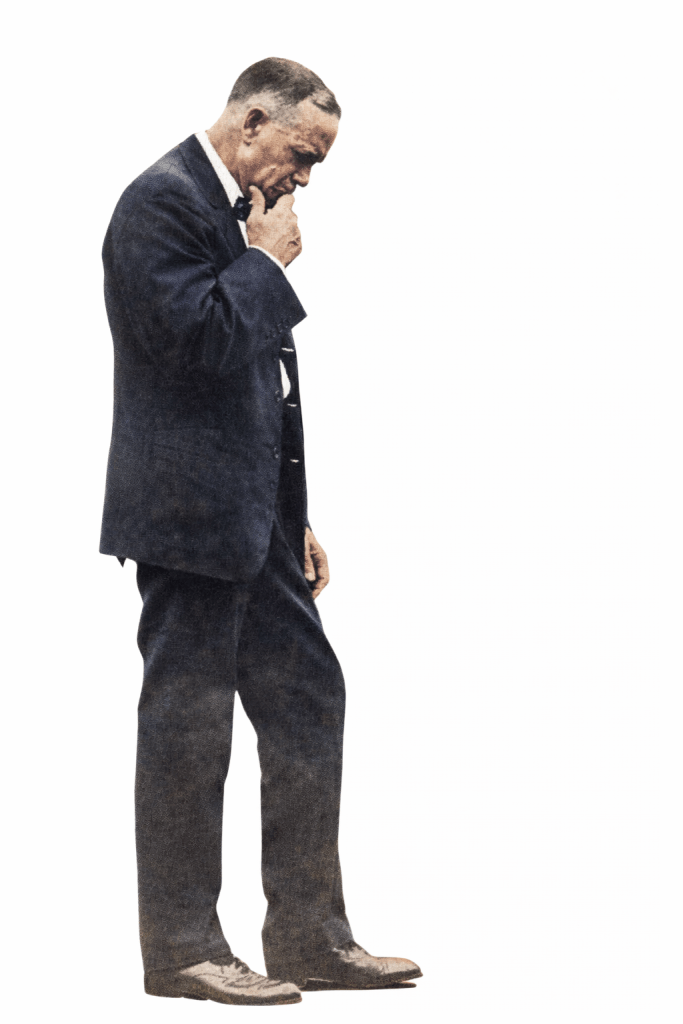
In his very first Fairfield sermon, growing overheated, he peeled off his coat, then his waistcoat, then his tie and collar — and even then his gestures grew so violent that sweat flew from his brow and ears as he beat the pulpit and tossed his head until he was hoarse. He acted out the gait and gestures of every character in his stories. When he preached on the wages of drink, he seized a chair and swung it over his head to dramatize a drunkard’s violence, then dashed it to the platform so hard the legs splintered. The performance was physical, even alarming, and it riveted the room.

Fear as the engine

For all the humor and showmanship, Denison was clear-eyed about the machinery underneath. Sunday preached the old, old doctrine of damnation, and he got his results by inspiring fear and gloom in the hearts of sinners — the fear of sudden death with torment waiting beyond it.

He spoke of the love of Christ, too, and with real tenderness. But even that he turned into a weapon: a tender reproach aimed at the hard-hearted, a way of making the unrepentant feel the full weight of what they were refusing. The joy came later, as a revival neared its close; the early going was meant to frighten.

Why the commonness worked

It would be easy to read all this — the slang, the theatrics, the chair-smashing — as mere sensationalism. Denison resists that reading, and his reason is worth holding onto.

No man, he wrote, could talk to three thousand sensible people night after night for a month in such language and hold them, unless they believed he was honest. The vehemence and the commonplace vocabulary would have defeated themselves if Sunday’s sincerity had not shone unmistakably from his face. The plainness was not a trick laid over the message. It was the message — proof, to the people in those benches, that salvation was meant for ordinary folks like them and not only for the genteel and the instinctively religious.

That conviction is the thread connecting Sunday’s pulpit to everything else about his revivals — including, as we’ll see next, the music.


Next in the series: Combs, Megaphones, and “Old Kentucky Home” — the music of a Billy Sunday revival.

“Fix It Up With God Afterward”: The Footrace That Tested a New Convert

Third in a series drawn from Lindsay Denison’s profile of Billy Sunday in The American Magazine, September 1907.


A new convert’s faith is rarely tested by something so simple as a temptation to sin. More often it is tested by an obligation he took on before he believed — a promise made by the old self that the new self has to honor or break. For Billy Sunday, that test came in the form of a footrace, a pile of other men’s money, and Cap Anson refusing to take no for an answer.

It is one of the best stories in Lindsay Denison’s 1907 profile, and Sunday told it on himself.

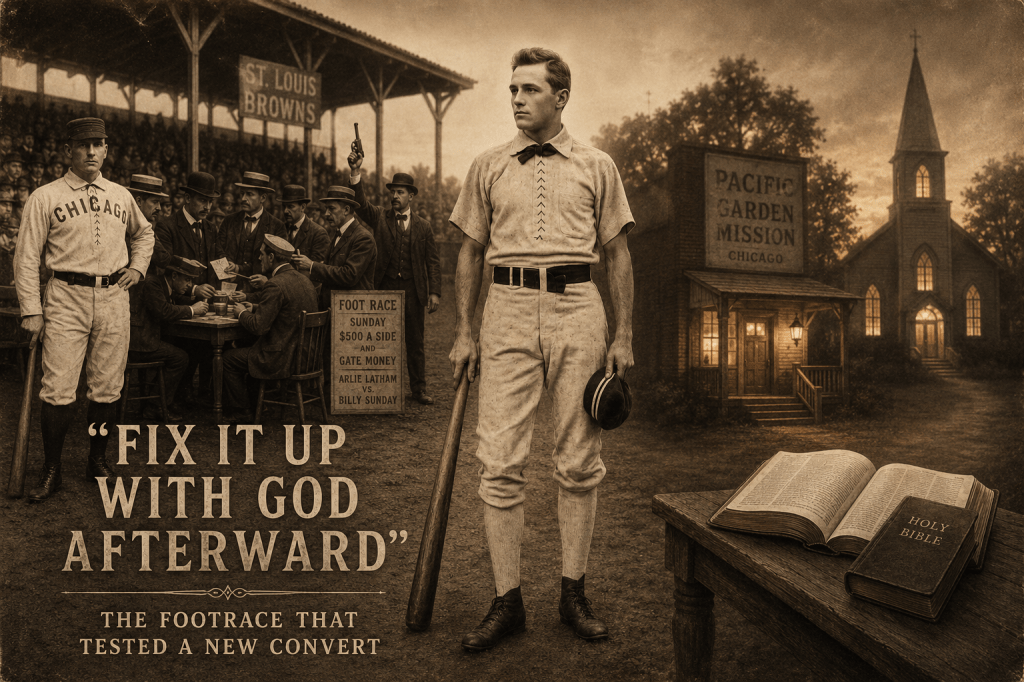
AI-generated image based on the story in this blogpost.

The bet

Before his conversion, Sunday had been matched in a hundred-yard race against Arlie Latham of the St. Louis Browns. The stakes were serious: $500 a side plus the gate money, with the race to be run in St. Louis on a Sunday at the close of the season. His captain, Cap Anson, had backed him heavily — and so had a great many of Anson’s friends. By Sunday’s own recollection, something like $75,000 was riding on the outcome.

Then Sunday walked into the Pacific Garden Mission and everything changed. Suddenly a man who had just resolved to live as Christ would have him live found himself committed to running a high-stakes gambling spectacle — on a Sunday, no less.

The prayer that wouldn’t resolve

This is the detail that makes the episode ring true. Sunday did not simply decide. He agonized.

He prayed over the race night after night, he told Denison, and still could not see his way clear. There was no clean answer. Backing out would betray Anson and the friends who had staked their money on him in good faith, long before his conversion. Going through with it meant a new Christian publicly running a Sunday gambling match. Either road ran against something he valued.

Unable to resolve it in prayer, he finally went to Anson and told him flatly that the captain would have to let him out of the race.

Anson’s answer

Anson would not hear of it. His first move was to needle Sunday’s pride — he wasn’t going to turn yellow and quit, was he? Sunday tried to explain himself. Anson wouldn’t listen.

What Anson said next is, in its rough way, one of the most quietly fascinating lines in the whole article — a piece of folk theology from a man who admitted he wasn’t much for religion. He told Sunday he’d backed him for thousands, and so had his friends, and then he reasoned it out: he didn’t believe God would want Sunday to begin his new life by throwing down his friends over a contract he’d signed before he ever went with God. So here was the plan. Sunday should go down to St. Louis, run the race — and then fix it up with God afterward.

It is the line that gives this post its title, and it deserves a moment’s attention. Anson, the irreligious ballplayer, was making a genuine moral argument: that a debt of honor incurred by the old self still binds the new one, and that a faith worth having shouldn’t begin with a betrayal. Whether or not the theology holds, the loyalty behind it is unmistakable.

“And, well, friends — I did”

So Sunday did exactly that. He went to St. Louis. He ran the race. He won it.

And then he came straight back to Chicago, went before the session of his church, and owned up to the whole thing. When the elders heard the full story, they let him off. He went on to serve as an elder of that same church for a good many years afterward.

What makes the story land is the order of operations. Sunday did not arrive at a tidy principle and then act on it. He wrestled, failed to find an answer, deferred to a friend’s blunt counsel, did the deed, and then submitted himself to his church’s judgment after the fact. It is conversion as a real human process — messy, compromised, and honest about the compromise — rather than a clean before-and-after.

Why he told it

It is worth asking why Sunday repeated a story that, on its face, shows him running a Sunday gambling race as a brand-new Christian. The answer is probably the same reason it works on us a century later: it made him believable.

A preacher who claimed to have gone instantly spotless from the moment he rose off that curb would have been easy to disbelieve and easy to resent. A preacher who admitted he prayed over a problem for nights, couldn’t crack it, ran the race anyway, and then went and confessed it — that man was telling the truth about how hard the early going had been. The audiences who heard him preach trusted him in part because he handed them stories like this one.

The footrace, in other words, was not a blemish Sunday hid. It was evidence he offered.


Next in the series: Preaching the Devil in Plain English — inside Billy Sunday’s pulpit style.

From Center Field to the Pulpit: The Conversion of Billy Sunday

Second in a series drawn from Lindsay Denison’s profile of Billy Sunday in The American Magazine, September 1907.


Before he was the man who made New England shiver and the cornfields cheer, Billy Sunday was a poor boy from Iowa with a dead father and a gift for running.

Lindsay Denison’s 1907 profile lays out the bare facts of that early life with a plainness that almost undersells them. Sunday was born in 1863 in Storey, in Ames County, Iowa. His father was a Union soldier, killed in battle before the boy was even born. He grew up in the Davenport Soldiers’ Orphans’ Home and was later apprenticed out to Col. John Scott — a state senator and former lieutenant-governor — before learning the furniture trade in Marshalltown.

It was an unremarkable beginning for a man who would become anything but unremarkable. And the thing that lifted him out of it was not religion. It was baseball.

Discovered by Cap Anson

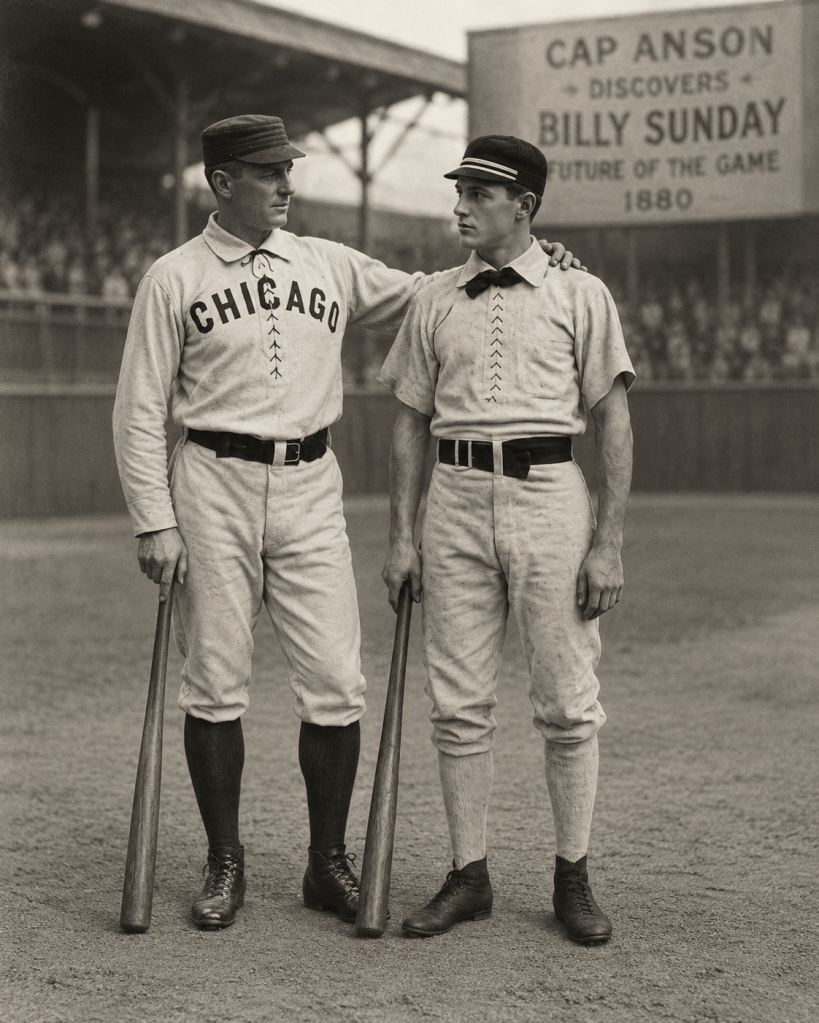
AI-generated from period images of Anson and Sunday.

While Sunday was working in Marshalltown, the famous Captain Anson of the Chicago White Stockings spotted the makings of a great ballplayer in him. Anson brought him to Chicago in 1883, and for the next five years Sunday played right field for one of the dominant teams of the era — fast enough that Denison calls him the quickest base-runner the National League ever knew.

He was, in short, a professional athlete in his prime in a major American city. Which makes what happened next all the more surprising.

The curb on Van Buren Street

The conversion story is the hinge of Sunday’s entire life, and Denison opens the whole article with it.

One afternoon — nineteen years before the article was written — Sunday sat with three fellow ballplayers on a curb on Van Buren Street in Chicago, directly across from the Pacific Garden Mission. The men were Mike Kelly, Johnny Ward, and Buck Ewing, all famous names of early baseball. The mission’s windows were open, and the sound of the organ and the hymns rolled out into the street.

When the singing stopped, Sunday told the others he guessed he didn’t want another drink. He waved them a laughing good-bye, crossed the street, and walked into the mission. Ever since, Denison writes, he had been trying to live as he believed Christ would have him live.

There was no thunderclap in the telling — just a man getting up off a curb and walking toward something. The drama would come later.

What the ballplayers thought

Sunday’s own account of the aftermath is one of the most human passages in the article, and it turns on fear. The shakiest moment, he admitted, came the day the Chicago papers broke the news of his joining the church, as he walked down to the ballgrounds dreading what his teammates would say.

He needn’t have worried. Anson shook his hand and said, “Good for you, Billy.” Mike Kelly told him to stick to it. Fred Pfeffer and John Clarkson were just as warm. And George Gore — the one Sunday feared most — grabbed him with both hands and told him it was the best thing he had ever done. Finding that men he respected respected him the more for becoming a Christian, Sunday said, braced him up more than he could express.

(One more test of that new faith was still ahead of him — a footrace, a heavy bet, and a memorable bit of advice from Cap Anson. That’s a story worth its own post, and it’s coming next.)

The cost of the calling

What Denison documents next is the part that answered, years in advance, the critics who would later call Sunday a money-grubber.

After Chicago, Sunday played three more seasons with the Pittsburgh and Philadelphia clubs of the National League, preaching from a pulpit on Sunday nights in whatever town he found himself, firing a locomotive between seasons to stay in condition, and taking courses at Northwestern University. Then, in 1891 — in answer, he believed, to prayer about his future — he secured his release from the Philadelphia team.

Cincinnati immediately offered him $500 a month to keep playing. He turned it down. Instead he became director of the Chicago YMCA at $83 a month — and during the hard times of 1893, his salary went unpaid for seven months running. He was so poor he walked downtown in the morning and home again at night because he could not afford the car fare.

Sunday recalled all this to Denison with a touch of grim humor that says everything about how the later “grafter” accusations stung him: nobody, he noted, was calling him a grafter in those days.

From the YMCA to the pulpit

The final step came four years before the article appeared, when the Presbytery of Chicago received Sunday into the ministry. He had served for a time under the Rev. Dr. J. Wilbur Chapman, one of the leaders of the wave of evangelization then sweeping the Mississippi valley — the mentor under whom the ballplayer-turned-secretary finished becoming a preacher.

From an orphanage in Iowa to right field in Chicago to a tabernacle pulpit in a hundred small towns: it is an improbable arc, and Denison tells it as one. The boy who got up off a curb because he didn’t want another drink had, within two decades, become the man the whole Middle West was talking about.


Next in the series: “Fix It Up With God Afterward” — the footrace, Cap Anson, and the bet that tested a new convert.

“He Is Doing God’s Work”: A 1907 Magazine Discovers Billy Sunday

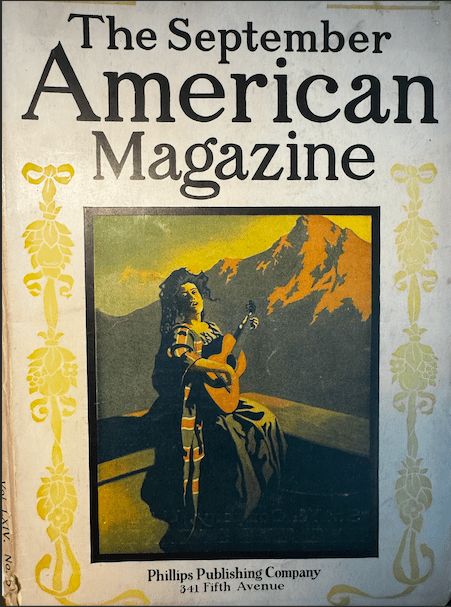
First in a series drawn from Lindsay Denison’s profile of Billy Sunday in The American Magazine, September 1907.


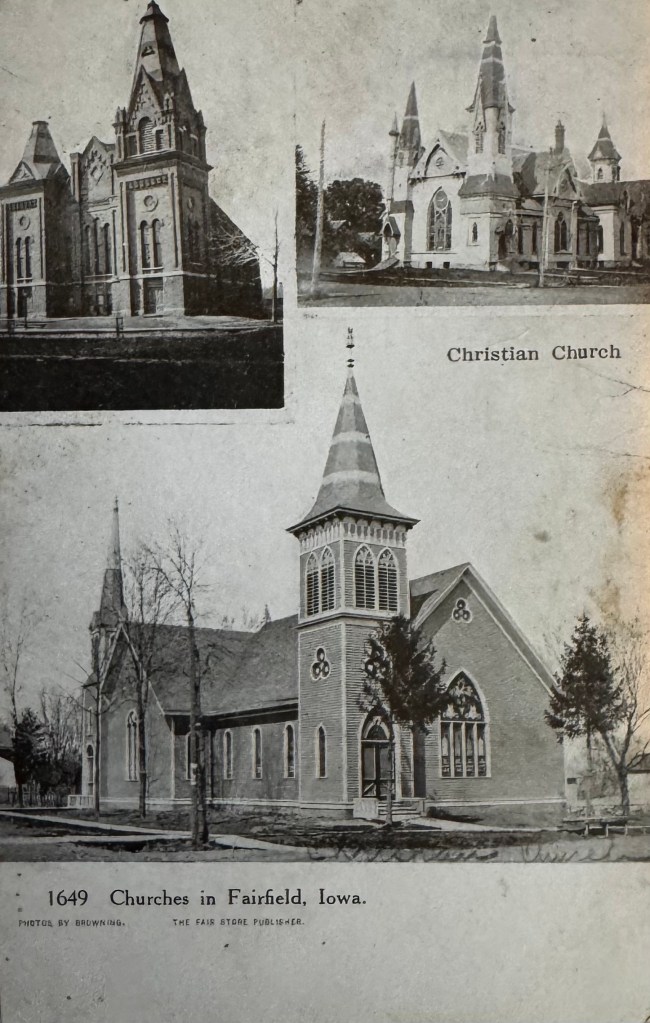
In the autumn of 1907, a New York journalist named Lindsay Denison stepped off a train into a tidy, prosperous Iowa town of about five thousand people. He had come a long way to watch a man preach.

The town was Fairfield. The man was the Rev. William A. “Billy” Sunday — former professional ballplayer, ordained Presbyterian minister, and the most electric revivalist the American Midwest had ever produced. Denison’s assignment was to explain him to the readers of The American Magazine, a national publication based a thousand miles east of the cornfields where Sunday did his work.

That distance is the whole story. In 1907, Billy Sunday was a regional sensation — a small-town, big-tent evangelist who worked a tight circuit through Iowa, Illinois, Wisconsin, Minnesota, and Colorado. But the fact that a New York magazine sent a reporter “all the way from New York,” as Sunday himself noted in one of his prayers, tells you something was shifting. The country was beginning to take notice.

A reluctant convert among the clergy

The article opens not with Sunday’s own voice but with the voice of a man he had thoroughly rattled: the Rev. Pearse Pinch, pastor of Fairfield’s Congregational church. Pinch’s testimony is one of the most striking things in the whole piece, precisely because it is so conflicted.

Sunday, by Pinch’s account, had trampled all over his theology and “kicked my teachings up and down that platform like a football.” The man had offended every refined notion the pastor held about his sacred profession. And yet — Pinch could not argue with the results. His congregation would grow by hundreds. So he humbled himself, gave the credit to Sunday and to God, and reached a conclusion he could not escape: the man was doing God’s work, and that he knew.

It is a perfect frame for the series ahead, because it captures the central tension of Billy Sunday’s whole career. Refined clergymen were horrified by his slang, his theatrics, his shirt-sleeve oratory. And then they watched the converts pour down the aisles, and they stopped arguing.

The numbers that made people look twice

Denison did not bury the lead. By 1907, Sunday had spent twelve years converting more than one hundred thousand men and women to a public profession of faith — and, crucially, he sent them into the churches and they stayed. A survey of ministers in eleven towns where Sunday had held revivals came back unanimous: the share of backsliders was small, even negligible.

This is what separated Sunday from the caricature of the fly-by-night tent preacher. He was, in Denison’s framing, making more church members than all the ministers of the Middle West working together. And he funneled converts not only into his own Presbyterian rolls but into the Methodist, Baptist, Episcopalian, Lutheran, Congregationalist, Roman Catholic, and Christian churches as well.

A man, not a “theological phonograph”

What made him work? Part of the answer, Denison found, was that Sunday never behaved like a clergyman descending on sinners. When he first arrived in Fairfield, he walked the stores around the public square and talked shop — cloth, horses, shoe leather, Chicago trade prices — and he knew his subjects well enough to impress the tailor, the livery man, and the shoe dealer.

By the time those introductory calls were done, the town had reached its verdict: Bill Sunday was a human being, not a theological phonograph. That instinct — to meet ordinary people as a peer rather than to preach down at them — is the thread that runs through everything else, from his plain-spoken sermons to the popular tunes his choir sang.

Why this series

Over the next several posts, we’ll work through Denison’s 1907 profile piece by piece: Sunday’s improbable journey from center field to the pulpit, the famous footrace that tested his new faith, the pulpit style that scandalized and converted in equal measure, the carnival-bright music of his meetings, the hard questions about money, and the unforgettable final day of the Fairfield revival.

Read as a whole, the article is more than a snapshot of one revival in one Iowa town. It is an early national notice of a man about to become one of the most famous preachers in America — caught at the very threshold, just before the rise steepened.

As Denison put it in his closing line, the spiritual ferment Sunday helped lead was spreading and intensifying across the country. What it would all come to, he wrote, was no part of his business to guess.

But it was worth watching.


Next in the series: From Center Field to the Pulpit — the conversion of Billy Sunday.