Seventh in a series drawn from Lindsay Denison’s profile of Billy Sunday in The American Magazine, September 1907.
By the final Sunday of the Fairfield revival, Billy Sunday had already brought nearly nine hundred people to a public profession of faith — more than any of the town’s ministers had believed possible. It would have been a triumph to stop there. Sunday had no intention of stopping. Lindsay Denison describes him on that last day as gripped by a fierce, almost savage zeal to gather in everyone still outside the fold.
What followed was, in Denison’s words, an unforgettable experience — and it makes the emotional climax of this whole series.
Three services in one day
Sunday’s custom was to preach three times on his final Sunday. The first, at half past ten in the morning, was open to all. The third, at night, was for everybody. In between came an afternoon service for men only — while Mrs. Sunday or one of the other helpers held a parallel meeting for women in one of the churches.
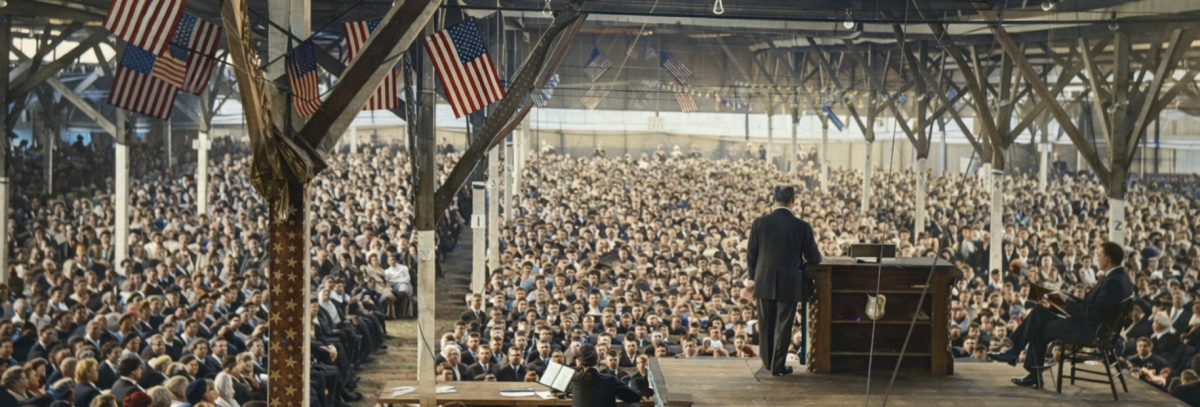
The men’s meeting, Denison thought, was in one sense the most impressive of the three. Much of the Fairfield company of the state militia sat on the platform in full uniform, many of them already Sunday converts. A great block of seats held the workmen of the Iowa Malleable Iron Works. The Odd Fellows, the Red Men, and the Woodmen filled reserved sections. The big barn-like room was packed wall to wall, with hundreds of men standing in the aisles.
The subject was “Booze.”
The banker who went first
When Sunday finished — whispering directions all the while to Honeywell about clearing the front benches to receive converts — he threw out the challenge: who would be the first to stand up for God and lead the way?
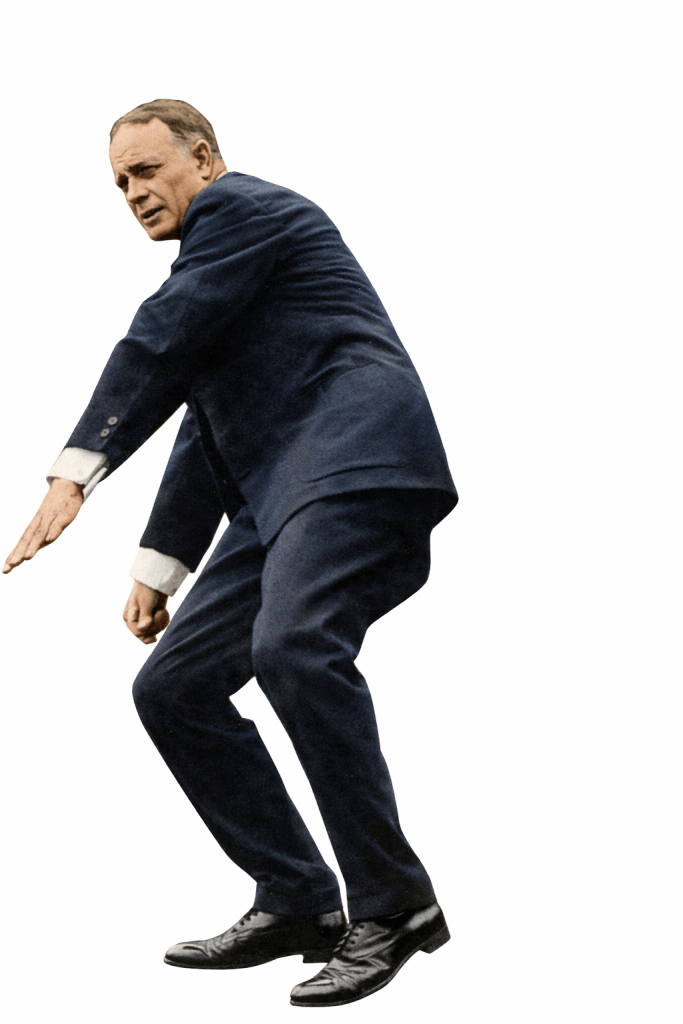
The answer came in a figure no one could miss. One of the town’s leading bankers rose and strode down the aisle, head erect and eyes shining, and behind him came farmers, storekeepers, lawyers, physicians, farm boys, and laborers. Sunday leaned far out over the edge of the platform, swaying his arms rhythmically as if to sweep the entire congregation forward with him, while the ministers and personal workers moved through the rows laboring with those still in doubt. Eighty men were converted in that single afternoon meeting.
The effect reached past the tabernacle walls. The next day, the agents of the two express companies had to report that three barrels of beer consigned to Fairfield citizens were refused on delivery — and in the “remarks” column of their paperwork, they noted the cause plainly: the influence of Sunday’s sermons.
A town that couldn’t get in
The crowds began gathering for the night meeting almost as soon as the men’s meeting let out, a little after four o’clock — though the evening service would not begin until half past six. By six, long streams of disappointed people were already tramping back downtown through the rain, having failed to get close enough even to hear Sunday’s voice.
Inside, the air itself seemed to tingle. Sunday, hoarse from a week of open-air preaching in the surrounding towns, could at times barely raise more than a husky whisper — yet every syllable carried. He spoke of how doubting parents and hesitating children might save one another, of the double blessing that came to anyone who brought a loved one out of the darkness, and, above all, of the nearness of death.
His text was a single word: To-morrow.
The veil and the coffin
The closing was vintage Sunday — fear wielded with terrible precision. To-night, he told them, when the last song was sung and the lights switched off and the tabernacle stood dark, the sinner’s chance would be gone. To-morrow, he warned, the doctor’s buggy might be standing at your gate, the family gathered with handkerchiefs to their eyes, the doctor turning to say, “He is gone.” Borrowing a line from the evangelist Moody, he pictured the unrepentant carried off as a corpse without Christ, in a coffin without Christ, to a grave without Christ. If only God would draw back the veil between a man and his own coffin, Sunday cried, he would leap back in horror to find it within arm’s reach. But you say “To-morrow.”
Then came the appeal, and the slow hypnotic sweep of his arms out over the benches. They came from every direction — girls and old women, gray-bearded veterans and schoolboys in their first long trousers, rich men and poor. Honeywell and the Rev. Mr. Cole ran up the aisles with arms outstretched to welcome them, while Sunday reached down to take each hand and give his blessing and the choir glided from hymn to hymn, sometimes humming, sometimes shouting in triumph.
The picture that stayed
Denison confesses that the reporters stopped taking notes. Everyone in the room was on his feet; some were standing on the tables. And out of the whole turmoil, he says, one small picture stood clear.
Fred Seibert had broken through the crowd at the back, dragging by the collar a weak-faced, loose-lipped boy — shambling along shamefaced but not unwilling. Sunday clapped him on the back; Honeywell settled him three rows from the front. Then, from a far corner on the left, came a muffled scream. A shabbily dressed girl came crowding out into the aisle and ran forward, tears streaming down her face, her hat knocked askew and her red hair hanging loose over her shoulder. She barely touched Sunday’s hand. She ran to the third bench, threw herself on the boy’s shoulder, wrapped her arms around his neck, and hid her face against his. She was still there, motionless, when a shout from another corner announced one more soul won.
Denison had seen college football celebrations, the riots of joy after a Yale–Harvard boat race, a famous New York district attorney’s election-night headquarters. He had never, he wrote, seen a crowd more beside itself than the Fairfield tabernacle that night.
The noise was formless until Fischer took hold of it and shaped it. There were a hundred surges toward the platform and Billy Sunday; people kept calling for three cheers for him. And when the final tally was announced — 1,118 Fairfield souls won from the Devil for Christ — it seemed, Denison wrote, as though the very roof were tugging at its rafters.
Next in the series: What 1907 Tells Us About the Rise of Billy Sunday — a closing reflection.