Former professional baseball player-turned urban evangelist. Follow this daily blog that chronicles the life and ministry of revivalist preacher William Ashley "Billy" Sunday (1862-1935)
Cited in: The Evening Public Ledger. January 5, 1915: 5.
“What is a revival? Now listen to me. A revival does two things. First, it returns the church from her backsliding; and, second, it causes the conversion of men and women; and it always includes the conviction of sin on the part of the church. What a spell the devil seems to cast over the church today!
“I suppose the people here are pretty fair representatives of the church of God, and if everybody did what you do there would never be a revival. Suppose I did no more than you do, then no people would ever be converted through my efforts; I would fold my arms and rust out. A revival helps to bring the unsaved to Jesus Christ.
“God Almighty never intended that the devil should triumph over the church. He never intended that the saloons should walk roughshod over Christianity. And if you think that anybody is going to frighten me, you don’t know me yet.
“I will cram it down their throats in this town for the miserable lies they hurl against me up and down the streets of this city. Don’t you forget it. You bet your life. You bet, and they will get it.
“When is a revival needed? When the individuals are careless and unconcerned. If the church was down on her face in prayer they would be more concerned with the fellow outside. The church has degenerated into a third-rate amusement joint with religion left out.
“When is a revival needed? When carelessness and unconcern keep the people asleep. It is must the duty of the church to awaken and work and labor for the men and women of this city as it is the duty of the fire department to arouse when the call sounds. What would you think of the fire department of Philadelphia if it slept while the town burned? You would condemn it and I will condemn you if you sleep and let men and women go to hell. It is just as much your business to be awake. The church of God is asleep today; it is turned into a dormitory, and has taken the devil’s opiates.”
In the fall of 1915, Nebraska found itself hosting two of the largest public gatherings in its history.
One was expected. The other was not.
In Lincoln, the Nebraska State Fair was in full swing. Newspaper headlines called it “the greatest ever held.” Despite rain and poor weather early in the week, crowds poured through the gates. By the time it ended, total attendance reached 180,767—a record-setting year. The fairgrounds were packed with machinery exhibits, livestock judging, aerial shows, wrestling matches, and the familiar buzz of a state coming together for its biggest annual spectacle.
It was, by every measure, a success.
But sixty miles away, something far more remarkable was unfolding.
In Omaha, a temporary wooden tabernacle had been erected for evangelist Billy Sunday. There were no rides. No prize livestock. No grandstand attractions. Just sawdust, benches, a pulpit—and a preacher.
Yet by the time Sunday’s campaign ended, the numbers told a different story.
The revival recorded approximately 930,000 total attendees across its six weeks of meetings. Of those, nearly 795,000 passed through the tabernacle itself. More than 13,000 people walked the “sawdust trail,” publicly declaring their decision for Christ.
Let that sink in.
The largest civic event in the state drew just over 180,000 people in a week. Billy Sunday’s revival drew over five times that number (in six weeks total).
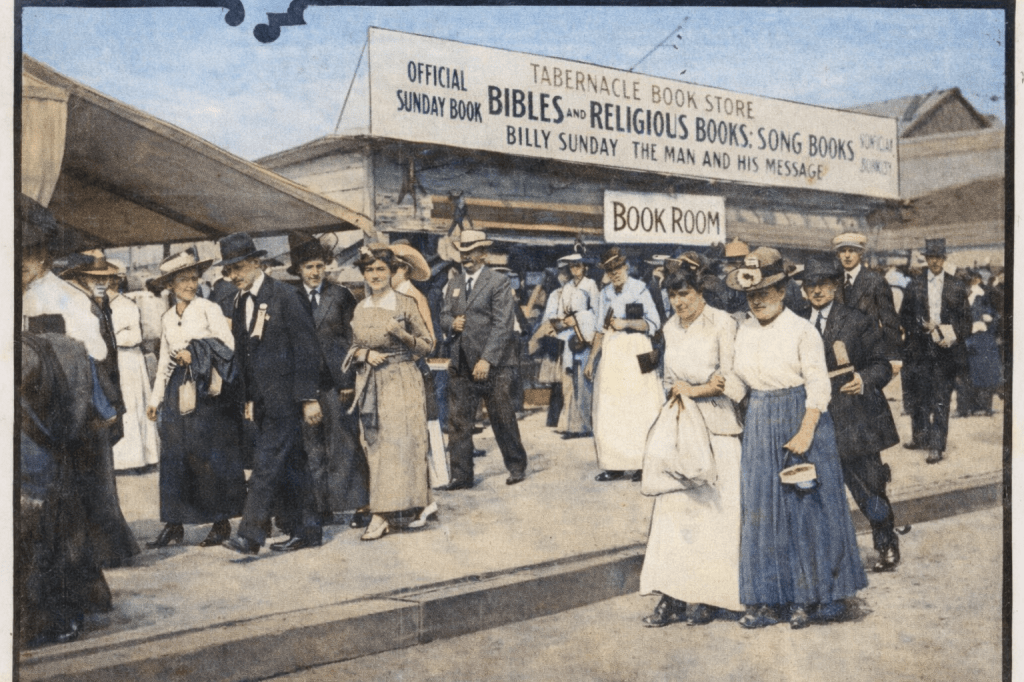
The 1915 Omaha Billy Sunday revival, bookstore.
And it wasn’t confined to a single venue or moment. The revival spread throughout the city:
Over 2,100 cottage prayer meetings during the campaign
Tens of thousands attending women’s meetings, Bible classes, and noon gatherings
Business leaders, factory workers, students, and families all pulled into its orbit
This was not simply a series of sermons. It was a citywide movement.
The contrast is striking. The State Fair represented the best of Nebraska’s agriculture, industry, and entertainment. It was planned, promoted, and expected to succeed.
Sunday’s revival, on the other hand, was built on something less tangible but far more powerful—a shared spiritual hunger that transcended social boundaries.
For a brief moment in 1915, Omaha became the epicenter of something larger than spectacle. Larger than tradition. Larger even than the state’s greatest annual event.
The fairgrounds would empty. The tabernacle would be torn down.
But for those who were there, the memory remained:
A season when the crowds came—not for entertainment—but for transformation.
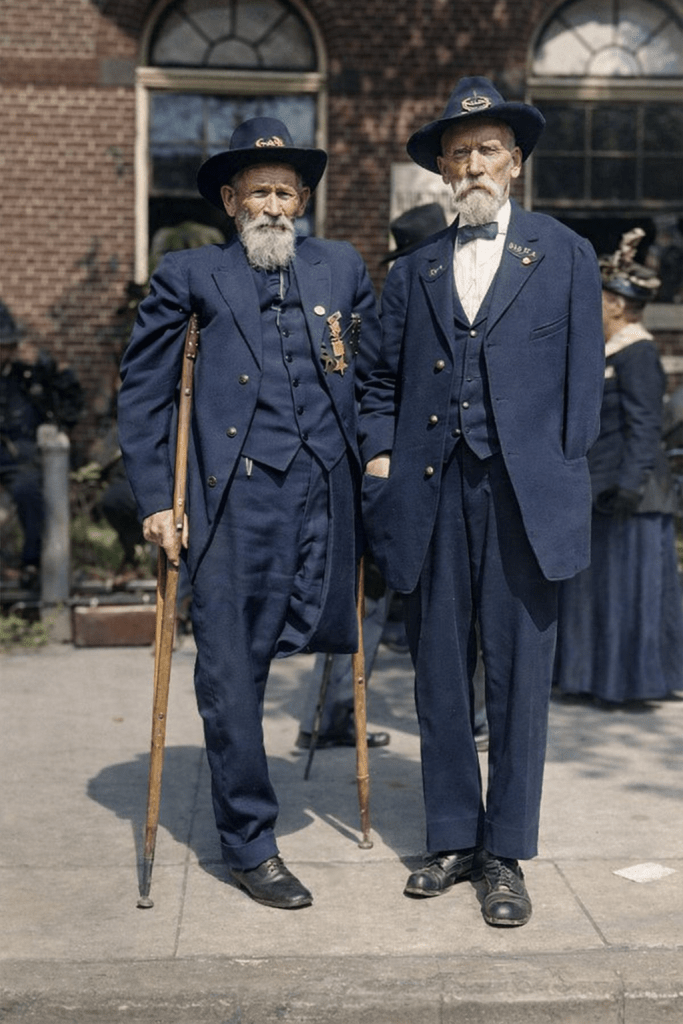
During Billy Sunday’s great revival in Baltimore in the spring of 1916, one evening at the tabernacle took on a distinctly historic tone. The sawdust aisles—normally filled with businessmen, laborers, and curious citizens—were suddenly occupied by a different kind of procession. A body of Union veterans of the Civil War, many gray with age but still proud of their service, marched forward together into the meeting.
1915 Civil War veterans, source unknown
According to the Baltimore Sun, nearly 500 veterans of the Grand Army of the Republic (GAR) attended the revival that night. The GAR, the powerful national organization of Union veterans, was still an important presence in American civic life in the early twentieth century. Though the war had ended more than fifty years earlier, the men who had fought to preserve the Union remained symbols of sacrifice and national memory.
The veterans were led by James E. Van Sant, commander of the Maryland Department of the GAR, along with E. R. Monfort of Iowa, who at the time served as Commander-in-Chief of the national organization. When they entered the tabernacle they were warmly received, and the crowd greeted them with enthusiastic applause.
The occasion had the character of both a patriotic ceremony and a revival meeting. The veterans arrived with a brass band, and when the musicians began to play familiar airs the audience responded with equal fervor. The strains of “Maryland, My Maryland” and “The Star-Spangled Banner” rang through the building, followed by old martial tunes such as “Yankee Doodle” and “Dixie.” The building reportedly shook with applause as the music echoed beneath the great wooden roof of the tabernacle.
The veterans also presented Billy Sunday with a gift—a ceremonial Old Glory mounted on an elaborately wrought brass standard. It was a gesture that connected the evangelist’s message with the patriotic ideals the veterans had fought to defend half a century earlier.
The evening was opened with prayer by Rev. B. F. Clarkson, chaplain of the Maryland GAR. Both Billy Sunday and his music director Homer Rodeheaver spoke warmly of the veterans and the sacrifices they had made for the nation. Rodeheaver added to the patriotic atmosphere by playing martial music and bugle calls on his trombone.
For the aging soldiers, the gathering was more than a nostalgic reunion. Many of them walked the same sawdust aisles as the younger men and women attending the revival. Their presence reminded the audience that the Civil War generation was rapidly passing from the scene. These men had once marched into battle for the Union; now they marched into a revival meeting in search of spiritual renewal.
By 1916, the Civil War was already receding into history, but its memory still held powerful emotional force. That night in Baltimore, the veterans’ appearance created a striking moment where patriotism, memory, and revival religion met under one roof.
The sight of those aged soldiers marching forward—flags waving, band playing, and the crowd cheering—must have been unforgettable. For one evening at least, the old warriors of the Union once again marched together, not onto a battlefield, but down the sawdust trail of Billy Sunday’s revival.
Curated from: The Philadelphia Evening Ledger. January 6, 1915:3.
You don’t just attend a Billy Sunday meeting—you step into it.
By the time I reached the tabernacle, the place was already alive. Not just crowded—alive. Policemen lined the edges, firemen stood ready, and yet there wasn’t even “the merest hint of disorder.” Whatever this thing was, it had structure. It had gravity. And it was pulling people in.
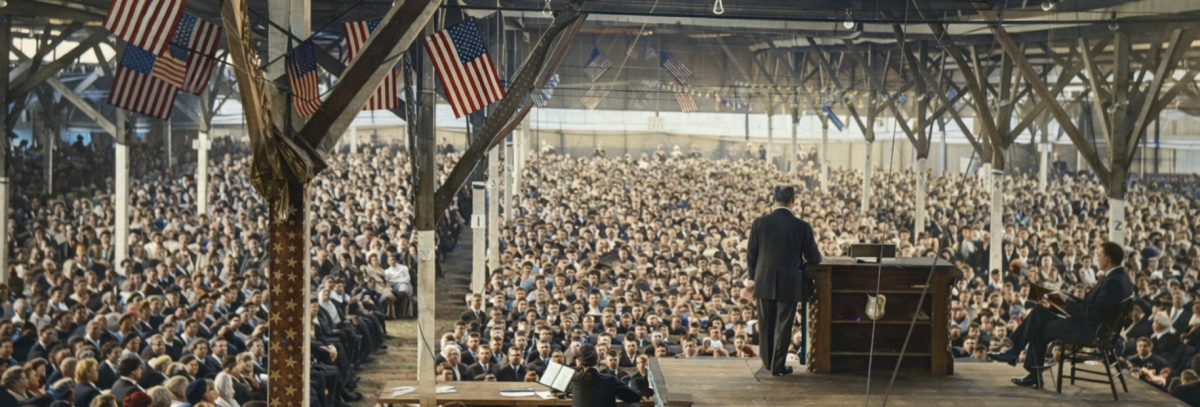
Colorized image of the Billy Sunday tabernacle in Philadelphia, c.1915.
Inside, the air carried that peculiar mixture of sawdust, sweat, and anticipation. Outside, though—that’s where you heard the real story.
A man near me, confident as a prophet, said to no one in particular:
“Billy Sunday has only started… it’s going to get worse and worse. He arouses more enthusiasm each day. If you don’t believe me, ask Scranton.”
That was the mood—this wasn’t the event. This was the beginning of the event.
The Crowd Watching the Crowd
It struck me quickly: people weren’t just watching Billy Sunday.
They were watching each other.
One visitor said it plainly:
“I was naturally interested in ‘Billy’ Sunday, and perhaps even more so in the crowd.”
And what a crowd it was.
A boy—no more than ten—hobbled in on crutches just to hear him. A sailor from the battleship Kansas had been waiting “for months” to catch a meeting. A woman stood nearby, nervous, almost whispering:
“Oh! no. I cannot give my name… my husband would throw a fit if he knew I had been in here.”
And yet—there she was.
That’s how you knew something was happening. Not just attendance—but risked attendance.
What People Were Saying
If you wanted to understand Billy Sunday, you didn’t start with the sermon.
You started with the talk afterward.
“What do you think of ‘Billy’?” someone asked.
The answers came quick, overlapping:
“Great.” “Some man.” “An ace.” “I like him because he goes after the hypocrites.”
Others reached for bigger words:
“Wonderful… splendid… marvelous.”
But not everyone could quite put their finger on it.
One woman, looking slightly dazed, said:
“I have had so many things fired at me in the last hour that I can’t quite set my bearings.”
That may have been the most honest response of all.
More Than a Sermon
There was something else in the air—something heavier than excitement.
A man, speaking to a small group of women, said what many were thinking:
“I would like to see ‘Billy’ Sunday wake this city up and get the rum out of it… Look how many homes he would make happy.”
And then, almost quietly, another moment:
In the northeast corner of the tabernacle, someone reported hearing a man say:
“This is my last drink.”
No sermon transcript can capture that.
That’s the sawdust trail doing its work.
The Unexpected Details
Not everything was solemn.
Someone joked about the sawdust itself:
“They say Mr. Sunday hates noise, and I know I am going to sneeze. I always do when around sawdust.”
Even the ministers weren’t immune to the moment. One well-known clergyman was said to amuse himself before preaching by reading The Fun of Getting Thin—and now, thanks to the crowds, “occupies two seats.”
And everywhere—evidence of men lingering longer than usual:
“There were enough cigar butts left in the gutters… to start a true second-hand cigar store.”
It wasn’t tidy.
It wasn’t polished.
But it was real.
Order in the Midst of It All
For all its energy, the thing held together.
The crowds were vast, but they moved. The police managed them. The firemen stood watch. The machinery of the city seemed, for a moment, to cooperate with something larger than itself.
One observer summed it up best:
“To get and hold a vast throng like this on a weekday for the purpose of hearing the gospel certainly is a tribute to the man himself.”
And It’s Only the Beginning
If you stood there long enough, listening—not to the sermon, but to the people—you began to realize something:
The revival hadn’t peaked.
It hadn’t even arrived yet.
It was building.
You could hear it in the confidence of the man who said, “ask Scranton.” You could see it in the boy on crutches. You could feel it in the nervous woman who came anyway. You could sense it in the man who muttered, “my last drink.”
Billy Sunday may have been the preacher.
But the city— the crowd— the conversations spilling out onto the streets—
They were becoming the message.
And Philadelphia, whether it knew it yet or not, was just getting started.
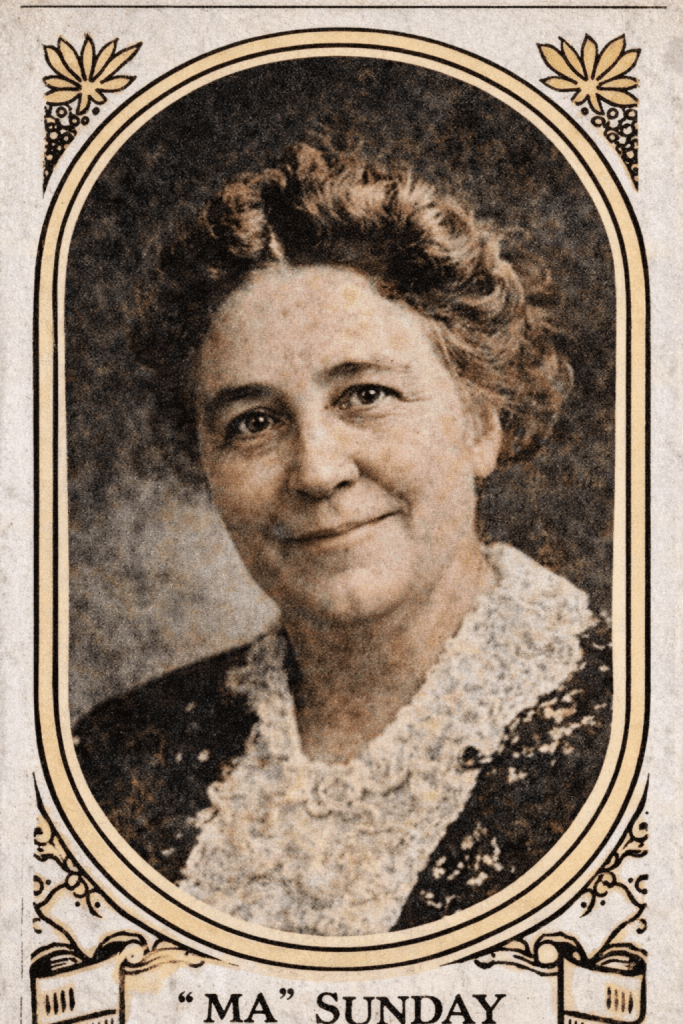
Mrs. William A. Sunday always denies the statement so often and so lovingly made by her son, George, also of the party, that she is the ‘boss’ of the Sunday campaign, but that doesn’t do away with the fact that it was largely through her efforts that the wonderful system of the Sunday’s has been developed.
Along with her many charming feminine qualities Mrs. Sunday is a woman of unusual executive ability, and her keen ability to see the needs and apply the remedies required in work of this kind has made possible the plans whereby the campaigns are made so effective.
‘Do you not relieve Mr. Sunday many tasks, of seeing people, of making plans and of deciding questions concerning the work,’ Mrs. Sunday was asked.
‘Oh, Yes, we all give him as much help as we can, but in the last analysis it is ‘papa’ who decides, and we, of course, do all that I can in this line.’
It has even been said by people who ought to know that Mrs. Sunday frequently suggests phrases for some of his sermons, and also the subjects. This is what she says about that:
‘When I go around with ‘papa’ I don’t just sit and look about, but I think and plan. I frequently see things which might be of use to ‘papa’ and I tell him about them. He is always welcome to all that I have to give him, to every suggestion I can make.’
Besides the work which Mr. and Mrs. Sunday are doing and which they both consider ‘God’s work,’ the nearest thing to Mrs. Sunday’s heart is her home. Her children are very dear to her. By reason of campaigns held in cities far from their home in Winona Lake, Mr. and Mrs. Sunday see little of their children during the nine months when they are doing evangelistic work.
‘I make it a point to go back home two or three days at a time, just to be where we are at home,’ Mrs. Sunday declares. ‘One of my greatest sorrows is the fact that my boys must grow up without the direct influence of Mr. Sunday and myself.’
‘Do you ever feel unhappy about leaving home to begin a new campaign,’ Mrs. Sunday was asked.
‘Yes, we both feel that way sometimes, but the thought that this is the greatest work which we could be given to do, helps us. For several days before we leave home, however, Mr. Sunday is completely broken up, and frequently is unable to eat.’
The Sundays do not grudge the sacrifice that they give, but instead they enter into the work with vim and with an intense desire to ‘live up to what God expects them to do,’ as they express it.
Paul, the eight year old son of the Sundays, who broke an ankle while playing football in the autumn, has recovered and is back at school and back too at his favorite sports.
In a very different way, Mrs. Sunday has just as great getting powers as her husband and when she addresses a group of women her sincere manner, her definite message and her wide-awake methods win the immediate attention of her audience.
‘Ma’ has her trail hitters too, and when she extends the invitation to the women to accept Christ and to lead Christian lives many are eager to shake her hand and to promise better living in the future.
It is an interesting life that Mr. and Mrs. Sunday have led ever since they were married out in Chicago years ago. For two years after their marriage ‘Billy’ played ball but he finally gave that up to do permanent work in the Y. M. C. A., in which he had been working in the winter months. Soon after that he became assistant for Dr. Wilbur Chapman and upon the retirement of that evangelist from active revival work Mr. Sunday conducted revival services in towns outside of Chicago.
Since then he has been in revival work.
Mrs. Sunday was formerly Miss Helen Thompson, one of four daughters of pioneer Chicago business men. Before her marriage she was interested in the church and was an active worker and since that time she has always assisted Mr. Sunday in God’s work.
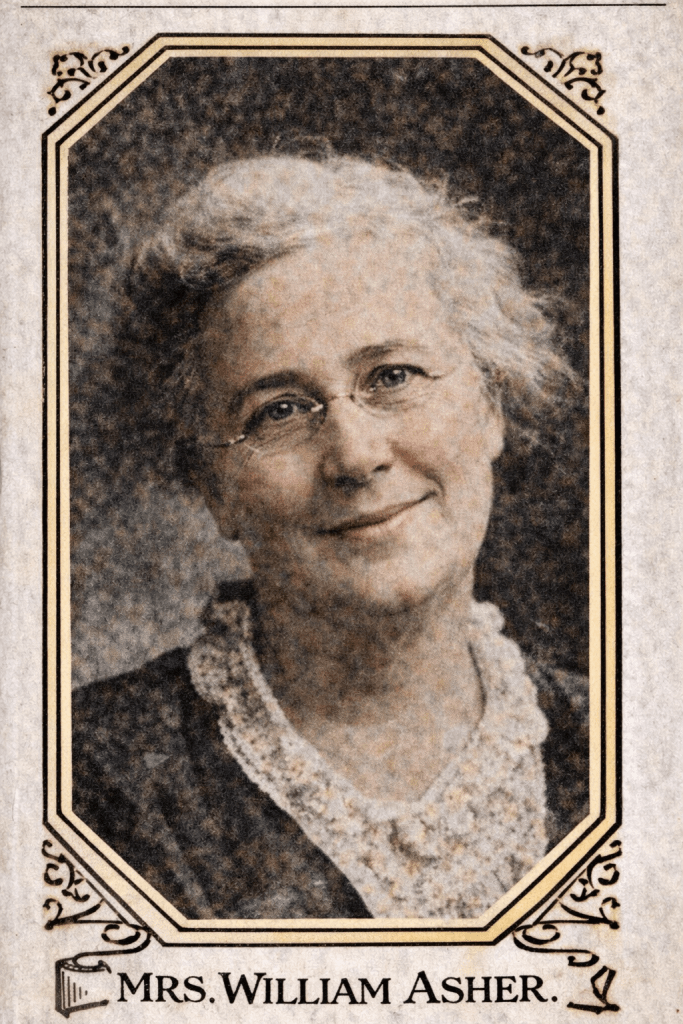
Mrs. William Asher, the director of the extension department of the business women’s work, seems to me to be just like the mother of the Sunday party—not that she is older than the rest, for she isn’t—but she has an abundance of gray hair which is now almost white and this gives her a very motherly appearance. Then her eyes, too, carry out the idea for they are heavy with pity for all of the suffering and sorrow that she has seen. It just happens that Mrs. Asher is the same age as Mrs. Sunday and everybody knows that that isn’t old. In Mrs. Ashers’ case, as in that of many persons, grief caused her gray hair, for within three months of each other her mother and her sister died.
“Yes, Mr. Asher and I and the Sundays are old friends,” she said in response to a question. “Years ago out in Chicago, which is my native city, we all worked in the same church. Mr. Asher was the assistant pastor, Mrs. Sunday was superintendent of the intermediate department of the Sunday school, and I sang in the choir and taught also. My friendship for Mrs. Sunday was cemented when her mother died. Mrs. Sunday was grief-stricken, of course. I sang at the funeral.”
Mrs. Asher not only sang at the funeral, but did all within her power to make the last days of the mother of Mrs. Sunday as pleasant as they could be.
There is no doubt that all of the members of the Sunday party have had unusual experiences and Mrs. Asher has been no exception. Practically all of her life, Mrs. Asher has been in evangelistic work. When she was a little girl of 11 years old, she was converted in the famous Moody Church in Chicago. Many persons have been converted under interesting circumstances; but few come into the church in an atmosphere such as surrounds the old Moody Church.
Years ago Mrs. Asher met and married William Asher, who was at that time a Pullman conductor on the run between Chicago and New York City. His uncle was a railroad man and had given the young man a start in life, but Mr. Asher soon realized that he was working on the wrong track. Giving up his position, he went to a theological seminary, where he studied and was ordained a minister.
It seems that opportunities in the case of Mr. Asher the opportunity came soon. DeWitt Talmage, the famous minister, needed an assistant and Mr. Asher was selected to fill this place, which he held for several years. Afterward he resigned to take up Bethel work in Duluth, Minn.
Dr. Wilbur Chapman was in Chicago conducting a religious revival one time and the Ashers became interested in his work.
“We were so interested in fact that Dr. Chapman asked and we did,” said Mrs. Asher here. “During the first five years of our connection with him we did saloon work. This was work that had been practically unattempted before. We had a little portable organ and with this we would go into the saloons and sing. We always got the consent of the owner of the saloon first before we went. The owner always understood the conditions upon which we worked. We did not do reform work, but we merely went to sing.”
“Was it very hard?” was suggested.
“Harder than you can imagine. Only those who have attempted it have any adequate idea of what it means,” she replied. Many a time Mr. and Mrs. Asher would be put out and their little organ thrown out of
This was trying work, but they stuck to it for five years, a long time for any person to spend in such a gruelling occupation. At the end of the five years they left the work, not because it was hard, but because larger opportunities for greater and more effective work offered themselves. The new work was arduous, though it did not have the hardships attendant upon it that the saloon work had. On several of Dr. Chapman’s trips around the world the Ashers accompanied him.
But the story of the relations with the Sundays is now the topic of perhaps greater interest. After the death of Mrs. Sunday’s mother, the bond between Mrs. Sunday and Mrs. Asher became closer. They worked together in the little church until Mr. Sunday entered upon his career as a revivalist. In 1911 they came together again and since then they have been engaged in the same work.
Mrs. Asher does splendid work among the women and girls of the factories, shops and mills and the girls grow to love her.
“We try to get the girl to realize her responsibility to herself to lead a Christian life and then to other girls around her. We want her to lead a life that will count for something in the love of those who live and work with her.”
Mr. Asher does a work that is of great value to Mr. Sunday, and of great benefit to the towns that Mr. Sunday cannot cover, and that are longing for a revival. To these towns Mr. Asher goes and conducts religious services. Just at present he is at work in Phelps, New York, although he is spending today in Trenton.
The Times (Trenton, New Jersey) · Sun, Jan 16, 1916 · Page 6 Downloaded on Mar 10, 2026
In the world of business, men who go along with poor methods, lack of punctuality, slovenliness and all kinds of slipshod ways are regarded as “out of it,” but that idea is not so prevalent in the religious world, possibly because so many religious world workers unconsciously use these methods.
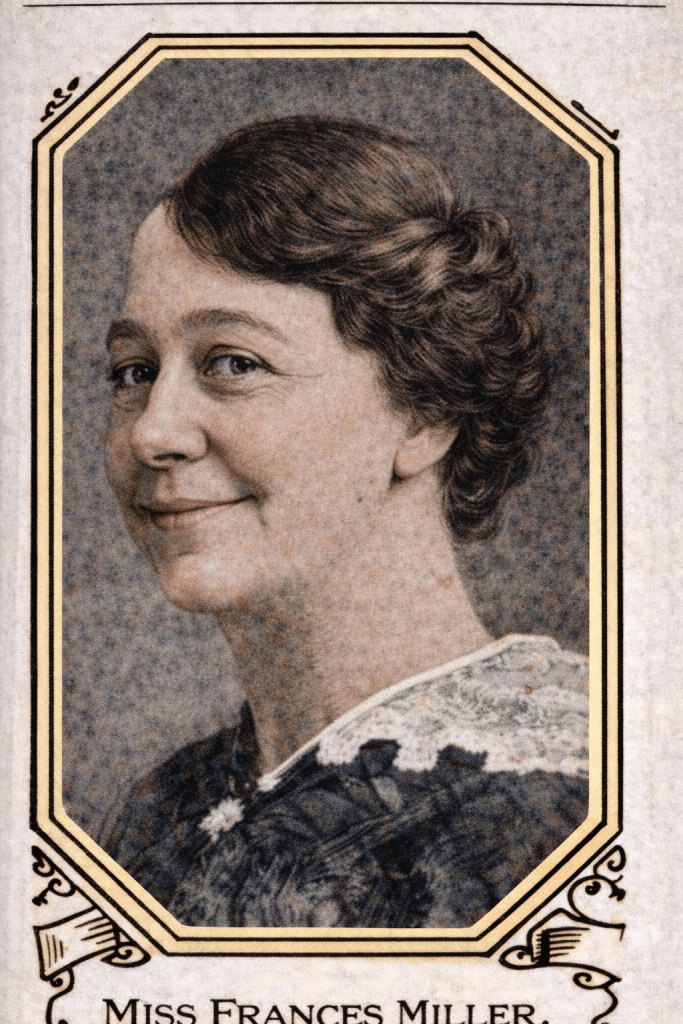
Miss Frances Miller, the director of business women’s work in the central district, uses no slipshod methods. One could scarcely meet a more hustling person in religious work than Miss Miller, excepting, of course, “Billy” himself. Some think that long association with his work has moulded Miss Miller’s naturally active temperament into the form that it now has.
Miss Miller is the youngest and oldest member of the Sunday party. Youngest in the point of years, but oldest in the length of time that she has been a member of the party. For 11 years she has been doing the work for business women that she is doing today and in that time she has become an authority in her line.
Born in the great northwest, where people just naturally have a swing and vim which those in the East don’t seem to have, she grew up in this atmosphere, and has developed all of the hustling qualities of a true Westerner.
From the standpoint of training Miss Miller is surely equipped to carry on the work which she has in charge. “I studied at the Presbyterian College in Cedar Rapids, and later graduated from the Congregational College in Fargo, North Dakota. From there I went to the Moody Institute, in Chicago,” she recently said.
There’s a kind of open secret about Miss Miller. She is an ordained minister, but she doesn’t always tell it because she thinks that if people knew that they they won’t warm up to the things that she wants them to, because they are afraid that she will preach to them. Don’t worry, Miss Miller’s preaching is something to listen to. It is her own individual brand, with a little of “Billy’s” thrown in.
After completing her religious education, Miss Miller was sent to the frontier by the Home Missionary Society, where she remained for two years. And those two years on the frontier were no joke. She had two parishes 12 miles apart from each other and each Sunday, in clear or stormy weather, she would drive from one in the morning where she preached to the other, where she would preach in the evenings.
That’s a wild black country out there, and many times she would drive for miles and never see a creature. The hardships, too, in that little circuit of hers were very severe, almost more than she could bear. After finishing two years as a preacher she came home, discouraged and feeling that the religious calling was a pretty hard one.
She hadn’t been home very long, when Dr. R. A. Torrey wanted her to assist in his evangelistic work. She refused, however, feeling that it was too much. Dr. Torrey knew a good thing when he saw though, and was not to be put off, and one day he wired to her: “Come tomorrow. I have you on the program for tomorrow morning,” and she went.
Just about 11 years ago she joined the Sunday party and has been helping business women and girls ever since. In this she has been very successful, due to the fact that she has a real message to give to the women and girls, and because of her splendid personality.
Miss Miller has a hobby. She love’s horses and almost every day in Syracuse one could see her out for her morning’s canter. Since she has been in Trenton she has not been riding, although she hopes for a gallop or two before she goes from here to Baltimore, the place of the next campaign.
The Times (Trenton, New Jersey) · Sun, Jan 16, 1916 · Page 6 Downloaded on Mar 10, 2026
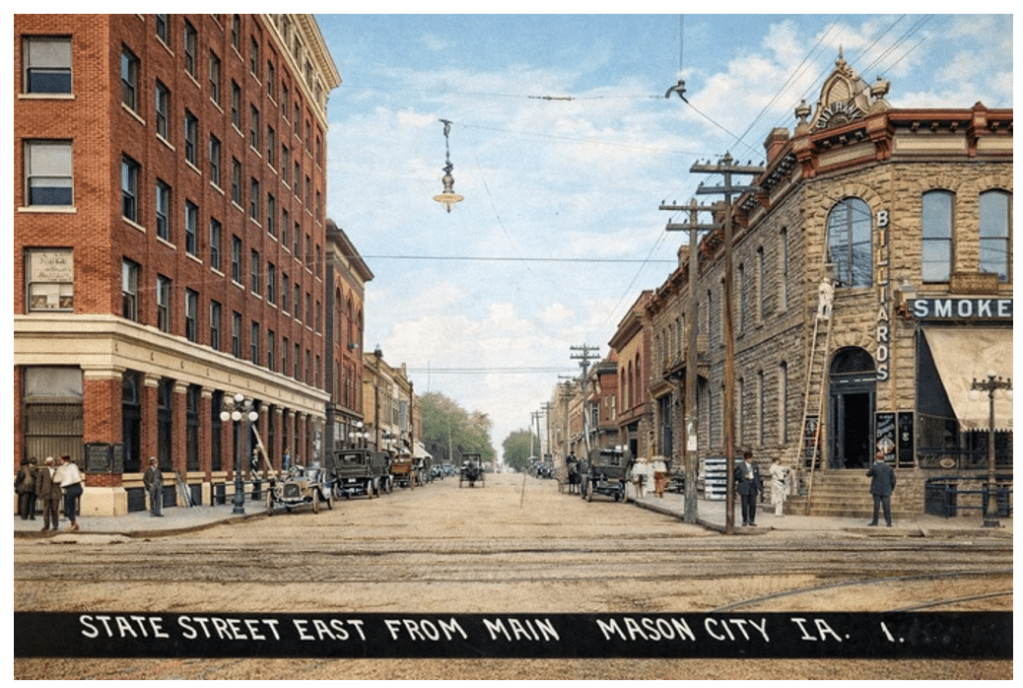
Billy Sunday conducted a month-long revival campaign in Mason City, Iowa, from January 13 to February 12, 1905, during a period when the city’s population was only about 8,300 and total church membership was roughly 3,000. A temporary tabernacle constructed of rough boards and tar paper—heated by six furnaces to withstand winter conditions—served as the central venue for the meetings.
Attendance was substantial for a community of Mason City’s size. One January meeting drew 2,000 men, while associate evangelist Ira E. Honeywell simultaneously addressed 1,000 women in a separate gathering. During a notable men’s meeting on January 29, Sunday delivered a forceful sermon condemning social vices; more than 50 men responded for prayer and conversion. The revival continued despite severe winter weather, including temperatures reported at twenty below zero.
By the campaign’s conclusion, the meetings had produced approximately 700 conversions, including 200 on the final day. Sunday received a $1,800 love offering, while an additional $2,500 was raised for campaign expenses and $800 for the city’s poor. Contemporary newspapers widely reported the revival and praised Sunday’s energetic preaching style and his unusual ability to sway large crowds.
Some one has said “To make ‘soul winners’ out of church members” is the business of Miss Francis Miller with the Sunday party. Her greatest opportunity comes each afternoon at the close of Mr. Sunday’s sermon. Christians of all ages and experience gather before her on the platform to be instructed how to use the Bible in meeting the excuses and answering the questions of sinners. She is an expert in teaching how to diagnose the sinner’s heart and apply the specific Scripture remedy chapter and verse. For years she was a passive church member when a sermon on “Personal Work” by Billy Sunday opened her eyes to a great responsibility. Mr. Alexander led her into Bible study and Grace Saxe made her eager to do Bible work. She carries ordination in the Congregational church and has had experience in pastoral work. Miss Miller’s work in other places is being duplicated in Cedar Rapids.
Miss Miller’s Bible work in connection with the revivals conducted by Mr. Sunday has ripened in the school of experience. At first she came on the ground at the close of the revival and organized union Bible study classes. Experiments of this kind at Knoxville, Iowa, Kewanee and Kankakee, Ill., revealed that the work done in this way could not be made of permanent value without local leaders, which was not always available. The experiment was tried out beginning in advance of the revival. Miss Miller went to Muscatine and Galesburg two weeks before Mr. Sunday to prepare the personal workers for his coming. Later Miss Miller worked during the three last weeks of the meetings and then remained two weeks after the close to organize the local Bible class work upon a permanent basis. This was the plan pursued at Springfield where forty-five district or neighborhood Bible classes were formed with a central training class for the leaders. These classes were interrupted by the summer vacation period but the classes took up their work this fall with about one thousand members working in the various districts. A class was formed among the so-called “society girls,” the girls of leisure, in well to-do homes. They call it “The Worth While Bible Class,” and they have been aggressive in Y.W.C.A. and associated charity work. One Bible class in Springfield supplanted a card club. The girls gave up their cards for Bibles. There was no breaking up of existing social ties but a change of bonds. No new social lines were drawn but a new directive of interest was taken. Many girls who have been stimulated to take up personal work have gone to Moody Institute for training. Word comes from Boulder, Col. that sixty high school girls hold regular Bible study meetings in the high school building. Miss Miller is one of the busiest workers of the Sunday party. She meets with the home girls of leisure at 10 a.m. The fifty gathered at the home of Mrs. Frank Watson Friday may be regarded as typical; at 11:15 three days of the week she meets the Coe college girls; at 12:15 she talks about 150 high school girls at St. Paul’s M.E. church; at 3:00 holds a personal workers’ class for everybody and at 6:30 for clerks, teachers and others. Careful plans are being made to insure systematic Bible study after the close of the big revival.
The Cedar Rapids Gazette. Thu, Nov 18, 1909 ·Page 5
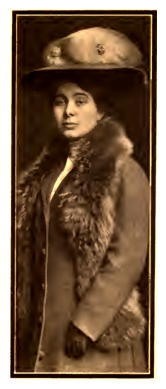
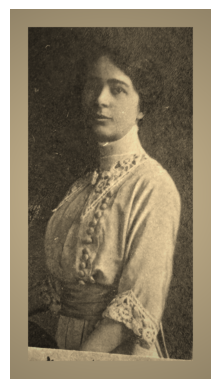
Miss Frances Miller
TRUE today as it ever has been, the title, “church member,” or “Christian,” are not synonymous with “soul winning.” Miss Miller, with Bible in hand, finger on chapter and verse, persuades you—yes, convinces you they should be—that they are. To make “soul winners” out of church members is her business with Mr. Sunday’s party, and she does it. Skilled herself through years of study and practice, she stands before her class of hundreds, each afternoon at the close of Mr. Sunday’s sermon and schools them to meet the excuses and questions of the sinner, not as the quack with the patent cure all, but as the trained physician who diagnoses, then prescribes. With clear, logical reasonings, deduced from Scripture, carried by a clear, far-reaching voice, she instructs how to diagnose the sinner’s heart and apply the specific Scripture remedy with chapter and verse.
Miss Miller herself was not always a soul-winning church member. For five years she was not. A church member, simply, she thinks, because she was asked to be. Reared in a Christian home, honest at heart, she was ready. When Billy Sunday, about sixteen years ago, broke the truth to her in a sermon on “Personal Work,” she surrendered to it. Mr. Alexander led her into Bible study and Grace Saxe made her want to do Bible work.
She was born in Minnesota, grew up in North Dakota, lived in Illinois, was educated in the high school at Waterloo, Iowa, and college at Fargo, N. D., and afterwards taking a two years’ course and finals in the Bible Institute in Chicago.
She spent a summer with Mr. Williams and Mr. Alexander, organizing Bible classes, etc., one of which at Vinion, Ia., still continues, and that is over ten years ago. Her first year out of college she had charge of two Congregational churches near Valley City, N. D., and later was ordained a member of the Congregational church.
Besides “personal work” classes she teaches systematic Bible study classes, special prayer meetings in Y.M.C.A., laundries, shops, high schools, etc., at times and places convenient for the many who cannot attend the regular services. Morning and afternoon she does it, conducting four or more meetings a day and plunges into the vast tabernacle in the evening hunting for someone to lead to her Christ.
Her Bible is pre-eminently a part of a great revival campaign in supplementing the preaching by preparing intelligent workers and grounding converts in the Scriptures. Thus two of the weakest spots, two chief causes of failure in modern revival work, are cared for.
And Why the Offer Destroys the Claim That He Preached for Money
One of the most common criticisms leveled against evangelist Billy Sunday is that he preached for money.
Critics point to the generous love offerings that were sometimes taken at the close of his revival campaigns and conclude that Sunday must have been motivated by financial gain. It is an easy accusation to make. But historical evidence tells a very different story.
One remarkable document from 1917 puts the matter in perspective.
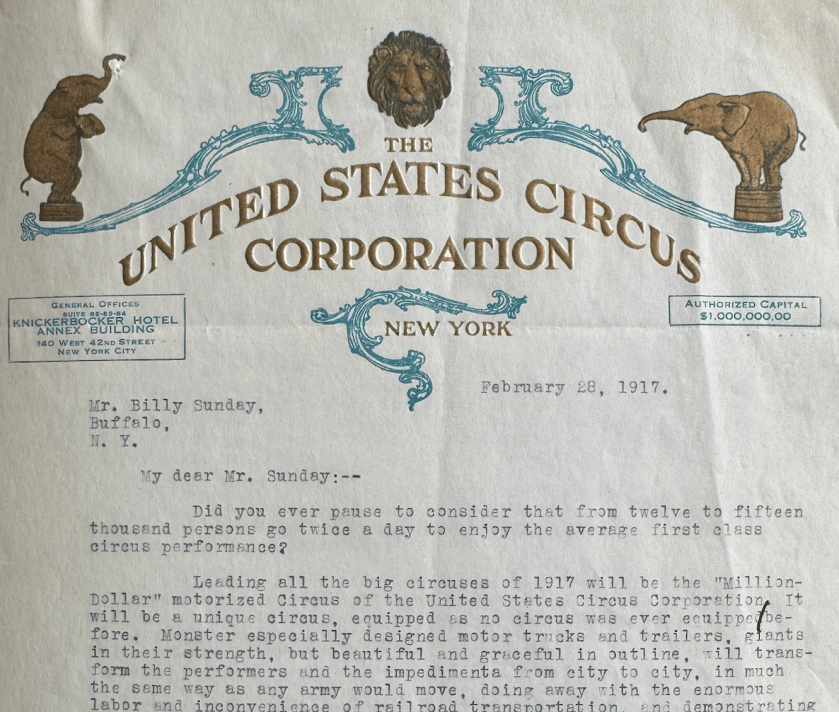
On February 28, 1917, Billy Sunday received an extraordinary letter from the president of the United States Circus Corporation. The proposal was simple, bold, and almost unbelievable.
The circus wanted Billy Sunday to join the show.
Original 1917 contract. Grace College. Morgan Library.
The letter opened by reminding Sunday of the enormous audiences that circuses attracted:
“Did you ever pause to consider that from twelve to fifteen thousand persons go twice a day to enjoy the average first class circus performance?”
The promoter explained that the company was launching what he called a “Million-Dollar” motorized circus, equipped with fleets of specially designed trucks and trailers that would carry the show from city to city.
The scale was enormous. Tens of thousands of people attended circus performances daily.
And the circus president believed Billy Sunday could preach to them.
Then came the offer.
“I… offer you a weekly salary of $14,000, or $2,000 a day, for as many weeks of the coming summer season as you can give.”
To grasp how staggering this proposal was, consider the numbers.
If Sunday had accepted the offer and worked for roughly ninety to one hundred days during the summer season, he would have earned between $180,000 and $200,000 in 1917.
Adjusted for inflation, that is roughly $4 million today.
In return, the circus would provide transportation, luxury touring cars for Sunday and his staff, and access to massive crowds across the country.
The promoter even suggested that Sunday hold revival meetings on Sundays as part of the circus program.
But here is the crucial point.
The proposal made no provision for Sunday to keep offerings from those meetings. In fact, the letter suggested that the proceeds from Sunday services could go largely or entirely to charity.
The circus wanted Billy Sunday not as a fundraiser—but as an attraction.
A headline act.
A revivalist who could preach to the largest audiences in America.
And yet Billy Sunday refused.
The Economics of Sunday’s Real Ministry
Now compare this circus offer to the income Sunday actually received during the same years.
During the summer Chautauqua season, Sunday could deliver 50 to 70 speaking engagements.
Typical speaking fees ranged from $250 to $500 per engagement.
That means a strong Chautauqua season might produce:
$12,500 on the low end
$35,000 on the high end
Even at the very top of that range, the circus contract would have paid five to six times more.
In other words, if Billy Sunday had been motivated primarily by money, the decision would have been obvious.
He could have become the highest-paid religious speaker in America simply by joining a circus.
Instead, he chose the sawdust trail.
He chose the revival tabernacle.
He chose the ministry that demanded months of exhausting preaching, travel, prayer meetings, counseling, and organization.
And he did it for far less money than the circus was willing to pay.
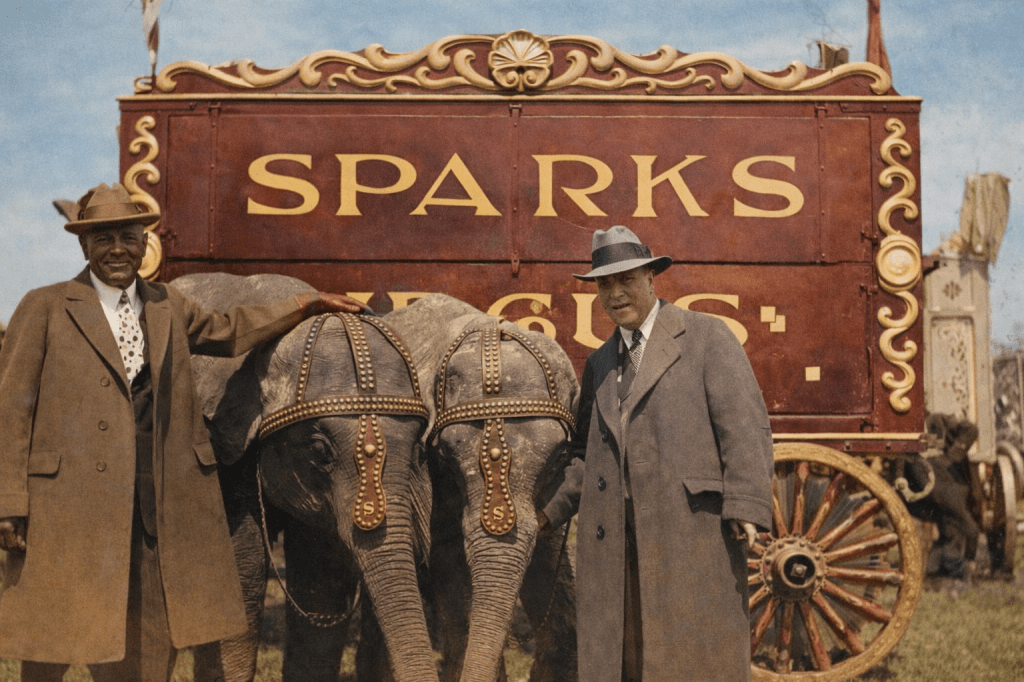
Rare original Sparks Bros Circus photograph showing evangelist Billy Sunday and Charles Sparks.
Why the Critics Miss the Point
Billy Sunday never pretended that money did not matter. Revival campaigns required large temporary tabernacles, choirs, staff members, and enormous logistical efforts.
But Sunday consistently refused opportunities that would have turned his preaching into entertainment.
The 1917 circus contract proves it.
The entertainment industry was willing to pay him millions in today’s dollars to headline the largest traveling show in America.
He said no.
The same evangelist who was accused of preaching for money walked away from a fortune.
And that fact should cause us to reconsider the narrative that Sunday’s critics often repeat.
Billy Sunday may have been many things—a fiery preacher, a former baseball player, a relentless evangelist—but the historical record shows that he was not in the ministry merely for the money.
If he had been, the circus would have had its star.
Instead, the revival fires continued to burn.
Did you know?
“It may not be generally known, but ‘Billy’ Sunday supports a mission on Van Buren street, Chicago, paying all the expenses of maintaining it out of his own pocket. He is also educating twenty boys and paying for it with his own money. These boys are waifs he has picked up out of the street. In this he is following the plan of the late Sam Jones, who in his lifetime educated hundreds of poor boys and made useful citizens out of them.”

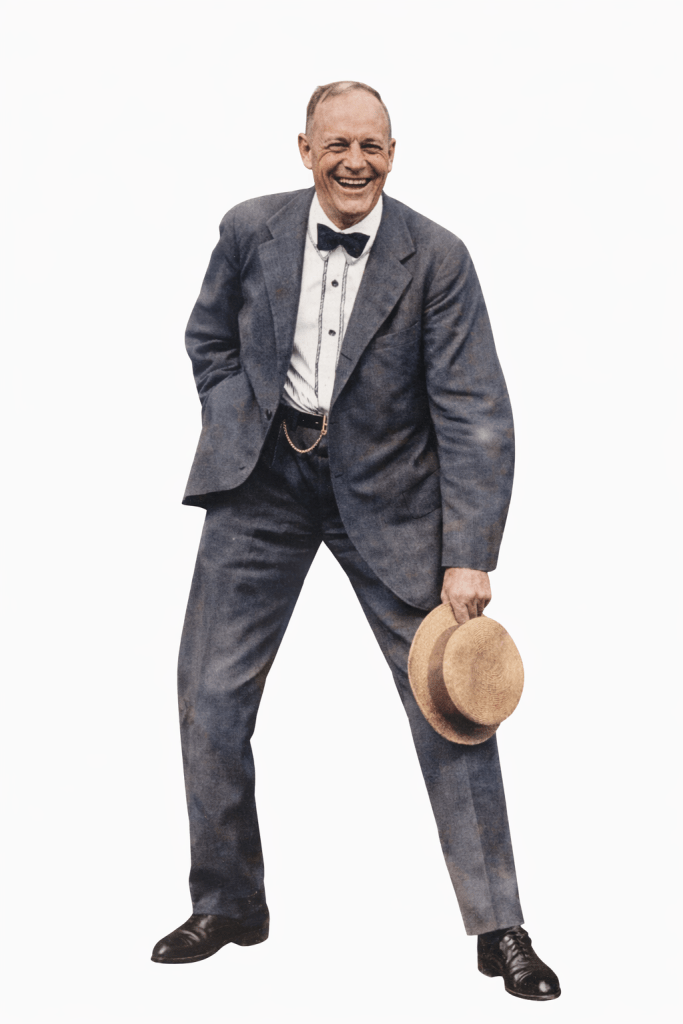
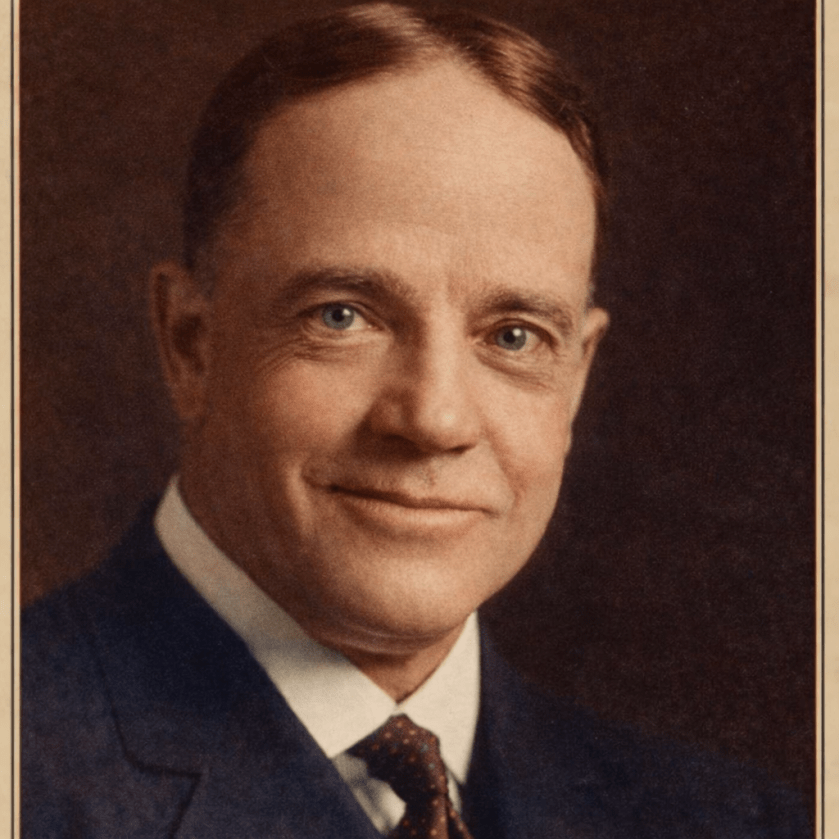
 Evangelist Billy Sunday (1862-1935)