Sixth in a series drawn from Lindsay Denison’s profile of Billy Sunday in The American Magazine, September 1907.
Sooner or later, every discussion of a famous revivalist arrives at the same question: what about the money? Lindsay Denison’s 1907 profile does not dodge it. In fact, it lays out the financial machinery of a Billy Sunday revival in unusual detail — and then takes the “grafter” charge head-on.
God helps those who help themselves
Sunday’s whole operation rested on a piece of practical theology: God helps those who help themselves. He had no intention of letting his revivals be dragged down by the constant whine of money-begging, so he built the funding in advance.
The process began only after the ministers of all a town’s evangelical churches signed a joint invitation and agreed to close their own churches and throw their full energy behind the revival. Once that was secured, the town had to put up real money. Typically a stock company was formed — an incorporated “Evangelical Association” — that issued shares to raise the necessary funds.
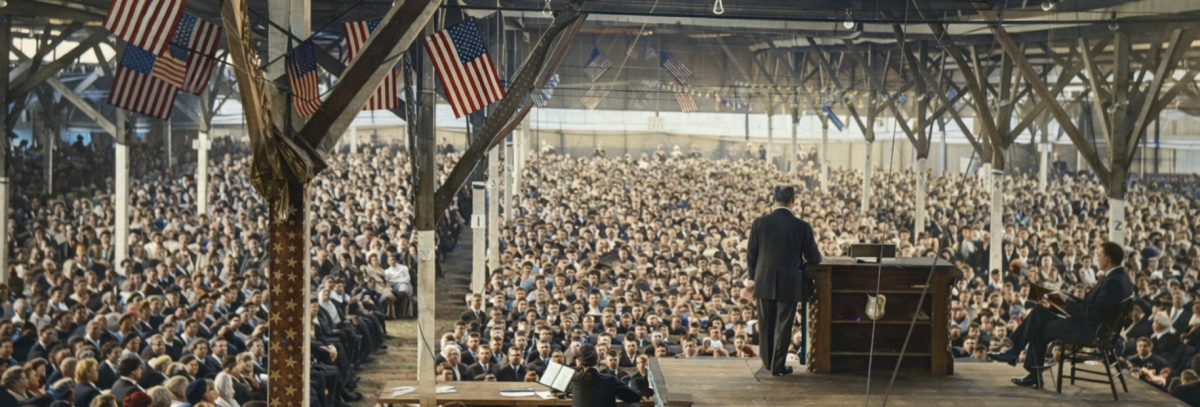
The list of what Sunday required was specific, and he printed it in a little pamphlet covering every detail. The town had to erect a wooden tabernacle with fixed seats. It had to guarantee board and lodging for Sunday and his entire company, cover their travel expenses, pay half of Fred Fischer’s salary, and handle the printing and advertising. On top of that, committees of church members had to be organized to serve as ushers, as personal workers pursuing converts, and as the choir.
A company to support
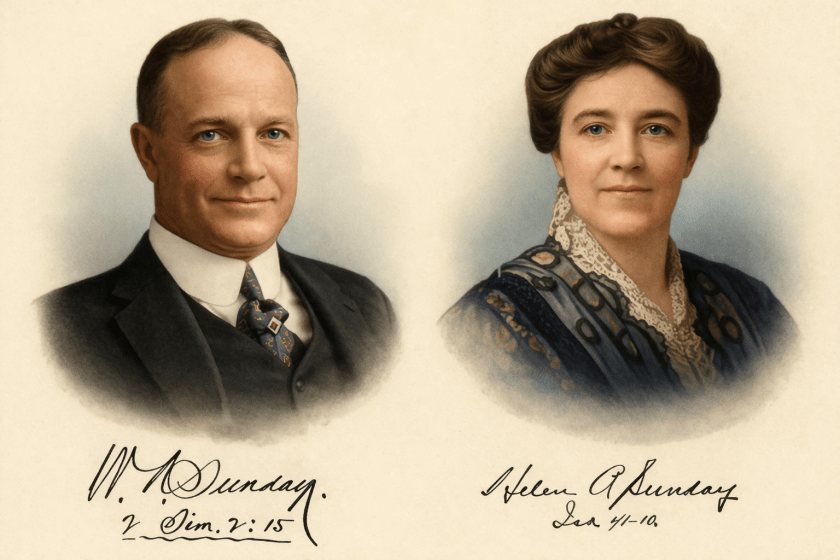
That company was not small. Beyond Mr. and Mrs. Sunday, it included Mr. and Mrs. Fischer; the Rev. T. E. Honeywell, secretary and associate evangelist; Miss Miller, a Bible-class teacher; and Fred Seibert — a former cow-puncher turned evangelist who handled most of the sexton’s duties between meetings and also sold the hymn books. Supporting that traveling staff, plus building a tabernacle from scratch, was a serious undertaking for a town of a few thousand.
The part the critics missed
Here is the distinction Denison is careful to draw, and it is the heart of the matter.
All of that up-front money — the shares, the tabernacle, the guarantees — went to expenses, not to Sunday’s pocket. He took none of it for himself. He even refused to guarantee that the collections taken at the services would be enough to repay the subscribers who had advanced the money. And yet, Denison reports, he had never once failed to raise enough within ten days or two weeks to square those accounts.
From the moment the guarantors were reimbursed until the final day of the revival, money was simply not mentioned — not by Sunday, not by anyone, with no collections taken at all. He deliberately minimized the money-raising in both time and eloquence.
“Give what you want to”
Sunday’s own income came from a single appeal on the very last day, made on the plain principle that the laborer is worthy of his hire. He explained that this closing collection was for himself, his family, and his helpers, standing in for the ordinary salaries and wages they might have earned in secular work. And he set no figure on it.
His pitch was disarmingly open-handed: people should give what they wanted to, in proportion to how much good they felt he had done the town. He could get along, he said, even if they gave nothing, because plenty of people had already been more generous than he deserved — though he added, pointedly, that those who labor for Christ ought to be able to live as well as those who labor for the Devil. Beyond that, it was up to them.
In Fairfield, the result was striking. After paying $3,200 to cover the revival’s expenses, the town gave Sunday a farewell thank-offering of $3,660. Even after the share he distributed among his helpers, Denison concluded, his own reward compared well with the salaries some big-city churches paid their pastors.
The grafter charge — and the rubber gloves
This was exactly the figure that drew sneers. Critics pointed to Sunday’s comfortable income, questioned his sincerity, and lumped him in with preachers better known for their finances than their good works.
Denison’s rebuttal is pointed: Sunday never raised money “for the Lord” and then quietly banked it to his own credit. The expense money was genuinely spent on the revival; his own pay came openly, once, at the end, with no pretense about what it was for. (As we saw earlier in this series, Sunday also had a long memory for the lean years — he liked to note that nobody called him a grafter back when the 1893 hard times left him too poor to afford trolley fare.)
He was, Denison admits, slow to discuss these criticisms, because he was apt to lose his temper over them — and sometimes did. When the editors of a small newspaper in nearby Brighton took it upon themselves to call him a grafter, Sunday held his wrath for three days. Then he aired it the only way the pulpit allowed: in a prayer.
Working down a list of surrounding towns he asked God to bless, he arrived at the Brighton editors and suggested the Almighty might tackle them too — but cautioned the Lord to be careful and take along a bottle of disinfectant, since he wasn’t sure much could be done with them. And if God did decide it was worth a try, Sunday added, here was a pointer: wear rubber gloves.
The congregation dissolved into smothered laughter and a roar of approving amens. It was not, perhaps, the most charitable prayer ever offered — but it tells you exactly how a proud man, stung by an accusation he believed unjust, defended his good name when he couldn’t quite manage to turn the other cheek.
Next in the series: “To-morrow” — inside Billy Sunday’s last day in Fairfield.

 Evangelist Billy Sunday (1862-1935)