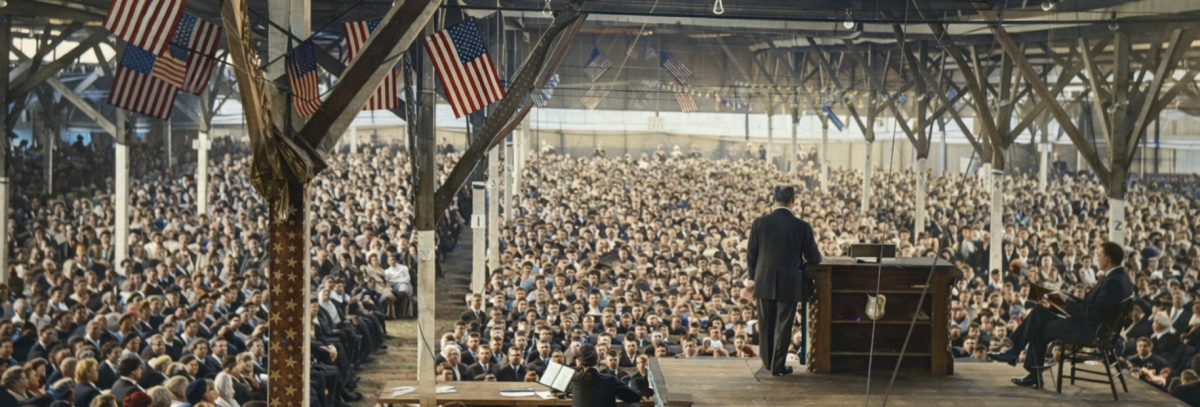
When Billy Sunday stepped out on his own as an evangelist in 1896, he did not start from nothing. He started from a kit. Much of that kit had been handed to him by the man he had served as advance agent and understudy, the polished Presbyterian revivalist J. Wilbur Chapman. Sunday himself never hid this. The interesting question is not whether he borrowed — it is what he borrowed, how long he kept it, and what he eventually built in its place.
A close comparison of Sunday’s early preaching record against Chapman’s own published sermon portfolio lets us answer that question with something better than impression. The picture that emerges is not a story of a man trapped inside his mentor’s material. It is a story of an apprentice spending down an inheritance and, year by year, replacing it with a voice that was unmistakably his own.
The starting kit, 1895
In the years he was still working closest to Chapman, Sunday’s preaching looks the most borrowed. Several of his 1895 titles are not merely similar to Chapman’s — they are the same sermon. “Is It Well With Thee?” runs on the same text Chapman used. “How Shall We Escape?” matches Chapman title-for-title and verse-for-verse. The sermon on receiving the Holy Spirit lands on the same subject Chapman had already put into print.
The rest of 1895 is standard revival stock of the period — the familiar parables of the lost sheep, the publican and the Pharisee, Zaccheus, the laborers in the vineyard. This is not yet a body of original work. It reads like a young evangelist preaching the sermons he had heard his mentor preach, in the order he had learned them.
1896: the borrowed frame, the new flesh
The year Sunday went solo, his sermon list more than doubles. The reason is simple and human: a man running his own multi-week campaign suddenly needs enough material to fill it, and the cheapest place to find that material was the well he already knew. So the Chapman skeleton is still doing real work in 1896 — the surrendered-life sermon on Kadesh-Barnea, the cluster on the unpardonable sin, the sermon on Christ’s first converts, the warnings to backsliders, the “decide now, don’t wait until tomorrow” appeal.
But 1896 is also the year you can first hear the other Billy Sunday — the one the country would eventually pack tabernacles to see. Alongside the inherited sermons sit titles with no parallel anywhere in Chapman’s portfolio: a sermon against drink, a broadside against the “isms and cults,” and a pair of plain, muscular talks about effort and preparation. The frame is still Chapman’s. The flesh on it is starting to be Sunday’s.
1897: the gospel of judgment turns personal
By 1897 the balance has tipped. Only one clear Chapman carryover survives in the record, and the center of gravity has moved hard toward judgment, hell, and eternity — “After death, the judgment,” “There is a hell,” “Where will you spend eternity?” — together with a frontal attack on infidelity and loose living.
This is the emerging Sunday brand, and it is worth noting what it is not. It is not Chapman’s measured, doctrinal, teaching voice. Chapman the careful Presbyterian taught his hearers what a Christian is and what the gospel means. Sunday kept the part of Chapman that pressed for a decision and quietly dropped the part that paused to instruct. He kept the closer and let go of the teacher.
The Chautauqua years: Chapman all but disappears
Now jump ahead to Sunday on the Chautauqua circuit between 1901 and 1911 — the popular lecture platform where he spoke to general crowds rather than revival congregations. Here the transformation is nearly complete.
Across more than two dozen documented Chautauqua appearances, the old Chapman material has effectively vanished. In its place stands a repertoire that is entirely, recognizably Sunday’s: the baseball talk, the temperance assault under titles like “The Devil’s Boomerang” and “Get on the Water Wagon,” the skeptic-bashing of “Nuts for Skeptics to Crack,” and the brisk motivational lecture “Forces That Win.” Conversion-and-judgment preaching, the very heart of the revival sermons, almost never appears on this stage. The platform audience came for a performance and a point of view, not an altar call, and Sunday gave them exactly that.
And yet one thread runs all the way through. The single Chapman sermon still standing on the Chautauqua circuit is “How Shall We Escape?” — the same sermon that had been a word-for-word borrowing back in 1895. It is at once the strongest early borrowing and the lone survivor a half-decade later. Of everything Chapman handed him, essentially this one sermon endured. The rest he had outgrown.
What was actually his
So which sermons were truly Sunday’s own — the small original core he built on while the borrowed material fell away?
The most reliable test is not simply “absent from Chapman’s list.” It is durability: which non-Chapman subjects appeared early and survived into his independent, mature preaching. By that measure, three themes stand out, and all three are visible by 1896:
- Drink. The early anti-saloon sermon becomes the most-repeated subject of his Chautauqua years. If any single theme is the signature of the independent Billy Sunday, this is it.
- Skepticism and infidelity. The early swipe at “isms and cults” hardens into a recurring, crowd-pleasing attack on doubt and unbelief.
- Effort and will. The plain talks on having a mind to work and on need, opportunity, and preparation point straight ahead to “Forces That Win.”
These are the sermons that were his, because these are the ones he kept when he no longer had to lean on anyone. The borrowed gospel of judgment got him started; this original core is what he became.
A note on the work behind this
This comparison rests on a sermon-by-sermon crosswalk of Sunday’s documented early titles against Chapman’s published portfolio, sorted into tiers — word-for-word borrowings, shared subjects, looser thematic echoes, and sermons original to Sunday. The early record (1895–1897) and the Chautauqua window (1901–1911) are well represented. The crusade years in between are still being reconstructed, and as that record fills in, parts of this picture may sharpen or shift. But the overall shape is already clear: Billy Sunday left his mentor carrying a borrowed kit, drew on it hardest in his first solo year, and over the following decade made himself almost entirely into his own creation.
How to cite this post
Chicago: McNutt, Kraig. “What Billy Sunday Borrowed from Chapman, and What He Made His Own.” Evangelist Billy Sunday (1862–1935), May 30, 2026. https://evangelistbillysunday.com/2026/05/30/what-billy-sunday-borrowed-from-chapman-and-what-he-made-his-own/.
MLA: McNutt, Kraig. “What Billy Sunday Borrowed from Chapman, and What He Made His Own.” Evangelist Billy Sunday (1862–1935), 30 May 2026, evangelistbillysunday.com/2026/05/30/what-billy-sunday-borrowed-from-chapman-and-what-he-made-his-own/.
APA: McNutt, K. (2026, May 30). What Billy Sunday borrowed from Chapman, and what he made his own. Evangelist Billy Sunday (1862–1935). https://evangelistbillysunday.com/2026/05/30/what-billy-sunday-borrowed-from-chapman-and-what-he-made-his-own/
Turabian: McNutt, Kraig. “What Billy Sunday Borrowed from Chapman, and What He Made His Own.” Evangelist Billy Sunday (1862–1935). May 30, 2026. https://evangelistbillysunday.com/2026/05/30/what-billy-sunday-borrowed-from-chapman-and-what-he-made-his-own/.

 Evangelist Billy Sunday (1862-1935)