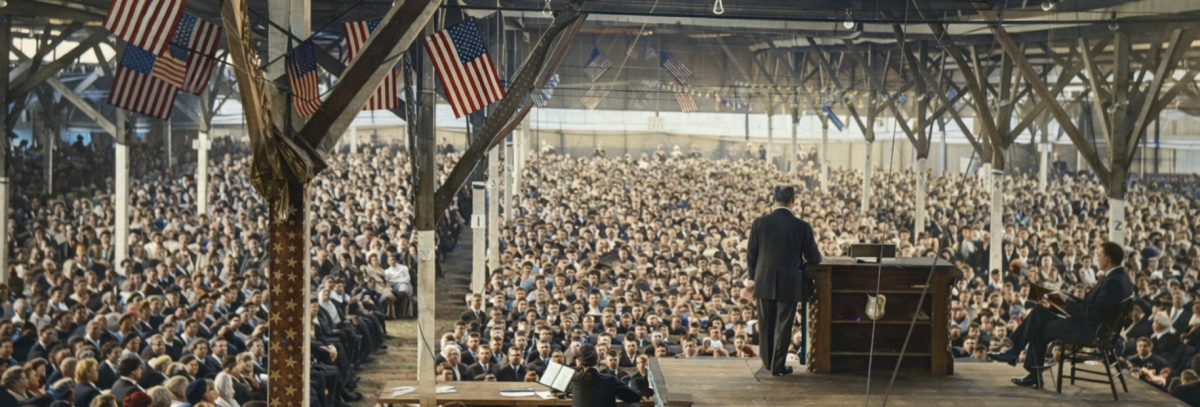
A year of small towns, growing purses, and the quiet beginning of the Chautauqua decade that would change everything.
If 1902 was the year Billy Sunday became Billy Sunday, then 1903 was the year he started learning what kind of Billy Sunday he was going to be. The previous year had handed him three breakthroughs: a documented preaching style, a working business model, and a public conversation about whether he might be the next Moody. 1903 was the year he had to do something with all of that.
By the documented record, he held only seven multi-week campaigns and Chautauqua appearances that year — a smaller schedule than 1902. But every one of them mattered, and one of them, a single afternoon talk in September, opened the door to the decade-long platform run that would carry him from regional tent revivalist to national headliner.
Osceola and Marengo: the work continues
The year opened where the previous one had ended — in a small Illinois town, in cold weather, in a four-week revival campaign. At Osceola, between January and February, Sunday drew a $710 purse against $1,100 in campaign expenses and recorded 410 conversions. The local paper noted that he was making “several times over” the salary of a professional baseball player. The Leon Journal-Reporter put a finer point on it in mid-January: he was “attracting enormous congregations.”
From there to Marengo, Illinois in March, where something quietly remarkable happened on Sunday, March 29. Billy preached to men only. Helen Sunday preached to women only. Sixty converts came forward that day across the two services.
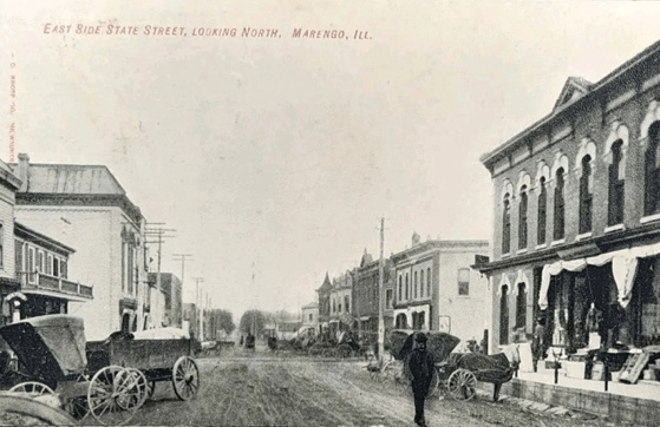
Helen had been managing the Sunday household for years, and she would eventually become her husband’s chief organizational lieutenant on the road. But March 29, 1903 is, as far as the curated newspaper record shows, one of the earliest documented occasions when she stepped into a public preaching role of her own. The Belvidere Daily Republican noted it without much fanfare. Three years later, when she announced she would join Billy on the campaign trail full-time, she described her future role as taking “charge of women Bible classes, organizing girl Bible classes and giving personal care to converted persons.” Marengo 1903 was the prototype. She had already been doing it.
Centerville: a town transformed
The defining revival of 1903 came in June at Centerville, Iowa — a small county seat in the southern Iowa coalfields. Sunday preached there for just over two weeks, between June 14 and June 30, and the impact on the town was, by every contemporary measure, immense.
851 conversions across the campaign. 615 of them came in the final week. 219 on Sunday, June 28 alone. 230 on the closing night, June 30. The crowds were enormous for a town that size. On June 29 Sunday preached to 1,500 people, some of whom had driven more than twenty miles to be there. At the men-only meeting earlier in the campaign, 1,200 men came; 155 of them were converted in a single service. Sunday’s purse for the two-week run was $1,500.
But the more telling numbers came after he left town. The Evening Times-Republican reported on July 11 that 428 new church members had joined Centerville’s congregations as a direct result of the revival. First United Methodist alone took in 67. One Centerville church’s regular weekly offering more than doubled in the weeks after Sunday’s departure. Almost every denomination in town began discussing new building plans to accommodate the new attendance. And on July 23, the Oskaloosa Herald reported that a brand new Centerville YMCA had been founded with 150 members — expanding to 250 within a few days.
This was the model working at full force. A two-week campaign generating not just conversions but durable institutional change — new church members, new buildings under discussion, a new YMCA chapter. The Centerville revival also produced one of the period’s most quotable Sunday biographical glimpses. Speaking with a reporter from the Evening Times-Republican on June 26, Sunday described his own childhood: he had been “raised in an infidel neighborhood up in Story County. His grandfather was an infidel and never went to church. Cursings and damnings were heard on all hands.” It is the kind of personal-origin detail that rarely surfaces in his own words elsewhere.
There was also a political dimension. During the Centerville campaign, more than 100 attendees withdrew their names from a local saloon-approval petition — early evidence that Sunday’s revivals were not just spiritual events but civic interventions that reshaped local temperance politics. Toward the close of the campaign Sunday ordered a new tent capable of seating 2,000 people. The local press, with characteristic dry wit, observed that he “proposes that no guilty man escape.”
“The splendid success which has been achieved by “Billy” Sunday at Centerville and at other points in Iowa as an evangelist is contradictory to the conclusions of those who have contended that revivals are a thing of the past and no longer efficacious. They are as effective now as they ever have been, with this difference that a larger share of ability and personality is required to influence the unsaved and bring them to repentance and salvation. People are wider read and more intelligent than they were. A higher order of clerical ability is exacted, and the church is supplying it. Strong, forceful, able and broad-minded evangelists are in greater demand that at any time heretofore and are invariably as successful in winning converts to Christianity as they ever have been.”
– The Courier (Waterloo, Iowa) · Wed, Jul 8, 1903 · Page 4.
The summer turn
The most consequential thing Sunday did in 1903 occurred in August and September. He took his first Chautauqua bookings.
On August 9 he appeared at Bloomington, Illinois — a single date on the Bloomington Chautauqua program. On September 7 he appeared at Ottawa, Illinois, where the Dwight Star and Herald reported that his subject was a denunciation of two-faced church gossipers. Both engagements were modest by the standards he would soon set. But both put him onto the summer platform circuit that would, by 1909, be paying him $43,000 a year and putting him in front of audiences of 8,000 to 15,000 in a single afternoon.
The Chautauqua movement in 1903 was already a national institution. Each summer, thousands of small Midwestern towns hosted ten-day Chautauqua assemblies under canvas — featuring lectures, music, religious programming, scientific demonstrations, and visiting speakers. The platform was hungry for evangelists who could draw a crowd without alienating the family-friendly audience. Sunday’s blend of muscular preaching, ex-baseball-player charisma, and crowd-tested theatricality turned out to be exactly what the format wanted.
A 1903 Sunday Chautauqua appearance was just a single afternoon talk — a long way from the multi-week revival campaigns that had been his core work. But the summer tour had one advantage that the revival circuit did not: scale. A single revival meant one town for a month. A single Chautauqua summer meant a dozen towns in three months, each with its own audience, its own newspaper coverage, and its own check. By September of 1903, Sunday had taken the first steps onto a platform that would carry him through the next decade.
Carthage: a new high
The fall return to revival work brought Sunday to Carthage, Illinois, where he preached from October through November 1 in a pole-and-canvas tabernacle built near the town square by local volunteers. His purse for the month-long campaign was $2,100 — at the time, the largest he had ever received. The Muncie Star Press flagged this as an editor’s note, treating the figure as newsworthy in its own right.
Three years later, in March 1906, the Mattoon Journal Gazette and Times-Courier would publish a stickiness analysis of Sunday’s earlier revivals — looking at how many of his converts remained in the faith years after the campaigns ended. Carthage came in at 80 percent still “living the new life” three years later. It was one of the strongest results in the entire study.
For a 41-year-old evangelist still mostly working the small-town Midwest circuit, the $2,100 Carthage purse was a meaningful threshold. The previous high had been Fairmount’s $1,600 the prior spring. Carthage put Sunday’s compensation on a clear trajectory — by 1907 he would routinely draw $6,000 purses, by 1909 over $10,000 — and the fact that the Muncie paper flagged the figure as “largest ever” tells us the regional press was already keeping score.
What 1903 was for
It is tempting to read 1903 as a quiet year. Only seven documented engagements survive in the curated archive, none of them generated the kind of national press coverage Sunday’s 1902 ministry totals had attracted, and the Chautauqua bookings looked at the time like modest summer side work. The story of 1903, if you were skimming the year for headlines, is thinner than 1902 on its face.
But three things happened in 1903 that mattered more than the headline count suggests, and each one set up something that would define Sunday’s career for the next decade.
Centerville proved the institutional model worked. The 1902 Fairmount campaign had shown that the stock-company funding mechanism could work. Centerville, a year later, showed that the durable institutional effects — new church members, new buildings, new YMCA chapters, lasting political consequences — were not flukes. Sunday’s revivals were not just emotional events. They were civic re-engineering exercises that small towns wanted and would pay for.
Carthage put Sunday’s earnings on a new escalator. $2,100 in a single month, on a model where the local stock company underwrote expenses and the closing collection went to Sunday personally, was no longer a regional curiosity. It was the kind of money that could only come from a campaign delivering real economic value to a town and its churches. By the end of 1903 Sunday was no longer asking communities whether they could afford to host him. He was being courted.
Bloomington and Ottawa opened the Chautauqua door. Two modest summer engagements in 1903. Twenty Chautauqua appearances in 1906. Eighty-six lectures in 1907. The Chautauqua decade — the platform run that would make Sunday a national-newspaper name well before the urban tabernacle campaigns of the 1910s — began with those two unassuming afternoons. Without 1903 there is no 1907. Without 1907 there is no 1909 Spokane, no Patterson Springs $3,600 record, no first meeting with Homer Rodeheaver at Winfield, Kansas.
The 1902 narrative had been about emergence — about a 40-year-old preacher publicly figuring out who he was. The 1903 narrative is harder to see because the changes are quieter. But by the time Sunday closed his Carrollton, Illinois campaign in November and moved on to start the Jefferson, Iowa campaign in mid-December, the trajectory of his ministry was no longer in question. The next ten years were already implied in the platforms he had just learned how to stand on.
The Chautauqua had a hold of him now. So did the small-town Midwest. And so, increasingly, did the watching national press.
All dates, figures, purse amounts, conversion counts, and contemporary press quotations in this post are drawn from the Sunday Master Speaking List, an ongoing research database compiled from period newspapers and archival sources, 2025–2026.
How to cite this post
Chicago: McNutt, Kraig. “The Summer Billy Sunday Found the Platform: 1903.” Evangelist Billy Sunday (1862–1935), June 7, 2026. https://evangelistbillysunday.com/2026/06/07/the-summer-billy-sunday-found-the-platform-1903/.
MLA: McNutt, Kraig. “The Summer Billy Sunday Found the Platform: 1903.” Evangelist Billy Sunday (1862–1935), 7 June 2026, evangelistbillysunday.com/2026/06/07/the-summer-billy-sunday-found-the-platform-1903/.
APA: McNutt, K. (2026, June 7). The summer Billy Sunday found the platform: 1903. Evangelist Billy Sunday (1862–1935). https://evangelistbillysunday.com/2026/06/07/the-summer-billy-sunday-found-the-platform-1903/
Turabian: McNutt, Kraig. “The Summer Billy Sunday Found the Platform: 1903.” Evangelist Billy Sunday (1862–1935). June 7, 2026. https://evangelistbillysunday.com/2026/06/07/the-summer-billy-sunday-found-the-platform-1903/.

 Evangelist Billy Sunday (1862-1935)