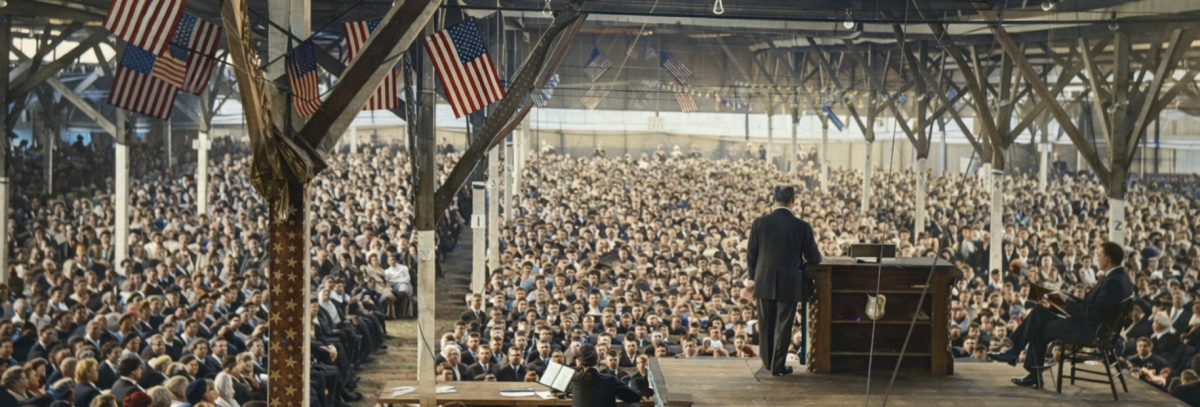
Between 1903 and 1909, Billy Sunday turned the summer Chautauqua platform into a repeatable performance machine. The secret was simpler than anyone expected.
In September of 1903, Billy Sunday stood on a Chautauqua platform at Ottawa, Illinois and preached against two-faced church gossipers. It was, as far as the newspaper record can tell us, his first Chautauqua engagement that anyone bothered to write up by subject. There was no title, no famous catchphrase, no broadside poster — just a single afternoon talk by a former baseball player turned evangelist, slotted somewhere between a band concert and a temperance lecture in a small Illinois town.
Six years later, in the summer of 1909, Sunday was delivering the same four sermons in twelve different towns across nine states, packing 6,000-seat tabernacles and pulling $500 paydays per lecture. He had figured out the trick. The trick was this: stop writing new sermons.
The platform problem
Chautauquas were the strangest preaching venue of Sunday’s career. Unlike his weeks-long revival campaigns — where he could pace himself, develop themes across services, and let an emotional arc build over a month in one town — the Chautauqua format was a one-and-done. You arrived in town, walked onto the platform, gave one talk (maybe two), collected your purse, and left for the next town the following morning. The audience came expecting entertainment as much as religion. They had paid a quarter at the gate and were sitting under canvas alongside crop demonstrations and a forty-piece band. The pressure to perform was relentless, and so was the pace.
Most evangelists who tried the Chautauqua circuit either burned out fast or watered down their content into harmless inspiration. Sunday did neither. He treated the circuit as a laboratory and, over six summers, ran an experiment: which sermons worked everywhere, in front of any crowd, in any town?
The experimental years
The first surviving titled Chautauqua sermon came in August 1904, when Sunday closed out the Sycamore, Illinois assembly with “Old Time Religion.” It was a safe choice — a familiar phrase, a sentimental hook. But it tested the format, and Sunday took notes.
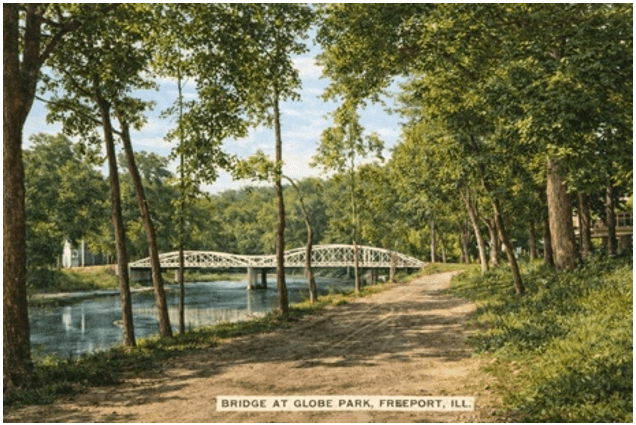
By the following summer, in 1905, he was experimenting more aggressively. At Globe Park in Freeport he preached on Baseball and the Atonement on alternating days, splitting the rhetorical register between personal-story-as-evangelism and straight theology. At Springfield he tried “The Bible” as a stand-alone theme. And at Sterling on July 16, 1905, in front of a crowd of 15,000 — the largest he had ever drawn to a platform — he set aside the sermon entirely and spent half an hour publicly demolishing Elbert Hubbard, the East Coast magazine editor who had recently called him a “grafter.” Coat off, vest off, sleeves rolled, fist in the air. The audience cheered almost every sentence. It was theater, not preaching, and Sunday seems to have realized two things at once: the Chautauqua crowd loved confrontation, and his own personality could carry a platform as well as any sermon he wrote.
By August of 1905 he had decided. A Rockford newspaper carried the announcement: Sunday was “so pleased with the results of his work among the Chautauquas during the summer that he has decided to devote a portion of all summers in the future to Chautauqua work.” He signed with a booking bureau. He was, formally, a Chautauqua headliner now.
The year everything became baseball
1906 is the year you can see Sunday’s strategy lock into place. Of his five documented Chautauqua appearances that summer, four featured “Baseball.” Belvidere on June 22 — 8,000 attendees at a 2:30 afternoon talk. Globe Park on July 8 — anchored on a text from First John, of all things. Janesville on July 29 — 4,000 spell-bound listeners. Sycamore on August 26 — spoke twice. The sermon was the same; the towns were different. Sunday had stopped writing new material and started repeating what worked.
At Muscatine on August 4 he debuted a second sermon: “Nuts for Skeptics.” It was a defense-of-the-faith talk aimed at the educated doubt that the Chautauqua audience — middle-class, literate, often Methodist — was most likely to bring with them. With Baseball anchoring the front half of his rotation and “Nuts for Skeptics” handling the back half, Sunday now had two reliable sermons. Two was already more than most evangelists managed.
The brutal summer of 1907
In 1907 Sunday delivered 86 Chautauqua lectures across roughly 30 sites for about $43,500 in earnings — the equivalent of roughly $1.5 million in 2026 dollars. He was the highest-paid evangelist in America that year, and possibly the highest-paid Chautauqua attraction of any kind. He was also exhausted.
The 1907 newspaper record is strangely thin on sermon titles. Of those 86 lectures, only three titles survive in the curated archive: “The Devil’s Boomerang” at Miami Valley, Ohio on July 23; “Amusements” at Sycamore on August 25; and “Grounders Hot Off the Bat” at the brand-new 4,000-seat steel auditorium at Joliet’s Dellwood Park on August 30. The thin record is itself telling — newspapers were so used to seeing Sunday on every regional platform that they had stopped describing what he preached. He was just Billy Sunday. He was the show.
“The Devil’s Boomerang” matters in retrospect, because it appears to be the first version of what would become the most-delivered sermon of Sunday’s Chautauqua career. The temperance crusade was tightening across the Midwest, and Sunday had found a sermon — eventually retitled simply “Booze” or sometimes “Get on the Water Wagon” — that channeled it. The third sermon in his rotation was now in place.
At Joliet at the end of August, after the steel-auditorium opening, Sunday told the press he was going to cut back on Chautauqua speaking after the season. The constant travel — overnight trains, missed sleep, hay fever, the relentless pace of a fresh town every day or two — was eating into the rest he needed for his revival work. He was 44 years old.
The full rotation
He did not, in fact, cut back. The 1908 Chautauqua titles have not survived in the archive, but by the summer of 1909 Sunday was running a tighter, more disciplined, and more deliberate rotation than ever. Across nine documented summer Chautauqua engagements between July 5 and August 25, 1909, he delivered just four sermons:
Booze — the temperance sermon, preached at Waterloo, Winfield, Trenton, Shelbyville, Petersburg, and originally scheduled at Clinton. Sometimes titled “Get on the Water Wagon.” The most-delivered Chautauqua sermon in Sunday’s archive.
Nuts for Skeptics to Crack — the defense-of-the-faith sermon. Albert Lea, Kearney, Litchfield. The expanded title is the only thing that changed between its 1906 debut and 1909.
Forces that Win — the surprise addition. Three appearances in 1909 (Winfield, Litchfield, Shelbyville), no documented earlier instances. Sunday appears to have developed it specifically for the 1909 summer circuit. The mystery sermon.
Baseball — still in the rotation but no longer dominant. By 1909, the temperance movement had given Sunday a sharper, more politically resonant sermon, and the personal-story sermon receded.
Four sermons. Nine engagements. Maybe two or three of these sermons were on offer at any given stop. The audience got whichever one Sunday thought would land best in their town. At Clinton on August 25, after he had already been booked to preach “Booze,” he changed his mind on the platform and switched to “Skepticism” instead — reading the room, pulling a different sermon from the rotation. The mid-stride change is the cleanest proof of the system: he was not preaching from notes that night. He was performing a known piece from memory, and he picked the one he wanted.
What the rotation tells us
It is tempting to read this as evidence of laziness or commercialism. Sunday found four sermons that worked, the argument might go, and ran them into the ground for the money. But the archive does not support that reading.
What Sunday was actually doing was solving a problem that traveling preachers had wrestled with for a century: how do you sustain emotional and rhetorical intensity across a punishing travel schedule, in front of audiences who have never heard you before? Moody used the same handful of sermons for decades. Sankey sang the same hymns. Sam Jones rotated a fixed set. Sunday’s innovation was not the repetition itself — it was the deliberate, almost engineering-grade winnowing process he ran from 1903 through 1908 to identify which sermons survived contact with audiences of every kind. By 1909 the rotation was tested. The Big Four were not lazy choices. They were the four sermons that had outlasted every other sermon he ever tried on a Chautauqua platform.
There is one more thing worth noticing. The arc of the four sermons traces the arc of American Protestantism between 1903 and 1909 with surprising precision. Baseball — the personal-conversion-story sermon — anchors the rotation early, when Sunday is still selling himself as a novelty. Nuts for Skeptics — the apologetics sermon — comes online in 1906, the same year that liberal theology and the rise of Higher Criticism are pressing hardest on evangelical preachers. Booze rises in 1907 and dominates by 1909, as the temperance movement accelerates toward what would become national prohibition in 1919. Forces that Win arrives in 1909 with no documented backstory — possibly Sunday’s own attempt to articulate what made his methods succeed, possibly a Memorial Day style civic sermon, possibly something else entirely. Whatever it was, it joined the rotation at exactly the moment when Sunday was preparing to make his transition to the big-city revivals that would define the rest of his career.
Four sermons. Every town. The Chautauqua circuit taught Billy Sunday what the big-city campaigns would soon prove: that a small, refined repertoire delivered with overwhelming conviction beats a large, polished one delivered with caution. By the time he walked off the Clinton, Illinois platform on August 25, 1909, with “Skepticism” still ringing in the audience’s ears, the apprenticeship was over. The career-defining decade was about to begin.
All sermon titles, dates, attendance figures, and contemporary press quotations in this post are drawn from the Sunday Master Speaking List, an ongoing research database compiled from period newspapers and archival sources, 2025–2026.
How to cite this post
Chicago: McNutt, Kraig. “Four Sermons, Every Town: How Billy Sunday Cracked the Chautauqua Circuit.” Evangelist Billy Sunday (1862–1935), June 3, 2026. https://evangelistbillysunday.com/2026/06/03/four-sermons-every-town-how-billy-sunday-cracked-the-chautauqua-circuit/.
MLA: McNutt, Kraig. “Four Sermons, Every Town: How Billy Sunday Cracked the Chautauqua Circuit.” Evangelist Billy Sunday (1862–1935), 3 June 2026, evangelistbillysunday.com/2026/06/03/four-sermons-every-town-how-billy-sunday-cracked-the-chautauqua-circuit/.
APA: McNutt, K. (2026, June 3). Four sermons, every town: How Billy Sunday cracked the Chautauqua circuit. Evangelist Billy Sunday (1862–1935). https://evangelistbillysunday.com/2026/06/03/four-sermons-every-town-how-billy-sunday-cracked-the-chautauqua-circuit/
Turabian: McNutt, Kraig. “Four Sermons, Every Town: How Billy Sunday Cracked the Chautauqua Circuit.” Evangelist Billy Sunday (1862–1935). June 3, 2026. https://evangelistbillysunday.com/2026/06/03/four-sermons-every-town-how-billy-sunday-cracked-the-chautauqua-circuit/.

 Evangelist Billy Sunday (1862-1935)