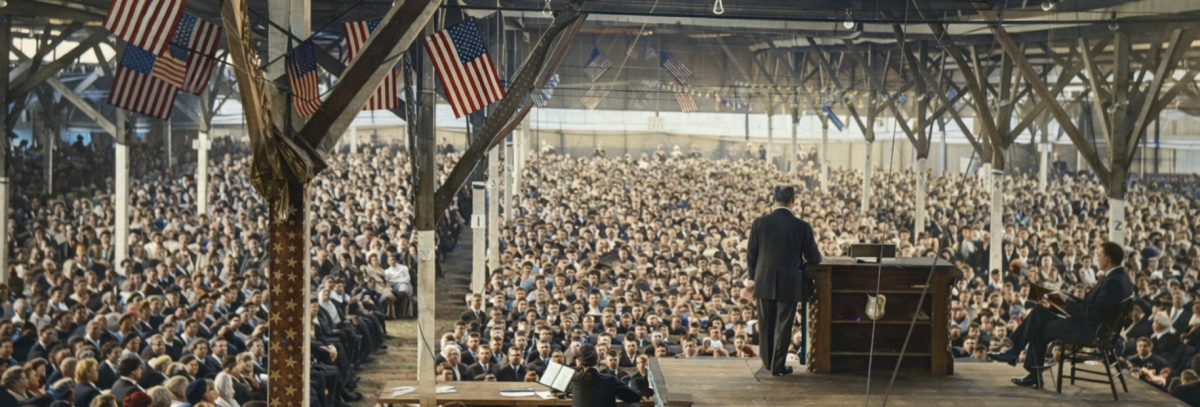
Twelve months that took a 40-year-old former baseball player from regional tent revivalist to publicly recognized “foremost of Evangelists” in America.
On January 18, 1902, William A. Sunday opened a five-week revival in the small Iowa town of Audubon. By the end of December, when he started his next campaign in Glidden, Iowa, he had preached eleven multi-week campaigns across four states, taken in roughly $7,500 in personal purses, watched at least 3,000 people walk down the aisle as converts, and become the subject of a serious national newspaper conversation about whether he might be the next Dwight L. Moody.
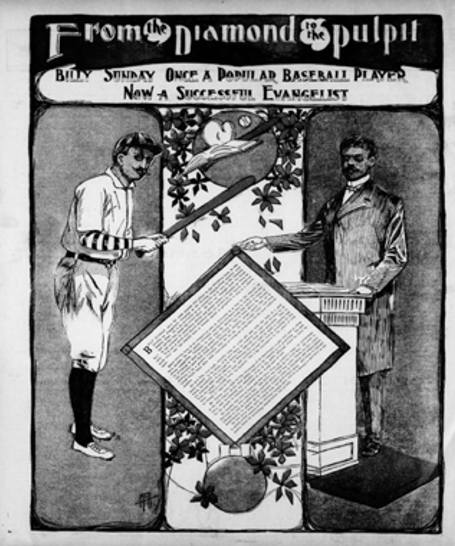
The Pittsburg Press. Aug 31, 1902:34.
He was 40 years old. He had been an independent evangelist for less than six years. And 1902 is the year — more than any other in his pre-Chautauqua decade — when you can actually watch him stop being a regional curiosity and start becoming a national figure.
A businessman’s revival
The most consequential thing Sunday did in 1902 had nothing to do with theology. It had to do with the way he organized a revival meeting.
At Fairmount, Indiana — a town of barely 2,000 people where Sunday preached from March 20 through April 28 — The Indianapolis News documented what it called Sunday’s “new and practical idea that appeals to business men.” The local supporters calculated four weeks of campaign expenses at $825. They organized a stock company for exactly that amount and sold shares to attendees, with basket contributions buying up the stock. Sunday took the last Sunday’s contributions as his personal compensation. When it was announced that the closing basket was for him, $1,640 was dropped into it.
It was a self-funding revival. Local risk underwritten by local capital, the evangelist’s purse paid by the same people who had benefited from his preaching, and the whole arrangement transparent enough that newspaper editors thought it was newsworthy. Sunday would refine this model for the next decade. By 1907 he would be the highest-paid evangelist in America, and the Fairmount stock-company structure — extended, scaled, professionalized — was the engine that got him there.
The 1902 archive shows him testing the model in five other towns. At Audubon in January and February he drew a $1,500 purse and 434 converts on a four-denomination joint sponsorship. At Atlantic, Iowa in February and March, $1,400. At Fairmount itself, $1,600. At Wheaton, Illinois in May, $813. At Iowa Falls in October, $749. At Woodstock, New York in December, $600. The purses were not uniform — Wheaton and Iowa Falls underdelivered, Fairmount overdelivered — but the structure was the same. And the numbers were big enough that they were getting noticed.
The leap up the aisle
In May of 1902 Sunday brought his revival to Wheaton, Illinois, and preached out of Gary Memorial Church with a 100-voice choir under his music director Fred G. Fischer. He stayed four weeks. He preached afternoon and evening every day for thirty days — over sixty sermons in all. He took apart Sabbath-breaking, named the Chicago Golf Club by name, and went after dance and card playing.
On June 4, the Omaha Daily News carried this sentence, buried halfway down a column that described his preaching at Wheaton:
On another occasion while preaching he made a run, leaped high into the air and landed twenty feet up the aisle, ran around the church, kept on preaching and shouted that he wanted to get in among the people to wake them up.
This is, as far as the curated newspaper record goes, the first contemporary documentation of the pulpit theatrics that would define Billy Sunday’s preaching for the next three decades. The leaping. The running. The breaking through the formal boundary between pulpit and pew. The athletic identity of his old baseball career — repurposed into evangelism in a way no preacher in American history had quite done before.
He had been preaching for six years. He was 40 years old. And he had just figured out the move.
“Foremost of Evangelists”
By late June of 1902, after closing a three-week campaign at Farmington, Illinois — Sunday’s smallest purse of the year at just $200 — a newspaper described him as the “foremost of Evangelists.” The phrase was almost certainly premature. There were better-known revivalists working the country in 1902. But the fact that any newspaper would apply that phrase to him, in print, in 1902, is the data point that matters.
The recognition got louder over the summer. In late June and early July he appeared at Winona Lake, Indiana for the first National Young People’s Bible Conference — the inaugural year of an event Sunday would return to for the rest of his life. J. Wilbur Chapman, the senior evangelist who had been Sunday’s mentor and employer through the 1890s, was also on the program. They were peers now.
On July 26 the Muscatine Journal carried what may be the most revealing single article of Sunday’s 1902 year. It was a ministry update in which Sunday spoke about his own income, by campaign, in his own words:
“God has been good to us,” is the way Mr. Sunday puts it. “He gave us $600 for a month’s work in Belvidere, Illinois; $200 for the same length of time in Farmington, and even frosty Wheaton, where there are costly Chicago millionaires, we drew $800 in thirty days.”
It was the kind of disclosure most preachers would never make. Sunday was happy to make it. The same article went on to say that out in Iowa, where Sunday had converted “more than 10,000 persons” over his ministry, “people assert that he is destined to be a greater evangelist than Mr. Moody.”
Two weeks later, on August 10, The Missoulian carried the more definitive number. Since Sunday had become an evangelist — going independent from Chapman’s organization in 1896 — he had taken in approximately $12,000 total. For context, a successful lawyer or doctor in 1902 made between $3,000 and $5,000 a year. The most successful corporate executives in America made between $10,000 and $25,000 a year. Sunday, at six years into his independent ministry, was on a trajectory to enter the top tier of American earners within another year or two. The Missoulian was not the only newspaper running these numbers. The story was syndicating.
A poem from Iowa
Somewhere along the way that spring — probably during the Atlantic, Iowa campaign in March — a writer named J.F. Lewis published a poem in a small Iowa newspaper called The Telegraph. The Leon Journal-Reporter reprinted it on April 17. Three years later, in 1905, The Des Moines Register reprinted it again. It is the earliest known poetic tribute to Billy Sunday:
Oh, Billy he’s a dandy,
A spade, a spade, he calls;
He’s a powerful hard hitter —
He practiced on base balls.He trained with old Pap Anson,
A name well known to fame,
And they tell us Billy Sunday
Put up a pretty good game.His triumphs in his present league,
The angels doth record;
His diamond is the world of sin,
His captain is the Lord,
And when the season’s ended
And the last ball has been passed,
I’ll bet you Billy Sunday
A home run makes at last.
There is no surviving record of who J.F. Lewis was. But the existence of the poem in 1902, in a small Iowa town newspaper, is itself the story. The baseball-to-pulpit framing — the conversion of athletic identity into religious metaphor — was already so well-established in Sunday’s public persona by April 1902 that an Iowa newspaper poet could turn out a quick eight-stanza tribute and assume his readers would get every reference.
The fall slowdown
The second half of 1902 was thinner. After the burst of June and July recognition, Sunday took two unusual engagements — a mid-August week at a Presbyterian church in Philadelphia, where the local paper said “at every meeting he has made hits that brought a run of Christians across home plate,” and a three-week revival at Harvard, Massachusetts in September that produced 190 converts. Both events were small. Neither generated the kind of headlines the spring campaigns had.
Then back to the Iowa rhythm: Iowa Falls in October at the Metropolitan Opera House (200 converts, a $749 purse), Woodstock, New York in November and early December (350 converts, $600 purse), and finally the December opening at Glidden, Iowa. The year ended quietly, on the small-town circuit where it had begun.
But the trajectory had changed permanently. The Chautauqua bookings — which would explode into the cornerstone of Sunday’s summer schedule starting in 1903 — were already being negotiated. The income story was syndicating. The pulpit-theatrics moment had been documented. The stock-company business model had been printed in a major Indianapolis newspaper for other preachers and other communities to read and copy. And a working evangelist in his own state was being told he might be greater than Moody.
What 1902 actually was
It is tempting to read 1902 as just one more year in a long apprenticeship. Sunday would not become a household name until the big-city campaigns of the 1910s — Pittsburgh, Philadelphia, New York. But that reading misses what the contemporary newspaper record actually shows.
1902 was the year Sunday’s preaching style locked into its mature form, with the Wheaton leap recorded in print for the first time. It was the year his revival business model was documented at Fairmount and explicitly described as a model other communities should imitate. It was the year his earnings reached a level that made him a serious financial story in regional papers. It was the year the Moody comparison entered print. It was the year a small-town Iowa poet wrote eight stanzas about him. It was the year he stood alongside J. Wilbur Chapman at Winona Lake not as Chapman’s protégé but as Chapman’s peer.
Most of the work of becoming the Billy Sunday of American memory was still ahead of him — the Chautauqua circuit, the steel-tabernacle campaigns, Homer Rodeheaver, the great urban revivals. But the architecture was now in place. By the time he opened his next revival at Glidden in December, the man who would fill 20,000-seat tabernacles a decade later was already, recognizably, the same man. 1902 was the year he became him.
How to cite this post
Chicago: McNutt, Kraig. “The Year Billy Sunday Became Billy Sunday: 1902.” Evangelist Billy Sunday (1862–1935), June 5, 2026. https://evangelistbillysunday.com/2026/06/05/the-year-billy-sunday-became-billy-sunday-1902/.
MLA: McNutt, Kraig. “The Year Billy Sunday Became Billy Sunday: 1902.” Evangelist Billy Sunday (1862–1935), 5 June 2026, evangelistbillysunday.com/2026/06/05/the-year-billy-sunday-became-billy-sunday-1902/.
APA: McNutt, K. (2026, June 5). The year Billy Sunday became Billy Sunday: 1902. Evangelist Billy Sunday (1862–1935). https://evangelistbillysunday.com/2026/06/05/the-year-billy-sunday-became-billy-sunday-1902/
Turabian: McNutt, Kraig. “The Year Billy Sunday Became Billy Sunday: 1902.” Evangelist Billy Sunday (1862–1935). June 5, 2026. https://evangelistbillysunday.com/2026/06/05/the-year-billy-sunday-became-billy-sunday-1902/.

 Evangelist Billy Sunday (1862-1935)