The Greatest Show You’ve Never Heard Of: Circuit Chautauqua and the Performance of America


If you lived in small-town America a century ago and heard that a massive tent was going up just outside of town, you knew exactly what was coming: the Chautauqua was back.
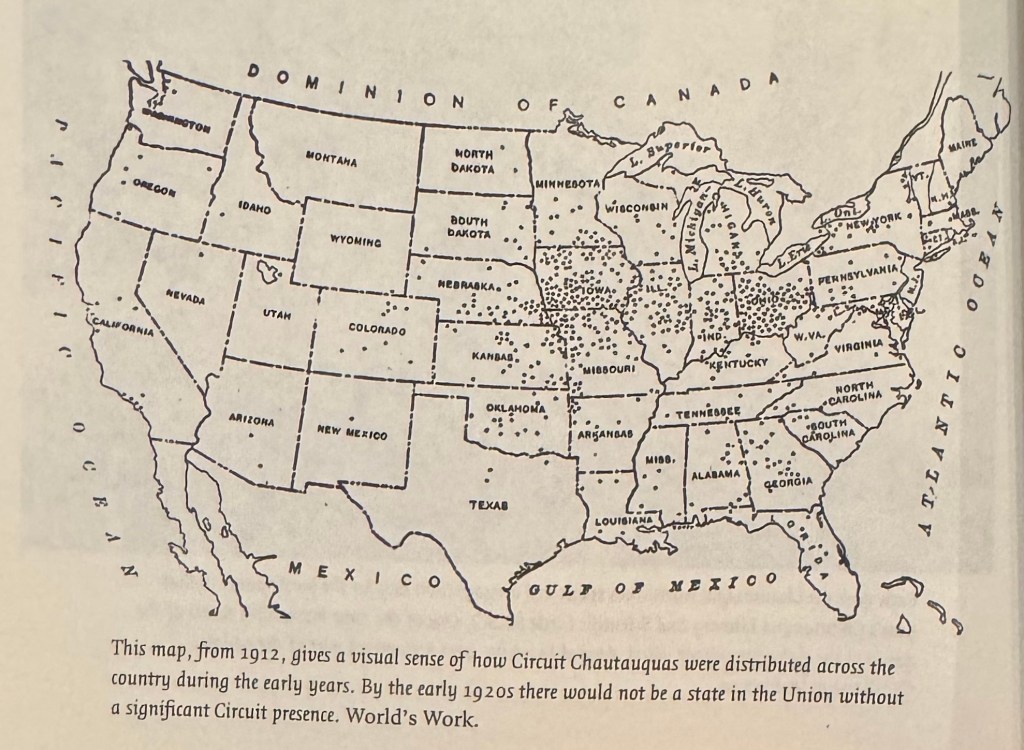
Canning, p. 26

But not just any Chautauqua. This was the circuit Chautauqua—a full-blown cultural caravan, rolling into communities like a blend of TED Talk, county fair, gospel revival, and Broadway road show. It was, as historian Charlotte Canning describes it, “the greatest aggregation of public performers the world has ever known.”

Forget the dusty image of civic lectures and sober-minded schoolteachers. Circuit Chautauquas were performance-driven experiences, intentionally designed to shape the American imagination. They were mobile festivals of ideas, music, drama, and moral vision—staged under a giant canvas tent, and scheduled with industrial precision across the country.

Canning helps us see these not merely as education-on-wheels, but as orchestrated acts of cultural storytelling. At their heart, circuit Chautauquas were about performing a kind of “Americanness”—a staged identity that included democracy, morality, individual responsibility, and civic pride. And these weren’t abstract ideas: they were embodied in actors, lecturers, and musicians who took the platform with everything from Shakespearean monologues to lectures on temperance and suffrage.

The Paradox? These events, often remembered as wholesome and nostalgic, were also deeply commercial. Promoters like Roy Ellison and Keith Vawter didn’t just want to elevate the public—they wanted to make a million. Yet that’s part of the genius: they succeeded in selling culture as spectacle, without cheapening either.

To Canning, the tent was a stage—not just for performers, but for the entire community to see itself. Who belonged? Who was excluded? What did it mean to be an American in 1910 or 1920? Every act—whether musical trio or biblical dramatist—answered those questions in subtle (and sometimes not-so-subtle) ways.
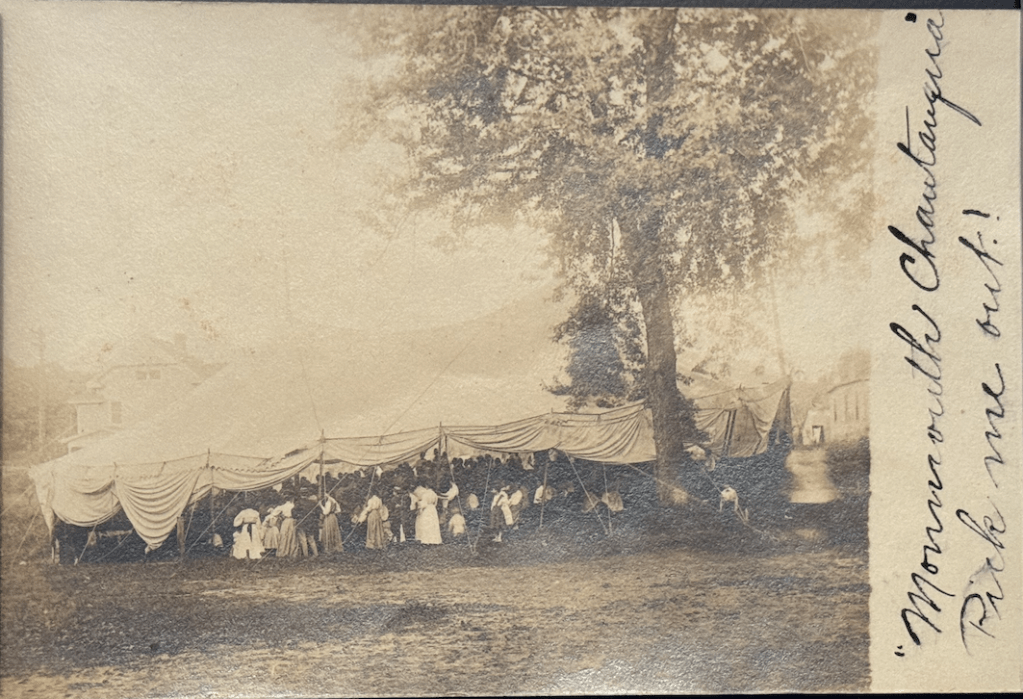
Monmouth, Illinois chautauqua, 1907 postcard. Author’s collection.
Billy spoke at Monmouth, August 17, 1906.

So the next time you think of rural America in the early 20th century, don’t just imagine plows and porches. Picture the circus-sized tent at the edge of town. The banners. The folding chairs. The packed crowd.

And inside that tent? America on stage.


Resource cited
Charlotte M. Canning. The Most American Thing in America: Circuit Chautauqua as Performance. 2005.
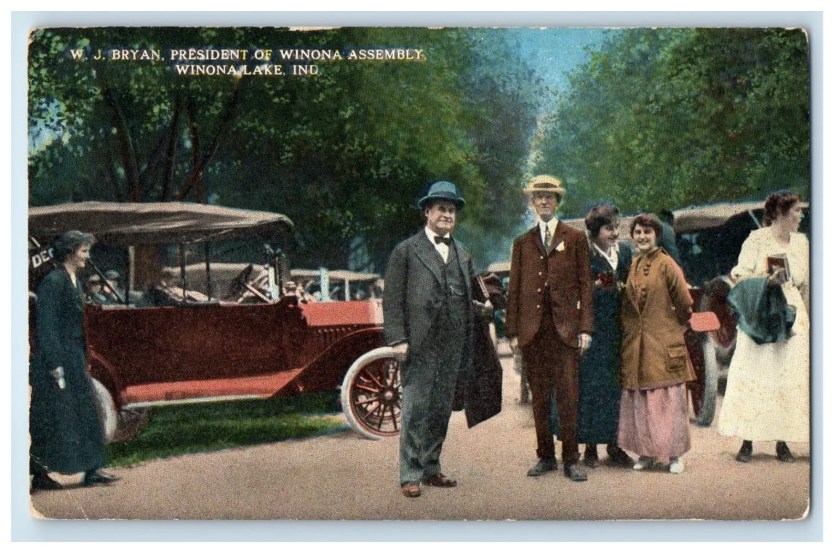
Winona Lake hosted a summer chatauqua assembly in the summer of 1913

Citation: The South Bend Tribune. Fri, May 16, 1913 ·Page 2

WINONA PLANS FOR GREATEST SUMMER

MANY CONVENTIONS ARRANGED FOR THE SEASON.

BIBLE SESSION FEATURE

William Jennings Bryan, David Lloyd George, Gipsy Smith, “Catch-My-Pal” Patterson and Others Will Speak at Gathering.

William Jennings Bryan. President of Winona Assembly. Winona Lake, Indiana.

The Tribune’s Special Service.

WARSAW, Ind., May 16.—Winona assembly, which will operate this season free from its load of debt, having arranged for the settlement of $300,000 claims by an agreement with the creditors, has prepared for a program of events that will establish a new record. One of the biggest events of the year will be the annual conference of the Church of the Brethren, which will start May 28 and continue until June 7. Between 40,000 to 75,000 churchmen are expected to attend.

The chautauqua program will start June 29 and will continue for 10 weeks. Among the spectacular offerings are the following: Ahasuerus, a sacred opera under the direction of William Dodd Cheney; “The Lost Princess,” under the direction of Mrs. Hortense R. Reynolds; Venetian night, and a great water carnival under the direction of Capt. J. R. Pine. Preparations for the latter event are already under way.

Will Hold Mission School.

Some very notable gatherings are booked to occur during the chautauqua season and at its close. Beginning June 19 and ending June 27, the summer school of missions will be in session. This will be held under the auspices of the interdenominational committee of the assembly. The summer conference of the Presbyterian young people will be held July 9 to 16. The annual meeting of the Ohio Farmers’ Insurance company will be held July 23 and 24. The Health and Happiness club with Mrs. Louise L. McIntyre and Miss Margaret Hall as directors, will be in session July 7 to 14.

The fourth annual conference of the Young Friends of America will be held during the assembly season. The fourth annual session of the international district training school for Sunday school workers will be held Aug. 11 to 21. The Kappa Sigma Pi, the new boys’ movement which was established in 1912 by Homer Rodeheaver, conductor of music for Rev. Billy Sunday, will be in session during July. W. M. Collisson will act as secretary and will be in charge.

Photographers Will Meet.

The 18th annual convention of the Indiana Association of Photographers will meet July 7 to 10. This will be held under the auspices of the National Reform Association. Among the speakers are Dr. James S. Martin, Dr. Lyman E. Davis, Dr. Grant W. Bower, Dr. James McGraw, Ng Poon Chew, of China, Dr. Merle de Aubing, of France, Dr. Armenag of Turkey, and Dr. R. J. Patterson, of Ireland.

One of the big events will be the annual Bible conference, which will be held Aug. 22 to 31. Dr. Sol C. Dickey will be director. He is already busy arranging for the meetings which will bring churchmen here from all parts of the world. Prof. E. O. Excell will have charge of the music and Rev. W. E. Biederwolf will be the assistant director. The opening address will be by Secretary of State William Jennings Bryan, who will also be president of the board of directors of Winona assembly to welcome the visitors. Among the other speakers already engaged are Rev. C. Campbell Morgan, of London; Rev. Gipsy Smith, of Connecticut; Rev. Robert (Catch-My-Pal) Patterson, of Belfast, Ireland, and Hon. David Lloyd-George, chancellor of the British parliament.

The South Bend Tribune. Fri, May 16, 1913 ·Page 2

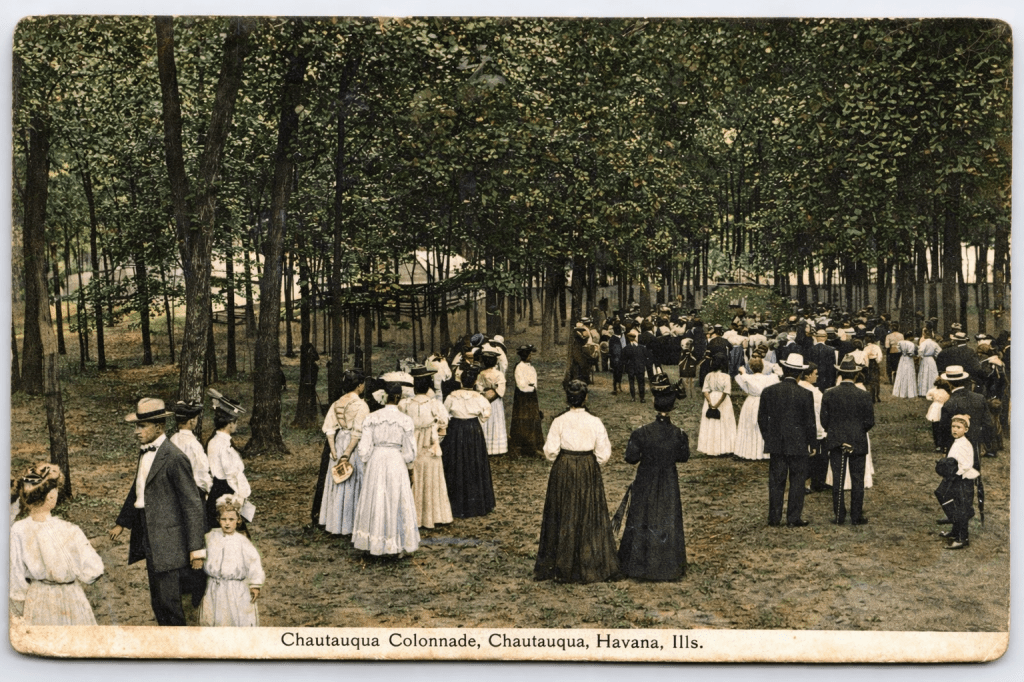
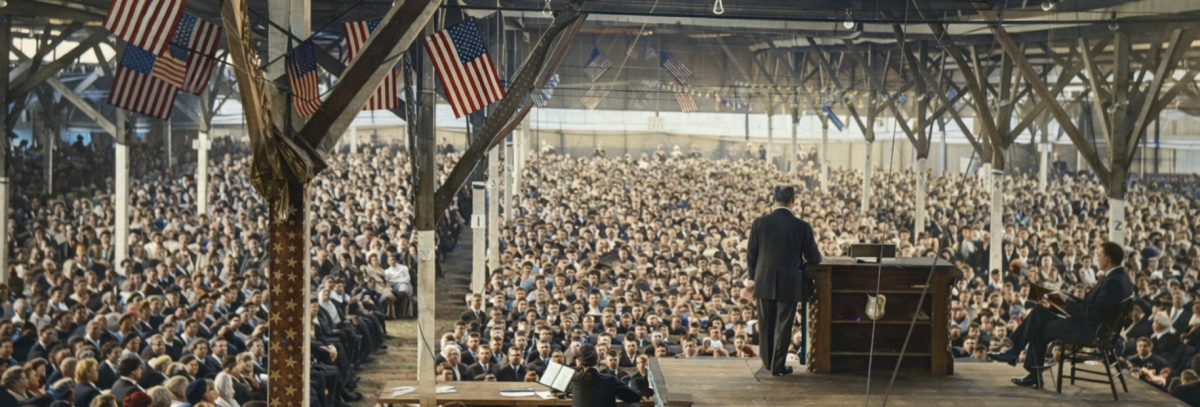
Billy Sunday postcard from Havana, Illinois chautauqua (c 1908)

There seems to be no record of Sunday hosting an evangelistic campaign at Havana, Illinois. This postcard is titled “Billy Sunday addressing 4,000 people at Chautauqua, Havana, Illinois.”

This appearance was part of the broader Chautauqua movement, which brought religious, educational, and cultural programming to communities across the United States.​

While Havana isn’t listed among the cities where Sunday held his major revival campaigns, his participation in the Chautauqua there reflects his widespread influence and the popularity of his preaching style. These events often featured prominent speakers and were significant cultural gatherings in early 20th-century America.

1908 Havana, Illinois Chautauqua