Stories of three other Evangelists: predecessors to Billy Sunday

The Ways and Works of Moody, Gypsy Smith and Chapman—Men Whose Methods Were as Different as Their Personalities.

By WILLIAM RADER

Cited in: The Philadelphia Evening Ledger. January 8, 1915:8.


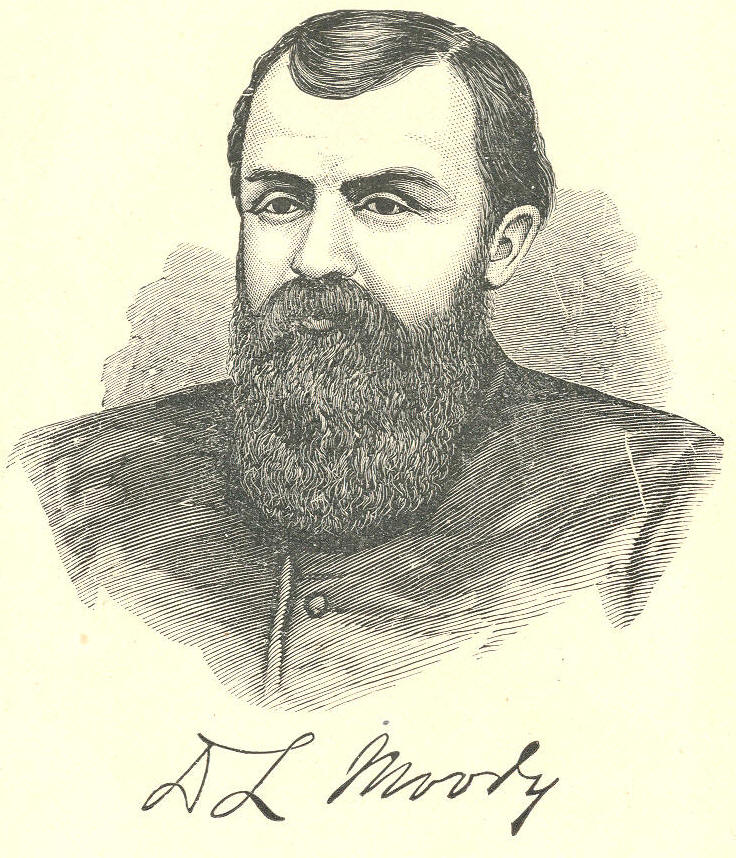
DWIGHT L. MOODY sleeps on Round Top, at Northfield, Mass. A few miles away, in Swanzey, N. H., is a simple shaft which marks the grave of Denman Thompson, of “The Old Homestead.” It is probable that the two men never met, but they were not unlike in appearance. Both were big, hearty Americans with good appetites, warm hearts and filled with loving kindness. The one spoke fiction on the stage as if it were truth; the other—to repeat a thought of Garrick—spoke truth on the pulpit as if it were fiction.

When Moody was a clerk in a Chicago shoe store, he became interested in religion through Dr. Edward N. Kirk and Edward Kimball. Without college or theological training, he began his great work and preached the gospel throughout the English-speaking world.


In the Old Pennsylvania R. R. Depot

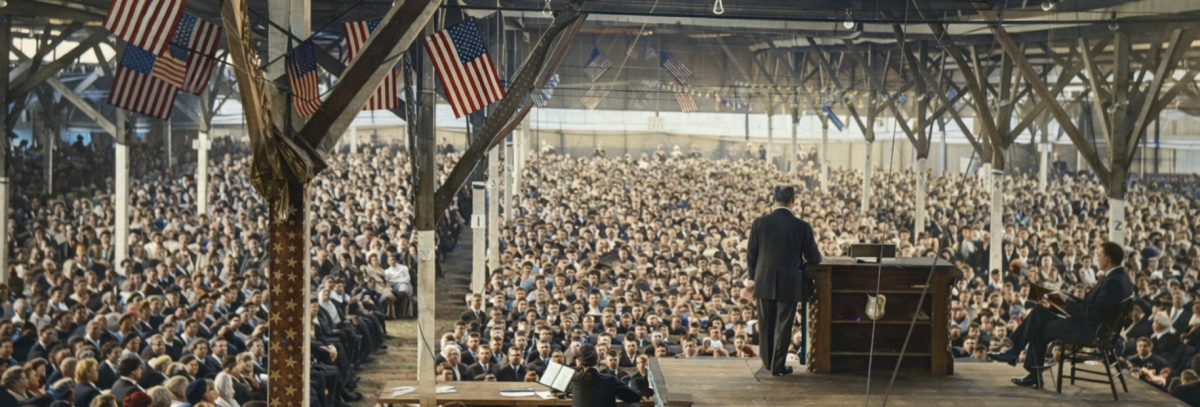
One of his notable campaigns was in Philadelphia. The meetings were held in the abandoned freight depot of the Pennsylvania Railroad, used afterward as the Wanamaker store. The building was provided with seats to accommodate 10,000.

A striking incident of Moody’s Philadelphia campaign was the meeting set apart especially for intemperate men and women. His tender appeal to that assemblage is still remembered by Philadelphians who heard him.

Singing helped the preaching of Moody. The songs of Sankey grew to be as famous as the sermons of Moody. A hymnal was published which caused Moody and Sankey much trouble, since it was reported that they received royalties from the sale. Certain watchdogs of the moneybag believe that the blackest sin on the calendar is for a preacher or evangelist to make money. Every evangelist must make it plain that he is not a grafter.

Mr. Moody was the greatest evangelist-preacher of his generation. He did not use the best grammar, but he had common sense. Who could forget his sermons on “Sowing and Reaping,” “The New Birth” and “Repentance”?


Everybody Sing!

There was no claptrap in the Moody method, no straining for effects, but conviction, point and directness, and irresistible persuasiveness. He did not shatter the icicle of sin with well-directed aim, but melted it with words hot with a passion for redemption.

The first time I heard Moody he did what I thought at the time a sensational act. It was in Tremont Temple, Boston. Anxious to see him, as a student at Andover, I went early and took a seat near the front. The big choir on the platform was being trained while the people gathered. An old gentleman sat on one side of me, a lady the other. Moody soon appeared. He was announced by a man reading a paper in the audience, and asked him to put it away and join in the singing. “Everybody sing!” he shouted. “Everybody get a book!” He announced a hymn, but the singing was very unsatisfactory, and he had the people sing it over several times. Seeing I had no book and showing annoyance, he took fair aim and threw a hymn book as straight as a bullet at me. It took me in the stomach, and I think it raised me about two feet from the pew, but my consternation was no whit greater than the surprise of those who sat with me. We were strangers, but we all sang out of the same book, and Moody from that moment was an acknowledged master.

He was a man-finder. He discovered Henry Drummond and introduced him to the American people. He found a great preacher in Campbell Morgan, of London, and made him at home in the American pulpit. He took keen interest in liberal and conservative.

The Northfield conferences, which continue to this day, furnished an opportunity for testing the mettle of promising men in England and this country. A number enjoy an international reputation who owe their start to the insight of Mr. Moody.

He was a builder of institutions. The Y. M. C. A. work throughout the country was assisted by him. He raised great sums of money for the work. The Mount Hermon schools for young men and women are one of his memorials. His evangelistic work reached its zenith in his British campaign and at the World’s Fair in Chicago.


The Stolen Overcoat

The last time I heard Moody he made an impassioned plea in behalf of criminals and prisoners, and while he was making it an ex-convict stole his valuable new overcoat. It was a study in practical theology to observe the effect of this disappointment upon the great preacher, who, while furious at first, finally submitted to the inevitable with grace that an evangelist is supposed to possess.


Gypsy Smith is one of my favorite evangelists. He is a full-blooded gypsy, swarthy skin and beautiful brown eyes. Socially he is “a hail fellow well met,” one of the ripe fruits of the Moody-Sankey British campaign. He has a sense of humor and a wit that is irresistible. His voice is musical, and it is a treat to hear him sing.

Gypsy Smith uses faultless English. I asked him how he acquired this gift of English diction, and he said that after leaving the gypsy camp he was placed in a refined English home, where he heard the best grammar. If you have ever heard Gypsy Smith’s great sermon on “With the Stripes” you have listened to a discourse that has all the qualities of great preaching.


A Cultivated Gypsy

He is the perfect gentleman on the platform, winsome, attractive, eloquent, cultured and sympathetic. As a maker of sermons he has no equal. His breadth of scholarship, depth of feeling and height of intellectual reach make him a superior man in the field of higher evangelism.

Rodney is his real name. He is of the Tachine Roman gypsy tribe, and his mother was a fortune-teller. The life in the tent has enriched his imagination, given him a strong body and aided him in living a clean, pure life, and not since the day John Bright has any man appeared in England who has more perfectly revealed the possibilities of Anglo-Saxon speech.


J. Wilbur Chapman was a Philadelphia pastor. For some years he was the pastor of Bethany Presbyterian Church; then he became a world evangelist.

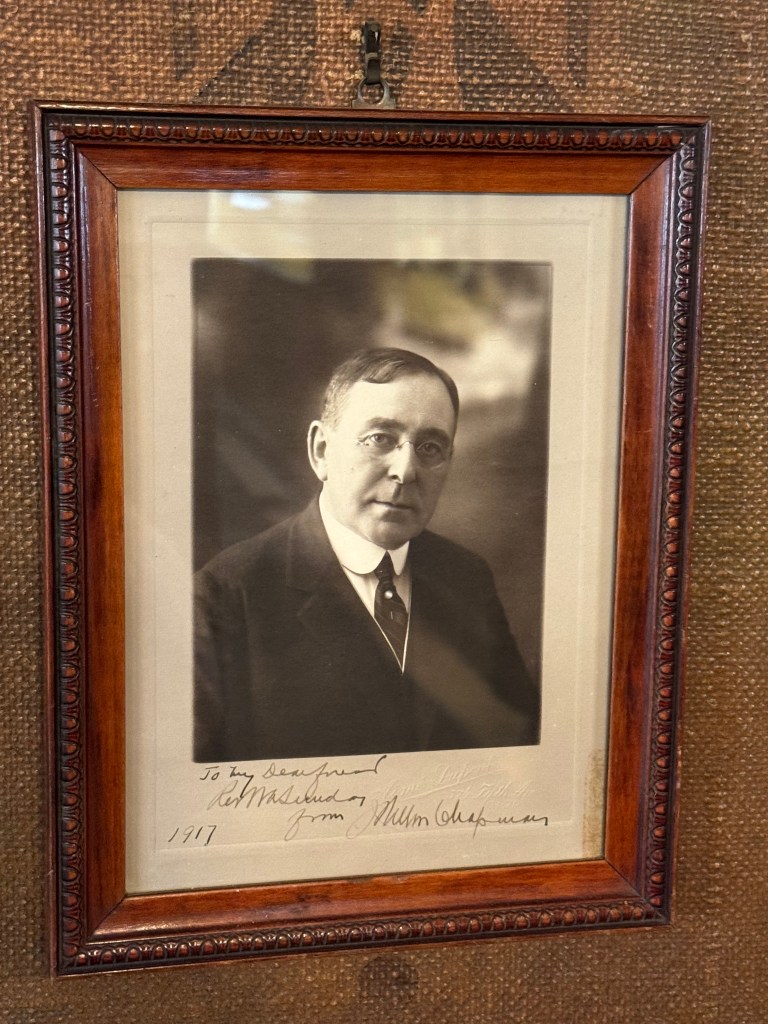
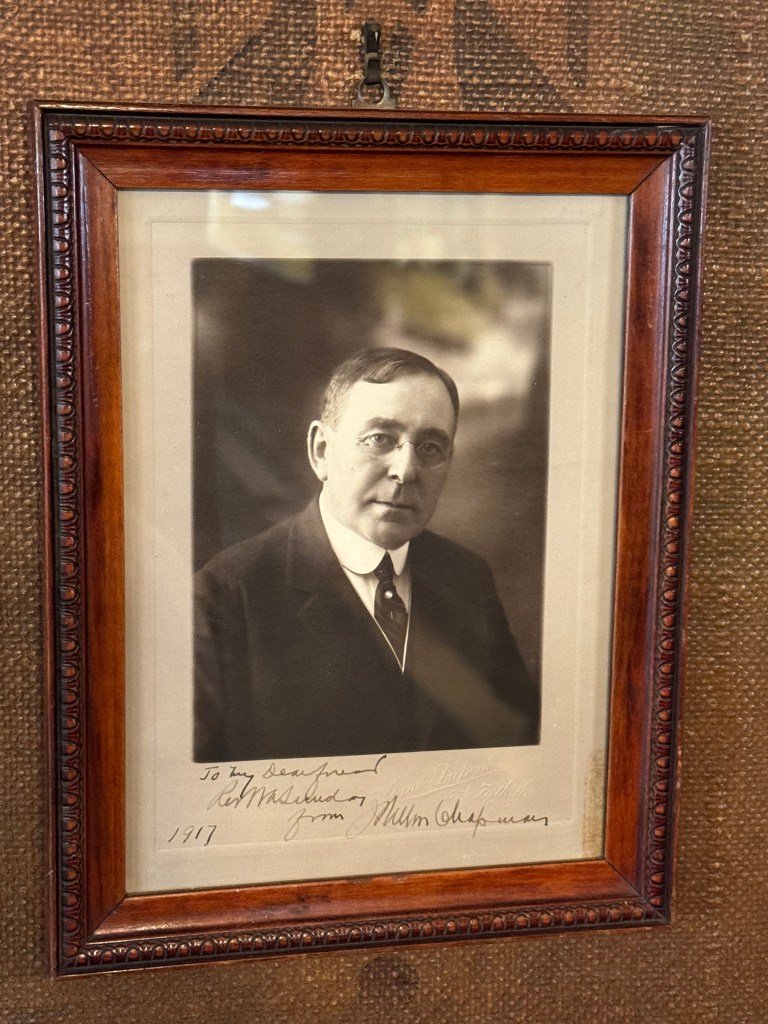
Picture of Chapman inscribed to Billy, hanging in his Winona Lake home.

Doctor Chapman’s approach to the masses may be likened to the sun eating its way through a snowdrift. Here is a quiet, modest, devout man who takes a passage of scripture and illuminates it with his interpretations. His sermons search and reach as the leaven works its way through a meal. Doctor Chapman is not the sort of man who creates a big furore, though his campaign in Australia and Great Britain made a profound impression. He is unostentatious, with a charming modesty, intense in his mission, with deep convictions, while a man of sweetness and light, is on occasion a real son of thunder.

The popular response to evangelists is a matter which compels a study of the human mind and of the organized preparation of every great evangelistic effort. The multitudes do not fill large tabernacles to hear a man talk, but to hear him talk about religion. The sea of public feeling is tossed while wave crests and eddies by emotional religion. It is a question whether these men could gather such crowds to listen to a lecture on Browning or Shakespeare. I believe that if the press and literary men should back the movement Rudyard Kipling or Bernard Shaw or Theodore Roosevelt might fill for a period of time a vast audience discussing a literary or secular subject.


Doctor Wanted

It must be conceded, however, that men are interested in matters which concern their destiny. Wicked men have a strange desire to hear a good man denounce them; people—most of them—like to see the dog.

All men have spasms of goodness; aspiration loves company. A man with a rope on a stormy sea will have no trouble attracting attention. Perhaps the attitude of the public toward the evangelist is best illustrated by the scene on the Atlantic when it was sinking. Jews, Catholics, Protestants and skeptics gathered in the cabin. Moody, with one arm clasping the pillar, read the 91st Psalm. Then he went to his berth and fell asleep. Men who give help and comfort will have the multitude, for people are sheep—they follow a shepherd.


DEFIANCE

Let life its legioned army throw
Against my pennoned castle walls,
With curse and jibe and bitter groan
Its band of lowly seneschals;

But when the dust of conflict blows
And sounds the bugle o’er the lea,
They shall not find me fallen, dead;
They shall not kill the love in me!

Tho stained with blood of bleeding heart
Up in the ramparts’ evening breeze,
My banner floats the same as yore
Above the brooding cypress trees.

The sun has set; the shadows fade;
The night comes silent from the sea;
They shall not find me fallen, dead;
They shall not kill the love in me!

—Alonzo Harbaugh, in New York World

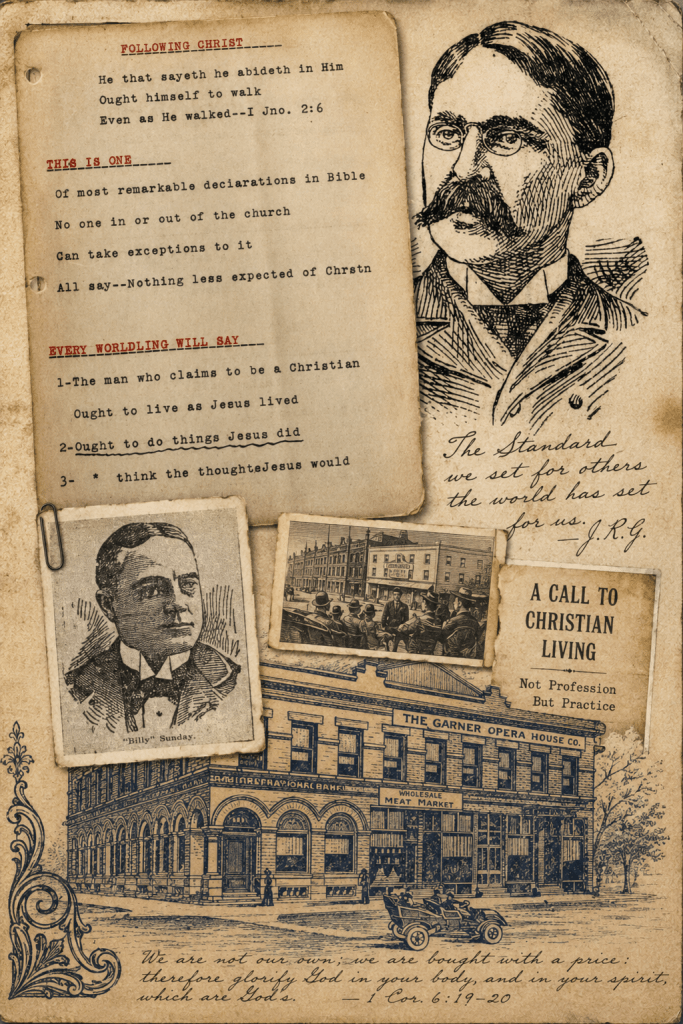
Billy Sunday was mentored by J. Wilbur Chapman

The following (1917) signed picture of J. Wilbur Chapman, in the Billy Sunday home in Winona Lake, attests to the massive influence Chapman had on Sunday.


When the Apprentice Met the Evangelist: How J. Wilbur Chapman Shaped Billy Sunday’s Early Ministry

Before the tabernacles were packed, before the crowds surged forward by the thousands, before the name “Billy Sunday” echoed across the country like a revivalist’s thunderclap—he was simply a former ballplayer, freshly converted, and hungry to make his life count for Christ.

That’s when J. Wilbur Chapman stepped into the picture.

It was 1893. Chapman, already an established evangelist with a Presbyterian pedigree and a knack for drawing the spiritually curious, needed an assistant—someone to handle logistics, rally local churches, and stir up enthusiasm before his campaigns. Billy Sunday had the energy and the zeal. Chapman had the method and the message.

For two critical years—1893 to 1895—Sunday shadowed Chapman like a student to his rabbi. He wasn’t yet preaching, but he was watching. Learning. Absorbing. Chapman’s campaigns weren’t just events—they were carefully orchestrated spiritual operations. Inquiry rooms. Personal follow-ups. Gospel invitations that were both clear and convicting. Sunday took it all in.

But it wasn’t just technique that Chapman passed on—it was a vision. A way of doing evangelism that held fast to the truth of Scripture while reaching real people in real places. Sunday saw in Chapman a man who carried both conviction and compassion. And though their styles couldn’t have been more different—Chapman, the dignified clergyman; Sunday, the kinetic whirlwind—it worked. Like iron sharpening iron.

In 1895, Chapman surprised many by stepping back from itinerant preaching to take a pastorate in New York. The pulpit reclaimed him. But for Billy Sunday, it was a release—a gentle push from the nest. With his mentor’s example still fresh, Sunday stepped onto his own stage. He started small—tiny Iowa towns, rough-hewn tabernacles, handfuls of seekers. But something was forming. Something bold.

It’s hard to overstate what those two years meant. Without Chapman, Sunday might’ve remained a sideshow curiosity—a saved athlete giving testimonies. But with Chapman’s imprint, he became an evangelist. A revivalist. A force.

And though their paths diverged, Sunday never forgot the man who shaped his earliest steps. He took Chapman’s gospel framework, set it ablaze with his own personality, and carried it farther than either man probably imagined.

Chapman taught him how to build the fire. Sunday learned how to preach like it mattered.

Rev. J. Wilbur Chapmain weighs in on Billy Sunday ministry while Sunday was serving in South Bend

DR. J. W. CHAPMAN IS VISITOR AT SERVICE

HE CALLS SUNDAY’S MINISTRY MARVELOUS ONE.

Citation: The South Bend Tribune. Wed, Jun 04, 1913 ·Page 11

Drives 100 Miles in Automobile to Hear Baseball Evangelist Preach—Gives Short Talk.

Dr. J. Wilbur Chapman, one of the most prominent evangelists in the country, who visited the Billy Sunday tabernacle last night, called Billy Sunday’s ministry one of the most notable of modern times. He said the baseball evangelist is doing a wonderful work, which is being felt throughout the country.

Dr. Chapman was accompanied by Mrs. Chapman and their daughter, Mrs. Bertha Goodwin. He had only just returned from Australia on his world tour in evangelistic work, and drove 100 miles in an automobile so that he could hear Sunday preach last night. Billy Sunday learned his trade, so he expressed it, under the other evangelist, and there was a warm greeting between the two when they met on the platform.

It was however, no less warm than that which was accorded Dr. Chapman when he became generally recognized by the crowd at the meeting. Those in the preachers’ section were the first to recognize hi mand they began the applause. Thousands in the throng joined in the ovation. The tabernacle became a great sea of waving handkerchiefs and the applause was deafening.

Dr. Chapman praised Sunday highly to the audience, then declared:

“Billy used to tell the people when he introduced me, that when he started out as an evangelist he used to use the outlines of some of my sermons. Let me tell you the sermons he is delivering now, are not my own. I have wished often I could claim some of them, however. They would be worth claiming.”

The South Bend Tribune. Wed, Jun 04, 1913 ·Page 11

Billy Sunday vs. His Contemporaries: What Set Him Apart?

by Kraig McNutt

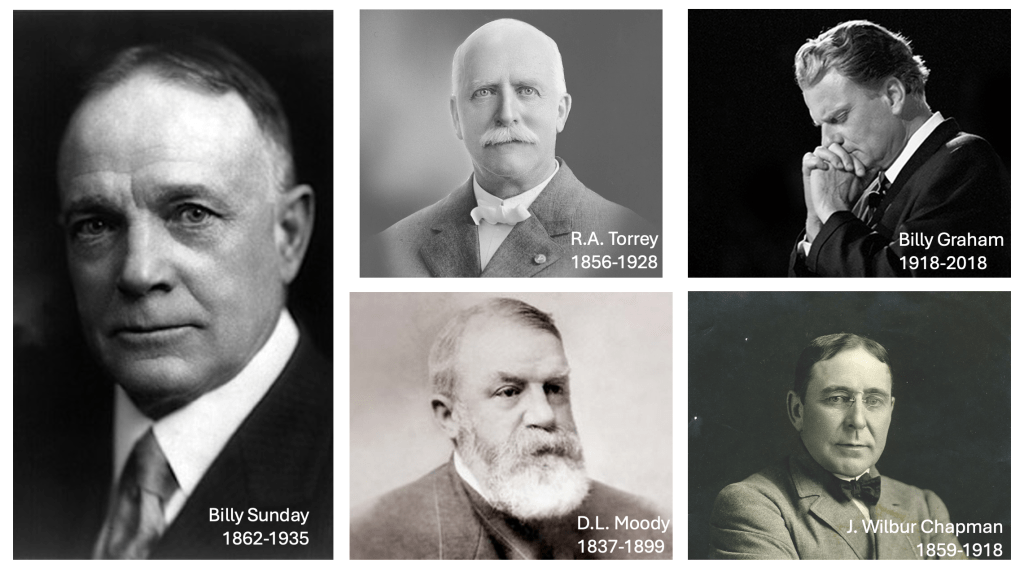
When most people think of revival preachers in American history, names like D.L. Moody, R.A. Torrey, or J. Wilbur Chapman often come to mind. But Billy Sunday was cut from a different cloth. He wasn’t just a preacher—he was a one-man spiritual cyclone, mixing athleticism, theatricality, and gospel fire in a way no one had ever seen before.

So what exactly set Billy Sunday apart from the rest? How did his preaching and ministry differ from his contemporaries? Here’s a snapshot comparison to help you see why Sunday’s voice roared across the American landscape like a thunderclap—and why his influence still echoes today.


A Quick Comparison: Billy Sunday vs. His Contemporaries

TopicBilly SundayContemporary Evangelists
Preaching StyleFiery, physical, theatrical; used slang and sports metaphorsMoody: Calm and fatherly; Torrey: Intellectual; Chapman: Pastoral
Theological EmphasisStrong focus on personal salvation, substitutionary atonement, and sinSimilar focus, though often with more doctrinal exposition or gentler tone
View of ModernismVehemently opposed; saw it as a threat to true ChristianityMost were critical, but some (like Fosdick) were sympathetic to modernist ideas
Social IssuesFiercely anti-liquor (Prohibition), anti-gambling, anti-dancing; championed “old-time religion”Moody: Emphasized charity and urban outreach; others less publicly political
Engagement with PoliticsHighly political; openly supported Prohibition, patriotic causes, and civic reformMoody and others were less politically vocal, though supportive of moral reform
Use of Media/PublicityMaster of mass media: posters, press coverage, advance men, tabernaclesChapman and Torrey used some publicity, but far less theatrically or broadly
Attitude toward Higher CriticismCondemned it outright as destructive to faithMost conservative contemporaries agreed, though some engaged it more thoughtfully
View on Women’s RolePraised godly mothers; Helen Sunday was integral to the ministry, though Billy upheld traditional rolesMore varied: some supported women in ministry (e.g., Aimee Semple McPherson)
Revival StructureMass meetings, community-wide, tabernacles, extended multi-week eventsSimilar formats, but Sunday’s scale and advance team coordination stood out
Legacy ImpactSet the stage for 20th-century mass evangelism (influence on Graham, etc.)Others laid groundwork (Moody), but Sunday modernized the revival model

Why It Mattered Then—and Now

Billy Sunday didn’t fit into a neat category. He was part preacher, part performer, part prophet—and all in for Christ. While others wrote theological treatises or built Bible schools, Sunday pounded his fists on pulpits and dove across stages to bring people to the cross.

His fierce denunciation of sin, especially the sins tearing apart American families—booze, gambling, corruption, moral apathy—connected with the common man. He used theatrical movement, slang, and sports metaphors to reach crowds who might never set foot in a traditional church.

But his legacy wasn’t just showmanship. Billy Sunday built the prototype for what would later become 20th-century crusade evangelism, paving the way for figures like Billy Graham. He made evangelism a national event, not just a church function.


Final Thought

In a world drifting further from spiritual conviction, it’s worth remembering men like Billy Sunday—men who refused to compromise truth, who called a nation to repentance, and who showed that the gospel is worth getting loud about.

Whether you’re a pastor, a historian, or just someone trying to figure out what revival looks like in your day, take a page from Sunday’s playbook: preach it hot, live it loud, and never apologize for loving Jesus.


The Preacher Paradigm: Promotional Biographies and the Modern-Made Evangelist

Between 1886 and 1931, Christian publishing houses in the United States offered an unprecedented biographical profile of the contemporary American evangelist as an unambiguously modern figure. Sold at tabernacle tents, Christian bookshops, and church fund-raisers, these texts simultaneously document concerns with the modern landscape as they regale readers with the styles and stories of headlining American Protestants, including Dwight Moody (1837-1899), Sam Jones (1847-1906), Reuben Archer Torrey (1856-1928), J.

Wilbur Chapman (1859-1918), Rodney “Gipsy” Smith (1860-1947), Billy Sunday (1862-1935), and Baxter “Cyclone Mac” McClendon (1879-1935). Although it is not difficult to discern distinguishing marks and regional inflections within the anecdotal particularities of these men, the overarching structure and themes of their chronologies is consistent. The purpose of this essay is to produce the beginning of a collective biography of the turn-of-the-century preacher, highlighting the persistent paradigm represented in the promotional products of these preachers. Whereas previous historians have described these men as antiquated proponents of an “old time” religion, this article argues that their narratives reveal a strikingly modern man, poised in an engaged and contradictory conflict with his contemporary moment.

Published online by Cambridge University Press: 18 June 2018
Religion and American Culture