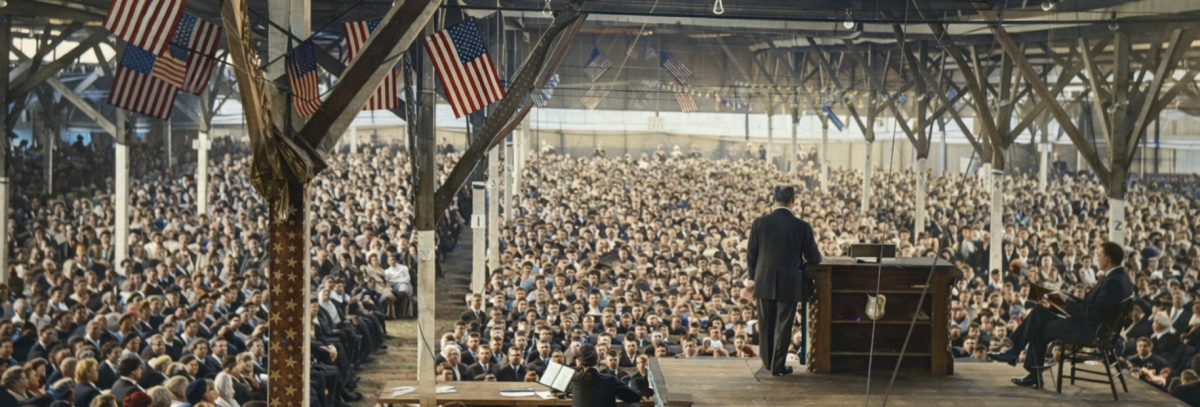
Third in a series drawn from Lindsay Denison’s profile of Billy Sunday in The American Magazine, September 1907.
A new convert’s faith is rarely tested by something so simple as a temptation to sin. More often it is tested by an obligation he took on before he believed — a promise made by the old self that the new self has to honor or break. For Billy Sunday, that test came in the form of a footrace, a pile of other men’s money, and Cap Anson refusing to take no for an answer.
It is one of the best stories in Lindsay Denison’s 1907 profile, and Sunday told it on himself.
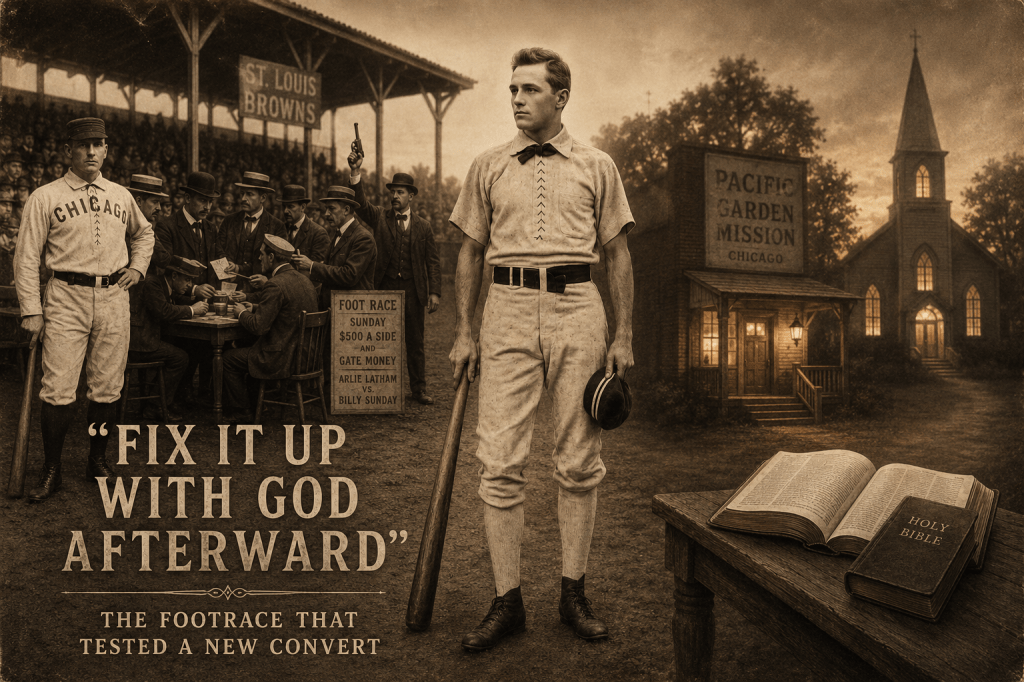
The bet
Before his conversion, Sunday had been matched in a hundred-yard race against Arlie Latham of the St. Louis Browns. The stakes were serious: $500 a side plus the gate money, with the race to be run in St. Louis on a Sunday at the close of the season. His captain, Cap Anson, had backed him heavily — and so had a great many of Anson’s friends. By Sunday’s own recollection, something like $75,000 was riding on the outcome.
Then Sunday walked into the Pacific Garden Mission and everything changed. Suddenly a man who had just resolved to live as Christ would have him live found himself committed to running a high-stakes gambling spectacle — on a Sunday, no less.
The prayer that wouldn’t resolve
This is the detail that makes the episode ring true. Sunday did not simply decide. He agonized.
He prayed over the race night after night, he told Denison, and still could not see his way clear. There was no clean answer. Backing out would betray Anson and the friends who had staked their money on him in good faith, long before his conversion. Going through with it meant a new Christian publicly running a Sunday gambling match. Either road ran against something he valued.
Unable to resolve it in prayer, he finally went to Anson and told him flatly that the captain would have to let him out of the race.
Anson’s answer
Anson would not hear of it. His first move was to needle Sunday’s pride — he wasn’t going to turn yellow and quit, was he? Sunday tried to explain himself. Anson wouldn’t listen.
What Anson said next is, in its rough way, one of the most quietly fascinating lines in the whole article — a piece of folk theology from a man who admitted he wasn’t much for religion. He told Sunday he’d backed him for thousands, and so had his friends, and then he reasoned it out: he didn’t believe God would want Sunday to begin his new life by throwing down his friends over a contract he’d signed before he ever went with God. So here was the plan. Sunday should go down to St. Louis, run the race — and then fix it up with God afterward.
It is the line that gives this post its title, and it deserves a moment’s attention. Anson, the irreligious ballplayer, was making a genuine moral argument: that a debt of honor incurred by the old self still binds the new one, and that a faith worth having shouldn’t begin with a betrayal. Whether or not the theology holds, the loyalty behind it is unmistakable.
“And, well, friends — I did”
So Sunday did exactly that. He went to St. Louis. He ran the race. He won it.
And then he came straight back to Chicago, went before the session of his church, and owned up to the whole thing. When the elders heard the full story, they let him off. He went on to serve as an elder of that same church for a good many years afterward.
What makes the story land is the order of operations. Sunday did not arrive at a tidy principle and then act on it. He wrestled, failed to find an answer, deferred to a friend’s blunt counsel, did the deed, and then submitted himself to his church’s judgment after the fact. It is conversion as a real human process — messy, compromised, and honest about the compromise — rather than a clean before-and-after.
Why he told it
It is worth asking why Sunday repeated a story that, on its face, shows him running a Sunday gambling race as a brand-new Christian. The answer is probably the same reason it works on us a century later: it made him believable.
A preacher who claimed to have gone instantly spotless from the moment he rose off that curb would have been easy to disbelieve and easy to resent. A preacher who admitted he prayed over a problem for nights, couldn’t crack it, ran the race anyway, and then went and confessed it — that man was telling the truth about how hard the early going had been. The audiences who heard him preach trusted him in part because he handed them stories like this one.
The footrace, in other words, was not a blemish Sunday hid. It was evidence he offered.
Next in the series: Preaching the Devil in Plain English — inside Billy Sunday’s pulpit style.

 Evangelist Billy Sunday (1862-1935)