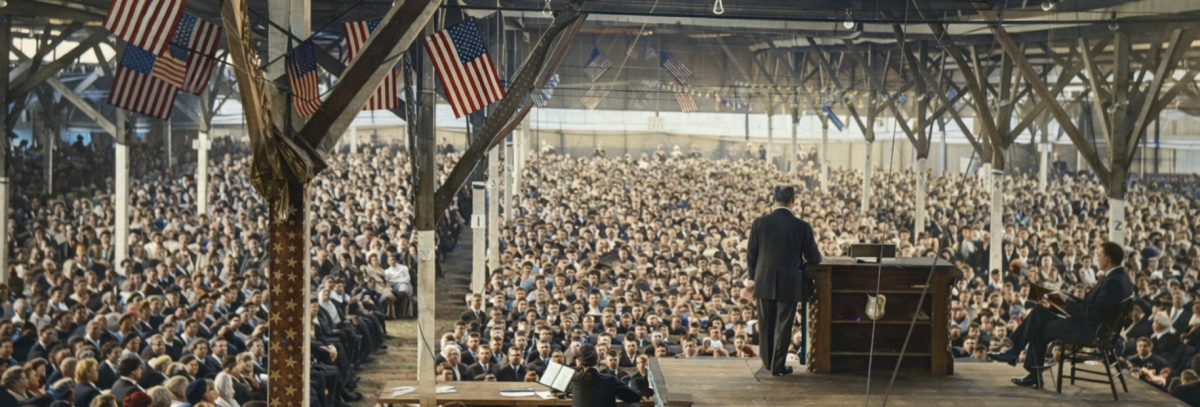
Last in a series drawn from Lindsay Denison’s profile of Billy Sunday in The American Magazine, September 1907.
Over the past seven posts, we’ve followed Lindsay Denison’s 1907 profile through a single revival in a single Iowa town — the conversion on a Chicago curb, the footrace that tested it, the plain-English preaching, the carnival-bright music, the money and the “grafter” charge, and the overwhelming final day in Fairfield. It remains to ask what the whole thing meant, and where it sat in the larger story of the man.
Denison asked the same question, and his answer is the most quietly important passage in the article.
“Merely a repetition”
The Fairfield revival, for all its drama, was not unique. It was, Denison wrote, merely a repetition of scenes that had already played out in a score of towns across Iowa, Illinois, Wisconsin, Minnesota, and Colorado — and that scores more towns in those states would yet know. Sunday’s calendar was booked solid three years ahead, and organizations both religious and secular kept coming to beg a place on his “future list.”
In other words, what a New York reporter had traveled west to witness as a marvel was, by 1907, already Billy Sunday’s settled routine. He had a circuit, a method, a company, a system — and a waiting list.
A small part of something larger
Then Denison widened the lens in a way that reframes everything. Sunday, he insisted, was really only a small part of a much broader spiritual ferment moving through the middle of the country. From Pittsburgh to Denver, from Duluth to New Orleans, the impulse to read the Bible, to pray, and to enlist one’s neighbors in the Christian army was spreading and growing more intense.
Sunday was not the whole movement. He was its most spectacular general. And what the movement would ultimately come to, Denison declined to predict — it was, he said, no part of his business to guess.
But, he added, it was worth watching.
Caught at the threshold
That line is the reason this 1907 article rewards a closer look. Read it carefully and you realize Denison was describing a man on the cusp.
Consider the geography of the situation. Sunday’s actual labors were confined to small towns in the rural Midwest — Fairfield had about five thousand people; he moved on from it to Knoxville, another small Iowa town, after only four days’ rest. Yet here was a national magazine, based a thousand miles east, sending a reporter “all the way from New York,” as Sunday noted in his own closing prayer, to explain this Midwestern phenomenon to readers who had likely never heard of him.
That gap — between where Sunday worked and who had now come to write about him — is the signature of a regional figure crossing into national awareness. The article is not documentation of a man already at the summit. It is an early national notice of a man about to climb one, arriving just before the ascent steepened. The largest and most famous campaigns of his career, the ones in major cities that would make him a household name, still lay ahead. In 1907 he was an extraordinarily successful small-town evangelist whom the wider country was just beginning to discover.
In that sense, Denison’s “worth watching” was better advice than perhaps even he knew.
The defense of plain language
Denison closed his profile not with a prediction but with a defense — and it is a fitting note to end this series on, too.
To most readers, he acknowledged, the methods seemed impossible to take seriously as religion: the circus-freak ushers and concert-hall tunes, the shirt-sleeve oratory and melodramatic impersonation, the Scripture rendered into a traveling salesman’s slang. These were not the means by which most people imagined the souls of the world would be won.
And yet, Denison reminded his readers, there had once been those who looked down on the plain speech of the Apostle Paul. The Saviour himself had rebuked the people who clung to their own traditions while rejecting the commandment of God. Denison let the apostle have nearly the last word, citing Paul’s declaration that God had chosen the foolish and the weak and the despised things of the world to confound the wise and the mighty.
It is the deepest defense of Billy Sunday in the whole article, and it goes well beyond results. The argument is not merely that the crude methods worked. It is that crudeness, plainness, even foolishness in the eyes of the refined had always been one of the ways the gospel reached people — and that the genteel critics wincing in the front rows of the tabernacle were standing, whether they knew it or not, in a very old tradition of standing in the way.
A snapshot worth keeping
That is what makes this 1907 article such a valuable document. It catches Billy Sunday whole, at a hinge moment — the ballplayer fully transformed into the preacher, the method fully formed, the national spotlight just beginning to swing his way.
A century and more later, we know what Denison could only sense: that the man on that platform in Fairfield was at the beginning of one of the most remarkable rises in American religious history. He told us it was worth watching.
He was right.
This concludes the series on Lindsay Denison’s 1907 American Magazine profile of Billy Sunday. Thank you for following along.

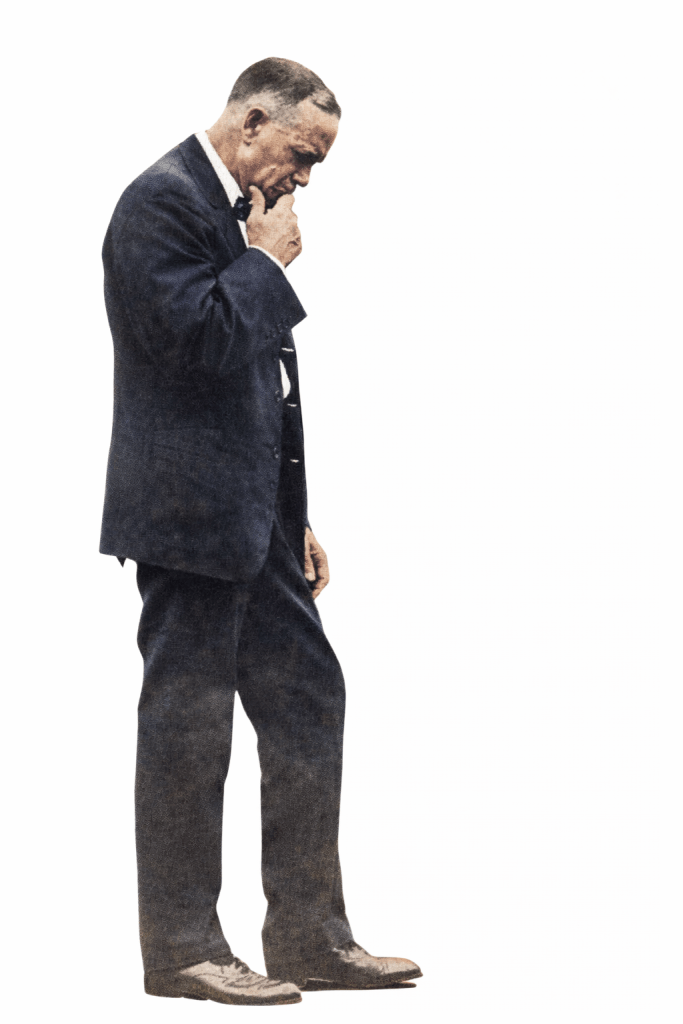
 Evangelist Billy Sunday (1862-1935)