A horsewhipping at the pulpit, a governor’s conversion, a record offering at Patterson Springs, and a chance meeting on a Kansas Chautauqua platform that would change the rest of his life.
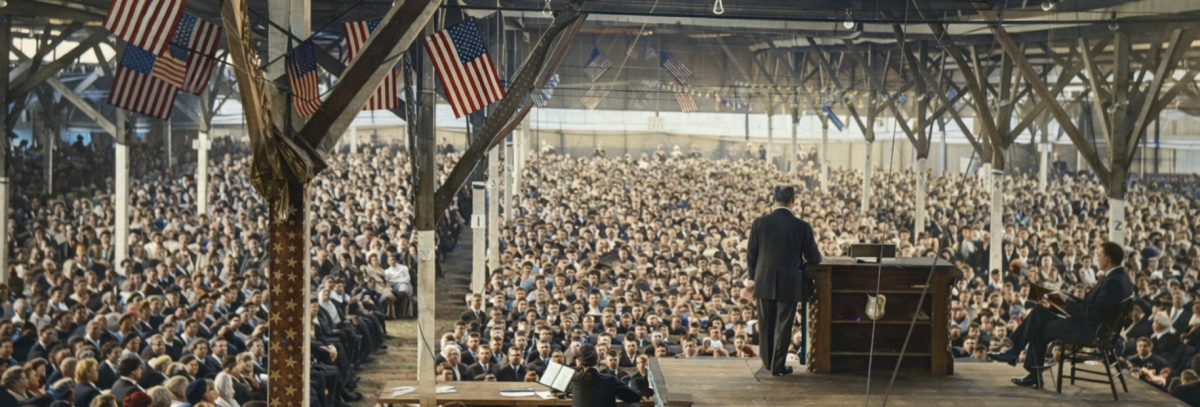
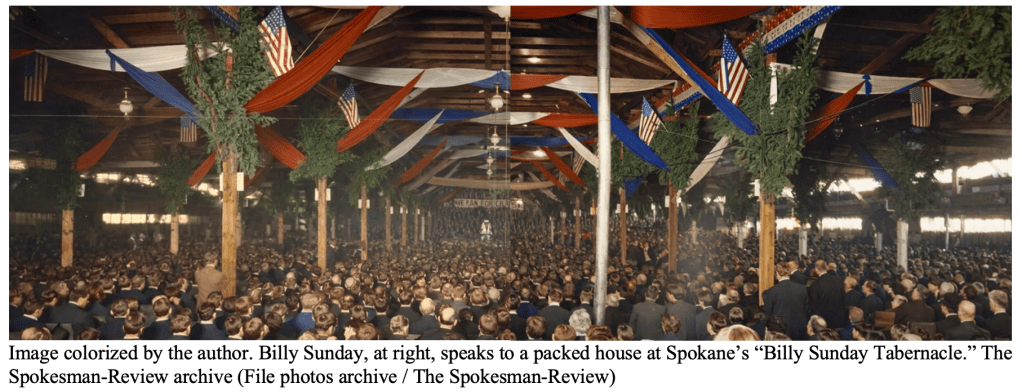
On Christmas Day of 1908, Billy Sunday and his family stepped off a train at Spokane, Washington. They had been expected five days earlier. The Spokane campaign committee had built an eight-thousand-seat wooden tabernacle for the occasion at a cost of more than four thousand dollars, and the city had been waiting since December 20.
Sunday was about to preach the first revival of his career in an American city of more than one hundred thousand people. Up to that point, every revival he had ever conducted had been in a town of under fifty thousand — usually under twenty thousand, and often under five thousand. Spokane was a real city: railroad terminus, regional commercial center, a population of well over a hundred thousand spread across several rapidly growing residential districts. The question that the Spokane campaign was going to answer was whether the revival method Sunday had built in Iowa river towns and Illinois county seats would actually scale.
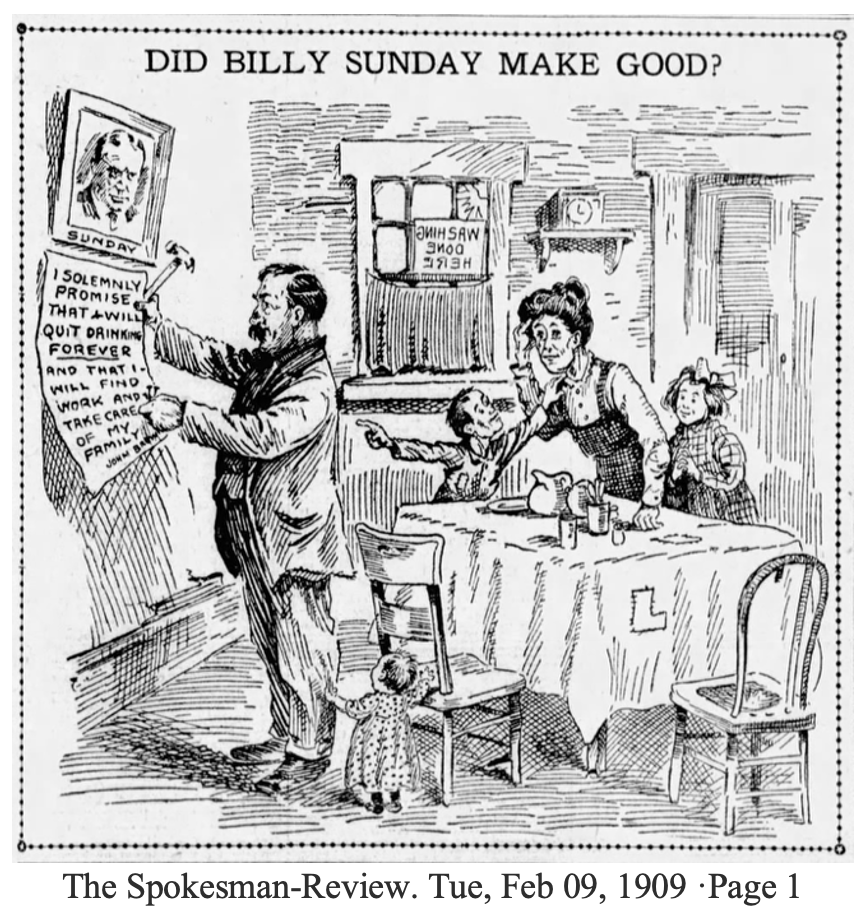
By the time he left Spokane in mid-February of 1909, he had his answer. Over five thousand six hundred people had come forward as converts. His purse came in at ten thousand dollars. The local saloons were reporting almost no business. Newspapers across the country were running headlines like “Beer Sales Fall. Bibles in Demand.” Roger Bruns, who would later write the standard scholarly biography of Sunday, summarized the moment this way: Spokane was where “the focus was now on where Billy could reach the masses.”
The Sunday method scaled. The big city wanted what the small town had been getting. 1909 became, almost overnight, the year that turned a Midwestern revivalist into an American institution.
A first city, a first “Tomorrow”
The Spokane campaign produced a number of firsts. The first big-city tabernacle. The first major lobbying operation built around a Sunday revival — one hundred and ten “representative men” sent on a special train to Olympia to lobby the Washington state legislature for a county-unit option bill while Sunday gave his “Booze” sermon back home, twice. The first organized homeless-relief effort attached to a Sunday campaign, during a cold wave that hit Spokane mid-campaign. Sunday personally helped feed and shelter hundreds of homeless men through the local churches.
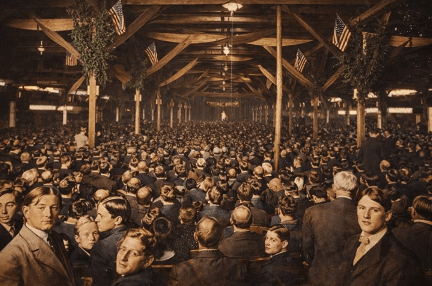
And, on the final day of the campaign, the first use of “Tomorrow” as a closing sermon. The sermon that would, more than any other Sunday delivered in his entire career, become his signature emotional closing. The text was simple: do not put off until tomorrow what you must decide today. The delivery, by every contemporary description, was relentless. The Spokane Spokesman-Review of February 11 carried the headline that captured what had just happened in their city: “Beer Sales Fall. Bibles in Demand.”
The detailed church-by-church convert tally from Spokane is the kind of thing that makes the modern researcher pause. Emmanuel Baptist took in 45 new members. First Methodist Episcopal, 360. First Methodist, 270. Westminster Congregational, 30. Central Christian, about 60. First Baptist, over 80. Plymouth Congregational, about 50. All Saints Episcopal, 12. Holy Trinity Episcopal and Our Lady of Lourdes, none. The Sunday method had divided Spokane’s churches into those that could metabolize the revival’s converts and those that could not.
Springfield: a governor and an assault
The Spokane campaign closed February 10. Sunday opened his next revival in Springfield, Illinois on February 26 — sixteen days later. The Springfield campaign would run six weeks, draw over six hundred thousand cumulative attendees, and produce forty-seven hundred conversions, including a remarkable seven hundred and seventy-four conversions on the final day. Sunday’s purse came in at ten thousand seven hundred and thirty-four dollars. The total offering for the campaign reached over twenty thousand.
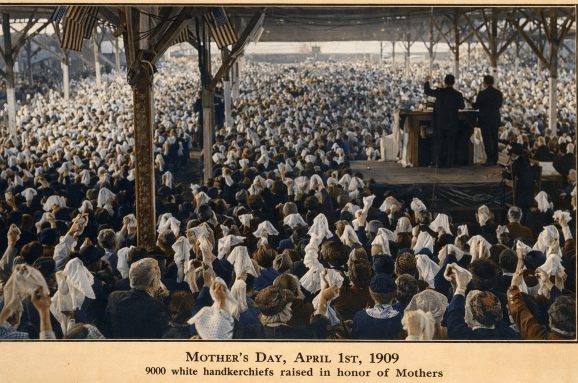
Two moments from Springfield stand out among everything that happened in 1909. The first occurred during the very opening of the campaign. Eight thousand people were in the tabernacle for the first night. As Sunday stood at the pulpit beginning his opening sermon, a man named Sherman Potts — a religious fanatic from near Lexington, Illinois, who had previously been committed to the Jacksonville insane asylum — walked up the center aisle, climbed onto the platform, and began horsewhipping Billy Sunday.
Sunday did what a man who had spent his twenties as a major-league outfielder might be expected to do. He leaped from the platform, knocked Potts to the ground, and held him there. The choir, on the platform behind, kept singing. The tabernacle did not empty. The Britt News of Iowa carried the story on March 4. The Spokane Chronicle, when it picked the piece up months later, ran a lengthy article on Potts himself. The assault did not interrupt the revival. The papers, in fact, treated it as a story about Sunday’s coolness under attack.
The second moment occurred on the final day, April 11. Governor Charles Deneen of Illinois and his family were among the seven hundred and seventy-four conversions that day. Governor Deneen joined First Methodist Episcopal Church in Springfield. A sitting state governor being converted at a Billy Sunday revival was a story that traveled — and a quiet political proof of how thoroughly Sunday had now entered the country’s mainstream civic life.
Sunday himself was unsatisfied with the Springfield numbers. His private take, later reported in the press, was that “personal work was not begun early enough.” Forty-seven hundred conversions, six hundred thousand cumulative attendance, twenty thousand dollars in offerings, the governor of Illinois joining the church on the final day — and Sunday thought he had not done enough. He was, by this point, his own hardest critic.
Marshalltown comes home
After Springfield, Sunday returned to Marshalltown, Iowa — a town of just over thirteen thousand people where he had briefly lived in the early 1890s. It was, in every sense, a homecoming campaign. The five-thousand-seat wooden tabernacle stood at the corner of Third and Main. The campaign ran six weeks, from late April through June 6. Over a hundred and ninety-eight thousand people attended. Two thousand and twenty-six conversions. Five hundred and twenty-eight cottage prayer meetings — small house gatherings, scattered through the town’s neighborhoods, that did much of the slow personal-work that the public revival services could not. Sunday’s purse: a little over six thousand dollars.
The campaign closed, as the Marshalltown Times-Republican put it, in a “blaze of glory” — thirteen thousand two hundred people present on the final day. Sunday had come back to the town where he had once been a young husband trying to make ends meet, and now drew an attendance figure equal to the entire population of the town.
The Marshalltown campaign also produced a recurring data anomaly that would surface in nearly every contemporary press report. The final conversion count appeared as 2,026 in one paper, 1,987 in a decorative stats card that circulated regionally, and 2,000 as a round-number summary in others. The Marshalltown press wars over which number was correct went on for weeks. The truth was probably in the neighborhood of two thousand. The truth was also that nobody really knew, because the Sunday operation by 1909 was generating numbers faster than even friendly reporters could verify them.
Winfield, Kansas: the man at the piano
The summer Chautauqua circuit took Sunday across Minnesota, Iowa, Kansas, Nebraska, Missouri, and Illinois. He delivered his now-fully-rotated four sermons — “Booze,” “Forces That Win,” “Nuts for Skeptics to Crack,” and the various baseball variants — to crowds of two thousand to ten thousand at a stretch, two or three towns a week.
On July 15, 1909, Sunday spoke at the Winfield, Kansas Chautauqua. His sermon was “Forces That Win.” Season tickets to the Chautauqua cost two dollars. Sunday’s appearance fee came in at five hundred dollars.
Two hours after Sunday finished his afternoon sermon, a Pennsylvania-born musician took the platform. His name was Homer Rodeheaver. He was thirty-three years old, a trombonist and gospel singer, traveling the Chautauqua circuit as a paid performer with his own small musical troupe. He performed for the Winfield crowd at four o’clock that Wednesday afternoon. Sunday was almost certainly in the audience. Roger Bruns, who has reconstructed this moment carefully, treats it as the first documented encounter between the two men.
Within months, Sunday had hired Rodeheaver to lead revival singing and choirs effective the following year. The partnership that began at Winfield, Kansas in July 1909 would last more than two decades. Rodeheaver would become the most recognizable musical figure in American revival ministry — the man whose trombone, choir-leading style, and gospel-song repertoire would carry Sunday’s tabernacle services for the rest of Billy’s preaching life. Without Rodeheaver, there is no big-city Sunday revival of the 1910s. Without Rodeheaver, there is no “Brighten the Corner Where You Are” or “I Walked Today Where Jesus Walked” reaching the audiences they reached.
And it all started on a Wednesday afternoon in a Kansas Chautauqua tent.
Patterson Springs and a record check
Three weeks later, on August 10, 1909, Sunday spoke at the Patterson Springs Chautauqua in central Illinois. He had also spoken there two days earlier on August 8. On the second appearance, the ticket receipts from the Sunday afternoon lecture alone came in at three thousand six hundred dollars.
It was, as a regional newspaper would note a year later, the largest single Chautauqua-lecture take in American history. Williams Jennings Bryan’s previous record had been twenty-four hundred dollars at Carthage, Missouri the year before. Sunday had broken it by a thousand and two hundred dollars. The Patterson Springs receipts traveled. The Hastings (Nebraska) Daily Tribune would still be writing about the record a year later.
Whatever the cumulative arithmetic of Sunday’s Chautauqua career had been — and the 1907 totals of $43,500 across eighty-six lectures were already known — the Patterson Springs receipts crystallized a particular kind of public fact: Billy Sunday, on any given afternoon, was the most commercially valuable single speaker on the American lecture platform.
Boulder and the team budget
In early September, Sunday opened a five-week revival in Boulder, Colorado. Four-thousand-seat tabernacle. About fifteen hundred conversions. Sunday’s purse came in at thirty-five hundred dollars.
The Boulder revival is most useful, in retrospect, for what it reveals about the Sunday operation’s internal financial structure by 1909. A Spokane Chronicle item from September 3 published the team-pay schedule for the Boulder campaign in full. Fisher, the singer, was being paid thirty-five dollars a week. Ackley, the musical director, thirty dollars a week. Mrs. Miller, the pianist, one hundred dollars a month. Siebert, the tabernacle caretaker, three dollars a day. The Sunday operation now had ten people on the payroll. Mr. Gill was directing the tabernacle construction itself. The offerings on the last day of the campaign — by long-established Sunday practice — went to him personally.
Most evangelists working in 1909 were essentially solo operators, working with a song leader and maybe a piano player they paid from their own purse. The Sunday operation was, by Boulder, a small business. Ten salaried positions. A tabernacle-construction supervisor. A musical director. A separate musical director’s deputy. Mrs. Miller on piano. Siebert handling the daily logistics. By 1909 standards, this was a substantial organization, and it was beginning to look much more like the operations of the mature 1910s big-city revivals than like the small-town Iowa tent campaigns of a decade earlier.
Cedar Rapids, a Gazette appreciation, and Sunday’s stamina
The fall return brought Sunday to Cedar Rapids, Iowa for six weeks from October 10 through November 21. The campaign drew 320,000 cumulative attendees, 2,906 conversions, and a purse of $7,080. Ninety-eight general meetings plus eighty special meetings designed for particular groups. Sixteen hundred cottage prayer meetings — three times the number Marshalltown had produced earlier in the year.
The Cedar Rapids Gazette on November 20 ran an editorial titled “Billy Sunday and His Work — An Appreciation” that captured better than almost any other contemporary piece what newspapers had now come to feel about him:
There are many of us who are never going to fully reconcile ourselves to some of Mr. Sunday’s methods, to his dramatic stunts, to his use of slang… After all, why should we greatly concern ourselves about his methods? He gets results… Billy Sunday is a man among men — and men admire him. Thousands of men do not sit spellbound at the feet of a religious sissy.
The line “Thousands of men do not sit spellbound at the feet of a religious sissy” was the line that traveled. Sunday’s audiences across the entire decade had been disproportionately male, and his appeal to men — the baseball stories, the slang, the muscular delivery, the dropped jackets and rolled sleeves — was central to what made him work. The Cedar Rapids editorial put the case for Sunday in language that even his critics could mostly accept. He gets results.
Joplin closes the year
From late November through the first days of 1910, Sunday held a five-week revival at Joplin, Missouri. Six-thousand-seat wooden tabernacle. Two hundred and seventy-three thousand cumulative attendees. Almost three thousand conversions, with 278 in the final service alone. About six thousand people attended each evening meeting; another five hundred attended each afternoon. Thousands were turned away nightly from a tabernacle that was simply not large enough.
The arithmetic of Joplin, like the arithmetic of Marshalltown and Spokane and Springfield and Cedar Rapids and Patterson Springs, was the arithmetic of an American revival operation that had completely outgrown the small-town format it was built on. The tabernacle was full nightly. The town was overwhelmed. Sunday and his ten-person operation closed out 1909 the way they had opened it — with more people wanting in than the building could hold.
What changed in 1909
If 1907 was the year that broke Billy Sunday and 1908 was the year he went east, 1909 is the year he became the public figure he would be for the rest of his life. Five things consolidated.
The big-city tabernacle. Spokane proved the revival method scaled. The format that had made him in Iowa river towns worked just as well in a Pacific Northwest railroad metropolis. Within five years, Sunday would be filling the same kind of purpose-built wooden tabernacles in Pittsburgh, Philadelphia, and New York.
Homer Rodeheaver. The Winfield meeting was the most consequential personnel decision Sunday ever made. Rodeheaver’s trombone, baritone, and choir-leading style would carry the musical side of Sunday’s revivals for the next twenty years.
“Tomorrow” enters the repertoire. The Spokane closing sermon premiered the sermon that would become the most-preached closing call of Sunday’s career. The dramatic emotional close that defined every big-city revival of the 1910s started here.
The Sunday operation became a business. Ten salaried team members. Specialized roles. Detailed payroll. Tabernacle construction supervisors. By Boulder, the Sunday camp had the kind of organizational chart that would be perfectly recognizable to anyone managing a touring company today.
The political register completed. The Spokane local-option lobbying. The Springfield Governor-Deneen conversion. The Marshalltown cottage prayer meetings as community organizing. Sunday was, by 1909, simultaneously a religious figure, a temperance crusader, a civic mobilizer, and a public-policy advocate. The categories had merged.
When Sunday closed his Joplin campaign on January 2, 1910, the architecture of the rest of his career was now in place. The big-city tabernacles. Rodeheaver at the music stand. Helen running her own parallel ministry. The “Tomorrow” closing call. The ten-person organization. The political-religious fusion. The Patterson Springs commercial record. The press appreciation. The cottage prayer meetings. The hundreds of thousands in cumulative attendance.
The Billy Sunday of American memory — the one who would fill twenty-thousand-seat tabernacles in Pittsburgh, who would dine with Theodore Roosevelt, who would campaign for prohibition across the country — that Billy Sunday was now fully assembled. The 1910s would scale him. But everything he scaled was put in place in 1909.
He was forty-six years old. He had been an evangelist for thirteen years. He had four hundred sermons in his head and the country in front of him.
How to cite this post
Chicago: McNutt, Kraig. “The Year the City Took Billy Sunday: 1909.” Evangelist Billy Sunday (1862–1935), June 19, 2026. https://evangelistbillysunday.com/2026/06/19/the-year-the-city-took-billy-sunday-1909/.
MLA: McNutt, Kraig. “The Year the City Took Billy Sunday: 1909.” Evangelist Billy Sunday (1862–1935), 19 June 2026, evangelistbillysunday.com/2026/06/19/the-year-the-city-took-billy-sunday-1909/.
APA: McNutt, K. (2026, June 19). The year the city took Billy Sunday: 1909. Evangelist Billy Sunday (1862–1935). https://evangelistbillysunday.com/2026/06/19/the-year-the-city-took-billy-sunday-1909/
Turabian: McNutt, Kraig. “The Year the City Took Billy Sunday: 1909.” Evangelist Billy Sunday (1862–1935). June 19, 2026. https://evangelistbillysunday.com/2026/06/19/the-year-the-city-took-billy-sunday-1909/.
 Evangelist Billy Sunday (1862-1935)