A Pennsylvania steel-valley revival, a lawsuit over his own sermons, a deaf interpreter, and the summer Billy stopped being just a Midwesterner.
A Pennsylvania steel-valley revival, a lawsuit over his own sermons, a deaf interpreter, and the summer Billy stopped being just a Midwesterner.
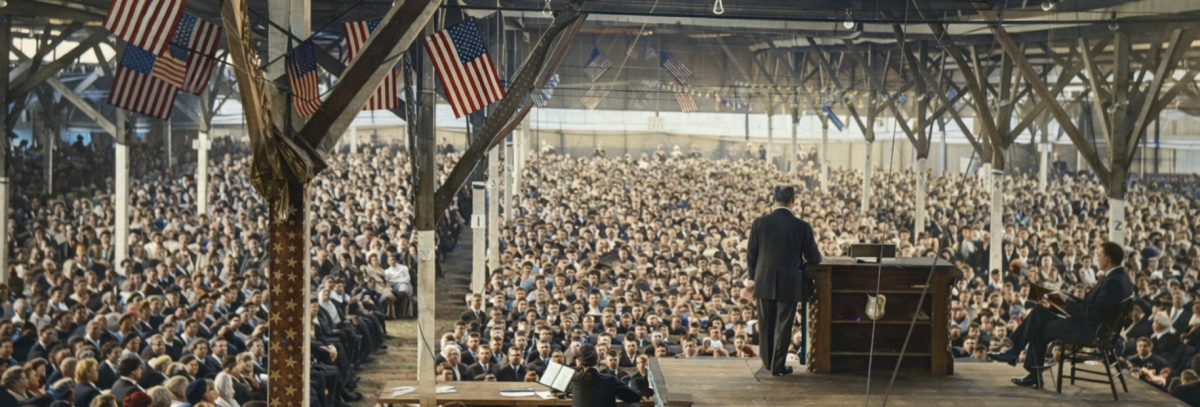
On a Friday in May of 1908, Billy Sunday stepped off a train in Sharon, Pennsylvania — a steel-mill town in the Shenango Valley along the Ohio border, eighty miles north of Pittsburgh. He had never preached this far east before. Every revival of his career up to that point had been in Iowa, Illinois, Indiana, Minnesota, Missouri, or one of the closer western states. The Sharon campaign was something new: a seven-week revival in a Pennsylvania industrial valley, and the first real test of whether the Sunday revival method would translate beyond the small Midwestern county-seat towns where he had built it.
By the time he left Sharon in late June, nearly five thousand people had come forward as converts. The campaign had drawn more than fourteen thousand dollars in offerings. A new mission was pledged for the city. And Sunday had given up the Chautauqua circuit for half the summer to make it work. The New Castle Herald, on the second day of the campaign, had already named the thing that mattered:
He has stirred up enthusiasm that has never before been evidenced in this town.
It was a quiet observation, written by a small-paper reporter who had no way of knowing that Sharon was the first piece of a much larger pivot. But the eastern industrial cities were where Sunday’s mature career would unfold. Sharon was the rehearsal.
Bloomington opens the year
The year began at Bloomington, Illinois — a town of about twenty thousand people in central Illinois. The campaign had been organized so thoroughly that the local committee opened the tabernacle on December 26, 1907, three days before Sunday himself arrived. When he stepped onto the platform on Sunday morning the twenty-ninth, three thousand people were already waiting, and they greeted him with what the Muscatine Journal called “the Chautauqua salute” — a waving of white handkerchiefs across the auditorium. It was the first time the gesture had been used to welcome him at a revival, but it would not be the last.
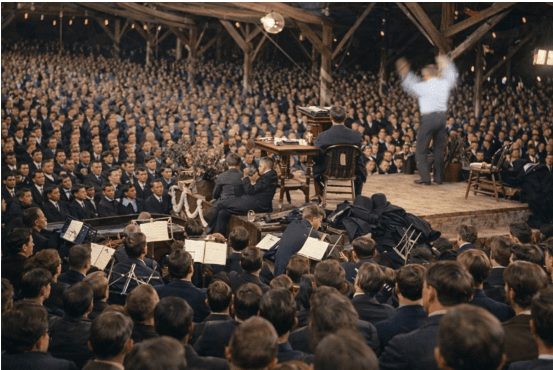
Eleven thousand people attended his three services that opening Sunday. Forty-five hundred came to the morning meeting alone. A five-hundred-voice choir carried the music. By the time the campaign closed five and a half weeks later, more than four thousand of those who had come had walked down the aisle as converts. Sunday’s purse came in at $7,773.19 — by some margin the largest revival purse of his career to date. And Helen, by now a fixture on the road with him, was preaching her own Sunday afternoon meetings to fourteen hundred women at the Second Presbyterian Church.
The closing sermon was titled “Always Be Ready to Give an Answer,” taken from First Peter chapter three. It would, in the months to come, become one of the most-printed sermons of Sunday’s career.
Decatur and the printed sermons
Sunday moved directly from Bloomington to Decatur, Illinois — another central Illinois town, this one with a population of about thirty-one thousand. The campaign ran for five and a half weeks, from early February into mid-March, probably in a temporary tabernacle erected inside Decatur’s Fairview Park. By the end of it, more than six thousand people had come forward as converts. Sunday’s purse came in at over eleven thousand dollars — surpassing the Bloomington record set just weeks earlier.
But the Decatur revival had a wrinkle that the contemporary papers found themselves writing about for months afterward. The Decatur Herald — a local newspaper — had been running Sunday’s sermons in print throughout the campaign. After Sunday left town, a Decatur printing concern collected those newspaper transcriptions and published them as a book. The book sold. Sunday had not authorized it.
He spent the next several months trying to stop the publication and, when he could not, decided to buy the copyright outright. The story finally surfaced publicly in September. According to the Freeport Daily Bulletin of September 5, Sunday paid the Decatur printing concern thirty-five hundred dollars for full possession of the copyright to his own sermons.
It was the kind of transaction that did not exist in the world of itinerant revivalism before 1908. Most evangelists were happy to have their sermons reprinted anywhere they could be reprinted. Sunday had decided, by the middle of his Pennsylvania campaign, that his sermons were worth more controlled than free. By later that year his own publishing operation was issuing sermon manuscripts under titles like “What Shall the End Be,” “The Three Groups,” and “The Moral Leper” — small printed pamphlets carrying the formal byline “William Ashley Sunday.” Sunday had become, alongside everything else, a publishing concern.
A March ticket for the Booze sermon
On Wednesday, March 18, 1908, Sunday made the short trip from Decatur to Clinton, Iowa for a single evening engagement at the local Presbyterian Church. The occasion was a local-option meeting — a temperance vote that DeWitt County voters would soon be asked to weigh in on. Sunday’s contribution was a single sermon, his now-famous “Booze.” The local committee printed numbered tickets in cream paper.
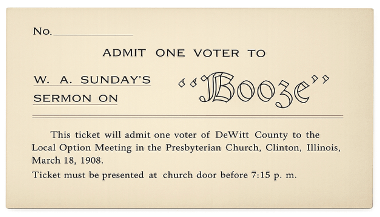
The phrasing made the political stakes plain. The sermon was a campaign event. The audience was specifically registered DeWitt County voters. The doors closed at 7:15 sharp. Sunday’s “Booze” sermon — already by 1908 a fixture of his Chautauqua repertoire — was being deployed as direct political advocacy on the eve of a temperance referendum. The line between revival preacher and political organizer, never very thick in Sunday’s career, had just become almost invisible.
Charleston and the deaf interpreter
After Clinton, Sunday spent the rest of March and most of April at Charleston, Illinois — another central Illinois revival, five weeks in a four-thousand-seat tabernacle that drew twenty-five hundred conversions and around two hundred and twenty thousand cumulative attendees. His purse came in at fifty-five hundred dollars. The Decatur Herald and Review called it “the greatest religious awakening that Charleston has ever known and one of the greatest revivals that has ever taken place in Illinois.” On the final night, the crowd refused to leave the tabernacle even after Sunday had gone home — the Herald reporter watched them stand around the platform “trying to shake the great minister’s hand for the last time.”
The Charleston campaign also produced one of the most quietly moving details in the entire 1908 record, though it would not make it into print until the next year’s Springfield souvenir booklet. A Charleston-based teacher at the State School for the Deaf, Professor Frank Reed Jr., had begun attending Sunday’s services with a delegation of deaf students. Reed stood up in the audience and signed Sunday’s sermons to the deaf attendees in real time. The visual rhythms of Reed’s interpretation became, for the hearing audience around him, almost a parallel performance.
Prof. Reed stood up and repeated to the mutes just what Mr. Sunday said, and it was a very unique and interesting sight to watch the movements and gestures of the interpreter. He would enter into the spirit of Mr. Sunday’s discourse… The expression on the faces of the mutes would brighten up as he said something amusing.
Between thirty and forty deaf attendees converted across that campaign and the Springfield campaign that followed in 1909. At the offering, when the deaf delegation contributed ten dollars, Sunday paused his sermon to address it from the platform: “If men who could not hear a word of what I say were contributing to this extent, what ought some of you fellows down there do who hear it all?”
Sharon, Pennsylvania
The eastward turn began on May 1, 1908. Sunday opened a seven-week revival in Sharon, Pennsylvania — a steel-mill town in the Shenango Valley along the Ohio border. The decision to take the Sharon engagement cost him most of his usual Chautauqua summer income, and the Sunday camp itself flagged this in a margin note: “this revival eliminated Billy’s opportunity to supplement his income from chautauquas; a significant diversion for several years.”
Sunday was forty-five years old. The Chautauqua circuit had been paying him more than forty thousand dollars in summers by now. He had announced the previous August that he was going to cut back on the platform work. And now he was choosing, for the first time, to forgo a major piece of the summer revenue in order to preach a long campaign in a place he had never been. The Sharon decision was the first time Sunday’s revival ambitions clearly outweighed his Chautauqua income. It would not be the last.
The Sharon campaign drew nearly five thousand converts. The freewill offering for Sunday came in at $6,448.45, with total collected offerings reaching over fourteen thousand dollars. A new local mission was pledged. The local New Castle Herald, in its earliest coverage, captured what Sharon was seeing for the first time:
His eccentric methods of delivering the gospel and his homely statements have hit their mark and today everybody in Sharon is talking of Billy Sunday, the old-time baseball player.
Sunday had stepped outside his Midwestern comfort zone and found a Pennsylvania industrial city that responded to him the same way Iowa farm towns did. The early evidence said the Sunday method traveled. The full proof would come in the urban tabernacle campaigns of the 1910s. But the test case was Sharon.
A compressed Chautauqua summer
Sunday returned to the platform circuit at the end of June for a sharply truncated summer. He had less than two months. He still managed to deliver Chautauqua talks at more than twenty different sites across Illinois, Iowa, Indiana, Ohio, Michigan, Missouri, and Pennsylvania. The four-sermon rotation that had crystallized the previous year carried him: “Get on the Water Wagon,” “Forces That Win,” “The Devil’s Boomerang,” and “Nuts for Skeptics to Crack.”
A few stops stood out. On August 9 at Patterson Springs, Illinois — declared “Billy Sunday Day” by the local committee — ten thousand people came to hear his “Booze” sermon. Helen was with him. Sunday was in real physical pain from what he described to reporters as a “carbuncle,” and he and Helen left town on the 7:30 a.m. train the next morning, exhausted. At Coshocton, Ohio on July 31, he was paid two hundred and fifty dollars for a two-hour talk and fifteen hundred people came to hear it. At Clarinda, Iowa on August 6, he spoke at a brand-new ten-thousand-dollar steel auditorium that held over four thousand. He stayed long enough afterward to umpire a baseball game.
Lincoln Chautauqua in Macon County, Illinois on August 15 produced one of the strangest preserved artifacts of Sunday’s middle period: a newspaper advertisement showing him in a head-and-shoulders portrait with his arms crossed, captioned “Meet Me At Lincoln Chautauqua: Saturday Afternoon, Billy Sunday.” It is, as much as anything in the 1908 archive, the moment when the Sunday brand became a commercial graphic asset that booking committees were placing in regional papers to sell admission.
Jacksonville and the G.A.R. veterans
Sunday’s fall return brought him to Jacksonville, Illinois for a six-week revival running from late September through early November. The campaign drew over twenty-five hundred converts and a freewill offering for Sunday of $7,279. By mid-October, more than 131,000 people had already attended services. The campaign was strong enough that multiple regional papers covered the closing service, repeating the same figures back and forth across the state.
From the Jacksonville pulpit Sunday delivered one of the tribute lines that the Freeport Daily Journal would reprint in November and that would become characteristic of his entire later career — a deliberate appeal to Civil War veterans of the Grand Army of the Republic:
If there are any public favors to be shown, are any offices to be filled, I want you young fellows to stand back and make room for the gray-haired veterans of the sixties. I want you to understand that there is but one piece of jewelry to which Billy Sunday takes off his hat, and that is the bronze button worn by the Grand Army of the Republic.
In 1908 the Civil War was still living memory for half the people in Sunday’s audiences. The Civil War veterans were now in their late sixties and early seventies — Sunday himself was forty-five — and were still organized in active local G.A.R. chapters in nearly every Northern town. Sunday’s tribute to them was both deeply felt and shrewdly calculated. The line traveled. The Freeport paper printed it. Other papers picked it up. And it remained one of the signature Sunday quotes for the rest of his life.
Ottumwa and the skin-flint complaint
The year ended at Ottumwa, Iowa. Six weeks in the local opera house, from early November through mid-December. Thirty-five hundred conversions. Sunday’s purse came in at seven thousand dollars.
The Ottumwa campaign also produced a moment of public criticism that the Minnesota New Ulm Review later reprinted, and that captures the kind of opposition Sunday now drew everywhere he went. The complaint, attributed to an unnamed correspondent in Ottumwa before Sunday’s arrival, ran like this:
Sunday’s skin-flint brand of religion is a money-getter to the sorrow of many a town. Let’s make Ottumwa the exception. Sunday uses his religion as his method of hypnotizing people, for he knows that in the heat of religious fervor people will give up money when you can’t get it from them in any other way. So, he uses religion.
It was the kind of complaint that had been following Sunday since the Charles City Herald editorial of 1907 had called him “a sideshow to the Chautauqua.” By 1908 it was a familiar pattern: regional papers running detailed positive coverage of his revivals; other regional papers running pointed editorial criticism that questioned his methods, his motives, and especially his money. Sunday rarely responded publicly to either. He just kept moving.
What 1908 changed
If the easy story of Billy Sunday’s career runs “small-town revivalist becomes big-city evangelist in the 1910s,” 1908 is the year where the move starts. Four things changed.
The eastern pivot. Sharon was the first sustained revival east of Ohio. He gave up half a summer of Chautauqua money to make it work. The Sunday method, transplanted to a Pennsylvania steel valley, performed exactly the way it had performed in the Iowa river towns. The proof of concept was now in hand.
The published sermon library. By the end of 1908, Sunday was operating a small publishing concern that issued sermon manuscripts under his own byline. The Decatur lawsuit had been the catalyst. The lesson was that his sermons had become an intellectual-property asset worth defending, and one that could carry his voice into towns where he himself would never preach.
The Helen Sunday women’s ministry. Helen’s Bloomington women’s meetings — fourteen hundred women, gathered at Second Presbyterian, on Sunday afternoons during the main revival — were now a documented and reportable part of the Sunday operation. She was no longer just on the road with Billy. She had her own platform alongside his.
The political-religious fusion. The Clinton temperance ticket, the G.A.R. veterans tribute, the local-option organizing folded into revival sermons, the integrated approach of revival-as-civic-mobilization — these were all visible in earlier years, but in 1908 they consolidated. Sunday was now a political force in every town he visited, in addition to being a religious one. His sermons sold pamphlets, mobilized voters, and built G.A.R. constituencies all at once.
By the time Sunday left Ottumwa just before Christmas to prepare for the Spokane, Washington campaign opening on December 25 — his first revival in a city of more than a hundred thousand people — the architecture of his mature ministry was effectively in place. Eastern cities. Published sermons. Helen running her own meetings. The platform-and-pulpit double income engine. The four-sermon Chautauqua rotation. The deaf interpreter. The G.A.R. tribute. The political mobilization. The carbuncle.
Spokane was the test of whether the whole thing would scale to a real American city. The answer would arrive within six weeks. But the architecture that would carry that test had been built in 1908.
How to cite this post
Chicago: McNutt, Kraig. “The Year Billy Sunday Went East: 1908.” Evangelist Billy Sunday (1862–1935), June 17, 2026. https://evangelistbillysunday.com/2026/06/17/the-year-billy-sunday-went-east-1908/.
MLA: McNutt, Kraig. “The Year Billy Sunday Went East: 1908.” Evangelist Billy Sunday (1862–1935), 17 June 2026, evangelistbillysunday.com/2026/06/17/the-year-billy-sunday-went-east-1908/.
APA: McNutt, K. (2026, June 17). The year Billy Sunday went east: 1908. Evangelist Billy Sunday (1862–1935). https://evangelistbillysunday.com/2026/06/17/the-year-billy-sunday-went-east-1908/
Turabian: McNutt, Kraig. “The Year Billy Sunday Went East: 1908.” Evangelist Billy Sunday (1862–1935). June 17, 2026. https://evangelistbillysunday.com/2026/06/17/the-year-billy-sunday-went-east-1908/.


