Why America’s Greatest Revivalist Preached to the Crowds
I actually think this has the potential to become one of the stronger essays on EvangelistBillySunday.com. The key is notto argue that Billy Sunday was consciously following Samuel Lane Loomis. We simply don’t know that. Instead, we can argue something stronger historically:
Billy Sunday’s ministry became one of evangelical Protestantism’s most visible responses to the urban crisis that Loomis had identified a generation earlier.
That is a defensible historical argument.
Billy Sunday and the Modern City
Why America’s Greatest Revivalist Preached to the Crowds
“The city had become America’s greatest mission field—and Billy Sunday intended to meet it there.”
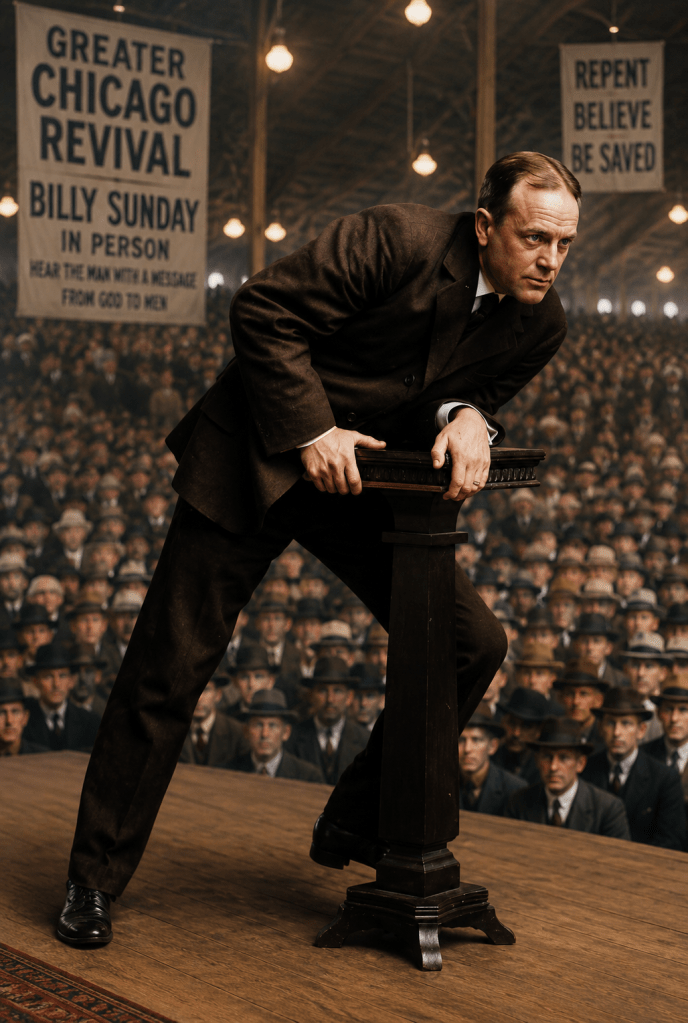
When Billy Sunday launched his ministry in the late 1890s, America was changing faster than most people could comprehend.
Small farming communities were giving way to booming cities. Factories drew workers from the countryside. Immigrants poured into urban neighborhoods. Streetcars stretched cities outward, skyscrapers climbed upward, and millions of people suddenly found themselves surrounded by strangers rather than neighbors.
To many Americans, these changes represented remarkable progress.
To many Protestant leaders, however, they also represented an unprecedented spiritual challenge.
Few understood that challenge more clearly than Samuel Lane Loomis.
A Warning Before Billy Sunday Arrived
In 1887, nearly a decade before Billy Sunday conducted his first independent revival campaigns, Presbyterian minister Samuel Lane Loomis published Modern Cities and Their Religious Problems.
His concern was straightforward.
America’s cities were growing faster than the Church was adapting.
The methods that had served rural America for generations were proving inadequate for crowded neighborhoods where churches competed with saloons, theaters, political machines, and the relentless pace of modern life.
Loomis believed the city itself had become the nation’s greatest missionary field.
The Church, he argued, must stop waiting for people to come through its doors and instead find new ways to reach the people where they lived.
Although there is no evidence Billy Sunday ever read Loomis’s book, history suggests that his ministry became one of the clearest answers to the challenge Loomis described.
Billy Sunday Understood the City
Billy Sunday’s revival campaigns were never random.
As his ministry expanded during the first two decades of the twentieth century, he increasingly focused on America’s growing cities.
Chicago.
Pittsburgh.
Philadelphia.
Scranton.
Columbus.
Syracuse.
New York.
These were not simply convenient locations.
They were places where America’s future was being written.
They were centers of industry, immigration, commerce, politics—and moral struggle.
Sunday instinctively recognized that if the gospel could influence the city, it could influence the nation.
Taking the Church to the People
Loomis criticized churches that expected the city to come to them.
Billy Sunday reversed the equation.
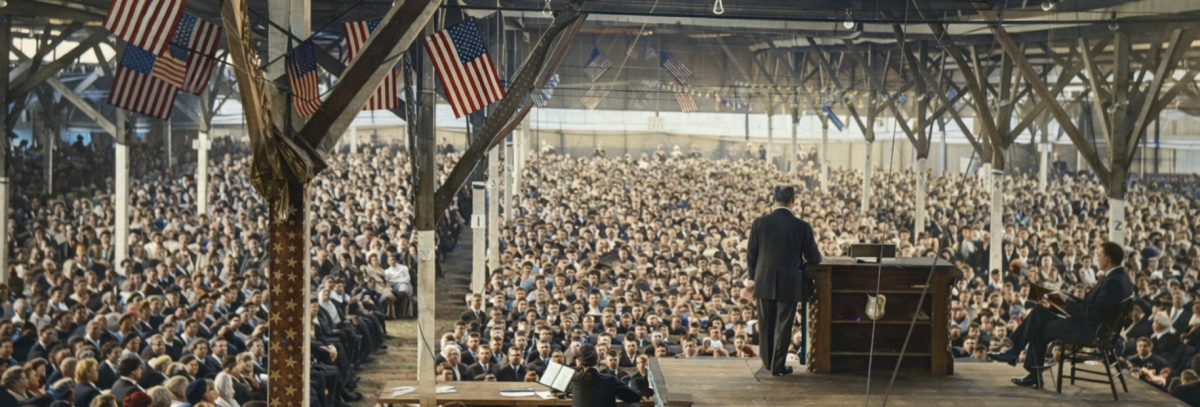
Rather than relying on existing church buildings, he erected enormous temporary wooden tabernacles capable of seating thousands.
These structures became impossible to ignore.
They stood in the heart of the city, inviting businessmen, factory workers, immigrants, politicians, homemakers, laborers, and curious skeptics to hear the gospel.
In effect, Billy Sunday took the Church into the public square.
A United Church for a Divided City
Another concern Loomis raised was the fragmentation of Protestant churches.
Individual congregations often labored independently while cities expanded around them.
Billy Sunday’s solution was cooperation.
Months before each campaign, committees representing dozens—and often hundreds—of churches organized every aspect of the coming revival.
Pastors who ordinarily worked independently prayed together.
Business leaders served together.
Volunteers visited homes together.
Choirs brought together singers from many denominations.
Sunday did not erase denominational differences.
He simply reminded Christians that the city was larger than any one congregation.
Speaking to Urban Problems
Critics sometimes portray Billy Sunday as a preacher obsessed with alcohol.
History tells a richer story.
Sunday addressed nearly every moral challenge associated with modern urban life.
He preached against drunkenness because he believed it devastated families.
He condemned political corruption because he believed dishonesty weakened public trust.
He confronted gambling because he saw it exploiting the vulnerable.
He denounced sexual immorality because he believed it fractured marriages and homes.
His sermons were not disconnected moral lectures.
They were directed toward the realities Americans encountered every day in rapidly growing cities.
Organized for a Modern World
One of the greatest misconceptions about Billy Sunday is that he relied solely on emotion.
In reality, his campaigns were remarkably organized.
Advance teams arrived months before meetings began.
Volunteer committees handled publicity, finances, transportation, ushers, music, prayer meetings, and follow-up.
Local newspapers received regular updates.
Businesses adjusted schedules.
Entire cities prepared for the arrival of the revival.
Ironically, while Sunday preached against many of modern society’s moral failures, he embraced many of modern society’s organizational strengths.
He understood that reaching a modern city required modern methods.
Why Millions Came
The popularity of Billy Sunday cannot be explained simply by his energetic preaching style.
Americans came because they sensed he was addressing questions larger than themselves.
How do families remain strong when society is changing so quickly?
How does honesty survive in competitive business?
Can communities preserve moral convictions amid rapid growth?
Can churches still shape public life?
These were not abstract questions.
They were the defining questions of urban America.
Billy Sunday offered answers rooted not in political ideology or social theory, but in the transforming power of Jesus Christ.
Reading Billy Sunday in Historical Context
Understanding Billy Sunday requires more than reading his sermons.
It requires understanding the world that made those sermons necessary.
Samuel Lane Loomis recognized that America’s greatest challenge was no longer reaching isolated frontier settlements.
It was reaching the crowded, anonymous, morally complex modern city.
Billy Sunday became one of the most influential evangelists to answer that challenge.
He did not merely preach in America’s cities.
He sought to reclaim them—one heart, one home, one church, and one revival at a time.
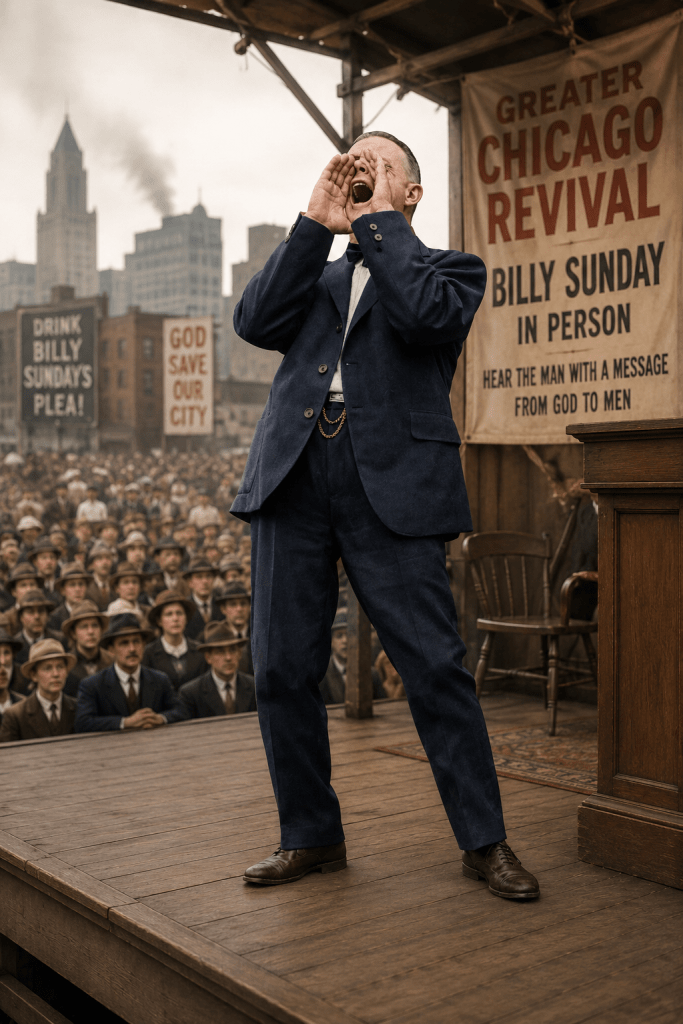
 Evangelist Billy Sunday (1862-1935)