Former professional baseball player-turned urban evangelist. Follow this daily blog that chronicles the life and ministry of revivalist preacher William Ashley "Billy" Sunday (1862-1935)
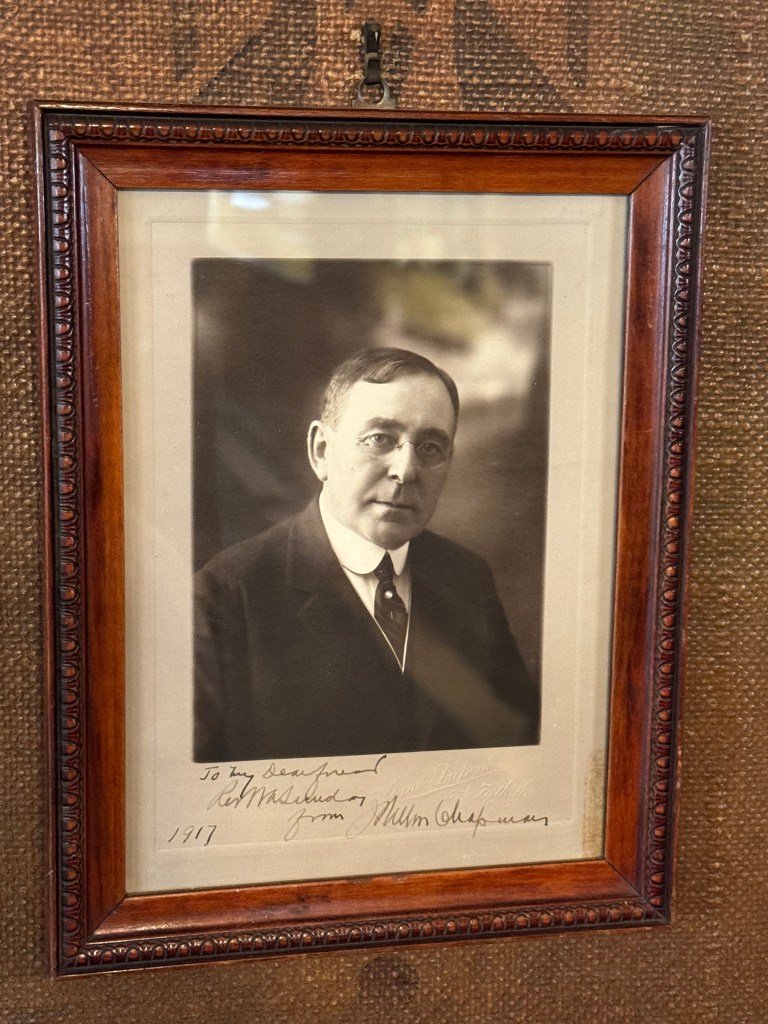
The following (1917) signed picture of J. Wilbur Chapman, in the Billy Sunday home in Winona Lake, attests to the massive influence Chapman had on Sunday.
When the Apprentice Met the Evangelist: How J. Wilbur Chapman Shaped Billy Sunday’s Early Ministry
Before the tabernacles were packed, before the crowds surged forward by the thousands, before the name “Billy Sunday” echoed across the country like a revivalist’s thunderclap—he was simply a former ballplayer, freshly converted, and hungry to make his life count for Christ.
That’s when J. Wilbur Chapman stepped into the picture.
It was 1893. Chapman, already an established evangelist with a Presbyterian pedigree and a knack for drawing the spiritually curious, needed an assistant—someone to handle logistics, rally local churches, and stir up enthusiasm before his campaigns. Billy Sunday had the energy and the zeal. Chapman had the method and the message.
For two critical years—1893 to 1895—Sunday shadowed Chapman like a student to his rabbi. He wasn’t yet preaching, but he was watching. Learning. Absorbing. Chapman’s campaigns weren’t just events—they were carefully orchestrated spiritual operations. Inquiry rooms. Personal follow-ups. Gospel invitations that were both clear and convicting. Sunday took it all in.
But it wasn’t just technique that Chapman passed on—it was a vision. A way of doing evangelism that held fast to the truth of Scripture while reaching real people in real places. Sunday saw in Chapman a man who carried both conviction and compassion. And though their styles couldn’t have been more different—Chapman, the dignified clergyman; Sunday, the kinetic whirlwind—it worked. Like iron sharpening iron.
In 1895, Chapman surprised many by stepping back from itinerant preaching to take a pastorate in New York. The pulpit reclaimed him. But for Billy Sunday, it was a release—a gentle push from the nest. With his mentor’s example still fresh, Sunday stepped onto his own stage. He started small—tiny Iowa towns, rough-hewn tabernacles, handfuls of seekers. But something was forming. Something bold.
It’s hard to overstate what those two years meant. Without Chapman, Sunday might’ve remained a sideshow curiosity—a saved athlete giving testimonies. But with Chapman’s imprint, he became an evangelist. A revivalist. A force.
And though their paths diverged, Sunday never forgot the man who shaped his earliest steps. He took Chapman’s gospel framework, set it ablaze with his own personality, and carried it farther than either man probably imagined.
Chapman taught him how to build the fire. Sunday learned how to preach like it mattered.
Advertiser (Adelaide, SA : 1889 – 1931), Saturday 23 March 1918, page 7
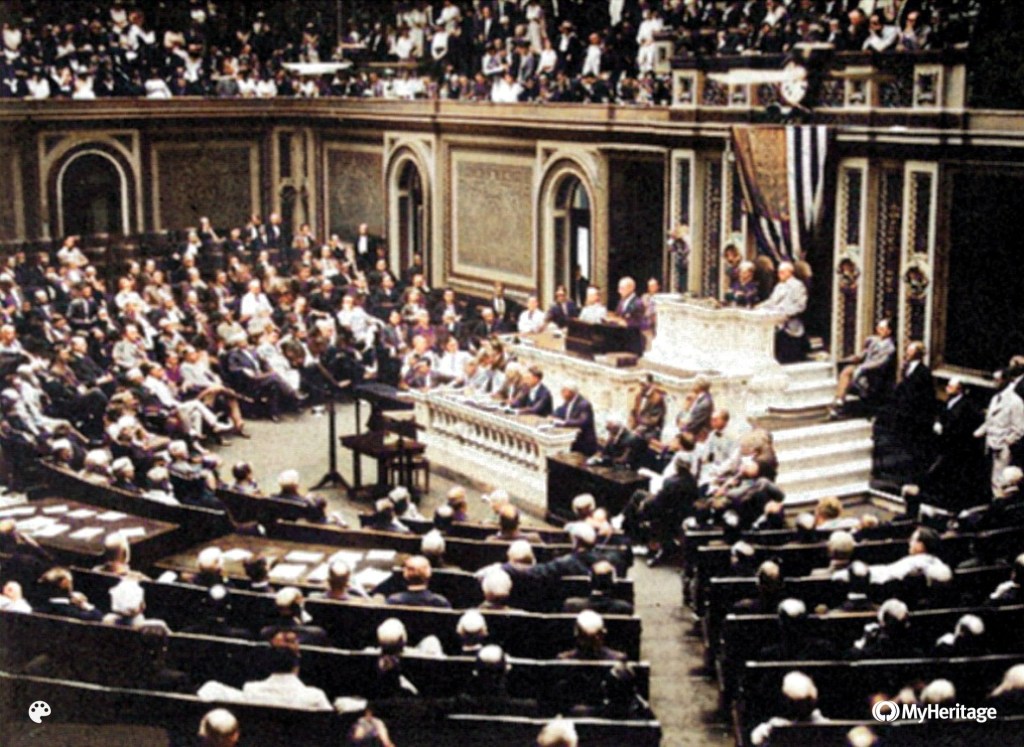
The U.S. House of Representatives, 1918. Colorized by author.
BILLY SUNDAY’S PRAYER.
CHEERED IN PARLIAMENT.
Billy Sunday prayed in the House of Representatives at Washington on Thursday, January 10, and was applauded at the close of his appeal. Mr. Champ Clark, Speaker of the House, extended the invitation to Mr. Sunday to take the place of the regular House chaplain. Mr. Sunday, in his prayer, verbally assailed the Germans, and invoked the aid of Divine Providence to help the President, the Secretary of War, and Congress to defeat Prussianism.
“We thank Thee that we are Americans,” prayed the evangelist, ‘”and live beneath the protecting folds of the Stars and Stripes. We thank Thee, that Thou canst look over the battlements of glory on our land and see that there is not one stain on any star or stripe. We thank Thee for our happy homes. We thank Thee for our wives and little ones. We thank Thee for the fruitful trees and bountiful harvests. We thank Thee that as a nation we have never gone to bed hungry, or scraped the bottom of our flour barrel, and we pray for Thy continued mercy and blessing.
Most Infamous Nation in History.
“We pray that Thou wilt forgive our transgressions and blot out our iniquities. Thou knowest, O Lord, that we are in a life-and-death struggle with one of the most vile, infamous, greedy, avaricious, bloodthirsty, sensual, and vicious nations that ever disgraced the pages of history.
‘”Thou knowest that Germany from the eyes of mankind has wrung enough tears to make another sea; that she has drawn blood to redden every wave upon that sea; that she has drawn enough shrieks and groans from the breasts of men, women, and children to make another mountain.
‘”We pray Thee that Thou wilt bare Thy mighty arm and strike that great pack ot hungry, wolfish Huns, whose fingers drip with blood and gore. We pray Thee that the stars in their courses and the winds and waves may fight against them.
“We pray Thee that Thou wilt bless our beloved President and give him strength of mind and body and courage of heart for his arduous duties in these sorrow laden, staggering days. We pray Thee to bless the Secretary of War and the Secretary of the Navy, and bless, we pray Thee the Navy Strategy Board. Bless we pray Thee, the generals at the head of our army and the boys across the sea. somewhere in France, and bless those protecting our transports, loaded to the water’s edge with men and provisions.
Prays for Allied Victory- ‘ “Bless our boys at home who are in ‘ cantonments. Bless, we pray Thee, this Senate and House, and give them wisdom and strength, for they seem to have come into the kingdom for such a time as this.
“‘And, Lord, may every man, woman, and child from Maine to California, from Minnesota to Louisiana, stand up to the last ditch and be glad and willing to suffer and endure until final victory sha’ll come. Bless our Alliée, and may victory be ours. And in Thy own time, and in Thy own way, we pray Thee that Thou wilt release the white-winged dove of peace until it shall dispel the storm and clouds that hang lowering over this sin-cursed, blood-soaked, and sorrowing world, and when it is all over we will uncover our heads and lift our faces to the heavens ‘ and ring with a new meaning
“‘My country, “tis of thee, sweet laud of Liberty.
” Of thee I sing.’
“‘And the praise shall come to Thee forevermore through Jesus Christ. Amen.”
The House broke into instant applause at the ending words of the prayer. Many members crowded around the evangelist, and shook hands with him, and an in-formal reception was held in the lobby.
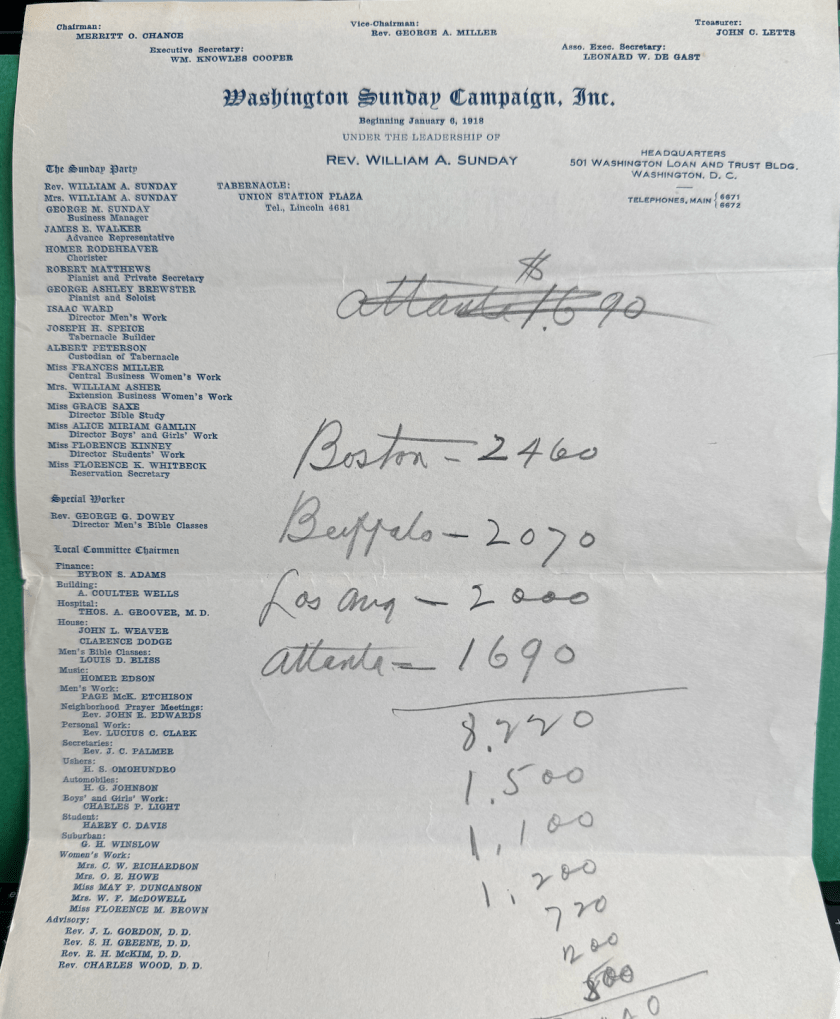
The Billy Sunday archives at Grace College in Warsaw, Indiana have the following related artifact in their archives. He seems to have spoken at Union Station Plaza, starting January 6, 1918.
Champ Clark (James Beauchamp Clark, 1850–1921) was a prominent American politician and leading Democrat in the early 20th century. By 1918, he was near the end of his long and distinguished career in the U.S. House of Representatives, which he had served in almost continuously since 1893.
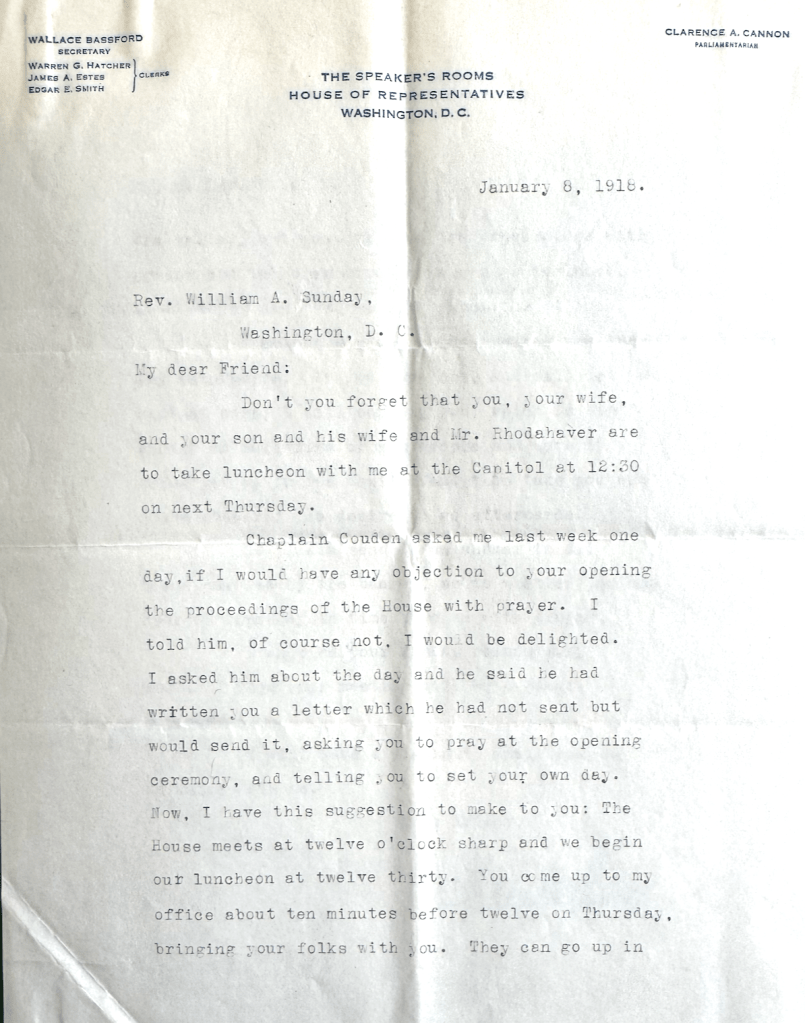
Transcription of above letter:
WALLACE BASSFORD, SECRETARY
THE SPEAKER’S ROOMS HOUSE OF REPRESENTATIVES
WASHINGTON, D.C.
January 8, 1916.
Rev. William A. Sunday,
My dear Friend:
Don’t you forget that you, your wife, and your son and his wife and Mr. Rodehever are to take luncheon with me at the Capitol at 12:30 on next Thursday. Chaplain Couden asked me last week one day, if I would have any objection to your opening the proceedings of the House with prayer. I told him, of course not. I would be delighted.
I asked him about the day, and he said he had written you a letter which he had not sent but would send it, asking you to pray at the opening ceremony, and telling you to set your own day.
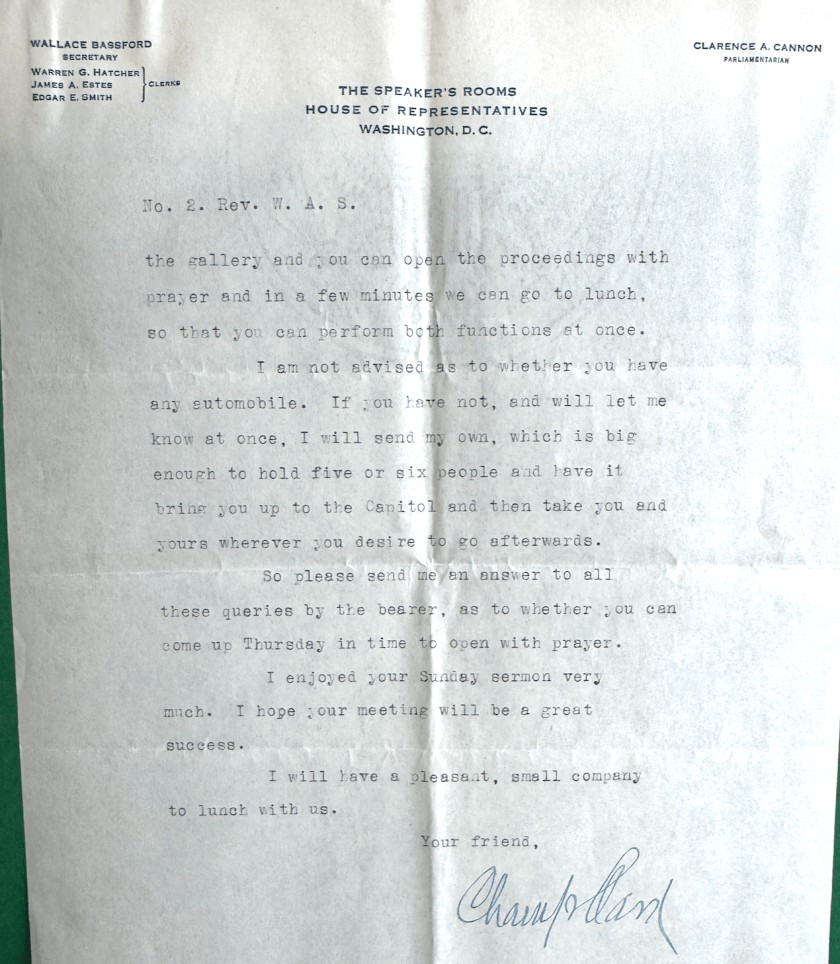
Now, I have this suggestion to make to you: The House meets at twelve o’clock sharp and we begin our luncheon at twelve thirty. You come up to my office about ten minutes before twelve on Thursday, bringing your folks with you. They can go up in the gallery and you can open the proceedings with prayer and in a few minutes we can go to lunch, so that you can perform both functions at once.
I am not advised as to whether you have any automobile. If you have not, and will let me know at once, I will send my own, which is big enough to hold five or six people and have it bring you up to the Capitol and then take you and yours wherever you desire to go afterwards.
So please send me an answer to all these queries by the bearer, as to whether you can come up Thursday in time to open with prayer.
I enjoyed your Sunday sermon very much. I hope your meeting will be a great success.
I will have a pleasant, small company to lunch with us.
How Industrialization, Urbanization, and Moral Upheaval Set the Stage for Revival
When Billy Sunday’s voice rang out across America’s wooden tabernacles, he wasn’t just preaching sermons—he was answering a cultural cry. From 1900 to the early 1920s, the United States was spinning in the whirlwind of transformation. Old institutions were cracking, new cities were rising, and the American soul was searching for an anchor. Into that spiritual vacuum stepped Sunday—a preacher who didn’t just understand the moment; he embodied it.
By the early 20th century, America was moving from farm to factory. In 1870, only 25% of the population lived in cities. By 1920, over 50% did. The dizzying shift from rural life to urban sprawl left many disoriented. Long-standing community structures—churches, front porches, family farms—were being replaced by crowded tenements, anonymous factory work, and the fast pace of modern life. People needed clarity, direction, and moral certainty.
Sunday gave it to them—loudly, plainly, and with baseball-player bravado.
The U.S. was also undergoing its greatest wave of immigration, with over 14 million new arrivals between 1900 and 1920. While these immigrants enriched the nation’s culture, they also stoked fears among native-born Protestants about identity, religion, and national character. Sunday’s revivals, though not overtly anti-immigrant, often appealed to a kind of nostalgic Protestant Americanism that comforted people who felt their world slipping away.
Meanwhile, the Industrial Revolution was rewriting the rules of labor and wealth. Robber barons rose; workers organized. Socialist ideas were gaining traction. Against this backdrop, Sunday didn’t call for revolution—he called for regeneration. He told workers to repent, not revolt. He urged bosses to clean up their lives, not just their payrolls. In an age when ideologies were competing to explain human brokenness, Sunday offered the most American answer imaginable: personal repentance and individual transformation.
And of course, moral reform movements were gaining steam—chiefly the push for Prohibition. The saloon had become a symbol of urban vice, immigrant excess, and male irresponsibility. Billy Sunday didn’t just preach against alcohol—he declared war on it. His famous line, “I’m against the saloon with all the power I’ve got,” wasn’t just rhetoric; it helped catalyze a national movement that led to the 18th Amendment.
So why did Billy Sunday rise when he did?
Because he stepped into a nation off balance, morally confused, spiritually hungry, and socially uprooted. He didn’t just ride the wave—he harnessed it. His sermons shouted what many Americans were whispering: that the old truths still mattered, that the Bible still had authority, and that one man’s conviction could still move a crowd.
In an age of massive upheaval, Billy Sunday stood like a lightning rod—conducting fear, hope, outrage, and repentance into one electrifying movement.
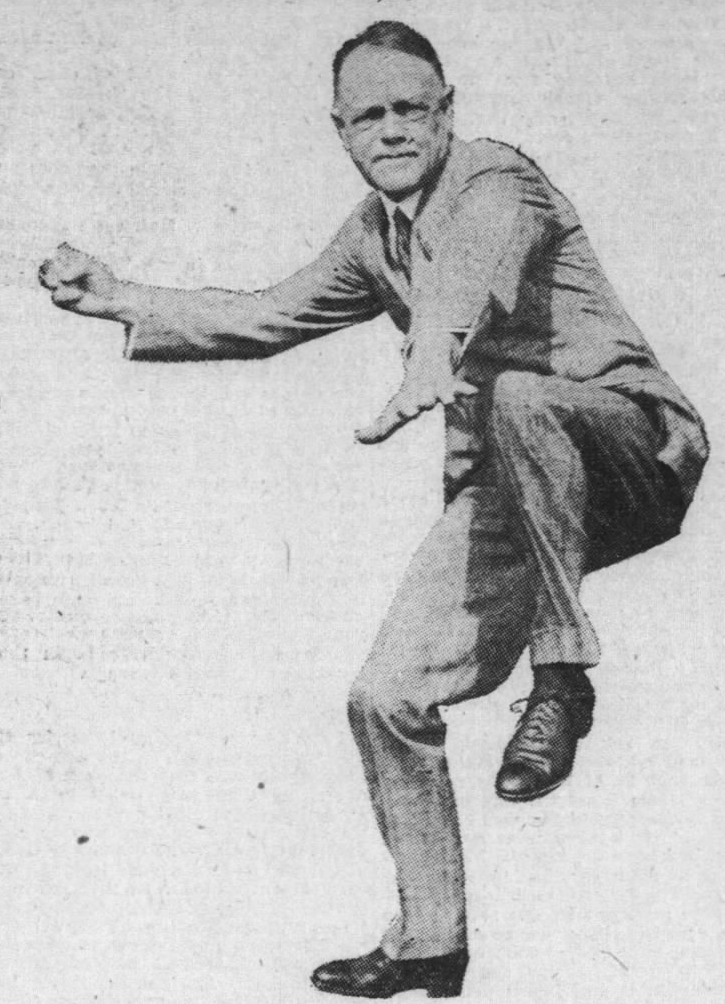
The movements and gestures of Billy Sunday have never failed to attract attention everywhere he goes. He is probably more active in the pulpit than any other preacher in the world to-day. Many try to imitate him, but none entirely successfully.
It has been figured the evangelist will make 1,700 or 1,800 moves in the ordinary sermon and in some of the longer ones, he moves 2,000 or 2,500 times, or even more.
In a recent sermon an effort was made to keep tally of every move the evangelist made. He gesticulated with one or both hands 884 times in less than one hour on that occasion, this being the most numerous movement of any one kind. He struck the pulpit in front of him with his clenched fist 826 times, and he swung from one side of the pulpit to the other exactly 229 times. On 121 different occasions, he paced from one end of the platform to the other, and 68 times he waved his handkerchief, either in the air or by his side.
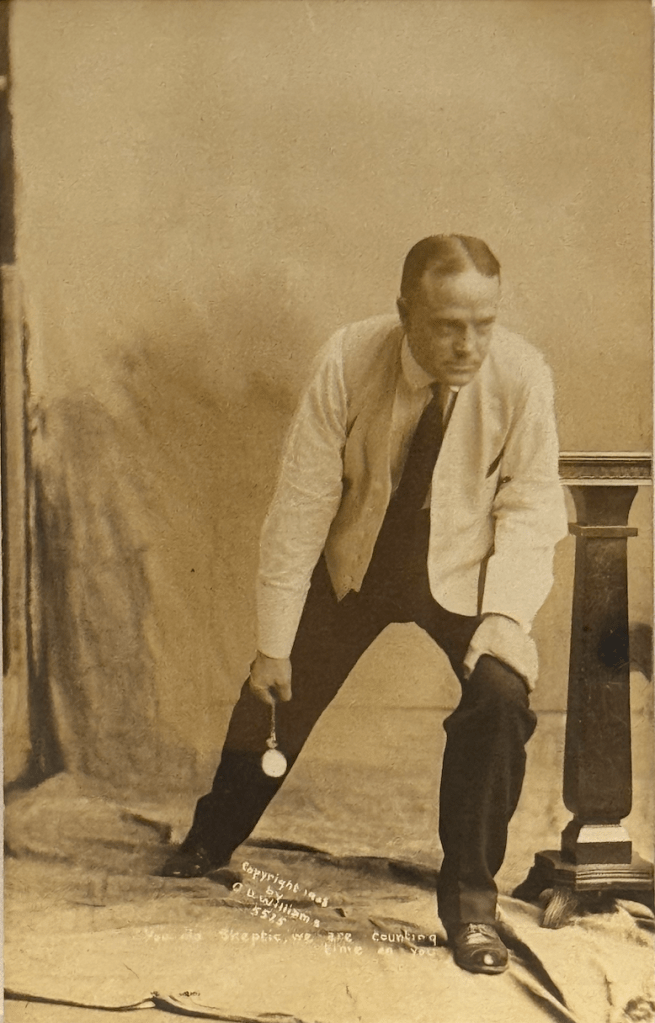
THIS IS HOW BILLY FINDS OUT IF YOU ARE GOING TO “TAKE THE COUNT”
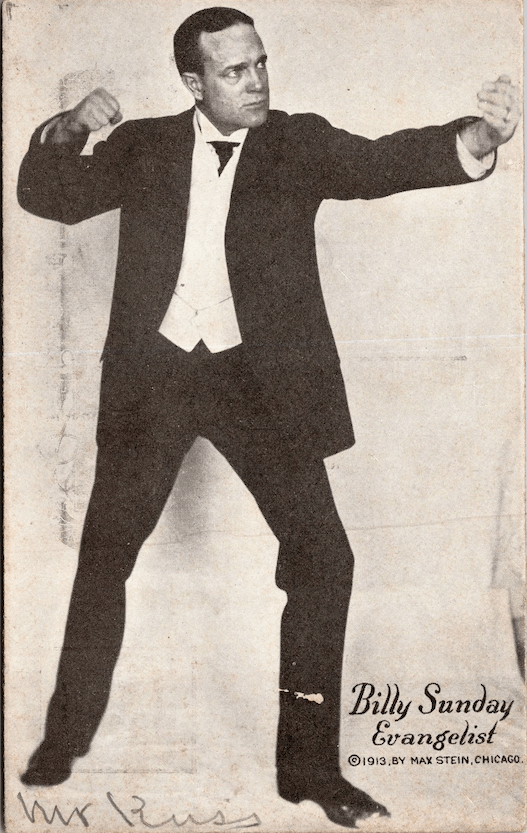
BILLY SUNDAY IN UNUSUAL POSE.
Billy Sunday in a famous pose. C. 1908. Author’s Collection.
The above is a characteristic position for Billy Sunday to assume during one of his meetings for men only.
He bends over until his right knee nearly touches the floor of his platform; then he pulls out his watch and inquires if you are going to “take the count” for the devil.
Sunday’s sermons are filled with such unusual features as this, but they are never so plentiful as in the men’s sermons. There is no doubt about it the evangelist is at his best in these talks. He always bends every energy to the end of impressing his male audience with the truth of what he is saying, and in this he never fails.
The South Bend Tribune. Thu, Jun 05, 1913 ·Page 10
Citation: The South Bend Tribune. Wed, May 28, 1913 ·Page 13
To those who know Billy Sunday it seems he has two almost distinctive personalities. This statement may seem odd inasmuch as it would lead one to think the evangelist is some such sort of a fellow as Dr. Jekell and Mr. Hyde but such an impression would be inequitable to Mr. Sunday. The personalities are not moral instead they are physical. Two distinct characters are noticed, one on the platform and the other off.
At home, on the street, coming down the aisle in the tabernacle, Billy Sunday appears to be a man slightly below the average in heighth, a bit stoop shouldered, chest somewhat sunken, with kindly eyes and an expression sympathetic on his face. But the moment he steps to the platform, takes off his hat, removes his overcoat and faces his audience he seems to be another man.
His strength of character appears to have grown tenfold. His chin seems more square, the lines of his face smooth out, and his eyes fill with the spirit of anticipation. The shoulders, which were but a moment before stooped, appear to straighten and broaden. His chest seems to fill out, and his whole body appears to have grown within the twinkling of an eye.
When speaking the evangelist has a way of impressing one with the fact he is wiry and has tremendous strength of body. And for a man of 50 years, Billy Sunday is of a fibre seldom equalled. This is due probably to his activeness on the platform, his utter disregard for the law of gravitation, as he whirls and balances now on one foot and then on the other.
When off the platform these things do not impress one. Sunday appears hardly more than the ordinary type of a man of unusual intelligence and his mysterious change of personality is a puzzle to many who have watched and studied him. Very few men make a better appearance on the platform, an appearance of ease, than does Billy Sunday and he seems more at home in the pulpit than anywhere else.
The South Bend Tribune. Wed, May 28, 1913 ·Page 13
BILLY SUNDAY EXPLAINS THAT OLD CHARGE OF STEALING.
OFTEN FAILS TO CREDIT
Citation: The South Bend Tribune. Wed, May 21, 1913 ·Page 11
Sometimes He Doesn’t Know Where Stuff Came From, Often He Forgets It, Baseball Evangelist Declares.
Ask Billy Sunday if he steals some of the material he uses in his sermons and perhaps he will frankly admit it.
That is, he will confess that he picks up hints, paragraphs, poems and anything else which will assist him in his work, only giving the creator of the things the credit when he happens to know their names, or when he thinks of it.
“The accusation in regard to my stealing the stuff for my sermons makes me tired,” said the evangelist when approached regarding the matter.
“There isn’t a public speaker today but what does the same thing. Every day I get poems and paragraphs and other knick-knacks through the mail from people I do not know, who suggest that I may have some use for them. I clip and save thousands of such things myself in the course of a year.
Doesn’t Know Author.
“Well, when I get ready to work them into my sermons, nine chances out of 10 I won’t know the name of the author. But I use them just the same, and give those who originated them credit when I can and when I remember it. But if I had to stop and give credit for every bit of outside material I work into the sermons, I wouldn’t have much time to say anything else.
“There are a dozen or 15 evangelists who are using my stuff every day they preach. Do I get any credit for it? Well, I guess not. They are free to use it if it will do any good without crediting it to me, so why should I go to the trouble of mentioning all these folks in my sermons.”
About Mothers’ Poem.
The evangelist told of an incident a few days ago in connection with his special Mothers’ Day address. He said he recited a poem during the sermon, which had been sent him by some anonymous letter writer. The poem was an excellent one and suited his purpose exactly. He quoted it word for word in his mothers’ sermon without giving any credit for it and a day or two later, discovered the name of the author while reading a magazine.
He has now noted down the name of the author and will give him credit for the work when he delivers the sermon again. The evangelist says if he is guilty of stealing literary stuff that every public speaker in the country could easily be convicted of the same offense.
Reads Everything.
The evangelist reads anything and everything worth reading, which is brought to his attention and by so doing he collects thousands of suggestions and hints for sermons and additions to sermons. He said he believed his clippings for his sermons in the course of a year, would fill an ordinary two horse wagon.
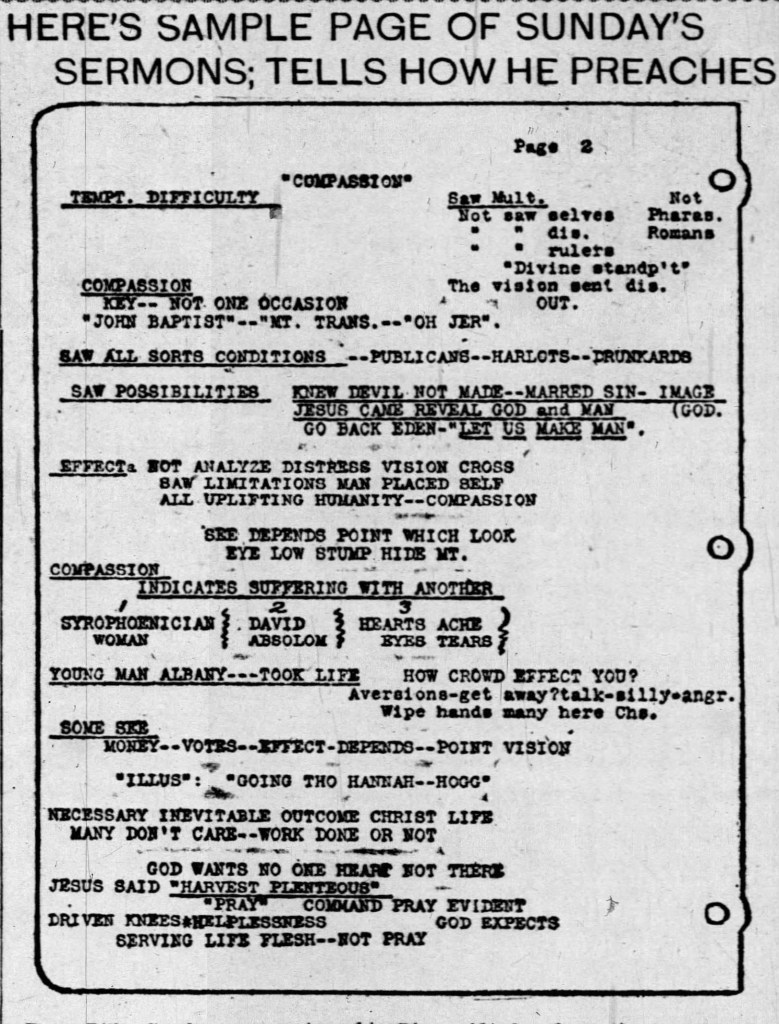
Sunday has a marvelous memory, which is also of great assistance in his work. In the preparation of a sermon, he writes only fragments of it out, depending on his faculty for remembering to carry him through it. A few notes, all of which have been typewritten, are all he has to show for the majority of his sermons, many of which have become famous and are generally regarded as masterpieces.
The sermon he will deliver to-night at the tabernacle, “The Second Coming of Christ,” has been heard by thousands, as one of the evangelist’s very best, is not in the mind of Sunday in full and probably never will be, unless he takes the trouble to clip it from some newspaper, which is printing detailed accounts of his talks.
Only Few Sentences.
Instead, it consists of only a few terse half completed sentences, which are set down in type written form to assist him in remembering the balance. In the majority of instances, the wonderful word painting in the sermons are simply noted in two or three words and a brief sentence may stand for two or three stories he tells during the talk.
The South Bend Tribune. Wed, May 21, 1913 ·Page 11
BILLY SUNDAY IS FOR SUFFRAGE FIRST, LAST AND ALL THE TIME
Woman suffragists ought to like Billy Sunday.
“Do you favor woman suffrage?” he was asked the other day.
“Why not?” he hurled at the reporter just as though the latter were an “anti.”
“I don’t know,” murmured the representative of the press, in a tone measured to encourage Mr. Sunday to a further discussion of the subject. And Mr. Sunday was quite willing to talk about it. And talk he can on any subject.
He launched into one of the most picturesquely worded and one of the most emphatic indorsements of woman suffrage that its most ardent supporters could ever wish to have, “Why shouldn’t women have the franchise? They are as worthy of it as the men,” was the substance of what he said.
There are 6,000,000 women and girls working for a livelihood in this country, he statistically declared to the reporter.
He urged that the working woman fills an important place in the industrial and business life of the country.
“Take them out of the offices, mills, factories and stores, and you’ll miss them quickly enough.” These 6,000,000 women so engaged were advanced as one of Mr. Sunday’s reasons for granting the franchise to women.
All an interviewer of Mr. Sunday can hope to do is to get impressions. In answering one question he said enough interesting things on the equal suffrage question to fill a small volume. He invented enough aphorisms and sprung enough epigrams to make an issue of Elbert Hubbard’s Philistine look like a mere sample package.
If you go to interview Mr. Sunday take the best stenographer in the state with you. No, take two or three. Mr. Sunday uses words with exceeding celerity. He confessed that he could use as many as 350 a minute. The interviewer gained the impression that he was trying to break the speed limit yesterday.
“There’s only one stenographer I have known who could get my speeches in full,” he said, “and he missed one word in ten.”
BILLY SUNDAY GOING TO TAKE PRECAUTION AGAINST FIRE.
Citation: The South Bend Tribune. Tue, May 13, 1913 ·Page 7
Just Now, Evangelist Has No Duplicate Copies of His Famous Addresses—Ackley Does Work.
“No, I have only the one copy of each of my sermons,” replied Billy Sunday to a question as to whether he had duplicates of his sermons.
“These sermons are not in full,” continued the evangelist, as he showed the books in which he keeps the addresses that sway so many thousands; “they are just mere skeletons of the sermon and no one else but myself can read them, or at least I don’t think that anyone else can.”
Mr. Sunday was asked if he could remember the sermons if they were stolen and he replied that he recalled the majority of the material that composed them. He says that he intends to have duplicates made of the sermons and have them put into a safety deposit vault so that if one is stolen or should be destroyed by fire or in some other manner, he will have a copy.
“I thought at first that I would be able to get them copied this summer,” he said, “but it don’t look like the work will be accomplished, as I have so much to do this year.”
B. D. Ackley, pianist of the Sunday party, and secretary to the evangelist, copies the sermons of Mr. Sunday. This work takes up quite a bit of the pianist’s time, as Mr. Sunday is continually adding and detracting from his sermons as he acquires new material from many different sources.
“I always let Ackley fix up the sermons. He has a knack for doing things up pretty and nice,” said Sunday, while talking of his work.
“Now, boss, just because we have company you don’t need to make fun of me to my very face. He knows that I can’t fix them right,” said Ackley, as he turned to the visitor.
“That is all right; you do it just to suit me,” replied Sunday.
It is probable that sometime within the next year or so the evangelist will have all his sermons duplicated and deposited in a safety deposit vault.

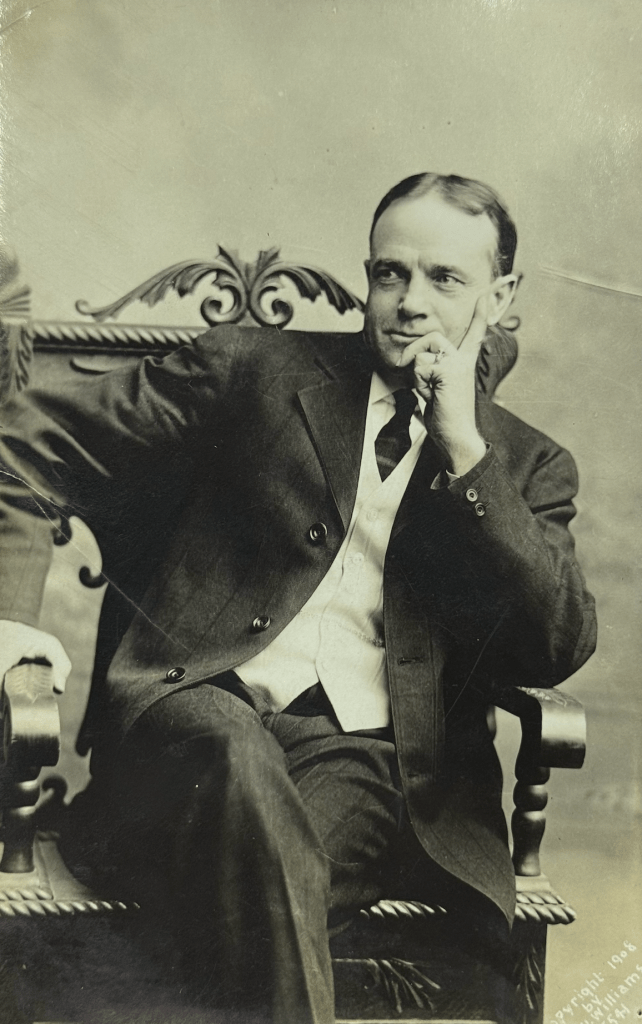
 Evangelist Billy Sunday (1862-1935)