Former professional baseball player-turned urban evangelist. Follow this daily blog that chronicles the life and ministry of revivalist preacher William Ashley "Billy" Sunday (1862-1935)
Just prior to starting the late April 1913 South Bend revival campaign, Billy Sunday finished his campaign in Wilkes-Barre, PA. He was apparently sorely missed just days afterward as a citizen-employee from Vulcan Ironworks sent this poem to the South Bend Tribune, published Mon, May 05, 1913 ·Page 7.
Billy’s Fearlessness and Independence Would be Bound to Win Masses if He Was Out for Office.
BY THE POLITICAL WRITER.
It may be said safely that a good percentage of the men and women who sat in open mouthed amazement at the tabernacle yesterday and saw Billy Sunday sway thousands by his magnetism, hypnotism and Lord-knows-what-ism afterward asked themselves the question: ‘Why didn’t he go into politics?’
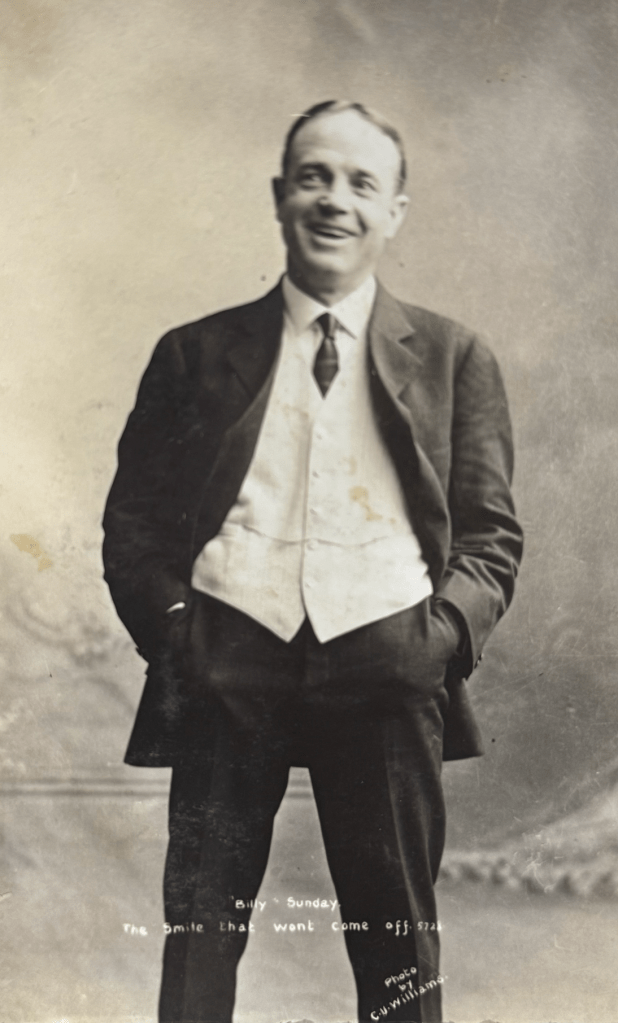
Billy Sunday’s most bitter enemies must admit that he is a leader of the natural-born species. His characteristics, his personality, his impulsiveness, his methods and that seductive ‘come-on-I’ve-got-you’ smile make him a power whether it be in evangelistic work or in a ‘swat the fly’ campaign.
Could Get Votes.
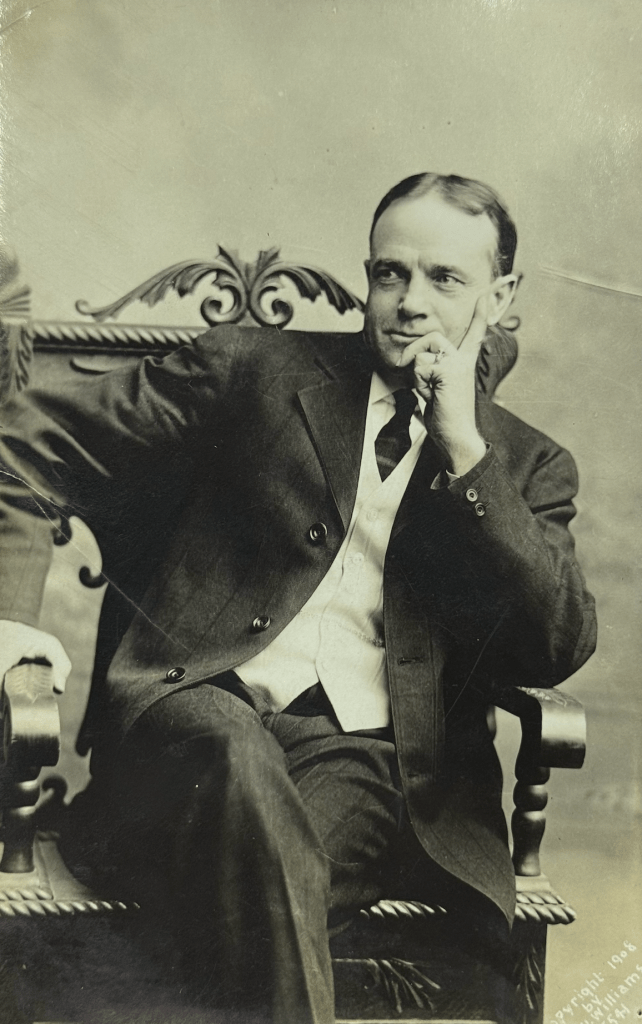
Billy Sunday, c. 1908. Author’s Collection
On the political stump Billy Sunday could get votes. It is idle to deny that fearlessness and vote-getting go hand in hand. They are so closely interlocked that there has never been a great vote-getter who was not brave and courageous in saying what he wanted to say regardless of the fear of adverse criticism. That’s just Billy Sunday’s line. To him a liar is a liar, a hypocrite is a hypocrite, a man is a man and a woman is a woman. He calls a spade a spade and does it from the housetops.
Billy Sunday undoubtedly would achieve as much success in politics as in a religious movement. Perhaps the latter critics are possibly more charitable in the belief that this gives the one under the acid test a greater opportunity to show his good. Billy Sunday does not seek charity or consideration, but rather goes after his auditors hammer-and-tongs.
Like a Fighter.
In politics that would result in delivery of the goods the same as in religion. All men like a fighter and Billy Sunday yesterday demonstrated that he can scrap from the drop of the hat. Such an individual would have followers in politics, followers of all kinds and description from curbstone heelers to nation wide statesmen.
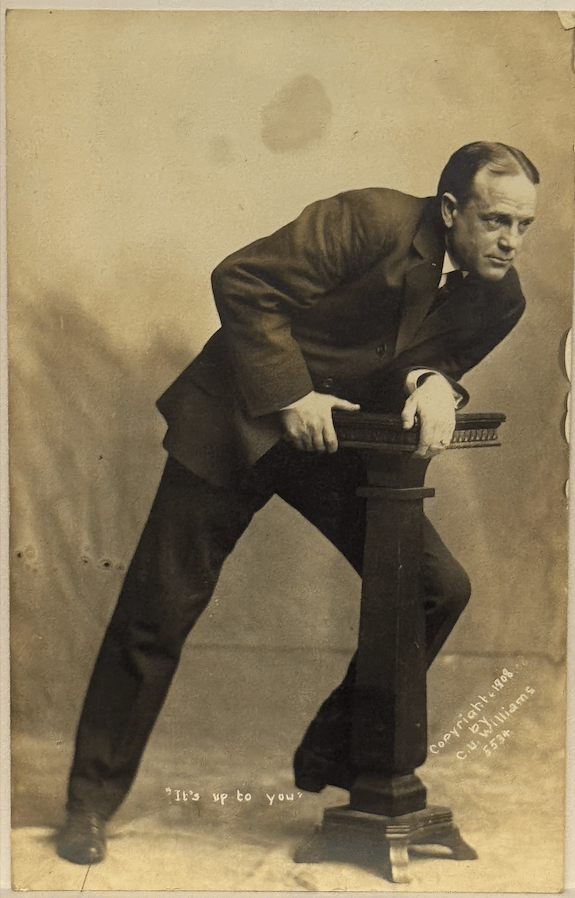
Under a convention system Billy Sunday would shine. Any man who can double himself into a knot, hit the floor and ceiling alternately, chase from one side of a platform to the other, shake his fist at a packed auditorium, telling all of them that they are doing wrong and telling some of them that they are quite on the direct route to hell—any man who can do so much in one breath and get away with it would have no trouble in turning a political convention into his way of thinking. If Billy Sunday appeared at an old time county convention and made a speech as dramatic, as fiery and as spectacular as he did yesterday, the delegates would be fairly falling over one another trying to get aboard his political band wagon.
“A Real Dandy.”
Asked what he thought of Billy Sunday, Gov. Tener, of Pennsylvania, who played ball against him back in the nineties, made answer in his semi-soliloquy and semi-quiz fashion: “Wouldn’t he make a dandy in politics?”
Those who know something of politics and who have heard Sunday quite agree with Pennsylvania’s chief executive.
The South Bend Tribune. Sat, May 03, 1913 ·Page 13
In the same edition of the newspaper, this story was also posted.
SUNDAY WOULD LIKE ONE POLITICAL JOB
EVANGELIST LETS OUT SECRET OF AN AMBITION.
Billy Pines to Get on School Board Some Time so He Can Raise Salaries.
Billy Sunday let his audience in on a nice little secret ambition of his, during his talk at the tabernacle last night. Mr. Sunday does not particularly aspire to the job, but if he ever gets into politics he wants to be a member of the schoolboard. This he confided to the crowd during his eloquent discussion of home problems.
The evangelist gave his reason for wanting the job, in the following manner:
“I would like to be on a school board so I could double the pay and arrange 12 months work a year for every school teacher under my jurisdiction. It is a disgrace, the wages we pay ministers and school teachers. Raise teachers’ salaries and we would have better influence for good among the scholars as a result.”
Billy halted his speech for a moment, then added:
“There is one thing I would do if I was a member of a school board and that is I would give back to the teacher the right to lick our boys and girls. It was one of the greatest mistakes of the nation in depriving them of this right.”
“They are fighting and talking about the needs of an institutional church, they are having gymnasiums and socials. But don’t forget the fact that salvation is the prime end of everything. I don’t object to the gymnasium and all such things if they make them a means to an end. But remember that salvation of the soul is the end which we need. That is what is the matter with the church to-day, she is losing sight of that one fact. The Y. M. C. A. is drifting away from what it used to do for the people. I don’t object to the Y. M. C. A. I don’t object to gymnasiums. I do object when they make that the prime thing, putting in pool tables and such things. The church and the Y. M. C. A. and the Salvation Army are getting away from the fact that the salvation of the soul is the supreme end. I want to see the salvation of the soul the supreme end of the world.”
Citation: The South Bend Tribune. Sat, May 03, 1913 ·Page 12
Citation: The South Bend Tribune. Fri, May 02, 1913 ·Page 17
HOW SUNDAY BADE HIS MOTHER GOODBYE AND JOINED ORPHANS
Billy Sunday and his brother, Ed, spent five years in an orphans’ home. Here is the story of his farewell to his mother and his journey to the orphans’ home:
My father went to the war four months before I was born. My mother drew a pension of $12 a month and the guardian ran off with most of the money. The wolf scratched at the cabin door, and finally mother said: ‘Boys, I’m going to send you to the Soldiers’ Orphans’ home.’ At Ames, Ia., we had to wait for the train and we went to a little hotel and they came about 1 o’clock and said: ‘Get ready for the train.’ I looked into mother’s face, her eyes were read, her hair was disheveled. I said: ‘What’s the matter, mother?’ All the time Ed and I slept, mother had been praying.
We went to the train; she put one arm about me and the other about Ed and sobbed as if her heart would break. People walked by and looked at us, but they didn’t say a word. Why? They didn’t know, and if they did, they wouldn’t have cared. Mother knew. She knew that for five years she wouldn’t see her boys. We got into the train and said, ‘Good-bye, mother,’ as the train pulled out.
We reached Council Bluffs. It was cold and we turned our little thin coats around our necks and shivered. We saw a hotel and went up and asked a lady for something to eat. She said: ‘What’s your name?’
‘My name is Willie Sunday and this is my brother Ed.’
‘Where are you going?’
‘Going to the Soldiers’ Orphans’ home at Glenwood,’ I said.
‘She wiped her tears and said: ‘My husband was a soldier and never came back. He wouldn’t turn anyone away, and I wouldn’t turn you boys away.’ She threw her arms about us and said, ‘Come on in.’ She gave us our breakfast and our dinner, too. There wasn’t any train going out on the ‘Q’ until afternoon. We played around the freight yards. We saw a freight train standing there, so we climbed into the caboose.
The conductor came along and said: ‘Where is your money?’ ‘Ain’t got any.’ ‘Where is your ticket?’ ‘Ain’t got any ticket. You can’t ride without money or tickets, I’ll have to put you off.’ We commenced to cry. My brother handed him a letter of introduction to the superintendent of the orphans’ home. The conductor read it and handed it back as the tears rolled down his cheeks. Then he said: ‘Just sit still, boys. It won’t cost you a cent to ride on my train.’
‘It’s only 26 miles from Council Bluffs to Glenwood, and, as we rounded the curve, the conductor said: ‘There it is on the hill.’ We went there and stayed five years.’
(Editor: 1872-1876)
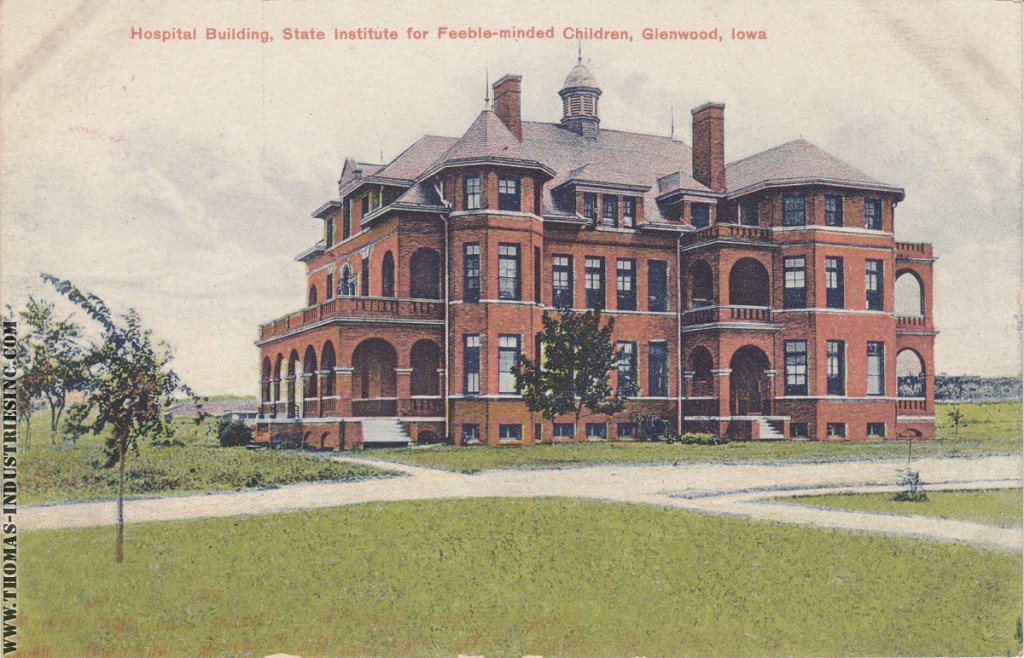
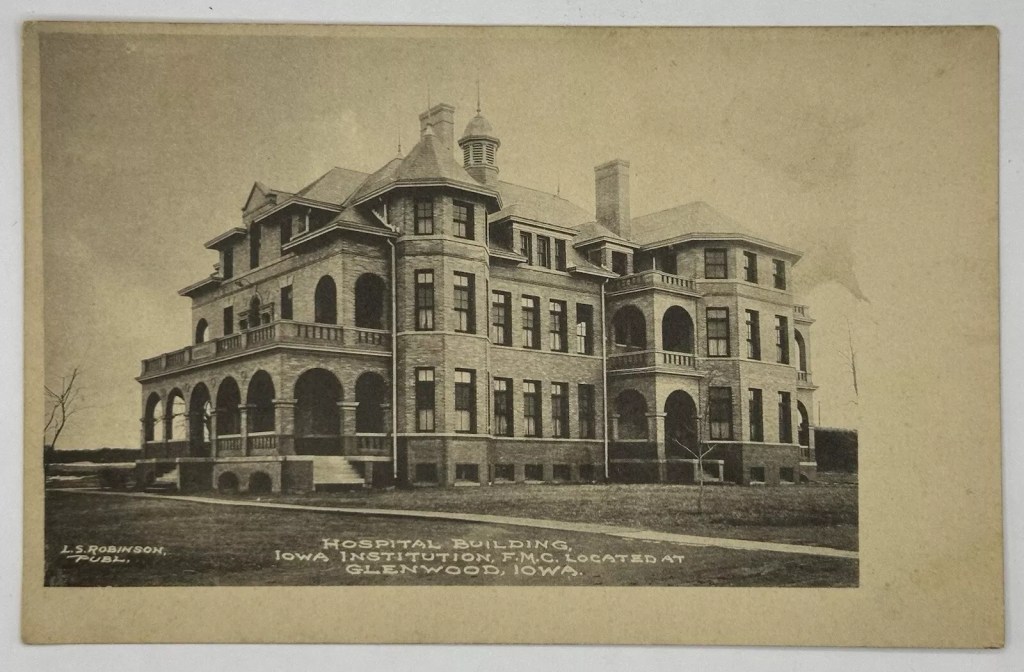
Former Old Soldier’s Home, Glenwood, Iowa.Former Old Soldier’s Home, Glenwood, Iowa. Billy Sunday lived here as a child with his brother, from 1872-1872. Author’s Collection.
Citation: The South Bend Tribune. Fri, May 02, 1913 ·Page 11
MRS. SUNDAY ARTIST.
Wife of Evangelist Has Done Work in Oils.
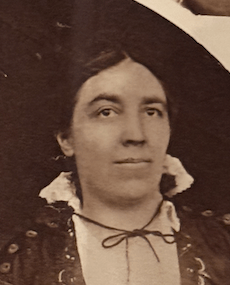
Mrs. Sunday is an artist of considerable merit. The evangelist’s wife in years past, has executed scores of oil paintings. Mrs. Sunday studied for several years in Chicago and spent much time at her art work afterwards. Her brother, W. J. Thompson, has a set of seven handsome oil paintings from Mrs. Sunday’s brush, which she presented to him as a wedding present.
The South Bend Tribune. Fri, May 02, 1913 ·Page 11
‘Ma’ Sunday. New York World Pictures. April 8, 1917. Author’s Collection.
Excerpt from: The South Bend Tribune. Sat, Apr 19, 1913 · Page 1
The character of Billy Sunday as an evangelist is well known generally. His methods although they do not conform to the ideas of many people, are energetic and forceful, and have proven to be productive. His fearlessness in denouncing evil and his portrayal of the sins of the world are his strongest assets on the platform. In nearly every city in which Billy Sunday campaigns he receives threatening letters from fanatics and from persons opposed to his almost militant methods. Wilkes-Barre, Pa., where he has just closed a very successful campaign was one of the exceptions to this, much to the surprise of Sunday and his party. It is not known as yet whether there will be any such persons brought from under cover in South Bend but the religious people here hope not.
In Columbus, O., a woman threatened to “cut his heart out”. She was laboring under the impression that Sunday had seriously harmed her. It is to protect himself from scandal that Mr. Sunday never allows women to call upon him and he never calls at a person’s house unless accompanied by some member of his party.
The following article appeared in The South Bend Tribune. November 7, 1935.
Sunday Heard by Big Crowds Here in 1913
Rev. William Ashley Sunday, who died suddenly Wednesday evening in the home of a friend in Rogers Park, a suburb of Chicago, conducted in South Bend in 1913 what probably was the greatest series of evangelistic meetings ever held in Indiana. His campaign began Sunday, April 27, and continued for seven weeks.
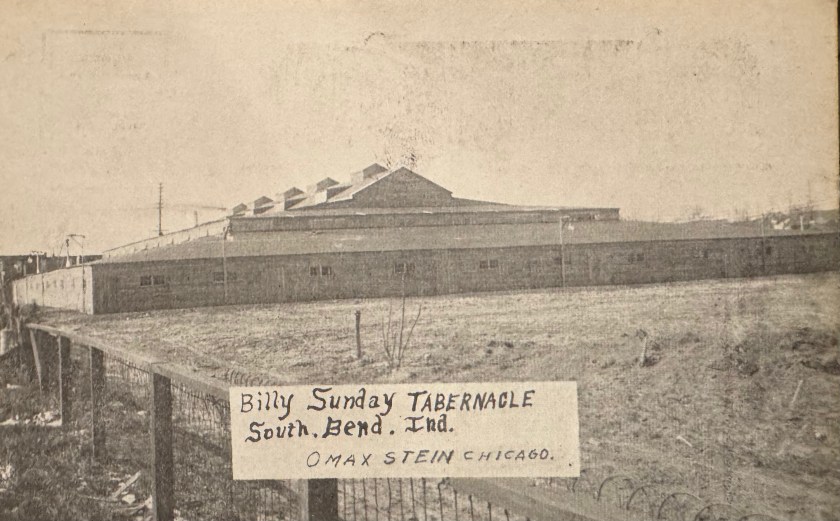
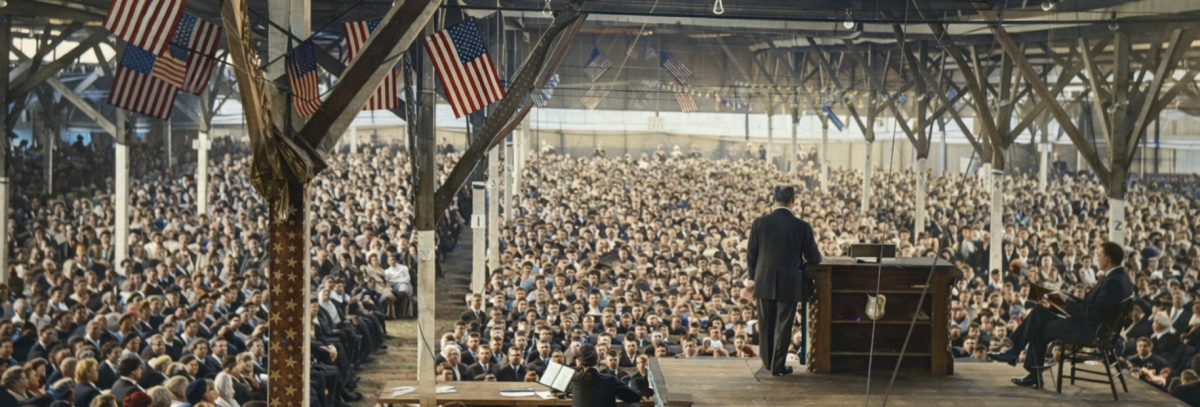
For two months before the famous Billy Sunday opened his meetings in South Bend workmen were engaged in the construction of one of the largest buildings ever erected in the city which became known as the tabernacle. It was built of wood on vacant land between Vistula avenue, now Lincoln Way East, and the St. Joseph river, with Monroe street on the north and South street on the south. The tabernacle had a seating capacity of about 10,000. Reservations were made for the largest musical organization ever assembled in the city, a chorus of more than 1,000 voices. The ground floor was covered with sawdust and fine shavings, making a soft, thick carpet and the outstanding celebrated sawdust trail.
4,000 at Dedication.
Mr. Sunday and his party were quartered in three houses at 515, 517 and 519 South Carroll street. His housekeeper, Mrs. J. W. Foults, of Cleveland, O., had charge of the households. The tabernacle was under the supervision of Fred Seitz, a close friend of the evangelist, who had charge of his tabernacles in the various places where services were held.
The tabernacle was dedicated on Sunday evening, April 20, more than 4,000 persons presenting many denominations in South Bend and elsewhere being present. Rev. Dr. Henry L. Davis, pastor of the First M. E. church, chairman of the tabernacle building committee, presided. He then introduced to E. C. Miller, chairman of the executive committee for the St. Joseph County Evangelistic association, which was largely instrumental in bringing Mr. Sunday to the city. Mr. Miller told of the purpose for which the tabernacle was built. The invocation was by Rev. Peter Moredyke, pastor of the First Reformed church, now out of existence.
Rev. C. V. Mull, pastor of the United Brethren church, led the responsive reading. The scripture lesson was read by Rev. J. C. Tomes, pastor of the Christian Church, of Mishawaka. Rev. Thomas W. Powell, pastor of the Quincy Baptist church, preached, his subject being “Divine Urgency.” Rev. A. C. Ormond, pastor of the Presbyterian church in Mishawaka, spoke on “God’s Victories,” praising Mr. Sunday’s work and saying that if Christian people could operate 40,000 souls in South Bend and Mishawaka could be saved. The benediction was by Rev. Dr. C. A. Lippincott, pastor of the First Presbyterian church.
Nursery Provided.
Marvin Campbell, chairman of the finance committee, announced that in addition to this the association would pay half of the salaries of Mr. Sunday’s co-workers. Mr. Sunday was not to receive anything until the last Sunday of the services when the entire collection was to go to him. Rev. C. A. Decker, pastor of the First Baptist church, told of preparations for handling the big crowds.
A nursery where parents left their children while the parents attended the meetings was situated near the tabernacle and was in charge of Miss Babcock, head of the city’s kindergarten training schools. Children under five years of age were not allowed to attend the services.
Before the tabernacle was completed South Bend business men began the erection of large and small billboards near the entrances to the tabernacle. This aroused the indignation of religious people to a point of battle and vigorous protests were made against the signs.
Nearly 20,000 Listen.
Members of the Sunday party arrived in South Bend previous to
The_South_Bend_Tribune_1935_11_07_1
SUNDAY SPOKE IN CITY IN 1913
Continued from Page One.
Saturday, April 26, and prepared for the great Sunday opening. Mr. and Mrs. Sunday arrived Saturday afternoon and the evangelistic services began the following day. The great evangelist’s first utterances were made before an enormous gathering. Hour after hour on the opening day nearly 20,000 upturned faces watched and listened in the great tabernacle. The morning crowd was estimated at 7,000, the afternoon at 4,000 and the evening at 8,000. Favorable weather, leaders of the movement believed, would have swelled the crowd to nearly 25,000. The morning collection amounted to $184, the afternoon to $70.28 and the night to $167.93, making a total for the day of $425.51. From the first meeting to the last seven weeks later Mr. Sunday had great crowds.
The great evangelist’s services closed on Sunday, June 15. On that day the collection amounted to approximately $10,000. The collection was given to Mr. Sunday. The total of collections for the seven weeks was $24,227.98, the total attendance was 600,050 and the total conversions 6,389. The taking of the offering for Mr. Sunday was one of the features of the closing day of his great campaign. A number of persons in South Bend and Mishawaka contributed $100 each. The largest individual contribution was $200 given by Samuel Murdock, of Lafayette, Ind., a well known and devout Catholic and one of the owners of the Chicago, South Bend & Northern Indiana railway of South Bend.
After Rev. Mr. Sunday completed his services and left the city the great frame tabernacle was torn down and the lumber was removed. The site is now covered by some of the best residences in South Bend and is known as Edgewater place.
Mr. Sunday’s literary activities are carried on for the most part at Winona and sometimes at his fruit ranch in Oregon. The exacting demands on his time during a campaign admit of very little new work. At Winona it is his favorite method to take his Bible and spend the long days beneath the trees reading. This he calls resting and with the single exception of preaching to a responsive audience, is his favorite occupation. He is also fond of books relating to evangelistic and kindred work.
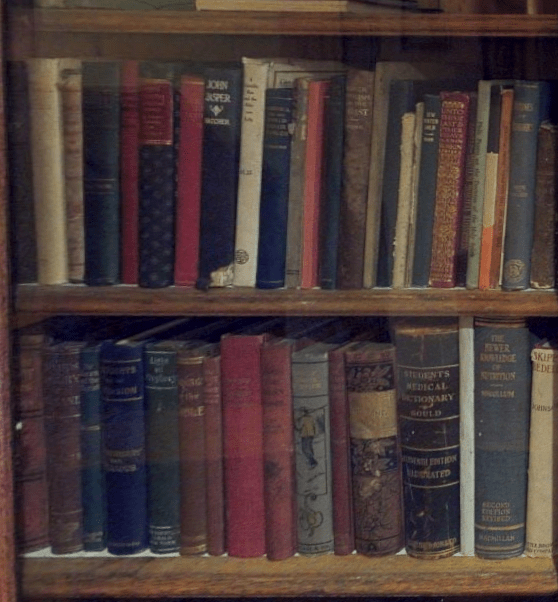
Books in the Billy Sunday home, Winona Lake, Indiana.
— “There are some books I like to read” he says, “I consider the Bible the best of them all. I also think the lives of Peter Cartwright, Charles G. Finney and John G. Paton are among the greatest of all books. Finney converted the owner of the New York mills at Utica, New York, and since he campaigned there, the mills have not been in the hands of non-Christian men.
He never goes into the pulpit with more than an outline before him. His extraordinary memory permits him to quote lengthy passages verbatim, but on this he does not rely for effect.
In comparing his sermons for use Mr. Sunday begins by noting various quotations and anecdotes which will illustrate the theme he wishes to handle. Notations of these are made on all sorts of scraps of paper and are then turned over to his secretary who shapes them into memoranda. Gradually the sermon takes form in the preacher’s mind and then with a great sheaf of notes in his hand he whips the whole into something like the form in which it will be used. Seldom if ever, however, are even his famous sermons preached twice exactly alike. He never goes into the pulpit with more than an outline before him. His extraordinary memory permits him to quote lengthy passages verbatim, but on this he does not rely for effect. It is in the infusion of intense personal enthusiasm that the most remarkable results from his discourses come.
In his earlier days Mr. Sunday made no effort to copyright any of his writings. What he considered unwarranted liberties with the text, however, later prompted him to do so, and in a little more than three years he copyrighted no less than 31 of his discourses.
The records of the Library of Congress show the following titles, copyrights of which are in his name:
The only feature of the book, which properly can be considered a life, are four pages of introduction. In the first paragraph of this introduction there are no less than five errors in fact, other portions of the meager outline are more or less at variance with actual conditions, although there is nothing to indicate any greater offense than carelessness.
The bulk of the 360 pages is taken up with reproductions of sermons. The readers of the book, if there be any, would have recognized whole pages of familiar expressions which he had heard in the tabernacle. The evangelist, however, more intimately familiar with the construction of all his works, finds that a number of his sermons were ruthlessly joined together and the entire continuity of thought disturbed.
Mr. Sunday, therefore, made it his business, at a considerable outlay in cash, to secure both the copy-right and the plates of the book, which he destroyed and effectively prevented any further issue. Copies are extremely rare and indeed none are known to exist outside of the Library of Congress. Thus ended the only previous attempt to put in book form the doings of the evangelist.
Billy Sunday preached 75 times in the tabernacle during the six weeks of his Richmond campaign (April 16 – June 4), and at least another 15 times outside the tabernacle, in surrounding towns close to Richmond. He sometimes preached four times in one day.
As reported in The Richmond Item. Sun, May 28, 1922 · age 7:
NINETY SERMONS TO LAST NIGHT
Old Man Statistics Gives Some Interesting Figures to The Item Reporters
Old Man Statistics dropped into The Item press box, yesterday, and when the reporters were not there, left a bundle of facts. He said Billy Sunday would preach his ninetieth sermon Saturday night, since the day he arrived at Richmond.
That seemed rather too many for the reporter who checked up on it. Yep! Old Man Statistics was all right, it appeared. With the sermon last night Mr. Sunday, has preached 90 at the tabernacle, if one counted the afternoon that Mr. Sunday spoke to the children when the Sunday school convention was held there.
To bring the total to 90, Old Man Statistics, mentioned two sermons at the country club, others at the high school, Earlham college or at the Pennsylvania shops. Then came trips to Portland, Anderson, Greenville, Bradford, O., and the morning sermons each day this week, at Liberty, Hagerstown, Spiceland and Cambridge City.
As reported by The Richmond Item. Fri, May 26, 1922 ·Page 7.
SUNDAY DONATES SUM OF $120,485
Then on Top of That he Gives $65,000 to Pacific Garden Mission of Chicago
Those who call Billy Sunday a grafter were asked yesterday afternoon to hear a little of some past donations of the evangelist. He told his tabernacle audience that when he was in New York City (c. 1917) he told the people coming to the tabernacle to give him all they were able to and he would give it all to the Red Cross and the Y. M. C. A., for their war work.
New York City gave me $120,485, Mr. Sunday said, and I turned over every cent for the work that I had said I would. I went to Chicago and the city gave me $65,000 and I gave the sum to the Pacific garden mission. I give away a tenth of my income. And that is all right. I do not advertise all the things I do with my money. I do not tell all the world the things that I pay off. You follow me around, some of you, and I will make you dizzy with the money I give away. But I don’t have to tell anyone. It is written down above so that is all that matters.
No Guarantee
When Mr. Sunday promised to come to Richmond, he was guaranteed nothing, and all that was to go to him was the free-will offerings the last day of the campaign. He exclaimed, I wonder whether any circus would come to your city on that basis just take up a collection. I wonder whether your county or city officials would collect its taxes on that basis take up a collection. I wonder whether they would let you go to the movies and then take up a collection. No collection for Dempsey when he stood ten minutes in the ring and received $300,000. Oh! no. If I got some of you pay more for your gasoline each year than you do for your church. Oh. it makes me mad when I see you putting God on a five and ten cent basis.
Little
Like one old bird who was always at prayer meeting giving testimony and telling of all he did when he had more on tobacco than he gave to the church in 13 years.
Mr. Sunday preached on God So Loved the World. The Rev. Alford of Columbus, O., made opening prayer. Messrs Mathews and Rodeheaver sang a duet. Mr. Rodeheaver sang My Wonderful Dream. following the sermon, Mr. Sunday gave the invitation and six persons responded.
had found the sheep that was lost. He took her tenderly, and in his shepherd’s plaid he carried her to the fold. One, two, three, four, five, six ninety-six, ninety-seven, ninety-eight, ninety-nine and one hundred. He locked the fold and entered the cabin and she had fallen exhausted on the floor.
She was lying there panting and at the sound of his voice and footsteps she staggered to her knees, reeling and fell dead.
That Jesus Christ should come to this old world to give us a chance to be saved, to try and find us, cursed and scarred and bruised with sin. That is God’s message to us. He so loved the world, that he gave his only Begotten Son, that whosoever believeth in him should not perish, but have everlasting life.
Once, years ago in New York I was told there lived a wealthy Christian merchant. He married a beautiful woman, gave her a bank account and unknown to him she drank. She used to go away and visit friends on pretence of visiting relatives. She kept it up and at last fell into a life of sin and shame.
One night he came home and found a note telling him that she had gone away never to return. That her life could not merit his true, Christian character and life. He hired detectives and they searched every where and they could not find her.
Copies of her pictures were left with the police and with undertakers around the country and he said, If you run across her body, use the best clothes that money can buy, buy the finest casket, etc.; bank it with flowers and send for me.
Three years went by when the phone rang and a voice said, We have found her.
And he went to the undertaking establishment and as he looked through the glass upon her face, he cried, Oh, Mary, if you only knew how I loved you, you would have come back.
He stood weeping as if his heart would break and he said, Bury her.
And he erected a costly monument and said to the undertaker, Put on it one word: Forgiven.
That is God’s message to us. He forgives our transgressions, and I am glad that I have a God and that I have a Salvation like that to preach to you.