Who is Hellen ‘Ma’ Sunday? c. 1909

The following is a biographical sketch of Helen Sunday, wife of Billy Sunday. Part of the 1909 Springfield campaign souvenir.

Mrs. W. A. Sunday

THE biographer who omits to study the wife of his subject certainly will miss the key to his problem of investigation. The world talks of the influence of the mothers upon its men; but it, curiously enough, generally omits appreciation of the strong influence of the wife upon any man; and perhaps more men have been made and unmade by their wives than by their mothers, when heredity is omitted from the matter.

Mrs. William A. Sunday was a girl of great strength of character when she was Miss Helen A. Thompson, the daughter of a Chicago business man. She married a famous baseball player and found herself the wife of one of the greatest of evangelists—and she not only made the revolutionary change with him but is one of the chief causes of William A. Sunday being what he is in the eyes of the world. She was a church worker, a shining exception to the rule of the results of marrying a man to make him better. She upheld the hands of her husband when he was in poverty and the poorly paid worker of the Chicago Y.M.C.A., writing letters declining, for seven times his salary, to return to the baseball field. When William A. Sunday was starting out as an evangelist along entirely new lines of endeavor which merged into In his entirely unprecedented lines of achievement, his wife helped greatly to keep up his courage, keep him along the line he had chosen, and keep him as much as possible free from worries. Mrs. Sunday complements her husband perfectly—they are not at all similar, and she is strongest where he is weakest and weakest where he is strongest. If he had a helpmeet like himself, Mr. Sunday might be plunging into hot water every month and every year. Luckily for him, his wife guides him around and over most obstacles, keeps his fingers out of the fire, and does what Mr. Sunday never thinks of doing—looks after his own interests.

The wedding of Mr. and Mrs. William A. Sunday was not the kind one finds pictured in Paul and Virginia by any manner of means; it was a twentieth-century marriage of two distinct individuals joining as helpmeets, without either submerging a personality in the other—certainly not the old kind of entire submergence of the wife in the husband. They disagree about as many things as other people do, but each knows in what things the other is best informed or strongest, and the one best qualified always decides the question. The result is that they are more free from actual, important disagreements—the kind called love spats or marital troubles—than most people. This is a match of brains as well as of hearts, of sense as well as of souls, and of respect as well as of love.

Mrs. Sunday does what she can in public during a series of meetings conducted by her husband, but the most important thing she does is to keep her husband able to do the great things he accomplishes in every city in which he works. She is a perfect wife for a very remarkable man.
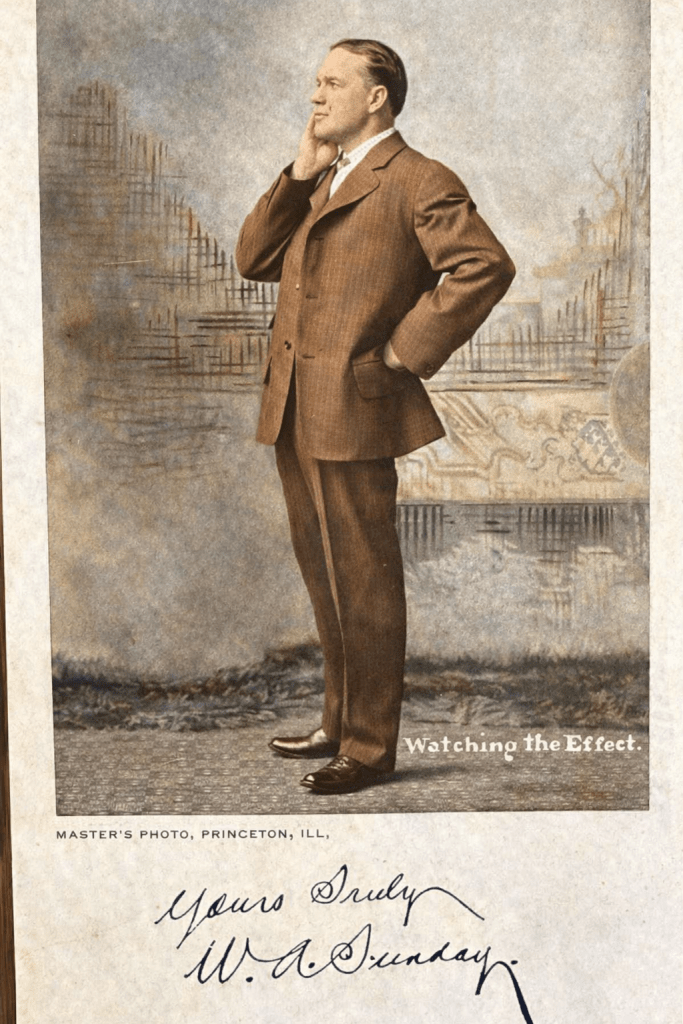
“Revivals Grew by Little”: How Billy Sunday’s Campaigns Slowly Expanded, c.1916

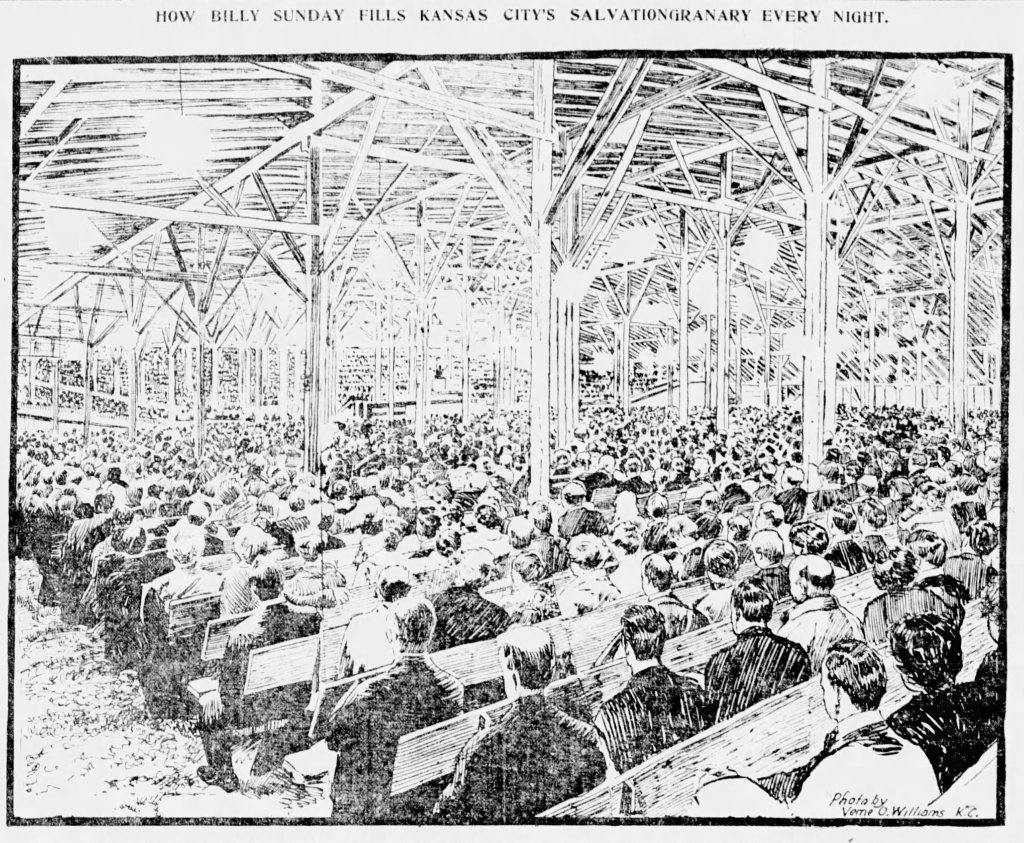
When the revival campaign of Billy Sunday reached Kansas City in 1916, observers could easily assume that the evangelist’s enormous crowds and national reputation had appeared overnight. But a reflective article in the The Kansas City Star reminded readers that Sunday’s success had actually grown slowly and deliberately over many years.

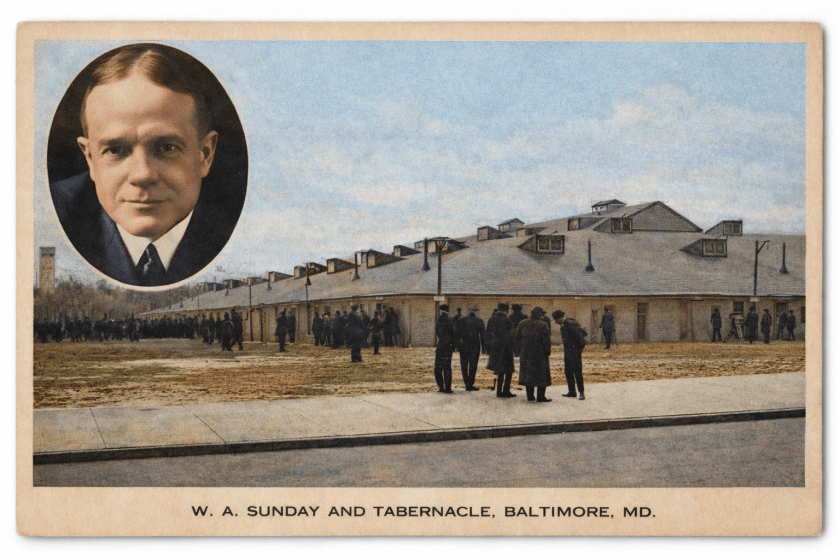
The Baltimore Tabernacle

The paper explained that there was nothing sudden or “mushroom-like” about the rise of the Sunday revivals.

“There is nothing ‘mushroom’ in the growth of the Billy Sunday meetings.”

Instead, the evangelist’s methods and audience steadily developed over time. In the early years, when Sunday first began holding revival meetings, his audiences often found little that seemed unusual.

“Early audiences found nothing spectacular in the sermons of the revivalist.”

Those early campaigns were also modest in scale. At first, Sunday and his team believed that smaller communities were the natural limit of their work.

“We used to think that the town of ten thousand population was our limit.”

As the years passed, however, confidence grew. The team gradually moved into larger towns and then into major cities. The article recalled how Sunday’s organization expanded step by step—building larger tabernacles and reaching larger crowds with each campaign.

“All the time we were gradually adding to our party and building larger tabernacles.”

By 1916, the scale had changed dramatically. Cities once thought far beyond reach were now the focus of massive campaigns.

“Here we are and New York City is in sight with a tabernacle seating twenty-five thousand.”

The article also emphasized that Sunday’s preaching style had developed its own distinctive character. His revival methods were not borrowed directly from older traditions but shaped by his own personality and experience.

The writer noted that Sunday had “thrown out the life line in a fashion distinctly unique.”

Another aspect of his ministry that caught the attention of reporters was the structure of the campaigns themselves. A typical revival lasted about a month, with the message unfolding gradually over time.

In the early weeks, Sunday often avoided direct appeals for conversion, instead using stories and humor to gain the attention of his audience. Only later did the preaching intensify.

By the third week, the article explained, Sunday would devote his sermons to confronting sin and pressing listeners toward repentance. The final week focused on urging people to make a decision.

Even the physical setting reflected Sunday’s distinctive approach. Unlike some revivalists, he rejected the traditional “mourner’s bench” used in earlier revival meetings. Instead, converts were invited to come forward and sit in chairs while he spoke with them personally.

The article also noted that Sunday was not closely tied to any one denomination. While he often expressed appreciation for various churches, his ministry remained broadly interdenominational.

By the time Kansas City hosted the campaign in 1916, Billy Sunday had become one of the most recognizable religious figures in America. Yet the newspaper’s reflection reminded readers that the movement had not been built in a single moment.

It had grown—campaign by campaign, city by city, and year by year.

And in the process, Billy Sunday had created a revival method that was unmistakably his own.

“BILLY” SUNDAY ASSAULTED.


Page 2 of The Britt News, published in Britt, Iowa on Thursday, March 4th, 1909
Horsewhipped by Religious Zealot at Springfield.

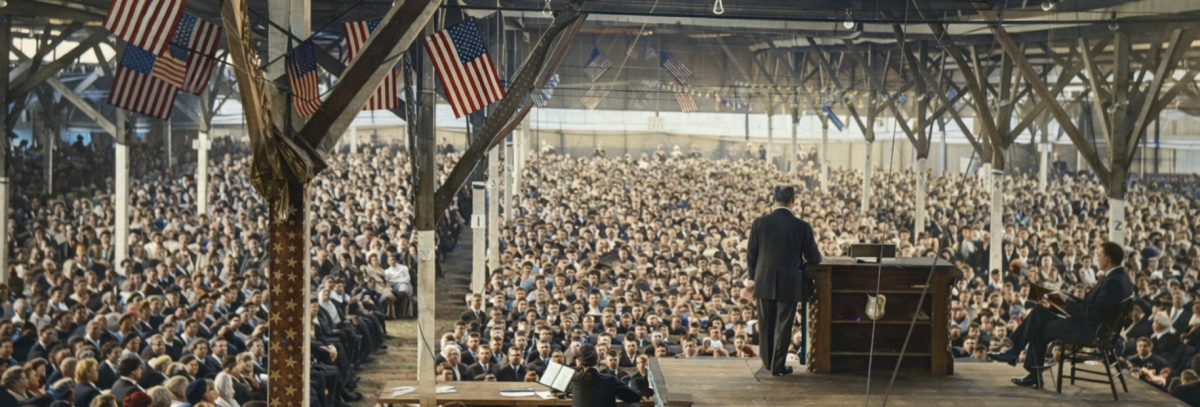
Rev W. A. Sunday, better known as “Billy” Sunday, a former baseball player, who is now an evangelist, was horsewhipped Friday night by a religious fanatic at the Sunday tabernacle in Springfield, Ill., where, in the presence of 8,000 persons he was conducting the opening meeting of a religious revival.

The evangelist had just made his opening remarks and was leaning against the pulpit while a hymn was sung by Fischer and Butler, his choral leaders, when a powerful man who says his name is Sherman Potts ran forward with a buggy whip and struck Sunday several terrific blows.

Sunday leaped from the platform and dashed at his assailant, whom he knocked down. The audience was on the verge of a panic, with women weeping and children screaming while Potts and Sunday rolled and tumbled in the aisle.

Mr Fischer directed the choir and the audience to sing, and in a few moments the entire audience was calmed Several men seized Potts and held him until policemen came and took him to jail.

Mr Sunday suffered several painful bruises from the whip The prisoner said his home was near Lexington, Ill According to his statements at the jail he was once declared insane and committed to the Jacksonville asylum, whence after a brief confinement he was released.

He made the attack he said, in defense of the virtue of women which he declared had been criticized by the evangelist The police say that Potts is a religious fanatic.

  • Page 2 of The Britt News, published in Britt, Iowa on Thursday, March 4th, 1909.

“Ma Sunday” Takes the Pulpit in Kansas City (1916)

During the 1916 revival campaign of Billy Sunday in Kansas City, one of the most striking moments came when the evangelist’s wife, Helen Amelia Thompson Sunday—known widely as “Ma Sunday”—took the pulpit herself.

A report in the The Kansas City Star described her address as unmistakably in the style of her famous husband: energetic, blunt, and deeply challenging to church members.

The newspaper noted that Kansas City audiences had not heard her preach before, but the reaction was immediate. Speaking rapidly and with confidence, she quoted Scripture freely, used expressive gestures, and even thumped the pulpit for emphasis.

By the end of her half-hour address, the reporter observed, “she was perspiring freely,” a familiar description for anyone who had watched Billy Sunday preach.

Her message was aimed squarely at professing Christians, not skeptics or outsiders. She criticized believers whose lives contradicted their testimony.

“The professed Christian who forgets his vows every time a joy ride is offered… is a liar—she said liar—every time testimonials are called for.”

Like her husband, Ma Sunday believed revival depended not only on converting sinners but also on awakening the church. In her view, too many Christians expected evangelists to do the spiritual work while they remained passive.

“Don’t you think that we are going to carry the load and let you sit back and say, ‘I hope you have a good meeting.’”

Instead, she challenged church members to take personal responsibility for the spread of the gospel. Her message emphasized the role of ordinary believers as witnesses for Christ.

She even offered a striking calculation:

“If every church member would win one person to God a year in twenty-five years the world would be saved.”

But she also warned that careless Christian living could damage the church’s influence.

“The church member who proves himself a liar every time he testifies is more harm than good to the church.”

At one point she posed a simple question to the audience: how many people were praying for others? Only a few hands rose. Yet when she asked how many were professed Christians, nearly every hand went up. The contrast, she implied, revealed the problem.

Another theme in her address was the temptation of worldly distractions. She criticized believers who treated recreation as more important than spiritual discipline.

“Lots of Christians forget every time they have a chance to go joy riding.”

Her solution was straightforward: prayer and active participation in the revival effort.

“Get a prayer list… I don’t mean to show around and talk about, but to pray for.”

She also defended the unusual style of her husband’s ministry. Critics often accused Billy Sunday of being theatrical or unconventional. Ma Sunday reminded her listeners that religious leaders throughout the Bible had often acted outside ordinary expectations.

“The Pharisees tried to trip up Jesus for doing things out of the ordinary… Mr. Sunday has lots of authority for doing things out of the ordinary.”

Her address illustrated an important aspect of the Sunday revival campaigns: they were family efforts. While Billy Sunday delivered the dramatic evening sermons, Ma Sunday frequently reinforced the message by speaking directly to believers about prayer, personal responsibility, and spiritual integrity.

In Kansas City that spring of 1916, the newspaper report made one thing clear. The revival was not powered by one voice alone.

Ma Sunday had her own message—and she delivered it with the same urgency and conviction that had made the Sunday campaigns famous across America.

The Kansas City Star. May 9, 1916:4.

Who was singer Fred G. Fischer?

Able Leader of the Singing at the Sunday Revival Meetings.

Note: This account was published in the Freeport Daily Journal in 1906.

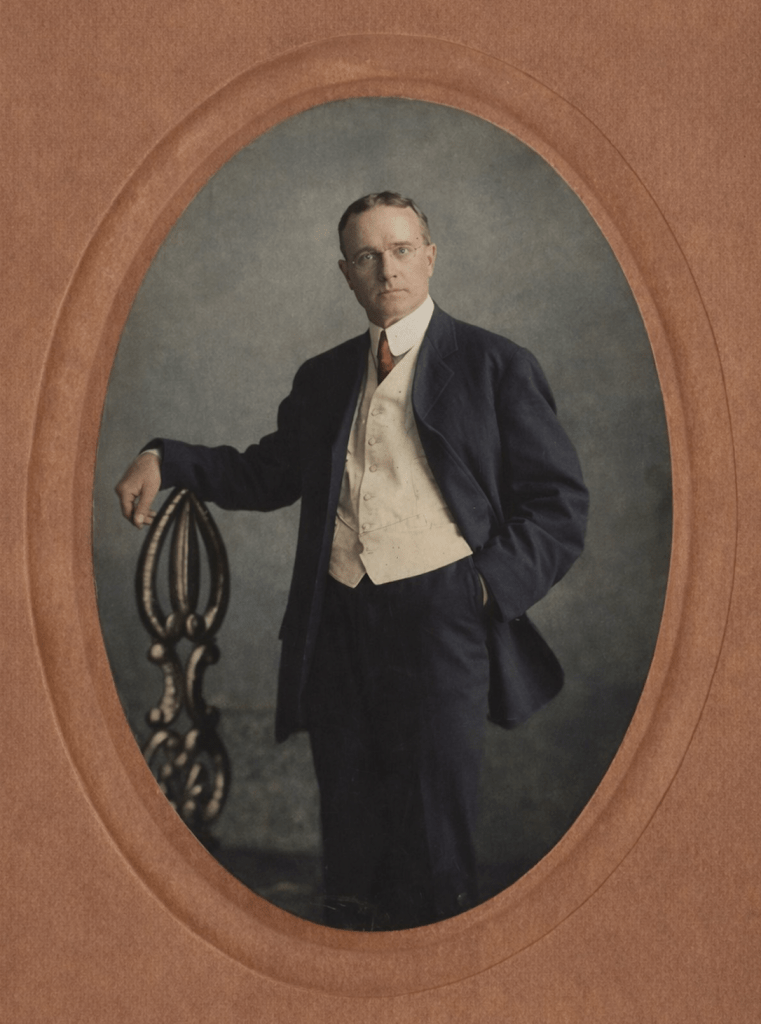
“Without good music, without good, stirring gospel singing, an evangelistic revival campaign would not make much headway. As choir leader and singer for the Sunday meetings, Prof. Fred G. Fischer is the right man in the right place. He was born at Mendota. He is of German parentage and inherits his musical talents. Mr. Fischer is a nephew of P. P. Bilhorn, the well-known gospel singer and song writer, and promises to become as famous as his illustrious uncle. He has given all his time to the study of music since he was eleven years of age, having quite school at that age for the purpose of cultivating his artistic talent.

Fred G. Fischer

Mr. Fischer studied with Robert Webster and Deveries, the great French vocalist. At first, he began as an independent singer, going from place to place, assisting pastors wherever he found one needing his services. He was in this work when he received a letter from Mr. Sunday, who had heard his sing, and a bargain was made for the two to travel together. Mr. Fischer went to the next appointment and was there for two days conducting the meetings before Mr. Sunday came. He has been with the evangelist ever since and expects to remain with him as long as there is work to do.

Mr. Fischer was married about two years ago, and lives in Chicago. He has a good voice, and, knowing how to use it to the best advantage, has few equals in leading a choir. Possessed of fine social qualities, he has already become popular with Freeport’s musical talent.”

The Daily Journal (Freeport, Illinois) · Tue, May 1, 1906 · Page 5.

Billy Sunday receives bomb death threat while in Omaha in 1915

Curated from original Omaha Daily Bee newspaper

A sensational threat upon the life of Evangelist Billy Sunday, conveyed through a crudely written “black-hand” letter, stirred the city yesterday but failed to interrupt the progress of the revival meetings at the great tabernacle.

The warning, received through the mails on Wednesday, declared that a bomb would be hurled into the tabernacle at 2 o’clock Thursday afternoon, September 23, and that Sunday would be killed unless he departed the city within ten days. The missive, scrawled in poor handwriting across ordinary note paper, bore at its lower corner the drawing of a black hand and a crude sketch of a bomb connected to a clock marking the fatal hour.

The Billy Sunday Tabernacle. Omaha, Nebraska.

Authorities were immediately notified. Chief of Police Dunn detailed detectives to trace the author of the threat, and a vigilant watch was ordered about the tabernacle grounds. Secretary Mathews, who first examined the letter, refrained from alarming the evangelist and quietly placed the matter in the hands of the police.

Despite the ominous warning, the Thursday afternoon meeting proceeded without incident. A squad of detectives, led by Sergeants Patsk Havey and Tom Donahue, mingled with the crowd, keeping careful surveillance in anticipation of any attempt upon Sunday’s life.

If the threat was intended to deter attendance, it met with mixed success. Many curious men flocked to the tabernacle, drawn by the sensational report, while the number of women present was noticeably reduced. Total attendance fell below the usual mark. Yet inside, the service moved forward undisturbed—save for the innocent crying of a baby, whose presence, smuggled past ushers, proved the only interruption to the evangelist’s address.

Thus, what promised to be a day of danger passed into one of quiet defiance. The bomb did not appear. The preacher remained. And the revival, under the watchful eye of the law, pressed on.

Adapted from: The Omaha Daily Bee, September 23 and 24, 1915

“Why the Church Is Weak”: Billy Sunday’s Blunt Message to Kansas City (1916)

When Billy Sunday preached in Kansas City during his 1916 revival campaign, his sermons often struck directly at the spiritual condition of the church itself. One message, reported by the The Kansas City Star, carried a sharp and revealing title: “Why the Church Is Weak.”

Sunday did not begin by blaming society, politics, or culture. Instead, he argued that the church’s weakness came from within.

“The sermon by Billy Sunday this afternoon had for its subject this verse from Judges xvi, 20: ‘He wist not that the spirit of the Lord had departed from him.’”

Drawing from the story of Samson, Sunday warned that the modern church could lose its spiritual power without even realizing it. In his view, the problem was not a lack of organization, buildings, or membership.

“Nothing in the world can substitute for the spirit of God.”

For Sunday, the church had become timid. Instead of confronting sin, it had grown cautious and respectable. He charged that many congregations had traded spiritual authority for social approval.

“The church is afraid of men and women; we are to be in the world, but not of the world.”

The evangelist insisted that the church had gradually surrendered its moral courage. Leaders often hesitated to rebuke wrongdoing among their members, even when it was obvious.

“Leading church members lead in nothing but card parties and society functions.”

To Sunday, such compromises drained the church of its influence. A church that tolerated worldliness could no longer confront it.

He argued that the true strength of Christianity had never been found in numbers or wealth. The early church, he reminded his audience, possessed little of either.

“God’s church has not increased correspondingly in power as it has in numbers… it has decreased in spiritual power.”

Sunday contrasted the modern church with the first believers described in the book of Acts. They had no impressive buildings, no social prestige, and little money. Yet they possessed something far greater—spiritual conviction.

“There was a time when the church had more members than she has today; there never was a time when she had more money than she has today… but there was a time when she had more spiritual power than she has today.”

Another cause of weakness, Sunday argued, was the church’s tendency to accommodate fashionable society. Rather than confronting sin, some congregations had become comfortable with it.

“That is why many a preacher is a failure today; he is a compromiser.”

Sunday spoke especially bluntly about moral compromise among church members. When churches tolerated behavior they should have challenged, they undermined their own witness.

“We have lost our power because we have compromised.”

But the evangelist did not end his message with criticism. He pointed his listeners toward the remedy: a return to genuine spiritual life. The church needed renewed faith, repentance, and courage.

He concluded with a simple but urgent appeal. If the church wanted to regain its strength, it needed to return to prayer and dependence upon God.

“If there’s anything the church of God needs it is to climb the stairs and get in an upper room.”

In the packed tabernacle that afternoon, Sunday’s message was unmistakable. The problem facing the church was not outside pressure or hostile culture. It was the quiet erosion of conviction within.

And until the church rediscovered the spiritual power that marked its earliest days, Sunday warned, its influence would continue to fade.